Posted in Uncategorized

Passover Pesach 2015 Seder Rube Goldberg Machine from Technion in Israel

OK, this is fun… 🙂

Technion students get ready for Passover, the festival of freedom, and let their imagination run wild. Watch closely as this Rube Goldberg Machine created by students from the Faculties of Mechanical Engineering and Architecture and Town Planning relates highlights of the Passover story. Filmed in the Faculty of Mechanical Engineering in The Sydney & Shirley Gendel and Emanuel Friedberg Family Creative Design Student Laboratory, a Project of the American Technion Society, Cleveland Chapter

Posted in easter, jesus, pagan, resurrection

The power of the Resurrection vs. the Stupidity of Easter

I work as a teacher aide in a kindergarten. I was working in my small group, and they noticed that some new decorations had gone up. In the room I share there was a large chick coming out of an egg hanging on the door, and around the room were other eggs, in pastel colors and with some rabbits too. One girl asked about it and I said it’s Easter decorations.

That got them talking about Easter and of course Easter egg hunts. They burbled and chatted.

Not my kids in kindergarten. This is an old picture I had taken

When’s Easter anyway? asked a girl.
April 5th! answered a boy.
I asked “What is Easter about?”
They all explained “It’s when you hide eggs with candy in them and hunt for them all around”.
But what else is Easter for?
Again they explained that the “Easter Bunny comes and you find candy and eggs in a basket”.
Anything else?
One girl explained, “When you go to church…”
Yes, yes? I eagerly leaned forward.
“…and you hunt for eggs and find candy.”
But isn’t it about Jesus?
The girl said, “Of course. He lays out the eggs.”

The most beautifully decorated egg
pales in comparison to the beauty of Jesus

It’s charming and sad all at once. Seeing the world through a child’s eyes is always funny and they say unexpected things but they also have more truth in them than we like to think. To a kid life is all about getting to the next candy bonanza. To them, Easter is just another fairy tale that has fantastical, magical creatures like a rabbit that delivers candy and eggs in a basket filled with fake grass. Jesus doesn’t figure into it at all or if He does it’s messed up. We certainly give out mixed messages.

In his sermon, “The Power of the Resurrection“, John MacArthur preached about the pagan mixture of Easter myths with the wonder and eternal glory of the Resurrection. He gave a good overview of the pagan origins of secular Easter celebrations and then he said,

While we laugh at that, we aren’t laughing at the resurrection. We’re laughing at the silliness of the world. But it really isn’t funny, because it’s another one of Satan’s efforts to muddle the issue. If I just do one thing this morning, I’d like to separate the resurrection of Jesus Christ from the stupidity of Easter.

I never liked Easter Egg hunts. This was because I never found any eggs. Even as a kid I didn’t enjoy competitions, I was slow and ungainly, I didn’t quite understand the point, and there were always lots of bullies intent in shoving you down to get that egg first. I left a grass-stained mess with bruises, hurt feelings and an empty basket.

In fact, the term Easter is not a Christian term at all. It is the name of the ancient Anglo-Saxon goddess of light, Estre, and you might be interested to know that Easter celebrations predate Christianity. ~MacArthur

I did enjoy the wonderful Easter baskets my parents left by the fireplace. They always held crinkly grass, chocolate, and pretty little jelly beans and more. They were always both artful and bountiful.

The egg is both, in ancient times, a symbol of fertility and a symbol of the sun because, of course, of the color of the yolk; and so eggs were used in ancient fertility rites as symbols offered to the gods and goddesses, and they were used in worship of the sun as sort of small emblems of the sun. ~MacArthur

I enjoyed dyeing the eggs too, a lot. There was always a new dress to wear, with hat and gloves, for Easter. It was the one time per year (maybe two) we attended a church. The point of the day was the dinner afterwards.

I wondered this week how the rabbits got into the scene…since rabbits really have nothing to do with eggs…and so I checked out some resources, and I found that in ancient Egypt, the rabbit is the symbol of birth, for obvious reasons if you’ve ever had rabbits…and the Egyptians used the rabbit as a symbol of birth, and also other ancient people considered rabbits the symbol of the moon; and since rabbits in Egyptian society were symbols of fertility and birth, and they were connected with spring when things came alive. ~MacArthur

Me, all dolled up for Easter

Yes, Easter the holiday has a mix of pagan rituals and myths. I am not a huge fan of churches holding Easter Egg Hunts. I’m not a fan of trunk or treat at Halloween either. However, the outreach possibilities at both holiday times are tremendous. Ministering to our neighbors with love,service, tracts, bibles, conversation, is a wonderful way to bring the Gospel to the world. So usually I leave it to Christian liberty and don’t stress about differing views.

GotQuestions discusses this in an essay about the Easter Bunny:

Should Christian parents allow their children to participate in traditional activities that refer to the Easter Bunny? This is a question both parents and church leaders struggle with. There is nothing essentially evil about the Easter Bunny, unless it is used to promote the goddess of spring or fertility rites. What is important is our focus. If our focus is on Christ and not the Easter Bunny, our children will understand that, like Santa Claus, the Easter Bunny is merely a symbol. As with Christmas, Easter should be a time to reflect upon and celebrate the incarnation, the resurrection and the risen Christ.

Yes, it’s all about Jesus. The crinkly grass, baskets, egg hunts, dyed eggs, ham dinners, and Easter outfits aside, the power of the resurrection is a wondrous event to contemplate. We take a special day to praise our Father for His power and His love in resurrecting His son.

So it is from the resurrection to the close of the New Testament, the theme is always that He rose from the dead. We must not be fooled by Satan’s efforts to hide the resurrection in the foolishness of the world… ~MacArthur

I am the first and the last, and the living one. I died, and behold I am alive forevermore, and I have the keys of Death and Hades. (Revelation 1:17b-18)

So…hunt for eggs if you must. But look for Christ.

Posted in dorcas, jehoram, peter, resurrection, service

Jehoram and Dorcas: A tale of two deaths

Jehoram:

He was thirty-two years old when he began to reign, and he reigned eight years in Jerusalem. And he departed with no one’s regret. They buried him in the city of David, but not in the tombs of the kings. (2 Chronicles 21:20)

Left, The Royal Sceptre of Boris III of Bulgaria

Dorcas:

Now there was in Joppa a disciple named Tabitha, which, translated, means Dorcas. She was full of good works and acts of charity. In those days she became ill and died, and when they had washed her, they laid her in an upper room. Since Lydda was near Joppa, the disciples, hearing that Peter was there, sent two men to him, urging him, “Please come to us without delay.” So Peter rose and went with them. And when he arrived, they took him to the upper room. All the widows stood beside him weeping and showing tunics and other garments that Dorcas made while she was with them. (Acts 9:36-39)

In the first case, a sinful king. He served satan, and practiced wickedness. He was still a man, however, and yet not one person lamented his passing. Not even his wife. He was a king, touching the lives of each and every person in his kingdom. His influence was the largest a man’s could be, and yet not one person in an entire kingdom or beyond mourned his death. He was not regretted.

In the second case, a woman. Her sphere of influence was small because of her gender. Her reach was especially small because she served widows, nearly the lowest of the low in terms of cultural power. At her death, relatives are not mentioned, it would seem that it was her friends the widows who washed her and laid her in the upper room. And yet, she was beloved. Usually the ritual was to immediately rub the body with spices and lay the death cloths on and bury immediately. Yet these women did not. They loved Dorcas so greatly they sought a different way.

They sent men to find Peter. They did not want to let her go. Dorcas’ life was regretted. They lamented and cried and presented her works to Peter. One can visualize wringing of hands and weeping and wailing of many. Dorcas was loved and lamented.

Dorcas: “who with her needle embroidered her name ineffaceably into the beneficence of the world.”~Unknown

Why was Jehoram immediately forgotten and Dorcas never forgotten? I cannot say definitively or exclusively, but one reason surely must be that Dorcas was in Christ, and Jehoram was in Satan. The verse says that Dorcas was “a certain disciple” so she was a believer. She must have been beautiful in Christ, bearing the fruit of His love and grace and joy and peace, all the while serving tangibly with her needle.

Who can say what influence a loving submissive disciple of Christ will have for His kingdom? Jehoram was given Christ’s kingdom (Judah) and he served satan with it. (2 Chronicles 21:6). Dorcas was given Christ’s kingdom and served Jesus with it. Both have everlasting eternal consequences but both have earthly consequences too.

As for the eternal consequences of their deaths, Jehoram’s life was snuffed out and the spiritual repercussions were zero. It seems that nobody was the better for Jehoram having lived. As for Dorcas, she was raised bodily from the dead but the effect of that was many were saved. They were raised from the dead, too! Their spiritual deaths were now over and many became alive in Christ! The effect of that was Peter stayed and nurtured the new church in Joppa, personally discipling many converts. What an eternal effect Dorcas had on the lives of the people there, personally and spiritually!

The question is, what kind of death would you have? Or me? Would my own death be unlamented? Unremarked? Or would it cause distress and weeping? The key is serving, and the fruit we bear. Dorcas served the people in Christ’s name. Jehoram expected to be served, and was one of satan’s. Dorcas served with her needle. Jehoram expected to be served with his scepter. Dorcas loved Christ and thus she loved her neighbors. And they noticed. Boy, did they notice. Jehoram loved satan and thus he hated his neighbors. And they noticed. Boy, did they notice.

And if it is evil in your eyes to serve the LORD, choose this day whom you will serve, whether the gods your fathers served in the region beyond the River, or the gods of the Amorites in whose land you dwell. But as for me and my house, we will serve the LORD.” (Joshua 24:15)

Love, serve, produce fruit. It will have an eternal effect.

Posted in 90 minutes in heaven, heaven is for real, heaven tourism, lifeway

Good News: Baptist Press reports LifeWay pulls all heaven tourism books

Quote from Phil Johnson [Exec. Director of: gty.org & works with John MacArthur]:

“Only four authors in all the bible were blessed with visions of heaven and wrote about what they saw: the prophets Isaiah and Ezekiel, and the apostles Paul and John. Two other biblical figures—Micaiah and Stephen—got glimpses of heaven, but what they saw is merely mentioned, not described (2 Chronicles 18:18; Acts 7:55).

As pastor John MacArthur points out, all of these were prophetic visions, not near-death experiences. Not one person raised from the dead in the old & new testaments ever recorded for us what he or she experienced in heaven. That includes Lazarus, who spent four days in the grave. Paul was caught up into heaven in an experience so vivid he said he didn’t know whether he went there bodily or not, but he saw things that are unlawful to utter, so he gave no details. He covered the whole incident in just three verses (2 Corinthians 12:2-4).

All three biblical writers who saw heaven and described their visions give comparatively sparse details, but they agree perfectly (Isaiah 6:1-4; Ezekiel 1 and 10; Revelation 4-6). They don’t agree with the Burpo-Malarkey vision of heaven. Both their intonation and the details they highlight are markedly different. The biblical authors are all fixated on God’s glory, which defines and illuminates everything there. They are overwhelmed, chagrined, petrified, and put to silence by the sheer majesty of God’s holiness. Notably missing from all the biblical accounts are the frivolous features and juvenile attractions that seem to dominate every account of heaven currently on the bestseller lists.”

Thankfully and gratefully and finally, Baptist Press reports today,

LifeWay pulls ‘heaven visitation resources’

LifeWay Christian Resources has stopped selling all “experiential testimonies about heaven” following consideration of a 2014 Southern Baptist Convention resolution on “the sufficiency of Scripture regarding the afterlife.”

Though LifeWay “was not mentioned in the SBC resolution affirming the sufficiency of biblical revelation and affirming the truth about heaven and hell,” King told BP in an interview, “the resolution was approved overwhelmingly and was considered during our process.”

The resolution, adopted by messengers to the SBC annual meeting in June, warned Christians not to allow “the numerous books and movies purporting to explain or describe the afterlife experience” to “become their source and basis for an understanding of the afterlife.”

The resolution did not list specific book or movie titles, but it seemed to describe works like “90 Minutes in Heaven,” “The Boy Who Came Back from Heaven” by Kevin and Alex Malarkey and “Heaven Is for Real” by Todd Burpo along with its companion movie released last year by Sony Pictures.

The resolution affirmed “the sufficiency of biblical revelation over subjective experiential explanations to guide one’s understanding of the truth about heaven and hell.”

In January, LifeWay announced it would stop selling “The Boy Who Came Back from Heaven” after coauthor Alex Malarkey admitted that he lied about having a vision of heaven as a 6-year-old. See related BP story. At the time, King said LifeWay was “committed to becoming even more proactive in the next few months in evaluating the resources we carry.”

end excerpts

Now if we can just get them to pull Beth Moore…

——————————–

Further Reading

The Burpo-Malarkey Doctrine

Heaven is for Real, But are the Modern Day Claims of “There and Back Againers” in Line with the Bible?

Video, Justin Peters, Why The Heaven Tourist Reports Contradict Scripture (Part One)

Posted in grace, love, salvation, wrath

I was not saved by a loving Jesus wooing me

I wasn’t saved by love. The Gospel was not attractive to me. It was not made attractive to me by smiling Christians. I was saved by wrath.

This is NOT my Jesus

Glorious Jesus who was and is and is to come did not woo me to the cross. No one fulfilled my felt needs. No one befriended me and cajoled me into loving Jesus. He battered my head with a 2X4, dragging me kicking and screaming to the cross, where He made me face my sin. Once I saw my sin, I saw His coming wrath for it.

I repented.

THEN I loved Him. After He opened my eyes I saw all His loveliness and grace and mercy and long-suffering and patience and grief over sin and sinners. But I was not wooed, nor was I loved onto Mt Moriah. It is not true that “Jesus won’t come where He isn’t welcome”. It is not true that “Jesus won’t force Himself on anybody.” He is sovereign God! He goes where He pleases! (Psalm 24:1). He drop kicked Saul/Paul to the ground AND blinded him! He didn’t ASK Mary if she’d like to become pregnant and an object of ridicule and rumor the rest of her life. No, He sent an angel to TELL her how it was going to be. (Luke 1:30-37)

He isn’t wringing His hands in heaven hoping that Jane or Tom or Mary will believe in Him, and maybe they will, if he just sends the Spirit to soften the pew cushions … or energizes the preacher with a louder “WOO!” … or if the musician plays one more verse of “Just As I Am.” Maybe if He can make church “exciting” then Harry will repent and believe. No.

It was the sovereign wrath that convicted me and convinced me. It is why I love passages like this.

The Judgment at Christ’s Coming
The Great Day of His Wrath, John Martin ~1853

This is evidence of the righteous judgment of God, that you may be considered worthy of the kingdom of God, for which you are also suffering— since indeed God considers it just to repay with affliction those who afflict you, and to grant relief to you who are afflicted as well as to us, when the Lord Jesus is revealed from heaven with his mighty angels in flaming fire, inflicting vengeance on those who do not know God and on those who do not obey the gospel of our Lord Jesus. They will suffer the punishment of eternal destruction, away from the presence of the Lord and from the glory of his might, when he comes on that day to be glorified in his saints, and to be marveled at among all who have believed, because our testimony to you was believed. (2 Thessalonians 1:5-10)

Let us begin the marveling now. Marvel at a Savior who saves by His sovereign election, will, purpose, and plan! Marvel at He who is wrath and judgment and holiness and fierce anger! Be afeared of His anger over your sin. Marvel that El Shaddai… El Elyon …sent His Son to take on all anger for sin. Marvel that He is also Jehovah Rapha, and Jehovah Jireh, the LORD that heals, the LORD will provide. Marvel at the wrath. It makes marveling at the grace all the more sweet.

Posted in bold, jesus, street preaching

Street preaching today

On Twitter, Chuck O’Neal ‏@ChuckONeal_ said this morning,

While preaching the Gospel to the crowd in front..this man slipped in behind to listen. #SneakyGospelListenersWelcome

What a beautiful photo. A man the Lord has raised up, preaching the Good News fearlessly to a hostile and dying world. But one man is drawn by God to hear His words of everlasting life. Again, a praise. Will the seeds planted by the word fall on hard ground? Thorny ground? Soft ground?

Meanwhile we don’t know where the wind blow. So we preach His Good News everywhere.
The Spirit knows.

The wind blows where it wishes, and you hear its sound, but you do not know where it comes from or where it goes. So it is with everyone who is born of the Spirit. (John 3:8)

Is street preaching an effective evangelism method?

Street preaching, or preaching openly in a public area, has been a method used throughout the history of Christianity for the purpose of evangelizing people who would not typically enter a church. Ever since the apostle Peter preached in the streets of Jerusalem in Acts 2, Christians have used this method to lead many to faith in Christ. Despite the long-standing tradition of street preaching throughout church history, some believe that the practice should no longer be used. They have a variety of reasons for their opinion…

And the master said to the servant, ‘Go out to the highways and hedges and compel people to come in, that my house may be filled. (Luke 14:23)


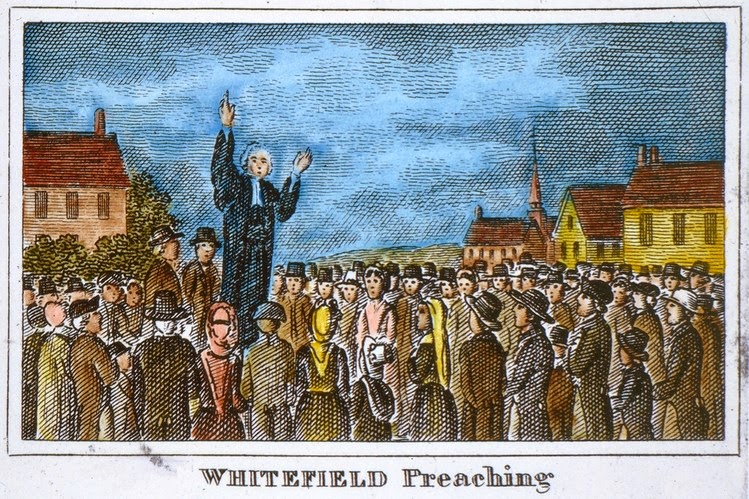
Harken An engraving, ca. 1740, of George Whitefield
preaching in the Americas. Photo: Granger, NYC / The Granger Collection. Source

George Whitefield:

In 1739, Whitefield set out for a preaching tour of the American colonies. Whitefield selected Philadelphia—the most cosmopolitan city in the New World—as his first American stop. But even the largest churches could not hold the 8,000 who came to see him, so he took them outdoors. Every stop along Whitefield’s trip was marked by record audiences, often exceeding the population of the towns in which he preached. Whitefield was often surprised at how crowds “so scattered abroad, can be gathered at so short a warning.”

The crowds were also aggressive in spirit. As one account tells it, crowds “elbowed, shoved, and trampled over themselves to hear of ‘divine things’ from the famed Whitefield.”

Once Whitefield started speaking, however, the frenzied mobs were spellbound. “Even in London,” Whitefield remarked, “I never observed so profound a silence.”

When he returned to London, he found many churches closed to his unconventional methods. He then experimented with outdoor, extemporaneous preaching, where no document or wooden pulpit stood between him and his audience.

The Gospel is always unwelcome, sometimes by those inside churches hearing it from pulpits, usually outside in the world by passersby to whom the message of Life is the aroma of death. No matter. For the one person who is later converted by the words, it will be eternally welcome.

Posted in blood moons, hagee, prophecy, science

A Christian Astronomer debunks the blood moon theory from both a scientific and a biblical perspective

An internet friend named James sent me an excellent article regarding the hoopla surrounding several astronomical events due to occur this week. The article debunks any credibility whatsoever regarding blood moons related to prophecy. It is reasoned, biblical, AND scientific. The author of the article is Dr. Hugh Ross, a Christian Astronomer. Dr Ross was asked by John Hagee Ministries to participate in Hagee’s movie regarding the blood moons, knowing Ross is a skeptic, to Hagee’s credit. Thus, we have a credible insider’s view on every level to explain to us why the blood moons are not ushering in a new era. Here is the beginning of the article and I urge one and all to read it.

Blood Moons: An End-Times Sign? (Part 1 of 2)
http://www.reasons.org/articles/blood-moons-an-end-times-sign-part-1-of-2http://www.reasons.org/articles/blood-moons-an-end-times-sign-part-1-of-2

Four Blood Moons, a theatrical one-night event scheduled for March 23, 2015, and based on Texas megachurch pastor John Hagee’s New York Times bestseller of the same name, has garnered attention. I’m featured briefly in the film as a skeptic of Hagee’s central claim that a sequence of four total lunar eclipses signifies that “world history is about to change,” bringing about the rapid fulfillment of a biblical end-times prophecy. I’m also included in a 20-minute panel discussion on the movie that was recorded at Hagee’s San Antonio headquarters.

Hagee knew in advance my views on his claims and I’m impressed that he would allow a “skeptic” of his view to participate. For that, he is to be commended.

The biblical basis for the four blood moons claim as an eschatological event appears in Joel 2:31, which states, “The sun will be turned to darkness and the moon to blood before the coming of the great and dreadful day of the Lord.” The scientific basis rests on the fact that often during a total lunar eclipse, the Moon, as seen from Earth’s surface, takes on an orange or red hue (see figures 1 and 2).

My greater concern centers on biblical, rather than scientific, misinterpretations of the blood-moon sign, and I will address those in part 2. First I will address the science and history of lunar eclipses.

And to get caught up on the biblical reasons debunking the blood moon theory, go here

Posted in discernment, encouragement, God, prophecy, sovereign, spring

3 Bad Reasons to Leave your Church, How cults begin, Spring has sprung

At the Millennial Evangelical blog, Chris Martin wrote a piece on 3 Bad Reasons to Leave Your Church. Chris is 24 years old, feels called to be a pastor and currently works as a Social Media Facilitator at LifeWay Christian Resources and is pursuing his M.Div. at Southeastern Baptist Theological Seminary.

I have not read a great quantity of articles at his site, but I did enjoy this piece. At the bottom of it, he has a link to a companion piece called 3 Good Reasons to Leave Your Church. Here is 3 Bad Reasons’ opening paragraph:

Stop treating your local church like your high school girlfriend, and start treating it like the bride of Christ.

You don’t leave the church when it doesn’t share the same musical interests, when it hurts your feelings, or when a newer, more popular one catches your eye.

The people of God, the Church around the world, is the bride of Christ, and the bride of Christ deserves the faithfulness of a bride, not the summer crush you bailed on when you were a jerk in college.

Your church is broken because it’s made up of broken people, including yourself. Abandoning the local church is only acceptable under a few extreme circumstances we’ll address on Friday. Other than in certain circumstances, the people of God have the responsibility to sacrificially love their local churches as Jesus has.

If anyone has the right to abandon the adulterous, idolatrous bride called “Church,” it’s God, and he hasn’t, so we need to be careful how quick we are to bail when the going gets tough.

Here are three bad reasons to leave the local church:

Read more by clicking the link above

This is how cults begin.

False teachers generate followers for themselves, not for Jesus. If the teacher is beloved more than the object of her teaching is, then there is a problem. Like this:

The tweeter could have meant to say “I’ll read her inspiring piece later” but given the amount and fervency related to Mrs Moore, I doubt it. Moore so often repeats the mantra that she talks with God and He gives her things to say, that it is no wonder her followers mistake her blog essays for inspired writing, no different than the truly God-breathed words given to the 66 writers of the bible.

Or this:

Manic women from Houston do not have the power to awaken a soul. That is the supernatural work of the Holy Spirit. Even creepier, is the reference to ‘mama Beth.’ it couldn’t be any closer to the verse in Revelation 2:23 where the LORD promises to strike the metaphorical false prophetess Jezebel’s spiritual children (of her second generation of false teaching) dead unless they repent.

I did not have to cherry pick these. It was a day where Mrs Moore had written some drivel on her blog and the followers were discussing it in droves. There was a lot of chatter. There was SO MUCH of this kind of adulation and worship of Beth Moore it was actually hard to narrow it down to these two.

These tweets and the thousands just like them aimed at Moore, and the millions just like them aimed at Joyce Meyer, Benny Hinn and others, fulfill the promise made via the Spirit by Timothy:

For the time is coming when people will not endure sound teaching, but having itching ears they will accumulate for themselves teachers to suit their own passions, (2 Timothy 4:3)

These women are heaping up false teachers to suit their passions. Whatever passion you want to fleshily indulge, there is a false teacher to fit.

Spring has sprung, by the weather (for us here in GA) and by the calendar. My yard has a burst of color, a chorus of tweets, and two new baby lambs added to the farm family. When I arrived home at 3:30 after a long week of school, the warm sun and bird song drew me to the swing, and not to the front door. I dumped my stuff, dug out my camera, and walked the yard taking photos. Then I simply sat in the swing and gently rocked in the sun, listening to birds, the sheep, some children playing next door, the occasional car, and the trees in the breeze.

I stayed there until the sun went behind the house, almost two hours. I thought about the regularity of the cycles, the silent march of invisible seasons gracing the earth for a time and then wisping away to make room for the next season’s turn to touch the earth. The time now is for new life, buds, birds, bushes.

I thought about the majesty of our God, ordaining each and every day under the sun. There is nothing new, but then again every year it is all new again. The dogwood blooms. The forsythia blooms. The baby birds explore. The lambs are born.

He made the moon to mark the seasons; the sun knows its time for setting. (Psalm 104:19)

You alone are the LORD. You made the heavens, even the highest heavens, and all their starry host, the earth and all that is on it, the seas and all that is in them. You give life to everything, and the multitudes of heaven worship you
. (Nehemiah 9:6)

For in him all things were created: things in heaven and on earth, visible and invisible, whether thrones or powers or rulers or authorities; all things have been created through him and for him. (Colossians 1:16)

We are truly blessed to worship the one true God. He alone is worthy, for the earth is His and everything in it. What a beautiful world. What a beautiful God.

Posted in david platt, missional, prosperity gospel, radical

Do I have to be uncomfortable to be a real Christian?

The Prosperity Gospel

I agree that the American church has a lot to answer for when we all meet Jesus. The prosperity gospel has sunk in deep and permeated every corner of the US. Now it’s exported abroad, and polluting churches in India and Africa and elsewhere. The prosperity gospel is no gospel. It teaches congregants to indulge their flesh, seek worldly things, and keep their eyes focused laterally instead of vertically. Joel Osteen is a master of this kind of gospel.

Joel Osteen flatly laid out the main precepts of Prosperity gospel out in a 2005 letter to his flock. “God wants us to prosper financially, to have plenty of money, to fulfill the destiny He has laid out for us,” Osteen wrote.

No, that’s not what God wants us to do. God wants us to live holy lives, pick up our cross, obey Him, be witnesses for His name, worship Him, be wise, and share the true Gospel all over the world, among other things. (1 Peter 1:15, John 4:24, Matthew 16:24, 1 John 5:2-3, Matthew 10:16, Matthew 28:19). The destiny he laid out for us includes trouble, persecution, hatred, and hardships, (John 16:33, John 15:18, Acts 14:22, 2 Corinthians 6:4).

The “prosperity gospel,” an insipid heresy whose popularity among American Christians has boomed in recent years, teaches that God blesses those God favors most with material wealth.
Cathleen Falsani

Wikipedia gives a quick overview of how this insidious gospel came to the fore:

It was during the Healing Revivals of the 1950s that prosperity theology first came to prominence in the United States, although commentators have linked the origins of its theology to the New Thought movement which began in the 1800s. The prosperity teaching later figured prominently in the Word of Faith movement and 1980s televangelism. In the 1990s and 2000s, it was adopted by influential leaders in the Charismatic Movement and promoted by Christian missionaries throughout the world, sometimes leading to the establishment of mega-churches. Prominent leaders in the development of prosperity theology include E. W. Kenyon, Oral Roberts, A. A. Allen, Robert Tilton, T. L. Osborn, Joel Osteen, Creflo Dollar, Kenneth and Gloria Copeland, David O. Oyedepo and Kenneth Hagin.

The Prosperity gospel was preached so heavily on televangelist tv channels throughout the 1980s, 1990s, and 2000s, that the 2010 David Platt book “Radical” touched a nerve and swept the pendulum rapidly in the other direction.

The Uncomfortable Gospel

The book blurb for Radical states:

It’s easy for American Christians to forget how Jesus said his followers would actually live, what their new lifestyle would actually look like. They would, he said, leave behind security, money, convenience, even family for him. They would abandon everything for the gospel. They would take up their crosses daily…But who do you know who lives like that? Do you?

The book challenged Americans to reassess their commitment to the Gospel and make changes if necessary. Making sure that we are living biblically in submissive commitment to Christ is a worthy reassessment, but many people feel (me included) that the book made it sound like if you were living a normal life that happened to include comforts, you were somehow less committed Christian. Tim Challies reviewed Radical in 2011, saying,

First, I think our attempts to live radically can ignore the Bible’s concern that we be radically godly in character. There is no doubt that I am called by God to live sacrificially and generously. My first calling, though, is to know God, to be shaped by him and on that basis to preach the gospel and to live as if it is true. I am called to do all of this right where the Lord has placed me. This means that there is great dignity and great value in doing whatever it is that I want to do, like to do, and can honor God doing. We do not all need to be foreign missionaries and evangelists; we do not all need to move to faraway lands. We can (and must!) primarily honor God in whatever it is he has given us to do. I am concerned that it is difficult to read this book and believe its message and not feel that normal life is dishonoring to God.

However despite book reviews of Radical stating these same concerns, and a subtle rebuttal by John MacArthur titled An Unremarkable Faith, the pendulum swung hard toward ditching everything and running off to Bali barefoot to evangelize whoever happened to be in the way. The collateral damage of this pendulum swing included a backlash against Suburban Christians and suburbia in general. This is where it gets personal.

I agree with Challies. I have not been called to be a missionary in Tonga. I am not called to be a preacher’s wife in the 10/40 belt. I am not a bible smuggler living dangerously in China or North Korea. I am a white, middle aged Christian woman living in rural/suburban Georgia. I go to a boring ole Baptist church with regular people who have a variety of blue collar jobs, or are farmers, or work in professional settings. I drive the 7 miles to school every day, assist children in Kindergarten, and drive home. I enjoy covered dish suppers, grocery shopping at the same place where I know all the checkout ladies, and banking at a small town bank where they know my name when I come in.

I live where there are rural farms all around including my own rental property where the lambs are about to be born any day! But horror of horrors, there are also ‘suburban’ subdivisions nearby, malls a half hour away, and a McDonald’s within a few minutes.

I don’t make a lot of money and in fact have to watch every penny, but I know by global standards I’m rich. I am comfortable in every aspect of my life, from what I drive, to what I wear, to where I worship, to where I work. Suburbia has gotten a very bad rep. I live in suburban-ish America, and according to many liberal and hipster Christians, I’m doing Christianity wrong.

Hipsters: It’s cool to Hate the ‘Burbs

Like this:

I asked Mr NickDon the following:

“Is there something sinful about living in a house in suburbia that will bring woe?” and of course I never received a straight answer.

In his piece “Why Do We Hate The Suburbs?” author Keith Miller pointed out the flaw in ‘burb-hate.

Here are a few of the most prominent Christian objections to living in the suburbs. How many of them hold up to even a slight bit of scrutiny?

Suburbs are inauthentic: I confess to not quite understanding what this means. Yes, suburban things are often newer and feature less exposed brick, but how is that a moral argument?
Suburbs are consumeristic: No more than large cities.
Suburbs are morally repressive: Wait, overt exhibition of immorality is a good thing?
Suburbs lack diversity: The most diverse places in the country are suburbs.
Suburbs are full of a lot of Evangelicals who vote Republican: Oh, wait, now we are getting somewhere…

Obviously, each of these charges deserves a post of its own to address these issues with the requisite nuance, but even the one-liner responses should cause us to think. Why are we down on suburbs? Do we have a biblically grounded objection rooted in our personal experiences, or have we merely baptized a secular prejudice and called it Christian ethics?

Why do Christians hate the suburbs? Or if hate is too strong a word, why do so many disparage it? The question was asked by Matthew Lee Anderson in his 2013 article “Is Radical Christianity Radical Enough?

David Platt, Francis Chan, Shane Claiborne, and now Kyle Idleman are dominating the Christian best-seller lists by attacking our comfortable Christianity. But is ‘radical faith’ enough? … Really. If there’s a word that sums up the radical movement, that’s it. Platt’s Radical opens with it, by describing what “radical abandonment to Jesus really means.” Idleman says he’s going to tell us “what it really means to follow Jesus.” Furtick says that “if we really believe God is an abundant God … we ought to be digging all kinds of ditches [for when he sends the rain, as Elisha did in 2 Kings 3:16-20].” Do those who lead mediocre, nonradical lives for Jesus really believe at all?

And there is exposed the subtle two-tiered system that books like Radical instituted. Therein lay the insidious mindset by these holier than thous, that the millions of people living and worshiping and witnessing in suburbia are ‘lesser-than.’

I reject that notion because of one important factor. This is where God put me.

And he made from one man every nation of mankind to live on all the face of the earth, having determined allotted periods and the boundaries of their dwelling place, (Acts 17:26)

God made the nations and all the peoples in the nations. He placed each one of us where He wants us, whether it be India or Canada, suburban Ohio or metropolitan Paris. He is sovereign and in His will and plan it pleased Him to give me this life. Who am I to speak back to God? Or worse, who am I to disparage His plan for me and many others He has set forth?

Yes- it would be sin if I lived in a comfortable environment and felt the call to become a missionary in Burma and refused Him because I was comfortable. Yes, I understand the original intent of the book Radical was to get us to reject sinking into a mealy mouthed Christianity because we’re surrounded by comfort.

The true fact is, no matter where a person lives, if they are doing Christianity ‘right’, it is not comfortable. It takes commitment, energy, a proactive stance, and diligence.  Matthew Lee Anderson concluded his piece this way-

The Good Samaritan wasn’t a good neighbor because he moved to a poor part of town or put a pile of trash in his living room. He came across the helpless victim “as he traveled.” We begin to fulfill the command not when we do something radical, extreme, over the top, not when we’re really spiritual or really committed or really faithful, but when in the daily ebb and flow of life, in our corporate jobs, in our middle-class neighborhoods, on our trips to Yellowstone and Disney World—and yes, even short-term mission trips—we stop to help those whom we meet in everyday life, reaching out in quiet, practical, and loving ways.

The essence of Christianity is loving your neighbor. Suburbia needs loving neighbors ‘reaching out in quiet ways’ just as much as the poor need help in Calcutta or the lost need help in Afghanistan. The daily grind of being a faithful witness for Jesus occurs all over the world, in jungles, mountain villages, cities, farming communities, and suburban plats. I reject the Prosperity gospel, and I also reject the Uncomfortable gospel. I accept and live by the only Gospel.

The Wycliffe Bible Encyclopedia summarizes the gospel message this way: The central truth of the gospel is that God has provided a way of salvation for men through the gift of His son to the world. He suffered as a sacrifice for sin, overcame death, and now offers a share in His triumph to all who will accept it. The gospel is good news because it is a gift of God, not something that must be earned by penance or by self-improvement (Jn 3:16; Rom 5:8–11; II Cor 5:14–19; Titus 2:11–14).

Now I want to make clear for you, brothers and sisters, the gospel that I preached to you, that you received and on which you stand, and by which you are being saved, if you hold firmly to the message I preached to you—unless you believed in vain. For I passed on to you as of first importance what I also received—that Christ died for our sins according to the scriptures, 15:4 and that he was buried, and that he was raised on the third day according to the scriptures, and that he appeared to Cephas, then to the twelve…( 1 Corinthians 15:1-5)