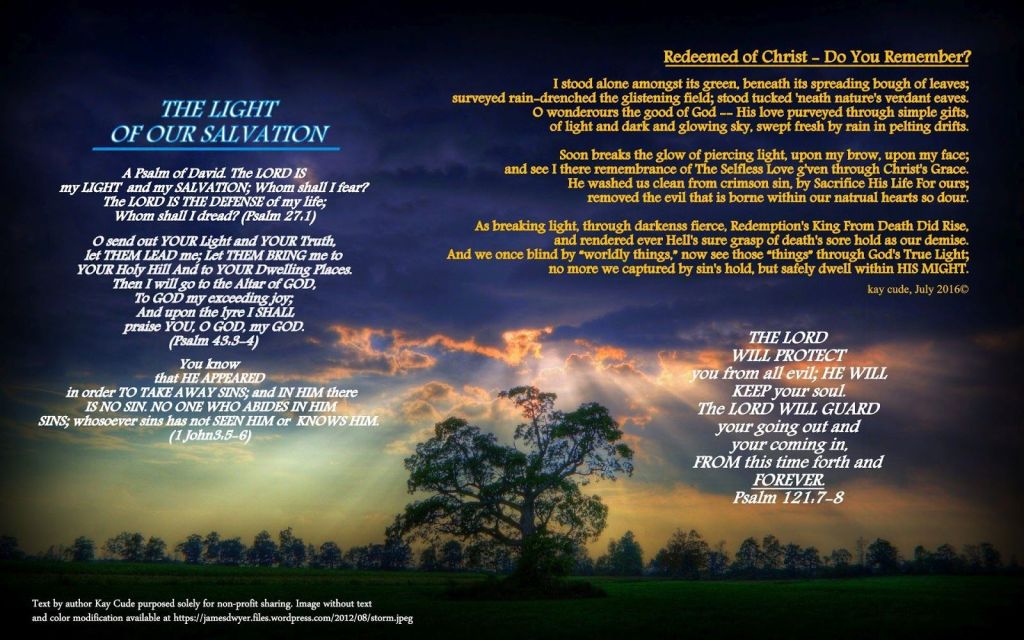
Kay Cude poetry. Used with permission. Right-Click to enlarge or read text below.
Redeemed of Christ – Do You Remember? I stood alone amongst its green, beneath its spreading bough of leaves; surveyed rain-drenched the glistening field; stood tucked ‘neath nature’s verdant eaves. O wonderours the good of God — His love purveyed through simple gifts, of light and dark and glowing sky, swept fresh by rain in pelting drifts.
Soon breaks the glow of piercing light, upon my brow, upon my face; and see I there remembrance of The Selfless Love given through Christ’s Grace. He washed us clean from crimson sin, by Sacrifice His Life For ours; removed the evil that is borne within our natural hearts so dour.
THE LORD WILL PROTECT you from all evil; HE WILL KEEP your soul. The LORD WILL GUARD your going out and your coming in, FROM this time forth and FOREVER. Psalm 121.7-8
THE LIGHT OF OUR SALVATION A Psalm of David. The LORD IS my LIGHT and my SALVATION; Whom shall I fear? The LORD IS THE DEFENSE of my life; Whom shall I dread? (Psalm 27.1)
O send out YOUR Light and YOUR Truth, let THEM LEAD me; Let THEM BRING me to YOUR Holy Hill And to YOUR Dwelling Places. Then I will go to the Altar of GOD, To GOD my exceeding joy, And upon the lyre I SHALL praise YOU, O GOD, my GOD. (Psalm 43.3-4).
You know that HE APPEARED in order TO TAKE AWAY SINS; and IN HIM there IS NO SIN. NO ONE WHO ABIDES IN HIM SINS; whosoever sins has not SEEN HIM or KNOWS HIM. (1 John 3.5-6)
The other day I came across a post on X (formerly Twitter) from The Transformed Wife/Lori Alexander/ @godlywomanhood, which stated flatly:
I erased the rest of the post so I could present the main focus, her outlandish statement. I left the date and time stamp if you want to look it up to see the rest of her sentence.
Lori plays doctor, making overgeneralizing claims that have no basis in reality. Ladies, sometimes it’s OK or even necessary to work. Circumstances vary from household to household. In Christian liberty, you and your husband should pray, discuss, and decide what is best for you.
“The workforce” doesn’t cause infertility. Activity such as a stressful work environment can impact a woman’s cycles. But so can intense physical activity. Some female athletes when intensely training for an event, can result in not having a period anymore, called Amenorrhea.
Avoid Lori, her counseling advice and her medical advice!
Point #1-
Lori is a Legalist. This means she puts burdens on people she declares as biblical mandates which are actually within the realm of Christian liberty. Legalism has several nuances.
1. Legalism is believing that salvation can be earned by obedience. 2. Legalism is believing that one can obey the Bible through his own will and power for the purpose of gaining a greater measure of God’s approval and favor.
And here is where Lori Alexander’s legalism comes in-
3. Legalism elevates man-made rules above the Scripture.“This third form of legalism elevates man-made rules, especially prohibitions, to the same level of authority as God-given commands and the belief that following these rules will aid you in your spiritual growth.” Source ACBC Biblical Counseling.com
There is no scripture that says a woman may never under any circumstances join “the workforce”. In fact you notice Lori rarely if ever attaches an actual verse to her commands and pronouncements. Not just Lori, but ladies, watch out for any “Bible teacher” who does this.
There are situations which a husband and wife decide the wife works- he is deployed, in jail, on medical disability, finishing college, trade school, or seminary. To save for a house to have large down-payment and low or no debt.
The Bible offers up women who DID work in “the workforce”. There are others mentioned such as prostitutes, servants, and slaves but I am not pointing to them. The ones in this list are women who had jobs or duties in some kind of work-for-pay outside the home or a job that took them from home, whether it was theirs or their father’s.
Rachel was a Shepherdess. Egyptian Midwives worked. Sheerah, a builder, was the daughter of Ephraim, son of Joseph, 1 Chronicles 7:24. Lydia worked, she had a business selling purple. Her work allowed her to have a large enough house to host church and guests for the propagation of the Gospel and the teaching of the saints. Deborah worked, she was a wife but also a Judge/Prophetess. Priscilla- was a Tentmaker with her husband. Esther, Candace, Sheba- Queens. Ruth- worked as a gleaner alongside Boaz’s women in the fields until the end of the harvests. (Ruth 2:23) Women were also patronesses & benefactors, such as Susannah and Phoebe, which required them to manage their means and likely an employee.
2 Thessalonians 3:10 says, For even when we were with you, we used to give you this order: if anyone is not willing to work, then he is not to eat, either.
I don’t see a gender prohibition in this verse. The verse doesn’t say, if any man is not willing to work, then he is not to eat, either; But women must not enter the workforce’…
It’s true that we must be diligent to sustain ourselves and not rely on the church or others without being willing to pull our own weight. But the Lord was gracious to leave us room to manage our individual affairs in ways that would be consistent with His general principles in this area without making strict mandates in a one size fits all forcible lifestyle.
Point #2-
Christian liberty means where the Bible doesn’t command or deny some kind of standard for us, it is within the realm of the individual or the couple to pray and follow biblical concepts as best they can.
Believers are free to do any activity that is not expressly forbidden in the Bible, as long it it does not present a stumbling block to others or violate your own conscience. Romans 14:22 says,
The faith which you have, have as your own conviction before God. Happy is the one who does not condemn himself in what he approves.
There are many verses in Proverbs and elsewhere that talk about the busy ant, verses speaking against the slacker and the idle. Christians work.
EPrata photo
The Bible does not expressly forbid women to work outside the home. The women named above were not chastised by any person in the Bible or any verse that said they were violating a command.
However, there is a third, very important point-
Point #3
When the couple begins to have kids mom should do all she can to be a stay-at-home mother, though. God did give women a special role in childbearing and child raising. Strongly, if at all possible, moms should be at home with their children.
What are God’s priorities for women? Seven priorities of a godly wife are spelled out in Titus 2:3-5 … Whether or not a woman works outside the home, God’s primary calling is for her to manage the home. That is the most exalted place for a wife. The world is calling many modern women out of the home, but not the Lord. His Word portrays the woman’s role as one preoccupied with domestic duties. It is a high calling, far more crucial to the future of a woman’s children than anything she might do in an outside job.
The ultimate decision is a personal one that each woman must make in submission to her husband’s authority. Obviously, a single woman would be free to work and pursue outside employment. A married woman with no children is perhaps a little more restricted in the amount of time and energy she can devote to an outside job. A woman who is a mother obviously has primary responsibility in the home and would therefore not be free to pursue outside employment to the detriment of the home.
Conclusion
1. Some “Bible teachers” who sound good and biblical at first pass are actually expert at mixing in untruths with truth to the disservice of your walk. Not all that glitters is gold. Don’t let unwise and uninformed internet teachers put a burden on you that does not exist. (Or release you from restrictions that should exist). Test all things.
2. Keep in mind your Christian liberty- absent a command or a forbidding, always seek to align your decisions with the values that God has for you in your role at each stage of life. Always compare what you are learning from any teacher online or real life, with what the Bible says- and doesn’t say.
3. If you have children it is true that you and your husband should seek the Lord’s help in structuring your life to align with the priority of the mother at home managing the home, while husband provides.
Further Resources
Lori follows the stance of (false) Dale Partridge, which is that women should NOT teach any theology to any man or woman. Ever. His stance is here.
Partridge’s stance is rebutted biblically by Henry Anderson at The Cripplegate, here.
Does the Bible Allow women to work outside the home? Live Q&A, video by Dave Guzik, “We shouldn’t treat one Bible passage as if it says everything about a subject- we need to do what 2 Timothy 2:15 says to do, rightly divide the word of truth, and that means not taking one verse and acting as if that’s the only thing the Bible says on the subject.” slide to 3:43 to 17:24
He was thirty-two years old when he began to reign, and he reigned eight years in Jerusalem. And he departed with no one’s regret. They buried him in the city of David, but not in the tombs of the kings. (2 Chronicles 21:20)
Left, The Royal Sceptre of Boris III of Bulgaria
Dorcas:
Now there was in Joppa a disciple named Tabitha, which, translated, means Dorcas. She was full of good works and acts of charity. In those days she became ill and died, and when they had washed her, they laid her in an upper room. Since Lydda was near Joppa, the disciples, hearing that Peter was there, sent two men to him, urging him, “Please come to us without delay.” So Peter rose and went with them. And when he arrived, they took him to the upper room. All the widows stood beside him weeping and showing tunics and other garments that Dorcas made while she was with them. (Acts 9:36-39)
In the first case, a sinful king. He served satan, and practiced wickedness. He was still a man, however, and yet not one person lamented his passing. Not even his wife. He was a king, touching the lives of each and every person in his kingdom. His influence was the largest a man’s could be, and yet not one person in an entire kingdom or beyond mourned his death. He was not regretted.
In the second case, a woman. Her sphere of influence was small. Her reach was especially small because she served widows, nearly the lowest of the low in terms of cultural power. At her death, relatives are not mentioned, it would seem that it was her friends the widows who washed her and laid her in the upper room. And yet, she was beloved. Usually the ritual was to immediately rub the body with spices and lay the death cloths on and bury immediately. Yet these women did not. They loved Dorcas so greatly they sought a different way.
They sent men to find Peter. They did not want to let her go. Dorcas’ life was regretted. They lamented and cried and presented her works to Peter. One can visualize wringing of hands and weeping and wailing of many. Dorcas was loved and lamented.
Dorcas: “who with her needle embroidered her name ineffaceably into the beneficence of the world.” ~Unknown
Why was Jehoram immediately forgotten and Dorcas never forgotten? I cannot say definitively or exclusively, but one reason surely must be that Dorcas was in Christ, and Jehoram was in Satan. The verse says that Dorcas was “a certain disciple” so she was a believer. She must have been beautiful in Christ, bearing the fruit of His love and grace and joy and peace, all the while serving tangibly with her needle.
Who can say what influence a loving submissive disciple of Christ will have for His kingdom? Jehoram was given Christ’s kingdom (Judah) and he served satan with it. (2 Chronicles 21:6). Dorcas was given Christ’s kingdom and served Jesus with it. Both have everlasting eternal consequences but both have earthly consequences too.
As for the eternal consequences of their deaths, Jehoram’s life was snuffed out and the spiritual repercussions were zero. It seems that nobody was the better for Jehoram having lived. As for Dorcas, she was raised bodily from the dead but the effect of that was many were saved. They were raised from the dead, too! Their spiritual deaths were now over and many became alive in Christ! The effect of that was Peter stayed and nurtured the new church in Joppa, personally discipling many converts. What an eternal effect Dorcas had on the lives of the people there, personally and spiritually!
The question is, what kind of death would you have? Or me? Would my own death be unlamented? Unremarked? Or would it cause mourning and weeping? The key is serving, and the fruit we bear. Dorcas served the people in Christ’s name. Jehoram expected to be served, and was one of satan’s. Dorcas served with her needle. Jehoram expected to be served with his scepter. Dorcas loved Christ and thus she loved her neighbors. And they noticed. Boy, did they notice. Jehoram loved satan and thus he hated his neighbors. And they noticed. Boy, did they notice.
And if it is evil in your eyes to serve the LORD, choose this day whom you will serve, whether the gods your fathers served in the region beyond the River, or the gods of the Amorites in whose land you dwell. But as for me and my house, we will serve the LORD.” (Joshua 24:15).
Love, serve, produce fruit. It will have an eternal effect.
Genesis 2:9 says, Out of the ground the LORD God caused every tree to grow that is pleasing to the sight and good for food; the tree of life was also in the midst of the garden, and the tree of the knowledge of good and evil.
Genesis 3:6 says, When the woman saw that the tree was good for food, and that it was a delight to the eyes, and that the tree was desirable to make one wise, she took some of its fruit and ate; and she also gave some to her husband with her, and he ate.
Eve already knew that all the trees were good for food. Only one tree she was told not to eat of it. Eve added ‘nor touch it’ herself, or perhaps Adam had instructed her so. In any case, ‘nor touch it’ wasn’t in God’s commands. He does not like when His word is added to or taken away from. (Deuteronomy 4:2, Revelation 22:18-19).
But satan suddenly made her ‘see’ it in a new way, a way that touched her selfish desires.
Did you know that John Bunyan wrote a commentary on Genesis? He had completed commenting on 10 chapters of Genesis fully and partially on Chapter 11. It was discovered oin his study in his own handwriting by Charles Doe, and then published in 1691. You can find Bunyan’s Genesis commentary online here at Monergism.com or at BibleHub, among other places. Here is what Bunyan had to say about that scene with Eve in the Garden-
————begin Bunyan commentary————
This verse presents us with the use that Eve made of the reasonings of the serpent; and that was, to take them into consideration; not by the word of God, but as her flesh and blood did sense them:
This is a very dangerous and devouring to the soul, from which Paul fled, as from the devil himself: “Immediately I conferred not with flesh and blood” (Gal 1:16).
Wherefore, pausing upon [the devil’s words], they entangled her as with a threefold cord-
1. “The lust of the flesh”; she saw it was good for food.
2. “The lust of the eye”; she saw it was pleasant to the eye.
3. “The pride of life”; a tree to be desired, to make one wise (1 John 2:16).
Being taken, I say, with these three snares of the adversary, which are not of the Father, but of the world, and the devil the prince thereof, forthwith she falls before him: “And when the woman saw” this, “she took of the fruit thereof, and did eat.”
“And when the woman saw.” This seeing, as I said, is to be understood of her considering what Satan presented to her, and of her sensing or tasting of his doctrine; not by the word, which ought to be the touch stone of all, but by and according to her own natural reason without it.
God commands to self-denial.
————end Bunyan commentary————
Self-denial. Obedience. Submission. Three little words that meant the difference between Righteousness and the Fall of the human race. And so it is today. Not popular words. Admittedly very hard to do. Even in the Garden of Eden when all conditions were perfect, our human nature wants to rebel, disobey, fulfill self. It’s harder now with our fallen nature tempting us at all points.
There is One who was tempted at all points and yet mastered sin. The Holy One, Jesus, lived the perfect life of righteousness on God’s eyes. He died for us as the sacrificial (eternal) lamb so we may life. Resurrected and ascended to heaven, He reigns there now, receiving all who would repent of their sin.
Outside of Jesus, we sin daily, minute by minute our thoughts and intentions of the heart, our words, and our actions displease God. His wrath already abides on us. But if we repent, God then sees us as He sees His Son, as righteous and holy. To be sure, we still sin, but the Spirit in us given as a deposit of the guarantee, will continue to lead us into righteousness and help us resist temptation. Jesus will forgive our sins when we repent.
Jesus is the most wonderful person in the universe. Repent unto salvation if you have not already. If you have repented unto salvation, work at mortifying our daily sin, putting it to death.
In Genesis 3:17, we read that Adam listened to the voice of his wife.
Then to Adam He said, “Because you have listened to the voice of your wife, and have eaten from the tree about which I commanded you, saying, ‘You shall not eat from it’;
The entire human race fell into sin with Adam’s disobedience- having listened to the voice of his wife.
In Genesis 16:2 we read that Abraham listened to the voice of his wife.
So Sarai said to Abram, “See now, the LORD has prevented me from bearing children. Please have relations with my slave woman; perhaps I will obtain children through her.” And Abram listened to the voice of Sarai. (Genesis 16:2).
The entire Arab world is forever fighting because of Ishmael, the result of Sarah’s scheme to get a boy child, who ended up being a wild donkey of a man who raised up his fist against everyone. (Genesis 16:12)
In Genesis 12:7 God told Abraham he would have offspring. In Genesis 15:5 God told Abraham he would have numerous descendants, and specifically that Eliezar would not be the heir. And yet Abraham disobeyed and listened to Sarah who connived a better plan, or so she thought.
The results of both men whom God Himself charged with listening to the voice of his wife, reverberates throughout history.
Now let’s get one thing clear. Women/wives are created to be a helpmeet. (Genesis 2:18). One of the ways they help husbands is that they give wise advice and have good opinions. Proverbs 31:26-27 is a verse admiring the wife precisely because “She opens her mouth in wisdom, And the teaching of kindness is on her tongue.”
The difference between Eve/Adam and Sarah/Abraham is that their counsel directly contradicted God’s. It was unwise and unkind, the opposite of the Proverbs wife. And the men listened.
I mean, in Genesis 15:5 Abraham heard that he’d have offspring, and in Genesis 15:6, the next verse it was counted to him as righteousness that he believed and trusted God. But Abraham succumbed to…something. Impatience? Sarah’s beauty? Masculine weakness? Who knows. But Abraham was charged by God as having listened to the voice of his wife, and not in a good way. Adam too.
Wives, please make sure you are not pressuring your husband to do things that arise from your own carnal desire, as Eve’s was. Nor should we create schemes and machinations to further our own personal agenda, as Sarah did. Be a Hannah, who loved her husband and waited on God and appealed to God (not her husband as Rebekah did) to open her womb. A Lois or Eunice, teaching the young Timothy as they raised the boy to a man. Most importantly, be a Mary, who soaked up Jesus’ teaching every chance she got.
This is what makes a wise wife. A wife whose voice will help her husband and please God. When you open your mouth, is it in wisdom or folly?
I was thinking about the difference between wisdom and discernment, since I read Proverbs 4 today. Which is a good set of verses to refer to again and again!
Wisdom is the result of applying knowledge through discernment. There is a difference in knowing things and being able to use the wisdom gained to advance your holiness.
Abigail- is a good biblical example of how wisdom gained and applied thru discernment. Abigail was the wife of a brute of a man, that’s the Bible’s description. He was Nabal, a name that means foolish. He kept sheep near Carmel and he wasn’t well liked by anyone, including his servants or his wife. David had asked Nabal for food to feed his men and Nabal refused. Incensed, David swore to kill Nabal. Abigail pleaded with David, at no small risk to herself, I might add, and her gentleness and discernment, tact and wisdom calmed David. He was impressed. SO impressed, he married Abigail when Nabal died. (1 Samuel 25:1-42; 2 Samuel 3:3).
Hebrews 5:14 reminds us that discernment is a skill and as such, we must train ourselves in it.
Hebrews 4:12 reminds us that discernment is precise. There should be no reply like, ‘well nobody’s perfect’, or ‘eat the meat and spit out the bones’. If we train in discernment, apply it with tact and wisdom, it will do its job to hearts and minds, and in so doing will glorify the Lord.
Romans 12:2 tells us that discernment not only helps us train but it helps us find the will of God, which nothing on this earth is more important.
1 Kings 3:9- Solomon knew there was nothing more important, discernment was the one thing he asked for when given opportunity by God.
Hosea 14:9- discernment allows the God fearer to walk uprightly and it is something that makes the transgressors stumble.
But HOW do we train in discernment? How do we gain it? As Joseph said to the cupbearer, baker, and Pharaoh, it is not in himself, but God delivers wisdom (in Joseph’s case, to interpret dreams, but you get the point). We obtain discernment, according to Sinclair Ferguson at Ligonier, from his article What Is Discernment?
How is such discernment to be obtained? We receive it as did Christ Himself—by the anointing of the Spirit, through our understanding of God’s Word, by our experience of God‘s grace, and by the progressive unfolding to us of the true condition of our own hearts.
You knew I was going to say that, right? That gaining wisdom and applying discernment comes from steady study in God’s word? THAT is where all truth, knowledge and beauty lies. Add prayer, a constantly transforming mind, add alert to occasions where discernment can be used, then repeat. Just as a boxer trains his footwork repetitively, just as a basketball player throws the ball to the basket in practice again and again, so we train in discernment repeatedly.
Discernment is a skill and as the verse in Hebrews 5:14 says, we must train. Have you been to the spiritual ‘gym’ lately?
It is a day off from school and for that I am grateful, because I can watch the Inauguration and celebratory proceedings.
President Trump is about to take the oath of office shortly, for the second time.
It has been a long 4 years since his first inauguration. As one who is so active on social media, Biden’s term has caused me no small amount of anguish. I have had to avert my eyes often, guard my heart, and work at reducing the bitterness, outrage, and unhappiness of all that I have witnessed. At times I’ve felt that my beloved nation was imploding, reminding me of the verse where God had said, Therefore I am like a moth to Ephraim, And like rottenness to the house of Judah. (Hosea 5:12). A moth silently eats away at the fabric, rot causes foundational collapse.
It seems that He has granted us a reprieve from the Alarics of the world from sacking Rome.
I’ve grown up as a political animal. My father ran for office and also helped in campaigns of others seeking office. From my earliest days I remember grange halls, bunting, that echo shoes make on the wooden floors, Sousa marching music, and more.
I love my country and participated in Project Close-Up as a freshman. We were taken to the Nation’s capitol and given a close up look at how our nation runs, and time with our senator and representative. Even a tour of the Supreme Court. I loved it.
I’ve always been happy and proud of our country. My grandparents immigrated from Europe, coming thru Ellis Island, made new lives, prospered. I’ve been able to speak freely, assemble, and practice my religion with no hindrances.
I’ve been able to vote. What a privilege. I’ve almost always voted third party. I have felt strongly that we need to be governed by someone with real world experience in business (and ‘community organizing’ doesn’t count). Someone who understands at the minutest level about the economy. Someone from outside the two parties, which increasingly to me looked like one party. My first election I voted for John Anderson, and then Perot, Forbes, and so on. (Not Nader though).
I stood on the shore of Newport beach in 1976 and was wowed by the Tall Ships passing, our national bicentennial was a superlative party and a great lesson in civics.
It has been a long slog just since July when Candidate president Trump was shot, his life spared by the One who governs all life, but by a hair’s breadth to our eyes.
As someone who loves my country and is proud of it (and I never forgot THAT comment, yes I’m looking at you, Michelle Obama) and someone who loves justice, truth, and beauty, the last 4 years have been difficult if not depressing. Perhaps it was to give us a minute glimpse into what it was like for 1st century Christians under Nero. Or 1st century Jews under Herod. And yes I am deliberately likening our immediate past president to Herod and Nero.
“It is He who changes the times and the periods; He removes kings and appoints kings; He gives wisdom to wise men, And knowledge to people of understanding.” (Daniel 2:21).
It is HE. I do not know why God in His sovereign will decided to give us this reprieve or what He has in mind for the near future. But for the first time in a while I have optimism, even while completely understanding that my hope is in Jesus.
I’ve been praying for President Trump’s salvation, first and foremost. Then, that he survives the swearing in, and the next 4 years. I’ve been praying for justice to be done. Oh what a balm to my soul that justice in all her glory would be served. What a grace if I don’t have to wait until Jesus returns to see leaders right some of these recent wrongs.
I also pray that Mr Biden will receive the elder CARE HE DESERVES. He is obviously suffering from dementia, and it is a grief to watch in real time a man used as a puppet, a prop, inhumanely manipulated for evil ends. I can’t wait for THAT injustice to be addressed by Jesus.
But still, my hope is in Jesus. However, I am excited for today. I pray our nation returns to its earlier vigor and founding values. My life is advanced but I do hope that this sojourn by President Trump in our Hall of History will establish something good and strong for the next generation.
We worship an orderly God, whose prophecies, whose seasons, whose mankind progresses according to His will. What a blessing it is to know we submit to a God who is perfect, whose mighty hand is outstretched to make Himself known and His works are a wonder.
See the poem by Kay Cude on the art below or transcribed below that. Enjoy your day of rest.
Swan landing on a lake
GOD’S PURPOSE IN THE SEASONS OF LIFE
Foamy crystal drops of damp, and he alights with ease; To rest upon a liquid bed, his heart content and pleased; To linger there and end his day, the journey hard and long; the banks call out to lay upon, this heart by rest made strong… kay cude, 2007 AD
To every thing there is a season, and a time to every purpose under the heaven…. A time to kill, and a time to heal; a time to break down, and a time to build up. Ecclesiastes 3:1, 3
According to several passages in the Bible, it is believed that angels may escort believers to heaven when they die, (Luke 16:22). We read about the poor man Lazarus who was carried to heaven by angels after he died. After all, Hebrews 1:14 says that angels are ministering spirits who serve those who will inherit salvation. It isn’t a stretch to surmise that they might minister to us as our flesh fades away and our spirit ascends to heaven, guided along by gentle zephyrs in the company of angels who tenderly bring us to our eternal place.
It’s a soft, comforting, lovely thought of the care that Jesus has for our souls, even at the end and beyond.
The difference of how the lost’s souls are handled is stark. Far from being guided in love to safely and gently dock in pastures so green in heaven, only the fires await those who are not in Christ. The lost are THROWN away (from the presence of Jesus). They are CAST into hell.
When you blow your nose and wad a tissue do you gently deposit it into the wastebasket? No, likely you toss it. A wadded up piece of paper? Throw it…score! When you deem something trash or waste, you don’t handle it gently. It is of nothing to you. Toss without care.
EPrata photo
The word ‘cast’ or ‘thrown’ is used repeatedly in the Bible referring to those whose destination is hell. Every time. Sin and Hades itself are also thrown or cast into the Lake of Fire.
Matthew 5:29, Now if your right eye is causing you to sin, tear it out and throw it away from you; for it is better for you to lose one of the parts of your body, than for your whole body to be thrown into hell.
Matthew 7:19, Every tree that does not bear good fruit is cut down and thrown into the fire.
Matthew 8:12, but the sons of the kingdom will be thrown out into the outer darkness; in that place there will be weeping and gnashing of teeth.
Matthew 18:9, And if your eye is causing you to sin, tear it out and throw it away from you. It is better for you to enter life with one eye, than to have two eyes and be thrown into the fiery hell.
Luke 13:28, In that place there will be weeping and gnashing of teeth when you see Abraham, Isaac, Jacob, and all the prophets in the kingdom of God, but yourselves being thrown out.
John 15:6, If anyone does not remain in Me, he is thrown away like a branch and dries up; and they gather them and throw them into the fire, and they are burned.
Revelation 20:10, and the devil who deceived them was thrown into the lake of fire and brimstone, where the beast and the false prophet are also; and they will be tormented day and night forever and ever.
Revelation 20:15, And if anyone’s name was not found written in the book of life, he was thrown into the lake of fire.
EPrata photo
The word used here is ballo with an ek in front. Ek means out. The definition isTo cast out, to drive out, to send out, to expel. Expel is to remove something by force.
We are so used to the notion put forth by false teachers that Jesus is a boyfriend romantically pursuing us, or that He is a ‘gentleman’ who wouldn’t not force Himself on us. Neither of these characterizations are accurate. He is meek, yes. He is compassionate, yes. He is never soft on sin. He is angry at sin. He has no use for those who did evil in His sight and there is no need to gently lay into the fire those who rejected His gospel. They are tossed.
Yes, He has compassion on those who are without a shepherd, but when it comes time for the judgment, it will be rough, hard, and a display of the ultimate rejection, them against Jesus and Jesus against them.
Why write this? To awaken a renewed sense of wonder at Jesus’ gospel. To spark a deeper gratitude that He saved us from this. We who are in Him will be witnesses to it. During the Tribulation there will be silence in heaven for ‘half an hour’. (Revelation 8:1). It is a solemn silence of profound expectation of the final and decisive catastrophe- wrath unknown and unexperienced until now.
And yet, the final judgment of casting souls inside fitted bodies into the fires will be worse. Isaiah 66:24 says
“All mankind will come to bow down before Me,” says the LORD. “Then they will go out and look At the corpses of the people Who have rebelled against Me. For their worm will not die And their fire will not be extinguished; And they will be an abhorrence to all mankind.”
Most commenters take this as figurative language, of those viewing the bodies of the Jews who had rejected Jesus and lay rotting in abundance in their deaths in the aftermath of the battle at Gehenna. I personally think it is literal, that there is a literal lake of fire with literal bodies of the lost in a literal fire. It will be literally somewhere and occasionally the saved will view them and remember as a testimony to God’s mercy that there but for the grace of God, go I.
Therefore let’s approach the throne of grace with confidence, so that we may receive mercy and find grace for help at the time of our need says Hebrews 4:16. As we approach that throne of grace, let gratitude flow that He has dealt gently with us.
I wrote two days ago about the celebrity grandmother ‘Bible teachers’ who were adept at crafting a conservative persona on social media contrary to the lives they were actually living.
They had to craft their outward picture (in hypocrisy) because firstly, when they started out the faith was much more conservative than it is now. They could not openly say they were preaching or having a career at the office. They had to say they were ‘speaking’ and only occasionally because they were stay at home moms. They had a ‘ministry’ not an all-consuming, busy career.
Secondly 40 years ago there was not as much social media as there is now. Back in the day there was only TV, newspapers, and radio.
I wrote an essay in 2018 saying this push of preaching to men was going to be a problem:
I also said so two days ago that the evil example of these grandmothers in the faith (Moore, Shirer, Meyer, Caine…) during the last generation is a problem:
So, a couple of days ago a woman whose handle is Cia Cloud, put up an Instagram story and a TikTok talking about the “romantic heart of Jesus”. The short video is below and here is the transcript:
After you’ve experienced the romantic heart of Jesus, you cannot go back to casual dating. I got out of a relationship a while ago, and when I did I asked the Lord can you teach me what it’s like for You to be my husband? And before you get weirded out, it’s because the church is known as the Bride of Christ, and He’s the groom. I wanted to know what it felt like to truly be pursued so that I knew what to look for in a future relationship. Let me explain what God does so you don’t settle. I wish more people understood that God wants to romanticize your heart. He wants to win you over. He created you to delight in pursuing you. He is the ultimate pursuer. We just get distracted. The other day for example, the Lord told me he was going to take me out to lunch…”
She went on with two more examples of how Jesus spoke to her and shortly afterward the minor things he allegedly said came true.
No. But what can we expect when young women of this generation have had such an evil example for decades, with no rebukes coming from the grandmother preachers’ denominations?
It was sad to see the comments asking how to hear God like she does, one woman saying “because for me he has been so quiet”.
Let’s spot the falsities in her speech:
Falsity #1. “Jesus is my romantic boyfriend”. No. John Gacinski on Twitter replied to the person who had posted Cia’s video-
John Gacinski, @johngacinski: “God wants to romanticize your heart” No. Jesus wants us to surrender to Him and serve Him. He wants us to be born again so we can be worthy vessels in His house. He’s not wooing us like some twenty something who’s desperate for a girlfriend. I’m so tired of this “Jesus is my boyfriend/homeboy” trash.
Notice Cia said “I wanted to know what it felt like” not ‘what does the Bible say?’
Falsity #2. “He speaks to me directly.” No. The canon is closed. He spoke through His word as Hebrews 1:1-2 says. Justin Peters has a rebuttal to the ‘still small voice that speaks to me’ error.
Falsity #3. “Prophetic words given directly to me are coming ‘true’. No. Stop looking for signs and omens and back dating what you thought you heard in the ‘voice.’ Just live your daily life according to the word.
Falsity #4. Needing an experience rather than what His word says. The people followed Jesus when He spoke good things, and they clamored for the signs and miracles. But when he spoke hard things, they drifted away. Turns out they were only following Him for a show. The walk of faith begins and ends in the word of God, which will never pass away.
Falsity #5. He pursues with uncertain outcome rather than sovereignly electing (He “wants to win you”). Jesus is not wishing and hoping and wringing His hands hoping you come to faith as He chases you. He elected His people from before the foundation of the world and at the fullness of each elected person’s time, they are given the grace to repent and come to Him. (Ephesians 1:4-6)
This problem of prophetic words, still small voice, romantic boyfriend Jesus issues are not all the wicked grandmothers’ fault. Seminaries are doing their best to pump out women preachers rife with false doctrine. Witness Cia Cloud:
I am sad for her future because she is standing on sand building a house of sand
These nextgen women don’t even hide it anymore, not like the other false female preachers did in the 90s and early 2000s. They are ‘out’ as preachers. Immodest ones, at that. Apparently Cia attended Liberty University.
But I do not allow a woman to teach or to exercise authority over a man, but to remain quiet, says 1 Timothy 2:12. See also 1 Corinthians 14:34-35, Ephesians 5:22-24 among other verses that clearly state what the woman and wife should do and not do.
If you have a teen or young adult daughter, I feel for you. Keeping the false doctrines at bay is difficult. Just as you put one doctrinal fire out, another pops up. I want to encourage you moms, grandmoms, young ladies, that if you stay in the word, Jesus will keep you on the center line of his doctrine. Guard your heart, keep your eyes on Jesus, stay in the Word.
Pastor Owen Strachan has some wise advice for women (men too, but I’ll post the women’s here) on what to do and what not to do.
You notice none of those pieces of advice say chase after signs, listen for a small voice, ascend the pulpit to preach, or treat the GOD OF THE UNIVERSE like a wooing, weak boyfriend.
Stay strong, ladies. Jesus will come back and He will raise us up. He will address the false doctrine and the people who promoted it. Meanwhile, be a pillar, upholding His precious true word.
When our sons in their youth are like growing plants, And our daughters like corner pillars fashioned for a palace,Psalm 144:12



 the-end-time.org
