Posted in prophecy

When a sweet smell is foul

Hear, O earth; behold, I am bringing disaster upon this people, the fruit of their devices, because they have not paid attention to my words; and as for my law, they have rejected it. What use to me is frankincense that comes from Sheba, or sweet cane from a distant land? Your burnt offerings are not acceptable, nor your sacrifices pleasing to me. (Jeremiah 6:19-20).

The LORD had instituted incense offerings which can be seen in Exodus 30:7-8; Exodus 30:34; 2 Chronicles 13:11. According to Easton’s Illustrated Bible Dictionary, from 1897, we read of incense that the sacrifices were

a fragrant composition prepared by the “art of the apothecary.” It consisted of four ingredients “beaten small” (Exodus 30:34-36). That which was not thus prepared was called “strange incense” (30:9). It was offered along with every meat-offering; and besides was daily offered on the golden altar in the holy place, and on the great day of atonement was burnt by the high priest in the holy of holies (Exodus 30:7 Exodus 30:8). It was the symbol of prayer (Psalms 141:1 Psalms 141:2; Revelation 5:8; Revelation 8:3 Revelation 8:4). Source Easton’s Illustrated Bible Dictionary, 1897. Public Domain, copy freely.
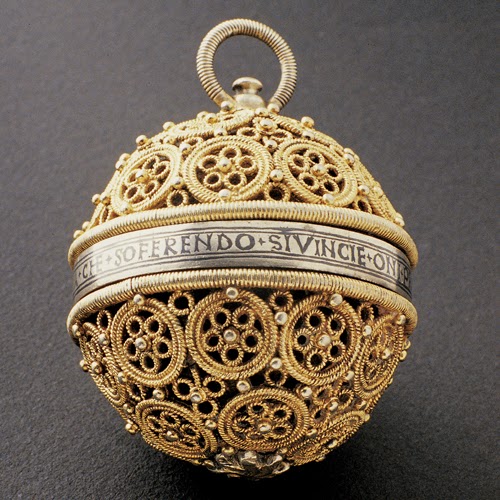
A Renaissance era pomander container. Source

In today’s verse from Jeremiah we read that the LORD had become angry with a sweet smelling offering that was devoid of obedience and love for His law. An empty sweet smelling fragrance would do nothing to satisfy Him or render the giver justified in any way. It’s ineffective. Instead, such an empty sacrifice incurs wrath.

The notion of ineffective perfumes reminded me of the 14th century bubonic plague remedy. People were told to carry pomanders, which were perfume balls containing herbs, flowers, and spices, either around their neck or in their hand, and to sniff it constantly so as to ward off the disease.

Pomanders are traditionally mixtures of fragrant substances which are often held within a container – although the term can also be applied to the container itself. The odours given off by the mixtures were once believed to offer protection against disease and they are particularly associated with times of plague, from the 1300s onwards. Their use is linked to centuries-old miasma theories which suggested that disease was transmitted through foul-smelling air. Keeping a sweet-smelling pomander close by was believed to offer protection.

Miasma theory posited that disease was carried by a cloud of poisonous vapor in the air, which was created by decay and could be identified by a bad smell. Following the logic that bad smelling air carried disease, it makes perfect sense that you could “cure” the air by making it smell good. Hence the perfume. And the long nose to stuff good smelling material into.

It seems silly to think that a perfume ball containing a few herbs and sweet-smelling spices would protect one from bubonic plague! But just as silly were the Jews who thought that they could disobey Him all day long and at the end offer the Lord God a sweet smelling offering and everything would be all right. Such empty fragrances do nothing to ward off the disease of sin. Nor would they protect one from wrath and judgment.

So what would satisfy His wrath and stay His judgment?

Thus says the LORD:
Stand by the roads, and look,
and ask for the ancient paths,
where the good way is; and walk in it,
and find rest for your souls
(Jeremiah 6:16)

The good way is traveling the road of His word. It pleases the LORD and it gives rest to the rebellious soul. We also would do well to inquire as to where the good paths are, and walk on them. The sweetest scent of all is obedience.

————————————

Note: Tomorrow- the link between incense and prayer

Posted in encouragement, Uncategorized

Feeling weak and weary? It’s OK. Even Timothy needed urging

For this reason I remind you to fan into flame the gift of God, which is in you through the laying on of my hands, 7for God gave us a spirit not of fear but of power and love and self-control. (2 Timothy 1:6-7).

Has your zeal waned? I’m not talking about the normal subsiding of a fervency that first ignites in the heart upon salvation but then matures to a steady fire. I’m talking about the day to day, month to months or year to year faith that, if left untended or un-nurtured, diminishes to an ember, with cold ashes all around. Or the faith that is timid and retiring, waiting for igniting or just fearful.

It happens.

As we see in the verse above, Paul was urging Timothy to fan into flame his gift (of faith). One who already has a flame doesn’t need someone to urge him to fan it. Only someone who is dimming needs such encouragement. Paul knew this was true of Timothy, so Paul wrote to encourage Timothy to nurture his faith.

Barnes’ Notes:

The idea is, that Timothy was to use all proper means to keep the flame of pure religion in the soul burning, and more particularly his zeal in the great cause to which he had been set apart. The agency of man himself is needful to keep the religion of the heart warm and glowing. However rich the gifts which God has bestowed upon us, they do not grow of their own accord, but need to be cultivated by our own personal care.

We all need that exhortation. Fan into flame the gift of God.

OK. How? What are the actions we should take when we sense our spiritual walk is slowing?

In the Spurgeon sermon Our Gifts and How to Use Them, we note that to stir up one’s faith requires action.  Spurgeon here has some ideas. The following are excerpts from the above link ‘Our Gifts and How to Use Them.’

~~~~~~~~~~~~~~~~~~

And this brings us, secondly, to the consideration of HOW WE ARE TO STIR UP OUR GIFTS.

EXAMINE YOUR GIFTS
First, we should do it by examination to see what gifts we really have. There should be an overhauling of all our stores to see what we have of capital entrusted to our stewardship.

STIR UP YOUR GIFTS
The next mode of stirring up our gift is to consider to what use we could put the talents we possess. To what use could I put my talents in my family? Am I doing all I could for the children? Have I labored all I ought for my wife’s conversion; my husband’s conversion? Then about the neighborhood: is there nothing more that I could do for the salvation of my poor godless neighbors?

… Are you doing all you can for Jesus? Come, answer like an honest man! Having done so, I have more for your self-inspection! Will you examine yourself in every relation in which you stand? As an employer, stir up your gift in reference to those you employ; as a servant, stir up the gift towards your fellow servants; as a trader, and stir up your gift in reference to those with whom you come in contact… If our churches were in a right state of spiritual health, men would not first say, “What can I do to make money?” but, “What can I do to serve Christ, for I will take up a trade subserviently to that.”

ACT IN AND THROUGH YOUR GIFTS
But, next, stir it up not merely by consideration and examination, but by actually using it. We talk much of working, but working is better than talking about working. To get really at it, and to do something for soul-winning and spreading abroad the glory of God is infinitely better than planning and holding committees. Away with windbags! Let us get to acts and deeds! … Work, work, and the tool that is blunt will get an edge by being used! Shine and the light you have shall grow in the very act of shining! He who has done one thing will find himself capable of doing two, and doing two will be able to accomplish four; and having achieved the four will soon go on to twelve, and from 12 to fifty! And so, by growing multiples, he will enlarge his power to serve God by using the ability he has.

IMPROVE YOUR GIFT
We have for years endeavored to stir up the young Christians of this congregation to educate themselves. … I think every man ought to feel, “I have been Christ’s man with a talent; I will be Christ’s man with 10 if I can; if now I do not thoroughly understand the doctrines of His gospel, I will try to understand them; I will read, and search, and learn.” We need an intelligent race of Christians, not an affected race of boasters of culture—mental fops who pretend to know a great deal, and know nothing! We need students of the word, adept in theology like the Puritans of old!

PRAY OVER YOUR GIFTS
—that is a blessed way of stirring them up, to go before God and spread out your responsibilities before Him. … It stirs one up to preach with all his might when he has laid before God in prayer, his weakness; and the ability which God has given him, and asked that the weakness may be consecrated to God’s glory, and the ability accepted to the Lord’s praise. Should we not do just the same, whatever our calling is—take it to the Lord and say, “Assist me, great God, to live for You; …

~~~~~~~~~~~~~~~~~~

End Spurgeon. Don’t you love his bluntness? ‘Don’t just talk about working, actually work. Away with windbags!’ Lol.

Does the flame of faith in your bosom need fanning? It is not sin, not yet. Fainting youths and weary soldiers give opportunity for stronger brothers to come alongside and exhort and encourage. Perhaps that strong soldier will need fanning one day, and you can return the favor. In addition, we are pitiful human creatures, stained with a sin-drenched mind always attempting to get the better of the Mind of Christ that is given to us. Or, our timid hearts stray to the back of the crowd. Or, our spotted souls seek to grow the spots instead of slay them.

The battle is long and the fight is tiring. It was for Timothy. What a blessing the Bible includes the weaknesses and flaws of our fainting brethren who came before us. See? You’re weak. I’m weak. It happens.

If you need fanning, no matter. Stir up your gifts, the basis is which is the gift of God of faith and repentance, the gift of knowledge of our own sin, and so seek to revive that flame to a burning love giving light and warmth to fellow soldiers and to the cold and wandering lost.

flame

Posted in encouragement, Uncategorized

What was the greatest revival ever?

Pentecost yielded 3000 souls. Hallelujah! However, the harvest of souls will be even greater during the Tribulation. (Rev 7:9-10, 13). Hallelujah again!

Was it The Great Awakening? That revival, in three waves, yielded thousands over three waves, (First (c. 1730–1755; Second c. 1790–1840); Third c. 1855–1900), but Jonathan Edwards worried that some of those in the frenzy were simply carried away by emotionalism and societal pressure rather than their own brokenness over sin, marking them as false converts. In response to the very real probability that mixed in with the genuinely converted were many false professors, he wrote The Distinguishing Marks of a Work of the Spirit of God.

Revivals have always been plagued by errors in judgment from leaders and participants alike, Edwards warned, and have suffered from the delusions of Satan. Great care and discernment are always the order of the day. ~God’s Spirit or Human Hysteria? My Time Among the Charismatics, by Jeff Robinson. So it’s hard to count that revival’s numbers and thus its effects.

So what was the greatest revival ever? For sure?

It was Nineveh that yielded 600,000 souls for the glory of God. It was and still is the largest harvest God has effected to date. In addition, we know that was a genuine repentance and coming to faith, because first, the Bible said so, and second, the LORD stayed His hand in destroying the city. (Jonah 3:5, 10).

How do we know it was around 600,000 souls when the only number mentioned in regards to Nineveh is 120,000? Jonah 4:11 says,

And should not I pity Nineveh, that great city, in which there are more than 120,000 persons who do not know their right hand from their left, and also much cattle?

‘Not knowing the right hand from the left’ is a Hebrew idiom meaning ‘children’. Children don’t know their right hand from their left. Extrapolating the number of children and assigning them to two parents, historians and theologians estimate the city was populated by about 600,000. Its size also (three days’ walk) indicates a populous, bustling city of this magnitude.

By comparing these revivals at Pentecost, Nineveh, and the Tribulation we can praise God for His continuing and marvelous ongoing work in salvation. We will have lots of company in heaven! As Jonah said, “Salvation belongs to the Lord.” (Jonah 2:9). He will glorify His name by His mighty power to deliver men from the darkness of bondage to sin, speaking life into their dead bones,and resurrecting them to eternal life. Praise the Lord!

salvation lamb

Posted in discernment

Just a little something to think about … Angels among us

This essay first appeared in September 2010 on The End Time

Angels. They exist. They were created by God and they serve God. There are multitudes and multitudes of them. (Hebrews 12:22).

The bible shows us that angels appear on earth as men, sometimes looking like ordinary men (Joshua 5:13-14; Mark 16:5), and at other times looking like something other-worldly, so much so that the people gazing upon them were gripped with fear, as was Zacharias in Luke 1:12. He was speechless before the angel who visited him. So were the keepers of Jesus’ tomb, ‘who became as dead men when they saw the angel of the Lord’ (Matthew 28:4).

When they appear to people on the earth sometimes they take on human form like in Genesis 18:1-19. Jesus and two angels appeared as men and actually ate a meal with Abraham. Later two of the angels went on to Sodom and slept overnight at Lot’s house. So we know they can incarnate, appear as men, and spend a period of time on earth.

We know that some angels fell, meaning, they sided with Satan in the angelic rebellion and were cast from their places in heaven. Satan’s fall is described in Isaiah:

How you have fallen from heaven, O morning star, son of the dawn! You have been cast down to the earth, you who once laid low the nations!” (Isaiah 14:12)

A third of the angels fell with satan:

Then another sign appeared in heaven: an enormous red dragon with seven heads and ten horns and seven crowns on his heads. His tail swept a third of the stars out of the sky and flung them to the earth.” (Revelation 12:3-4).

Though satan lost his high position, he is god of this world (2 Corinthians 4:4), therefore, being cast out doesn’t interfere with from his intent to deceive us. He still pretends to be on God’s side, as seen here. “And no wonder, for Satan himself masquerades as an angel of light.” (2 Corinthians 11:14). Note the word ‘masquerades’ and ‘light’. Masquerade means “An involved scheme; a charade; as in wearing a mask or disguise’. Of course he would pretend he is one of the good guys to an unsuspecting unbeliever, or even to a Christian. His underlings pretend to be on the good side, too. His servants are the fellow angels that followed satan in the war against God and also pretend to be one of the good angels. But they only want to deceive.

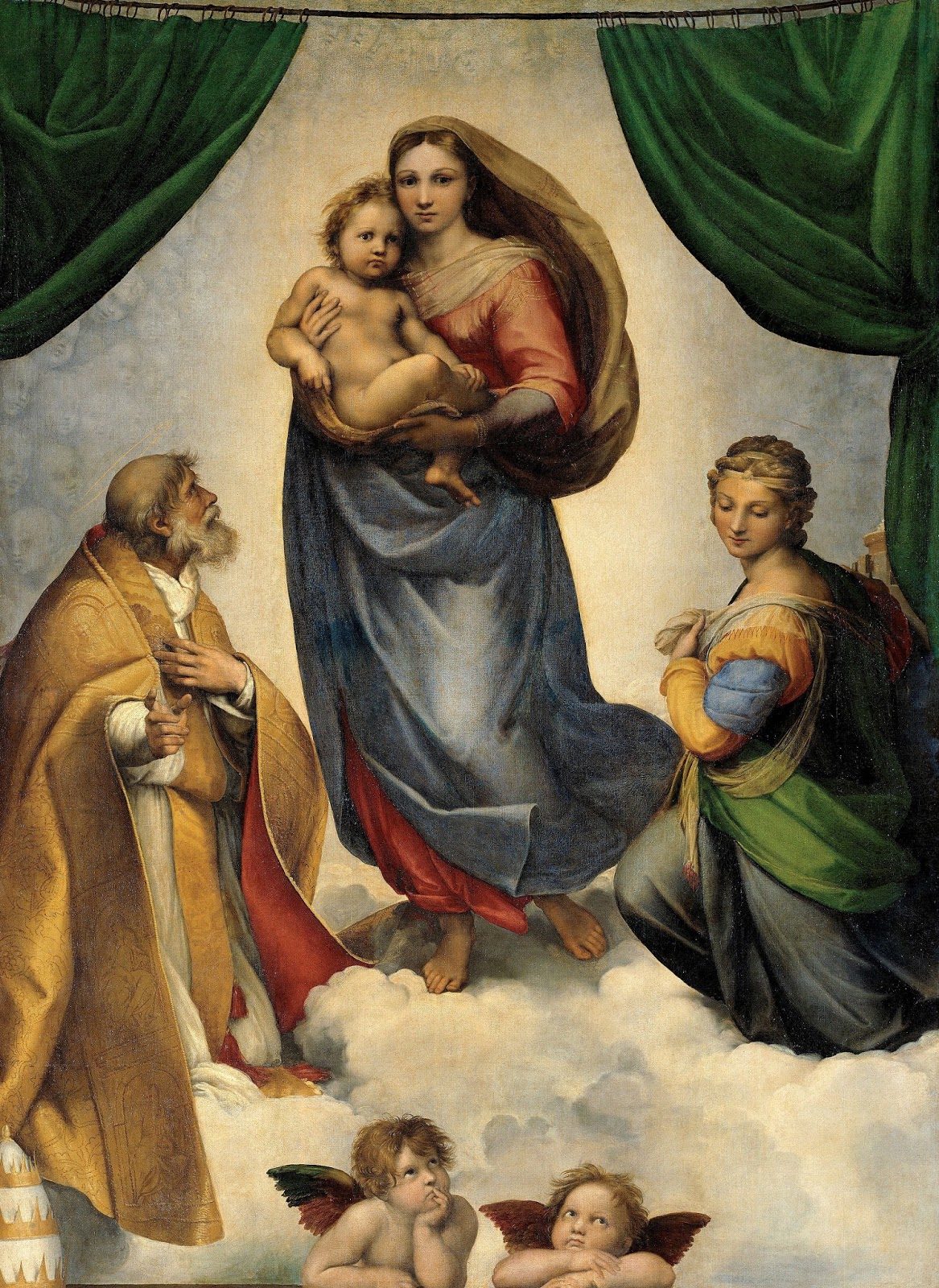
You know these guys. They’re putti, or cherubs as the Renaissance artists love to portray angels.

The two innocent-looking cherubs seem harmless. They’re from an excerpt of the larger piece called Sistine Madonna by Raphael. Angels are not cherubic babies. But satan and his demonic horde would like you to think so.

It is not surprising, then, if his servants masquerade as servants of righteousness.” (2 Corinthians 11:15).

Hebrews 13:2 says we sometimes entertain angels unawares.

So the point is, if you were beset by an angel of light, how would you know he is one of the good guys, or one of the bad guys? There is a 1 in 3 chance he is one of the bad ones. How would you know? Would you be so gripped with fear that you just accept what the angel says? Would you be so filled with pride that one of these beings was sent to you that you would accept what he said without question? Would you be so entranced by their light that you unquestioningly accept they are from God?

The only way to know is to know the Word of God. John and Peter both warned of false teachers, and Jesus said they may come to us in sheep’s clothing (Matthew 7:15; 1 John. 4:1; 2 Peter 2:1). John said our duty is to “test the spirits,” and Paul said: “Test everything. Hold on to the good.” (1 Thessalonians 5:21).

Not all angels come in peace. Some are your enemy. Be watchful and test all things!

Photo/postprocessing art EPrata