Posted in discernment, Uncategorized

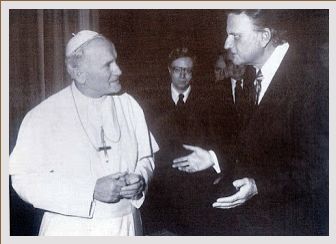
Billy Graham Waffles for Breakfast #2: Is AIDs a judgment from God?

Waffles for Breakfast #1: Billy Graham on the Nixon Tapes, remarking about the Jews

This series is a study on hypocrisy. Number 1 is above. The series is based on the following verses.

it is not what goes into the mouth that defiles a person, but what comes out of the mouth; this defiles a person. (Matthew 15:11).

Woe to you, scribes and Pharisees, hypocrites! For you are like whitewashed tombs, which outwardly appear beautiful, but within are full of dead people’s bones and all uncleanness. 28 So you also outwardly appear righteous to others, but within you are full of hypocrisy and lawlessness. (Matthew 23:27-28)

Waffling is a secular term that means changing one’s mind frequently on a topic. “For breakfast” means to do it easily. That defines world-famous evangelist and itinerant crusade preacher Billy Graham, whose going back and forth on theological issues was so easy and so frequent it became second nature to him.

His slide from what he stated he believes, into doctrines so far outside orthodoxy, was so incremental and so little reported, that many people don’t know that he spent a lot of time retracting, clarifying, re-explaining and watering down any doctrine where he encountered push-back. Here is one example. In a sermon given on September 1993 in Columbus OH he remarked about AIDs

Is AIDs a judgment of God? I could not say for sure, but I think so.

Afterwards, Graham received many protest letters. He contacted the Cleveland Plain Dealer newspaper and retracted what he’d preached. His stated reason for saying it in the first place was that he was tired.

“I do believe God stands in judgment of all sins but AIDs is a disease that affects people and is not part of that judgment. To say God has judged people with AIDs would be very wrong and very cruel. I would like to say that I am very sorry for what I said.”

When Graham preached about sins, he said he wasn’t sure if AIDs was a judgment of God, but when experiencing criticism for saying it, suddenly he is sure that it is NOT a judgment for sins.
aids graham final

Here is a comparison to Graham’s waffle on AIDS of how a preacher of God’s word is clear on biblical doctrines. He is supposed to be able to succinctly give an answer, and then stand on the Rock when the waves of cultural anger resulting from his firm stand wash up upon him. Here is John MacArthur on the same subject 4 years before Graham dealt with it in his sermon.

People have asked me whether I believe that AIDS is the judgment of God. My response is that AIDS is the judgment of God in the same sense that cirrhosis of the liver is the judgment of God or that emphysema is the judgment of God. If you drink alcohol, you’re liable to get cirrhosis of the liver. If you smoke, you’re liable to get emphysema or heart disease. And if you choose to violate God’s standards for morality, you’re likely to contract venereal disease—even AIDS. It is a law that the Bible describes in terms of sowing and reaping. Article You can Trust the Bible, 1988

When a preacher is at the pulpit, it is assumed that he has been confirmed by elders as to his calling, been trained, and has studied/ prepared for the sermon. He should then declare the biblical truths with clarity and conviction. If there exists a pattern of waffling, retracting, and constantly clarifying, then it is perhaps either an issue of his qualifications for preaching (able to teach- 1 Timothy 3:2) or his heart, with hypocrisy leaking out.

Paul’s criterion “able to teach” in 1 Timothy 3:2 refers to the ability to communicate and apply the truth of Scripture with clarity, coherence, and fruitfulness. Source

Watch out for the constant clarifying, retracting etc. A preacher is supposed to be a declarer of truth, not a constant retractor of tired sermon mistakes. Such a pattern could betray either hypocrisy as stated in the two verses above, or the following:

Woe to you, when all people speak well of you, for so their fathers did to the false prophets. (Luke 6:26)
for they loved the glory that comes from man more than the glory that comes from God. (John 12:43)
For am I now seeking the approval of man, or of God? Or am I trying to please man? If I were still trying to please man, I would not be a servant of Christ. (Galatians 1:10)

Posted in discernment, Uncategorized

Billy Graham Waffles For Breakfast #1: The Jews

Billy Graham Waffles for breakfast #2: AIDs as a Judgment from God 

This is a study on hypocrisy. Hypocrites deceive us so easily, sad to say. They deceive themselves, worse to say. Hypocrisy is poison for everyone involved.

This series is based on two verses.

it is not what goes into the mouth that defiles a person, but what comes out of the mouth; this defiles a person. (Matthew 15:11).

Woe to you, scribes and Pharisees, hypocrites! For you are like whitewashed tombs, which outwardly appear beautiful, but within are full of dead people’s bones and all uncleanness. 28 So you also outwardly appear righteous to others, but within you are full of hypocrisy and lawlessness. (Matthew 23:27-28)

BG-NIXON
Billy Graham with Richard Nixon in 1968. Source 

Waffling is a secular term that means changing one’s mind frequently on a topic. “For breakfast” means to do it easily. That defines world-famous evangelist and itinerant crusade preacher Billy Graham, whose going back and forth on theological issues so easily it is second nature to him.

It’s been 15 years since Graham’s last crusade. His heyday of the 1960s, 70s, and 80s was well before this latest generation’s knowledge and experience. Youngsters don’t know who Graham is, except for the name. Hence, this essay series.

As for the waffling, Graham’s pattern has been to say something in an interview or in print and when it causes a ruckus, then he apologizes, or says he was misquoted, or he didn’t mean it, or he doesn’t remember saying it. Back and forth the waffling goes, on issues like creation/evolution, baptism, AIDS, alien life outside the planet, and more, over every decade of Graham’s life.

It is well known that Graham has been a friend and counselor to Presidents. He has counseled every President of the United States, since WWII up through #45, Donald Trump.

Richard Nixon, who served from his election in 1969 until his resignation in 1974, met with and took phone calls from Billy Graham on a regular basis. They were personal friends and had been since before Nixon’s election.

Unbenownst to Graham, Nixon secretly recorded all his phone calls and visits inside the White House, and later, at Camp David, the presidential retreat. The recordings of course included calls to and from Graham.

In 2002, hours of the Nixon tapes were released to the National Archives. In one that was recorded on February 1, 1972, Nixon and Graham can be heard discussing Nixon’s and Graham’s true feelings about the Jews. This conversation was secretly recorded with H.R. Haldeman in attendance, who also kept a diary, (archives here) in which he further reported that Graham said that “the Bible says there are satanic Jews and that’s where our problem arises.”

In the tape under consideration today, February 1, 1972, Nixon is complaining about the Jewish dominated media. In researching Graham’s flip-flops on different theological topics, I’d read one in which great evangelist Graham is quoted as explaining why he chose NOT to evangelize Jews. (as stated in Christian News April 24, 1972, “The Conversion Of The Jews” where Graham said he does not judge the Jews as a people lost to salvation).

Really? So I researched further, googling “Graham evangelize Jews.” What I found was equally disturbing. The Nixon Tapes. I had not been aware of Graham’s recorded conversation revealing his thoughts on what he deemed as a Jewish problem.

Here is the (near) transcript I put together from various quoted articles and also some of the actual tapes. The conversation was held after Graham had led a White House prayer breakfast. The NY Daily News called the conversation “chilling and frightening.” I agree.

Source 1
Source 2 (short)
Source 3 (long)

Graham had said he’d planned a meeting with editors of Time Magazine

Nixon: You meet with their editors, you better take along your Jewish beanie (yarmulke).
Graham: That right? /chuckles/
Nixon then said that media such as Life magazine, Newsweek, the New York Times, the Los Angeles Times, and others, are “totally dominated by the Jews.” Nixon goes on to say that network TV anchors Howard K. Smith, David Brinkley and Walter Cronkite were “front men who may not be of that persuasion,” but that their writers are “95 percent Jewish.”

Graham: This stranglehold has got to be broken or the country’s going down the drain.
Nixon: You believe that?
Graham: Yes, sir.
Nixon: Oh, boy. So do I. I can’t ever say that but I believe it.
Graham: No, but if you get elected a second time, then we might be able to do something

Nixon: … not all the Jews are bad, the best Jews are the Israeli Jews
Graham: That’s right … but there’s a powerful bloc of Jews … opposing you in the media.
Graham: And they’re the ones putting out the pornographic stuff.

Graham later confides to Nixon how he acts when Jews are around.

Graham: I go and I keep friends with Mr. Rosenthal at The New York Times and people of that sort, you know. And all — I mean, not all the Jews, but a lot of the Jews are great friends of mine, they swarm around me and are friendly to me because they know that I’m friendly with Israel. But they don’t know how I really feel about what they are doing to this country. And I have no power, no way to handle them, but I would stand up if under proper circumstances.
Nixon: You must not let them know.

Graham’s actions of friendliness to Jews to their face and internal hatred for their control of media and their destruction of the country, in addition to being satanic, is hypocrisy at its worst.

In 1994 when the Haldeman diaries were published and Graham was questioned about Haldeman’s memory of events, Graham said flatly that “those are not my words.”

He lied.

A false witness will not go unpunished, and he who breathes out lies will perish. (Proverbs 19:9).

Imagine, to lead a prayer breakfast so sensitively delivered that Nixon said people were in tears, and then for Graham to turn around and speak about the Jewish controlled media that is ruining this country, and colluding with the President to “do something about it” is venal beyond belief.

They are Graham’s words. In 2002 when the tapes themselves were released, it turned out to be true that Billy Graham had indeed spoken those words. He is either a deeply anti-Semitic man, or pretended to be in order to curry favor with a President and keep his seat at the power table. Either way, it’s gross.

In 2002 when the tapes were released, The Nation magazine sought reaction to Graham’s remarks from some prominent Jews. Here is one:

“He just showed that he was the pious hypocrite that we all knew that he was anyway,” says Arthur Schlesinger Jr., who had served in the Kennedy White House a decade earlier. “Sinclair Lewis wrote about all those fellows in the great Elmer Gantry.”

Schlesinger nailed it when he referred to Elmer Gantry.

Gantry is an incendiary look at hypocrisy from the inside. I don’t know how author Sinclair Lewis did it so expertly, but he showed us the very thought process and the slow hardening of heart of one pastor over a lifetime, who inside his whitewashed tomb was evil, lusty, craven, self-seeking, vainglorious, greedy, and more. Read that book.

Oh! The waffle? It came in a 2002 statement.

Although I have no memory of the occasion, I deeply regret comments I apparently made in an Oval Office conversation with President Nixon. They do not reflect my views, and I sincerely apologize for any offense caused by the remarks.’ NY Times

Posted in encouragement, Uncategorized

Heaven is a busy place

busy
The busyness of Rome’s Piazza del Popolo can’t compare
to the busyness of heaven. EPrata photo

Heaven is busy. I know you know this. But sometimes we let the invisible become abstract, and once abstract, distant. People tell me that they feel that since our faith relies on invisibility, despite their certainty, praying to heaven sometimes feels like whistling in the wind.

I understand the feeling, and I’d like to help along those lines.

Let’s get specific.

When we have a civic issue, we do things. We write letters to the editor. We complain on Facebook. We join protests. We march. We petition. We attend Town Council meetings and speak in the microphone.

“My road isn’t paved and it’s wrecking my car!”
“There’s too many potholes on my road, do something!”
“You can’t fire the Town Manager/increase the budget/Add onto the school!”
“We need a stoplight at John Smith Road!”
“Make John Q. Public Street a 4-way stop!”
“Re-stripe the lines on Main Street!”

We are pretty busy when it comes to civic duties. We make ourselves heard for our civic needs in all the venues that are available to us.

What do we do when we have a spiritual issue? We do things. We write letters to the pastor. We complain on Facebook. We join grumbling protests. We prayer march. We petition. We attend Elder Council meetings and speak up.

What don’t we do? Pray. For whatever reason, we don’t make available to us the first thing we should be doing. Instead, we relegate it to a last resort.

Far from being an inert, harp-playing, cloud lounging, Deistic place, heaven is active and always in motion. It is in operation all the time. Heaven is busy, Heaven is involved.

Heaven has angels coming and going, presenting themselves to God. The High Court is always in session. Jesus is praying. Incense is rising. The angels are hollering holy, holy, holy. Warfare is breaking out. Martyrs are arriving. Jesus is mediating. Requests and Petitions are coming in. Praise and worship is continuing.

So pray! Pray for all your concerns. Pray to praise Jesus. Pray for your sanctification. Pray for your friends’ salvation. Pray for nations abroad, and your kids at home. Pray about everything, especially your concerns.

When you pray, you become intimately involved in the activity of heaven. Your prayer is heard by Jesus and is then absorbed into the great stream of work and operations of the celestial realms. If Jesus heard Hagar’s lone cry in the vast desert, if He saw Elijah’s exhaustion in his escape from Jezebel, if He knows the heart of Nicodemus by night, if He understands all our sorrows, fears, and feelings, He hears your prayer. You don’t have to worry. You don’t need a liver shiver or a sign or confirmation. He hears it.

Scripture references

Job 1:6; Revelation 4:1-11; Hebrews 6:20; Hebrews 7:25, Romans 8:24; Revelation 8:4, Revelation 4:8, Isaiah 6:2-3; Daniel 10:13, Revelation 12:7
Genesis 28:12; Revelation 6:9; 1 Timothy 2:5, Job 9:33; Philippians 4:6, 1 Timothy 2:1; Revelation 19:6-7, Revelation 11:16.

Posted in encouragement, Uncategorized

Christ, The Sure and Steady Anchor

Storm of the Century, March 1993. I was living on my sailboat, and I was in it. The arrow shows where.
Storm_of_the_century_satellite

I was saved at age 42, and before that I traveled a lot. I lived on a sailboat for two years, traveling about 10,000 nautical miles (with another 2000 miles on a speedboat delivery). As they say, “A lot of blue water under my keel.”

We left on our first voyage in October 1992. In March of 1993, we were anchored at Georgetown Bahamas, where we experienced the Storm of the Century.

anchor
The anchor as seen at night, through clear Bahamian waters, 20 feet down! It was convenient to be able to see that it was set well. Note the ripples the chain made in the sand as the boat at anchor sways gently to and fro.

In this from the Broward/Palm Beach New Times, we read the article Lost at Sea:

They called it the “storm of the century.” … that unnamed freak March tempest killed as many people in Florida as Hurricane Andrew and left $500 million in damage, even dropping snow in the Panhandle, by the time it finally moved out of Florida. It took with it a 40-foot sailing ketch called Charley’s Crab. No scrap, no bit of flotsam, no article of clothing was ever found from that boat, and after two desperate SOS calls, the four people who were sailing it just off the coast of Palm Beach were never seen or heard from again.

The storm continued to wreak havoc as a record-breaking blizzard as it moved up the east coast of the United States and into Nova Scotia. NOAA Weather:

The Superstorm of 1993 (also called the Storm of the Century) was one of the most intense mid-latitude cyclones ever observed over the Eastern United States. The storm will be remembered for its tremendous snowfall totals from Alabama through Maine, high winds all along the East coast, extreme coastal flooding along the Florida west coast, incredibly low barometric pressures across the Southeast and Mid-Atlantic, and for the unseasonably cold air that followed behind the storm. In terms of human impact the Superstorm of 1993 was more significant than most landfalling hurricanes or tornado outbreaks and ranks among the deadliest and most costly weather events of the 20th century. (source)

Wikipedia specifically mentions the derecho winds:

The squall line produced a serial derecho as it moved into Florida and Cuba [and The Bahamas, Ed. Note] shortly after midnight on March 13. Straight-line winds gusted above 100 mph at many locations in Florida as the squall line moved through. The supercells in the derecho produced eleven tornadoes.

Today’s point, is the anchor.

anchor 2
In gentler times, pulling the anchor up at dawn, another day of sailing
the Intracoastal Waterway.

1993 was before the internet and cell phones. GPS was very new and few sailors had it. Yet the sailing network still worked. We had been dithering about anchoring outside the harbor a little ways off behind a small island, really a sand bar hump, that had a lone palm tree. If we had followed through with that decision we might have died. As we came back in to the harbor from our day sailing, we heard the weather buzz. The chatter about the coming storm was pitched and nearly manic.

The severe weather talk prompted us to set two anchors instead of one.

As we further learned of the severity of the storm, I suggested that we set a third anchor. We possessed a third anchor but it wasn’t attached to the rope (rode) yet. We normally used the CQR as the main anchor and the Danforth as the backup two each night. The third, a Bruce, was the spare for emergencies. I considered this an emergency.

My husband resisted, but I pushed. Eventually he got busy and attached the anchor to the rope and set the third. We’d set the two anchors as if the wind would come from the normal direction, north-northwest. The harbor was very large, it could hold up to 400 boats in peak season. It was peak season. There were many, many boats anchored around us.

Storms in that location usually come in from the north-northwest. However as the unusual derecho swept over the peninsula of Florida, the Gulf Stream, and then western Bahamian Islands, it became obvious this was a storm that didn’t adhere to anything “normal.” It came not from the north, the usual winter storm pattern, but from the west.

As boaters anchored ahead of us were hit with the wind we heard them yelling into their VHS radios, reporting data from their anemometers. The wind only increased as it swept over the harbor.

“It’s 50 miles an hour!”

It’s 75 miles an hour!

“It blew out the anemometer at 98 miles an hour!”

My husband looked at me wide eyes. Without a word, he turned on the engine.

I heard it before I saw it. A terrible train sound increasing in its unearthly roar even as it blackened the horizon and roiled toward us at unbelievable speed. It seemed like a monster, a clawing, gobbling thing intent on devouring the yachts in its path like matchsticks. The last thing I heard before it hit was the incredulity in one yachtsman’s voice:

“IT’S COMING FROM THE WEST. THE WEST!!!”

610__360x_tayana37-sailplanIt hit. Our sailboat had a full cast iron keel from bow to stern, weighing 7,000 pounds. Our boat overall weighed 23,000 pounds. The derecho hit us on the side and slammed us over like a baby in a tub dunking a rubber ducky. Our side rail hit the water and as we righted, two of the anchors popped loose. My husband had gunned the engine to full speed, but we made no headway to relieve the wind’s pressure on the third anchor. All our prayers were on that last anchor. One thin rope ending in one metal anchor is all we had between us and destruction.

Boats all around us were dragging. Some were dragged by the insane wind onto the beach. Others were dragged into each other, masts tangling and rigging twining together. My husband and I stood the storm shoulder to shoulder, engine at full throttle, leaning into the wind staring into the black. Just standing. There was nothing else we could do in the face of such power.

The derecho passed over and left behind a week of winds. Thankfully, we were unscathed but many boats sustained damage, even anchored in the harbor. We heard that the sailboat Charley’s Crab (Florida restaurant owner) on its way across the Gulf Stream was lost, a tugboat and a freighter were lost at sea, too. Overall 48 people on the sea were reported missing. The Coast Guard rescued 160 people at sea. 270 people died on land.

anchor
That one little anchor, that one thin line, is all that saves you in a storm. It’s all that keeps you in one place at night when you pull down the sails and anchor in place. You go to sleep knowing that the anchor has to hold. Otherwise as you sleep, your boat could be dashed upon the rocks or swept to sea.

Christ has meaning for me as The Sure and Steady Anchor. I will hold fast to the anchor.

Posted in discernment, Uncategorized

Discernment in entertainment is really cultural discernment, and we need it

theater sign

We are told to be in the world but not of the world. What this means is we have to know the world if we’re in it. Not love it. Not cater to it. Not compromise with it. But we have to be aware.

so that we would not be outwitted by Satan; for we are not ignorant of his designs. (1 Corinthians 2:11).

Be sober-minded and alert. Your adversary the devil prowls around like a roaring lion, seeking someone to devour. (1 Peter 5:8)

I have given them your word, and the world has hated them because they are not of the world, just as I am not of the world. 15 I do not ask that you take them out of the world, but that you keep them from the evil one. (John 17:14-15).

Because being IN the world means you take in a movie once in a while, or read a book, or attend a poetry slam, or visit an art museum…Entertainment is a fact of life, sometimes a quite nice fact!

Here are three resources to keep in mind for when you take in the messages of the world. Movies, for example, are not non-theological. They do have a message. These resources help you discern that message and how to combat it as you make your entertainment choices.

#1- Start with this short article from Ligonier:

TableTalk: Discerning Entertainment
by Burk Parsons

Entertainment of all sorts can be a wonderful way to rest and recuperate from the busyness, noise, and struggles of life. … But we must always guard our eyes and our hearts. For we cannot even begin to understand all the ways that Hollywood has affected us. Entertainment affects our minds, our homes, our culture, and our churches. Consequently, we must be vigilant as we use discernment in how we enjoy entertainment—looking to the light of God’s Word to guide us and inform our consciences.

#2- Professor Grant Horner is professor at The Master’s University and has written a book on discerning entertainment called Meaning at the Movies: Becoming a Discerning Viewer. This first one is a link to an article discussing his 2011 book.

It’s All About the Fall

Author Grant Horner believes every film is ultimately about the human condition—and that watching movies is serious business that requires solid discernment. The article asks Horner the following questions and more.

Your book doesn’t list movies we should or shouldn’t watch as Christians. Why not?
But is there a standard or a cutoff point you go by?
Many people limit “discernment” to avoiding the negatives: If a film doesn’t have sex, violence, or bad language, it passes the test. Anything wrong with that approach?

Here is a link to Dr Horner’s book:

Meaning at the Movies: Becoming a Discerning Viewer
This is a purchaser’s summary of the book:

This is the best book I’ve read on the intersection of faith and film. The first chapter, which gives a biblical and theological explanation of art and culture, is worth more than the price of the book on its own. Horner uses Romans 1 to explain that all human production is characterized by both a knowledge of God and his truth and also the suppression of that knowledge. For this reason, Horner argues, we must be discerning when we watch movies. We can enjoy them and learn much from them, even when the film has been crafted by a non-Christian. But we also need to be discerning (even when the film has been crafted by a Christian). Horner’s book is well written and his arguments are persuasive. The last half of the book features an insightful look at a handful of important film genres, and in each case Horner gives a wonderful discussion of the genre itself, along with a theological look at why we find that particular genre appealing. This book should be required reading for anyone interested in faith and film, and I would recommend it to anyone wanting to understand the arts in general.

Here is part 1 of a ten-minute Youtube interview from the Full Circle Ladies with Grant Horner regarding his book on movies and discernment. And here is part 2.

#3- The Gospel Coalition has some things to say about discernment and teenagers, this nations’ largest consumer of entertainment.

Teach Teens Discernment
by Jaquelle Crowe
We cannot grow without discernment. Yet discernment isn’t a sort of hyper-criticism that turns you into an embittered watchdog sniffing out others’ mistakes. Instead it’s a holy call to discern what is pleasing to God and what is not (Rom. 12:1–2). It frees you to relish what’s beautiful and true, and to reject what’s ugly and false. Discernment equals growth.

The article deals with the following issues:

  • How to Explain Discernment to Teens
  • How to Help Teens Pursue Discernment
  • No In-Between

It’s high summer…may your entertainment be light and your days be long. 🙂

Posted in prophecy, Uncategorized

God is faithful to his Gospel

The Great Tribulation is a time prophesied to occur in the future, where God will pour out His stored-up wrath on the unbelieving world, and onto Israel. The church will have been raptured prior to the beginning of this 7-year period. (Revelation 3:10). The church is not under wrath, but our sins have been forgiven. In us there is no condemnation, that’s why we will be removed beforehand.

The Tribulation is not the general time between His first and second comings where believers will have the promised trials and persecutions. The tribulation is a distinct time referenced as THE Tribulation. It will exist for a set purpose, certain things will happen in an progressive fashion (as prophesied in Revelation 6-18 and elsewhere) and it will cease at its end to usher in a 1000 year kingdom on earth of peace where Jesus walks and reigns with His people. (Revelation 20:2-7, 2 Thessalonians 1:7-8, Daniel 9:24-27, Matthew 24:3-28…)

During this Tribulation, it will be a hell on earth, literally. The abyss is opened and many chained up demons are let out to wreak havoc. (Revelation 9:1-12). It’s a time when God’s 4 sorest judgments will occur. He releases 4 horsemen to have their fill of death and chaos and sin and evil wrought upon the people. It will be a time of punishment, vengeance, retribution, and wrath. Many millions upon billions die. (Revelation 6:8, Revelation 9:15).

Before I get to my main point, let’s turn aside for a comment. People incorrectly view the God of the Bible as a split personality. There’s the God of the Old Testament who is wrathful, and the Jesus of the New Testament who is nice. Jesus “hung out with sinners” and spoke the Beatitudes, after all.

God is God and He changeth not. In the OT He rendered wrath, but He was also compassionate and kind. I can give many examples. He spoke gently to Hagar in the wilderness. He sent angels to feed and comfort Elijah. He answered Habakkuk’s complaints gently. He gave Hannah the son she prayed for. He spoke to Moses as a friend. And so on.

In the NT, God is kind but He is also wrath. Wrath is mentioned many times in the NT. It’s mentioned in Matthew, Luke, John, Romans, Ephesians, Colossians, 1 Thessalonians, Hebrews, and most of all, 11 times in Revelation, where Jesus is rendering it or ordering His angels to deliver it. If you read the Jesus of Revelation, there exists no sissified, needy Jesus at all. He never existed. THAT Jesus is a figment of man’s imagination.

Now to the point, despite the horrors of The Tribulation, despite the wrath and death and chaos and sin, God still seeks souls. He saves. He saves many, multitudes one cannot number! They are saved from every language and nation and tribe and tongue! His grace abounds even in wrath.

By what process does He save?

1. His Two Prophets. Their story is contained in a Revelation 11:3-13. Their ministry begins:

And I will grant authority to my two witnesses, and they will prophesy for 1,260 days, clothed in sackcloth.

They preach in Jerusalem and according to prophecy, it’s for a set number of days. People will try to kill them. Those who hate the LORD will hate their message of sin and wrath and judgment. But while they are prophesying God’s word on earth during the allotted number of days, nothing can harm them. As a matter of fact, they can spew fire and kill those who try to kill them. (Revelation 11:5). When the allotted number of days is up, they will be successfully killed. (Revelation 11:7). Their bodies will lie in the street for three days, and the world rejoices that their devastating message will have been silenced, or so the world thinks. They are resurrected and ascend to heaven before the world’s astonished face. (Revelation 11:11-12).

The result is that for 1,260 days the world hears two indestructible witnesses preach the everlasting gospel to the world, whether they want it or not.

The 144,000.

Their story is contained in Revelation 7:3-8 and Revelation 14:1-5. God plucks 12,000 from each Jewish Tribe as His firstfruits of Gospel salvation in their Messiah. Though none of the verses explicitly say that the men from the 144,000 evangelize, it’s highly likely that they are agents of the Gospel. The fact that they are chosen, sealed from harm during the judgments indicates that they have work to do. One’s relief and joy in Christ always yields a loosened tongue to proclaim His glories. How much more so in the Wrath? Also, the very next scene after they are saved and sealed, we see multitudes of redeemed from the earth. Imagine 144,000 Apostle Pauls running around, lol. People are going to be saved.

The Three Angels at Midheaven.

Their story is in Revelation 14:6-11, but the first angel in verses 6-7 is the one who proclaims the eternal Gospel to the entire world, every nation, tongue, tribe, and people.  Every. One. Hears.

What a God we serve! He pursues even as He concludes the last moments of His Age.

ecclesiastes

Posted in encouragement, Uncategorized

The ever-present peril of God’s wrath, removed

I mentioned the other day that I’ve started Professor Grant Horner’s Bible Reading Plan. You read ten chapters a day from books in the OT and the NT. One thing I enjoy about this approach is that I go through such a variety of books at the same time. Historical narrative, poetry, wisdom, philosophy etc. I am getting a feel for the “voice” of each writer. Which is doubly amazing because the uniform voice is God’s, through the Holy Spirit, But He washed His words through man’s brain and out his pen and so the distinctive style of each man come through.

Paul’s warm regards in Thessalonians is so different from his clinical lawyerly philosophy in Romans. Below is one verse from Romans that caught my attention yesterday, and the Commenter’s note about it. Sometimes the shortest verse gives the most opportunity to meditate on His word.

Much more then, being now justified by his blood, we shall be saved from wrath through him. (Romans 5:9)

Barnes’ Notes:

Much more, then – It is much more reasonable to expect it. There are fewer obstacles in the way. If, when we were enemies, he overcame all that was in the way of our salvation; much more have we reason to expect that he will afford us protection now that we are his friends. This is one ground of the hope expressed in Romans 5:5.

As I grow by His grace in sanctification, the feeling of escape from wrath of God becomes more present. The wrath of God abides on all the lost. (Romans 1:18, Ephesians 5:6, Colossians 3:6…) This is something the lost feel, whether that admit it or not or whether they suppress it or not. Post-salvation, the relief one feels from having escaped the wrath transforms into wonder and gratitude. That terrible feeling of ever-present peril is removed.

I am reminded of the story about the Sword of Damocles, from Wiktionary.

Damocles was an obsequious courtier in the court of Dionysius II of Syracuse, a fourth century BC tyrant of Syracuse. Damocles exclaimed that, as a great man of power and authority, Dionysius was truly fortunate. Dionysius offered to switch places with him for a day, so he could taste first hand that fortune. In the evening a banquet was held where Damocles very much enjoyed being waited upon like a king. Only at the end of the meal did he look up and notice a sharpened sword hanging directly above his head by a single horse-hair. Immediately, he lost all taste for the amenities and asked leave of the tyrant, saying he no longer wanted to be so fortunate. Dionysius had successfully conveyed a sense of the constant fear in which the great man lives.

In Jesus, we have the ever-present hope, instead of the ever-present wrath. Such a simple fact, but profound. It’s one upon which we should be thankful every day. Never let this get old.

Posted in poetry, Uncategorized

Kay Cude Poetry: No Condemnation for the Redeemed

Kay Cude poetry. Used with permission. Excerpted Artist’s statement below.

THE BALM OF GILEAD AND SOURCE OF MERCY

We know this world is not our home; it is the residence of the Adversary’s “world-system” and its participants. As “strangers” we sojourn here for the specific amount of time measured-out by God Himself. In His perfect and inerrant will He has not notified us about that exact day, the specific hour or the year of our departure, whether it be by death or by our catching away. But He has forewarned and made clear that during our sojourn we will have trials and tribulations, and that it is He (not us) Who is the Source of our peace, courage and endurance. “These things I have spoken to you, so that in Me you may have peace. In the world you have tribulation, but take courage; I have overcome the world.” (John 16:33) and “Peace I leave with you; My peace I give to you; not as the world gives do I give to you. Do not let your heart be troubled, nor let it be fearful.” (John 14:27) and “But if any of you lacks wisdom, let him ask of God, Who gives to all generously and without reproach, and it will be given to him.” (James 1:5).

We will recognize and remember that “our failures” are temporary. We will remember that we are new creations in Christ, living according to the Spirit. We will remember that we ARE NOT who we used to be! We ARE the redeemed; and as such, know that the redeemed of Christ will be perfected in and through Christ. “For I am confident of this very thing, that He Who began a good work in you will perfect it until the day of Christ Jesus.” (Philippians 1:6).

For the redeemed of God, the remedy for anxieties or stresses encountered during trials and tribulations is Christ, the Balm of Gilead. Let Him apply upon us lavishly His balm through His inerrant, revealed Word!

Posted in encouragement, Uncategorized

I finally found a Bible reading plan that works for me

I’ve failed at every Bible reading plan I ever tried. I’ve tried The Chronological method. I’ve tried ‘read the Bible in 90 days’. I’ve tried the audible, listening to Max McLean read Robert Murray M’Cheyene’s plan. I’ve tried the Five Day reading Plan. I’ve abandoned them all.

But now I found Grant Horner’s Bible reading system and I just love it. Rather than talk myself into reading every day, I can’t wait to read every day. I adore the way it’s set up. Here is Tim Challies introducing the system. He had spent the first paragraphs explaining his own previous unsuccessful attempts to stick with a plan, too.

It’s unique among the systems I’ve attempted in that it requires more reading and yet somehow makes all that reading seem so much easier, enjoyable and attainable.

Yes. I have found this to be true.

The system is quite simple–every day you read ten chapters of the Bible. That seems like a lot, so stick with me as I explain it.

What?! Ten chapters!? Yes. Don’t bail out. The plan suggests that you read at somewhere between speed-read and skim. Just read normally. Don’t deep study and don’t go so slow you focus on every word. The reading consistently only takes me about 35 minutes. That’s really only as long as it takes. Challies again-

Each of the ten chapters will be from different books, which is to say that at any given time you’ll be reading ten books of the Bible concurrently, one chapter per day. So on day one of the system you will reading the first chapter of Matthew, Genesis, Romans, 1 Thessalonians, Job, Psalms, Proverbs, Joshua, Isaiah and Acts. You will read each of these books, one chapter per day, and then go on to other books before repeating it all again. This means that every year you’ll read through all the Gospels four times, the Pentateuch twice, Paul’s letters 4-5 times each, the Old Testament wisdom literature six times, all the Psalms at least twice, all the Proverbs as well as Acts a dozen times, and all the way through the Old Testament History and Prophetic books about 1 1⁄2 times.

Scripture begins to interpret scripture. You don’t need the deep-study while reading on this plan because the volume and variety of readings you do each day begin to knit together of themselves. You can deep-study at another time, but if your goal is to read the Bible through, despite the seeming length of material expected to be read daily, this Bible plan is excellent.

Professor Horner says of his plan,

After just a few days the reading gets much easier; in a month it will be a habit, and in six months you’ll wonder how you ever survived before on such a slim diet of the WORD. And then — you’ll tell others to start the system!

I have found this to be true as well. Here is Challies with a few tips with which I agree:

  • Stay somewhere between speed reading and deep meditation. Get through the text without dawdling, looking up cross-references and so on. Get to know the Bible and these things will explain themselves.
  • Stick with one Bible, not just one translation, but one actual Bible. I would try to ensure it’s a printed Bible, not an electronic one.
  • Read in the order he suggests, which means you’ll be moving from Old Testament to New and back again several times every day.
  • Don’t be legalistic. If you miss a day, pick up and keep going. Don’t quit.

The link to the various styles of bookmarks already have the numbers on top. The ones I printed out didn’t, so I just added a post-it tab on top. I use my MacArthur Study Bible to study, I use this Bible to read. I like using this one because I’m not distracted by the study notes on the bottom and wander off to chase rabbit trails. I just read. 🙂

Since not all the chapters are the same length, and on Day 15 you won’t necessarily be on chapter 15 of all the books, I also use a post-it tab to show me where to begin each day. One thing I like about this plan is that once I printed out the bookmarks and put the tabs on them I was done with organizing. (5 min) There is no paperwork or fussiness to this plan.

I have small note papers next to my laptop. Even though the plan demands you read at a regular reading pace, I do have questions as I read, make comparisons, draw insights. If necessary, I stop very briefly to jot them down on a small paper. It’s small so I won’t interrupt my reading for very long, just a quick note to follow up later.

That’s it! Last time I write about beginning a Plan and then abandoning it, someone had suggested in the comments that I try the Horner plan. Well I finally did! Thanks readers!

———————————-
Further reading:

Professor Horner explaining how he developed his system

Here is a link to Professor Horner’s system itself:
https://www.scribd.com/doc/12349985/Professor-Grant-Horners-Bible-Reading-System

Here is a link to printouts of different styles of bookmarks, the bookmarks help you keep track.

Sunny Shell reviews Horner’s Bible Reading plan.