Posted in encouragement, theology

Throwback Thursday: Do You Pass The Smell Test?

This first appeared on The End Time in January 2010

By Elizabeth Prata

“But thanks be to God, who always leads us in triumphal procession in Christ and through us spreads everywhere the fragrance of the knowledge of him. For we are to God the aroma of Christ among those who are being saved and those who are perishing. To the one we are the smell of death; to the other, the fragrance of life. And who is equal to such a task?” (2 Corinthians 2:14-17)

This is a beautiful passage, with many layered and deep elements. First, Christ uses His believers to spread the fragrance of knowledge of Him. Christ as the ultimate fragrance. The word “fragrance” can have many nuances, each with their own evocation of meaning. ‘Odor’ evokes something unpleasant, and the word ‘smell’ is simply utilitarian. But fragrance is a perfume…that is a sweet and wonderful aroma, evoking lightness and sweetness, as Christ is, of course.

Second, the verse moves from Christ as the fragrance to the believers themselves as having fragrance. Any believer is in Christ and as such, has His aroma as well. To God, this is most pleasing.

Last, the one who is perishing smells the odor of death instead of the perfumed fragrance of Christ. Why? They are perishing.

To the perishing, the knowledge of Christ is an odor unto death. They writhe under it, flee from it. If trapped with it, they try to cover it with anything handy, air freshener, orange peels…(as a metaphor) but the smell of Christ can never be covered up. The aroma remains the same, only its effects differ upon the receiver.

In this passage, Paul was evoking a common sight, the triumphal procession. The order of the participants in the procession was standard, from the generals to the soldiers carrying the spoils, to the captives in chains. Behind them, the priests come swinging the incense bowls. The captives in chains knew they would be executed soon. What was the incense smell of victory to those lining the streets was the smell of death to those in chains.

How’s your aroma? Is it pleasing to God? Are you in the triumphal procession? His fragrance through us spreading everywhere the knowledge of Him? Do you pass the smell test?

botanical garden flowers

Posted in theology

The spiritual battle is real

We are in a battle. It is real, and it is constant.

You learn about predators during shark week and when the week is over, turn it off and think of other things. You learn about raptors watching Jurassic Park and when the movie’s over think of other things. But our enemy is just as fierce, relentless, and powerful as sharks and raptors, more so, because the devil and his minions don’t need to sleep. Ans, they have a mindful, pointed, specific hate for all God’s people because they hate God Himself. They are always watching, prowling, and waiting for a more opportune time. Then, they POUNCE. (1 Peter 5:8, Job 1:7, Luke 4:13).

Don’t be pounced.

In a scene from Pilgrim’s Progress, Apollyon confronts Christian in the Valley of the Shadow of Death.

Then Apollyon, espying his opportunity, began to gather up close to Christian, and wrestling with him, gave him a dreadful fall; and with that Christian’s sword flew out of his hand. Then said Apollyon, I am sure of thee now: and with that he had almost pressed him to death, so that Christian began to despair of life.

But, as God would have it, while Apollyon was fetching his last blow, thereby to make a full end of this good man, Christian nimbly reached out his hand for his sword, and caught it, saying, Rejoice not against me, O mine enemy: when I fall, I shall arise, Mic. 7:8; and with that gave him a deadly thrust, which made him give back, as one that had received his mortal wound.

Christian perceiving that, made at him again, saying, Nay, in all these things we are more than conquerors, through Him that loved us. Rom. 8:37. And with that Apollyon spread forth his dragon wings, and sped him away, that Christian saw him no more. James 4:7.

Here is that uplifting Micah verse once again,

Rejoice not over me, O my enemy;
when I fall, I shall rise;
when I sit in darkness,
the Lord will be a light to me.
Micah 7:8

When we fall, by God’s grace and strength, we shall rise. Again. And again. And again.We cannot run from the enemy, our armor has no back. It’s only forward looking and thus, we must always be forward moving. When we confront the enemy, we do so head-on.

Until that glorious day when we shall rest once for all, to war no more, to find permanent peace.

collage
Resist the devil and he will flee from you. Do you know the word well enough to nimbly wield it in the heat of battle?
Posted in theology

The Truest Poverty Social Justice Can Never Cure

They had it all, “social justice” had been performed nearly, and Jesus told them that they were still suffering from wretchedness, nakedness, blindness, and poverty. Here is the verse:

Because you say, I am rich, and increased with goods, and have need of nothing; and know not that you are wretched, and miserable, and poor, and blind, and naked: (Revelation 3:17).

The verse context is Jesus speaking through Apostle John in His revelation to the 7 churches. Jesus is harshest to the church at Laodicea. Laodicea at that time was a thriving metropolis in the Lycus valley. It had merchants selling and producing goods. The guild system (a trade association promoting unity among craftsmen) in this area was strong, most strongly in Thyatira but guilds existed also in Laodicea. Guilds are like the Labor Unions of old, when unions were at their strongest, to help each other in maintaining standards adn for mutual aid, and influence. There was a famous medical center to which students and patients arrived from all around. Laodicea was a banking center, finance was the anchor of its commercial center.

Laodicea had it all. It had “social justice” in its nearly perfect sense.

And according to Jesus, it failed.

Social Justice will always fail.

They [Laodiceans] really had not what was necessary to meet the actual needs of their nature, and, therefore, they were poor. Their worldly property could not meet the needs of their souls; and, with all their pretensions to piety, they had not religion enough to meet the necessities of their nature when calamities should come, or when death should approach; and they were, therefore, in the strictest sense of the term, poor. Barnes’ Notes on the Bible

Jesus said the Laodiceans were rich but still poor. The only cure for poverty, despair, inequality, and injustice is the Gospel. The more that Social Justice Warriors take their eyes off the Gospel and onto temporal problems and fixes, the more they will fail. The more they argue that this is what the world needs, the more they will fail. What we are here on earth to speak for first and foremost, is the soul problem, not the social problem.

PS: Of course we help the poor, of course we establish orphanages and hospitals and of course we have concerns for the disadvantaged. But you get the point of the essay, I hope. If legitimately not, ask me in the comments and I’ll happily clarify.

copper
Alexander the coppersmith and Demetrius the silversmith were in guilds.  (Acts 19:25–27)
Posted in encouragement, theology

Staying afloat from all the negativity

I publish a scripture picture every day on my personal Facebook, my The End Time Facebook page, Instagram, and Twitter. Also Pinterest if I think of it. I usually tie the daily pictures to a theme for the week. Recently, I’ve been writing a Sunday Biblical Literacy essay (“Word of the Week”) explaining one of the foundational words of the faith. I’ve written essays on Justification, Transcendence, Immanence, Propitiation, Sanctification, Glorification, Orthodoxy, Heresy, Omniscience, Perspicuity, and Aseity. All the Scripture Pictures for that week with verses match each Word of the Week.

You likely don’t know the themes and thought that I put into each picture of the week. You might not even notice that I have a theme for the scripture pictures. You don’t have to, it’s not expected.

On another topic, I’ve been reading a lot about social justice recently. I read the race baiting and anger and accusations from Social Justice Warriors (SJW). I anticipated then read MacArthur’s sermons and blogs on the topic. I read the massive Statement that came out. I read tweeted garbage against the originators of the statement, particularly against Justin Peters this week. Disheartening for sure. I thought through whether I’m going to sign or not, and answered several emails and messages asking me just that.

I am proud of the men who met and prayed and researched and edited and ultimately stood for Jesus and His Gospel by issuing the Social Justice Statement. It was needed, and they did it. Good job.

However, with all the negativity surrounding it, and all the back and forth about theological nuances and philosophies of man and heated debates, it’s gotten really negative. By necessity, contending does that. Satan never sleeps. I felt I needed simply Jesus. I decided that my scripture picture the theme for this week will be “Jesus.”

Let’s get back to Him. Who He is, His work, His character. Whenever I feel the ‘garbage’ mounting up against me, swirling, and ready to turn my attention and heart away from the simple things, I go back to Jesus.

So the theme for my Scripture Pictures this week will be Jesus. The verses will flow from who He is to my favorite aspects about Him-

Only begotten Son of God, John 3:16

A Man of Sorrows, Isaiah 53:3

The Lamb of God, John 1:29

Jesus Christ the Righteous, 1 John 2:1

The Shepherd of the Sheep, Hebrews 13:20

The Lily of the Valley, Songs 2:1

So that is my little insight. It’s important to stay current with the theological news and debates, of course. I might be a simple person, but I think it’s also more important when things start to get heated and complicated to always go back and focus on just Jesus. He is the ultimate recalibration.

grace grace grace

Posted in jesus, theology

Remembering our earliest grace

By Elizabeth Prata

New Christians are so full of zeal and fervor! They run hither and yon, proclaiming and exclaiming the glories and perfections of Christ. Those early days of their grace-filled life are sweet to witness. Do you remember your early days?

As sanctification grows, so does the fruit of the Spirit. The fruit of the Spirit is love, joy, peace, forbearance, kindness, goodness, faithfulness, gentleness and self-control. (Galatians 5:22-23).

As a bundle of one fruit, the fruit in growing saints sweeps in as a rushing tide, later to settle as a gentle march of steady growth.

But as time passes for the mature saint, does the early zeal grow slight? Does it wane? Does the steady growth sadly slow to a state of frozen molasses, inching along only imperceptibly? Let it not be so! Let not the grace filled days of zeal sputter into a distant memory.

Spurgeon said of Christian zeal aimed rightly-

We do little or nothing, the most of us; we fritter away our time. O that we could live while we live; but our existence—that is all we can call it—our existence, what a poor thing it is! … O that we may become inexhaustible and permanent rivers of usefulness, through the abundant springs from whence our supply cometh, even the Spirit of the living God. … We cannot advance so far as the Saviour’s bloody sweat, but to something like it the Christian ought to attain when he sees the tremendous clouds of sin and the tempest of God’s gathering wrath. …

How can I see souls damned, without emotion? How can I hear Christ’s name blasphemed, without a shudder? How can I think of the multitudes who prefer ruin to salvation, without a pang?

I have to close by commending zeal. Let my words be few, but let them be weighty here. In commending zeal, let me say, I think it should commend itself to every Christian man without a word of mine, but if you must have it, remember that God Himself is zealous.

Charles H. Spurgeon, “Zealots” sermon No. 639

If we constantly hark back to our beginning days, we can fan the flame of zeal when we remember our former state. We remember His work to deliver grace. We remember our joy in the relief of the terrible burden of sin and judgment. John Bunyan wrote:

It is profitable for Christians to be often calling to mind the very beginnings of grace with their souls. … It was Paul’s accustomed manner (Acts 22), and that when tried for his life (Acts 24), even to open, before his judges, the manner of his conversion: he would think of that day, and that hour, in the which he first did meet with grace; for he found it support unto him. When God had brought the children of Israel through the Red Sea, far into the wilderness, yet they must turn quite about thither again, to remember the drowning of their enemies there (Num 14:25). For though they sang his praise before, yet “they soon forgat his works” (Psa 106:11-13).

My dear children, call to mind the former days, “and the years of ancient times: remember also your songs in the night; and commune with your own heart” (Psa 73:5-12). Yea, look diligently, and leave no corner therein unsearched, for there is treasure hid, even the treasure of your first and second experience of the grace of God toward you. Remember, I say, the word that first laid hold upon you; remember your terrors of conscience, and fear of death and hell; remember also your tears and prayers to God; yea, how you sighed under every hedge for mercy.

John Bunyan, Grace Abounding

Saint, remember the early days. Remember all that Jesus has done. Extol His virtues and perfections, His willingness to endure the cross with all its loneliness and wrath. His death and burial, and glorious resurrection. Remember all that, so the grace that He delivered to us in forgiveness of our sins will revive the quieting heart, renew the callousing heart, resound the forgetting heart. Jesus was zealous for His Father’s house. We can gather and be zealous for His house also. Zealous in love and submission and awe and worship.

Have a wonderful Lord’s Day!

fruit of the light


Posted in prophecy, theology

The only glory they’ll ever see…

…is when they are standing at the Great White Throne. It will be the ultimate flashbulb moment.

Psychologists have a thing called ‘Flashbulb memory”. It’s that moment when a piece of extremely emotional or traumatic news was heard. Cognition Magazine explains,

“Almost everyone can remember, with an almost perceptual clarity, where he was when he heard, what he was doing at the time, who told him, what was the immediate aftermath, how he felt about it, and also one or more totally idiosyncratic and often trivial concomitants.”

The prototypical event in past cognition studies was the moment President Kennedy was shot. More recent studies use the moment the news broke about the attacks on the Twin Towers in New York on September 11, 2001.

When I was a teenager, my father gave me a 1940s Argus camera, similar to the one above. It had the kind of flash you mounted on top of the camera. It was extremely bright, and you had to pop the bulb out after, which was extremely hot. The photo subject always involuntarily blinked in the microsecond after the flash went off, due to the brightness. You know when they closed their eyes, the reverse negative of the image is emblazoned on the inside of their eyelids. That’s a real flashbulb moment.

When the unsaved are exhumed and gathered to the Great White Throne, they will see Jesus in His glory. They will account for their lives, and try to explain their sin. However, they will be found without excuse. When the judgment is done, they will be sent to outer darkness.

They will see the Ancient of Days, hair white as wool, glorious in light and power. They will see. Their eyes having been blind on earth to Him, will now see Him AND His glory. It will be bright.

Then they will be cast into outer darkness, fire, and torment forever. The darkness will be complete, palpable, utter. It will contain no hope, no glimmer, no crack at all. Even when waving one’s hand in front of one’s face, the sinner will find no relief from the ink. The only light they will ever see will be the glory light of God emblazoned on the inside of their eyelids forever. The actual glory will be unreachable, its chasm unbridgeable. It is the ultimate flashbulb moment.

Sister, we have been forgiven of our sins, the sins that would have sent us to that throne to plead our case, only to be finally rejected and sent to the Hopeless Dark. Our flashbulb moment will last for eternity. We will see Him and not be consumed by wrath. We will enjoy the brightness of His glory through glorified eyes. Let’s take a moment to be grateful for His grace today, and to remember the destiny of others. Be a witness to His name.

Then I saw a great white throne and Him who sat upon it, from whose presence earth and heaven fled away, and no place was found for them. And I saw the dead, the great and the small, standing before the throne, and books were opened; and another book was opened, which is the book of life; and the dead were judged from the things which were written in the books, according to their deeds. And the sea gave up the dead which were in it, and death and Hades gave up the dead which were in them; and they were judged, every one of them according to their deeds. Then death and Hades were thrown into the lake of fire. This is the second death, the lake of fire. 15 And if anyone’s name was not found written in the book of life, he was thrown into the lake of fire. (Revelation 20:11-15).

Throw out the worthless slave into the outer darkness; in that place there will be weeping and gnashing of teeth. (Matthew 25:30).

By Elizabeth Prata

Posted in theology

Cappadocia fairy chimneys

By Elizabeth Prata

Well, this is quite an interesting landform I’ve just learned about. It’s in Cappadocia.

Cappadocia is mentioned in the Bible in several places. When Peter was preaching the first sermon in Acts 2, people from around the region who had gathered for the Jewish Passover, heard Peter preaching in their own language. Cappadocians were among the people groups listed.

Parthians and Medes and Elamites, and residents of Mesopotamia, Judea and Cappadocia, Pontus and Asia, (Acts 2:9)

Peter opened his letter with greeting fellow Christians in various areas to which they had been scattered in the persecutions. Cappadocia was one area he intended brethren to read his letter.

Peter, an apostle of Jesus Christ, To those who reside as aliens, scattered throughout Pontus, Galatia, Cappadocia, Asia, and Bithynia, who are chosen…(1 Peter 1:1)

Cappadocia was a large Roman province in the central eastern part of Asia Minor, in what is now eastern Turkey.

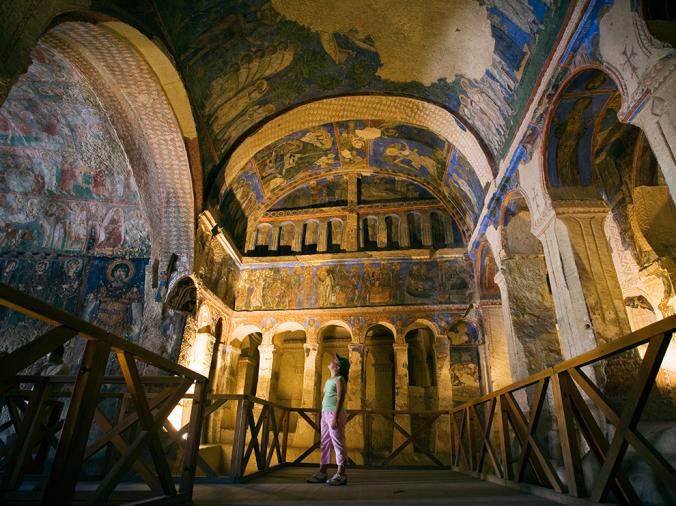
What makes this area unique are the unusual land formations. The site is in fact now a World Heritage site. The nearby but extinct volcano Mount Erciyes emitted ash during its eruptions, of course. The layers of ash built up over subsequent eruptions. Strong wind and water eroded the ash into pillar-like formations out of the tuff. These chimney-like pillars were used as hiding places for persecuted Christians. The tuff is strong but can be carved. Archaeologists have found old dwellings and even churches inside the pillars.

Some have called the area a fairy landscape, and it is definitely bizarre and eerie, but beautiful in its sculptural aspect.

National Geographic explains: (please excuse their mention of ‘mother nature’, they know not what they do…)

Erosion shaped the incredible landscape of Turkey’s Göreme valley, but thousands of years ago humans took a cue from Mother Nature and began carving an incredible chamber and tunnel complex into the soft rock. Beginning in the fourth century A.D., an urbanized—but underground—cultural landscape was created here.

It wasn’t just Christians who needed to flee and hide from persecution. The area has been used for several thousand years as a hiding place as political regimes changed and empires came and went. You might remember the tribe Hittites from the Old Testament, ancient enemies of God. NatGeo again: (NatGeo calls the area Göreme).

Göreme was inhabited as early as the Hittite era, circa 1800 to 1200 B.C. and later sat uncomfortably on the boundary between rival empires; first the Greeks and Persians and later the Byzantine Greeks and a host of rivals. This precarious political position meant that residents needed hiding places—and found them by tunneling into the rock itself.

Called ‘fairy chimneys’, the landscape does indeed look magical.  Though the landform and their uses is incredible enough, it seems that the enterprising ancients built massive underground cities and tunnels to connect them. Smithsonian has the story:

In ancient Cappadocia, now part of modern day Turkey, the people who lived there dug incredible, honeycomb-esque cities into the soft rock—underground complexes that could go stories deep. Today, remnants of these underground hives are scattered through the region, and the most recently discovered of these ruins are also some of the most impressive. In 2012, a crew of demolition workers inadvertently uncovered a network of tunnels near Neveshir, Turkey, and now that archeologists have given this find a deeper look, they think it could turn out to be the most extensive underground city ever known.

Wow.

Whenever someone replies to me about the Bible being God’s truth, saying, ‘Aw it’s just a bunch of hooey written by know-nothing ancient desert shepherds,’ I laugh to myself and think of the Pyramids, the Sphinx, Machu Picchu, and now the fairy chimneys and underground cities of Cappadocia. And what a blessing the fleeing Christians had places to flee to and live in during the persecutions. God’s foreordination saw to it that they had a place to run to.

Thanks for coming on a virtual trip with me to eastern Turkey. All those cities and locations mentioned in the Bible are so interesting. Now, where will I “visit” next”?… 😛

The site became a religious refuge during the early days of Christianity. Monks excavated extensive dwellings and monasteries and created Byzantine fresco paintings in cave chapels beginning in the seventh century. The paintings endure in well-preserved isolation to this day. Source NatGeo
PHOTOGRAPH BY DAVID SUTHERLAND, ALAMY STOCK PHOTO

 

Posted in theology

I Surrender All (Or Do I?)

By Elizabeth Prata

I do hope your faith is growing and your trust in Jesus is too. He is so magnificent. Daily I’m awed by His sweetness, perfection, and power. I wrote on this blog a while ago about how the Spirit sometimes leads me through listening to hymns, and one example blessed me. I like the traditional hymns because they either directly quote scripture, or closely paraphrase Bible verses. This morning I awoke humming “I Surrender All.”

So that got me thinking on the word surrender. I was wondering, what IS surrender, exactly. How does one surrender? What does one surrender? I know we “surrender” because it’s a war between the flesh and the Holy Spirit who draws us. Even after conversion with the Spirit in us, we still struggle against the flesh. Our carnal nature still seeks to gain territory within us, making us less effective for Christ.

Self-surrender is defined in Galatians 2:20: Paul saying, “I have been crucified with Christ; it is no longer I who live, but Christ lives in me; and the life which I now live in the flesh I live by faith in the Son of God, who loved me and gave Himself for me.”

Curious, I looked up the word surrender in the biblical encyclopedia. It’s defined as “the struggle between the natural human impulses of self-seeking, self-defence and the like, on the one hand, and the struggle toward self-denial, self-surrender, on the other. The Scriptures represent self-surrender as among the noblest of human virtues.” The following is an excerpt on surrender. Go to this link to read the short paragraph.

Some examples given in the Old Testament are Adam and Eve, In the Old Testament self-surrender is taught in the early account of the first pair. Each was to be given to the other (Genesis 2:24; Genesis 3:16) and both were to be surrendered to God in perfect obedience (Genesis 3:1-15).”

Also the faithful ones like Abraham are characterized by self-surrender. Abraham abandons friends and native country to go to a land unknown to him, because God called him to do so (Genesis 12:1). He would give up all his cherished hopes in his only son Isaac, at the voice of God (Genesis 22:1-18). Moses, at the call of Yahweh, surrenders self, and undertakes the deliverance of his fellow-Hebrews (Exodus 3:1-4:13). The prophets are good examples of self-surrender.

The International Bible Encyclopedia defines self-surrender as,

In the New Testament self-surrender is still more clearly set forth. Christ above all men was the prime example of self-surrender to the Father’s will. Christ’s teachings and example as presented in the Gospels, give to it special emphasis. It is a prime requisite for becoming His disciple (Matthew 10:38; Matthew 16:24 Luke 9:23, 24, 59; Luke 14:27, 33). When certain of the disciples were called they left all and followed (Matthew 4:20; Matthew 9:9, Mark 2:14, Luke 5:27 f). His followers must so completely surrender self, as that father, mother, kindred, and one’s own life must be, as it were, hated for His sake (Luke 14:26).

Do we surrender? As saved sheep of the Shepherd, we have been called to surrender our ego, our desires, our souls to Him, and we continue striving to do so. But how much territory does Satan gain back? He cannot take all of it because we are sealed for Christ and we’re His for certain. But satan can tempt us. I read recently that all one needs to do to conform to a secular world view, is nothing. We must work against the current and continue to swim upstream, every day. Part of that struggle involves surrendering ourselves to the cross every day. (Luke 9:23).

Meanwhile, I sing “I Surrender All” and consider it a privilege to ask the Spirit to guide me into ever deeper submission to His will. It is a good Will, working for the good of all those who love Him.

apple

Posted in theology

Biblical theology: Eating the elephant one bite at a time

What is Biblical theology?

Biblical Theology
Excerpt

‎Biblical theology is theology drawn from the Bible rather than theology imposed onto the Bible. Biblical theology helps Christians understand the broad biblical message, discern developments in the canon, and see how each particular text fits in with the larger story of Scripture. In studying biblical theology, interpreters try to determine what the authors of the Bible thought or believed in their own historical contexts and on their own distinctive terms.

Köstenberger, A. J. (2012, 2016). Biblical Theology. In Faithlife Study Bible. Bellingham, WA: Lexham Press.

Having a biblical opinion about Jesus means you have a theology. Everyone has a theology, it just depends on how informed or uninformed it is, or how shallow or deep it is.

Pastor Nate Pickowicz’s wife Jessica Pickowicz wrote a wonderful study guide to go along with the recently published Biblical Theology: A Systematic Summary of Bible Truth by John MacArthur and Richard Mayhue. She also set up a Facebook group of women last year who are interested in going through the study together. Her lessons have been just right: biblical, thought provoking, studious, and readable & doable.

This past June, Jess paused the weekly study for the summer so she could attend to Bible studies in her home church. She promised to resume in September. That time is here. The next study guide lesson begins on Thursdays, so the time for the next chapter of Biblical Doctrine is tomorrow. We resume with the chapter on Pneumatology, or study of the Holy Spirit.

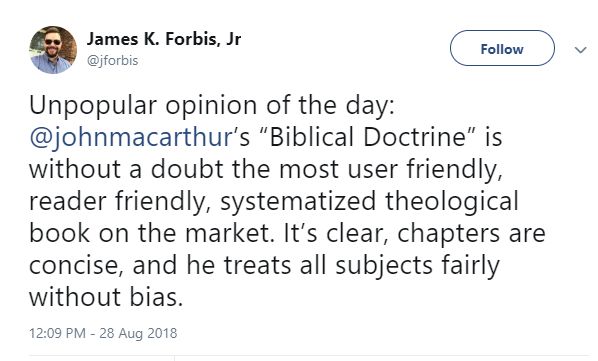
Please feel free to join us ladies studying through this wonderful book Biblical Doctrine. I agree with this opinion from Mr Forbis. I’ve been through several systematic theology books or programs and this book is the best.

Biblical Doctrine is a hefty tome, but through Jess’s guided study, we do ten pages a week. Taking one bite of the elephant per week, with other like-minded ladies, is a great way to study through the doctrines of God, be edified, and learn more about our wonderful savior. Please join us!