The Gospel of Jesus Christ is the greatest GOOD NEWS ever delivered to men and to a man or woman. Jesus Christ is the greatest Person ever to walk the earth. His message of sin, judgment, atonement, repentance, and peace is the best news a person could ever hear.
Most people on earth do not believe this.
The Gospel is the GOOD NEWS of Jesus. Is judgment good news? No, but is a necessary part of the PRE-good news. We must understand our condition from the moment of birth to the moment of death, with the knowledge that we are born sinners. (Romans 3:23; 6:23). Sinners cannot live with a holy God. In fact, our sin enrages Him. (Psalm 7:11). We are transgressors on His earth, (James 2:9) His wrath abides on us, and our end will be a just punishment in hell.
One of my top favorite verses in the Bible is Acts 1:11. It says,
and they said, “Men of Galilee, why do you stand looking into the sky? This Jesus, who has been taken up from you into heaven, will come in the same way as you have watched Him go into heaven.”
That one verse does so much! It finalizes Jesus’ work on earth- His ministry, His death His resurrection, and His ascension, an important part of the Gospel. He resumes His exaltation in glory. His ascension physically proves His departure from earth, where not long after, Stephen saw Him standing beside the Father. Finally, the verse makes the promise that He will return.
He will return! We Christians cling to that promise of a sure future with Jesus. It is a joy to think on.
Acts 1:9 says He was taken up in a cloud, and in verse 11 He will return the same way. But there is more to His return than the simple vertical up and down.
By my count, He actually makes three stops.
First he returns with his witnesses (us). He is on His horse and leads us down from heaven. The armies of all the world are assembled ready to make war against Him who is called Faithful and True. This is at Armageddon.
Armageddon: Revelation 19:19, And I saw the beast and the kings of the earth and their armies, assembled to make war against Him who sat on the horse, and against His army.
Zechariah 14:3-5 Then the LORD will go out to fight against those nations, as He fights in the day of battle.
Revelation 17:14, They will make war against the Lamb, and the Lamb will triumph over them, because He is Lord of lords and King of kings; and He will be accompanied by His called and chosen and faithful ones.
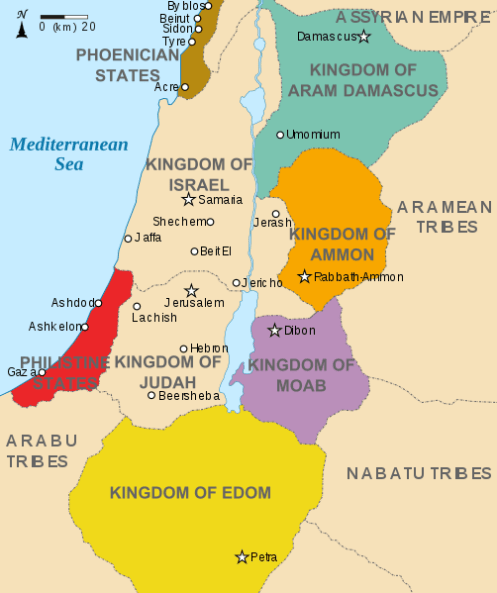
Next, He rescues the huddled Jews who had fled across the wilderness at the start of the Tribulation (perhaps) to Bozrah/Petra.
Remember in Matthew 24:15–16 when Jesus is answering the disciples’ question about ‘when will these things be?’ and Jesus replied, known as the Olivet Discourse? He said that when the “abomination of desolation” occurs at the midpoint of the Tribulation, those in Jerusalem should flee Judea into the surrounding wilderness areas to the east, which is in the direction of Edom where Bozrah/Petra are. He protects them-
Revelation 12:6, Then the woman fled into the wilderness where she had a place prepared by God, so that there she would be nourished for 1,260 days.
In that verse, we learn that there is a specific location God had prepared, to which they flee. At some certain place, the Jews run to and are secured for the duration of the Great Tribulation. It’s not unreasonable to think that ‘place’ they flee and remain is at Petra throughout the Tribulation. God nourished the fleeing Hebrews in the Exodus with manna and quail andwate from the rock. He could do it again for the remnant at Petra, or if not Petra, whatever place it is that they hide.
On that day the LORD will protect the inhabitants of Jerusalem, and the one who is feeble among them on that day will be like David, and the house of David will be like God, like the angel of the LORD before them. 9And on that day I will seek to destroy all the nations that come against Jerusalem. (Zechariah 12:8-9)
Many people interpret that the place where they are protected and nourished is Petra, the rose red city carved into the rock. It’s also interesting to note that in Daniel 11:41, there is one region in the entire world that never falls under the Antichrist-
He will also enter the Beautiful Land, and many countries will fall; but these will be rescued out of his hand: Edom, Moab, and the foremost of the sons of Ammon.
Edom, Moab, and sons of Ammon are the lands to the east (where Jesus said to flee to) and the southern end is Petra. We do not know for sure but it makes sense that when Jesus said flee to the mountains, knowing Petra is such a protected enclave, that they would go there.
When Jesus returns, Isaiah notes in his future prophecy that Jesus’ clothes are bloodstained. Perhaps from slaying those assembled at Armageddon. Then He rescues His hiding remnant at Petra.
Isaiah 63:1-3 Who is this coming from Edom, from Bozrah with crimson-stained garments? Who is this robed in splendor, marching in the greatness of His strength? “It is I, proclaiming vindication, mighty to save.” / Why are Your clothes red, and Your garments like one who treads the winepress? / “I have trodden the winepress alone, and no one from the nations was with Me. I trampled them in My anger and trod them down in My fury; their blood spattered My garments, and all My clothes were stained.
Revelation 19:13– He is clothed with a robe dipped in blood, and His name is called The Word of God.
Revelation 14:20- And the wine press was trampled outside the city, and blood came out from the wine press, up to the horses’ bridles, for a distance of 1,600 stadia.
Finally, after those two things are accomplished, Jesus stands on the Mount of Olives, His physical presence once more touching earth.
Zechariah 14:4-5,
Then the LORD will go forth and fight against those nations, as when He fights on a day of battle. 4On that day His feet will stand on the Mount of Olives, which is in front of Jerusalem on the east; and the Mount of Olives will be split in its middle from east to west forming a very large valley. Half of the mountain will move toward the north, and the other half toward the south. 5And you will flee by the valley of My mountains, for the valley of the mountains will reach to Azel; yes, you will flee just as you fled from the earthquake in the days of Uzziah king of Judah. Then the LORD, my God, will come, and all the holy ones with Him!
So to sum up, return and slay those at Armageddon, rescue the remnant at (perhaps) Petra, and stand on the Mount of Olives. There are a variety of verses scattered across many of the Old Testament and New Testament books, which makes it hard to interpret, but that to me is the general sequence.
Whatever the details, the Lord Jesus will return. Zechariah 14:9 makes this glorious prediction!
And the LORD will be King over all the earth; on that day the LORD will be the only one, and His name the only one.
I can’t wait for the day when satan and his demons howl in pain and anguish, knowing they are finally, completely defeated.
They know what’s ahead. The demons in the man from Gadara begged not to be put into the abyss. (Luke 8:31). In Mark 1:24 the man with a demon in the synagogue shouted to Jesus asking if He had come to destroy them. (Mark 1:24).
Be encouraged by the future prophecy of satan and his demons’ defeat!
And the devil who deceived them was thrown into the lake of fire and brimstone, where the beast and the false prophet are also; and they will be tormented day and night forever and ever. (Revelation 20:10).
Sin, death, and hell will be no more. Take comfort, friends!
SYNOPSIS The Seven Thunders in Revelation are mentioned but John is ordered to seal them. They remain mysterious, possibly indicating terrifying judgments. While speculations abound, their essence reflects God’s authority and terror due to the already-delivered wrath and more wrath to come. This essay emphasizes the chilling reality of the future Tribulation and urges readers to share the Gospel before these events unfold.
What are the terrifying secrets of the seven thunders? I don’t know. No one knows.
EPrata photo
Revelation 10:1-4, I saw another strong angel coming down from heaven, clothed with a cloud; and the rainbow was on his head, and his face was like the sun, and his feet like pillars of fire; 2and he had in his hand a little scroll, which was open. He placed his right foot on the sea and his left on the land; 3and he cried out with a loud voice, as when a lion roars; and when he had cried out, the seven peals of thunder uttered their voices. 4When the seven peals of thunder had spoken, I was about to write; and I heard a voice from heaven, saying, “Seal up the things which the seven peals of thunder have spoken, and do not write them.“
The Seven Thunders seem to be a part of the series of judgments in the Book of Revelation. I say “seem to be” because the words were not allowed to be written down, so we cannot be sure that they specifically are judgments. However, coming in sequence after the Seal and Trumpet judgments, and before the Bowl judgments, it seems that the mysterious Thunders may be judgments too.
Given that thunder is the voice of God in judgment, it furthers the notion that these mysteriously sealed instructions may be judgments. They were actual words, because John heard them. They were something that was uttered, and could have been written down intelligibly, except that John was ordered not to.
John MacArthur wrote of the Seven Thunders in his book Because the Time is Near:
The seven peals of thunder did not merely make a loud noise, but communicated information that John was about to write. In obedience to God’s commands, John had already written much of what he saw in his visions. Later in Revelation, John would once again be commanded to write what he saw in his visions. (14:13; 19:9; 21:5). But before John could record the message of the seven peals of thunder, he heard a voice from heaven saying, “Seal up the things which the seven peals of thunder have spoken and do not write them.”Whether the voice was that of the Father, or Jesus Christ, or an angel is not revealed. The command, however, clearly originated with God. The reason John was forbidden to record the message is not revealed. It may be that the judgments were simply too terrifying to be recorded. Any speculation as to the content of their message is pointless. If God wanted it to be known, He would not have forbidden John to write it. They are the only words in the book of Revelation that are sealed.
Let’s focus in on the “too terrifying” part of the reasoning here. In all the apocalyptic movies I’ve ever seen specifically related to the Tribulation, they are all uniformly sanitized. In other words, the horrific reality of the Tribulation as depicted in the Bible’s Book of Revelation was visually watered down to be as non-reflective of the reality of a cellophane wrapped hamburger meat at Publix is compared to the blood, filth and messiness of a low-rent butchery. And even that is not reflective of the reality of what is coming.
The non-Christian apocalyptic movies movies I’ve seen, Threads, The War Game, and It’s A Disaster, were harrowing and soul-searing. Their real depiction of nuclear or nerve gas apocalypse stayed with me for a long time. The War Game was commissioned by the BBC in 1965 to specifically illustrate the horrors of nuclear war. WHen it was completed and shown to the Commission, the BBC Board found the movie too realistic to be released. For twenty years it languished in a closet until released in 1985. Yet even that film doesn’t go the distance of what the reality of the Tribulation will be like in terms of nuclear horror and death. People just do not understand what it really means when Jesus promised it to be a time of distress exceeding even the time of the Flood. (Matthew 24:21). And remember, that was a time when everybody on earth horribly died. (Except 8 people).
So here is Oliver B. Greene in his Verse-By-Verse Study of Revelation, on the Seven Thunders’ terror:
Thunder is the voice of the Lord in judgment (I Samuel 7:10, Psalm 18:13). The seven thunders “uttered their voices.” (John assumes that the readers already have Some knowledge of these seven thunders.) In Revelation 4:2, 3 John saw a throne encircled by a rainbow, and here in chapter ten we see the same rainbow. In Revelation 4 John saw upon the throne One who was to look upon as a jasper and a sardine stone, and “out of the throne proceeded lightnings and thunderings and voices.” In chapter 10, we have the same thunder, sounding out a message of God’s fury and judgment.
Personality is attributed to these “seven thunders.” Everything is in sympathy with the Lamb of God. These mighty thunders utter messages that are intelligible . . . they speak words. John heard what they said – and when the time comes in reality, the seven thunders will speak literal words that earth’s dwellers will fully understand. It will be a message in tones of thunder. We use a public address system to amplify voices when we want to be heard – but God needs no amplification. He can speak like mighty thunder – and He WILL when the time comes!
At the beginning of these marvelous visions, John was commanded to write in a book what he saw and heard – past, present and future. But when the thunders spoke, John was given another command. He was about to write – but a voice from Heaven said: “Seal up those things which the seven thunders uttered, and write them not!” The seven thunders must have given a terrible message. Already set before us are blood, tears, famine, heartache and heartbreak; killing, misery, hail, fire, burning mountains, demon monstrosities, men begging to die and unable to do so. Surely what John was forbidden to write must have been beyond human imagination and understanding! There is no need to speculate on what the thunders said. Your guess is as good as mine; but you may rest assured that the message had to do with God’s last gigantic, unheard of, indescribable judgment, when God “lowers the boom” in utter destruction.
Will YOU be on earth when the seven thunders speak? You are the only one who can answer that question. If you are born again you will NOT be here – but if you are not born again, you may be here. Read John 1:11-12, 3:16-18, 3:36, 5:24; Romans 10:9-10, 10:13, 10:17; Ephesians 2:8-9; I John 1:9. Read these verses, hear what they say; receive them – and you will not be here when the seven thunders utter their message of destruction. You will be with Jesus.
A foreboding sky. EPrata photo
Imagine a message that exceeds the terror and blood of all that had already previously been spoken. Or if that was not the case, imagine a message that was so tremendously powerful it needed to be sealed from our tender brains until the moment they would be spoken during the Tribulation.
Prophecy is supposed to motivate us to witness, and yet the reality of the judgments of souls in rebellion to God is omitted from the message of the Good News when liberals or ashamed people share it. How terrible that it’s omitted so often these days, when the days are coming that many will be living it!
May this essay motivate you to read Revelation, to pray for wisdom and understanding of the coming days, to receive the promised blessing for having read it, and for its words to be a catalyst in your heart for the lost who are under that very “boom” Greene mentioned, soon to be lowered…
The devotional is from GraceGems, a site stuffed with goodies from the past. Much to read and be edified by there.
Today is Sunday, the Lord’s Day. I pray you have a good church to attend. Gather with the saints in fellowship to worship, pray, sing, learn. This world wearies us, this is where we go to drink the Living Water, be refreshed, and go on in the week proclaiming His excellencies. Sunday is a day of rest, and don’t you feel rested after resting in Him? And just think of the eternal rest we will be given by our gracious Savior. DO think of home more often!
Tim Challies posted this from Dan Doriani:
Now on to James Smith’s devotional-
James Smith, (1802—1862) “A Devotional Glimpse at Psalm 23“
“I will dwell in the house of the Lord forever!” Psalm 23:6
Notice, David’s expectation for eternity. Not in the sheepfold in the wilderness, but in the house of the Lord! The dwelling-place of God, the family residence of the Father of mercies and His beloved children. In that house, we shall have . . . all our desires gratified, all our prayers answered, and our highest expectations more than realized!
There we shall dwell in peace, united to all the saints, and enjoying the society of all the ransomed brethren! All friendship will be unchangeable, and fellowship perpetual and pure.
There we shall dwell and worship–and our worship will be spiritual, pure, and perfect!
There we shall dwell and enjoy–and our enjoyments will be dignified, delightful, and eternal.
There we shall dwell and obey–and our obedience will be perfect, hearty, and perpetual.
There, we shall dwell and rest–and our rest will be sweet, refreshing, and satisfying. There will be no wilderness storms there. There will be no cruel, crafty, malignant foes there. O glorious prospect! O sweet anticipation!
In our Father’s house are many mansions; and all those mansions will be occupied, for . . . every one beloved and chosen by the Father, every one for whom Jesus became a substitute and sacrifice, every one ever born of the Spirit, will be there!
All God’s children shall be there–not one of them lost! All God’s sheep shall be there–not one hoof left behind!
There the Eternal Father will be surrounded by, and enjoy the society of all His happy family. There the glorious Savior will see of the travail of His soul, and be fully and forever satisfied. There the Holy Spirit will fill all His temples, and enjoy His divine workmanship, and the presence of all whom He has prepared for glory. There, Jehovah, at home with His people–will manifest forth His glory, and pour floods of light, love, and blessing upon them forever!
Well then may the Psalmist say, “In Your presence is fullness of joy; in Your right hand are eternal pleasures!”
Let us often think of home! This vain world is not our rest. Here on earth, we have no continuing city. Home, the home of the believer’s heart, is in the skies . . . where Jesus is, where Jesus reigns, where love is perfect, where there is always a full tide of joy, where God displays all his glory, where grace satisfies the utmost desires of every renewed soul!
The week of August 21-28, 2026 was an incredible week. It was chock full. We had a death of a uniformly beloved, long-term celebrity, a ministry scandal and fall of leaders that shook the reformed world, and a horrifying natural disaster.
Since God is sovereignly in control, and allows or directly causes all things to happen, and for the Christians, for their good to those who love Him, let’s see what we can learn from these incredible events. We never want to just say “goodness that’s awful” move on without thinking of the heaven above, salvation of others, and our own lesson we can learn. Jesus above all.
Dolly
Southern singer, movie actress, and icon to drag queens Dolly Parton died this week. She was 80 years old. She often spoke of “my faith”, “God”, and ‘living out my beliefs’. To that end, she was consistently kind to all, generous to many, and loving as a state of being. She was gracious under fire, humble, and never put a foot wrong. Never said a wrong thing (in the world’s eyes), and did so while being witty and charming- all for over 60 years in the public eye.
But was she a Christian? It’s heartbreaking to even have to ask. We don’t want to know. We want to say ‘of course she was’ but the evidence of her lived-life says otherwise. Unless she had a change of heart in the end, of course, the evidence over her life in her words and actions, while kind and loving, were not based on the sacrificial death and resurrection of Jesus Christ, but of a God she made up in her heart and a spirituality that doesn’t match His.
It’s easy to say, “Sure, Hitler wasn’t saved” but it is very hard to look at a nice person and say “Well, maybe not.” Because there are only 2 camps, God’s, and satan’s, we shrink back to think Dolly maybe was in satan’s camp. But remember, only two roads.
Dolly was self-deceived that the God she clung to was the God of the Bible. People claiming her as a sister in Christ are deceived by substituting kindness and generosity for repentance and faith. Let’s take a look-
In 2005, Dolly wrote a song called “Travelin’ Thru” for the movie Transamerica (about a male who wants to change genders to a female, and his heretofore unknown son who turns into a gay porn star). She said her motivation for writing the song was to change minds, “Some people are blind or ignorant, and you can’t be that prejudiced and hateful and go through this world and still be happy. One thing about this movie is that I think art can change minds. It’s alright to be who you are.” (Source).
‘Who we are’ are sinners deserving of God’s wrath.
Dolly publicly stood as an ally for gay and transgender people, which is against God’s standards. She was also immodest, posing for the cover of Playboy Magazine, and wore revealing clothes often.
Do not be deceived and do not fall under the power of deception. Be clear-eyed about what faith is and isn’t. Measure a person’s words and actions against the Bible in God’s words, not against our fallible human standards of love, kindness, or generosity.
G3
Oh, G3 Ministries, you break my heart. I attended the G3 Conference twice and I loved both times. I met wonderful people, had great conversations, and was wowed by the quality of the teaching and preaching. I was thrilled at seeing 5000 the first time then nearly 8000 people the second time come from all over the nation to worship God. I was struck to tears when singing with thousands of others to Jesus. I was mainly happy to see what God can do, raising up so many for His name.
What I didn’t know was that at the center of it was sin. The edges were good, but the center was rotten. “Things fall apart; the center cannot hold” to quote the famous line from “The Second Coming,” a 1919 poem by Irish poet William Butler Yeats. And the center did not hold.
Last year the president of the conference and lead pastor of the church that organized it was outed as a hypocritical sinner. He was forced to step down. This was last year. But then last week, his peers at the church and the Conference were outed as maliciously divisive accusers and liars. The main people behind the church that put on the conference, were sinning unrepentantly and maliciously. Be careful, your sin will find you out. Sadly, when it’s a bunch of pastors who were on one side of their mouths speaking in Jesus’ name and for His glory, and on the other side of their mouths reviling & slandering a brother pastor in Christ anonymously, it’s worse when it’s found out. Titus 2:5, 1 Timothy 6:1, Romans 2:24, 1 Peter 2:15 all are warnings to do right, so the name of God will not be blasphemed or reviled.
Measure a person’s words and actions against the Bible. As we have seen with G3 leaders and their church pastors, sin is deceptive. And it’s everywhere, even where you least expect it.
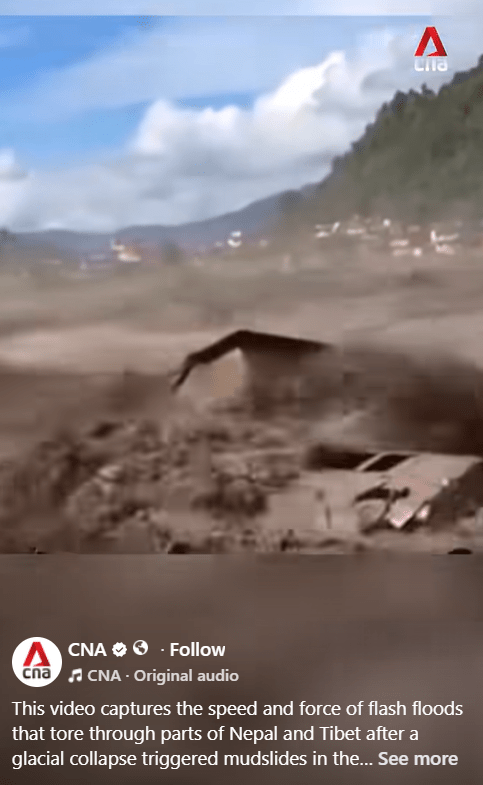
Nepal flood
Far away across the world and atop the earth’s highest mountains, villagers dwell in vertical lives. Their mountainous buildings and constructions amid the heights with no horizontal ground are amazing achievements. Carving out lives and thriving where the air is thin and the borders are close takes human ingenuity.
And it was all washed away in seconds. A glacier collapsed high above them and its meltwater rushing down the unsuspecting villagers in its wrath and speed astounded those who survived and filmed the spectacle. We watched as it was happening, amazing in itself. Boulders the size of buildings tumbled down amid rushing waters with the speed of a jet as if they were a mere matchstick. Mountainsides were re-shaped in an instant. Solid buildings of concrete and sturdy structure collapsed like a house of cards.
People recorded the disaster and the commonest refrain on social media as we watched horror unfold with mouths agape was: “We are nothing before the power of nature.”
Imagine the global Flood. Imagine the coming Tribulation!
We are puny humans, worms in the dust. We are at the mercy of powers of ‘nature’ and ultimately the power of God which we cannot understand. We get a glimpse when building-sized boulders tumble down as a feather, with the rushing waters defying our comprehension, carving our new channels despite all the endeavors of man to have held it back.
WE CANNOT have a right conception of God unless we think of Him as all-powerful, as well as all-wise. He who cannot do what he will and perform all his pleasure cannot be God. As God hath a will to resolve what He deems good, so has He power to execute His will.
“The power of God is that ability and strength whereby He can bring to pass whatsoever He pleases, whatsoever His infinite wisdom may direct, and whatsoever the infinite purity of His will may resolve…As holiness is the beauty of all God’s attributes, so power is that which gives life and action to all the perfections of the divine nature. How vain would be the eternal counsels, if power did not step in to execute them. Without power His mercy would be but feeble pity, His promises an empty sound, His threatenings a mere scarecrow. God’s power is like Himself: infinite, eternal, incomprehensible; it can neither be checked, restrained, nor frustrated by the creature.” (Stephen Charnock).
The only safe spot on earth is in the arms of Jesus, after repenting of our sin and believing in his death, burial, and resurrection.
SYNOPSIS The article discusses Thomas Boston’s views on the inescapability of sin, emphasizing that it is inherent in human nature, even among the grace-receiving faithful. Sin follows individuals like a shadow, deeply rooted within. Our temptations arise from internal desires, highlighting the necessity of recognizing human corruption and the need for divine grace.
Spiritual Warfare is real. Yet many Christians ignore this topic, which should be on our mind daily. After all, we battle the unseen realms in our own body as we kill sin in our flesh; we battle unseen spirits who tempt us; and we battle the world with its philosophies constructed by satan and his minions.
On the other side, the topic draws crazies who hyper-focus on it. We need to be balanced in our approach to any topic. Face it realistically, biblically, but not with excessive, out-of-balance focus.
The topic of spiritual warfare is outlined in many places in the Bible, but one of the most familiar is in Ephesians 6. That chapter outlines our armor available to us in the battle, which is specifically described.
While spiritual warfare is real and prevalent in our lives, and while it is a topic often addressed in the Bible, I’ve found few solid resources on it. The topic seems to invite twisted approaches, fringe ministries, lure crazies. So I compiled a few of the solid resources for you on the topic of Spiritual Warfare.
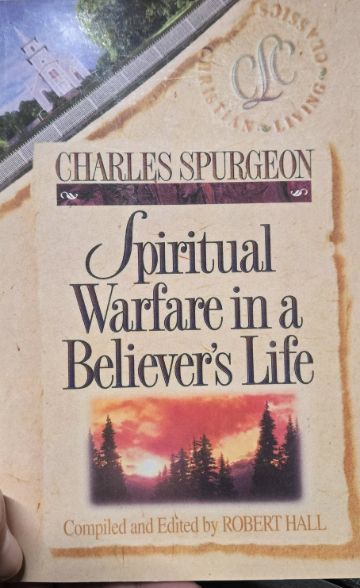
The synopsis for the book Spiritual Warfare in a Believer’s Life says, “Spiritual Warfare in a Believer’s Life is a practical compilation of sermons and teachings by Charles H. Spurgeon, England’s famous 19th-century preacher. The book cuts through mystical ideas to focus on how believers can use the power of the gospel to fight everyday discouragement, sin, depression, and spiritual opposition.”
Or listen to Spurgeon’s sermon on spiritual warfare being read here, or read along with the transcript, here
In this two part message, David Powlison sets forth a biblical demonology and explains the biblical parameters for battling the world, the flesh, and the devil.
Book by Donald Grey Barnhouse- Book blurb: “In this series on The Invisible War: The Panorama of the Continuing Conflict Between Good and Evil, it explores the spiritual battle involving God, Satan, angels, demons, and humanity. Dr. Barnhouse explored a theme rarely touched upon by students of the Bible: the great conflict which exists in the spirit realm. Although almost entirely unrecognized by mankind, this warfare affects, in one way or another, the life of every person on earth and especially the life of the child of God.”
Ligonier resource on Ephesians 6 and “The Church’s Warfare”, a message given by Stephen Nichols. The synopsis states, “Having redeemed us from sin, Satan, and death, God has enlisted us as soldiers in His army, calling us to wage spiritual warfare against the enemy until Christ returns and giving us armor and weapons for the battle. In this message, Dr. Stephen Nichols looks at spiritual warfare and the armor of God as described in Ephesians 6:10–20, guiding us in what it means to be strong in the Lord.”
He who has the seven spirits of God and the seven stars, says this: ‘I know your deeds, that you have a name that you are alive, and yet you are dead. (Revelation 3:1).
How could a seemingly thriving church be dead?
I want to take a look at a reason love grows cold. In my opinion, Hebrews 2:1 has one possible answer. In the NASB the paragraph is introduced with the simple but clear title “Pay Attention.” The first verse says “Therefore we must give the more earnest heed to the things we have heard, lest we drift away.”
I love the nautical metaphors the Bible writers use. Marine allusions never change throughout time. If we picture the church as a bunch of people on an anchored boat in front of a lighthouse, and we fail to tend the anchor frequently, it slips. It slips because there are tides, and currents and winds trying to push the boat off its anchorage, just as culture buffets us in the world trying to push us away from Christ. As the anchor slips, we drift away slowly at first. As any mariner knows, the less the anchor digs in the faster the drift becomes. Pretty soon the ground under the boat deepens enough so the anchor is still attached to the boat but it’s just hanging there, not doing its job of digging in and keeping the boat close to the Lighthouse. Away the boat goes and in between the boat and the Light are many perils and things that could sink the boat. It does not take long in the neglect of tending the anchor, to become adrift on a cultural tide and too busy trying to control the boat in the currents, tides, waves, and wind to think of the Lighthouse anymore.
What are people doing on the boat that causes no one to notice the slipping anchor? Well, some are on the foredeck, sunning themselves. They say they are warm and comfortable, the sun feels good, and they leave the anchor-tending to someone else. (Sardis failed to keep watch, they are dead- Rev 3:1-3).
Others go below, to cook and eat and play cards and to watch TV. (worldly spirit- 2 Timothy 4:10). They say that they finally have a chance to relax, being on this nice yacht, and they are going to take advantage of it. (wilful sin-Hebrews 10:25-31).
Others are doing boat-things, like repairing sails, or changing the oil in the engine, but still they don’t take the time to go up and glance at the anchor line because they are too busy. (appearance of Godliness- 2 Tim 3:5). One person noticed a fraying anchor line but when he told his fellow boat-dwellers, they said he shouldn’t worry about it, the rope was strong enough for now. (They heard, but did not do- James 1:22).
What they didn’t know was that a storm was on the horizon that would fray the rest of it and cause them to drift. (Matthew 16:3; Luke 12:56). Everyone is supposed to be vigilant and take his or her watch, looking out for storms, fraying anchor line, slipping anchorage. We are a body and we all take a watch. We as individuals and corporately must monitor our position in front of the Lighthouse!
Leaving the anchor-tending to one person (the pastor) or worse, no one, means for sure sometime you will slip away. The Lighthouse is still there and always will be. It is the boat that drifted away. We have love growing cold because too many people are abdicating their watch.
I used to live on a sailboat for two years, me and my husband. We rarely went in to a marina to use a dock for the night, which means we anchored each night in a cove or sheltered open area. We handled the anchor twice a day, letting it down at dusk for the night and lifting it up in the morning when we left. We would look for two things: good anchoring ground and a protected area. Then we would make a plan for anchoring, me at the helm and him at the bow pointing us to the spot he had decided on. Next, we made a pass over the spot, ensuring there were no hidden dangers that would give a nasty surprise that night. Then we would go through the process of anchoring, making sure the anchor was well set.
Finally, though we were stopped for the day and relaxing, we never fully relaxed. One or the other of us would continually take sightings, check the anchor line and generally be on guard, even getting up in the night, lest we drift away. Props to my husband (and me) because our vigilance and fore-planning meant we never slipped anchor. We always awoke the next morning where we had stopped the night before.
We up anchor at sunrise on a Georgia river, circa 1994.
The thing that begins love growing cold is taking your eyes off Jesus the Light and replacing Him with a world view. A world view is satan. The second you give satan an inch, he will bring his crowbar in and pry you away from your first love, inch by incremental inch. That is why it takes an entire body to be on guard, you may not notice your own drift away by inches, but someone else looking at you may spot it.
Admittedly, it is a lot of work to tend the anchor of our salvation. You cannot relax, yet our carnal nature very much wants to. I understand that. What people consistently fail to understand is how devastating even a few moments of relaxing are. Ultimately, failure to tend the anchor is a neglecting of our salvation and that salvation was bought at too great a price to neglect it. (1 Corinthians 6:20).
God is our refuge and strength, A very present help in trouble. Therefore we will not fear, though the earth should change And though the mountains slip into the heart of the sea; Though its waters roar and foam, Though the mountains quake at its swelling pride. Selah. There is a river whose streams make glad the city of God, The holy dwelling places of the Most High. God is in the midst of her, she will not be moved; God will help her when morning dawns. (Psalm 46:1-5)
For through the grace given to me I say to everyone among you not to think more highly of himself than he ought to think; but to think so as to have sound judgment, as God has allotted to each a measure of faith. (Romans 12:3).
Paul began the chapter with talking about our bodies as a living sacrifice, and continued after verse 3 with tying it to the spiritual gifts and our entwinement with each other as members of the Body. The concepts here are service and sacrifice.
“Measure of faith” is defined at Logos as “A biblical term referring to the spiritual capacity or level of belief given by God to individuals.”
But translating and understanding what God meant by ‘measure of faith’ turned out to be not so easy. But I loved wrestling with scripture.
Martyn Lloyd-Jones explains the measure of faith is not justifying faith. We all have that equally. It is not the spiritual gift of faith, only some have that. He used George Muller as an example of someone given the gift of deep, trusting faith “who was was able to pray with confidence and assurance and the amazing things happened that we can read“.
So what IS the ‘measure’ of faith? Commenter Marvin Vincent (1887) wrote that it is a difficult phrase to translate. I found this to be true. Preachers or commenters Martyn Lloyd Jones, John MacArthur, RC Sproul, Matthew Henry etc all interpreted it slightly differently. However, there are three concepts that stood out- first, God gives the faith, second, for the measure of faith we are given, we use in conjunction with our spiritual gifts to serve. Thirdly, we must not become conceited about our faith or our gifts nor think more highly than ourselves over another person.
Here, J. Witmer in John Walvoord’s The Bible Knowledge Commentary acknowledges Paul’s ‘involved word play’ in this verse:
“By his involved word play on various forms of the verb phroneō, “to think,” Paul emphasized that human pride is wrong (cf. 3:27; 11:18, 20) partly because all natural abilities and spiritual gifts are from God. As a result every Christian should have a proper sense of humility and an awareness of his need to be involved with other members of Christ’s body. As Paul explained, a parallelism exists between a believer’s physical body which has parts with differing functions and the community of believers in Christ as a spiritual body (cf. 1 Cor. 12:12–27; Eph. 4:11–12, 15–16). The point is that each member functions to serve the body, not the body to serve the members.”
Marvin Vincent in Word Studies in the New Testament, (1887) focuses on the word measure, saying our entry into the Kingdom at conversion means we now see ourselves measured against God as our new standard of measurement-
“Faith, in introducing him into God’s kingdom, introduces him to new standards of measurement, according to which he accurately determines the nature and extent of his powers, and so does not think of himself too highly. This measure is different in different individuals, but in every case faith is the determining element of the measure. Paul, then, does not mean precisely to say that a man is to think more or less soberly of himself according to the quantity of faith which he has, though that is true as a fact; but that sound and correct views as to the character and extent of spiritual gifts and functions are fixed by a measure.”
As usual, the solid and trustworthy Matthew Henry in his commentary on the whole Bible (1704) brought Jesus into the discussion-
“Because God deals out his gifts in a certain measure: According to the measure of faith. Observe, The measure of spiritual gifts he calls the measure of faith, for this is the radical grace. What we have and do that is good is so far right and acceptable as it is founded in faith, and flows from faith, and no further. Now faith, and other spiritual gifts with it, are dealt by measure, according as Infinite Wisdom sees meet for us. Christ had the Spirit given him without measure, Jn. 3:34. But the saints have it by measure; see Eph. 4:7. Christ, who had gifts without measure, was meek and lowly; and shall we, that are stinted, be proud and self-conceited?”
It seems to me after chasing down all these winding trails and mulling this phrase for the last few days, that my conclusion is we need to employ trust in our Christian church relationships. We of course remember the primary notion, we are each given a measure of faith in which we operate our spiritual gifts. Do not disparage the weaker brother or be jealous of the stronger brother. We all have a different measure.
So, when we hear preaching, trust that the preacher is operating to the widest extent in his good service to Jesus. When we see hospitable women hosting the sisters, trust that she is operating her faith and using her gifts to the fullest extent according to the measure given her. And so on for each person and each gift. We are one body, and what one does affects the others.
Simply put, use grace to think more highly of others. If we are going to measure anything, measure ourselves in sound judgment to ensure we are serving Jesus with all our mind, heart, soul, and body.