This section of verses that show Jesus’ life are focused on His attributes & earthly ministry. We’ve seen Him through what He does, as servant, teacher, shepherd, intercessor, and healer. Now we look at who He is by looking at His attribute of omniscience yesterday and today we ponder His authority.
How to represent the authority of Jesus over life, in pictorial form? That was a tough one. I settled on the notion of the dock being the long journey of finite earthly life in the flesh, then we come to an inevitable end and launch up and into the eternal heavens. Jesus has authority over every step.
I recently wrote an essay focusing on the authority of Jesus. It is linked below if you’re interested, along with a couple of additional essays from credible sources.
Recently Beth Moore departed Lifeway, renounced being a Baptist, and loudly left the Southern Baptist Convention. In June she declared on her Twitter that she had found a “small liturgical church” in her area. Beth has been mightily enjoying this small, liturgical church. It is an Anglican church. Anglican, not Episcopalian.
She and husband Keith became members of it in September. She said she’s figuring out the “kneeling bench”. She bought the book Every Moment Holy Vol 1, containing over 100 liturgies for daily life (including liturgies for meals). She gushed and gushed about being ‘deeply wounded’ in previous churches, and is wowed by loving people who wrapped their arms around her and her husband and welcomed the pair. She was happy to find a different way to worship.
She said she loves saying the Creed. She said the liturgy has filled her with hope again (not Jesus?). She said she and Keith shot to the altar for communion ‘like starving people begging for bread.’ She also loves what this liturgical church is about, because it’s “not just primarily upon what is coming from the pulpit.”
The Moores’ new church is part of the Anglican Church of North America. You can read about the Anglicans’ beliefs here, but suffice to say, it is as close to Roman Catholic as one can get without being Catholic. Some people in the congregation kneel as they enter the pew, as Catholics do. Some genuflect in the RCC sign of the cross. A crucified Christ remains on the cross attached to the main lectern. Vestments are highly ornate and present on all who serve at the pulpit, including women. Women serve as deacons.
Remember, her husband Keith was raised by staunch Catholics, and Moore has taught publicly that RCC is another denomination akin to Methodists and Baptists.
Because this is 2021 and people misunderstand and misinterpret things, I’ll be clear. I am NOT saying that Anglican (or other more overt liturgical church denominations of Episcopal, Lutheran, some Presbyterian, and some Methodist) are filled with lost people. NO. Men I respect like JI Packer were Anglican. Chris Rosebrough is a Lutheran pastor. Many millions of people who attend liturgical churches are brethren, blessed by the liturgical service structure and glory in it.
I AM saying that if a person is lost, as Beth Moore is, they will want the trappings of religiosity without the submission. THAT is much easier to find in a liturgical church than a confessional one. They want to appear righteous without the obedience. (Matthew 23:28). They are devoid of the Holy Spirit, so they will want outward religious apparatus, ornamentation, and ritual. They will love the emphasis on liturgical tradition and its script, not “just primarily upon what is coming from the pulpit” as Beth Moore has said. And of course she wants to avoid “what is coming from the pulpit” from her previous churches, the word of God convicts of sin and urges repentance. Moore is neither about obedience to the word nor repenting of her usurping ways with changing her long rebellion against Jesus. She is a seeker of a place that will indulge her ungodly passions.
While many saved people enjoy liturgical services, many false believers find it easier to fit in to them. The service affirms their intellectual assent but does nothing for their soul. These false converts feel satisfied in participating in religious scripts, rather than glorifying God in obedience to His word.
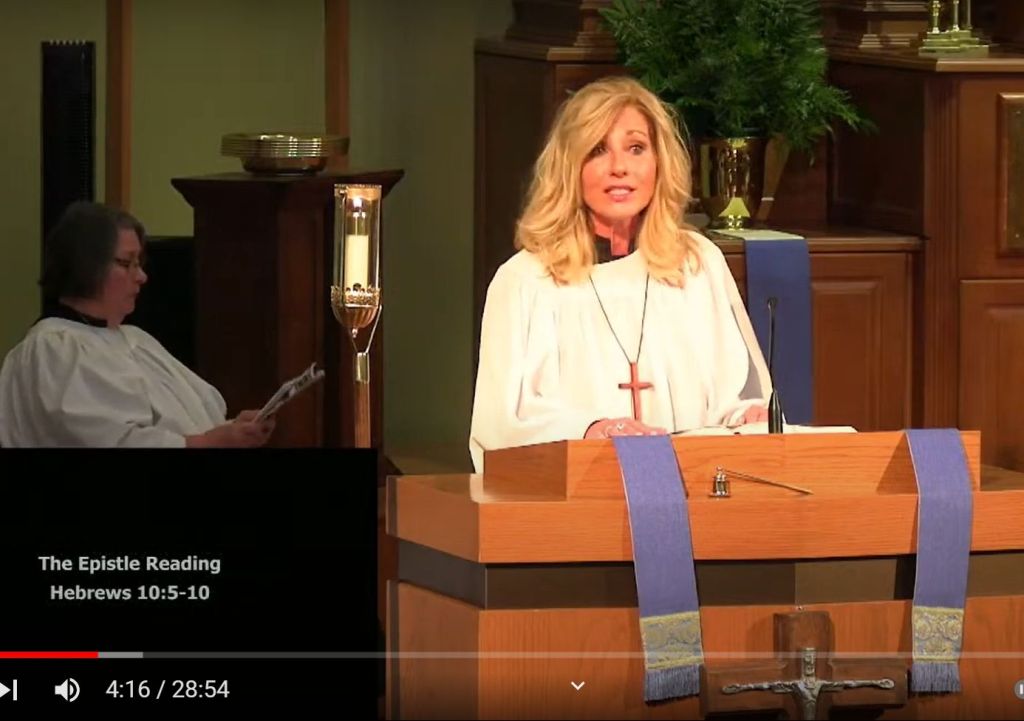
Beth Moore reads from Hebrews during service. A woman, serving as Deacon since 2008, gave the sermon. Notice attached to the pulpit the crucifix with a non-risen Jesus.
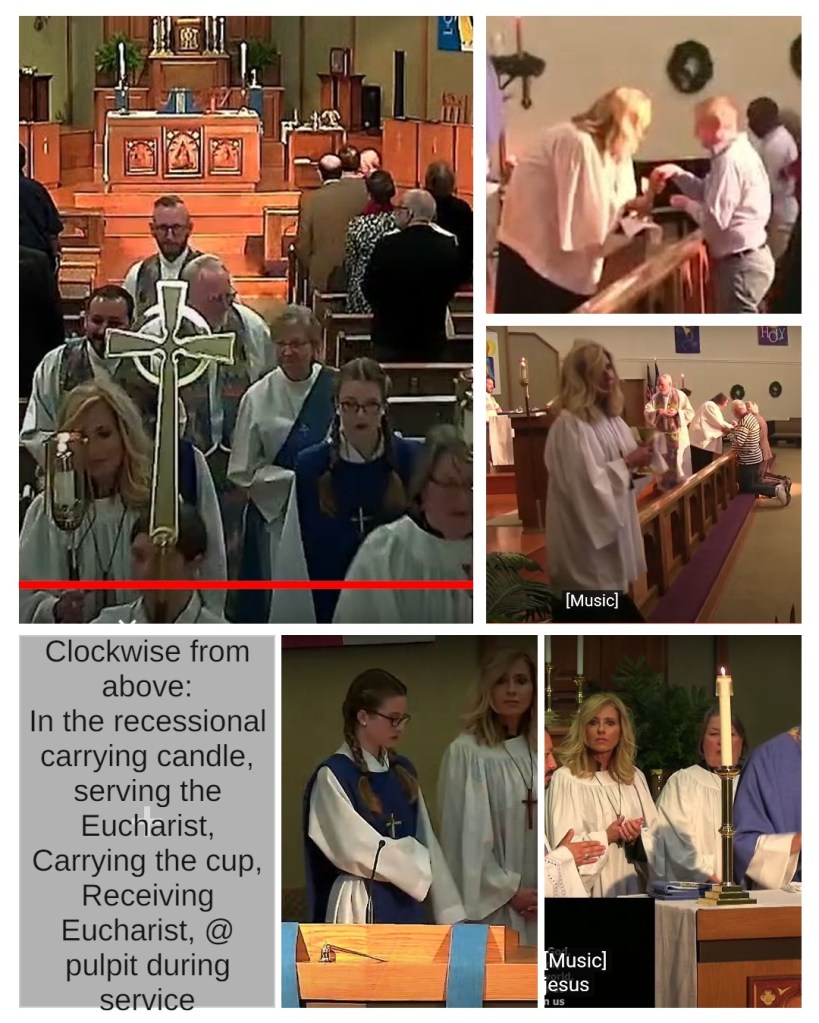
There are a great many women serving during the service at Beth Moore’s new church. They wear the priestly-type vestments, speak from the lectern, participate with the priest regarding the Eucharist portion of the service, lead processionals…even give the sermon as a woman did this week. This visible role of women would appeal to a rebel female preacher like Beth Moore. It’s natural for a false convert such as Moore to slide in to a church like this that offers her satisfaction of her lusts. (2 Timothy 3:4)
The second point of my essay is this, and it’s sad. False believers bring with them their false notions.
After just 2 months of being a church member, Beth Moore was asked to teach a study at her new Anglican church. The class is part of her church’s School of Ministry and “is for education for both ordained and lay people.” It’s titled “The Biblical Narrative and How to Teach a Bible Study.” You notice right underneath the class calendar listing screen shot below, is a course about women in ministry – taught by female deacon Rev. Deacon Lisa Schwandt. Schwandt was one of only 3 women invited in 2019 to the College of Bishops meeting (big Anglican meeting, like the SBC Annual Meeting) to discuss women in ministry.
Sadly though, installing Moore so quickly as a teacher in her new church, one by her own admission she is totally unfamiliar with in terms of doctrine and practice, demonstrates that the person making these decisions in her new church lacks discernment. It is unknown whether she is teaching a co-ed class. One person on Twitter asked, but the query went unanswered. She was also asked to MC the church’s Women’s Advent luncheon. (Though she did take time out to carp that she was asked not to speak but only to emcee…). She’s become embedded, fast.
I saw that she was listed as an alter server for an upcoming service. I am not sure what a Ps/Epis does but I think it is a person who reads a Psalm and an Epistle during service. See photo above, where Moore is reading the Epistle of Hebrews. We see in the collage below that Beth Moore is in vestments and serving in a variety of ways during the service.
I am not remarking on a liturgical service or anything about Anglicanism. I am saying that Beth Moore’s departure from the SBC to a place where her heart’s desire has always been to serve in a place the Bible forbids has finally been satisfied. She is finally “home”.
Beth Moore’s gravitation away from the faith is evident in this new move. She has always been me-centered and man-centered. Religious trappings for her are not a vehicle to further glorify God but a way to appear deeply committed, while absent of the obedience Jesus requires to be one of His own.
But realize this, that in the last days difficult times will come. 2 For people will be lovers of self, lovers of money, boastful, arrogant, slanderers, disobedient to parents, ungrateful, unholy, 3 unloving, irreconcilable, malicious gossips, without self-control, brutal, [a]haters of good, 4 treacherous, reckless, conceited, lovers of pleasure rather than lovers of God, 5 holding to a form of godliness although they have denied its power; avoid such people as these. (2 Timothy 3:1-5) underline mine.
then the Lord knows how to rescue the godly from a trial, and to keep the unrighteous under punishment for the day of judgment, 10 and especially those who indulge the flesh in its corrupt passion, and despise authority. (2 Peter 2:9-10)
We have been through a section of verses that show Jesus’ life in His earthly ministry. We’ve seen Him as servant, teacher, shepherd, intercessor, and healer.
Now we look at His attributes. Today- Omniscience.
This section of verses that show Jesus’ life are focused on His earthly ministry. We’ve seen Him as servant, teacher, shepherd, intercessor, and now Healer.
Jesus healed people of their afflictions and diseases. He healed Mary who had 7 demons. He healed the woman who’d had a blood issue for 12 years. He healed lepers, even touching them, a dramatic split from protocol. He healed the Centurion’s servant from a distance. Whether with a word or a touch, the power of Jesus to heal was demonstrated. He healed the blind, the sick, even the dead. He healed Peter’s Mother-in-Law. Strangers or friends, he healed. He did this to who He was who he said He was- from God and Son of God, Messiah, and the prophesied one.
He did this to show His omnipotence. He healed to show His compassion. The word Splagchnizomai, meaning compassion, is used 12 times in the New Testament, and each time it’s used it’s Jesus feeling it. Prior to the NT, the word when used meant courage. Splanchnizomai is not the only word used for compassion in the NT but it is distinctly used with Jesus and in the context of His healings.
Jesus took the term a step further and used it to define the attitude that should capture the life of every believer. In the parable of the unforgiving servant, the master had compassion and forgave the servant’s debt (Matt. 18:27). The prodigal son’s father had compassion on him (Luke 15:20). The good Samaritan had compassion on the injured traveler (Luke 10:33). Jesus had compassion on the crowd (Mark 6:34). People needing help asked Jesus for compassion (Mark 9:22; cp. Matt. 9:36; 20:34). Source: Holman Illustrated Bible Dictionary
People who need help are the ones who need compassion. Jesus is a God of compassion and He demonstrated this in His willingness to heal.
Usage:
This word is used 12 times:
Matthew 9:36: “when he saw the multitudes, he was moved with compassion on them, because they fainted,” Matthew 14:14: “a great multitude, and was moved with compassion toward them, and he healed” Matthew 15:32: “his disciples unto him, and said, I have compassion on the multitude, because” Matthew 18:27: “lord of that servant was moved with compassion and loosed him, and forgave” Matthew 20:34: “So Jesus had compassion on them, and touched their eyes: and immediately” Mark 1:41: “And Jesus, moved with compassion, put forth his hand, and touched him, and” Mark 6:34: “much people, and was moved with compassion toward them, because they were” Mark 8:2: ” I have compassion on the multitude, because they have now been with me” Mark 9:22: “him: but if thou canst do any thing, have compassion on us, and help” Luke 7:13: “Lord saw her, he had compassion on her, and said” Luke 10:33: “where he was: and when he saw him, he had compassion” Luke 15:20: “his father saw him, and had compassion, and ran,”
I’m looking more and more forward to the return of Christ as each day passes. Aren’t you? I don’t even really read the news anymore, and I’ve quit even looking at headlines. Men turning into women, murderers getting bail while trespassers languish in jail for months with no trial, vaccines that kill and a virus that doesn’t, a president who is cognitively impaired is somehow worse than a fully intelligent president who’s morally impaired… Ack
The world literally does not make sense, and there’s no point in trying to understand why or how or wherefore…it just is a fact. So I look to Christ. I look at Him in His word, I think of Him and the coming Kingdom, I think of eternity. Ahhh, MUCH more pleasant. If you are in Christ, you are destined to dwell forever in glory light with the risen Christ, in love and where no sin dares to creep. Perfection awaits. So hang on, friends, it’s coming.
EPrata photo
Gabe Hughes chronicled the plagiarism scandal that broke this past summer, as Southern Baptist Convention Presidential candidate Ed Litton was campaigning just before the vote. I was distressed to see how little gravity it was given by the people to whom it should have mattered most. I was a member of a church whose pastor had been discovered to have plagiarized every word he spoke from the pulpit, even the supposed personal anecdotes (as Litton had). I was grieved, felt cheated, betrayed, mourned the spotless name of Jesus being muddied, and felt I’d lost years of spiritual advancement that the worthless shepherd had stolen from me and from his other members.
It takes a long time to organize such a voluminous content, and I’m grateful to Pastor Gabe Hughes for doing it.
Preacher Steven J. Lawson the Death of a Society, as Romans 1:18-32 depicts. Buckle up, it’s not a pretty picture…
We read at 2BeLikeChrist some Ways to Be Critical of Your Church. Good advice, because sometimes we do disagree with what is being taught, legitimately, but there is a way to disagree and a way not to disagree.
Are we a faithful friend? I have been blessed to have friends stand by me even when it was difficult for them. I’ve been forgiven by faithful friends, hosted in faithful friends’ homes, and loved by them. Are you a Faithful Friend? The author at the Women Encouraged site has some thoughts.
The Shack movie has hit streaming services now, and it’s good to remember that though the movie is well made, with known actors, and addresses the love of God in an appealing way, the representation of the Trinity is so out of the realm of God’s revelation it taints the rest of the movie. And there are other issues too. Here is one review that explains more
The Wonder and Joy of Advent It’s no mystery why we start looking forward to the Christmas season even before the first leaf falls in autumn. Amid all the tumult and strife of our weary world, we long for peace. Bombarded by cynicism and sarcasm we seek for simple, childlike wonder. Drowning in heartache and pain, we hope, however faintly, for joy.
What are you looking at this Christmas? It’s a week to go until Christmas Day. In the build up to Christmas, our attention seems to be here, there and everywhere. Everyone may celebrate differently, and for some, they may not celebrate at all. Regardless of what Christmas Day means to you, I can guarantee you’ll be drawn in. The question is: what to? What will have your gaze and attention?
From Good, Cheap Eats we have 12 Spice Mixes to have at home or give as gifts Making your own spice mixes for home or to give as gifts is a great way to save money. When you do, you’re also tooling up to add great flavor to your cooking with little work or expense.
A friend and I were talking last night about how much we love to read, how much we love books- buying them, owning them, reading them, organizing them. Sadly, life intrudes sometimes and we do not get as much reading time as we would like. That doesn’t stop us from accumulating more books though, lol. Here is an article from Country Life UK (a FANCY magazine!) advising those of us who are fortunate to own a magnificent manor in the British countryside, of the necessary things to stock our libraries. Now pardon me while I go purchase that $6,000 bookcase…
Fulfilled as we rest with the Word with us In all the extra work of the season, I forget that true rest is only found in the Savior I’m working so hard to celebrate. He offers us rest for our souls when physical rest is elusive.
It is a season of great joy. I pray you seek that joy and hold on to it, and savor the season of Emmanuel – God With Us…and soon enough, we will be with HIM!
How can we know God unless He reveals Himself to us? The creation confirms His existence, but what does the creature know of His attributes, Person, or Power? Unless He teaches us about Himself, we will not know. God sent His Son Jesus to earth as a born-babe, to live the full life of sinlessness under the Law, and to teach us about Himself. He was prophesied to die as the atoning sacrifice, and then rise again to receive His people through His work on the cross. Grace abounds.
The word does not occur elsewhere in the New Testament, except in the passage before us. The essential idea is that of bringing to emptiness, vanity, or nothingness; and, hence, it is applied to a case where one lays aside his rank and dignity, and becomes in respect to that as nothing; that is, he assumes a more humble rank and station. In regard to its meaning here, we may remark:
(1) that it cannot mean that he literally divested himself of his divine nature and perfections, for that was impossible. He could not cease to be omnipotent, and omnipresent, and most holy, and true, and good.
(2) it is conceivable that he might have laid aside, for a time, the symbols or the manifestation of his glory, or that the outward expressions of his majesty in heaven might have been withdrawn. It is conceivable for a divine being to intermit the exercise of his almighty power, since it cannot be supposed that God is always exerting his power to the utmost. And in like manner there might be for a time a laying aside or intermitting of these manifestations or symbols, which were expressive of the divine glory and perfections. Yet,
(3) this supposes no change in the divine nature, or in the essential glory of the divine perfections. When the sun is obscured by a cloud, or in an eclipse, there is no real change of its glory, nor are his beams extinguished, nor is the sun himself in any measure changed. His luster is only for a time obscured.
Though the verse is literally speaking about King David, the relation of David to Christ means the verse also prefigures the preeminence of King Jesus. The throne, through David’s line, would last forever through Christ.
Gill’s Exposition says,
Also I will make him my firstborn,…. Or, “make him the firstborn”; make him great, as Jarchi interprets it; give him the blessing, the double portion of inheritance: so Christ is made most blessed for ever, and has all spiritual blessings in his hands; and is heir of all things, and his people joint-heirs with him. Christ is God’s “firstborn”, or “first begotten”, Hebrews 1:6, being begotten by him, and of him; … even him the Father promises to make “higher than the kings of the earth”; having a kingdom of a superior nature to theirs, and a more extensive and durable one; and even they themselves shall be subject to him; hence he is called “King of kings”, Revelation 19:16.
The King of Kings shall reign forever, His Kingdom shall endure.