I know what hack reporting is. I know all too well how people with a platform can manipulate public perception under the guise of “journalism”. I know how easily they may turn from good intentions at some point in the past, but once they get a taste of blood in the water, they begin use their platform as a bully pulpit.
Why are there so many female teachers and preachers running around saying they have received a word from God or a prophecy from Jesus? Why is scripture suddenly INsufficient? Why do people seek after ‘a fresh word’? Did the Bible go stale? When was its expiration date?
These are the things I ponder as I see what is being taught or tweeted by so-called women teachers.
In truth, people have always wanted to exalt themselves within their spiritual circles by claiming to have heard from Jesus. It’s not a totally new phenomenon, because sin is not totally new. Neither are false teachers who want to cement their credibility with women who are undiscerning, to get their money. (2 Peter 2:3). However, the wider church’s reaction to such claims is what has changed.
In 1637 female preacher Anne Hutchinson had caused a ruckus that nearly split the nascent colony in two. She was holding meetings in her home where she preached, refused correction, taught that sin had no bearing on one’s attainment to heaven, and more. She held her own against the meetings she was called to with her deep knowledge of scripture and her articulate deftness of warding off opposers in her scripture war. However what did her in was her final argument at her trial, where she claimed God had directly told her she was to continue preaching and teaching. THAT was the final straw, and was a hook her adversaries could hang their hats on. Hutchinson’s fate was sealed.
“Anne was proclaimed a heretic. She and her family were banished from the colony and any supporters in positions of authority were removed. All supporters were forced to surrender arms.”
History.com
We don’t hear of people much since the mid-1600s, 1700s, and 1800s who claimed direct revelation- at least, none who were taken seriously by mainstream Christians. Hutchinson was exiled. Joseph Smith (Mormonism) Mary Baker Eddy (Scientology), Ellen G. White (Seventh Day Adventist) all claimed direct revelation and founded false sects of Christianity upon these alleged revelations from on high.
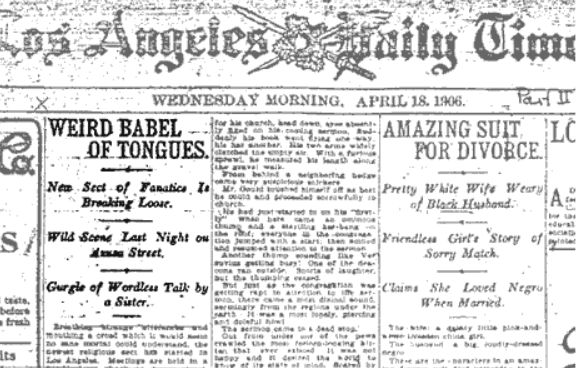
It wasn’t until 1906 when a “weird babel of tongues” as the LA Times put it, broke out at a local mission on Azusa Street.
‘New sect of fanatics is breaking loose’, ‘Wild scene last night on Azusa Street’, ‘Gurgle of wordless talk’
This new approach to Christianity, with the Holy Spirit allegedly speaking through people (and its twin soon arrived, prophecies) was not embraced widely- at first:
Christians from many traditions were critical, saying the movement was hyper-emotional, misused Scripture and lost focus on Christ by overemphasizing the Holy Spirit. Within a short time ministers were warning their congregations to stay away from the Azusa Street Mission
However, discontent with God’s word in the 20th century had arrived. More and more people claimed to have heard directly from God or Jesus or were prompted by the Holy Spirit…and the more that such alleged events were accepted, the more that other women and men clamored for similar experiences. Babbling in tongues and people claiming direct revelation were still marginalized throughout the early part of the 20th century. Everyone seemed to understand that the canon was closed.
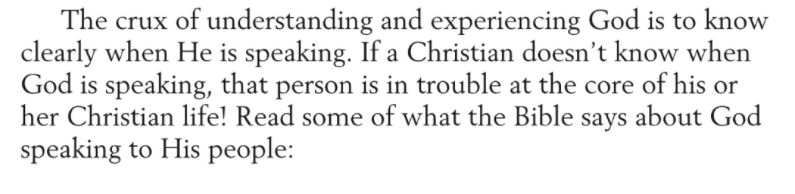
Even when Henry Blackaby and Claude King published their book Experiencing God in 1976, it didn’t get a lot of traction at first. Inside the book, they taught that you can and should be hearing directly from God. The 2021 version states:
Earlier versions of the book promote a similar theological warning, for example: “If you have trouble hearing God speak, you are in trouble at the very heart of your Christian experience.” ~Henry Blackaby
When the 1976 book was revised and expanded and re-issued in 1990, THEN it took off. People were entranced with the idea that they could and should be hearing straight from God.
Blackaby was a conservative Southern Baptist, a denomination of adherents known back then as ‘People of the Book’, because people in the Southern Baptist Convention were strict about following the inerrant word of God. So they thought, if HE is saying this…and if Lifeway is promoting it…then it must have legs.
“There is nothing more important in life than understanding when God is speaking to you. If you are disoriented to God’s voice, your life is dangerously vulnerable. The Bible indicates conclusively that God does speak to people and that he does guide them in his will. The problem of not hearing from God never lies with God. He does communicate his will. It is not a matter of us searching in vain for God’s hidden will. He readily reveals it to those who show themselves obedient to do it. If you do not hear God’s voice, could it be your heart is not ready to respond to what he says?” ~Henry Blackaby
Wow. A lot of scare tactics there. ‘important’ ‘dangerous’, ‘vulnerable’, ‘problem’…
Removing the trustworthy word of God from its position from heaven outside our sinful minds and instilling a notion of God’s word emitting from a position of subjectivity and internal impressions and whispers only leads to confusion. Worse, was Blackaby blaming the believer when he or she doesn’t “hear”.
Beth Moore was also in the SBC and was considered conservative at the time she founded Living Proof ministries in 1994. She picked up on the Blackaby concepts and began to repeat them, that of hearing from God is an everyday occurrence, claiming she has direct revelations from on high, and teaching from these extra-biblical revelations.
Of course at the time there were others doing the same, claiming to hear directly from God, but those people were fringe and not taken seriously. But when Blackaby and Moore started with it, it took root.
The idea that Christians can and should hear audible words from God or rely on subjective impressions or respond to whispers, is a dangerous teaching that by nowadays has become deeply rooted in evangelicalism.
Joanna Gaines of Magnolia industry and HGTV Fixer Upper TV show, Jennie Allen, founder of wildly popular IF:Gathering, Sarah Young of the books Jesus Calling, Lysa TerKeurst of Proverbs 31 ministry, Priscilla Shirer and others not only believe you should be hearing ‘a fresh word from God,’ but for years, these women have been actively using their ministries to teach women how.
The other day I wrote “A History of Quiet Time” that attempted to show when or where the idea of hearing God’s whispers during our Bible Study time originated. Of course, it goes all the way back to the Garden when the serpent whispered to Eve, but in modern times we can say that one place that the notion took traction was in 1898 when FB Meyer’s book The Secret of Guidance taught that we wrongly go about initiating things for ourselves “instead of ascertaining what God was doing, and where He required our presence.” If that sounds exactly like the 1990 Blackaby’s tenet, “Find out where God is at work and join Him there” well, Solomon said there is nothing new under the sun…
The Azusa Street babble, the various books through the decades promoting direct revelation from God, and the reissue of Experiencing God, combined with various women who consistently and persuasively teach and promote direct revelation has caused the unbiblical concept to become normalized. To be in the club now you have to say you’ve heard a fresh word from God and here it is…
This is sad. This causes confusion, jealousy, pietism, and ill-will.
Please rely only on the word of God. It is trustworthy, while whispers and impressions are not! The Word is Jesus and He gave us His word. It is pure, rich, truthful and dependable. Our subjective impressions are not.
False prophets and lying wonders: Similar ideas have found sweeping acceptance even among non-charismatic Christians. Southern Baptists have eagerly devoured Experiencing God by Henry Blackaby and Claude King, which suggests that the main way the Holy Spirit leads believers is by speaking to them directly. According to Blackaby, when God gives an individual a message that pertains to the church, it should be shared with the whole body. As a result, extrabiblical “words from the Lord” are now commonplace even in some Southern Baptist circles.
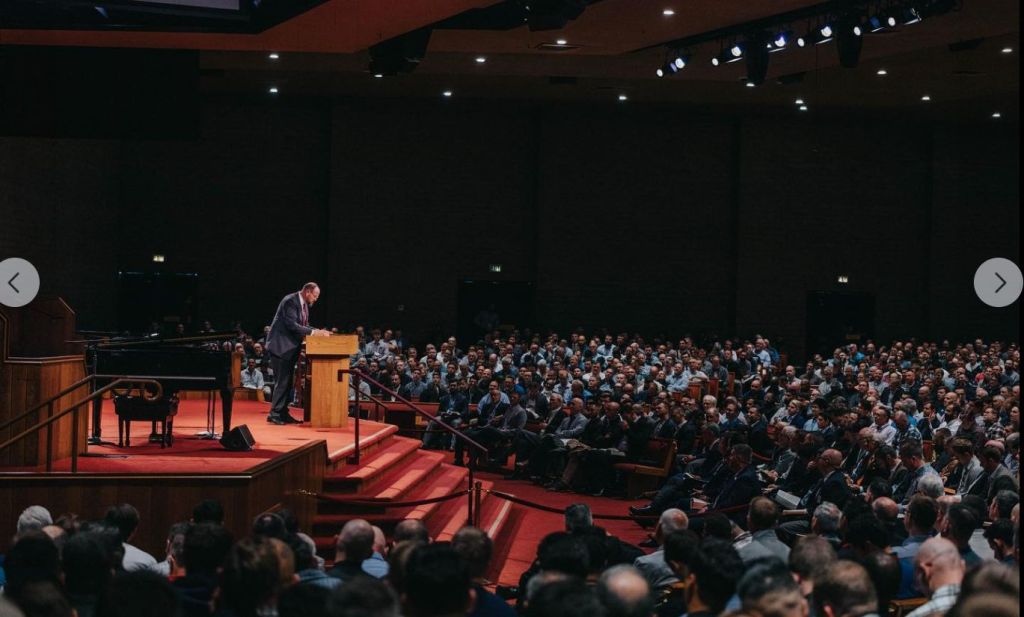
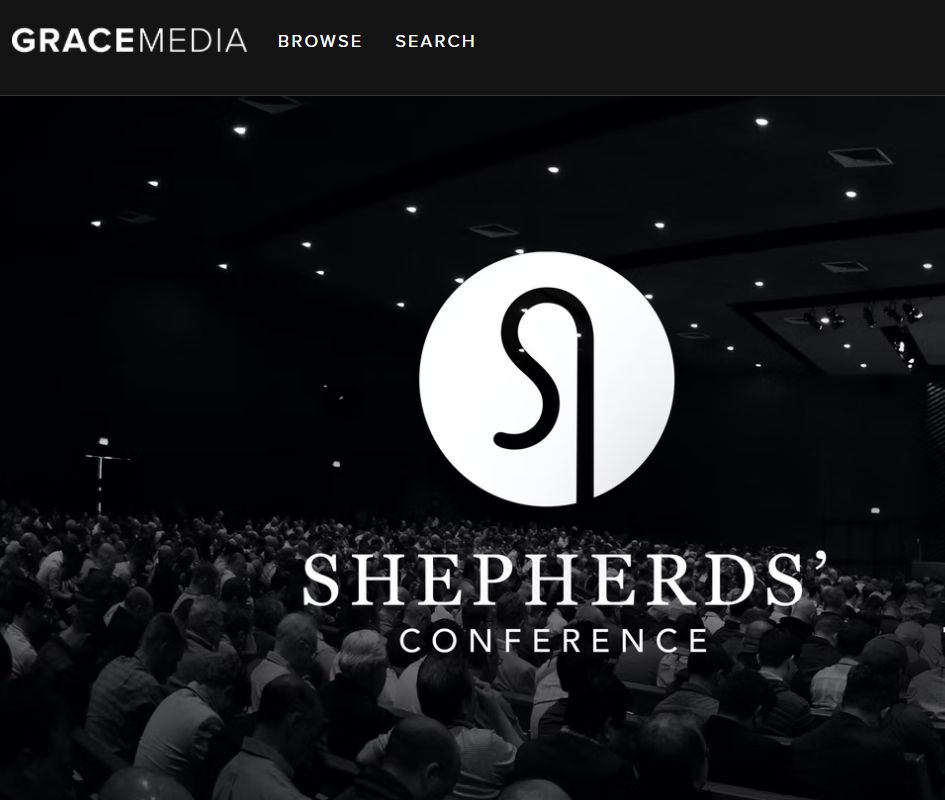
The Shepherds’ Conference is a conference held at California’s Grace Community Church hosted by its pastor-teacher John MacArthur. It has been going for 20 years, annually, with 2021 the lone exception. For two decades it has hosted thousands of pastors, teachers, leaders from around the world who travel there to be encouraged with like minded laborers, to learn more of Jesus (being preached TO is something these men don’t receive often, being the ones who preach), and to be served by eager volunteers who want to host these weary ministers of the word, rejuvenating them before returning them to the battles they face.
The men who come enjoy it, the servers who serve enjoy serving, and I, as a watcher on the sidelines, am also encouraged by this conference. Ever since I began watching it in 2007, I am mightily moved by scenes from the conference. I don’t know why THIS particular conference moves me so, but it does. Maybe because I have been edified over the years by John MacArthur, Phil Johnson, Paul Twiss, Don Green, and many other teachers at Grace Community Church. Maybe because I rejoice in the word of God being preached so well and to so many.
The earnest pastor hunched over the place where truth winds from Bibles from mouths to ears…the eager listeners with pens in hand and open Bibles, receiving the pure word, reviving their hearts and minds. I’m moved because there are SO MANY pastors in that audience- a sea of heads and hearts inclined to Jesus. Because they represent SO MANY churches where people have been saved and are being saved. How great is God.
I’m also moved in the other direction when I see that photo, sadness, because while we have the joy of hearing the word and exalting Jesus because of it, SO MANY don’t know Him! There are myriads of lost, their hearts gleefully exulting in sin and darkness as they go about stumbling toward death. They do not know the wrath of God hangs above them like a heavy storm cloud about to break over their heads.
Amid all the Twitter hoo-hah from detractors arguing about ShepCon, I think the grumps and crankies mainly forget that this conference, as with others like Ligonier, G3, Truth Matters, etc, that for attendees hearing the word, returning with a strong resolve, a better walk, a higher grasp of the Word, we multiply the sheep. Ultimately we are about our father’s business. Most days, we can’t see it. We gather in our local churches once a week, see our friends, hear the sermon, and scatter back to work on Monday, doing our best to live the Christian life.
When we’re lifted out of our small sphere to see all those men gathered at the Shepherds’ Conference, men who are husbands, pastors, grandfathers…making the huge effort in time and money to attend a conference with such superlative preachers…it’s moving. It’s a reminder that we are out there in force, pleading with souls to repent. It makes me feel joy to see visibly the pastors who otherwise I’d not know about. They are all trophies of grace the Lord has given the world. Rejoice in that!
MacArthur is a man who has preached steadily for 53 years. Nary a blot on his name. He has given the gospel to thousands, millions even, if you count the radio ministry. His MacArthur Study Bible is seen in the hands of an African preacher walking barefoot down a rural dusty path amid the elephants. It is seen in the hands of a pastor preaching truth in the Arctic circle on a tiny rock of an island in the Faroes, and everywhere in between. Thousands of men have been trained up by MacArthur, his men, and the seminary and sent as milkweed seeds into the rare places and the busy places and the common places, with the sole intent of bringing Jesus to the lost.
Who wouldn’t be excited for a ministry like that, and conference coming out a ministry like that? I am. The Lord always leaves a remnant. He is great and His promises are sure.
Whatever a fundamentalist is these days, I’m often “accused” of being one. We know that to the world, “Fundies say the darnedest things” and I’ve been quoted on that so-named forum more than once. The world points to biblical Christians as narrow minded, bigoted, closed minded, or myriad of other epithets to indicate that we need to be accepting, tolerant, and broad minded, especially of ‘all religions.’
A certain gentleman made the following remark on Facebook: “The Fundies have little room in their hearts for a good man like this [the Pope] and even less room in their minds.“
We have all the room that is possible to have for a man like that, because there but for the grace of God, go us. We love our fellow man enough to witness to the power of Jesus to turn a heart of stone like the Pope’s into a heart of flesh. (Ezekiel 36:26).
There aren’t any “good men.” There aren’t even ‘all religions.’ There are only two. God’s and satan’s. Much about the Christian life is very stark and clear. It is either-or. Heaven or hell. World vs. Christian. Unforgiven sinner or forgiven sinner. In fact, being “narrow minded,” at least where the Bible and the Lord’s commands come in, is a good thing.
Satan will mimic, counterfeit, masquerade and just plain lie as to the way to heaven.
In a recent sermon about heaven John MacArthur delivered to an audience of youths, he drew on the Bible to show just how narrow the way is and how wide is the gulf between the two worlds. This sharp divide of either/or, in or out, is discussed by Jesus in the Sermon on the Mount in Matthew 5-7. Jesus used several metaphors to draw the distinction between the two ways. MacArthur explained:
Strive to enter the narrow gate. What is this talking about? What does it mean to strive to enter the narrow gate? … As we come to the end of the Sermon on the Mount there is a series of contrasts.
Two gates, wide and narrow Two ways, broad and narrow Two destinies, life and destruction Two crowds, many and few Two trees, one good, one corrupt Two fruits, one good and one bad Two builders, wise and foolish Two foundations, rock and sand Two houses, one stands and one falls
If being narrow-minded means ONLY accepting the Lord’s truth and not all the world’s, I will gladly accept the description. If being too narrow means I am on the Lord’s narrow road, I am grateful. If I am in the crowd of the few and not the many, then all is well.
How many entrances do we need? One is all it takes, and for Jesus, it took a lot. He lived a scrupulously sinless life. He suffered the indignity of humiliation on the cross. He bore all the punishment and wrath for sin into His very self, and He endured the agonizing separation from His Father for the first time in all eternity. He did this to make a way for us to enter through Him.
Enter by the narrow gate. For the gate is wide and the way is easy that leads to destruction, and those who enter by it are many. (Matthew 7:13)
Whenever I make a comment that a certain person is a false teacher, I do not do it lightly. It is based on years of observation, comparison to many teachings of that person over time to the Bible, and a heavy heart.
What we are supposed to do in discernment, is ask. If someone says my favorite teacher is false, let’s ask why they believe that. Spiritual conversations are, at root, about Jesus. We are either impugning His honor, or promoting His honor. We need to be sure we are in the latter camp, not the former. Therefore, we can either educate that person as to why my favorite teacher is not false or we can listen to her and be educated as to why he or she is fact, false.
Spiritual conversations are supposed to edify. If Jesus is the reason we’re having the conversation, then we should be sure we are in truth, and if it is done properly, we are spiritually energized and more knowledgeable than we were before we began.
Sadly, most people who reply to discernment comments or engage with discerners in discussions rarely ask questions. They rarely use scripture to back up what they are claiming. What they DO do, is, make moral judgments and slanderous accusations under a guise of “sadness” and pietistic babble. Here is one example I received in an email.
“As a former atheist and now a devout follower of Christ and not people or denominations of men who believes the Bible to be the inspired Word of God, I have to say that it’s people like yourself that drove me away from Christianity for so many years. Where is your love for your brother? Where is your forgiveness? Where is the unity of fellowship? Where is your humility? Do you really think you have it all figured out with regard to the book of Revelation? Rather, I see jealousy, envy and strife. See 1Chorinthians and what Paul had to say about it. Or is Paul also a false prophet according to you?”
Let’s unpack this.
This person is using the same talking points that most every other defender of other false teachers use. Probably unwittingly. But comments like these are remarkably similar. Weirdly similar.
“People like you drove me away from Christianity“. People who leave Christianity don’t leave because some old woman like me on the internet said something about some other woman on the internet. No. They ‘leave Christianity’ because of their sin. They do not want to hear messages calling out their sin, or they want to continue to be in sin, or they desire to protect their sin. They leave because they sin and they want to stay in sin.
Remember, no one leaves Christianity. If they leave they were never in it. Their leaving proves that. All the commenter is doing is trying to make you feel guilty. Don’t fall for it.
They went out from us, but they were not really of us; for if they had been of us, they would have remained with us; but they went out, so that it would be evident that they all are not of us. (1 John 2:19)
“I’m a devout follower of Christ, and you…” No they aren’t. They most assuredly aren’t a devout follower, maybe not even a follower at all. People who are devout followers of Christ seek His glory and stand on scripture. They don’t use fake names or anonymous accounts to email or post judgmental, slanderous insinuations, and otherwise misuse the name of Christ in order to feel better about following their favorite (false) teacher. They seek to educate, edify, learn, or ignore. They give grace and charity. They don’t make claims of being “devout” then destroy that claim with mocking and sarcastic behavior.
“Why don’t you love them?” Another guilt trip, this time misusing the word love. First, the word love gets thrown around too much without a proper context. Jesus called his religious educators the priests, Pharisees, and scribes, vipers. Did He not love them? Jesus mourned them! He cried over Jerusalem and its lost people. Yes He loved them. Correction or rebukes or warnings to someone does not mean an absence of love. In fact, it often means the opposite- we DO love them.
“For the Lord disciplines the one he loves, and chastises every son whom he receives.” (Hebrews 12:6).
My son, do not reject the discipline of the LORD, and do not loathe His rebuke; (Proverbs 3:11).
We must let our Christian family know that the false teacher is hurting them with their lies and opposition to Jesus. Most of us indeed do it in love and for love.
“I’m disappointed in your tone” – Talking about a false teacher usually calls down the Tone Police. They’ll come into a thread to voice their disappointment in the “tone” of your comments. They won’t address any scripture you’ve shared, they won’t use any scripture themselves, they won’t reply on a biblical stance, but instead will try to guilt you into not making comments about a false teacher. They’ll try to convince you that you sound like a harridan. And heaven forbid you’ve actually named that false teacher, which makes them even more “disappointed”. They will simply camp on an emotion. ‘I’m disappointed you’ve…I’m sad that you…’ “What people are saying doesn’t seem to matter [to the Tone Police] half as much as how people are saying it.” said Mike Riccardi in his article “A Sanctified Rant about the ‘Tone Police”.
If you went to a potluck dinner, and I said I knew one of the dishes had poison in it, but since I don’t want to name names, and we want to only focus on the poison-free dishes, I wasn’t going to tell you which dish could kill you? Does that make sense? No. False teaching is poison. We must point it out. Unashamedly.
Staying in the word of God is the best way to remain unswayed by opposers of the truth – either the false teachers themselves or their defenders. Stay strong in the Lord.
Shepherds’ Conference 2022 is coming up! Shepherd’s Conference, or affectionately known as ShepCon, will begin this Wednesday, March 9 to Friday, March 11. It’s eagerly anticipated because last year the conference was canceled in 2021 for that year. We missed it.
There is nothing like the firehose of truth coming out of the speakers aimed at supporting, edifying, and loving 5000+ shepherds, AKA pastors and ministers who attend. It is live streamed. Listening to 5000+ voices lifted up in praise of our Lord is quite moving. It makes one yearn to be in the heavenly choir on the Day!
The theme for this year is UNASHAMED. How fitting. The blurb says: “Throughout the New Testament, God calls leaders in His church to be unashamed—a call for courage, fortitude, boldness, and humility.”
The website for it is here: Shepherds’ Conference. There you can find past Shepcon videos, information & resources, and the live stream for this year.
In addition, the website Media Gratiae also will have a live stream, and lots of additional Grace Church content you should check out!
Media Gratiae has Grace Community Church media content in one place as a one-stop shop. The blurb is: “Your one-stop mobile and TV app for all Grace Community Church video content—from original shows to sermons and lessons to a dedicated Sunday service livestream. Simply click the “subscribe now” button below and enter your email and password to access everything for free.” There is some great stuff here!
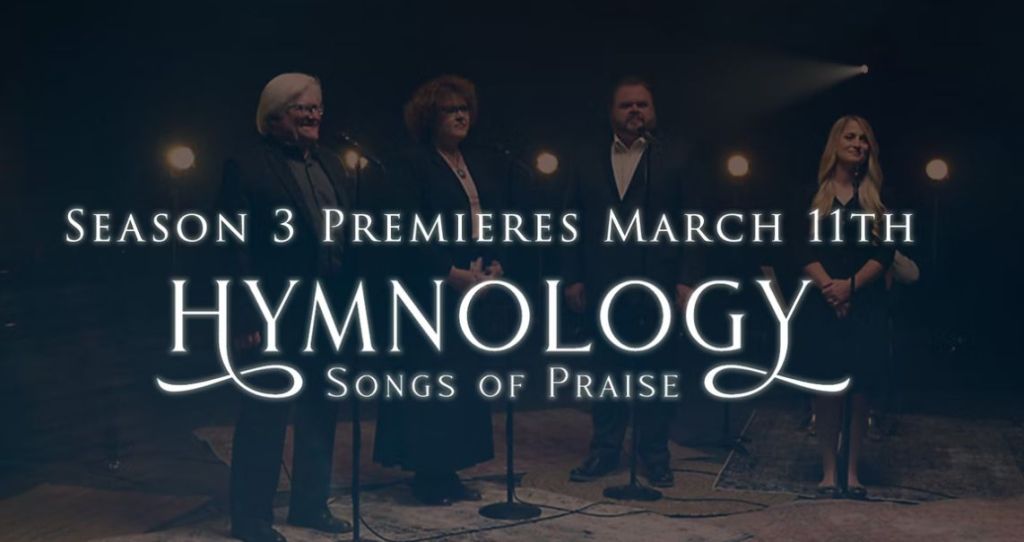
If you are not familiar with Hymnology featuring Phillip Webb, and you love music, then you are definitely missing out! It is at Media Gratiae media site:
Hymnology: “Melding beautiful melodies with eternal truth, learn the historical stories and drama behind hymns that focus on God, His Word, and the Gospel story. Hymns of Grace exist to assist believers in their corporate and private worship of God.”
There are three seasons, all with fantastic hymns with knowledgeable people explaining the background, then they sing it. Beautiful.
There is also Minute with MacArthur! Something new.
Minute With MacArthur: “Sit down with Pastor John MacArthur as he answers Bible questions submitted by our viewers. These short episodes are straight to the point and very practical to help increase your knowledge of the Bible on some simple topics and complex ones as well.”
Worship Conversations: “Philip Webb sits down with a variety of individuals to discuss the importance of biblical worship in the life of the church as well as other topics in this series of candid interviews.” Conversations so far include with John MacArthur, Steve Lawson, and Paul Washer.
There’s also Men of the Word teaching series, Every Woman’s Grace, Grace Church baptisms, The Road to the Reformation, and MORE!
I have two desires with this writing ministry. One is to employ the gift of discernment that the Holy Spirit has graciously given me and educate women as to what discernment is, why we need it, and which false teachers to avoid. Secondly, I ALWAYS want to employ my discernment to vet ministries and various content and present them to you for YOUR consideration. Don’t trust me blindly, always check things out for yourself, but when I find a good ministry offering edifying and solid content, I note it and recommend it to you. So that what today’s essay has been about. I hope you find any of these links worthwhile and enjoy them. All glory to Christ 🙂
This essay is about how the personal Bible reading time of the previous generations changed from prayers to God into personal communication with an expected back and forth between the believer – with God delivering individual revelations to the believer for daily living. A Disclaimer: The Holy Spirit does guide us. But we can’t ‘feel’ it at the time. Aside from knowing it as promised in the Bible, we can’t intuit what He is doing moment by moment. He certainly doesn’t whisper His daily directions to us. So how did this situation come about?
Poetry by Kay Cude. Used with permission. Right click on image to open larger in new tab. Artist’s statement below.
I keep returning to our (me!!) needing to “remember” God’s promises and provision. GOD THE I AM is the only fortress in Whom we find a righteous protector, defender and provider. He is the only place of eternal refuge from the world’s continuing tragedies and chaos. He is the stronghold Who is and Who will provide peace, wisdom, understanding, instruction and endurance.
To wait is not merely to remain impassive. It is to expect–to look for with patience, and also with submission. It is to long for, but not impatiently; to look for, but not to fret at the delay; to watch for, but not restlessly; to feel that if he does not come, we will acquiesce, and yet to refuse to let the mind acquiesce in the feeling that he will not come.”
Andrew B. Davidson, Waiting on God. AB Davidson was an ordained minister in the Free Church of Scotland and Professor of Hebrew and Oriental languages in New College, University of Edinburgh.
As I look around in my small sphere and see the dramatic changes in parenting styles and kids not rebounding from quarantines and lockdowns…and the wider sphere of prices rising and difficulties rising in just living a life…and the even wider spheres of the world where there is war and want and hate…and opposition to the Gospel and many who are dying apart from Christ…I more and more often say “Lord, soon come!” But I must wait. So…this quote-
To wait is not merely to remain impassive. It is to expect–to look for with patience, and also with submission. It is to long for, but not impatiently; to look for, but not to fret at the delay; to watch for, but not restlessly; to feel that if he does not come, we will acquiesce, and yet to refuse to let the mind acquiesce in the feeling that he will not come.”
In Exodus 3:6, Moses was afraid to look at God. Hagar marveled that she had an encounter with God and was still living. (Genesis 16:13). Jacob said the same. (Genesis 32:30). But Beth Moore claims that Jesus tells her all sorts of things, calls her ‘Babe’, speaks so casually to her in all their informal chats, where she and God “had a blast.” No.
EPrata photo
The fear of God is the beginning of wisdom… and since people like Moore, not just celebrity preachers but many lay-people, have no fear, she lacks wisdom. Too many people have lost their fear of God for who He actually is and have lost their notion of how evil evil really is. Even have lost their definition of evil. Too many people think a Hitler-Holocaust level is the only evil. They think evil has to look black and be immediately recognizable. Saran is cleverer than that. He is the most subtle creature in the garden. He sends a smiling and seemingly kindly Joel Osteen to do his evil.