Posted in theology

Jesus opens the door and He shuts the door

By Elizabeth Prata

Do you take the Lord’s power and grace for granted? Have you diminished His Holiness in your mind? Many people in this day and age have. How do I know? They think the Lord will somehow relent, and allow everyone into heaven after all. Or that His mercy is so great and so wide that they will be forgiven, even if they do not know Jesus. Jesus will not relent. His decision is final, and His decrees are sure. If you do not know Jesus on the day you die, you will be cast into hell.

I say again, if you do not know Jesus on His day of wrath, if you die you will be cast into hell.

Even saying such a thing in this day and age seems like a revolutionary act. People chide us Christians who flatly declare the truth from the Word, that He will not relent. “Our God is a loving God,” they exclaim. “He would never do that!” Well, remember rebellious Korah who was swallowed by the earth? Remember Uzzah who touched the ark? Remember Ananias and Sapphira, who blasphemed the Spirit by lying to the Apostle? Jesus will not relentbecause He is the door.

I am the door: by me if any man enter in, he shall be saved, and shall go in and out, and find pasture.” (John 10:9).

He is the only One who opens the door.

I know your deeds. See, I have placed before you an open door that no one can shut. I know that you have little strength, yet you have kept my word and have not denied my name.” (Revelation 3:8).

He is the One who shuts the door.

And they that went in, went in male and female of all flesh, as God had commanded him: and the LORD shut him in. (Genesis 7:16).

When the ark was filled He shut the door and the rest of the world was judged. And so it will be again, for the unaware.

But while they were on their way to buy the oil, the bridegroom arrived. The virgins who were ready went in with him to the wedding banquet. And the door was shut. “Later the others also came. ‘Sir! Sir!’ they said. ‘Open the door for us!’ “But he replied, ‘I tell you the truth, I don’t know you.’ (Matthew 25:10-12)

He is the King of the Kingdom and it is He who says who enters and who doesn’t. He is the Door.

and with all the deceit of unrighteousness in those who perish, because they received not the love of the truth, that they might be saved. And for this cause God shall send them strong delusion, that they should believe a lie,” (2 Thessalonians 2:10-11)

Enter now while the door is open. Repent and believe the truth: that Jesus is resurrected Lord and He is the only way to enter the Kingdom. He speaks the truth, and when He says that judgment is coming, believe it. The time will come when the door will be shut.

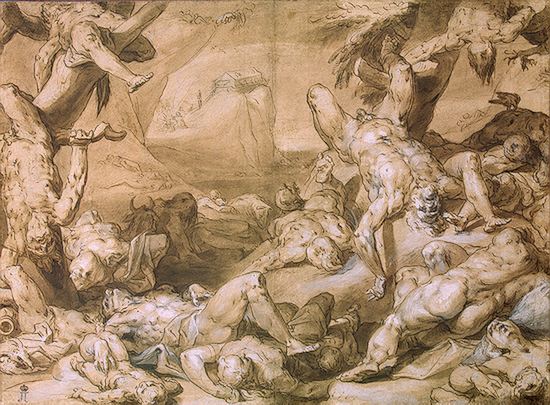
While the door was open, they did not listen and believe in Noah’s day:

William Bell Scott: The Eve of the Deluge, 1865
After the Flood , Circa 1588 Cornelis Cornelisz. van Haarlem

This is what grace looks like:

Noah’s flood KAULBACH, Wilhelm von (1805-1874)

How so? you ask. How is this grace? The the people are dying! Well, don’t focus on the serpents and the people. It is one way we diminish His holiness and His mercy. Focus on Him and His protected righteous and the fact that His promises of salvation are sure. The angels ministering, the ark itself is grace.

Please answer His call, and repent!

“Once the owner of the house gets up and closes the door, you will stand outside knocking and pleading, ‘Sir, open the door for us.’ “But he will answer, ‘I don’t know you or where you come from.‘” (Luke 13:25)

For Jesus to ‘know’ you means He has a righteous relationship with you. If you have repented of your sins and fallen on Jesus as Lord and Savior, He will know you.

Everything that the Father gives Me will come to Me, and the one who comes to Me I certainly will not cast out. (John 6:37).

The Door is open to repenting sinners. Won’t you come?
Posted in theology

John MacArthur on the coming totalitarianism and antichrist

By Elizabeth Prata

2022: The Covid Crisis, Totalitarianism, Antichrist | John MacArthur Interview

I listened to a Q & A between Phil Johnson and John MacArthur recently. They discussed COVID and the mitigation efforts that were placed on their church, the Legacy Standard Bible, its beginnings and why we need this particular translation, the upcoming John MacArthur Old Testament Study Bible (YAY!), and interestingly, this question:

PHIL asked: “Do you ever think we will get back to normal? Post-Covid?”

Continue reading “John MacArthur on the coming totalitarianism and antichrist”
Posted in poetry, Uncategorized

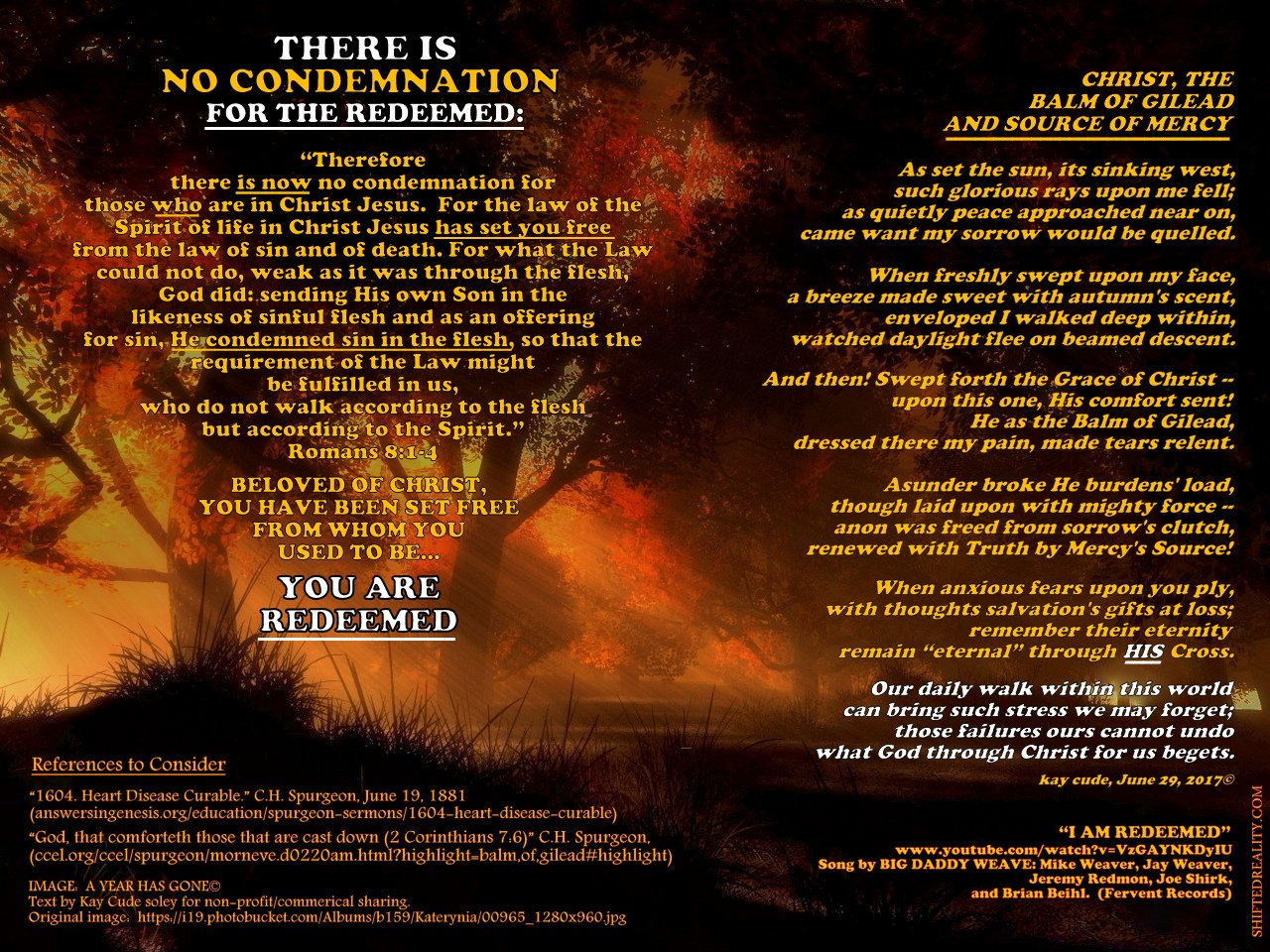
Kay Cude Poetry: No Condemnation for the Redeemed

Kay Cude poetry. Used with permission. Excerpted Artist’s statement below. Right-click on picture to open larger in new tab.

THE BALM OF GILEAD AND SOURCE OF MERCY

We know this world is not our home; it is the residence of the Adversary’s “world-system” and its participants. As “strangers” we sojourn here for the specific amount of time measured-out by God Himself. In His perfect and inerrant will He has not notified us about that exact day, the specific hour or the year of our departure, whether it be by death or by our catching away. But He has forewarned and made clear that during our sojourn we will have trials and tribulations, and that it is He (not us) Who is the Source of our peace, courage and endurance. “These things I have spoken to you, so that in Me you may have peace. In the world you have tribulation, but take courage; I have overcome the world.” (John 16:33) and “Peace I leave with you; My peace I give to you; not as the world gives do I give to you. Do not let your heart be troubled, nor let it be fearful.” (John 14:27) and “But if any of you lacks wisdom, let him ask of God, Who gives to all generously and without reproach, and it will be given to him.” (James 1:5).

We will recognize and remember that “our failures” are temporary. We will remember that we are new creations in Christ, living according to the Spirit. We will remember that we ARE NOT who we used to be! We ARE the redeemed; and as such, know that the redeemed of Christ will be perfected in and through Christ. “For I am confident of this very thing, that He Who began a good work in you will perfect it until the day of Christ Jesus.” (Philippians 1:6).

For the redeemed of God, the remedy for anxieties or stresses encountered during trials and tribulations is Christ, the Balm of Gilead. Let Him apply upon us lavishly His balm through His inerrant, revealed Word!

Posted in theology

They saw God … and lived?

By Elizabeth Prata

When Isaiah was brought up to the Throne Room of heaven and saw God in His glory, he fell down and said,

“Woe is me! For I am lost; for I am a man of unclean lips, and I dwell in the midst of a people of unclean lips; for my eyes have seen the King, the LORD of hosts!” (Isaiah 6:5).

Being in the presence of God induces that kind of reaction, and not just in Isaiah. In everyone who encounters Him.

Continue reading “They saw God … and lived?”
Posted in theology

Shot and killed point blank in Alabama while giving the Gospel

By Elizabeth Prata

“How Long, O Lord” Sovereign Grace Music

She didn’t know that 6 days after exchanging love and affection and anniversary gifts, he would be dead.

“Last week, the husband of former Miss Mississippi was fatally shot in front of his 2-year-old child while sharing the gospel with people in Montgomery, Alabama.”

On January 20 she announced her pregnancy, their second child was expected.

On January 20th also, she posted on their anniversary how much she loved her husband.

Just two days later, on January 22, he was shot dead on the street in front of her and her toddler.

The sin-washed world sinks under the weight of its own groaning. The burdens of sin and grief stagger us, our hearts weighed with the sadness that sin brings. Oh, foul fiend, our ball and chain of sin attached, we moan in the night. But in the morning, THAT blessed morning, joy will come. How long, O Lord?

“How Long, O Lord” Sovereign Grace Music

Our tomorrows are not guaranteed. Cherish your spouse, adore your children, worship your God.

Posted in theology

Why did Isaiah say ‘I am a man of unclean lips’ and not ‘a man of unclean heart’?

By Elizabeth Prata

Isaiah was lifted up in a vision to see the throne room of God. He saw the I AM seated and being praised by Seraphim who shouted,

Holy, Holy, Holy, is the Lord of armies.
The whole earth is full of His glory.

(Isaiah 6:3)

Isaiah’s response was:

“Woe to me, for I am ruined!
Because I am a man of unclean lips,
And I live among a people of unclean lips;
For my eyes have seen the King, the Lord of armies.”
(Isaiah 6:5).

The word ‘Woe’ here means in the Hebrew, to cease, to destroy, to be cut off. THAT is how powerful glimpsing God’s glory is. We know from the reactions of those who have seen the LORD’s glory that they marvel that they are still living. But why did Isaiah not say, “I am a man of unclean heart?” especially since from the heart flows all sin. Or why didn’t he say “I am a man of unclean soul (or spirit)?’ Why lips?

Matthew Henry wrote of the scene,

“[I]t may be taken more generally; I am a sinner; particularly, I have offended in word; and who is there that hath not? Jam. 3:2. We all have reason to bewail it before the Lord,

(1a.) That we are of unclean lips ourselves; our lips are not consecrated to God; he had not had the first-fruits of our lips (Heb. 13:15), and therefore they are counted common and unclean, uncircumcised lips, Ex. 6:30. Nay, they have been polluted with sin. We have spoken the language of an unclean heart, that evil communication which corrupts good manners, and whereby many have been defiled.”

(1b). “We are unworthy and unmeet to take God’s name into our lips. With what a pure lip did the angels praise God! “But,” says the prophet, “I cannot praise him so, for I am a man of unclean lips.” … The impurity of our lips ought to be the grief of our souls, for by our words we shall be justified or condemned.

(2.) That we dwell among those who are so too. We have reason to lament not only that we ourselves are polluted, but that the nature and race of mankind are so; the disease is hereditary and epidemic, which is so far from lessening our guilt that it should rather increase our grief, …” Henry, M. (1994). Matthew Henry’s commentary on the whole Bible: complete and unabridged in one volume (p. 1089). Hendrickson.

Let’s look at that Hebrews verse Matthew Henry mentioned-

Hebrews 13:15 says, “Through Him then, let’s continually offer up a sacrifice of praise to God, that is, the fruit of lips praising His name.

Our lips are what form the words of praise or the words of sin. See also Isaiah 57:19; Hosea 14:2. We might be redeemed and have the Holy Spirit dwelling in us, but we still sin. We are justified, but not yet glorified. Our lips still sin, as we see from James 3:8-10 says,

But no one among mankind can tame the tongue; it is a restless evil, full of deadly poison. With it we bless our Lord and Father, and with it we curse people, who have been made in the likeness of God; 10 from the same mouth come both blessing and cursing. My brothers and sisters, these things should not be this way.

There is a little known prophecy in Zephaniah. One glorious day it will come to pass:

Zephaniah 3:9, For then I will restore to the peoples pure lips, So that all of them may call on the name of the Lord, To serve Him shoulder to shoulder.

Our mouths will be glorified, pure and without sin. Our praises, which the Lord is due, will come from clean lips, praises gloriously melding together from all those redeemed who are also singing exaltations to the Lord. We will be standing shoulder to shoulder in our white robes of sinlessness, praising Him eternally…purely and cleanly.

Posted in theology

When you have it all…and it isn’t enough

By Elizabeth Prata

Imagine having everything. You have earned a law degree and a Master’s in Business, and are a success at it. You’ve earned many National Championships from various events. You’re beautiful, and won the Miss USA Pageant. You have been nominated twice for a Daytime Emmy Award for your broadcasting work on the television news/entertainment show Extra. You’re known as an activist for all the right causes, generously donating your time and money to them. You are beloved by family and fans alike. You have become a success in every arena in which you’ve attempted. You’ve done all this before the age of 30.

Yet, all this leaves you empty.

All this leaves you looking at the milestone birthday with skepticism, depression, and a haunting sense of pointlessness.

The New York Post broke the story. Woman who jumped from NYC high-rise identified as Miss USA 2019 Cheslie Kryst

Writing for Allure in March 2021, Magazine, Miss USA Cheslie Kryst said,

“Why earn more achievements just to collect another win? Why pursue another plaque or medal or line item on my resume if it’s for vanity’s sake, rather than out of passion? Why work so hard to capture the dreams I’ve been taught by society to want when I continue to only find emptiness? …

Allure

Sadly it seems that Miss Kryst could not satisfactorily answer her questions in a way that filled her with hope, but instead only led to more emptiness and despair.

Meanwhile, I was rewarded with a lonely craving for the next award…

The plaintive cry in her article revealed similar sentiments that a famous king also wrote about: Solomon. Ecclesiastes is THE Bible book of man’s default state of hopelessness and vanity.

Solomon wrote how fame is fickle and recognition is fleeting. (Ecclesiastes 4:13-16). One’s fame rarely lasts after you’re gone, people quickly forget who you are or what you did. Miss Kryst felt this. She wanted to use her reign as Miss USA to make a difference. She spoke out on injustice and other meaningful issues, but her fans didn’t want that. They wanted beauty that held middle-of-the-road opinions. They rejected her opinions. Kryst wanted a life of substance. Her fans wanted an illusory life of external adornment.

Miss Kryst sensed the folly of youth and the awfulness of aging unto emptiness. She turned 30 years old recently and that apparently had done her mind in with fear and worry.

“Each time I say, “I’m turning 30,” I cringe a little. … but turning 30 feels like a cold reminder that I’m running out of time to matter in society’s eyes — and it’s infuriating.”

Allure

Aging is a dread prospect for us all, but particularly for a woman whose biggest laurels rest on beauty, fashion, and style. Outward appearance brought her to heights, its fleetingness scared her to death. All humans sense the futility of life apart from Christ.

All flesh is like grass,
And all its glory is like the flower of grass.
The grass withers,
And the flower falls off,
But the word of the Lord endures forever.

(1 Peter 1:24-25)

Solomon also addressed aging in his monumental book on the vanity of life:

the time of old age, which is evil, i.e. burdensome and calamitous in itself, and far more grievous and terrible when it is loaded with the sad remembrance of a man’s youthful follies and lusts, and with the dreadful prospect of approaching death and judgment, which makes him see that he cannot live, and yet dare not die“, Jamieson-Fausset-Brown Bible Commentary on Ecclesiastes 12, aging.

Upon what do we rest our achievements? What foundation? Why do we pursue excellence? And why does it leave us empty when we get there? This is the biggest question in life. Why do we do what we do, and for what purpose? Kryst felt this.

“I discovered that the world’s most important question, especially when asked repeatedly and answered frankly, is: why?”

Reading about this young woman brought tears to my eyes. She was so bright, so accomplished, so beautiful. Yet she sensed the futility of a life that honors God not, lived a life that pursued fleeting vanities, only to see them wisp away as she felt compelled to pursue the next one.

What broke my heart further was this despairing plea from an unknown person who read this sad news and replied with her own sense of the hopelessness of the Great Chasm:

What hope do any of us have? Apart from Christ, there is none. There is no hope at all. Sadly, some people discover this early. The weight of futility can only be suppressed for so long, and then? Darkness envelops the aching heart and the worst happens, suicide.

This news sparked articles talking about the need for more mental health conversations. That’s good, but I hope and pray that this news sparks in Christians a renewed understanding of the hopelessness Gentiles feel, and their ultimate need, the Gospel.

So many are lost!

The reality of death apart from Christ further fueled my own quiet aching for all the lost people who dwell apart from Christ, both in this evil world, and in the nether regions undergoing the beginning of their torments. For them, death is not the peace and solace they sought, but only the beginning of a hopeless and punishing eternity.

“Now, I enter year 30 searching for joy and purpose on my own terms — and that feels like my own sweet victory.” ~Cheslie Kryst

O! The woes of the lost who want life on their own terms and not the Great I Am’s. Even those seeking death on their own terms they discover too late, far too late, the tragic mistake of living for themselves and dying on their own terms.

Christian, let this sad situation be a lesson for us, a renewal of the compassion we must feel for those who dwell upon the earth in hopeless despair. In darkness. In futility. Their smile may hide it. Their life may seem perfect. But all humans apart from Christ feel an aching nothingness that lurks, that nibbles and scratches at their conscience, whispering, “what if this is all there is?”

Seeing the crowds, He felt compassion for them, because they were distressed and downcast, like sheep without a shepherd. (Matthew 9:36).

Let us show them that there is more, much more! There is Christ, there, in the Light where peace and joy dwells. Where His Gospel infiltrates the wondering heart and brings soothing light to the stinging conscience. Where fulfillment bounds the aching heart to calm and wrest away all doubts of the futility of life. For in Christ, all hope dwells.

And in His name the Gentiles will hope.” (Matthew 12:21).

Further Reading:

The hopelessness of work explored in this essay:

Overview of the Book of Ecclesiastes

Posted in theology

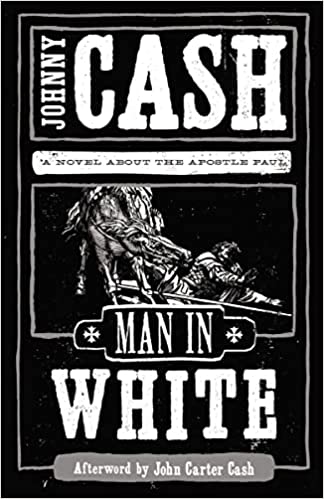
“Man In White” by Johnny Cash: Book Review

By Elizabeth Prata

Johnny Cash wrote a novel on the life of Paul. Yes, THAT Johnny Cash, known as the Man in Black. (1932-2003).

It shouldn’t really be a surprise, because although Cash was known for his singing, he was also a songwriter. He was inducted into the Nashville Songwriters Hall of Fame in 1977. He wrote over a hundred songs. He was also an actor, appearing in television shows and movies, more of them than you think. He was creative.

Cash also is famously known for his struggles, his Christianity, and his marriage, usually all tied up on one knot.


He began drinking and using drugs in the late 1950s when his career took off and he needed to stay awake on the punishing long tours. He drank. He became drug addicted. He smuggled drugs, caused a terrible forest wildfire that nearly killed him, was arrested several times, divorced his first wife, and spun out. He sobered up stayed in control for some years in the 1970s, and got addicted again winding up in the Betty Ford clinic for drug rehabilitation in the 1980s. His final rehabilitation was in 1992.

Cash was raised by Southern Baptists. He claimed to be a Christian throughout his life. With wife June, Johnny completed a two-year course of study in the Bible through Christian International Bible College, receiving a theology degree. He and June made a pilgrimage to Israel in November 1978. He was also ordained as a minister around that time.

Johnny Cash was a creative Christian man interested in the things of Christ, so it’s no wonder he wrote a novel about the Life of Paul. It’s called “Man in White.” I looked at the question of “Is novelizing a book of the Bible or a Bible character’s life adding to scripture?” here. Some believe yes others, no.

I appreciated Cash’s preface to the book. In it, Cash described his research process, his interviews with Jewish rabbis and biblical scholars, and his trip to Israel. He described his thoughts about why he wrote the book. He explained it humbly, too, another thing I liked about the introduction. His explanations satisfied any lasting qualms I had about a novelization of a Bible character’s life.

In reading Man in White, it seemed to me that Cash took what was known about Paul, the culture of the day, the temple, the Pharisees etc, and depicted it accurately. We know of Paul’s zeal for Christ as one of Paul’s endearing and awe-inspiring character traits. We also know that Paul prior to conversion was zealous for the Temple and that he was fervent in killing Christians. Cash took that personality trait of Paul’s – his unswerving religious zeal and his staunch commitment to God – and aptly showed how the Lord turned murderous zeal into a Gospel fervor for Jesus.

For example, we know Saul had a letter from the High Priest allowing Saul to kill Christians. Cash did a good job of showing Saul’s irritation at Christians over time turned into an almost unmanageable zeal and how it seemed to be unbalancing him. Saul ignored warnings from friends and the High Priest alike. Cash used the Bible’s letter scene by showing Saul committing to a 7-day fast in preparation for putting into action his commitment to wipe out Christians everywhere he found them. Yet also sensitively showed Saul’s niggling doubts, and how he suppressed the truth in unrighteousness every time his conscience reared up.

We know that Paul had a father who was a Pharisee. (Acts 23:6). We know he had a sister and a nephew, mentioned in Acts 23:16. We also know that Jesus said he would cause division in families. (Luke 12:49-56). So Cash took that concept and made an issue with Saul’s conversion from zealous Pharisee to fervent Christian and depicted a split in the family between his sister and her husband. Cash created a fictional but plausible scenario where after Paul’s sister might have converted, and her husband then sought a bill of divorcement and also split from Paul. The sister’s resulting struggles as a hunted single Christian woman were similar to struggles we know Christian characters had with converting during that time of persecution.

I also thought Cash’s depiction of the three days of blindness Saul/Paul had after encountering Jesus on the Road to Damascus was plausible. He wrote what Paul must have been thinking, of the fears of Christians to have Paul in their midst, and so on.

Where it depicts biblical events, it’s accurate. Where it shifts into novelization, it’s plausible, staying true to the concepts of the time. All in all, my opinion is that “Man in White” is a worthwhile book.

Posted in poetry, Uncategorized

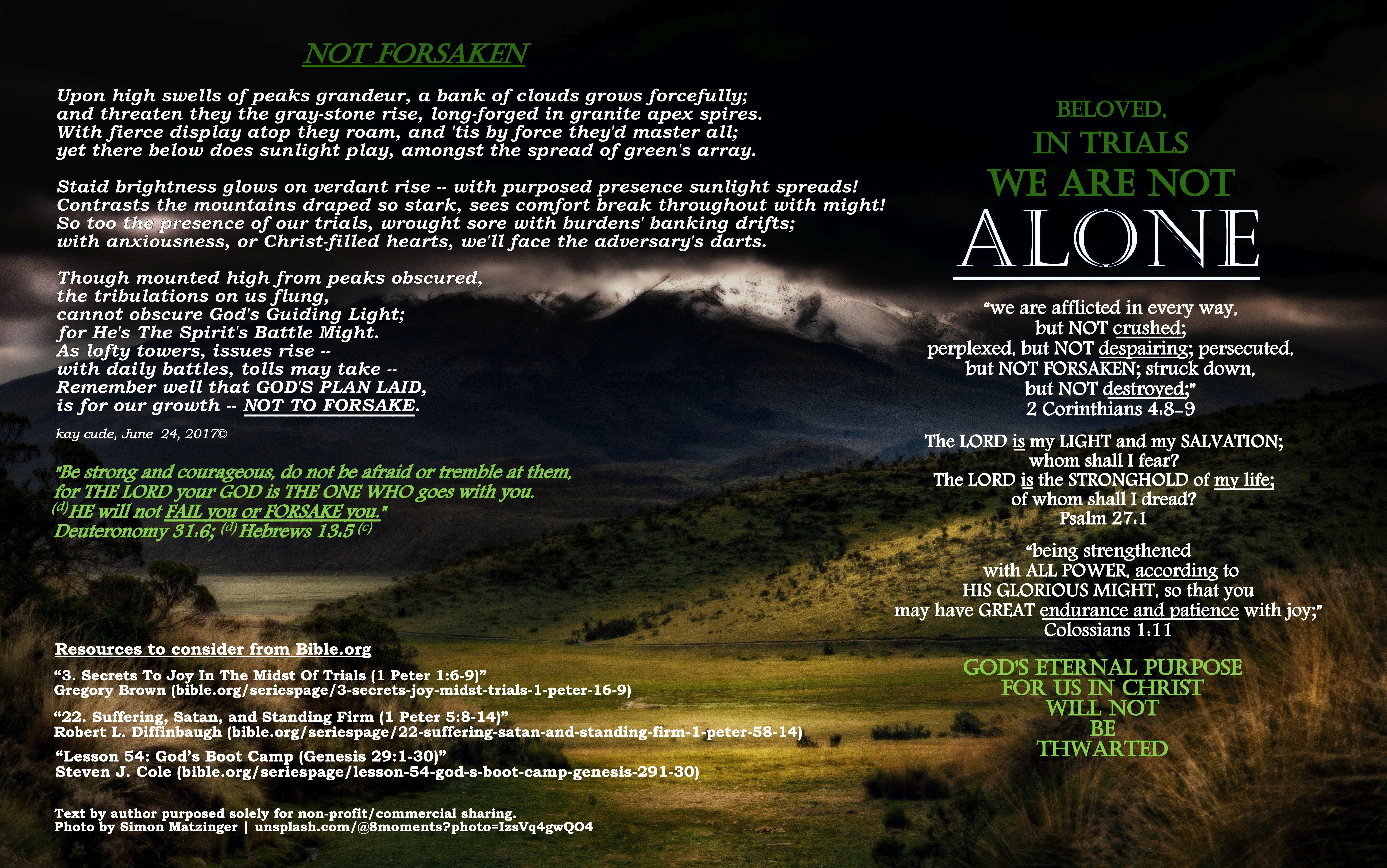
Poetry by Kay Cude: In Trials We Are Not Alone

Poetry by Kay Cude. Used with permission. Right-click on photo to see larger in new tab. Artist’s statement below.

NOT FORSAKEN, NOT ALONE

Artist’s Statement:

Sometimes the trials we go through seem never-ending! It often appears that they are gathered together and perched atop a high place just waiting for an “exacting” moment in which to unleash themselves. Even worse, they seem to multiply in force, if not line up one-after-another like a hoard of paid hooligans determined to batter us down into hopeless and “fruitless” Christians–or worse as assassins, prepared to annihilate us completely!

As they strengthen the tactics of those “assaults,” we can be assured that God remains in control, from the start of the trial to the very end. He will not forsake us–He will grow us!! He provides the “weapons” we need to endure and overcome, as well as prepares us by the renewing of our minds through His Word! The battles are His. Trusting and relying on Him enables us to learn, endure and overcome! Trusting and relying on our “flesh” enables disastrous consequences.

When at our lowest point, that point of exhaustive weakness where we become more vulnerable to fleshly speculation, we must not permit ourselves to wonder if we are alone. We are not!! And we know this!! We will remember that our weakness is exactly where it must be; for in that weakness, our strength is Christ! Through difficulties, trials or persecution, God is present and He is working. He never abandons His beloved redeemed–He teaches and strengthens us! We must allow Him to mature us and stop employing our “fleshly” reasoning and efforts!

We will remember Paul’s example in 2 Corinthians 12:9-11: 9 “And He has said to me, ‘My grace is sufficient for you, for (A)power is perfected in weakness.’ Most gladly, therefore, I will rather (B)boast [a]about my weaknesses, so that the power of Christ may dwell in me. 10 Therefore (C)I am well content with weaknesses, with [b]insults, with (D)distresses, with (E)persecutions, with (F)difficulties, (G)for Christ’s sake; for (H)when I am weak, then I am strong.”

We will remember that it is God who sovereignly allows our tempering as fine gold through the many refining fires of trials. Therefore, let us be refined into the golden metal of God’s mettle. And in our trials display the strength of character with Spirited determination that marks the mental and emotional character unique to those matured through the purposeful workings of the Holy Spirit of God in us!

YES AND AMEN!! GOD’s eternal purpose for us IN CHRIST will not be thwarted! What joyful hope and assurance we have obtained!