Wherever the corpse is, there the vultures will gather. Does the bell toll for thee, SBC?
Introduction & Disclaimer
I am not a fan of the SBC. I’ve been member of churches who were part of the Convention. I’ve watched the denomination for some time now. I don’t like the direction they are going and I haven’t for a while. But I haven’t said much about it because ultimately it’s 1) for my pastors or elders to decide, and 2) it doesn’t affect me much in spiritual life, my ministry, or my daily routine.
This will be my only blog on the SBC Annual Meeting.
There are two main parts to time immediately before Christ comes: the End Times and the Tribulation.
The end times are characterized by signs that are spoken of by Peter, Timothy, Jesus, Daniel, Isaiah, and in other books of the Bible in both the New and Old Testaments. The end time began when Jesus ascended in Acts 1:11 and will end at His return in Revelation 19:11.
The Tribulation begins when the Antichrist confirms a seven year covenant (treaty) with Israel. Daniel 9:27, Daniel 12:11. Then, a series of seven seals are opened.
The first four seals release a horseman as each are opened in turn:
White: the Antichrist, Revelation 6:2
Red: War, Revelation 6:3-4
Black: Famine, Revelation 6:5-6
Pale/Chloros: Death, Revelation 6:8
Fifth Seal: Death of Martyrs, Revelation 6:9
Sixth Seal: Great earthquake/moon as blood/sun darkened, Revelation 6:12
Seventh Seal: ushers in the next series of judgments. The Trumpets. These will be so harrowing there is silence in heaven for half an hour.
Trumpet 1: Hail and Fire burn up grass and 1/3 trees, Revelation 8:7
Trumpet 4: Removal of 1/3 light on earth, Revelation 8:12
These judgments remove 1/3 of everything we need to live: water, vegetation, light. Thus ends the ‘easy’ part. Now God gets tough.
Trumpet 5: Scorpion-Locusts from the Abyss, five months torture from their stings, Revelation 9:1-12.
Trumpet 6: Four angels bound in Euphrates loosed and kill 1/3 mankind, Revelation 9:14
Trumpet 7: Initiates Bowl judgments. “Great” Tribulation begins. This is when satan is cast out of heaven (Revelation 12) and he becomes so angry that he tries to kill the Jews, (Revelation 12:12-13) but they flee to the wilderness (understood to be Petra in Jordan) (Revelation 12:14) and so satan turns his hate and anger and frustration to the Christians. (Revelation. 12:17)
Bowl 1: Painful sores upon those with the Mark, Revelation. 16:2
Bowl 2: Sea into blood, all seas & creatures die, Revelation. 16:3.
Bowl 3: All fresh water turns to blood, Revelation. 16:4.
Bowl 4: Sun scorches people with fire, people curse God, Revelation 16:5
Bowl 5: Antichrist’s throne & kingdom thrown into total darkness, Revelation. 16:10
Bowl 6: Euphrates dried up, enabling Kings of East to assemble armies at Armageddon, Revelation. 16:12.
Bowl 7: “It is done!” Earthquake so great every island and mountain pass away, 100lb hailstones fall upon men. Revelation. 17:21.
The Harlot of the One World Religion is destroyed and the battle of Armageddon takes place when Jesus returns with his church in victory. He reigns for 1000 years! Revelation 17,18 and 19. Praise God!
Good links to more about the chronology with commentary and explanations:
Yesterday I posted an excerpt from a chapter from a book called GETHSEMANE—Leaves of Healing from the Garden of Grief by Newman Hall, 1891. His bio:
Christopher Newman Hall (1816-1902), born at Maidstone and known in later life as a ‘Dissenter’s Bishop’, was one of the most celebrated nineteenth century English Nonconformist divines. He was active in social causes; supporting Abraham Lincoln and abolition of slavery during the American Civil War, the Chartist cause, and arranging for influential Nonconformists to meet Gladstone. His tract Come to Jesus, first published in 1848 also contributed to his becoming a household name throughout Britain, the US and further afield, supposedly selling four million copies worldwide over his lifetime.Source Wikipedia
Christopher Newman Hall (1816-1902), born at Maidstone and known in later life as a ‘Dissenter’s Bishop’, was one of the most celebrated nineteenth century English Nonconformist divines. He was active in social causes; supporting Abraham Lincoln and abolition of slavery during the American Civil War, the Chartist cause, and arranging for influential Nonconformists to meet Gladstone. His tract Come to Jesus, first published in 1848 also contributed to his becoming a household name throughout Britain, the US and further afield, supposedly selling four million copies worldwide over his lifetime.Source Wikipedia
His famous tract Come to Jesus can be found at Chapel Library and read for free.
Even if you don’t read the Old Testament much, most believers know the story of Job and his friends. God initiated a conversation with satan, where God called Job “a blameless and upright man, fearing God and turning away from evil.” (Job 1:8). God asked satan if he had noticed that. Of course satan had, and pouted that of course Job loved God because he lived on easy street, but if satan could just get his hands on him, he’d prove that Job only loved God for what he could get out of Him. God said, OK, go, do it.
We know that the rest of chapter 1 and chapter 2 records horrific events, all against Job. Job never sinned with his lips, though. He maintained his devotion to God. Job’s faith was separate from his circumstances. He never blamed God. (Job 2:10).
Job’s friends heard about the utterly disastrous state to which Job had been reduced, and came to commiserate with him. The theology of the time, then and right up until the time of Jesus’ incarnation, was a literal you reap what you sow. If you were rich, prosperous in all things, and healthy, you were righteous. If you were sick, poor, crippled, enduring tragedy of some sort, you were being punished for sin. (Luke 13:1-5, John 9:2). They thought that outward circumstances were a reflection of inward spirituality and standing with God.
Job’s friends, after a good start of showing empathy and giving comfort in silence, then began to hammer Job with their theology, charging Job with secret sin. They kept on, and on, and on. Job got sick of it and said they were miserable comforters! (Job 16:2). But the point was, Job’s circumstances didn’t alter his faith. He loved God for who He is, not for what his life was like moment to moment.
We are also probably familiar with the story of Naomi and Ruth. Naomi was from Bethlehem in Judah. She married and had two sons. However, there was a famine in the land, so when they heard there was food in Moab, they moved there. Her husband died. The sons married Moabite women. The sons died. Naomi was left without husband or sons, and saddled with two other widows to boot. These were dire circumstances for a woman of that time. With no way to gain income or to work hard enough in the fields to support herself and her two daughters-in-law, Naomi became disconsolate.
She heard that the LORD was moving in Judah and now there was food. Naomi resolved to go back to her homeland and re-settle in Bethlehem, and urged her two daughters-in-law to go back to their parents’ home in Moab. Naomi was bitter. She was pouting because she had no husband or sons, was too old to get more sons, and actually said her lot was worse than her daughters-in-law, (who had lost their own husbands and were grieving too!) Naomi actually said “The hand of the LORD is against me.”
Ruth resolved to stay with her mother-in-law, to help and comfort the woman. When they got back to Bethlehem and people said ‘Naomi’s back!’ Naomi actually replied,
And when they had come to Bethlehem, all the city was stirred because of them, and the women said, “Is this Naomi?” But she said to them, “Do not call me Naomi; call me Mara, for the Almighty has dealt very bitterly with me. I went away full, but the LORD has brought me back empty. Why do you call me Naomi, since the LORD has testified against me and the Almighty has afflicted me?” (Ruth 1:19-21).
Naomi felt she had lost everything. She’d been hungry, widowed, and her children died. She blamed God numerous times. Her faith was bound up in her circumstances. She was the opposite of Job.
Is your faith bound up in how prosperous you are or what you’re feeling at the time? Do you praise God when things are going well but blame satan when things take a downturn? Or worse, blame God? Or is your faith steady no matter what is going on around you? That’s harder, especially if, like Job, you have friends who insinuate that your circumstances are due to judgment or sin or punishment.
Strive to be a Job when things turn “bad.” Or if you’re in a prospering season, strive to be a Ruth and encourage someone else who is having a hard time. Ruth’s constant loyalty and kindness to Naomi was a standout feature of the book of Ruth, while Job’s friends’ spiritual harangues and moral indictments were a standout feature of the book of Job.
One of the hardest things to do is praise God in joy when trouble comes. (Philippians 4:11-13). It was something Paul had to learn. But we can learn it too.
Birth pangs, or labor pains, are defined as “One of the repetitive pains occurring in childbirth. Often used in the plural. Also: Difficulty or turmoil associated with a development or transition.” Birth pangs are an event that is unstoppable, they increase in intensity and frequency, and result in a new creation. During labor, the mother is in throes, sweats, and travails. When it is over there is peace, and rest.
God is fully in control and He has always sent weather to show His wrath, or to shake up the people, or to render judgment. He sends snow: Job 37:6“For to the snow He says, ‘Fall on the earth,’ And to the downpour and the rain, ‘Be strong'”
He sends hail. Psalm 105:32: “He gave them hail for rain, And flaming fire in their land.”
He sends drought, earthquakes, thunder, and so on.
In a different kind of judgment, He also lifts his hand of restraint and gives a people over to their desires. (Romans 1:18-32). It’s less dramatic than the showy weather related ones, but in all ways more devastating judgment. John MacArthur describes the wrath of abandonment:
In Hosea 4:17, it is recorded that God said, “Ephraim is joined unto idols; let him alone.” There comes a time when God abandons men. God comes to a point where He lets a people go, lets them go to the consequences of their own sinful choices. They will not accept His counsel, they spurn all His reproof, as Proverbs says, so they eat the fruit of their own choices and they have to be satisfied with the devices they have chosen. Of the Pharisees, Jesus said, “Let them alone; they are blind leaders of the blind.” Matthew 15:14, the most terrifying words, “Let them alone.” Source- John MacArthur
The runaway inflation the US is currently experiencing, the squeeze of our budgets to buy groceries and gas, the racial and sexual and gender agendas seemingly succeeding, even overtaking our children, the rampant abortions, is emotionally difficult to endure. God’s judgment on a nation as seen in the Bible is often displayed in giving us over to our desires and no longer restraining us. When a nation is under judgment He gives them bad leaders and women leaders. Surely America is under judgment…
Josh Love said recently,
Does everyone understand that America is reaching the level of Sodom and Gomorrah and in some aspects have surpassed it already? I fully believe America’s judgment is going to be much worse than Sodom’s or just as bad. Repent & trust Christ today to flee the wrath to come.
Cognitively, we understand we are no better than Sodom or Gomorrah and in many ways a lot worse, and we understand we are deserving of judgment. Emotionally, it’s so hard to watch, though. On the one hand, to see the LORD’S power is fearful and awesome. To watch His promises unfold is a blessing, hard as these particular promises are to endure. But also with the increase in intensity and frequency of birth pangs comes heartache and tragedy for people. People we know and love are travailing. People we do not know are weeping in grief. Children lose parents, parents lose children. The unsaved are at increased risk of their fate: eternal separation from God! The terrible times Paul said would come are indeed here.
and yet, to the good of those who love Him-
“Affliction awakens the sins in our hearts that we didn’t realize were there. Seeing the truth about ourselves produces the fruit of humility.” — Christina R. Fox
Are we in ‘the end time”? Yes. The last days spoken of by Christ in Matthew 24 and elsewhere in the New Testament, are the times between His ascension and His return. All of the Church Age, so to speak. So yes, it’s now. Christ has never been closer to His return than He has ever been since the writing of the New Testament.
We are not in the Great Tribulation but we are in the expansive period between 33 AD and the promised return of the future, which is characterized by birth pangs. One could assert the birth pangs began in 64 AD at the Great Fire of Rome, which Roman Emperor Nero blamed on the Christians. Thus, the first wave of persecutions started. The Church believers were martyred and those who survived dispersed over Asia Minor. How much more intense are birth pangs after 2000 years? Intensifying, even if the Lord tarries another 1000 years, birth pangs intensify over time, and we are feeling their intensity here in American and elsewhere on earth.
For me, it is a most terrible time knowing that as each day passes, many more unsaved are sent to their eternal destiny. The loss of so many unsaved is a heartache beyond comprehension. I know that for the Lord it is even worse, for “God is not willing that any should perish, but all should come to repentance.” (2 Peter 3:8-10). Unfortunately we know that many still go on the broad way, to their destruction.
Hardest of all though is watching coldness overtake love, and apostasy or apathy overtake zeal. People are falling away from their first love at a terrible rate. It’s hard to watch church betrayals, spiritual abuse, denominational political agendas, all substituted for strength in the Lord and love for His people.
Provost & Research Professor of Theology, @GBTSeminary Owen Strachan said, “The thief in the night is coming, so keep your bags packed and ready by the door. I urge you to pray for the church in this hour, saints. Denominations aside, Satan is pressing his attack on the bride of Christ. Pray hard for the strengthening and endurance of the body, assaulted from all angles as we are. Pray that we will trim our lamps and await our King.”
Christian, please continue praying. Stay strong, appealing to the Holy Spirit to stand us upright. Now is not the time to quail, cower, or quit. “Do all things without grumbling or disputing; so that you will prove yourselves to be blameless and innocent, children of God above reproach in the midst of a crooked and perverse generation, among whom you appear as lights in the world,” (Philippians 2:14-15).
The world needs the light of Jesus now more than ever. Be that light, in prayer and in love.
Do you feel like you want to make an impact for the Kingdom, but you’re insignificant and what you’re doing amounts to nothing? Do you feel like the glories you share about Christ fall on deaf ears, passed over and powerless?
When we love Christ, we do our best to proclaim Him in whatever way the Lord gives us to do so, and as much as we can. But the Christian walk oftentimes is one of plodding, and as we tread through the days on our calendar, sometimes we might feel like though our hearts burst with love and dedication, our sphere is too small to make any difference at all. We are not a mighty redwood, but a small ant.
Romans 1:20: “For since the creation of the world God’s invisible qualities; his eternal power and divine nature; have been clearly seen, being understood from what has been made, so that men are without excuse.”
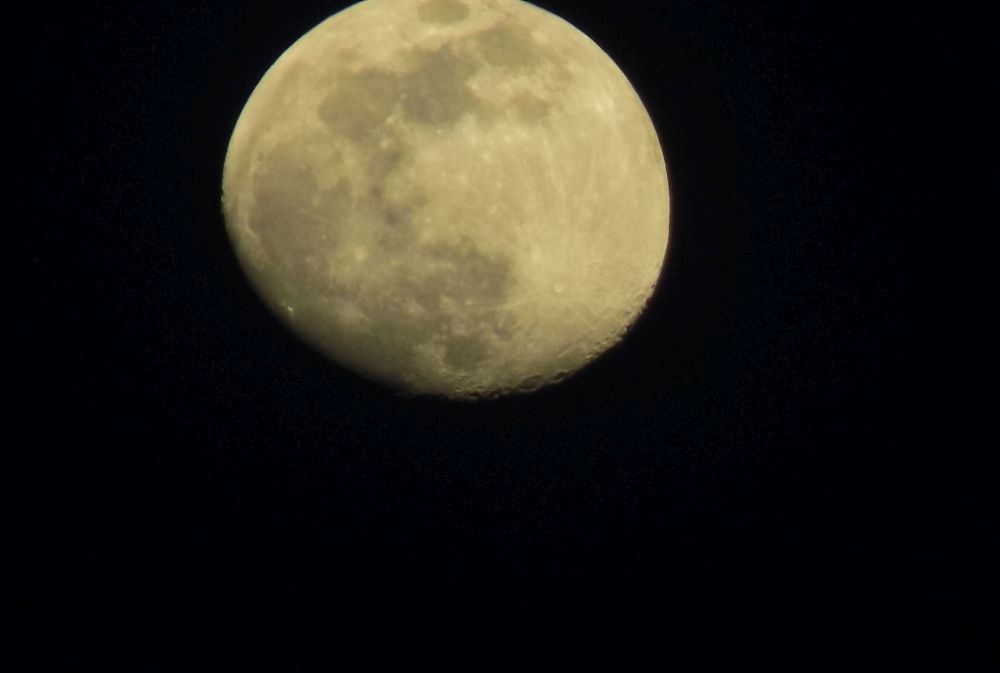
Beauty in this world is an echo of Eden. Our very souls in their innermost parts know God is in the center of the beautiful. No? Then why do we sigh when the sun dips below a beautiful sunset? Why do we ache for the sweep of the tide and the undulations of the ocean? Why do we thirst for moonrise, settle into the sway of the pine tree? God is beauty. We long for the open spaces of our soul to be filled with His empyrean substance as expressed through nature.
Is it true that a person can come to know about God through nature? Yes. The scriptures say so, and that is the ultimate authority. It is how I came to know God. It is how I was so perplexed about how the world came into being was confused and why we humans existed upon it.
As I traveled, each time I saw an amazing natural event I’d think: “this could not have all come about by chance.” I’d think, “I do believe God is behind all this. It is too beautiful otherwise. Too complex.”
Satan, created the most beautiful of all angels, perfect in beauty (Ezekiel 28:12, 17), likely could not get humans to dispense entirely with the planet’s beauty, so the environmental movement is about being utilitarian. We don’t say ‘save the environment because it is beautiful!’ we say ‘save the environment because we can get stuff out of it!’ The environment is just someplace we extract energy rather than experience beauty and perhaps, contemplate God. God shines in His glory in the heavens and in His whole creation and as far as satan is concerned, the less we see it as beautiful the less chance we will see of God in it.
Second, our lives are increasingly crowded. We are over-scheduled. Our mental life is increasingly devoid of meditation time, imagination, contemplation. Every moment is utilitarian. I am grateful that I had the opportunity to reflect on the wonders in nature I was seeing during my travels. If I was too busy commuting and working and scheduling every moment I never would have pondered the larger things. And never have eventually wondered about God in them. Satan diminishes the glory of God’s creation to a utilitarian product and crowds our lives with less time to contemplate it.
It is one of satan’s methods to combat Romans 1:20, squeeze out the beauty in the world. 2 Timothy 3:3 tells us that in the end times people will be brutal;… brutality isn’t beautiful, is it?
Beauty draws you. Combat satan. Consider beauty. God is there. Praise the Creator for His wondrous works!
We read in so many books aimed at Christians that there is a secret code in the Bible. That life has a secret code. That there’s like hacks based on a code (enneagram, anyone?). There are no secret codes in the Bible and the only life hacks that do exist in the Bible are either indicatives or imperatives. But did you know there IS a secret, recently discovered, code to the universe?
I remember vividly when it was discovered and the wider general public became aware. January 1983. I subscribed to Smithsonian Magazine, the magazine associated with Smithsonian Museum. The cover displayed a weirdly balloon-like object on the cover, even more weirdly named a “fractal.” Intrigued, I read the article. I read it again, and re-read it many more times over the years, keeping that edition long past its sell-by date.
I never quite understood what fractals were or why the mathematics world was so excited about them. I wished I understood it. I wanted to understand it. I sensed its importance. But the point escaped me.
I wasn’t saved then.
Now I am.
This week I found a Christian scientist teaching about fractals at the Answers in Genesis Conference. His name is Jason Lisle and here is his bio:
Dr. Jason Lisle is a Christian astrophysicist who researches issues pertaining to science and the Christian faith. Lisle earned a PhD in astrophysics at the University of Colorado in Boulder. Dr. Lisle has worked at Answers in Genesis, the Institute for Creation Research, and is the Founder of the Biblical Science Institute. (Source)
Now, why are fractals a code to the universe?
When we discover a mathematical truth we have discovered something about the way God thinks.
The original fractal, now called the Mandelbrot set, after its discoverer
The video below is a really understandable video of Dr. Lisle explaining fractals and why they are a code to the universe, a peek at God’s mind, AND a mind-blowing, awe-inspiring concept. In fact, in watching him explain it (he does it really well- you WILL understand it!) I actually teared up with joy at seeing this peek at something that is behind and supports God’s creation- the universe. I urge you, if you’re feeling down, if you want to glimpse our Holy God, if you are simply curious, or for any reason at all, to watch the video!
Here are some other creation beauties. I applaud, exalt, and praise our God for His incredible beauty. RC Sproul used to say that God is good, true, and beautiful. He’d often ask, “What happened to beauty?” I am fascinated by this question and I speak of it often. Here are a few mind-blowing examples of our Beautiful Creator!
God has made everything beautiful in its time; also, He has given human beings an awareness of eternity; but in such a way that they can’t fully comprehend, from beginning to end, the things God does (Ecclesiastes 3:11).
This isn’t CGI, it’s a real-life creature known as a sea angel (Clione limacina) found in the cold waters of the Arctic and North Atlantic Oceans.
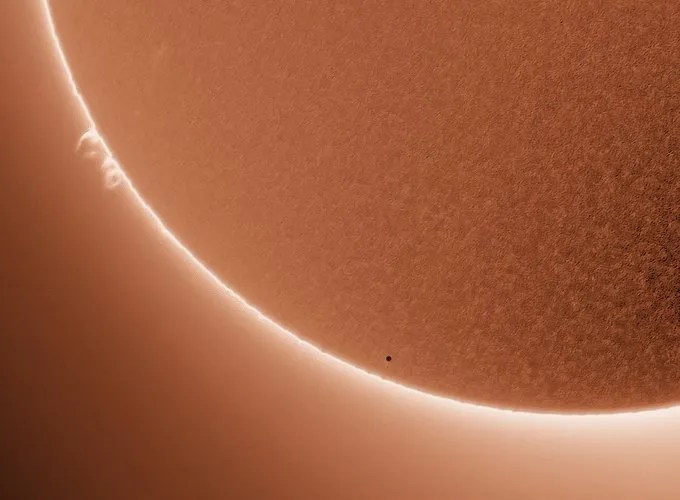
Did you know that Mercury is a planet AND a comet? Here’s NASA-
The black dot is Mercury! Photo from NASA
“Researchers have known for years that Mercury has a huge tail. Last week, Andrea Alessandrini photographed her from the balcony of his home in Veroli, Italy. … First preceded in the 1980s, Mercury’s tail was discovered in 2001. Its origin is Mercury’s super-thin atmosphere. Mercury is so close to the sun that the pressure of sunlight can push atoms out of the atmosphere into space. The escaping gas forms a tail more than 15 million miles long.“
We contemplate God in church when we worship, when we pray, when we read the Bible. But please take some time to contemplate Him as Creator.
Genesis 1:1 – In the beginning God created the heavens and the earth. Job 12:10 – In his hand is the life of every creature and the breath of all mankind. Psalm 8:3-4 – When I consider your heavens, the work of your fingers, the moon and stars, which you have set in place, what is mankind that you are mindful of them, human beings that you care for them? Psalm 104:24-25 – Lord, how many are Your works! In wisdom You have made them all; The earth is full of Your possessions. There is the sea, great and broad, In which are swarms without number, Animals both small and great.
Contemplate the beauty of His creation and His beauty itself.









 the-end-time.org