With today’s post, we’ve now flowed through the first section of this series, in looking at verses that prophesy Jesus’ coming, His arrival, and His early life.
Starting tomorrow, from Day 12-16 we will look at verses that focus on Jesus as The Son.
From Day 17-26, verses will focus on the preeminence of the Son, His works, and Ministry.
Days 27-36, His resurrection, ascension, and return.
Yes, there are more than 30 verses, lol. There’s a postlude.
Coffman’s Commentaries on the Bible
The precocious wisdom of the boy Jesus, and his certain consciousness of his unique relationship to the Father in heaven, were not looked upon by Jesus as sufficient to his earthly mission; he recognized himself still to be a child. The hour of his emergence as the world’s Saviour would be awaited by him until some sure indication of the Father’s will informed him that “his hour” had come. In the meanwhile, he would not disgrace himself as a child prodigy. He manifested the noblest quality of youth, that of loving submission to his earthly parents.
Jesus honors the authority of His Father through complete obedience. A very clear but seldom pondered truth of the New Testament is that Christ’s entire life and ministry were orchestrated by His Father and that Jesus was careful to carry out every detail according to the will of His Father. “Then I said, ‘Behold, I have come . . . to do thy will, O God’” (Hebrews 10:7).
~~~~~~~~~~~~~~~~~~~~~~~~~~~~~~~~~~~~~ Thirty Days of Jesus Series-
With Him are wisdom and might; To Him belong counsel and understanding (Job 12:13).
Further Reading:
The Day Jesus Went AWOL Second, in this account are recorded the very first words of our Lord Jesus. Naturally, no words were recorded from the birth and infancy of Christ. Many of our Lord’s words were recorded from His later ministry. But the words of our Lord in this text are His first recorded words, and very important words they are indeed.
Twelve-year-old Jesus goes to the Temple After the host of witnesses to Jesus in Luke 1:5–2:40, Jesus now speaks for himself for the first time. This is the literary climax of Luke’s initial section and shows the sense of mission and self-awareness Jesus possesses. Jesus has a unique relationship to God and a clear sense of his calling, one that transcends his relationship to his earthly parents.
This is the only story in the gospels about Jesus between his infancy and his public ministry as a man. Some have argued that the story is a legend created by the early church to fill in some of the gaps in their knowledge of Jesus’ life. What shall we say to this claim?
We are still in the section of verses from the Bible depicting the prophecy of Jesus’ coming, His arrival, and His early life before ministry. With two more days after today to go, then we shift into looking at Jesus Himself, His earthly ministry, and the different aspects of Himself that He displayed.
There are not many verses recounting the childhood and pre-ministry life of Jesus, but there are a few. Here is one:
What happened during Jesus’ childhood? Other than Luke 2:41–52, the Bible does not tell us anything about Jesus’ youth. From this incident we do know certain things about Jesus’ childhood. First, He was the son of parents* who were devout in their religious observances. As required in the law, Joseph and Mary made the yearly pilgrimage to Jerusalem for the Feast of the Passover. When Jesus was 12 years old, they brought Him along on the trip to celebrate the Feast with them. Luke paints a picture of a typical boy in a typical family of that day.
Although the boy Jesus was gifted with a wisdom far beyond His years — a wisdom which was His because He was the Son of God, yet He lived much as other boys lived, doing the tasks that were given Him by His parents and being subject to them in all things.
We are told many times in our wonderful Bible to live well. We must walk uprightly says Psalm 84:11. We should ‘give heed to the blameless way’ says Psalm 101:2. MANY other Psalms advise the believer to walk in God’s ways.
In the New Testament, Romans 12:3 tells us not to think of ourselves more highly than we ought. Ephesians 4:1-3 spends a good amount of time instructing the believer to walk rightly. In 1 Peter 1, we are explicitly called to holiness. We must pursue it. And so on. We know all this, right?
We must live well.
We must also die well.
Death is always a shock. Even for the believers who possess eternal life and the hope of seeing Jesus one day and reuniting with His previously departed children, we’re shocked when death occurs. For us, one day, the warm hand of the Lord will curve around us and carry us to eternity. Yet it’s still a shock to our system to have a cognitive reality become real and present. Our minds know, but we don’t really KNOW until it happens near to us.
For the unbeliever, it’s worse. They hardly ever think of death. Their mind won’t go there, it’s too painful. When the icy hand of death visits near to the unbeliever, the pain of not comprehending it is too heavy to bear. They have no hope and thus, when it happens near to them, they grieve hopelessly.
Sometimes death comes like a lightning bolt, quickly and instantly. In 2006 the world was shocked and saddened to hear of Australian zookeeper ‘Crocodile guy’ Steve Irwin’s death by a stingray dart to his heart. His companion on the filming shoot said ‘if he’d been five feet one side or if he’d been coming from another direction or if the sun had been somewhere else, it wouldn’t have happened’…If-if-if. That is how the unbeliever sees death, something that can be managed. Handled with just the right set of circumstances. Death’s intrusion into a life is so unwanted that the mind supposes it can be avoided if…
Yet God is sovereign over all things, including death, which He conquered for humans on the cross. For some, there is no time for goodbyes. As Adrian Rogers said in his sermon “The Perils of Postponement”, some people climb into a car to go somewhere not knowing it will be the last drive they ever take. Do not boast of tomorrow, for it may not come.
Death could come suddenly as it did for Steve Irwin, or it could come agonizingly slowly, as Alzheimer’s does to people.
In between, the Lord is gracious to some. He marks some believers for a number of days that is shy of a full life span, but graciously allows death to make its presence known at the door for a little while prior to entering eternity. Goodbyes can be said. Hymns can be sung. Arrangements can be made. And before the pain of watching a soul’s light fade out becomes unmanageable (or even sinful), He takes them to His bosom.
Our church was given that grace last month. One of our elders’ wives was taken to her heavenly home. The time span was about 6 weeks from undiagnosed to eternity. An unknown brain tumor captured our lady’s life, but during the days she and her husband family were dealing with it, and though she never left the hospital after the surprise diagnosis came down, she was the very model of a Christian dying well.
We are called to live well and even die well, trusting Jesus from the moment of conversion to the moment our eyes close for the last time. How do we die well? Allow me to post some of the comments and updates shared publicly about our elder’s wife’s last weeks.
-God’s name already is being honored in how they are handling this challenging and difficult news. -Her physical suffering was horrific. Yet she did not complain. Not once during the 7 weeks. -Those who knew her best praised her as a “tremendous mom and she excels in so many areas.” -She even comforted others, patting their hand, and reminding that “God is in control.” -The sweetness of loving Jesus permeated her speech. Even as strength faded, her nods and whispers of love and trust in Him were frequent. -It was clear to see that God was being glorified by how she and her husband walked through this suffering.
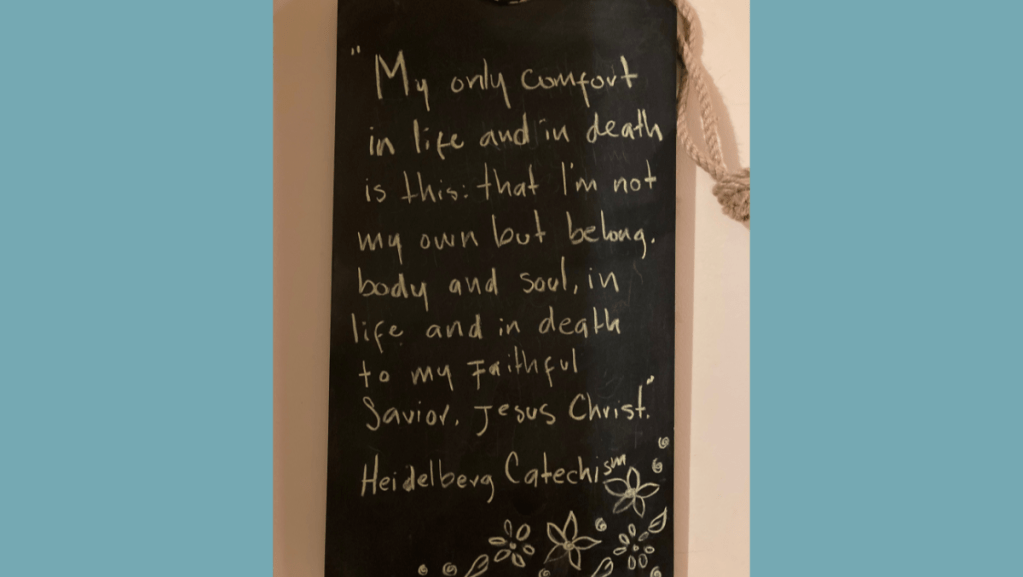
Her husband wrote: “Several weeks before we ended up at the hospital [she] was thinking a lot about the beginning of the Heidelberg catechism and was stirred by it. So, she decided to write up some of the answer to the first question on our board in our kitchen. The first question is: What is your only comfort in life and death? This picture is what she wrote (with her flowers in the corner).”
Jesus was her comfort in life, but she did not know that her death was near and that this bookend of life would also be her comfort in a few short weeks. This chalkboard reminder was not a response to a dread diagnosis, but was her response in all of her believing life, to trust Jesus in all:
We die well by living for Jesus. A family member wrote, “As the end approached, We were listening and singing along to hymns for about the final 45 minutes in her room at hospice yesterday. The moment she went to be with the Lord she was listening to Rock of Ages (the Amy Grant/Vince Gill version). It had just gotten past these lines…“
“Nothing in my hand I bring Simply to Thy cross I cling Nothing in my hand I bring Simply to Thy cross I cling.”
This is a beautiful paragraph from J.C. Ryle. The first sentence of this paragraph the Lord has powerfully pressed home these last few weeks. Ryle says:
“If you are a true Christian, you are far nearer heaven than you think. This very day if the Lord should take you, you would find yourself in paradise. The good land of promise is near you. The eyes that you closed in weakness and pain would open at once on a glorious rest, such as my tongue cannot describe.”
Here is a quote from RC Sproul that another elder read during one of the church services when we received an update:
“God is our refuge and our strength in times of trouble his promise is not only that he will go with us into the valley even more important is his promise of what lies on the other side of the valley God promises to go with us for the entire journey in order to guide us to what lies Beyond the Valley of the shadow of death is not a box canyon it is a passageway to a better country the valley leads to life – life far more abundant than anything we can imagine the goal of the vocation of death is heaven itself.“
And then, we received the news. “It is with profound grief and joy that we share a message to our church family this morning:“
“Yesterday (11/24/22) [she] went to heaven. She went to fullness of joy and pleasures forevermore. She saw the Lord Jesus and heard those wonderful words: ‘Well done good and faithful servant, enter into the joy of your Lord.’ Thank you all for the thousands of prayers that have been made for her. Her faith was so strong. I thought this was really good from Tim Challies (who lost his son Nick 2 years ago). He said: ‘The apostle Paul insisted that to live is Christ, and to die is gain. There is gain to be had in death, and it’s the gain that comes when we are released from all that is evil and awakened to all that is good. I would not summon Nick back to this world if I could, for that would be to rob him of the greatest of all gains and to force him to experience so much loss.'”
Our lady fought the good fight, she finished the race, she kept the faith. The LORD graciously gave her an opportunity to witness to the peace of Christ. May much GOOD come of it.
“We are not doomed to an ultimate conflict without hope of resolution. The message of Scripture is victory-full, final, and ultimate victory. It is not our doom that is certain, but Satan’s. His head has been crushed by the heel of Christ, the Alpha and Omega. Above all suffering and death stands the crucified and risen Lord. He has defeated the ultimate enemy of life, vanquished the power of death. He calls us to die, but that call is a call to obedience to the final transition of life. Because of Christ, death is not final; it is a passage from one world to the next.”
Such peace does not come the day after the dread diagnosis. It does not come while lying on the hospital bed. It does not come when hospice looms. It only comes from loving the Lord and pursuing Him all the days of your believing life. So that when these moments come, He is the Rock upon which we stand.
We will meet again, dear lady, we all will, freed from the shackles of sin and death and surrounded by the glory of Jesus and joy eternal.
The Lord granted us who watched these last few weeks, a beatific vision of how to die well. Dying with peace, and trust, and assurance of a better country. It was a grace He gave us, even as we say so through tears.
If you do not know the Lord today, please heed these words: death comes for us all. Sometimes it is sudden and there is no time to prepare your soul for it. Steve Irwin only had time to say “I’m dying”. Was it with surprise? Anger? Grief? We will never know.
Other times death creeps in slowly and agonizingly and causes blasphemy and curses (Mrs Job!). In other cases it causes one to look back rather than forward (Mrs Lot!). But it comes.
Our lady died with a blessing of the Lord on her lips. This is the difference Jesus gives.
Knowing the Lord Jesus is the ONE THING that matters most in this world. Here is an 8 minute video from Paul Washer quietly explaining what Christianity is and why you need Jesus.
She fought the good fight, she finished the race, she kept the faith. Till we meet again, sweet lady.
Many people worshiped Jesus during His earthly ministry. They bowed before Him and called Him the Messiah, Son of God, or other titles indicating they knew they were worshiping the one True God. Some people worshiped extravagantly. We think of Mary with her bottle of expensive nard, or David worshiping God with all his might before the ark processional.
No one came farther or brought more expensive tokens of worship than the Magi, known as the Wise Men from the East. Their journey of about 900 miles was difficult, fraught with danger, and took months. Their gifts of gold and frankincense and myrrh were expensive. But that was nothing to them. They journeyed, they found the child, they knelt before Him in humble worship. Though they themselves were considered rulers of sorts, when they saw His place they rejoiced exceedingly with great joy. (Matthew 2:9). They knelt before a little child and presented their gifts of adoration.
During this Advent, let us do the same. We do not have the blessing of an incarnated Messiah to bow to, that will happen later, but we can rejoice today with exceeding joy and present to him our precious gift: our bodies as a living and holy sacrifice. (Romans 12:1).
Grace To You: What the Magi Mean To Christmas Just exactly who are they and why are they there? Well, the question as to why they’re there is answered in the text, and that is to worship Him. They came to worship. That becomes absolutely clear. In chapter 2 and verse 2, they say, “We have come to worship Him.” That is their point. Herod even acknowledges this in verse 8 and says, “Come back and tell me when you find Him, that I too may come and worship Him.” Answers in Genesis: We Three Kings The Magi Arrive These magi followed the star, which moved ahead of them, bringing expensive gifts of gold, frankincense, and myrrh to Jesus—who was now a young child living in a house (Matthew 2:9–11).5 They worshipped the Christ Child (Matthew 2:11). Jesus is called a “young child” (paidion, Matthew 2) instead of babe (brephos, Luke 2:16) at the time that the magi arrived. Brephos specifically refers to a baby, whether born or unborn, while paidion refers to an immature child, possibly an infant (Matthew 2:11), so we should not be dogmatic about His age. Love Worth Finding: The Gifts of the Wise Men and Our Gifts to Jesus It’s that time of year again…time for gift-buying, gift-wrapping, and gift-exchanging. What are the gifts we could bring Jesus this Christmas? One way we can discover that is to look at Matthew 2:1-12, which tells of the gifts the wise men brought Him on the night when God became flesh and dwelt among us.
The beginning flow of this Advent series is a presentation of 11 verses overlaid on photos depicting the life of Jesus from prophecy to birth and boyhood.
The next section (#12-16) will feature verses about the Son as an adult God-Man.
From #17-26 we will survey the Preeminence of the Son, His attributes, and His ministry.
From #27-36 we’ll look at His Resurrection, Ascension, & Return.
Yes there are more than 30 verses. I just couldn’t pare it down! There’s a postlude.
All photos are by EPrata unless otherwise noted.
There is no better refreshment for the soul than to meditate on Him. Enjoy!
I will meditate on your precepts and fix my eyes on your ways. (Psalm 119:15).
Today’s verse: now that Jesus has been born, and the angels had announced His arrival to the Shepherds, who went to see with all haste this thing the angels had spoken of, now Jesus must flee. So we see from the first moments of His life, hatred against Jesus for who He is and what He has come to do. And so it will be for anyone IN Christ, as well. But His flight to Egypt did not happen before others made great efforts to come and see the Babe- namely the Magi from the East. It was their gift of gold which enabled the poverty-stricken Joseph and Mary to fund their flight to Egypt. God’s providence is perfect, and so is His timing.
Thirty Days of Jesus Series-
Further Reading
Bible Art: Adoration of the Magi by Giotto his picture—at once austere and tender—belongs to a series of seven showing the life of Christ. The masterly depiction of the stable, which is viewed from slightly below, and the columnar solidity of the figures are typical of Giotto, the founder of European painting. The impetuous action of the kneeling king, who picks up the Christ Child, and Mary’s expression of concern translate the biblical account into deeply human terms.
GotQuestions: What Does the Bible say about the Three Wise Men (Magi)? It is a common misconception that the wise men visited Jesus at the stable on the night of His birth. In fact, the wise men came days, months, or possibly even years later. That is why Matthew 2:11 says the wise men visited and worshiped Jesus in a house, not at the stable.
Answers in Genesis: We Three Kings The original meaning of mάgoi is likely in view here—wise men who interpreted special signs. There are at least three reasons for this identification. First, they acknowledged that they were interested in signs in the heavens.
Grace To You: Who Were the Wise Men? Vincent, who has written some very helpful word studies, says in regard to this, “Many absurd traditions and guesses respecting these visitors to our Lord’s cradle have found their way into popular belief and into Christian art. They were said to be kings and three in number. They were said to be representatives of three families of Shem, Ham, and Japheth and, therefore, one of them is pictured as an Ethiopian. Their names are given as Caspar, Balthazar, and Melchior.” You’ve probably heard that. And their three skulls, amazingly enough, are said to have been found. Yes, they were found “in the twelfth century by Bishop Reinald of Cologne.” The bishop dug those up and knew right off they were skulls. It’s very clear. And their eyes were still in the sockets fixed toward Bethlehem. Today, believe it or not, friends, they are on exhibit in a priceless casket in a great cathedral in Europe.
We’re in the section of the 30-day Advent flow of the prophecies of Jesus’ coming, his arrival, and his early life. Yesterday’s scripture picture was “The Babe has arrived” and the scripture was from Luke 2.
How can we go any further without pondering that He, the King of Glory, the Infinite, left glory to be wrapped in human flesh and dwell among sinners? To seek and save the lost, humbling himself not only as a God-Man, but departing His heavenly home of glory where He constantly received His due worship… To be rejected, despised among men, and killed. All for us, rotten sinners.
Our God is truly AMAZING!
Further information
God’s Glory: Ligonier Devotional We turn today to the first verse of the second chapter of James, wherein the apostle refers to Jesus as “the Lord of glory.” Even though this is an acceptable translation of the original Greek text, it is not necessarily the most accurate way to render the verse in English. As the note in the Reformation Study Bible indicates, it is also possible to translate “the Lord of glory” as simply “the glory.” In reality, it does not really matter which one we choose because the two translations are synonymous. However, to say Jesus is “the glory” is a good way to encapsulate a portion of the New Testament’s description of the majesty of Christ.
Thinking about Jesus: Owen on meditating on Christ’s glory In his devotional work, The Glory of Christ, John Owen provided five useful helps to meditate on Christ as a divine/human Person. I pass these meditations along to you, hoping that they will increase your devotion to Christ (you can read the full section in Owen’s Works, 1:312-322). John Owen’s quotes on Jesus’ glory (Goodreads) “No man shall ever behold the glory of Christ by sight hereafter who does not in some measure behold it here by faith.”
Bethlehem (around 2,000 years ago): Joseph and Mary arrive at the sleepy town in the middle of the night. Mary, already in labor, remains on the donkey while Joseph frantically searches for a room at the local inns. Desperate, he begs one reluctant innkeeper for any place at all to have this baby. The innkeeper finally relents and makes room for them in a tumbledown stable with the cows. There’s just one problem. This isn’t what the Bible teaches.
Read more from Answers in Genesis at the link above.
GotQuestions:What does it mean that baby Jesus was wrapped in swaddling cloths? Swaddling clothes are cloths and bands used in the practice of swaddling, or essentially “wrapping” an infant tightly in cloth. The idea behind swaddling is that it helps the baby transition from the womb (a very snug place) to the outside world. Swaddling clothes are still used today, but with some modifications…
We know that Acts 17:11 tells us to compare what a teacher is teaching to the Bible. Paul was not offended when the Bereans did just that. Instead, he called them noble! The main way you can tell if a person is teaching rightly, is by comparing what they teach and how they behave, with the Word.
Ladies, here is another way to begin detecting if the person you follow as a Bible teacher is false or true-
I see many Beth Moore defenders defend Moore’s teaching with emotional words and familar nicknames, such as ‘Auntie Beth’, saying they “grow closer to Jesus” through her lessons, and state other warm fuzzy type defenses of her teaching. But HOW do we grow closer to Jesus? There is only one way.
Any Bible teacher, if teaching rightly, will extract from the Bible its truths, including truth about sin and our need for repentance – not just upon salvation, but every day. He or she will then teach those truths. You will know you are “growing closer to Jesus” if said teaching-
reveals unknown sin in your heart, or if you are convicted of your sins, or if you drive yourself back to the Bible to seek Jesus, or if your affections change from carnal to holy, or if you learn more about Jesus, or if you desire to pursue holiness, or if you want to treat others above yourself, or all of the above!
Those are a few ways you can tell if you are ACTUALLY growing closer to Him.
This will happen because the true Bible teacher will be extracting truth from the Bible, which is living and active. Its writ thus delivered to you will knit conviction of sin, self-denial, and love for Jesus for who He is (not how He makes you feel or what you can get from Him).
If a teacher is false,
you will feel good and warm and have fuzzies during and after the lessons. But you know full well that emotions are fickle. They evaporate. or when the buzz of the teaching dissipates, you still feel the same, or if your knowledge of Jesus is less but your knowledge of that teacher is more, or if your prayer life isn’t energized, or your conscience isn’t pricked toward repentance, or if your affections haven’t changed, or if you still pursue carnal things at the expense of your conscience, or if you’re in a rut and decide to grab ANOTHER ‘study’ from that teacher because you need to feel good again, and not because you want to know more of Jesus, or all of the above!
then that teacher is false.
Why is she called “Auntie Beth” by so many? She makes people feel good. They enjoy her funny and charming personal anecdotes that makes them feel close to her in some way, a connection. She makes them feel cared for- but a false teacher’s love is a false love and a carnal love. It’s a carnal love because its origin is fleshly, which includes overlooking sin, love of self, and pursuit of a different Jesus than the one the Bible presents.
As for the cutesy nickname the flat screen admirers give Beth Moore, just think on this. We don’t call a Charles Spurgeon ‘Uncle Charlie’ or John MacArthur “Daddy John” or Paul Washer “Paulie dear”. Why not? Not that nicknames and familiar terms for people we admire are necessarily bad. But these men have a dignity in teaching that comes from their devotion to and teaching of the holy Word of God. Likewise older women are supposed to have a dignity as well, (Titus 2:5) exhibiting deep knowledge of doctrine and living a lifestyle that results in inhibiting such over-familiarity and pet nicknames from people.
Amy Carmichael’s sickroom was called The Room of Peace. China Missionary Gladys Aylward was called The Virtuous One. Spurgeon was called The Prince of Preachers. They received respectful nicknames and not cutesy ones because these teachers were unashamed of the Gospel. Remember, most people who call Beth Moore “Auntie Beth” don’t even know her personally, but know only the persona Beth chooses to present through a screen.
These concepts I’ve outlined in this brief blog stand for any teacher, but especially celebrity teachers such as Paula White, Joyce Meyer, Christine Caine, etc. Technology’s constant presence and our ability to stream material at-will 24/7 means that we tend to think that our favorite celebrity teachers and preachers are closer to us than they really are. True Bible teachers have students who learn and grow in holiness.
“[T]he true prophet must preach what he believes to be the truth, uninfluenced by any considerations of what will please others or profit himself, and must accept no man’s conscience as a substitute for his own, and must be ready to go on a diet of bread and water for a testimony to his sincerity-above and beyond all these, he must have laid hold of the eternal principles of divine government, and whole truths, not half-truths, must be the basis of his preaching.“
Source of above quote: True and False Prophets in 1 Kings, Chap. 22, Author(s): Dean A. Walker, Source: The Biblical World, Oct., 1902, Vol. 20, No. 4, pp. 272-277
Advent series in scripture photos. We are in the section of my Advent thirty day flow where we examine PROPHECY, ARRIVAL, and EARLY LIFE of Jesus.
‘He will save from sin…’ Do we even know of our sin? Matthew Henry says of the parallel Luke 1:35 verse:
JESUS! the name that refreshes the fainting spirits of humbled sinners; sweet to speak and sweet to hear, Jesus, a Saviour! We know not his riches and our own poverty, therefore we run not to him; we perceive not that we are lost and perishing, therefore a Saviour is a word of little relish. Were we convinced of the huge mass of guilt that lies upon us, and the wrath that hangs over us for it, ready to fall upon us, it would be our continual thought, Is the Saviour mine? And that we might find him so, we should trample on all that hinders our way to him.
What is sin? Sin is a riddle, a mystery, a reality that eludes definition and comprehension. Perhaps we most often think of sin as wrongdoing or transgression of God’s law. Sin includes a failure to do what is right. But sin also offends people; it is violence and lovelessness toward other people, and ultimately, rebellion against God. Further, the Bible teaches that sin involves a condition in which the heart is corrupted and inclined toward evil.
What is the definition of sin? – Got Questions Sin is described in the Bible as transgression of the law of God (1 John 3:4) and rebellion against God (Deuteronomy 9:7; Joshua 1:18). Sin had its beginning with Lucifer, probably the most beautiful and powerful of the angels. Not content with his position, he desired to be higher than God, and that was his downfall, the beginning of sin (Isaiah 14:12-15). Renamed Satan, he brought sin to the human race in the Garden of Eden, where he tempted Adam and Eve with the same enticement, “you shall be like God.”
Matthew Henry on Matthew 1:18-25 That she had conceived by the power of the Holy Ghost; not by the power of nature. The Holy Spirit, who produced the world, now produced the Saviour of the world, and prepared him a body, as was promised him, when he said, Lo, I come, Heb. 10:5. Hence he is said to be made of a woman (Gal. 4:4), and yet to be that second Adam that is the Lord from heaven, 1 Co. 15:47. He is the Son of God, and yet so far partakes of the substance of his mother as to be called the fruit of her womb, Lu. 1:42. It was requisite that his conception should be otherwise than by ordinary generation, that so, so though he partook of the human nature, yet he might escape the corruption and pollution of it, and not be conceived and shapen in iniquity.
Henry, M. (1994). Matthew Henry’s commentary on the whole Bible: complete and unabridged in one volume (p. 1613). Hendrickson.






 the-end-time.org