I wasn’t saved by love. The Gospel was not attractive to me. It was not made attractive to me by smiling Christians. I didn’t suddenly melt because of all the syrupy love Jesus flowed down onto me. I was saved by wrath.
This is NOT my Jesus
Glorious Jesus who was and is and is to come did not woo me to the cross. No one fulfilled my felt needs. No one befriended me and cajoled me into loving Jesus. He battered my head with a 2X4, dragging me kicking and screaming to the cross, where He made me face my sin. Once I saw my sin, I saw how ugly it is. I saw His coming wrath for it.
I repented.
THEN I loved Him. After He opened my eyes I saw all His loveliness and grace and mercy and long-suffering and patience and grief over sin and sinners. But I was not wooed, nor was I loved onto Mt Moriah. It is not true that “Jesus won’t come where He isn’t welcome”. It is not true that “Jesus won’t force Himself on anybody.” People who say that never read of Paul’s conversion!
He is sovereign God! He goes where He pleases! (Psalm 24:1). He drop-kicked Saul/Paul to the ground AND blinded him! He didn’t ASK Mary if she’d like to become pregnant and an object of ridicule and rumor the rest of her life. No, He sent an angel to TELL her how it was going to be. (Luke 1:30-37)
He isn’t wringing His hands in heaven hoping that Jane or Tom or Mary will believe in Him, and maybe they will, if He just sends the Spirit to soften the pew cushions … or energizes the preacher with a louder “WOO!” … or if the musician plays one more verse of “Just As I Am.” Maybe if He can make church “exciting” then Harry will repent and believe. No.
It was the sovereign wrath that convicted me and convinced me. It is why I love passages like this from 2 Thessalonians-
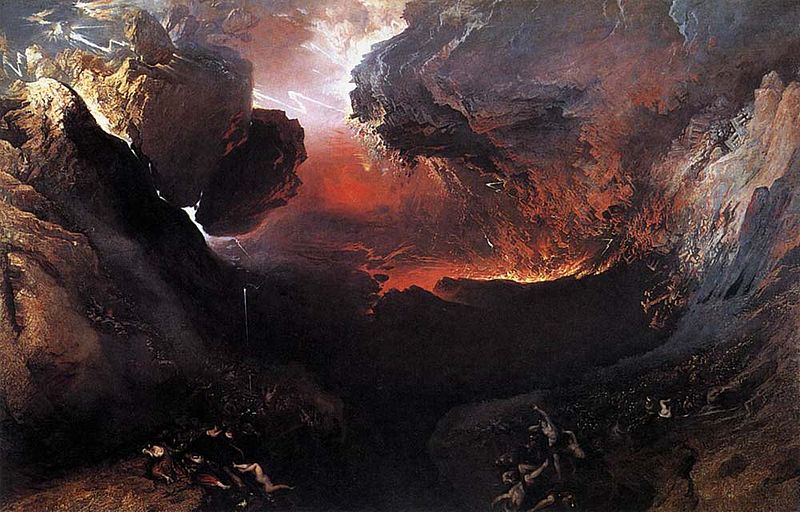
The Great Day of His Wrath, John Martin
GOD’S RIGHTEOUS JUDGMENT
This is a plain indication of God’s righteous judgment so that you will be considered worthy of the kingdom of God, for which indeed you are suffering. Since it is right for God to repay with affliction those who afflict you, and to give rest to you who are afflicted and to us as well at the revelation of the Lord Jesus from heaven with His mighty angels in flaming fire, executing vengeance on those who do not know God and to those who do not obey the gospel of our Lord Jesus. These will pay the penalty of eternal destruction, away from the presence of the Lord and from the glory of His might, when He comes to be glorified in His saints on that day, and to be marveled at among all who have believed—for our witness to you was believed. (2 Thessalonians 1:5-10)
Let us begin the marveling now. Marvel at a Savior who saves by His sovereign election, will, purpose, and plan! Marvel at He who is wrath and judgment and holiness and fierce anger! Be afeared of His anger over your sin. Marvel that El Shaddai… El Elyon …sent His Son to take on all anger for His elect’s sins. Marvel that He is also Jehovah Rapha, and Jehovah Jireh, the LORD that heals, the LORD will provide. Marvel at the wrath. It makes marveling at the grace all the more sweet.
Romans 14:13-23, about food may seem archaic, because Christians have been released from Hebrew food rules for 2000 years. But food rules have been going strong in the Catholic faith for equally as long. For Catholics who come to saving faith and become Christian, their lifetime of food rules, especially during Lent, may still have a hold on them. So let’s explore how we can help the brethren who may be struggling with the food issue, as Paul advised.
EPrata photo
We are in the height of the Catholic 40-day 2023 Lenten season, which began February 22 and will extend through April 6. Catholics are obligated to perform fasting and abstinence (as well as acts of piety and charity) as acts of penance during Lent. And not just during Lent, but “Even outside of Lent, the bishops in the U.S. still exhort the faithful to observe all Fridays as days of penance in recognition of Friday as the day of our Lord’s death and in preparation for the heavenly banquet at Sunday Mass” says this page from the United States Conference of Catholic Bishops about Lenten Regulations.
The exact rules for a Catholic about fasting and abstinence vary from continent to continent.
The US Catholic Bishops explain the reason for explicit rules about food. It is because,
“Humanity’s “Fall” away from God and into sin began with eating. God had proclaimed a fast from the fruit of only one tree, the tree of knowledge of good and evil (Gen. 2:17), and Adam and Eve broke it. Fasting is here connected with the very mystery of life and death, of salvation and damnation.” (Source)
So, food rules figure prominently for the Catholic. in the United States. Rule #1 in the US is that during Lent, everyone age 18 and older is to abstain from eating meat on Ash Wednesday, all Fridays of Lent and Good Friday. Hence, many Roman Catholics eat fish on Fridays.
Eprata photo
“Everyone age 18 and up to their 59th birthday is obliged to fast on Ash Wednesday and Good Friday. On these days, the Catholic is allowed to eat only 1 full meal. When fasting, a person is permitted to eat one full meal, as well as two smaller meals that together are not equal to a full meal. The norms concerning abstinence from meat are binding upon members of the Latin Catholic Church from age 14 onwards“, says the USCCB.
There are similar rules for a person who had been of the Eastern Orthodox persuasion, as well.
Therefore when a Roman Catholic or an Eastern Orthodox person converts to Christianity, they may well have impressed on their conscience for many years the fasting and abstinence rules. When they come to the verses that all foods are clean, it may be hard to overcome their bound conscience and accept these verses-
However, not all men have this knowledge; but some, being accustomed to the idol until now, eat food as if it were sacrificed to an idol; and their conscience, being weak, is defiled. But food will not commend us to God. We neither lack if we do not eat, nor abound if we do eat. (Romans 8:7-8).
EPrata photo
There are no rules for the Catholic person requiring them to “give up” something for Lent, but the people are encouraged to do so, in order to be ‘mourning their sins by denying themselves something they enjoy’ and ‘to train themselves to resist temptation’.
Therefore, Christian,
For if because of food your brother is grieved, you are no longer walking according to love. Do not destroy with your food him for whom Christ died. (Romans 14:15)
The paragraphs in 1 Corinthians 8 about food sacrificed to idols Romans 14 are explained by Warren Wiersbe:
“Christians affect each other (vv. 13–15). Note the possible ways we can affect each other. We can cause others to stumble, grieve others, or even destroy others. Paul was speaking of the way the strong Christian affected the weak Christian. Paul dealt with a similar problem in 1 Corinthians 8–9, where the question was, “Should Christians eat meat that has been offered to idols in heathen temples?” There he pointed out that knowledge and love must work together. “Knowledge puffs up, but love builds up” (1 Cor. 8:1, NIV). The strong Christian has spiritual knowledge, but if he does not practice love, his knowledge will hurt the weak Christian. Knowledge must be balanced by love.”
Source- Wiersbe, W. W. (1996). The Bible exposition commentary (Vol. 1, p. 560). Victor Books.
So, dear reader, knowledge combined with flaunted liberty might actually hurt the weaker sister. Many false religions have food rules. Hindus may not eat beef according to their religion. Seventh Day Adventists follow a strict lacto-ovo vegetarian diet. Meat, fish, poultry, alcohol, tobacco, or caffeine are prohibited. Islam has halal, which means certain foods must be prepared a certain way before they are considered acceptable to eat. If you are in a sphere with a former Catholic or any other recent convert where their life was dominated by food rules, please be the stronger sister and resist flaunting our liberty in Christ where it comes to food.
Do not tear down the work of God for the sake of food. All things indeed are clean, but they are evil for the man who eats and gives offense. It is good not to eat meat or to drink wine, or to do anything by which your brother stumbles. (Romans 14:20-21).
Right-click to open larger in new window. Published with permission
Artist’s Statement:
I was compelled to say something that spoke encouragement for “the saved to continue on,” even while recognizing and knowing the true character of sin, the taste and its aroma. Our efforts to reach the lost becomes harder each day; the news-media ridicules Christ’s redeemed, and with deceptive words, demands we not speak Gospel Truth. But we must “continue on.” I must keep fresh in my mind that previous centuries of the lost hated Christ, and that this present century of the lost will hate us (even as we the “saved” seek their rescue).
He was thirty-two years old when he began to reign, and he reigned eight years in Jerusalem. And he departed with no one’s regret. They buried him in the city of David, but not in the tombs of the kings. (2 Chronicles 21:20)
Left, The Royal Sceptre of Boris III of Bulgaria
Dorcas:
Now there was in Joppa a disciple named Tabitha, which, translated, means Dorcas. She was full of good works and acts of charity. In those days she became ill and died, and when they had washed her, they laid her in an upper room. Since Lydda was near Joppa, the disciples, hearing that Peter was there, sent two men to him, urging him, “Please come to us without delay.” So Peter rose and went with them. And when he arrived, they took him to the upper room. All the widows stood beside him weeping and showing tunics and other garments that Dorcas made while she was with them. (Acts 9:36-39)
In the first case, a sinful king. He served satan, and practiced wickedness. He was still a human, yet not one person lamented his passing. Not even his wife. He was a king, touching the lives of each and every person in his kingdom. His influence as a king was the largest a man’s could be, and yet not one person in an entire kingdom or beyond mourned his death. He was not regretted.
In the second case, a woman. Her sphere of influence was small. Her reach was especially small because she served widows, nearly the lowest of the low in terms of cultural power at that time. At her death, relatives are not mentioned, it would seem that it was her friends the widows who washed her and laid her in the upper room. And yet, she was beloved. Usually the ritual was to immediately rub the body with spices and lay the death cloths on and bury immediately. Yet these women did not. They loved Dorcas so greatly they sought a different way.
They sent men to find Peter. They did not want to let her go. Dorcas’ life was regretted. They lamented and cried and presented her works to Peter. One can visualize wringing of hands and weeping and wailing of many. Dorcas was loved and lamented.
Dorcas: “who with her needle embroidered her name ineffaceably into the beneficence of the world.”~Unknown
Why was Jehoram immediately forgotten and Dorcas never forgotten? I cannot say definitively or exclusively, but one reason surely must be that Dorcas was in Christ, and Jehoram was in Satan. The verse says that Dorcas was “a certain disciple” so she was a believer. She must have been beautiful in Christ, bearing the fruit of His love and grace and joy and peace, all the while serving tangibly with her needle.
EPrata photo
Who can say what influence a loving submissive disciple of Christ will have for His kingdom? Jehoram was given Christ’s kingdom (Judah) and he served satan with it. (2 Chronicles 21:6). Dorcas was given Christ’s kingdom and served Jesus with it. Both have everlasting eternal consequences but both have earthly consequences too.
As for the eternal consequences of their deaths, Jehoram’s life was snuffed out and the spiritual repercussions were zero. It seems that nobody was the better for Jehoram having lived. As for Dorcas, she was raised bodily from the dead but the effect of that was many were saved. They were raised from the dead, too! Their spiritual deaths were now over and many became alive in Christ! The effect of that was Peter stayed and nurtured the new church in Joppa, personally discipling many converts. What an eternal effect Dorcas had on the lives of the people there, personally and spiritually!
The question is, what kind of death would you have? Or me? Would my own death be unlamented? Unremarked? Or would it cause distress and weeping? The key is serving, and the fruit we bear. Dorcas served the people in Christ’s name. Jehoram expected to be served, and was one of satan’s. Dorcas served with her needle. Jehoram expected to be served with his scepter. Dorcas loved Christ and thus she loved her neighbors. And they noticed. Boy, did they notice. Jehoram loved satan and thus he hated his neighbors. And they noticed. Boy, did they notice.
And if it is evil in your eyes to serve the LORD, choose this day whom you will serve, whether the gods your fathers served in the region beyond the River, or the gods of the Amorites in whose land you dwell. But as for me and my house, we will serve the LORD.” (Joshua 24:15)
Love, serve, produce fruit. It will have an eternal effect.
But if the ministry of death, in letters having been engraved on stones, came with glory, so that the sons of Israel could not look intently at the face of Moses because of the glory of his face, which was being brought to an end, 8how will the ministry of the Spirit not be even more in glory? 9For if the ministry of condemnation has glory, much more does the ministry of righteousness abound in glory. 10For indeed what had been glorious, in this case has no glory because of the glory that surpasses it. 11For if that which was being brought to an end was with glory, much more that which remains is in glory.
12Therefore having such a hope, we use great boldness, 13and are not like Moses, who used to put a veil over his face so that the sons of Israel would not look intently at the consequence of what was being brought to an end. 14But their minds were hardened; for until this very day at the reading of the old covenant the same veil remains unlifted, because it is brought to an end in Christ. 15But to this day whenever Moses is read, a veil lies over their heart, 16but WHENEVER a person TURNS TO THE LORD, THE VEIL IS TAKEN AWAY. 17Now the Lord is the Spirit, and where the Spirit of the Lord is, there is freedom. 18But we all, with unveiled face, beholding as in a mirror the glory of the Lord, are being transformed into the same image from glory to glory, just as from the Lord, the Spirit. (2 Corinthians 3:7-18)
In reading these passages from 2 Corinthians 3:7-18 I was struck by two images the verses evoked. The first is the veil. The second is the phrase ‘where the Spirit of the Lord is, there is liberty.”
There is much spiritual meat here. Praise His name! But the focus today is the veil and mirror. We are in the end times. We know that at the time of the very end there will be a one world dictator in control of the currency, economy, religion, and politics of the entire globe. This is the antichrist. The time prior to the antichrist is characterized by shrinking; shrinking economy, shrinking currency, shrinking spheres of influence for formerly powerful nations, shrinking amount of people who wield power; all aimed toward the moment when the shrinking will have been reduced to only one power-wielder.
There IS power behind the throne and those are the fallen angels who are given permission by God to influence these powerful men, leaders, and elected officials. People have become interested in these powers, groups such as the Freemasons, Bilderbergs, Illuminati, World Economic Forum (WEF) and so on. And there is always a germ of truth at the core of the rotten conspiracy.
But think about this fact: Chasing the Illuminati and Freemasons et al is in effect chasing satan. In chasing the Illuminati and the Freemasons and the other shadowy organizations (Bohemian Grove, and so on…) , we get trapped in a hall of mirrors with reflections of the evil fallen angels dancing from mirror to mirror. Pursuing the Illuminati, even in thought, is pointless. We already know that satan influences some of earth’s leaders. Does it matter that we know who these Bilderbergs are and what they plan? We know who the power is behind the throne. We know that there will be a New World Order. We know that prayer is the most effective weapon. We know God wins. Isn’t that enough?
We have a choice on what to watch on television and where to put our energy and resources. We can pursue the shadows in a never-ending race or we can remember we have had the veil lifted from our face and the glory is in Jesus. “But we all, with unveiled face, beholding as in a mirror the glory of the Lord, are being transformed into the same image from glory to glory, just as by the Spirit of the Lord.” How wonderful! How great!
‘Where the Spirit of the Lord is, there is liberty.’ We can spend time and energy with veiled eyes pursuing the endless mirror of the Illuminati/Masons/Bilderbergs, or we can remember the veil is taken away in Christ and gaze upon HIM!
Beth Moore speaking at a race conference at Baylor in 2022.
Just out is Beth Moore’s third memoir, “All My Knotted Up Life.” (The first two were Feathers from My Nest: A Mother’s Reflections and Things Pondered: From the Heart of a Lesser Woman.)
Moore is a great oral storyteller and she is also good writer. She has written over 25 Bible studies beginning in 1999 with A Woman’s Heart: God’s Dwelling Place, three memoirs, a novel, and numerous other books. For most of her publishing life, Moore has been with Lifeway, the publishing arm of the Southern Baptist Convention. In 2021, when Moore left the publisher, it was stated,
Moore was Lifeway’s best-selling author, with a reach far beyond the SBC to conservative believers of many denominations. Her books and related materials “kept the Nashville-based publisher afloat,” according to Baptist News. At her peak, she generated more than $30 million a year in revenue.
Her current memoir, published by Tyndale, is accompanied by the ubiquitous book tour. Moore is sweeping the south with her book signings. Interest is high in her book’s contents and with that, interest is high on her in general. Her opinion on various topics is being sought. And Beth is happy to give it.
Moore is capitalizing on this widespread interest by speaking up about “white privilege”, “white supremacy”, and “racism” “in the church”. Earlier she jumped on the “misogyny” bandwagon when the #MeToo movement surfaced, and previously jumped on other Christian trends and fads, speaking out on them when they were popular.
From the beginning it must be stated: Beth Moore is a false teacher. Her skill in storytelling, her rough life, and her emotional appeals notwithstanding, when she teaches the Bible, her teaching fails the Berean test. When comparing it to scripture, these things are not so. (Acts 17:11).
When I attended a Living Proof Live event in 2011 at an 18,000 seat filled arena, I spoke with women in the lobby as we waited to get in. Many of them traveled long distances to hear Beth. Some, I discovered, follow her from venue to venue. One boasted she’d seen Beth at more than 20 LPL events. I’d used the word groupie to describe them in a previous essay, and it’s how some describe themselves, but my concern is her groupies that have heaped Beth up are now a cult – and she is their idol.
Think I’m kidding? Nope. See some of the recent comments about Beth Moore. These aren’t cherry picked. There are frequent comments like this.
Beth Moore’s recent elevation by her ticked-ears followers is a concern. Moore has millions of people whom she influences between social media, interviews, LPL events, and book signings.
Therefore the following issues are important to state:
Beth Moore does not speak for the church.
No one elected Beth Moore spokesman for “the church”. Moore is making numerous allegations, sweeping assertions, and accusations about “the church”. She has not defined the church of which she speaks. Her own church? The Baptist denomination church? The church in America? The global church? The only church of which she should speak is her own. And even then, nasty public accusations are not God-honoring. (Exodus 20:16, 1 Peter 2:1, Proverbs 11:9).
Beth Moore does not speak for the church. Beth Moore does not speak for you. Or me.
1. Making categorical, unqualified and vague accusations that are sweeping in scope causes division.
For example, Moore stated at a recent conference at which she was an invited speaker:
“How do people who claim to love God and place such a high value on Scripture place such a low value on justice?” (Source)
Which people? Where? How can she make such a sweeping claim?
Also: “At that time, such things as the titanic need for criminal justice reform had not even registered with me” (Source).
“What became increasingly and startlingly clear was that our politics informed our faith, rather than our faith informing our politics,” Moore said. (ibid)
“Our”? Whose faith was being informed by politics? Hers? Yours? Her church’s? What are some examples? None are ever given, just constant nebulous assertions.
She did the same in 2018 in a “Letter to My Brothers” which talked of “skewed attitudes.” She asked that her brothers (not named, not defined) “would simply have no tolerance for misogyny and dismissiveness toward women in your spheres of influence.” She talked of being a female leader and having to “work within ‘the system'” (instead of saying ‘I joyously submitted to God’s hierarchical roles for men, women, youths and children? Her church was ‘a system’?).
Her insinuations in the Letter to My Brothers again were vague and unclear. Did she meant the men in her own church, men in the global church, or men everywhere?. Michelle Lesley wrote of the Letter to My Brothers’ unsubstantiated accusations,
How is anyone supposed to agree with or refute the facts of what Beth is saying unless she gives clear explanations and details? What Beth has done in her blog post is to throw out unsubstantiated, generalized accusations against a wide swath of nameless Christian men and churches and she expects us to take her word for it that there’s some epidemic of misogyny across the board in the church.
The Bible says about people like Moore who make unsubstantiated assertions:
Reject a factious man after a first and second warning, (Titus 3:10).
The word factious here (or divisive in other translations) means, according to Strongs-
hairetikós – a factious person, specializing in half-truths and misimpressions “to win others over” to their personal opinion (misguided zeal) – while creating harmful divisions (used only in Tit 3:10).
How aptly this verse applies to Beth Moore! One person tweeted an even more pointed comment after watching her recent woke/racism interview,
“all I saw was emotion with buzz words attached.”
Friends, avoid Beth Moore, because the Bible says-
“You shall not bear a false report; do not join your hand with a wicked man to be a malicious witness. (Exodus 23:1).
2.Beth Moore hops onto fads. She copied Joel Osteen’s mantra for a while, copied hearing from God from Henry Blackaby, contemplative prayer, blue bracelets, home altars, lectio divina, #metoo, misogyny, woke, diversity…
Moore is just like the “the Athenians and the strangers visiting there used to spend their time in nothing other than telling or hearing something newer.” (Acts 17:21). Chasing after the latest trend is as old as the hills. And it’s not new to Beth Moore. Whatever’s popular, she goes after with misguided zeal.
3.She variously minimizes or exaggerates herself or her living situation to fit the current atmosphere.
Therefore, laying aside falsehood, speak truth each one of you with his neighbor, for we are members of one another. (Ephesians 4:25)
In the quote below, Moore used the language of woke, saying that she lived in white privilege,
“I was in a very privileged part of the world and a very privileged part of the church,” she conceded. Awareness of her privilege began to dawn on her just over a decade ago…” (Source).
She was born in 1957. In fact checking her statement about growing up privileged, a word she did not define, according to the 1960 census the median income for her county was $3,100 and her specific city’s was $3,800. That is $38,000 today. Wealthy salary it ain’t. Unemployment was 8.6%, one of the higher unemployment numbers of all the counties in Arkansas. Only 4.3% of female white women completed four years of college at that time. That’s not privilege. It’s poverty, poorness, and/or underprivilege.
She constantly uses language to shape a narrative she wishes a particular audience to resonate with. Moore either exaggerates (the privilege example above) or minimizes it. Here are examples of how she minimizes her situation when it suits her-
We have a tiny little sliver of water not far from us that you could call a creek if you were in a particularly generous mood. It’s got some sand by it that the kids really like. Be blessed that this is not a scratch and sniff picture because the creek doesn’t always smell all that good, especially if it hasn’t rained in a while. But if your nose is slightly stuffy, it can be pretty fun.
Moore was describing the creek that runs through her estate. It’s Spring Creek, and it begins near Waller Tx and runs about 45 miles to drain into the San Jacinto River. It divides Harris and Montgomery County. Spring Creek is the only natural creek in both Harris and Montgomery County. It is known for “its sandy banks, undisturbed natural surroundings, and clean water, and it serves as home to many animals, including deer, otters, raccoons, opossums, and alligators. Many species of fish, including white bass, catfish, crappie, largemouth bass, and bluegill inhabit its waters. It is also known for its occasional Swainson’s warbler sightings and for being the easternmost sighting of the green kingfisher, as well as bald eagles, herons, egrets, and other birds.” (Wikipedia)
Along the way there are many parks and greenways which attract locals and tourists. Spring TX, home to Moore’s church, was named after the river. Hardly the dirty smelly creek she described. At all.
Here’s her description of her home she moved into several years ago:
So, three years to the day later, we’re making it out in these modest woods. These acres would not be beautiful to everybody but they’re beautiful to us. Life has been brand new out here. I won’t kid you. It’s been an adjustment. A lot less eating out. A lot more cooking. A lot more driving to work. The cars stay filthy. The raccoons won’t stay out of the trash. Fed Ex never can find us. But we don’t mind. Because it was time to make a move. For us, it was out where the dawn breaks to the crow of a rooster.
Evokes an image of the Ingalls dirt hut out on the prairie, doesn’t it? What Moore doesn’t tell you is that the Moore Trust property in Tomball TX, are not “modest woods” that “would not be beautiful to everybody.” Her property is a 46 acre forested enclave with its own road, two houses with total of 7 bedrooms and 7 1/2 baths, custom outdoor kitchens and fireplaces, a combined square footage of 6600 sf, and assessed by Harris County TX at over $2 million dollars.
She plays white privilege when it suits her. She plays regular sista when she wants to hide her then-4 houses, large home estate, and flying to her venues on a private jet, even to Australia.
4. Beth Moore is an expert at using political rhetoric to her advantage.
Political rhetoric is deliberately vague. You know the kind, the candidate speeches that roll around every election cycle that fling around words like liberty and freedom and prosperity, that each different person listening has a different idea of its meaning.
“Political language is vague because politicians are shrewd and desire to build a winning coalition of people who hold different views“, said Larry Etheredge of Massachusetts Institute of Technology.
That’s Beth Moore. Not desiring to speak unadulterated biblical truth, but to build a coalition of people who hold different views- so as to make merchandise of them (2 Peter 2:3).
Vagueness is why Moore refused to answer when I and other ladies asked her point blank if homosexuality was a sin. It’s why she has never come out in support of the Roe v. Wade overturning, or said clearly that abortion is bad. It’s why she never has to my knowledge taught a Bible lesson on 1 Timothy (you know, the book that says a woman may not preach to men or have authority over them?) It’s exactly why Moore makes vague claims and will never stop making them-
There are also certain advantages in the use of fuzzy concepts and vague boundaries, because they extend the range of options open to a speaker, offering a chance to express many grades of truth and many different attitudes towards propositions without the speaker having to be pinned down to just one position. (Lakoff, “Hedges: A study in meaning and the logic of fuzzy concepts. Eighth Regional Meeting of the Chicago Linguistics Society, 183-228, 1972).
That’s Beth Moore, expressing many grades of truth.
I deliberately chose the above examples of how Beth hops onto fads, chooses vague language, and changes her own narrative to suit the situation, because the facts add up to this conclusion: she cannot be trusted in what she says.
I’ll repeat: Beth Moore cannot be trusted when she speaks. You can’t trust her words.
She is riding a high wave of widespread approval due to the sad and tragic revelations of her autobiography. I empathize with her various tragedies. But remember, many Christian people have had those tragedies and worse, but they do not slander, make sweeping accusations, become hardened and unteachable, and tacitly accept their cult status.
Beth Moore is a false teacher deceiving and being deceived. While she has her reward now, judgment awaits for her many sins. I plead with women reading this, do not give an inch to the false teachers or you will become part of the evil they do:
But false prophets also arose among the people, just as there will also be false teachers among you, who will secretly introduce destructive heresies, even denying the Master who bought them, bringing swift destruction upon themselves. And many will follow their sensuality, and because of them the way of the truth will be maligned. (2 Peter 2:1-2).
The fading glory of a flower The grass, scorched under the sun and withering before our eyes Nest, filled with tweets but now empty
The temporal nature of riches Sliding, slipping through our hands
The downy clouds skimming across the sky scudding dark, releasing rain dissipating into vapor untouchable and gone
Try halting the orange sun as it rises, Nothing can hold it.
The things of earth to which we ascribe glory will fade…
EPrata photo
God’s glory will never fade!
Be exalted above the heavens, O God; Let Your glory be above all the earth. (Psalm 57:11)
His glory outshines the sun! We have no need of a sun, when the Son in in His glory!
And the city has no need of the sun or of the moon to shine on it, for the glory of God has illumined it, and its lamp is the Lamb. (Revelation 21:23)
He does not only shine in glory, he is the Lord of glory!
which none of the rulers of this age has understood; for if they had understood it, they would not have crucified the Lord of glory. (1 Corinthians 2:8)
Who is He, this King of glory? Yahweh of hosts, He is the King of glory. Selah. (Psalm 24:10)
Ponder the glory. Not the glorious sunrise, as pretty as it is, nor the glory of a flower covered field, as gorgeous as that is too. But the real glory, His glory, shining like the sun
Jesus took issue with the Pharisees and Scribes because they had become whitewashed tombs. (Matthew 23:27). This means that they were sick with sin on the inside and were only doing external things that hid their sin but did not address it. They were dead inside but performing rituals as if that would bring them alive. Their rituals had no meaning, and as Solomon would say, they were only striving after wind. (Ecclesiastes 1:14).
People say things today that sound pious but aren’t. These sayings are just as dead as a whitewashed tomb, and are only striving after wind.
However, these sayings sound legitimate on their surface. It is sometimes hard to tell what truly is Christian and what merely sounds Christian. Charles Spurgeon wisely said, “Discernment is not a matter of simply telling the difference between right and wrong; rather it is telling the difference between right and almost right.”
So what is right and what is almost right (AKA ‘wrong’) about these sayings?
Some of these mottos are:
“Let go and let God”
“I don’t use commentaries because they’re men’s wisdom. I only use God’s Word when I study.“
We can’t know for certain what the bible means, I’m not that smart”
“Pray big because we have a big God.”
“He’s so heavenly minded he’s no earthly good“
Let’s look at the first one.
EPrata photo
#1. “Let go and let God.” In this pious-sounding saying, the person is trying to indicate that they submit to the sovereignty of God by letting everything go and allowing Him to roll circumstances over us as He will. However if we unpack that a bit we’ll see actually that ‘Let go and let God’ actually contradicts the Bible. Here are two sources which speak to the subject, GotQuestions, and Ligonier Ministries.
GotQuestions: Are We Supposed to Let go and Let God?: “Let go and let God” is a phrase that cropped up some years ago and still enjoys some popularity today. Actually, the Bible never tells us to “let go and let God.” In fact, there are so many commandments about what we are to do that it completely contradicts the way most people interpret “let go and let God.” The popular idea of “letting go” is to adopt a sort of spiritual inertia wherein we do nothing, say nothing, feel nothing, and simply live allowing circumstances to roll over us however they may.
The Christian life, however, is a spiritual battle which the Bible exhorts us to prepare for and wage diligently. “Fight the good fight of faith” (1 Timothy 6:12); “Endure hardship…like a good soldier of Christ Jesus” (2 Timothy 2:3); “Put on the full armor of God so that you can take your stand against the devil’s schemes” (Ephesians 6:11). Letting go in the sense of sitting back and watching events unfold however they may, is not biblical.
Having said that, though, we have to understand that the things we are to do, we do by the power of God and not on our own steam. The truth is that working at “letting go” is just as much as an effort-filled work as anything else we try to do for God and not nearly as easy to do as some things. (Source)
So true! If it was that easy to ‘let go’ our sin, we would have done it! If it was that easy to ‘let go’ our worry, we’d be all set! If it was that simple as to let go our our will, we wouldn’t need God! “Letting go” is just as difficult as hanging on. Submit, yes. But even that is a daily struggle we’re told to perform as we pick up our cross (Matthew 16:24) and to pray daily for the will and help to submit. (Matthew 6:9-13).
Andrew Naselli at Ligonier Ministries explains, “Why “Let Go and Let God” Is a Bad Idea“. He says, in looking at the origin of this two-tiered theology from the 1875 Keswick theology movement, that letting go and letting God promotes in part,
–Perfectionism: It portrays a shallow and incomplete view of sin in the Christian life. –Quietism: It tends to emphasize passivity, not activity. –Pelagianism: It tends to portray the Christian’s free will as autonomously starting and stopping sanctification. –Methodology: It tends to use superficial formulas for instantaneous sanctification. –Impossibility: It tends to result in disillusionment and frustration for the “have-nots.” –Spin: It tends to misinterpret personal experiences. You can tell that Keswick theology has influenced people when you hear a Christian “testimony” like this: “I was saved when I was eight years old, and I surrendered to Christ when I was seventeen.” By “saved,” they mean that Jesus became their Savior and that they became a Christian. By “surrendered,” they mean that they gave full control of their lives to Jesus as their Master, yielded to do whatever He wanted them to do, and “dedicated” themselves through surrender and faith. That two-tiered view of the Christian life is let-go-and-let-God theology.
I am aware that the motto ‘Let go and let God’ is a heavily used precept in Step 3 of the Alcoholics Anonymous recovery plan. AA has helped millions recover from their addiction to alcohol, and in this sense, AA is helpful. But don’t mistake AA’s Christianese for legitimate biblical principles. Here is more information:
The language may sound pious but it collapses under scrutiny. The fact remains, let go and let God does not align well with biblical standards of behavior for a Christian.
AsJim Vander Spek asked, “The problem with making “Let God” the focus is that it pushes the burden back on Him. If things don’t work out, will you blame Him?“
The New Testament is replete with active verbs aimed at the believer. We are supposed to strive, walk, run, persevere, wrestle, fight… none of those sound as passive as ‘letting go and letting God’ do they? No, friend, keep walking, strive to maintain your position on the center of the road and doing our part in the sanctification process.
He who has an ear, let him hear what the Spirit says to the churches. To him who overcomes, to him I will give some of the hidden manna, and I will give him a white stone, and a new name written on the stone which no one knows but he who receives it.’
Did you ever wonder about this stone thing? I have. First, before the stone, about the name.
Yahweh changed the name of many people in the Bible. Simon bar Jonas was given the name Peter in Matthew 16:18 by Jesus, meaning rock. Saul became Paul. God renamed Jacob who became Israel. He renamed Abram to Abraham and Sarai to Sarah. Ashpenaz was Chief of Officers of the court, or the master of the eunuchs, for Nebuchadnezzar. He renamed Azariah to Abednego, Daniel to Belteshazzar, Hananiah to Shadrach, and Mishael to Meshach. Ben-Oni also renamed Benjamin by his father Jacob.
The point here is that the one who has authority over another is the one who can rename. In the Bible examples above, the dad, the king, a court officer, Jesus, and God all had the authority to rename a person. In our day, the parents name the child, or we go through a process in the courts that allow or disallow a name change. A higher authority changes the name. In the Bible at the end of the end, God, our authority, will change our name.
The White Stone:
Ovid was a Roman poet who lived from 43 BC – 17/18 AD. He describes a process of casting a vote in a court proceeding. Black stones and white stones would be put into an urn. When all stones were cast, they’d be counted. Black stones meant guilty, white for innocent. More white than black stones meant the person was innocent. In this way, the white stone became a symbol of innocence. Ovid wrote-
15:53 A custom was of old, and still remains, 15:54. Which life, or death by suffrages ordains: 15:55. White stones, and black within an urn are cast; 15:56. The first absolve, but Fate is in the last. 15:57. The judges to the common urn bequeath 15:58. Their votes, and drop the sable signs of death; 15:59. The box receives all black, but, pour’d from thence, 15:60. The stones came candid forth; the hue of innocence. From Ovid’s Metamorphoses.
There are many other reasons why the white stone was used (once, it was even a sort of credit card with an authorizing name engraved on it). A white stone was also involved in a custom of hospitality-
From Manners and customs of Bible Lands by Fred H. Wight:
Friends as guests. In the East a friend is always welcome to receive hospitality. The Romans of New Testament times had a token of hospitality between two friends, which consisted of a tile of wood or stone, which was divided in half. Each person wrote his name on one of the two pieces, and then exchanged that piece with the other person. These were often kept and handed down from father to son. To produce the counterpart of one of these pieces would guarantee the hospitality of a real friend. The Book of Revelation no doubt refers to this custom in one of the promises to overcomers: “And will give him a white stone, and in the stone a new name written” (Revelation 2:17).
So, there are many reasons why a white stone will be given, therefore I can’t be dogmatic about the interpretation of why Jesus will give us one in the New Earth, but it’s all so interesting. We don’t know now but we will know when the time comes. For now let us end with Barnes’ Notes. We accept the white stone with new name,
as a pledge that he is accepted of God, and that the rewards of heaven shall be his; the world does not understand it, or attaches no value to it. And in the stone a new name written – A name indicating a new relation, new hopes and triumphs.
Look in the Bible for how many times clouds are mentioned. The word is used for different reasons and in different ways. It is fun to think of His grace in giving us the literal clouds, which shield us from the hot sun, or which gives us rain. The variety and wonder of the different shapes of clouds: nacreous, cumulus, tubular, cirrus, etc, and the different reasons for clouds, both literal and symbolic, is a study in itself.
The best reason to think of clouds is that Jesus will return in one!





















 the-end-time.org