The past few days has been involved for me with discerning a false ministry, but one that has a quarter of a million followers. Her impact is huge and the negative reverberations of her well-hidden errors will go on to the undiscerning and naïve. For that I feel prayerfully grief-stricken and have a deep concern for young ladies in this ever-darkening culture over whom they follow and what dark webs they may get caught up in.
One thing that caught my attention that I have been pondering in the calming-down aftermath here in my little corner of the world, is humility and teachability.
The more popular a teacher grows, the more chance there is for him or her to become prideful. It’s just the way of human flesh. God knows this. It is exactly why He said for new believing men not to become leaders, due to the temptation to become conceited-
and not a new convert, so that he will not become conceited and fall into the condemnation of the devil. (1 Timothy 3:6).
But the moment people start noticing our ministry is just the moment we need more humility.
So now I can hear the replies in your mind. ‘But I don’t HAVE a ministry!’
My reply to young ladies, married ladies, mothers, older ladies, is that we ALL have a ministry. It might not be codified. It might not have a name. It might not be a 501(c)3. But we do have a ministry.
you also, as living stones, are being built up as a spiritual house for a holy priesthood, to offer up spiritual sacrifices acceptable to God through Jesus Christ.(1 Peter 2:5).
We are all priests, working for His name in the spheres in which He has placed us. No matter if the sphere is large or small, we work for His name, aware that our every move, our entire being, is for His name.
Therefore I exhort you, brothers, by the mercies of God, to present your bodies as a sacrifice—living, holy, and pleasing to God, which is your spiritual service of worship. (Romans 12:1).
The young unmarried woman is a ministry – by example – of her modesty and chasteness and eagerness to learn. The married woman is a ministry – by example – of her unity with her husband and presentation of her marriage as a parable of what the Gospel is like. The mothers are a ministry – by example – of literally presenting your bodies as a sacrifice of praise to Jesus who knit the baby in your womb. Raising children is a worthy calling for both the mother and father. The older woman is a ministry – by example – of ministering to younger women. Grandchildren. Ladies in church and elsewhere. Our own raising of children may be complete (if the Lord had granted it) but there are others to minister to, encouraging them in the admonition of the Lord and exhorting to share the beauty of Jesus.
We all have work to do. We’re all in a ministry.
Now. I was also thinking of a certain someone in a ministry who said people are accusing her of the following: “I am even being called dangerous, legalistic, ungodly, and a false teacher.” She said people are saying those things of her. She is a person who does have a formal ministry. It has a quarter of a million followers, she’s been interviewed widely, she wields a great deal of influence.
None of that matters. None.
What matters is, are we ministering in such a way that the holy and spotless name of Jesus is being upheld by our teachings and our lifestyle? Ministry is about the outworking of doctrinal truths applied to our lives, in His name, for His name. Are we doing it well?
It does a person good to occasionally review one’s life, one’s ministry, one’s teachings. Are we still on the center line of doctrinal truth? Are we speaking and behaving in such a way that would bring glory to Jesus, or bring reproach to Jesus?
You know, we are told to examine ourselves, more times in the New Testament than we think.
2 Corinthians 13:5 – Test yourselves to see if you are in the faith; examine yourselves! Or do you not recognize this about yourselves, that Jesus Christ is in you—unless indeed you fail the test?
Galatians 6:3-4 – For if anyone thinks that he is something when he is nothing, he deceives himself. But each one must examine his own work, and then he will have reason for boasting, but to himself alone, and not to another.
2 Peter 1:10 – Therefore, brothers and sisters, be all the more diligent to make certain about His calling and choice of you;
1 Corinthians 11:28 – But a person must examine himself, and in so doing he is to eat of the bread and drink of the cup.
Matthew 7:5 – You hypocrite, first take the log out of your own eye, and then you will see clearly to take the speck out of your brother’s eye!
If we are told to examine ourselves so much for that variety of reasons, why ignore the fact that we are to examine ourselves when we are doing ministry? No! Let it not be so!
Let us all, those in formal ministry and those who quietly or informally minister, examine ourselves to see that we are doing and saying things that are pleasing to God. If people are saying to us or about us that we’re dangerous, legalistic, ungodly, or a false teacher the question remains: do we love Jesus first or do we love ourselves first? Our entire attention and focus must be on His name. If I am doing anything that is dangerous or false or legalistic, upon hearing such accusations, is my pride such that I never take the charges seriously and go examine myself fairly? Never let it be so!
Pride is the first sin and the most serious. It is the root of all other sins. God speaks in His word many times about pride. Here are a few,
Proverbs 8:13 – The fear of the Lord is to hate evil; Pride and arrogance and the evil way And the perverted mouth, I hate.
Proverbs 11:2 – When pride comes, then comes dishonor, But with the humble is wisdom.
Proverbs 16:5 – Everyone who is proud in heart is an abomination to the Lord; Assuredly, he will not be unpunished.
Proverbs 16:18 – Pride goes before destruction, And a haughty spirit before stumbling.
It is humbling to publicly repent of something done in sin or taught incorrectly in His name. It is humbling to eat crow. But pride should not be so strong that it prevents us from kneeling down and saying “I was wrong. Forgive me.”
I’ve seen some public teachers do it. Far from making me think less of them, I think MORE highly of them. I myself have been open about my mistake of following Joel Osteen at the start of my Christian life (before I had a blog, thankfully). Also of my newspaper eisegesis and looking at signs according to the news, early on in my blogging career. I was excited to finally have had all the answers in the Bible as to why the world was the way it was, and I’m not apologetic at that first rush of relief and joy and my worldview shifted so rapidly. But I am thankful the Spirit grew me out of that and I didn’t persist and become wayward in doctrine or hopefully not lead others astray.
If you are receiving congratulations for a job well done in ministry, great, but don’t let it go to your head. If you are receiving charges of falsity or error, stop, take a breath, consider the source, and examine yourself to see if it is so. The spotless name of Jesus is paramount to all we do in ministry, and yes we all have a ministry.
Though the internet affords opportunity for anyone to come forth with a blog, a Youtube or TikTok channel, to tweet or comment on Facebook boldly, not all content should be absorbed. Lori Alexander The Transformed Wife’s should not.
But first, a defense of discernment
Jesus praised the folks at church at Ephesus doing discernment properly. It’s in Revelation 2:2 and 2:6-
‘I know your deeds and your toil and perseverance, and that you cannot bear with those who are evil, and you put to the test those who call themselves apostles, and they are not, and you found them to be false;
Yet this you do have, that you hate the deeds of the Nicolaitans, which I also hate.
Critiquing a ministry is appropriate. “Going to them” personally is not required. Public teachings can and should be publicly assessed. Evaluation is noble. (Acts 17:11)
Discerning Lori Alexander
If you take Lori Alexander’s tweets individually, if you read them occasionally or one-by-one, they seem good. Like this one:
I agree with this one as well:
Nothing bad there. It’s good advice. Firstly, the tricky part comes when she also mixes in things that are not biblical. Secondly, the damaging part is consuming a steady diet of her material. Over time you see an accumulation of tone and thought: that almost every tweet disparages women, wives, and marriage in some way. Worst of all, the advice you see over time, is extra-biblical because it’s legalistic.
Ligonier definition of Legalism: “Legalism is, by definition, an attempt to add anything to the finished work of Christ. It is to trust in anything other than Christ and His finished work for one’s standing before God.“
To that end, The Transformed Wife’s cumulative posts reveal a constant pointing to a wife’s works as the measure of a marriage, her standing with God, and her soul. It’s trust in Debi and Michael Pearl, not Christ of the cross. It’s trust in the idol of submission Lori has made it for herself. Husband’s responsibility is not mentioned. Grace is not found. Charity, fruit, prayer, or scripture is not evidenced. Only legalistic, negative-Nellie warnings in confident absolutes. Dire and dour. For example, “women destroy everything”, see screenshot below.
Her focus is as she states here- is usually on Eve alone. She’ll accuse Eve like here- “The devil deceived Eve, “and Adam was not deceived, but the woman being deceived was in the transgression”(II Tim2:14)” but not include Romans 5:12-13, stating that Adam also sinned.
Biblical concern # 1, Lori Disbelieves in Original Sin
In a post now scrubbed, Lori wrote in 2016: “Your children are born in the flesh. It’s not sinful yet since they haven’t sinned, just as Adam’s flesh wasn’t sinful before he sinned“. (Source). And in 2022 or 23 The Transformed Wife replied to a woman asking Lori directly about original sin. Her reply was completely unbiblical. (Source: Lindsey Davis-Knotts)-
I asked Lori about her stance on original sin in May 2023 but she refused to answer and blocked me. Later, Lori came out with a weak affirmation of original sin but I suspect its sincerity, because it was issued under cloud of the growing scandal that her stance had generated when it resurfaced.
Disbelieving in our sin nature from the womb and at birth going forward in life is a big doctrine to get wrong. This heresy is actually called Pelagianism after Pelagius who promoted it. This doctrine was condemned as heresy in 418 by the Council of Carthage.
Biblical concern # 2: Lori teaches that women should not teach doctrine to other women, thus her view of scripture is skewed
My conviction that women shouldn’t be teaching women doctrines other than the doctrine of biblical womanhood, as commanded in Titus 2:3-5, has given me a lot of criticism from many places. I am even being called dangerous, legalistic, ungodly, and a false teacher. Women’s Bible studies are the pathway that has led to many female preachers/pastors, women speaking in the churches, and lukewarm churches. If women can preach/teach Scripture in a church, how is this any different than the men who do this on Sunday mornings?
The first issue with this stance, is that it is wrong. We are not saying Titus 2 urges women to preach in church. The verse is urging older women to teach the younger. That’s all. Lori tends to make straw man fallacies and argue them when they in fact don’t exist.
Teaching what is good means teaching about God – who is the only Good. (Mark 10:18). She got this ‘no teaching doctrine or theology’ from Dale Partridge, who is a man who fell below reproach due to serial plagiarism, and should not be teaching or pastoring. This shows that Lori displays a lack of discernment. More on Partridge on another day. She elevates Michael and Debi Pearl and Dale Partridge’s teachings as if they are Gospel words from Jesus Himself. But when challenged, won’t take anyone else’s words, research, or experience into account.
The apostle Paul tells Titus, in verse 3, that older women must first of all teach what is good. What could possibly be better than the Lord Jesus Christ? Doesn’t being a godly wife, mother and housekeeper flow out of knowing Him? Surely women without the Lord are fully capable of teaching those basic skills!
Only a Christian woman, however, can teach her sisters Who Jesus is. And obviously she can’t do so unless she teaches sound doctrine. Theology lays the groundwork for having godly marriages, raising children by godly principles and maintaining a home that reflects godly order. Theology deepens our understanding of who God is and what He values. So when a woman teaches right theology to other women as a supplement to the pastor’s preaching, she assists their abilities to be wives and mothers that bring glory to God.
DebbieLynne is wise.
Lori Alexander’s self-imposed strict legalism about not teaching women other doctrines than the one doctrine Lori deems acceptable to teach, that is, biblical womanhood, has resulted in her skewed view of scripture. 2 Peter 3:14-18 can be applied to her, particularly where the unstable distort God’s teachings. For example, several times she has said the following:
Legalism will take one verse and camp on it to the exclusion of other verses and to the exclusion of the authorial intent and context. This is what is meant by the unstable twisting God’s word.
Her version of submission is one way only and she doesn’t to my knowledge teach young women what to expect from a husband according to Ephesians 5 or any other pertinent verses.
Ephesians 5:25 urges believers “Just as Christ loved the church and gave himself up for her”. Ephesians 5:28–29 says “So husbands ought also to love their own wives as their own bodies. He who loves his own wife loves himself”. This is sacrificial love. Not submissive love per se, but a gentle leadership love that sacrifices for the wife. There is none of that kind of teaching in Lori’s world.
Husbands lead. Yes they are the ultimate decision-maker, but leading means leading in kindness and grace, remembering what Christ has done for His church and mimicking the same in sacrificial love.
Submission is Lori’s ‘tithing of mint’. “But woe to you Pharisees! For you pay tithe of mint and rue and every kind of garden herb, and yet disregard justice and the love of God; but these are the things you should have done without neglecting the others.” Luke 11:42
3. Lori is a King James Onlyist
Lori said in a blog post she agrees with Michael Pearl who teaches KJV-Only. Pearl had said in that video, “I believe that the King James Bible is the Word of God and not the other books” (Michael Pearl). Pearl has also said,
“The others are not really translations, they’re not preservations of the Word of God. They’re modern renderings which involve somewhat the imagination of the authors, and they’re all done for the sake of selling something.” (MPearl)
This shows a lack of discernment on Lori’s part. It again demonstrates her total acceptance of what Michael and Debi Pearl teach, a stance she has repeated many times in affirming the Pearls’ ministry and defending their teachings.
Rebuttal: Dr. James White spends a few minutes with Todd Friel of Wretched (Wretched is a ministry Lori quotes and speaks well of), on the fact that while the KJV is good, as the centuries have passed and as more archaeological finds have occurred giving us original documents of the original Bible, there are better versions nowadays.
That video with Friel and White was 9 years ago and lately the Legacy Standard Bible has been issued. This new version is a spare updating of the original NASB 1995. The translators went back to the original languages of the Hebrew, Greek, and Aramaic. Alan Hunter spends 3 minutes explaining it, here.
It is of biblical concern she promotes KJV-onlyism which again I say, displays a lack of discernment. She wrote that she likes it, besides the fact that Michael Pearl taught that it’s the best and only version that is acceptable, but because homosexual is a recently made up word but the KJV uses sodomite and that is a way better word, Lori says. Oy.
One of the saddest signs of legalistic Christianity is the tenacious defense of the KJV as the only legitimate English-language translation. Almost as sad is that countless hours of scholars’ and pastors’ time must be diverted from the larger priorities of God’s kingdom to point out the numerous historical, logical, and factual errors of KJV Onlyism — even though these errors have been repeatedly exposed in the past.
4. Lori is unteachable. She resorts to victim status when challenged or corrected
Every teacher and every person with a ministry, has both a responsibility to be as correct as possible, and has a duty to be accountable to their own overseers and to those whom they teach. In ministry, we’re talking souls, we’re talking of eternal truths from the Bible, and we’re talking of our Sovereign King. Heavy stuff. Though we do not kowtow to trolls, and though we should have a fair amount of confidence in our own settled convictions that we teach, no one is above error. As Lori says constantly when defending the indefensible (more on that below) she overlooks and ignores error by constantly replying to challenges of Gothard or the Pearls or Hannah Pearl Davis, “no one is 100%”.
Well, that seems not to apply to her, because when she was asked about original sin by me, I was blocked right away. Others report the same, blocking rather than engaging. She never seems to give her teachings a fair evaluation when many, MANY who have pleaded with her to do just that. Nor does she give an evaluation of the terrible teachings of the Bill Gothard of IBLP or the Pearls (Debi & Michael) though constantly asked by many to do just that. Her reactions are knee-jerk defenses. Often they don’t make sense or she contradicts herself within the same posting.
A minister of the Gospel should be teachable, fair, and humbly allow correction when wrong. Lori does not. Rather than seek truth, she retreats behind a blocked wall, scrubs content, deletes tweets, hides comments, and carries on with error. Proverbs 12:1 applies here, which I’ll share in the KJV since Lori likes that version so much-
Whoso loveth instruction loveth knowledge: but he that hateth reproof is brutish.
And then out comes the victim status. After asking about her stance on original sin, she messaged me, saying: “I can’t believe you’re scouring through my writings to find things against me that was stolen from my private chat room by trolls!”
There is no need to ‘scour’ writings since she has been on blogs and other social media since 2011, and all of them public. I asked about nothing that wasn’t public. ‘To find things against me’ is typical victimhood. In her mind, a person asking about the basis for her theology and lifestyle choices is actively trying to bring her down. She wants 100% agreement all the time, when in fact, questions about what a teacher has written is called reasoning together to find mutual understanding, or to enact repentance and correction.
And you say, “How I have hated discipline! And my heart spurned reproof! I have not listened to the voice of my instructors, And I have not inclined my ear to my teachers! I was almost in utter ruin In the midst of the assembly and congregation.”
What one expects of a teacher is right belief within orthodoxy, and the fruit of the spirit- two of which are teachability and humility. When a person lacks those, their doctrine becomes skewed, as well as their ability to discern.
5. Lori Alexander defends alleged instances of marital rape & engages in child beating, under the names ‘submission and ‘discipline’
This is a serious charge. I will back it up.
Lori gave advice on a video to a woman who said that her husband had asked her for sex and the wife had said no thanks, but the wife awoke to her husband in the middle of the night having sex with her anyway. The question the wife asked Lori was, ‘is this rape?’
In the video, Lori replied,
“I said well do you feel like you need to call the police and have them locked in jail because if true rape is when you’re assaulted and against your will by some stranger and you you feel like he’s worthy of being put in prison.”Here, time stamps 2:33, 2:51.
She received a lot of flak for that (rightly so) and in unteachable fashion, didn’t take fair look at her reply but doubled down instead. She said in a defensive-rebuttal blog post-
I told her that no, this wasn’t considered marital rape. Marital rape is when a husband forces himself upon his wife on a frequent basis while drunk or high on drugs or is simply an abusive, mean man. If there is true marital rape, there is physical abuse that comes with it. … It’s not that big of a deal!” source.
Wait, a woman has to be raped a bunch of times for it to be rape? Or he has to be high for it to be rape? It’s not rape if it only happened once, or if he was sober when he did it? If no physical evidence of your refusal can be seen, it’s not rape? (That’s an outdated 1980s rape culture philosophy that harmed and silenced many women). Lori said nothing about Jesus’ charge to the husband to exhibit self-control, or as Ephesians 5:29b says ‘he should nourish and cherish her just as Christ also does the church’.
She has extremely troubling views on consent and boundaries (which include positive mentions of husband swatting his wife on the behind? Corporal punishment of the wife?!)
Legally, most states consider it rape when the victim is unconscious. Further, regarding consent laws, “Researchers who have spoken to husband-rapists conclude that they rape to express anger, and to reinforce power, dominance, and control over their wives and families. • Stereotypes about women and sex such as women enjoy forced sex, women say “no” when they really mean “yes,” and it’s a wife’s duty to have sex continue to be reinforced in our culture. Such stereotypes mislead into believing they should ignore a woman’s protests. These stereotypes also mislead women into believing they must have sent the wrong signals. Women blame themselves for unwanted sexual encounters, believing they are bad wives for not enjoying sexual encounters, or believing they are bad wives for not enjoying sex against their will.”
With Lori Alexander, you begin to notice that everything is always the wife’s fault. She has a dim view of marriage, a joyless outlook, and dispenses advice filled with lots of legalism and blame. Like this screenshot.
Worse, when I read this account of her approach to ‘discipline’ I had to walk away and calm myself down. I grew up in a not-safe household where things like this happened or were threatened to happen. Lori Alexander, following the Pearls’ advice, beat her children in the name of godly submission and obedience.
Christmas is a time to celebrate the wondrous incarnation of Christ, to gather with family and prayerfully and joyfully speak and sing of His love, share gifts in that spirit. It isn’t to focus on the opportunity to abuse your children by hitting them in anger (severe lack of self-control to hit babies in anger!) for a totally appropriate child-like reaction to Christmas. Please note that there are many mentions of her hitting her children for being children, even crawling babies, urging women to hit them hard enough to make them feel pain so they won’t crawl off the blanket or display unwanted negative emotions.
It isn’t just about locking them outside on a cold morning. The act of closing your home’s door against your babies and toddlers should enrage even the most strict disciplinarian. All that “teaches” them is that you can be tossed out at a moment’s notice and that your home is NOT SAFE and it’s NOT PERMANENT. It just shows the kids that ‘home’ could be lost for the most trivial of reasons.
Here is a link to a Christianity Today Article from 2011 “When Child Discipline Becomes Abuse which notes several children have died under this cruel and abusive method that Lori encourages moms to use to this day. Yet she defends her actions of hitting babies with belts or a switch to this day.
Here is a page of 34 screen shots showing her stance on physical punishment of under-three-year-olds. The one where she says make sure you’re in a state that allows you to use an instrument like a belt or a rod rather than just a hand…smh. And advising women to ‘break the child’s will’? Where is the nurturing and loving admonishment?
She kicked her cat, too, hard enough to break its ribs if she’d actually connected. She smacks her babies in anger, why not the cat? (Source)
“Blanket Training” is a technique in the Pearl’s book that involves putting a 6 month old baby on the floor on a blanket, putting a few toys just off the blanket, encouraging the baby to crawl off the blanket to get the toy, then and then hitting the child with an implement like a wooden spoon or a stick if they do so. Repeat until the child remains on the blanket despite temptations.
This is a practice Lori Alexander enacted and approves of. I’d show you recent screen shots from Twitter but she has deleted them. Nevertheless, here is one reply to one of Lori’s now-deleted tweets approving of blanket training,
@jannabstil: Blanket training is holding power over the powerless. Putting out toys that they can’t have, and then hitting them when they reach for it..you are tempting them to sin. Something Jesus never did and says not to do. Obedience should never be taught using fear. This is abuse.
Tim Challies is a book reviewer, author, blogger, and pastor. He reviewed Debi Pearl’s book and Michael Pearl’s books books negatively. This is the method Lori says completely transformed her and which she follows to the letter. Tim is Canadian and known to be an even more polite Canadian than most Canadians. Even if a book review is negative, it’s usually softly presented. Not this time. He reviewed both the Pearls’ books severely.
Throughout the book, Pearl shows that she is a poor and unwise mentor. In place of the wisdom and the fruit of the Spirit that ought to mark a mentor, she displays a harsh and critical spirit, she offers foolish counsel, she teaches poor theology, she misuses Scripture, and she utterly misses the centrality of the gospel.
A student will go no higher than her teacher, and thus, Lori is exactly the same as Challies described Debi Pearl above.
Michael Pearl’s book How to Train up a Child, a review titled by Challies “How (Not to) Train up a Child” had so much to say he made his review into two parts. (Part 1, Part 2). About Michael Pearl’s book, Challies said
But the fact remains that the weight of the book is driven by an unbiblical view of human nature which in turn leads to the wrong emphases. In place of the gracious, loving mercy of gospel is the harsh justice of law.
And that is the same spirit that touched Lori Alexander so much that it ‘transformed’ her, and sadly, which she displays in her online persona via Tweets, Youtubes, TikToks, blogs, Facebook, and Instagram posts. Remember, it was Debi Pearl’s book that she says transformed her, NOT the Holy Spirit’s illuminating truth to her mind. THAT is why her advice is twisted and legalistic, because it’s not based on God’s book, but on her idol’s book.
Lori Alexander’s dependence on the KJV only, the Pearls, and to a lesser degree Bill Gothard’s teachings, along with a limited view of scripture has drawn her into a sphere where she dispenses seemingly surface good advice but comes from a very cultish place.
“It’s a culture of fear, is what it is,” says Veinot, who wrote a book about Gothard and IBLP. “If you [follow] these rules, you make God happy and thereby will be protected. If you violate the rules, then you will be punished: Your car will break down and your washing machine won’t work and your kids will rebel.” The charismatic leader, the authoritarian control, the isolation of members, the severe punishments, the demand for absolute and blind loyalty—all those elements outlined in the lawsuit add up to IBLP being “cult-like,” he says.
He was speaking of the Gothardites but I find his assessment can and should be applied to Lori Alexander, who is a kind of Gothardite herself.
Ladies, don’t be so relieved you found someone online who refreshingly teaches biblical womanhood that you overlook the serious flaws from the Transformed Wife’s ministry. She’s wrong on not teaching doctrine to other women, she’s wrong on the Pearls, she’s wrong on the Duggars, she’s wrong on Bill Gothard, she’s wrong on KJV-only, she’s wrong on her version of wifely submission and the husband’s role.
Yes, she pushes back against culture but does it so far and so hard far that she enters legalistic, pharisaical territory. Many of her teachings are in absolutes, as in these paraphrased attitudes-
‘No wife should EVER work outside the home’, ‘higher education for a woman means she is a feminist’, ‘anyone who critiques me is a hater Jezebel,’ and this a direct quote- “Our culture sure isn’t turning out many great children now; that’s for sure.”
I’d encourage women to watch these two videos, and compare against the tone and content of Lori’s teachings. The first is a short video of a mom listening to her boy after he’d been thru the consequence of his disobedience and had a tantrum. He had calmed down and was talking it through. Can you envision Lori gently speaking with her son this way? Or does the picture of Christmas morning and in fury smacking her son with a slipper come to mind? It’s just 1:18 long.
This next one is a marvelous Titus 2 woman from ‘across the pond’. She is Sharon Dickens, who has been in Women’s Ministry for 25 plus years, written books on biblical womanhood, and has a loving approach to being a Titus 2 woman. Think of the end goal here. Lori’s end goal is always telling women to submit and that everything that goes wrong in a marriage is her fault. That is her only mantra. And because she has restricted herself from speaking of Jesus, her mantras are devoid of love.
Here Sharon is interviewed by Exposit the Word’s UK leader, David Knight. David asked her about her church’s ministry program, “20 schemes” (a scheme in Scotland is akin to a lower middle-class neighborhood or ‘the projects’).
She said, “Growing up the next generation and [unintelligible] leaders that’s what I get excited about. I mean God saving people and then investing in them and seeing them moving to become all that God has meant them to be. So, women’s ministries, yeah I love I love the ministry. My role in that as Director of Women’s Ministries is I love seeing God save and transform and then I love seeing our new believers fulfill their full potential.“
Wow. What a breath of fresh air, taking joy in salvations, attributing womens’ sanctification to God, and reveling in ladies growing in His likeness. And Sharon puts her money where her mouth is, teaching the whole Bible to whole women, enjoying Christ and being transformative via His word shared in real lives.
Friends, rather than simply taking Lori’s words at face value, look at what she says AND does. I’d heard somewhere that “When someone shows you who they are, believe them.”
Conclusion
Lori Alexander has a lot of influence. Here is an article from 2018 describing her influence:
She has a massive following of over 232,000. This is concerning to me. She is on Facebook, Administers a private chat room, Twitter, Instagram, TikTok, Gab Social, Youtube, and has a blog probably with subscribers and for sure, readers.
I urge women, especially younger women who may be relieved to discover a conservative and traditional older women, to avoid Lori Alexander. And I haven’t even gone into the hypocrisy and contradictions, of which there are many. (The Wiki link below has them, so take a look).
In delving into her videos, posts, tweets, books, and influences, I have come to the conclusion she is completely unedifying. In my opinion she is a rigid, joyless, emotional miser, mindlessly defending the cult of Gothard and Pearl, and promoting unthinking, soul-shrinking capitulation, not joyful soul-expanding submission.
Her entire ministry is one of berating, warnings, and loveless unconcern for the many women to look to her for advice. Rather than exhibiting joyful submission in honor of the grace bestowed by a compassionate savior nurturing his sheep, she advises dour duty and plodding legalism heavier than a weight around one’s neck. Lori Alexander IS a millstone, and she will weigh you down and bring you down if you follow her.
My conclusion is based on the unbiblical view she has of doctrine, of her narrow interpretation of Titus 2, of her own words regarding marital sex (not lovemaking, and btw a subject she discusses way too frequently for a discreet godly woman she alleges to be), and her own words regarding her spiritual gurus Gothard and Pearl.
What did Jesus excoriate the most? The rigid legalism of the Pharisees. Remember, He pronounced WOES upon them for doing what they did to the helpless sheep. Woes represent his deepest anger. I weep for young ladies who get drawn into Lori’s sphere. There are more wholesome and balanced women’s ministries out there.
The scribes and the Pharisees have seated themselves in the chair of Moses. Therefore, whatever they tell you, do and comply with it all, but do not do as they do; for they say things and do not do them. And they tie up heavy burdens and lay them on people’s shoulders, but they themselves are unwilling to move them with so much as their finger. And they do all their deeds to be noticed by other people…(Matthew 23:2-5a).
My discernment radar is off the charts with this ministry. Her influence is vast, the danger is real. I found this entry below to be fair and is saturated with links to original words or screen shots.
The following is a critique of Bill Gothard and the Institute in Basic Life Principles (IBLP) by well-respected journalist Don Veinot. Lori vehemently defends alleged child abuser Bill Gothard, summarily rejects accusations of his alleged cult, and vigorously defends the Duggars, rejecting allegations of child abuse & molestation in the family. She has come out with several blogs affirming the Duggars in the face of the documentary exposing the abuse and cult-like atmosphere, and published another one today, claiming it is the evil ‘globalists’ agenda’ behind the doc.
As I said, Lori lacks discernment and is so invested in her own system she won’t entertain even an iota of mention that it is false. To her, wifely submission is more important that rightly regarding Christ.
Sharon Dickens is a good role model:
I am certainly not the first person to critique Lori Alexander. Many have been saying these things for years and still do to this day. I am a Johnny Come Lately. But here are a couple of other critiques I found that I think are accurate:
I listened to two videos from Gina at Where the Wild Bee Wings critiquing Lori Alexander/The Transformed Wife. I just found Gina today. I am not familiar with Gina’s videos except the two I watched on Lori and one on morning coffee.
I find her gentle and honest and spot-on. I was impressed, for two reasons. First because the first video I watched began with an explanation of why Gina had deleted her original video critiquing Lori Alexander. A commenter had made a gentle rebuke and asked Gina to think about it. Gina did think about it, agreed with the rebuke, and then deleted her entire video and remade it in better fashion. I was impressed with this and it made me want to listen to her more. That is being teachable and humble!
Secondly, because Gina makes insightful comments. Here is another video from Gina rebutting the blog essay Lori wrote about not expecting the husband to fulfill emotional needs (here). And a video about Lori’s reaction to Shiny Happy People docuseries and Lori’s defense of the Duggars. (here).
Disclaimers
Yes, I have ‘gone to Lori’ personally. It didn’t last long. I asked the one question about original sin, and she complained I was out to get her like the rest of her trolls, blocked me and misstated on her blog what had happened. Secondly, going to a person privately when critiquing her public ministry is not necessary. It’s nice, but not mandated.
No, I’m not “jealous” of Lori’s marriage, her following, or her life. Why would I be jealous of someone Jesus is probably going to pronounce woes upon? The question is, are you concerned for thousands of young women who cling to her awful advice, which includes mishandling scripture, bad psychiatry, untrained medical pronouncements, hypocrisy, and child abuse?
I am a member in good standing of a local, elder led, expository church and I believe in the God-ordained role for women: The older to minister as Titus 2 says to the younger, and for the younger, to become wives and moms IF the Lord grants a husband and/or children. I believe the Bible is patriarchal, and that husbands lead families and men lead churches.
I believe that women especially if married should make home their primary orientation and that is what I teach and encourage, BUT that each husband and wife come to their own decisions regarding women’s work outside the home and anyone who makes generalized absolute pronouncements upon others with no knowledge (like Lori Alexander does) is a legalist and an ignorant busybody.
Recommended women’s ministries- they teach online and in real life with grace and humility, and with these ladies, Christ is central, not just “submission”.
Women’s Hope: A podcast: Join Dr. Shelbi Cullen and Kimberly Cummings as they bring hope and encouragement through 25 years of combined experience in biblical discipleship.
“Everyone then who hears these words of mine and does them will be like a wise man who built his house on the rock. And the rain fell, and the floods came, and the winds blew and beat on that house, but it did not fall, because it had been founded on the rock. And everyone who hears these words of mine and does not do them will be like a foolish man who built his house on the sand. And the rain fell, and the floods came, and the winds blew and beat against that house, and it fell, and great was the fall of it.”
~Matthew 7:24-27
When I was 8 years old I heard the “Onward Christian Soldiers” hymn for the first time. It was at a Wednesday night bible study a friend had brought me to, and immediately I hated the song. Unsaved as I was, I thought the war was about physical, earthly war. I thought as many unsaved people do, that “Religions cause wars,” and that Christianity was the worst instigator of all.
I was wrong. On all counts.
What a difference 54 years makes. I am saved now, and when I sing Onward Christian Soldiers I am struck by the battle language, and the language in the other hymn I hear sung, “Stand up Stand up for Jesus.”
Onward, Christian soldiers, marching as to war, with the cross of Jesus going on before. Christ, the royal Master, leads against the foe; forward into battle see his banners go!
Stand up, stand up for Jesus, the trumpet call obey; forth to the mighty conflict, in this his glorious day. Ye that are brave now serve him against unnumbered foes; let courage rise with danger, and strength to strength oppose.
We are in a war. All of us. Prior to accepting Jesus as Savior, you are God’s enemy. (Rom 5:10; Col 1:21) The moment you accept Jesus as Savior you become God’s friend but satan’s enemy (1 Pet 5:8). Satan perpetrates wiles and snares and strategies and attacks against you. Paul reminded the church at Ephesus that they “fight not against flesh and blood but against the rulers, against the powers, against the world forces of this darkness, against the spiritual forces of wickedness in the heavenly places.” (Ephesians 6:12)
Our Lord is great, and He equips us for the battle. (For he has already won the war!) He gave His Word, He gave us the privilege of prayer. He gave us the Holy Spirit…and He also gave us battle equipment- the armor of God. Christian, are you wearing it?
“Therefore take up the whole armor of God, that you may be able to withstand in the evil day, and having done all, to stand. Stand therefore, having girded your waist with truth, having put on the breastplate of righteousness, and having shod your feet with the preparation of the gospel of peace; above all, taking the shield of faith with which you will be able to quench all the fiery darts of the wicked one. And take the helmet of salvation, and the sword of the Spirit, which is the word of God; praying always with all prayer and supplication in the Spirit, being watchful to this end with all perseverance and supplication for all the saints….” (Ephesians 6:10-18)
He is so gracious to save us then equip us. But wait! There’s more! The Lord is our shield AND buckler. “Take up shield and buckler; arise and come to my aid.” (Psalm 35:2) Did you ever wonder what’s the difference between a shield and a buckler, which is essentially another shield? A buckler differs from a regular shield in that the buckler is carried by straps and worn on the arm whereas the shield is large, held in one hand, and gripped with your fist. The buckler was a small, maneuverable, hand-held shield for deflecting and punching blows at close range. It’s used in hand-to-hand combat, in close quarters. The shield is larger and is used to protect from arrows, notably, the Romans used shields to create a shield-wall when the enemy combatants were raining down a volley of arrows. However, the shield was often too large and cumbersome in close combat so the buckler was the preferred piece for protection in that case. (Above, fighting with bucklers)
Satan has different methods of assaulting us. The Lord gave us armor to protect us and then if the battle rages too hot, we remember “He shall cover thee with his feathers, and under his wings shalt thou trust: his truth shall be thy shield and buckler.” (Psalm 91:4). In His grace, He provides for us in every kind of battle, in all battles! (Left, shield wall to deflect incoming arrows)
One reason for the urgency in these end times is for the unsaved to repent. To understand that it is God speaking to them when a Christian witnesses, or they read a Christian blog, or they hear the Gospel preached somehow- and to turn from wicked ways and accept the Savior.
We must pray they understand correctly and then repent! Put on your armor, Christian! It does you no good in a heap at the back of the closet. Do you want to be like Barney Fife, fumbling to find the bullet in the heat of battle? Take out the bullet of the Word and be ready- lock and load! The Word is the surest dart! Put on the armor, it is your protection! The Lord is the shield and buckler! Fight for those lost! Fight for those Saints who are weakening!
It’s a critical time, now. All Christians are needed. There can be no more back seat pew dwelling. We are in a war, we are told, and it’s all hands on deck. Even so,
“Though an army besiege me, my heart will not fear; though war break out against me, even then will I be confident.” (Psalm 27:3)
We know that satan is a liar and the father of lies (John 8:44). He is a counterfeiter, never having created anything himself, but only copying and perverting all God has made. Satan promotes a counterfeit gospel. (2 Cor. 11:3,4), institutes counterfeit ministers (2 Cor. 11:13-15), presents counterfeit doctrine (2 Tim. 4:1, Gal 1:6-7), even has a counterfeit communion table (1 Cor. 10:19-21), has a counterfeit power of lying signs, wonders and miracles (2 Thess. 2:8-10), even promotes a counterfeit messiah (2 Thess. 2:3,4).
Our loving God gave us the grace to follow Him. I sincerely pray you have praised Him for that grace. The best way to see through counterfeit gospels, gods, doctrines, and commandments, are to know the real ones through and through. Read the Bible each day, practice memorizing scriptures. Pray deeply in your walk with the Lord, not just quickie hello prayers or “I want” prayers seeking His hands. Seek His face. If you possess the REAL Spirit, sealed inside you, your walk will be sweet, refreshing, and peaceful- no matter the circumstances in which you find yourself.
A friend and I met for Bible discussion. She was in Psalm 130 and asked, what was the Psalmist waiting for? What does ‘wait’ mean here, and how is waiting tied in with trust?
I hope for Yahweh, my soul does hope, And for His word do I wait. My soul waits for the Lord More than the watchmen for the morning, The watchmen for the morning. Psalm 130:5-6
We talked about who in the Bible waited. And we talked about who waited well or poorly. The first person that came to mind was Sarah. The LORD had told them that they would have a child. Decades went by. No baby. Sarah pushed Hagar onto Abraham. Oops.
Simeon waited for the consolation of Israel. He was so faithful in his long aged wait and so eager, he was even given the promise of not passing away until he saw it with his own eyes.
Hannah waited and waited for a baby. She waited well, and we discussed her prayer that shows us women these many thousands of years later, how well she waited.
So, those were a few who waited for a promise to be fulfilled, or an answer to prayer. But, what does the Psalmist mean exactly about waiting? What was the psalmist waiting for? Is what he meant a promise or an answer to prayer? I turned to Matthew Henry’s Whole Commentary on the Bible for this one-
The psalmist engages himself to trust in God and to wait for him, v. 5, 6. Observe, 1. His dependence upon God, expressed in a climax, it being a song of degrees, or ascents: “I wait for the Lord; from him I expect relief and comfort, believing it will come, longing till it does come, but patiently bearing the delay of it, and resolving to look for it from no other hand. My soul doth wait; I wait for him in sincerity, and not in profession only. I am an expectant, and it is for the Lord that my soul waits, for the gifts of his grace and the operations of his power.”
After we finished our coffee over Bibles and laughed and talked a good while, I headed home with the thoughts of waiting still on my mind. I pondered the question, ‘Which person in the Bible waited best?’
It came to me. I know who displayed infinite patience in the wait and perfect trust while doing so.
Jesus.
Before time began, the Father said He’d gift His Son with a bride. An intra-Trinitarian council was held and the three members of the Trinity discussed redeeming humanity. This occurred before the world was made and prior to any humans having been created or born. (Ephesians 1:4-6; Psalm 2:7).
How long ago was that? We do not know. Long, long ago.
And then history began, the garden, the Fall, the long era of promise of redemption. Redemption came to earth, and He is still building His bride soul by soul. Thousands of years. Jesus was promised a redeemed humanity for His very own, and He is still waiting.
He incarnated and did the work the Father gave Him to do. He performed it perfectly and patiently. He died, rose again, and ascended. Jesus is still waiting for the bridal party to be complete, and is waiting for His Father to say “SON, GO GET YOUR BRIDE!”
Why would God do that? Because he loves the Son and the 17th chapter of John, as we’ll see later, the Son celebrates the mutual love that he has with the Father, and love gives, and the Father determines in his eternal love within the Trinity that he will express his love for the Son by giving the Son a gift, and that gift, essentially, is going to be a redeemed humanity. If you will, he gives his Son a bride.
In the ancient world, fathers chose the brides for their sons. That’s the way it was done. Nobody chose for themselves. That was the father’s responsibility. And here you have the divine pattern as God determines that he will choose a bride for his Son. It’s a way that the Father could express his love to his Son. It’s a way he determined to do it, that he would give to his Son a redeemed humanity.
Follow that thought to the 6th chapter of John, a section of scripture that we refer to often in our studies in the Word of God because it’s so foundational. In John 6:37. This is critical. “All that the Father gives me shall come to me.” This is where it has to be understood. Every saved person is a gift from the Father to the Son. The Father determined in eternity past that he would give to the Son a bride, that he would give to the Son a redeemed humanity. The Bible tells us that he actually wrote their names down in the Lamb’s Book of Life knowing that even before the foundation of the world, the Lamb would have to be slain to pay the price for that redemption. —End MacArthur
Jesus is patient as He waits for the promise of a Bride for Him to be fulfilled, and He trusts His Father perfectly as he waits. He knows that all who are promised to Him will be given to him, as John 6 says.
What a day that will be when God sends His Son to scoop up His Bride and as one body, we ascend to heaven to celebrate with the Lamb at His supper. (Revelation 19:9).
Jesus is always our best model for anything and everything. Who waited longest and best? Jesus. Who trusted most faithfully in the waiting? Jesus.
He is the Alpha and the Omega.
Further Resources
Charles Spurgeon wrote an exposition of every Psalm. It’s called The Treasury of David, and it’s online in several places, like here, and here
Scott Aniol of G3 Ministries recently wrote a book on the music of God (Psalms). It’s called Musing on God’s Music. Here is a discussion about the book: Honest Conversations in Black and White Episode 6
Eleven years ago, apocalypse fever was a global phenomenon. The alleged ‘Mayan apocalypse’ of 2012 sparked writings, tv shows, wild social media commentary, and predictions of doom. People really thought the ancient Mayans were right about the world ending in 2012.
During that feverish time, UK graphic designer, fashion student and editor Loren Kristie Aldridge (now Loren Aldridge-Clouston) asked me to contribute an article to her ‘zine which would be sold at the 2nd Annual Nottingham Zine Fair in London, England. She was putting together a ‘zine about the apocalypse and wanted me to contribute something from the Christian point of view. She asked me for a bio and also to spend 800 or so words describing what is going to happen according to the Christian version of the apocalypse, and why I believe the Apocalypse is going to happen. (FYI the Apocalypse IS going to happen but not according to the date the ancient Mayans predicted, it is an unknown date).
The fact that what the Mayans predicted didn’t pan out, nor did any of the other fake prophets like Nostradamus or modern day so-called prophets predictions come true, shows that firstly, the Bible is right (no one knows the day nor hour) and secondly, God is the only One in control of history, time, the earth, and its destiny and all that is within it.
Loren’s request was a tall order to be that broad but have so few words to say it all in, but the Holy Spirit was gracious and led me to what I feel is a good written product.
Her graphic zine product came out great, I really like it from what I could glean from photos. I never got to see the final version of her whole zine. Loren told me the “Apocalypse This” zine sold out quickly. The pages she showed on her social media as they were being created were well done.
Here is what my article’s page looks like. I like it. She took my 800 words and arranged them in the form of a cross.
The Nottingham Zine Fair is still going, eleven years later.
Martin Luther and early American Revolution pamphleteers such as Thomas Paine were technically zinesters. A zine is simply “a self-published print medium of focused theme and small circulation” according to the definition. Often there was only one edition. More often, the minority interest contained in the zine was of a more alternative nature, countercultural, or even anarchic.
In Thomas Paine’s and Martin Luther’s day the ‘minority interest’ of alternative nature contained in pamphlets, or zines, was anti-government or anti-pope, a dangerous position indeed, often carrying with it a death sentence for treason or heresy. This was because small pamphlets had the potential of having a huge impact on capturing the vox populi despite large corporate or governmental control of information and thus perception of the status quo.
To put it into an example, just think the moment on October 31, 1517, when, according to traditional accounts, Luther’s 95 Theses were nailed to the door of the Castle Church. The rippling reaction turned the world upside down. Just think of Thomas Paine’s Common Sense, it having the effect of galvanizing the Colonies toward revolution and separation from England as the mother country.
I was humbled and grateful to have been asked to contribute to Apocalypse This zine. Due to the alternative nature of zines these days, having a piece about Jesus in and amongst the other subjects meant that people will read the Gospel who don’t normally come across it.
Below is what I wrote for the zine –
The Apocalypse has been the source behind some of the greatest poetry, art, and writing. One of Yeats’s greatest poems is called The Second Coming, most of Renaissance art contain Apocalyptic or biblical scenes, and many films these days have apocalyptic storylines. It all comes from the Bible, the world’s greatest selling book. That’s pretty amazing when the fact is the Bible is incomprehensible to any person who doesn’t know Christ.
You heard me. More on that in a second.
But first, what IS Apocalypse?
The word apocalypse comes from the Greek for “revelation,” or “unveiling.” It’s about future things dealing with the return of Christ and the events of the end time. Do you know that a third of the Bible is prophecy? Did you know that every book in the NT except Philemon speaks about the end times? It’s not just a Revelation thing. It’s a Jesus thing, and Jesus is throughout the entire Bible.
So what IS going to happen? Jesus is going to punish sin, plain and simple. Punishment is never pleasant, and Jesus said that the Apocalypse will be the worst time on earth there will ever be. (Matthew 24:21; Daniel 12:1b). Daniel 9:24 explains the 6 things God will do during the Apocalypse punishments. God, who is loving, wants us to be righteous so we can be with Him in heaven, so He sent Jesus. God, who is holy, is going to punish the unholy, who reject Jesus.
There will be earthquakes so bad that entire mountains crumble and islands flee away. One hundred pound hailstones will squash men. Plagues (and wars and beasts) will kill 1/3 of people. Demons will be let out of the abyss to inflict a painful bite so bad that people want to die: but can’t. They’ll chew their tongues in agony. Starving people will die in the streets, but no one will care. Things will come upon the earth so frightening that people have heart attacks on the spot. The sun and moon go dark, stars fall from the sky. Jesus said it will be so bad that if He let it go longer nobody would survive. As it is, 4 billion die within the 7 years. (Revelation 6-19).
Sin is real. God’s judgment of sin is real. Satan is real. Hell is real. The coming Antichrist is real. Everything in the Bible is real. Not any other book. Apocalypse will happen. The rapture will be the signal that it’s beginning.
How can I be so sure? Because for 43 years I had everything I ever wanted. Money, fame, comforts, ease, professional recognition, world travel, and yet I felt empty. I felt in my soul that there had to be something more. What was this longing? This hole I felt within me? (Ecclesiastes 3:1). Is this all there is? Live a life and then die? It seemed like a lot of trouble to go through just to die. Is there a heaven? Will I go there? I wondered all these things.
It was the lack of knowing Jesus that was the problem. He created us. (Rev 4:11) and because we are born with a sin-nature, I was separate from him. THAT’S what I was feeling. I had been trying to fill that hole with temporary and unfulfilling things. I finally found the answer, at middle age without ever having gone to a church (so I’m not brainwashed into Christianity, lol). When you confess your sins and repent to Jesus, He forgives you and He brings you to fellowship with Him. He sends the Holy Spirit to make the things of God understandable, like the Bible. (2 Corinthians 3:14). Before I was saved, the Bible made no sense. I thought it was stupid. I thought Bible thumpers and Jesus followers were stupid. After I repented, the Bible made total sense and I loved Jesus.
I now see death differently from all the rest of the world that has no hope. It is simply a transition, from something tiring and full of struggle, to something wondrous and glorious beyond compare. I have no fears of the Apocalypse, because I won’t be here to experience it. Those in Christ will be taken out of the way, because He is not angry with us. We’re forgiven sinners. He is angry with unrepentant sinners. O, it is a terrible thing to fall into the hands of an angry God!
I am very sure this age will come to a terrible end. I am sure that time is not long away. I am very sure that I will be lifted bodily away from earth to meet Jesus in the air at the rapture to live with Him forever. (1 Thessalonians 4:13-18; 1 Corinthians 15:50-54.) If you want that certainty too, then repent of your sins and turn to Jesus. Believe He is Lord, who sacrificially died to satisfy God’s wrath about sin and who was raised on the third day. I will be in heaven. I hope you will be too.
Sarah offering Hagar to Abraham, copperplate engraving, 1804
How does hyper-patriarchy get born? As with any doctrine, intense fixation on one part of a doctrine while ignoring others will throw a believer off balance. This skews discernment. One of two things happens then. When a person is confronted with the biblical facts, they either by grace of God see through the lens of the Bible, and repent; or they double down. The latter is in my opinion due to a process known as “Deception by Investment.”(Phrase not coined by me).
Deception by investment is when a person begins to suspect their favorite teacher is a false teacher, they continue with the deception because they’ve invested so much of their life in them. They’ve invested their reputation. They’ve invested their money. They’d rather persist in deception and suppress the truth rather than admit they were deceived and abandon their investment, opening themselves up to what they see as reputational damage or ridicule.
Hyper patriarchy is an excessive devotion to one part of the patriarchal family system the Bible commands while excluding others. Patriarchy exists. It was the established pattern of faith in the Old Testament (I mean, The Patriarchs! Acts 7:9, Acts 2:29, Hebrews 7:4…) and in today’s life still resounds with the men as leaders and the women as helpmeet. Genesis 2:18 still stands, it hasn’t been erased from the Bible.
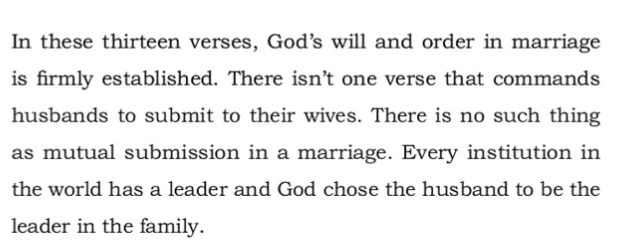
Men are called to submit to Jesus, and are called to lead at home. He submits mutually with His wife. But ultimately as on a ship there is only one captain, when it comes to ultimate decisions, the husband decides as the biblically identified leader of the family. The wife submits to her husband, and the children submit to the parents.
In hyper-patriarchy, a person excessively and almost solely focuses on the husband’s leadership, which sadly is often twisted into a husband’s rulership. In some quarters, it is recommended that the wife call her husband ‘lord’. As I said, rulership.
In this false system, proponents ignore or do not teach that the husband graciously submits to Jesus as Jesus submitted to the Father. They ignore or do not teach that marriage is a picture of Jesus and His Bride. They ignore or do not teach that marriage is a parable of the Gospel.
They just keep harping on “the woman submits”, “the woman submits”, “the woman submits”, “the woman submits”, “the woman submits”…
In Genesis 3:1, the serpent focused on one part of God’s command, and twisted it slightly. He didn’t restate what God had said,
“From any tree of the garden you may freely eat; but from the tree of the knowledge of good and evil you shall not eat, for on the day that you eat from it you will certainly die.” (Genesis 2:16).
The serpent asked, (not restated), to Eve, (not Adam),
“Has God really said, ‘You shall not eat from any tree of the garden’?” (Genesis 3:1b).
The serpent knew perfectly well what God had said, but he focused on one part- ‘you shall not eat’ rather than ‘you may freely eat.’ People who twist God’s word do the same. After all, they learned from the OG of Falsity.
We should absorb the whole counsel of God. We should share the whole counsel of God. In other words, as Christians, we seek balance in our learning. As with anything in life, we strive to be well-rounded.
Genesis 3:1 says the serpent is the most subtle creature in the garden. He can twist anything good into something false and still make it sound good.
In the end, hyper-patriarchy gets born because someone has an agenda, or they have a personal pet idol based on fleshly desires. They are not interested in the whole counsel of God. In discernment, watch out for people, or systems, or ministries that are hyper-focused on one doctrine. It is these that usually go off the rails first and spectacularly.
Tim Challies resoundingly negatively reviews hyperpatriarchy pusher Debi Pearl’s “Created to be His Helpmeet“. And if you know Challies’ reviews, the book has to be a horror show for him to utter anything even a toe into the side of negative. “Much of Pearl’s counsel is utterly heartless and even that which is not is too often proud and terse and utterly devoid of biblical wisdom. She displays a distinct lack of wisdom.”
I wrote on my other blog yesterday about the food haul I scored at Kroger. I am trying my best to manage my budget with these ever-rising food prices. Since I’m so intolerant of processed foods I can’t cheap out or take any shortcuts with my menu. I have to cook everything I eat myself and it has to be fresh. I go thru copious amounts of fruit and veggies, and I try to find reasonably priced seafood and chicken. It’s getting harder.
One thing Kroger has is rotisserie chickens for sale. I like chicken if it’s already cooked and I can slice off my own meat, ensuring nothing texturally off is going to make me gag and turn away from chicken forever, lol.
The rotisserie chickens are getting smaller, I noticed, and the price is creeping up. They are $8 now. But when they mark them down to $4.25 and I have the $1.25-off coupon I feel like the Queen of the World when I can score a whole, cooked chicken for $3.
Lately I’ve been having tofu, eggs a that a friend in church gives away, and quinoa for my proteins, so I was ready for something more substantial. I was on the hunt for chicken!!
I stopped in after church and headed straight for the spot where the cooked chickens are kept.
EPrata photo
But now I must digress for a moment. Before I was saved, I used to enjoy Monty Python, both the 1960-1970s TV show, and their movies. The film The Life of Brian tells the story of Brian Cohen (played by Graham Chapman), a young Jewish-Roman man who is born on the same day as—and next door to—Jesus, and is subsequently mistaken for the Messiah. It was one of the highest grossing movies in 1979, and is listed as one of the top 50 funniest movies. It was not without controversy, as you might expect. It was banned in several countries, it was picketed for blasphemy, and so on.
Me as a pagan, well, all that just made me want to see it all the more. There was one scene I remember and enjoyed the most. It was when a figure of the real Jesus was giving the Sermon on the Mount, distantly, and the people at the bottom of the mount in the back of the crowd had a hard time hearing it clearly. I remember it this way, though the actual scene in the movie is slightly different.
[Distant figure of Jesus saying] ‘The cheese shall inherit the earth’ [Crowd member] Aw, why should they get it?
I laughed. It’s just like us sinful humans, isn’t it?! To be jealous of what someone else has. Glad I’m not like that!
So back to Kroger. I’m pushing the grocery cart toward the chicken area, almost there, and just then I see a woman pulling away with three marked down chickens in her cart. WHAT?! Did she take all of them? Why should she get it?
I stewed and fumed.
Oh.
Wait a minute. I AM like that!
I talked myself down from the cliff. I decided to not think that she was greedy. I decided to think that maybe she has a large family. Maybe she has 2 friends who would appreciate the chickens. Maybe she is going to make chicken pot pies for the homeless.
I don’t know her deal, but I know my deal. The Bible tells us not to covet what others have. It also tells us to think of others above ourselves. It also tells us that God will provide. It tells us to rejoice with others. And more. So many verses I was breaking. I repented and asked the Spirit to turn my mind from my covetous anger.
God reveals sin to us and I thank Him that He revealed it immediately. I pray we recognize this reveal when it happens. I haven’t bribed anyone lately, I haven’t murdered anyone recently. I haven’t committed ‘big sins’ but I do commit sin. ‘Little’ sins are sins. Momentary sins are sins.
I can’t be SO focused on the deal that I overlook the people. If He’d wanted me to have the chickens, He’d have arranged for me to arrive 5 seconds earlier rather than 5 seconds later. Trusting that the Lord will provide is a big ask, but it helps to grow our faith. Apparently I have a ways to go in that department.
But how wonderful that we can repent to our Savior and He forgives us. How wonderful really, that He reveals our sin to us. How wonderful that He puts both big and little hurdles in front of us so we can grow in holiness.
As Jerry Bridges wrote in his fantastic book “Respectable Sins”,
“One of our problems, however, is that we neither think of ourselves as saints — with our new state’s concurrent responsibility to live as saints, nor do we think of such actions as our gossip and impatience as sin. Sin is what people outside our Christian communities do. We can readily identify sin in the immoral or unethical conduct of people in society at large. But we often fail to see it in what I call the “acceptable sins of the saints.” In effect, we, like society at large, live in denial of our sin.”
“[W]e can be orthodox in our theology and circumspect in our morality and yet tolerate in our lives some of the subtle “acceptable” sins we are discussing in these chapters. I believe that all of us have “blind spots,” character flaws, or subtle sins, that we are not aware of.”
Let’s keep our consciences sensitive to the Holy Spirit’s leading us to conviction of our sins. I’m not a super-saint. In this case I repented eagerly and immediately. Other times, the Spirit has had to metaphorically hit me upside the head with a 2X4 long after. But the main idea is, we should always strive to keep growing in holiness.
1. They, who are once effectually called, and regenerated, having a new heart, and a new spirit created in them, are further sanctified, really and personally, through the virtue of Christ’s death and resurrection, by his Word and Spirit dwelling in them: the dominion of the whole body of sin is destroyed, and the several lusts thereof are more and more weakened and mortified; and they more and more quickened and strengthened in all saving graces, to the practice of true holiness, without which no man shall see the Lord.
2. This sanctification is throughout, in the whole man; yet imperfect in this life, there abiding still some remnants of corruption in every part; whence ariseth a continual and irreconcilable war, the flesh lusting against the Spirit, and the Spirit against the flesh.
3. In which war, although the remaining corruption, for a time, may much prevail; yet, through the continual supply of strength from the sanctifying Spirit of Christ, the regenerate part doth overcome; and so, the saints grow in grace, perfecting holiness in the fear of God.
There’s no such thing as an ex-Christian. Look at 1 John-
“They went out from us, but they did not really belong to us. For if they had belonged to us, they would have remained with us; but their going showed that none of them belonged to us.” (1 John 2:19)
John is saying here that people who ‘backslide’ and then fall away from the faith entirely, a symptom of the end times by the way, never really were saved to begin with. “They profess to know God, but by their deeds they deny Him,” (Titus 1:15).
So what do we say to the verse in 1 Timothy 4:1-3 which states that many will fall away?
Now the Spirit expressly says that in latter times some will depart from the faith, giving heed to deceiving spirits and doctrines of demons, speaking lies in hypocrisy, having their own conscience seared with a hot iron, forbidding to marry, and commanding to abstain from foods which God created to be received with thanksgiving by those who believe and know the truth. (1 Tim 4:1-3)
Again those who fell away were never really one of Jesus’ elect to begin with.
And before the person started falling away, in came sneaky heresies they began listening to. They enjoyed these false teachings and heresies because their darkened heart had never experienced the light.
But there were also false prophets among the people, even as there will be false teachers among you, who will secretly bring in destructive heresies, even denying the Lord who bought them, and bring on themselves swift destruction. (2 Peter 2:1)
For certain men have crept in unnoticed, who long ago were marked out for this condemnation, ungodly men, who turn the grace of our God into lewdness and deny the only Lord God and our Lord Jesus Christ. (Jude 1:4)
So the progression is: profess Christ by mouth… but since there was no visible fruit to show the state of grace they were claiming on the inside, they were never really saved & regeneration never occurred; fail to walk closely with Jesus by procrastinating in discipleship, Bible study, prayer, and/or worship, furthering the distance between themselves and Jesus; (OR, faithfully attending church and Bible study but due to hard heart always were learning but never able to come to knowledge of the truth); listen to or promote destructive heresies that either they knowingly or unknowingly begin to believe, start doubting Christ’s sufficiency; doubt more, and then slide into apostasy’s full blown renunciation and end up in a state of atheism.
Peter says “For if, after they have escaped the defilements of the world by the knowledge of the Lord and Savior Jesus Christ, they are again entangled in them and are overcome, the last state has become worse for them than the first.” (2 Peter 2:20)
Notice the words that both Jude and Peter use to describe the heresies what will infiltrate the church in the last days; “secretly” and “crept in”. The heresies don’t come into the church by way of aggressive men bellowing a ‘new doctrine’ to the delight of followers who joyfully jump their pews and run out the door to his new church.
No, they come sneakily, secretly, subtly. And no wonder, “Now the serpent was more subtil than any beast of the field which the LORD God had made…” (Genesis 3:1) so satan isn’t going to capture hearts with bellicose attitudes or flagrantly detectable bad doctrine. Many of the preachers and teachers will not even openly pronounce their heresies, they will be secret within their heart and only after a while, introduced slyly. Jude’s words “crept in” also indicate something that also isn’t readily detectable and is subtle at the start.
These teachers will have a big, white smile, open their lecture with a warm joke, and tell you that Jesus was a good, moral teacher and that you deserve the best life now. They will never tell you that your best life is later and that Jesus didn’t come to be a moral leader but to seek and save the lost- And that you are lost.
Others will tell you that we are all one universal consciousness, we are our own gods, and then, they will give you a car. They will tell you that if you believe in Jesus, He will make your life better, while you are seeking Him from comfy ampitheatre watching a techno-sermon with a cappuccino in your hand. Seeker-sensitive churches are false on its premise because in Romans we learn that no one seeks God.
The end result of a Christian in name only – that is, one who claimed Jesus but never really believed – and is one who is at risk of being tempted by destructive heresies, and ultimately of apostasy. What comes next is atheism.
“At the same time, it takes just as much faith to believe in atheism. To make the absolute statement “God does not exist” is to make a claim of knowing absolutely everything there is to know about everything and of having been everywhere in the universe and having witnessed everything there is to be seen. [I]t cannot be proven that God does not exist. It takes just as much faith to be an atheist as it does to be a theist.”
Which, I suspect, could be one of the reasons Peter said it makes a person worse off from what they were before. After apostasy settles in and atheism rears its head, a person is well and truly now in the dangerous pits of despair, misplacing their burgeoning faith in Something for a faith in Nothing that will last forever.
An interesting article appeared in Maine Family Policy Council’s online publication, The Record:
“While there may be a diversity of opinion about the nature of God, no one in state government has stepped forward to doubt His existence. Atheism remains a strong taboo in political circles, in part because of the widely-held belief that faith in God is the mainstay of civil society. Eight state constitutions explicitly forbid atheists from holding public office. Tennessee’s state constitution gives the clearest statement in this regard:”
“No person who denies the being of God, or a future state of rewards and punishments, shall hold any office in the civil department of this state.” –end article
It all starts with destructive heresies, ungodly men creeping in unnoticed. And why aren’t they noticed? Because Christians today all too often fail to be familiar with the real thing. They abandon Bible study, quiet time, prayers, and worship, so that when the counterfeit shows up, being only subtly different from the Truth, it goes unnoticed.
What today’s Christian needs is larger doses of the above, not smaller. As times get tougher and stress makes a person weary, as work loads increase and family strife abounds, people fall away from the paving stones of a faith that lead from the cross to glory. This process separates the Christians In Name Only from the true believers. Are you worried about your salvation? Are you unsure? Has there been no visible fruit in your life for a while? You are at risk. Repent. Take it to the cross, and make sure you are saved. Apostasy is a ‘subtil’ thing, as subtle as satan. Has he crept into your heart?



















 the-end-time.org