False prophets were and still are a huge problem in the faith. So are false prophetesses!
“Now you, son of man, set your face against the daughters of your people who are talking like prophets from their own imagination. Prophesy against them and say, ‘This is what the Lord GOD says: “Woe to the women who sew magic bands on all wrists and make veils for the heads of persons of every stature to capture souls! Will you capture the souls of My people, but keep the souls of others alive for yourselves? For handfuls of barley and pieces of bread, you have profaned Me to My people, to put to death some who should not die, and to keep others alive who should not live, by your lying to My people who listen to lies.”’” (Ezekiel 13:17-19)
God is angry here, ANGRY. If you are of the opinion that we should live and let live, we shouldn’t come out against the false teachers and prophetesses, that ‘we don’t know their heart,’ that we should chew the meat and spit out the bones, or that being discerning is ‘mean’; please read Ezekiel 13 in entirety over and over until your soul and mind is aligned with God’s so that we hate what He hates.
We may not know their heart in most cases (in some cases we do), but God always does. He has pronounced woes upon the false prophetesses. WOES are the deepest and most fiery curse. When woe is used as a pronouncement of judgment, it is sure to come to pass. Look how angry God is with the women who claim words from Him but are merely vain imaginings:
Therefore, this is what the Lord GOD says: “Behold, I am against your magic bands by which you capture souls there as birds, and I will tear them from your arms; and I will let them go, those souls whom you capture as birds. I will also tear off your veils and save My people from your hands, and they will no longer be in your hands as prey; and you will know that I am the LORD. (Ezekiel 13:20-21).
In case a person is thinking, well, that’s the Old Testament God, not the gentle Jesus of the New Testament, oh, no! It’s all the same God. Look in Revelation 2 what He promises to do to the false prophetess Jezebel in Thyatira:
Behold, I will throw her on a bed of sickness, and those who commit adultery with her into great tribulation, unless they repent of her deeds. And I will kill her children with plague, and all the churches will know that I am He who searches the minds and hearts; and I will give to each one of you according to your deeds. (Revelation 2:22-23).
He will put the false prophetess onto a bed of pain and KILL the ones who followed her. Do you really want to chew bony meat so much that you risk what is promised to those who follow false teachers – pain and death? Do you really want to ‘be nice’ by sinning the sin of tolerance?
Why is God so angry with the false women prophesying in His name? Because, as He has said himself in Ezekiel 13:
-they capture souls (v18) -their victims become prey (v21) -they dishearten the righteous (v22) -they use falsehood in His name (v22) -they encourage the wicked not to turn from his wicked way (v23).
False prophetesses are a problem!
Many charismatic women claim words from the Lord but are vain imaginings, we know that. But also there are self-identifying evangelical women who say the same. These women have claimed God spoke directly to them and were told to go and tell you. Do not listen. Do not become ensnared in their web as prey. Do not risk being part of the herd that Jesus kills dead for partnering with these women.
Above all, do not listen to women who claim they have had a word from God and tell you all about it. The written word was given to us as a magnificent gift, don’t adulterate it or abandon it because you want to hear directly. We did hear directly, it’s the Bible.
Blessed are those whose way is blameless, Who walk in the Law of the Lord. Blessed are those who comply with His testimonies, And seek Him with all their heart. (Psalm 119:1-2)
Man loves to explore. Man loves to ponder on disasters, especially the RMS Titanic sinking in 1912.
Stockton Rush is the CEO of OceanGate Expeditions, a company that develops and manufactures deep-ocean submersibles. His ‘Titan’ submarine vessel carries passengers to deep water expeditions if you can pay $250,000. They carry passengers to explore the deep water hydrothermic vents in the Azores, they’ve been to the wreck of the Titanic, to the Bahamas, or if none of those suit, a paying customer can design their own expedition. The Titan sub can go to 13,123 feet deep. The Titan began its sea trials in 2018, and took its inaugural journey in 2021.
This week, the Titan submerged for an expedition to the wreck of the Titanic. The ship lies at the bottom of the north Atlantic Ocean at a depth of 12500 feet.
It launched this past Sunday with 4 passengers and CEO Stockton Rush, captaining the vessel. The BBC Reports:
Researchers aboard the Polar Prince – its mothership on the surface – lost contact with the crew shortly after the Titan began its dive. There is limited oxygen on board, and it is estimated that supplies are set to run out by around 10:00 GMT (06:00 EDT) on Thursday.Banging noises have now been detected in the search area, but it is not known where they are coming from or what they mean.US, Canadian and French agencies are working together to locate the submersible, and the tour firm OceanGate says it is exploring all options to get it back safety.
The plight of these 5 souls has captured the world. The irony of exploring the Titanic, which was said to be unsinkable, and now their own vessel has been either entangled in the wreckage or otherwise unable to regain the surface../shudder/. The dark, oppressive, murky depths…the loneliness, the fear.
My thoughts of course go to eternity. I’m sure theirs do too. Man’s plight is so much worse than being lost at the bottom of the sea. Man, in his sin, is separated from God and when his flesh expires, his soul will got to a wrathful eternity. His body will be fitted for enduring all the wrath, pain, punishment in fire for their sins against God while they lived in earth.
I think of Paul, chained to his jailer, a captive audience.
The Gospel Is Preached
Now I want you to know, brothers and sisters, that my circumstances have turned out for the greater progress of the gospel, so that my imprisonment in the cause of Christ has become well known throughout the praetorian guard and to everyone else, and that most of the brothers and sisters, trusting in the Lord because of my imprisonment, have far more courage to speak the word of God without fear. (Philippians 1:12-14).
The guards rotated every 8 hours. Paul had many in which to pead for their soul.
Paul was also at another time under house imprisonment with a guard living with him. (Acts 28:16)
Paul had a captive audience. He preached and preached. He sang hymns. He preached some more. Man’s true plight is not the earthly circumstances, in prison or captive in a deep-down lost sub. It’s our imprisonment to sin and the distance from God. It’s our eternal future in wrath.
When the actual Titanic ship was sinking, preacher John Harper was in the water. He swam from drowning victim to drowning victim. He preached the Gospel. He pleaded for their conversion. One man said for Harper to go away from him. After a short while, the man floated by Harper again. He asked Harper to say again about the Gospel, and this man converted and was saved. He was saved from His sin because he converted, even as John Harper himself was losing consciousness and sank beneath the frigid waves himself. He was John Harper’s last convert.
Few were found alive and plucked from the water, but this man was. He was George Henry Cavell. In Hamilton, Ontario, afterwards George testified that he was John Harper’s last convert. Harper had used his last breath to plead for George to repent and believe.
I am praying the five souls on board the sub Titan are found in time and their stricken vessel is raised successfully. Time (and oxygen) is running out. It’s a race against time to save them alive. But it’s always a race against time for a sinful human to repent and be TRULY saved before the number of their days expires. One never knows the days allotted to a person before God calls them to eternity.
My deepest prayer is that there is one Christian on board the Titan who is boldly proclaiming the way of Truth to the others. Like Paul, the Christian would have a captive audience in which to preach, pray, and sing the glories of Christ. This is the true salvation. If they are raised to the surface alive then they will enjoy the rest of their days serving Jesus before their translation to heaven. If they’re raised inside a sub that had become a tomb, then if they wrote their last words on paper, we might be able to rejoice they are alive in God’s heaven. Even if they are never found or never raised, those fleshly bodies if they converted, will be resurrected and reunited with their soul in heaven for all eternity.
People are never more eager to hear about Jesus than when death looms and eternity awaits. I pray the Lord stationed one Christian in the sub. Even just one…
Quick take: the answer to the title’s question and conclusion is YES.
Ladies, this is an important concept to understand rightly. If a woman believes she may only teach a certain, limiting set of verses to other ladies, she is limiting herself from knowing Jesus fully (even if she learns about Him from her pastor or her husband). Further, we are charged with making disciples, not homemakers. We are charged with proclaiming the whole counsel of God to one and all, including other women. Limiting one’s self randomly to Titus 2, or Proverbs 31 or Genesis 2:18 is nonsensical.
The Bible says of itself, “All Scripture is inspired by God and beneficial for teaching, for rebuke, for correction, for training in righteousness; so that the man or woman of God may be fully capable, equipped for every good work.” (2 Timothy 3:16-17). Limiting your sharing of His word with other women to just one or two verses is a rejection of God’s proclamation of the usefulness of His own words.
As RC Sproul used to say “Everyone’s a theologian.” It’s incumbent on us when we proclaim, disciple, or individually learn, that we are absorbing the whole counsel of God and doing so rightly. Here’s Nick-
BY NICK CAMPBELL- The Great Commission is for all Christians and includes the command to “make disciples,” and “teaching them” all that Jesus commanded.
EPrata photo
Aside from explicitly commanding “teaching,” discipleship presupposes teaching from scripture, what it means to be a Christian, Christian truths/doctrine, and what follows: theology.
Most in the latest fad of women can’t teach “academic theology” [a debated category of theology, anachronistically injected into scripture for eisegesis], concede that…
1) Women are included in the Great Commission and 2) Women can share the Gospel.
Theologians have agreed that sharing the Gospel is only the beginning of discipleship, discipleship cannot be reduced to one’s conversion, but it is being taught the faith.
The faith in scripture is doctrine and the ethics that flow from said doctrine.
In either case: the Gospel is a theological message comprised of scriptural truths, and the impartation of the Gospel often involves teaching said truths (doctrine).
To say otherwise is to reduce oneself to something tantamount to “no creed but Christ.”
Women are included in the command to make disciples, and I have yet to see a Christian limit the great commission to men only.
Nick Campbell, ‘Christ is the Cure’ @CITC_org
Women are included in the command to make disciples, and I have yet to see a Christian limit the great commission to men only.
But if women are not to exercise authority over men (particularly in overseer roles, to which I agree), who is left for them to fulfill this command with? Irony abounds in the movement mentioned above.
They posit: what can a woman offer a woman that a man cannot? They state there is no good reason for women <fill in the blank.>
Yet, they are the ones most emphatic that women and men are distinct sometimes to extremes.
Yet, if women and men are distinct in the way posited, then the logical benefit of a woman disciplining or teaching another woman is obvious. Some of this comes out in other teachings by these proponents, where women are told to have women friends because a woman cannot offer the same friendship and connection as a man. It’s logically incoherent.
What is more perplexing is that the movement utilizes the proof text of Titus 2 wherein women are told to “teach” women and that teaching within the full context, as all Christian ethics are, is rooted, grounded, and presupposes Christian truths.
When pressed on whether or not one can teach Christian ethics apart from Christian truth (i.e., baseless behavior modification), they will say no, but say that these women are teaching “biblical womanhood,” not scripture/doctrine/academic theology.
Of course, aside from this category being imposed onto the text to create arbitrary parameters, “biblical” womanhood presupposes biblical instruction on what it means to be a “woman.”
Further, consider the following: -Women are to “teach” women to “submit to their husbands.” -A woman attempts to do so, and the learner asks, “Why?” -How can the “teacher” proceed without appealing to scripture, creation, headship, anthropology, etc.?
The only way for the position to be defensible is for individuals to hold to parameters not found in scripture, “they can teach devotional theology, not academic theology.” [the former is not a formal or widely accepted category, the latter a debated and less utilized category even by most pastors].
EPrata photo
While theological categories are helpful, we cannot interject them into the text for our theological propositions.
Further, while theological categories are helpful, we cannot just disregard the categories established in numerous theological textbooks. On the most basic level, women are teaching (in Titus 2) “practical theology,” which is built upon other categories of theology.
Still, the question is: are women called (or permitted) to impart (I.e., teach) scriptural, doctrinal, ethics rooted in theology to other individuals in any capacity in scripture?
This leads to the following: The most difficult burden for these adherents is producing any scripture that bars women from teaching in any capacity other than in ecclesiastical offices held by men.
She cannot exercise authority “over a man,” are women included in this or are they distinct?
However, if one is going to make a standard (a law/commandment/restriction/holiness code: as they imply women who go beyond “Titus 2” are sinning), they need to have clear scriptural testimony…
To not have such is quite literally to be a Pharisee in adding to the scriptures a tradition to bind the conscience. To do this is to fly directly in the face of the Reformation and what freed men and women from the shackles of extra-biblical commandments.
Lastly, the typical rhetoric of inappropriate settings, “small groups, coffee shops, etc,” is quite bizarre, and quite ironically, women likely discussed scripture and Jesus Christ with other women while in the “workforce” of the 1st century.
Surely the local community centers (synagogues) were places of typical discourse as well! A random limitation on the setting for these commandments, is simply ridiculous.”
A good and clear disclaimer about this thread is that this is not advocating for the overcorrection wherein the great commission qualifies women for the office of pastor/overseer/elder. As I mentioned, I’m in agreement with the traditional understanding of ecclesiastical offices. —end Nick Campbell, Christ is the Cure essay—
Driving to Puyo on what we called “the bus plunge road” so called because even travel agencies had quit using it because the buses would plunge off the road down the Andes. At one point we went under an overhanging rock with waterfall, driving blind for a few seconds. It was so narrow see the construction worker stand off to the side as cars pass.
Sometimes I mourn the lost years of not being able to serve Jesus because I wasn’t saved till age 42. But I know the Lord’s timing is perfect. How he put up with my four decades of sin is an amazing testament to his patience.
I mourned of loss of years serving Jesus when I was in Europe seeing the great cathedrals and the great art- I’d have known the biblical stories behind the David or the Annunciation for example.
But God’s timing is perfect. At least I know those stories now and can praise Him for His work on earth for sinful humans.
In the 1990s I traveled a lot. I spent a month in Ecuador. We spent 4 days in the border town called Puyo adjacent to the rainforest. In the mid 1990s it was like a frontier town in the Old West. A mud street with boardwalk sidewalks, a few businesses, a restaurant and a hotel. Rainforest looming over, its boundary demarcated but always encroaching and striving to recapture the ground it had lost when the village was carved out of the dense foliage.
Doing laundry in Puyo: beat the clothes on the rock, then rinse in the river. EPrata photo
One of the businesses along the main street was a casket company. Apparently it was the thing to create the four corners of the casket concave and install in each corner a garishly painted mini statue of a saint. Then put convex plexiglass over it, forever enclosing the little statue inside its hole to keep watch for the body inside? I guess?
Another guy was building a copper still. We watched his progress over the days we were there. He was building it by hand, hammering the copper himself, a craftsman.
A craftsman hand hammering copper to make a still! EPrata photo
As I recently thought about my time in Ecuador, and our days in Puyo, it occurred to me to look up the distance from Puyo and Arajuno, Jim Elliot and Nate Saint and the others’ camp. In 1952-1956 those men were the famous missionaries making contact for the first time with the violent Amazon tribe called the Aucas. It was 40 miles. Just 40 miles away from where we stayed, the missionaries and their martyrdom had made such an impact for the Lord. I wonder if any of the people we interacted with in Puyo had known the men or were converted by their efforts.
I didn’t know the story of the men who were speared in the jungle just 40 years and 40 miles from where I stayed. I was oblivious to the spiritual battle that had taken place in that spot. I was ignorant of the fallout and whether Christianity had taken root where I was sitting all those days, drinking milky coffee on the verandah and watching the roosters strut up the street. I was just looking at the jungle, watching the copper still get made, and curious about the caskets.
The pagan’s mind is on things of this earth. But we have the mind of Christ. Therefore,
Set your mind on the things above, not on the things that are on earth. (Colossians 3:2)
Sometimes I wonder why the Lord does things the way He does, but I know that His ways are all good. Now that I’m transformed by the grace of God from earthly-thinking pagan to daughter of the Most High with a transformed mind, it all just makes me try and be sure not to miss any opportunities to share Him now that I am saved.
When I published that discernment article exposing some major doctrinal and behavioral issues with The Transformed Wife (Lori and Ken Alexander)’s output, there was quite a bit of reaction. One of the reactions was Lori’s husband Ken messaged me on Facebook. I did not solicit nor expect a personal private message, and not from a married man, no less. As you read the correspondence, please keep in mind that I have no relationship with Mr Alexander, personal or spiritual, I did not invite the messaging, and I tried to cut it off, but he breached that boundary of non-consent.
I have the screenshots.
People who message have a reasonable expectation of privacy. Normally I keep messages private and do not publish messages. (Sometimes I ask permission to publish if a reader has offered a really good thought or blog idea, and I publish if yes or no if they say no). However when Ken contacted me again after I’d asked him not to, all bets were off.
As you read this, keep in mind also that he claims identity in Christ as a Godly man.
So here it all is. Explanation at bottom. I refrained from editorializing as much as I could and tried to give you just the facts. You decide. I might have erred in replying. My goal and intent was to try and get him to see the issues and hopefully repent. I tried. Maybe that was my mistake. Again, you decide.
MESSAGE #1 from Ken Alexander. His wife had already blocked me after 1 engagement which she initiated.I believe she blocked me because I’d asked her if she had repented of her false teaching of Pelagianism. Lori never answered that. Neither did Ken when I asked him. I did not solicit this contact.Ken wrote right off the bat that I’m influenced by satan. So much for pleasant contact:
Hi Elizabeth,
After reading your article on Lori I could not recognize my own wife by the time you were done.
I found it interesting that you claim she is unteachable, yet when she makes her position clear on Original Sin in a post you gloss it over as “too little too late.”
We raised four wonderful Children together with strong and reasonable discipline… and they are all secure Believers in Christ with highly successful lives and families of their own. You’re just dead wrong on this idea of “hitting.” It’s spanking and there is very little cold in So Cal. How did you do with your family and kids?
Lori says that some time back you praised her ministry and agreed with her, yet somehow you caught Satan’s whisper and have been quite undiscerning here. You sound like a post from the trolls you are listening to.
She is full of love and grace, but hard hitting because she is goes up against the strong influence of feminism. You are correct that she purposely avoids the teaching the man’s role to keep women focused on what God calls them to do without pointing a finger at their disobedient husband they are called to win.
Lori’s ministry is not perfect, just as you have now proven that yours is not either. But many women write her regularly with wonderful stories of changed lives and marriages, proof that God is using her and blessing her God given wisdom from the Word. We don’t expect everyone to agree with her… even I don’t 100% 🙂. But when you attack one of the few godly women teaching the vital principles of Biblical Womanhood you do a disservice to the advancement of the Kingdom of God. She is teaching things that you and many other women cannot teach because she walks the talk with her life and love of our Jesus.
Ken wrote again before I even saw his 1st message and could reply:
Ken’s MESSAGE #2
I just read this by you and wonder if the Lord wasn’t telling you something, yet you projected it upon others without careful reflection for the words you just wrote against another sister in Christ?
It’s something to ponder in the Spirit as you asked others to do the same. 🙂
“It is humbling to publicly repent of something done in sin or taught incorrectly in His name. It is humbling to eat crow. But pride should not be so strong that it prevents us from kneeling down and saying “I was wrong. Forgive me.”
My reply to the above Ken-messages #1 & 2:I wrote-
Lori’s ministry is exactly as I described. The measure of a ministry is not how many people are writing in, but how doctrinally correct it is. She is an obviously troubled woman dwelling in error, and leading many astray. You have your part in that. Your influences such as the Pearls are atrocious, and this error has flowed down into your own ministry to your wife and her errant ministry to women. Her insistence that the Pearls, Partridge, and Gothard are worthy models, and her excuses for lack of sexual boundaries with wives and lack of boundaries in child punishment is appalling. Repent of those things and I’ll listen.
The Pharisees were ‘hard hitting’ too, and they were mostly right on their doctrine but went beyond by adding and adding, and by the guilt (‘millstone’) laid upon the neck of the sheep. You need to repent too for your part in the devastating millstones, and graceless absolutes you teach your wife to lay on women.
As far as the Original Sin controversy, I asked Lori if she has repented of her previous stance that we are not born as sinners but only BECOME sinners when we sin. It was not answered. HAVE you repented of that?
Your statement that Lori is one of “few godly women teaching the vital principles of Biblical Womanhood” is evidence of how skewed your vision has become. Lori is NOT one of the few women teaching this. You are NOT a bulwark. (And she doesn’t even teach it correctly or evenly).
She should look at gracious and doctrinally correct models such as The Women’s Hope Show from The Master’s Seminary, A Word Fitly Spoken podcast (Spreeman & Lesley), Open Hearts in a Closed World online conference and all women associated with that, DebbieLynne Kespert, Susan Heck, and MANY others who believe as you and Lori do, but who have a balanced view of scripture, and a FULL Titus 2:5 wisdom that includes being “sensible, … kind” but are missing from Lori’s online presence.
I have prayed for her and I do hope the Lord will graciously lift the scales from your and her eyes. Something to ponder and I am not being snarky, I am totally grieved over this. Consider, repent, and then we can talk some more. I’m always willing to listen.
Ken’s message #3, replying to my above: [Editor’s Note- Yes their lives ARE an open book. Lori and Ken have kept a blog for 12 years with hundreds of thousands of words written, 6 years’ worth of hours of video, and thousands of tweets. Yes their lives ‘are an open book,’ therefore there’s much material available to evaluate in order to make a solid assessment of their lives.] Ken wrote:
Elisabeth, I have no idea who you are really, but our lives are open book. Your comment “She is an obviously troubled woman dwelling in error, and leading many astray,” is so very far from the truth.
Lori is a woman whose heart is set completely upon the Lord. She has proven herself to her husband and to her family, friends and online friends as a woman of grace, peace, joy and full of the fruits of the Spirit. How can you make such an awful and incorrect assessment of her and expect me to take you seriously?
Ken then messaged again before I could reply. By now I’m getting the idea he lacks patience and self-control. Ken’s message #4-
If you want to dialogue, pick one or two issues you believe she is “so wrong about” that her errors are worthy of you trying to destroy her ministry over… and let’s talk about them. There are no grave errors in her teaching, just a difference of opinion on things we cannot have a definitive answer about.
You cannot prove from the scriptures that woman should be teaching doctrine and theology. WE know for certain it must not be from the pulpit, but where do you get the authority for women to teach other women outside of Titus 2?
So you and Lori disagree on something… that is not grounds to disqualify her God given ministry.
Child discipline… you know nothing about our child discipline but for a few stories from the trolls you disagree with. You are welcome to disagree, but you are not welcome to mischaracterize the facts that you do not possess. There were no freezing children that Christmas morning, and the discipline was appropriate and well received. A story we all laugh about including the kids. Yet you want to portray it as wring and grounds for disqualification of a ministry?
My question to you is why did you lie about what I wrote to you? You attacked Lori on at least 10-12 things and I challenged you on 3 of them. Yet you write on your page that I challenged you on “everything.” That is not true… why tell falsehoods?
The pattern seems clear to me that you are one who God keeps telling you to repent of your attacks on others, show kindness and grace, yet you have done nothing of the kind yourself. Speaking of Pharisees… you might consider talking the log out of your eye before trying to remove the specks from others.
I have not read any of the rest of your stuff, but I understand that you can be ruthless in your writing, betraying your own stated purpose: “Writing ministry of The End Time, by Elizabeth Prata, Exalting name of Jesus through Christian essays.”
Please prayerfully consider the words my Spirit has given for yours. We are all about trying to build up the kingdom of God, and Lori’s ministry will not be perfect… neither yours. But as far as I know we are on the same team Jesus.
‘You’re a ruthless liar’… ‘We build up the kingdom of God’. Bit of a disconnect .Photo by nega on Unsplash
My reply to Ken’s message #4. I kept it short thinking he’d said all that needed to be said and I was done too.
Thanks. I ask you to do the same. Have a pleasant day.
(He gave it a thumbs up in reply)
Ken’s message #5: out of the blue hours later. I had not replied.
Some of the things you write must be a joke: “I wrote about how Lori’s insistence on not teaching anything except home economics from Titus 2 (a stance which, even then, lacks several aspects of the verse, such as kindness, sensibility, reverence, etc).”
Lori has not only taught on all these subjects extensively but she has a book out with a chapter on each one.
You really need to find the Spirit here. I have never heard her equate Titus 2 with Home Economics. Now your just making up lies.
Mark Jay Goebel/Getty Images
Obviously I’d get nowhere with a man who has that little self-respect and that much anger, to think himself a Christian and called me a troll, a liar, a joke, making up lies listening to satan, not walking the walk, so much ad hominem… but not an ounce of self-reflection. I’d had enough: My reply to Ken Message #5.
Please do not contact me again. And repent of your rough mouth. “For out of the heart come evil thoughts, murders, acts of adultery, other immoral sexual acts, thefts, false testimonies, and slanderous statements.” Mt 15:19
Ken disrespected my boundary and in a shocking lack of self-control, contacted me again: Ken message #6:
It’s interesting how often the Spirit gives you thoughts that you should be applying to yourself, yet you ignore them. May He open up your hardened heart to see what you are doing is not glorifying to Him.
I think we are on the same Team Jesus…. I sure hope so.
My reply to unasked for Ken Message #6. I knew he’d be looking to see what I’d say so I waited until the little circle showed he had read my reply below, then I blocked him.
“BLOCKED and REPORTED for HARASSMENT”
PS: I tried to find the Facebook information on harassment but had a hard time finding it, and when I finally did and read it, decided his correspondence didn’t rise to the level of harassing. He was just more of an annoyance.
—–end correspondence—–
The reference to the children and the hitting and the cold was a story Lori had published about a Christmas morning when she came downstairs to see her 1, 3, 5, 7 year olds had opened up every single present. She was “so upset” and began hitting her kids with her slipper hard enough to “let them know she was clearly angry”. Running upstairs to Ken he came down and put all of them outside on the porch to them the shutting out of the Garden of Eden, so the 1 year old and the others “could ponder their sin.” Later Ken relished the memory by saying they were ‘so cute all lined up out there.’ Ken and Lori are careful nowadays to say ‘swat’ or ‘spank’ instead of hit or beat. He dislikes when I say “hit”.
Anyway I wanted the messages to be public so it would be transparent, not only his behavior, but mine too. So you can decide. A journalist puts the information out there in the most credible and factual way possible, and so that the reader can make her own assessment.
As a journalist, I am familiar with how people act when their worldview is challenged. I know what happens with some, who, when presented with facts contrary to their long-held opinion, act up. I’m used to people like Ken Alexander.
But the issue is: he is half of the Transformed Wife’s ministry He is an overseer of it, contributing author to it, and ultimate teacher within it. A student will go no higher than his teacher, so, my goal is to present information that clearly shows that the Transformed Wife’s ministry is not healthy. Ken and Lori Alexander should not be followed.
My goal, sole goal, is to present information about this self-stated ‘ministry’ of Lori Alexander, The Transformed Wife, which is partnered by Ken Alexander, that demonstrate that the two of them are to be marked and avoided as false teachers. Their issues, both behavioral and doctrinal, give a clear picture that their material should not be consumed. Stay away.
Writing in the mid-1500s, John Foxe was living in the midst of intense religious persecution at the hands of the dominant Roman Catholic Church. In graphic detail, he offers accounts of Christians being martyred for their belief in Jesus Christ, describing how God gave them extraordinary courage and stamina to endure unthinkable torture.
From the same link, the book’s purpose was fourfold:
Showcase the courage of true believers who have willingly taken a stand for Jesus Christ throughout the ages, even if it meant death,
Demonstrate the grace of God in the lives of those martyred for their faith,
Expose the ruthlessness of religious and political leaders as they sought to suppress those with differing beliefs,
Celebrate the courage of those who risked their lives to translate the Bible into the common language of the people.
The Fourth Persecution, Under Marcus Aurelius Antoninus, A.D. 162
Engraving by Michael Burghers, from his book ‘The Life of S. Polycarp, Bishop of Smyrna’ c 1685
Polycarp, who was a student of the Apostle John and the overseer of the church at Smyrna, heard that soldiers were looking for him and tried to escape but was discovered by a child. After feeding the guards who captured him, he asked for an hour of prayer, which they gave him. He prayed with such fervency that his guards said they were sorry they were the ones to capture him. Nevertheless, he was taken before the governor and condemned to be burned at the market place.
After his sentence was given, the governor said to Polycarp, “Reproach Christ and I will release you.”
Polycarp answered, “Eighty and six years have I served him, and he never once wronged me; how then shall I blaspheme my King, Who has saved me?”
At the stake to which he was only tied, but not nailed as usual, since he assured them he would stand immovable. As the dry sticks around him were lit, the flames rose up and circled his body without touching him. The executioner was told to pierce him with a sword, which he did. Upon being pierced, a great quantity of blood gushed out and put out the fire. Although is Christian friends asked to retrieve the body so it could be buried, the enemies of the Gospel insisted that it be burned in the fire, which was done.
“Rendering service with a good will as to the Lord and not to man,” (Ephesians 6:7)
My prayer: ‘Lord, thank You for the example of the martyrs, who were living, breathing examples of Christ-likeness unto death. Polycarp’s hospitality, prayers, and steadfastness under the most extreme pressure was an example to the pagans around him and is an example to us today. Thank you for the blood-bought opportunity to go to a worship service, the blood-bought privilege of carrying a bible to that place, and the inexpressible privilege of prayer. May we all proclaim Christ boldly, echoing Polycarp’s words, that we shall not blaspheme our King, Who saved us.’
Sister, I hope you are eating solid food in your walk with Christ. If you have been saved for a while but still regard the Bible as too deep, can’t understand it, and don’t get much out if it, this is a problem.
“Concerning him we have much to say, and it is hard to explain, since you have become dull of hearing. For though by this time you ought to be teachers, you have need again for someone to teach you the elementary principles of the oracles of God, and you have come to need milk and not solid food. For everyone who partakes only of milk is not accustomed to the word of righteousness, for he is an infant. But solid food is for the mature, who because of practice have their senses trained to discern both good and evil.” (Hebrews 5:11-14).
It is critically important for every believing man, woman, youth, and child to be bathed in the word constantly. And not just head knowledge, though that is where the transforming begins- the mind. (Romans 12:2). But we also need to take what we know and apply it to our lives.
Otherwise the babe in Christ is at risk-
“Beware of the false prophets, who come to you in sheep’s clothing, but inwardly are ravenous wolves.” (Matthew 7:15)
How can you be wary of something if you don’t know what it is or what it looks like? If you were never taught what a wolf was, you’d be likely to think it was a dog and go up and pet it!
We are in an evil and corrupt time, when abominable demons stalk the people of the world, when satan and his masquerading minions do all they can to deceive you, when spies are entering the church to put you back into bondage, – And you are still on milk?
“Although satan and his minions know they can never destroy your salvation, they will do everything under their power to destroy your enjoyment of that salvation.”
~Sinclair Ferguson, Ligonier course, “Union with Christ”
One way they destroy your enjoyment of His salvation is to enslave you like the Pharisees did and bind you with rules. Another is to draw you away from good teaching and instill in your mind false teaching that clouds your vision of who Jesus actually is and gives you a different picture of His character.
Mainly, absorbing His word should be a delight! It is refreshing to be washed by the word, to dive into its jewel-like beauty and its endless complexity but its truths so graciously illuminated by the indwelling Spirit! We glory in His word and are jubilant when we graduate from milk to meat! For we know we are seeing Jesus more clearly, and we can then confidently turn around and extend a hand to those on milk and help them to rise in understanding of it! ALL to have a closer relationship with Jesus through His word.
We are heavily encouraged to feast on the meat of the word.
“Milk does a body good”, but meat sustains you! Get on the meat!
I do not recommend Lori Alexander, The Transformed Wife’s ministry
The TRUE transformation of a woman from a non-believer to a believer is the most beautiful miracle of our day or any day. The transformation of a justified woman into a Titus 2 woman, whether married or NOT married, whether she has children or NO children, is also a beautiful thing.
I wrote a critique of Lori Alexander The Transformed Wife AKA @godlywomanhood. It seemed needed.
After interacting with Lori a few times and having read some of her recent statements, I also wrote several other essays that were rebuttals to things she has taught. They are listed below.
During some interactions with Lori (and her husband Ken), I discovered that though it’s one of the Titus 2 mandated qualities, kindness is not in her vocabulary. Also that she is unteachable (lacks humility). Here, I wrote about the importance of women to engage in humble, self-examination- We All Have a Ministry
Sadly, Lori’s version of biblical womanhood is a Hyper-patriarchy that’s not biblical and not a good example of how to live a godly, womanly life.
I wrote about how Lori’s insistence on not teaching anything except home economics from Titus 2 (a stance which, even then, lacks several aspects of the verse, such as kindness, sensibility, reverence, etc) and this has skewed her worldview to an extent that 2 Peter 3:16 warns about- Balance in our theology is important
Something that Lori Alexander The Transformed Wife often does, is make a statement that is her opinion, and is so broad-brush that it’s actually an overgeneralization, then she argues within the overgeneralization while never providing a source. She overgeneralizes so frequently this has caused me to look into what overgeneralizing is. It is a cognitive issue. I encourage you to spot these when she makes these broad-brush statements.
Here is a 2 tweet thread on it, with a definition of overgeneralizing. “Overgeneralizing is a distorted way of thinking or cognitive distortion which results in wrong or misconstrued assumptions. Often it’s described as making a broad assumption about something without much evidence or data to back up that assumption.” Quote from Be Well Counseling.
Lori makes a statement that is really opinion but disguises it as fact, and never provides a source.
Here is another definition: “Overgeneralizing is a cognitive distortion, or a distorted way of thinking, that results in some pretty significant wrong assumptions.” (Cognitive Behavioral Therapy of LA)
Here is a 2-tweet thread I did on Twitter showing an example of a recent overgeneralizing statement Lori made: “Public Schools were created so women could be in the workforce”. No. This is wrong and so easily provable.
I’d also pointed out that Lori misuses statistics, or she doesn’t understand statistics well enough, and presents flawed arguments to make her narrow points. Here, she had said that “25% of women are on anti-depressants” then argued the point based on her misstatement.
In fact, the study from which she got the number said that 25% of women over 60 (Lori’s demographic) are on the drug. Only 10% of women 18-39 (child bearing years) are on it. She’d made an overgeneralization from the misstated statistic then tied in the fact that the reason so many women are on antidepressants is because they don’t submit to their husbands and they work outside the home.
Here, her overgeneralization is that simply asking someone how many kids they’d like is ‘giving into the birth control mentality infecting the country’. There is no possible way Lori knows the mentality of every person who asks that question in the entire country. Then she ties it in to abortion. Big leaps. Unwarranted, and dangerous.
She overgeneralizes and she misuses statistics. Watch out for that.
OTHERS’ Critiques
Bob Jennings at I’ll Be Honest (associated with Paul Washer’s ministry) wrote this in 2010, therefore isn’t a direct critique of Lori Alexander, The Transformed Wife, but it addresses a falsity Lori insists on advising to women: where Lori says women should not go to college and should remain at home till marriage. Here is the article which Mr Jennings addresses this false notion scripturally: Patriarchy vs. Single Women in the Bible
Tim Challies reviewed Debi Pearl’s book Created to be His Help Meet and Michael Pearl’s How to Train Up a Child. His reviews (below) are included here because Lori Alexander The Transformed Wife has said many times it was Debi’s book that was that catalyst for her transformation. She admires these two as spiritual leaders and identifies them as her formative mentors. She quotes them incessantly. Challies was a strong NO on both books:
A Ray of Dawn has a blog titled The Transformed Wife is Dangerous and Wrong. She’s got links and screen shots. I liked her point here: “This is my main issue with Lori – she claims men should be leaders, but doesn’t expect them to actually lead in areas of Godliness. Rather, she insists women coddle their husbands regardless of how they behave, which is the opposite of what the Bible says.”
Gina at Where the Wild Bee Wings has a video series critiquing Lori Alexander The Transformed Wife’s teachings (and more videos on The Duggars, IBLP/Gothard, and the Pearls): (Gina is a nice lady and I agreed with these particular videos, but disagree with Gina’s approach to Christianity, i.e. she’s not attending a church, and recently claimed Jesus appeared to her in a vision. But the Lori/Pearls/Duggar videos are wise).
This Wiki page gives an overall view of Lori’s life in a bio, and highlights that she has made contradictory statements over the years and that some of her personal stories don’t match up. There’s screen shots. Fundamentalist Wiki: Lori Alexander
I am grateful in reverse for Lori, because with my brief interaction with her and her material this May and June, has settled me into a conviction that I, and women who minister, need to be KIND. Kindness is mandated in Titus 2:3-5,
Older women likewise are to be reverent in their behavior, not malicious gossips nor enslaved to much wine, teaching what is good, so that they may encourage the young women to love their husbands, to love their children, to be sensible, pure, workers at home, kind, being subject to their own husbands, so that the word of God will not be dishonored. emphasis mine.
Kindness is in short supply in real life, and online especially. Kindness is a refreshing quality, as of course the other Titus 2 qualities are. In my opinion, Lori is unkind, modeling exactly the thing that DISHONORS Christ within the very verse she camps on for her raison d’etre (reason for being). So for that I’m grateful. Seeing how ugly unkindness is, I can work on my own kindness, and look for it and encourage others when I see it.
I will add other links as I discover them or are forwarded them.
We’ve all read Matthew 11:28-30, “Come to Me, all who are weary and burdened, and I will give you rest. Take My yoke upon you and learn from Me, for I am gentle and humble in heart, and YOU WILL FIND REST FOR YOUR SOULS. For My yoke is comfortable, and My burden is light.”
We all know what a yoke is. Even if we don’t live in farming country, we understand the idea that whoever puts a yoke on an animal it means the person is master over that animal. When the master puts a yoke on an animal he will cause the animal to work for him, able to turn it this way or that. The master might make the animal work hard and long, or short and sweet, but he has control over that yoked animal. The animal is ‘owned’.
Left, are the yoke references in the Bible, extending back as early as Leviticus and ending with 1 Timothy. Most are agricultural references.
Yet we also discover in ancient times, the Romans (and others) had a method of subjugating their enemies. When an army conquered an army they had three choices. They could kill them all (a waste of potential human usefulness to the victor), they could keep them as prisoners (hard to feed and house that many), or they could absorb them into their culture’s life. But first, there had to be some kind of ritual to impress upon the vanquished that they were indeed subjects under a master and not at liberty any more.
The Romans would plant two upright spears in the ground and tie a third across it, kind of low. They would strip the conquered to their underclothes, and make them go under. This ritual was called “passing under the yoke.” The Latin phrase was sub iugummittere. The Roman alphabet didn’t have a ‘j’, it was ‘i’. This is where we get the English word, subjugate.
Definition subjugate: bring under domination or control, especially by conquest. make someone or something subordinate to.
In earliest examples, Livy tells us, the ritual was used to remove blood guilt from the vanquished, so as to allow them to become slaves then potentially freed-men eventually.
Below is Charles Gleyre’s artistic rendition of the ritual, titled The Helvetians Force the Romans to Pass Under the Yoke. Their victory didn’t last long, the Romans soon arrived with reinforcements and re-conquered the Helvetians (the Swiss). Gleyre takes some liberties here. The yoke new subjects were made to pass under was not an actual animal yoke, it was the three spears.
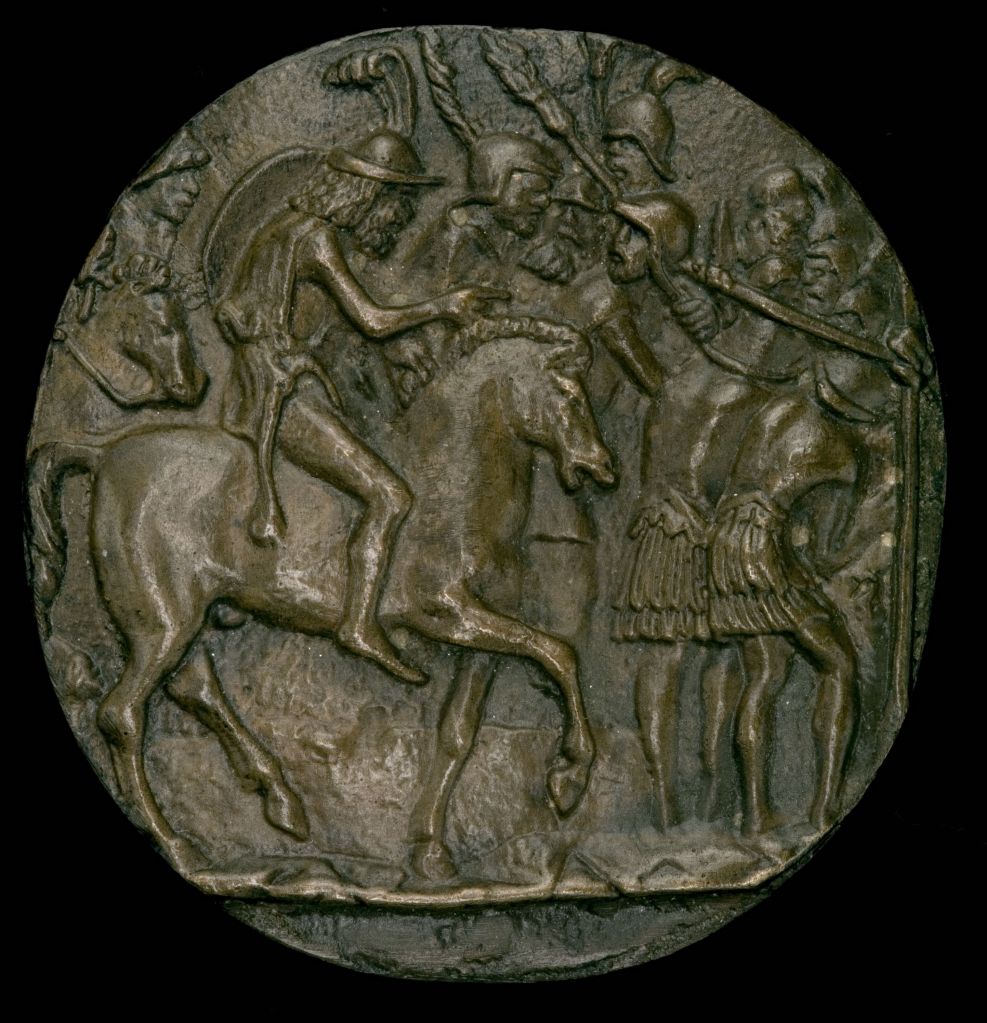
We see a truer depiction here of a medallion depicting the Romans being sent under the yoke by the Samnites (Pseudo-Melioli, c. 1500). Source Wikipedia
“Pseudo Melioli, Romans Passing Under the Yoke, late 15th – early 16th century, overall (irregular disk, largest diameter): 4.46 cm (1 3/4 in.)
overall (irregular disk, smallest diameter): 4.21 cm (1 11/16 in.)
gross weight: 22.08 gr (0.049 lb.), Samuel H. Kress Collection, 1957.14.201”
When we read Matthew 11:29, Take my yoke upon you, as the Jamieson, Fausset, Brown Commentary says it’s “the yoke of subjection to Jesus”.
In today’s easy peasy salvation and sanctification religion, we often forget the abjectness with which we must come to Jesus. And though our position after salvation is one of an adopted child of God, we still must remember to Fear God, and be Humble. Our position and lifestyle should be one absent of pride, unless it is boastful pride in our perfect Savior and His work. This author, explaining the Roman method of making people pass under the yoke, said,
They had to be brought out of one status into another; they must not be any longer the same beings they were before the deditio; ~W. Ward Fowler, “Passing Under the Yoke” The Classical Review, 1913.
We come to Him bowed, low, naked, and stripped of attachments to this world and of our former identity (as hopeless sinner). We pass under His yoke. Our status changes, we are changed. Rather than staggering under the terrible burden of sin, we now are “glad and lightsome, and said with a merry heart, ‘He hath given me rest by His sorrow, and life by His death,’ said Christian in John Bunyan’s book The Pilgrim’s Progress.
With all this information in mind, hear Jesus say the words again, ‘As opposed to the rough yoke of oppressors in a defeated kingdom, MY yoke is easy. MY burden is light. Pass under it.’
O, but doesn’t it seem heavy when looking at the spears and contemplating the humiliation of repentance! Look at the solders’ faces in Gleyre’s painting! Side-eye, suspicion, skepticism. We sinners think, “No, not THAT! Anything but that!” But yes. Bring yourself low, whether passing under the yoke of Jesus for the first time for salvation, or as you repent of sin even though you walk with Him. His yoke is easy! His burden is light!
Do you need to repent to be saved by the blood of Jesus? Do it! Do not hesitate! If you are born again, do you need to repent for something you have done? Do it! Do not hesitate! Passing under the yoke of Jesus you will find rest for your soul.
Fellow Christians, as the Church Age draws to a close, the anger, mocking and scoffing grows. On internet chat boards, forums, blogs, and e-mails, the unsaved rail and rebel in unloving and unforgiving manner. In real life, they mock and sneer, scorning our beliefs. Oppression, ridicule and persecution grows. Marriages dry up. Children go prodigal. Even witnessing to family members can be heart-breaking, as the most polite response is usually simply a deafening silence or at worst, rifts grow.
All this can bring a Christian down. It can cause one to despair and stumble, as we wonder if the tears that Jesus wipes from our face will be falling in grief because our loved ones are absent in glory.
Remember, Jesus knows this would be the circumstance in the end of days. (The last days are the time between His ascension and His second coming, i.e. now). He inspired Jude to write these words, as comforting to the church then as to us now:
A call to persevere
But you, beloved, must remember the words that were spoken beforehand by the apostles of our Lord Jesus Christ, that they were saying to you, “In the last time there will be mockers, following after their own ungodly lusts.” These are the ones who cause divisions, worldly-minded, not having the Spirit. But you, beloved, building yourselves up on your most holy faith, praying in the Holy Spirit, keep yourselves in the love of God, waiting for the mercy of our Lord Jesus Christ to eternal life. And on some, who are doubting, have mercy; and for others, save, snatching them out of the fire; and on others have mercy with fear, hating even the tunic polluted by the flesh.
To him who is able to keep you from falling and to present you before his glorious presence without fault and with great joy— to the only God our Savior be glory, majesty, power and authority, through Jesus Christ our Lord, before all ages, now and forevermore! Amen. (Jude 1:17-25)
The NKJV has these section titles, which I think is a good outline of Jude’s epistle. While we worry about everyone else and that is fine, we should at some point turn our attention to our own walk and Jude does partway down:
Greeting to the Called Contend for the Faith Old and New Apostates Apostates Depraved and Doomed Apostates Predicted Maintain Your Life with God Glory to God Amen.
Dear reader, witness in love, pray for the lost, and persevere. For He is able to keep us from falling, He is the most Worthy One to whom we shall be presented in due time and in great joy.























 the-end-time.org