Posted in bible, encouragement, refresh, word

And now a word from our sponsor: the Word of God

By Elizabeth Prata

Did you ever get home from a long week and your body just throbs? Pulses with stress and worldly pollution and reverberating with clanging and noise you just can’t seem to get out or clear your head?

Saturday morning I slept late, always nice. (until 7:00 am!). I roasted broccoli, butternut squash, orange peppers, and spaghetti squash. On weekends when I process the produce and cook, I listen to sermons. I enjoy Refnet, Reformation Network. It’s a 24-hour online radio station featuring expositional sermons, prayers from the Valley of Vision, music and hymns, devotionals, some talk on news issues from a Christian perspective, and plain old reading of the word, uninterrupted and unadulterated. It’s a great network. No ads, and it’s free.

So on Saturday morning while my hands worked, my mind was busy listening. I listened to three sermons on RefNet.fm while I cooked: Alistair Begg on David and Goliath (which is not about facing your giants but is about the might of God), RC Sproul on Mary’s Magnificat (brought me to tears), and John MacArthur on predestination in Romans 8, gorgeous.

Reformation Network: 24-Hour Internet Radio Committed To the Historic Christian Faith

As for the prayers, I heard one from the Valley of Vision that was so lovely, it was so beautifully written. Here is just part of it:

Lord Jesus, give me a deeper repentance, a horror of sin, a dread of its approach. Help me to flee it and jealously to resolve that my heart shall be yours alone. Give me a deeper trust, that I may lose myself to find myself in you, the ground of my rest, the spring of my being. Give me a deeper knowledge of you as Savior, Master, Lord, and King. Give me deeper power in private prayer, more sweetness in your Word, more steadfast grip on its truth. Give me deeper holiness in speech, thought, action, and let me not seek moral virtue apart from you. The Valley of Vision (Puritan Prayer)

When people are stressed or overwhelmed they do a lot of things. They work out. They go for a walk. They cook ;). They enjoy their hobby/game/movie. For the Christian, there is no better stress reliever than the Word. Read it or listen to it. I don’t know how to explain the supernatural advance of the Spirit in us, but when I listen to the reading of the word and sermons explaining the word and music that praises the Lord, it does something to me. It washes me from the inside. It restores me, cleans me, revives me.

After a few hours, my heart was expanded with love for Jesus, my head was full of scripture, and my belly was satisfied with food He had provided.

The law of the LORD is perfect, reviving the soul; (Psalm 19:7a)

he refreshes my soul. He guides me along the right paths for his name’s sake. (Psalm 23:3)

I am exceedingly afflicted; Revive me, O LORD, according to Thy word. (Psalm 119:107)

for he satisfies the thirsty and fills the hungry with good things. (Psalm 107:9)

He gives strength to the weary and increases the power of the weak. (Isaiah 40:29)

Power-
and what is the immeasurable greatness of his power toward us who believe, according to the working of his great might (Ephesians 1:19)

The reviving energy of the Word is part of the great power He bestows on us.

The word “power” (dynamis; cf. 3:20) means a spiritually dynamic and living force. This power of God is directed toward believers. Paul then used three additional words to describe God’s power. It is according to the working (energeian, “energetic power,” from which comes the Eng. “energy”) of the might (kratous, “power that overcomes resistance,” as in Christ’s miracles; this word is used only of God, never of believers) of God’s inherent strength (ischyos) which He provides (cf. 6:10; 1 Peter 4:11). This magnificent accumulation of words for power under scores the magnitude of God’s “great power” available to Christians.
Hoehner, H. W. (1985). Ephesians. In J. F. Walvoord & R. B. Zuck (Eds.), The Bible Knowledge Commentary: An Exposition of the Scriptures (Vol. 2, p. 620). Wheaton, IL: Victor Books.

What a good and loving God we have. His word is eternal and strong, it refreshes, revives, strengthens, and enlivens. Don’t put off reading it or listening to it.

Before reading/listening to the Word

After reading/listening to the Word

Posted in Aaron, almond tree, bible, jeremiah, resurrection, symbol

The Almond Tree: the promise and the beauty, a symbol of resurrection

By Elizabeth Prata

Most of us aren’t farmers. Many of us don’t garden. Having lost our connection to the land, sometimes the biblical symbolism of certain agricultural meanings are lost to us. Let’s look at the almond tree.

Flowering almond trees, Wiki CC, by Daniel Sancho

The almond tree is mentioned in scripture several times and always in interesting contexts. Almond tree twigs are mentioned as early as Genesis 30:37 and Genesis 43:11. In Exodus 25:33, God is describing how the Golden Lampstand in the Tabernacle should look.

Source

Sweet almond tree branch with blossoms. Wiki CC

three cups made like almond blossoms, each with calyx and flower, on one branch, and three cups made like almond blossoms, each with calyx and flower, on the other branch—so for the six branches going out of the lampstand.

Calyx is the collective name for sepals of a flower. Easton’s Bible Dictionary explains,

A native of Syria and Palestine. In form, blossoms, and fruit it resembles the peach tree. Its blossoms are of a very pale pink colour, and appear before its leaves. Its Hebrew name, shaked, signifying “wakeful, hastening,” is given to it on account of its putting forth its blossoms so early, generally in February, and sometimes even in January

The International Standard Bible encyclopedia says,

The masses of almond trees in full bloom in some parts of Palestine make a very beautiful and striking sight. The bloom of some varieties is almost pure white, from a little distance, in other parts the delicate pink, always present at the inner part of the petals, is diffused enough to give a pink blush to the whole blossom.”

Did you know that there are sweet almonds and bitter almonds. Bitter almonds are toxic. It becomes cyanide when crushed and mixed with other enzymes inside the almond.

Gabriel Garcia Marquez once wrote poetically about the scent of bitter almonds and the fate of unrequited love as a lead-in to murder by cyanide poisoning. And in bitter almond oil as in a tragic romance, the sweet and the toxic are inextricably entangled.

Benzaldehyde is made by the decomposition of amygdalin (named for Prunus amygdalus, and in turn responsible for the bitterness that gives bitter almonds their common name). The other decomposition products are glucose (sweet) and hydrogen cyanide (toxic). … The utility of amygdalin to the plant is for defense, specifically as a deterrent to grazers from eating the valuable seed as well as the dispensable fruit. Inside the cells of the almond kernel, amygdalin is sequestered from the enzyme that breaks it down: amygdalin hydrolase. Crushing, as happens when the plant is grazed upon, brings the enzyme and amygdalin together, and cyanide is produced as a result–as much as 4-9mg per almond.”

Aaron’s rod famously budded almond leaves, blossoms, and fully ripe fruit. The LORD did this to prove that Aaron was His designated spokesman, with Moses.

On the next day Moses went into the tent of the testimony, and behold, the staff of Aaron for the house of Levi had sprouted and put forth buds and produced blossoms, and it bore ripe almonds. (Numbers 17:8)

As with Aaron’s rod, Jeremiah 1:11 use of the almond as a symbol. Jeremiah 1:11-12:

And the word of the Lord came to me, saying, “Jeremiah, what do you see?” And I said, “I see an almond branch.” Then the Lord said to me, “You have seen well, for I am watching over my word to perform it.

Pulpit Commentary says of Verse 12. – I will hasten my word; literally, I am wakeful over my word; alluding to the meaning of the Hebrew word for almond. The LORD will hasten to perform His judgments of Jerusalem which He proclaimed in His word to Jeremiah.

It was inevitable: the scent of bitter almonds always reminded him of the fate of unrequited love.”
Gabriel Garcia Marquez, ‘Love in the Time of Cholera”.

In Genesis 43:11 one of the ‘best gifts’ of the land that Joseph’s father Jacob urged his sons to bring to Egypt (unknowingly, to Joseph) were almonds.

In Plants of the Bible, it says, “The almond, Amygdalus communis, is a medium sized tree with narrow, light green leaves. Unlike the fig and olive, the almond does not live to a great age. The almond is a well-known symbol of resurrection because it is the first tree to flower. The white, five-parted flowers are up to two inches across and come in the late winter before the leaves of the tree develop. Because they may flower as early as late January or early February, it is sometimes possible to find almond flowers with snow.

Charles Spurgeon preached on the lessons of the Almond Tree. He says here,

“While I have felt compelled to speak of these solemn Truths, I am glad to turn to the other part of the subject which is this—that God is quick in performing His promises. They are like the almond tree—they blossom and bear fruit very quickly. “What sort of promises,” you ask, “are thus speedily fulfilled?” Well, first, the promise to give salvation to all these who believe in the Lo rd Jesus Christ. Listen— “The moment a sinner believes, And trusts in his crucified God, His pardon at once he receives, Redemption in full thro’ His blood.” I see “a branch of an almond tree” here. The Psalmist says, “His word runs very swiftly,” and I am a witness that it does. Many years ago, I, a poor sinner, went into a place of worship to hear the Gospel preached. The preacher repeated the Lord’s command, “Look unto Me, and be you saved.” I looked to Christ and I was saved that very instant. It takes no longer to tell the story than it did to work the miracle of mercy. Swift as a lightning flash I looked to Christ, and the great deed was done! I was a pardoned and justified soul—in a word, I was saved! Why should not the same thing happen to you who are here? It will happen to everyone who shall now be led to believe in Jesus Christ.”

On this most joyous of days, you who wonder at our joy, it is because we looked to Christ as our all in all, forgiver of sins, Lamb of God. You, also, look to Christ – and be saved. The almond tree blooms, quick with promises. The most wondrous promise of all is the resurrection of the Son of God.

Aaron’s rod budded, sprouted, and offered fully formed fruit, all at the same time. “According to the law of nature, all living things have a beginning and an end. However, this was not the case with Aaron’s rod, for God gave it a new lease of life. This miracle hinted at the resurrection of Jesus Christ. Even though death came to the world because of the actions of the first man, Adam, resurrection would come about on account of Jesus Christ (1 Cor 15:17–22). Hence, when Jesus was about to raise Lazarus from the dead, He told Martha, “I am the resurrection and the life. He who believes in Me, though he may die, he shall live” (Jn 11:25). … the flowering rod served to quell Korah’s rebellion and re-affirmed Aaron’s position as high priest. Furthermore, this wondrous sign hinted at the future Messiah and His status as the firstfruits of resurrection (1 Cor 15:20).” (source)

He is risen!

————————-
Further Reading

The Sign of the Almond Tree

The Lesson of the Almond Tree

Daily Bible Study: Almonds

Posted in bible study, encouragement, exhortation

Shallow vs deep Bible study: do you want to really see?

By Elizabeth Prata

Moreover the word of the LORD came unto me, saying, Jeremiah, what do you see? And I said, I see a branch of an almond tree. Then said the LORD unto me, You have seen well: for I am ready to perform My word.” (Jeremiah 1:11, 12.)

Charles Spurgeon said in sermon #2678, “Lesson of the Almond Tree”,

OBSERVE, first, dear Friends, that before Jeremiah becomes a speaker for God, he must be a seer . The name for a Prophet, in the olden time, was a “seer”—a man who could see—one who could see with his mind’s eye, one who could also see with spiritual insight, so as vividly to realize the Truth of God which he had to deliver in the name of the Lord.

Learn that simple lesson well, O you who try to speak for God! You must be seers before you can be speakers. The question with which God usually begins His conversation with each of His true servants is the one He addressed to Jeremiah, “What do you see?” I am afraid that there are so me ministers, nowadays, who do not see much. Judging by what they preach, their vision must be all in cloudland, where all they see is smoke, mist and fog. I often meet with persons who have attended the same ministry for years—and when I have asked them even very simple questions about the things of God, I have found that they do not know anything.

It was not because they were not able to comprehend quickly when the Truth was set forth plainly before them, but I fear that it was, in most cases, because there was nothing that they could learn from the minister to whom they had been accustomed to listen. The preacher had seen nothing and, therefore, when he described what he saw, of course it all amounted to nothing.

No, my Brother, before you can make an impression upon another person’s heart , you must have an impression made upon your own soul. You must be able to say, concerning the Truth of God, “I see it,” before you can speak it so that your hearers shall also see it. It must be clear to your own mind, by the spiritual perception which accompanies true faith, or else you will not be able to say with the Psalmist, “I believed, therefore have I spoken.” Let me say again that sentence which I uttered a minute ago—the speaker for God must first be a seer in the Light of God.

I often cry out to the Lord that I want to see. I want to plumb the depths of His word and learn more about Him all the time. I want to go deeper, see more, understand Him. I know I see through a glass darkly now, and it will only be later that I fully know, but still, can I know You more today than yesterday, please? (1 Corinthians 13:12).

It’s a double edged sword though. Knowing Him better through His word means I get to know myself better, also. In reading Who He is, we get to know ourselves better to, positionally. I get convicted, repentant, and sorrowful over my own sin and the sin of the world.

This is the analogy.

If you know the size of RI, the ocean is never very far, since RI is so small. Moreover, my grandparents had a house on the bayfront, and we kids and all the cousins would visit constantly. Weekly, just about daily in summer. And we always had a boat.

Lubec Harbor, ME. Murky Atlantic waters hide rocks & great hazards.
EPrata photo
 

In the book The Wind in the Willows, Water Rat is extolling the virtues of being on the water to Mole, who has never been in a boat. Mole wants to know if it’s nice.

“Nice? It’s the only thing,” said the Water Rat solemnly as he leant forward for his stroke. “Believe me, my young friend, there is nothing—absolute nothing—half so much worth doing as simply messing about in boats.”

The bay or the ocean has many charms, and all of them are interesting to a child. We splashed on the water, swam, messed around on the boat, played at the water’s edge. We collected shells and we dove off the dock and we raced to the mooring buoy and we lazed on the grass. We loved the water.

Snorkeling is the practice of swimming on or through a body of water while equipped with a diving mask, a shaped tube called a snorkel, and usually fins. Use of this equipment allows the snorkeler to observe underwater attractions for extended periods of time with relatively little effort.

As we grew older, we became fascinated with what was under the water. We’d fight for the masks and snorkel gear and paddle along, looking in fascination below the surface at the pretty pebbles the small waves were rolling along the sand. Or a hermit crab curling into his house shell as we swam over him, darkening his shallow water sky. Sometimes we’d forget we were in such shallow water and scrape our knees as we kicked along the beach’s edge, heeding our grandmother’s warning to stay close to shore.

As we grew even older, we wanted to see what was under the surface, really deep. Could we see horseshoe crabs? Fish? The anchor of the boat as it bobbed in the calm waves under a sunny sky? What was under there!? It was frustrating, the waters were not clear and even with a mask and flippers, we couldn’t get down far enough to see the bottom. Under the surface was still a mystery to us.

Then I sailed in The Bahamas. The waters are clear there. It was both fascinating and disconcerting to say the least! Suddenly I could see all the way down, but what the clear water revealed was another world, and one fraught with dangers, toils, and snares. Our keel passing over a coral head, we didn’t know if the coral was inches below the surface and ready to open the underside of our boat like a sardine can, or was in fact as deep below as the charts said. Predator barracudas were everywhere. And actually seeing the bottom was sometimes not a blessing, because it gave us an aquatic vertigo, always unsteady in thinking the boat as about to run aground in what looked like mere inches of water but was in fact fathoms.

In this photo, it was so clear that we could see our own anchor,
in 30 feet of water. In the moonlight. EPrata photo

Being able to see the depths under the surface of the waters revealed another world. It was as if the surface of the ocean was simply a thin veil, covering a vast and mysterious and beautiful world, hidden until now. It was a world that existed with ours, was immediately adjacent, and in this bit of Bahamian clarity, was in equal parts scary, dangerous, and destabilizing.

Do you want to go deeper? Do you want to see? Really see, as Spurgeon described? I hope you do. As we grow in sanctification we do not stay in the shallow water for long. We should desire to peer into the depths of the ocean of truth and see what the Lord will reveal.

“Like newborn infants, long for the pure spiritual milk, that by it you may grow up into salvation…” (1 Peter 2:2)

The milk here is the spiritual food good for building up. When we’re born-again as babes we begin feeding on the pure spiritual milk. We crave it with intensity like a baby cries for his bottle! We need it every few hours! When we have capacity to understand more, we still thirst, and we go deeper into the Living Waters.

But we must be ready to withstand its glories. We remember who we are and in taking in all truth, we see our depravity compared to His holiness. We cry out, as Isaiah did,

And I said: “Woe is me! For I am lost; for I am a man of unclean lips, and I dwell in the midst of a people of unclean lips; for my eyes have seen the King, the LORD of hosts!” (Isaiah 6:5)

Reading the bible deeply, coming so close to His glory as revealed in the bible, some days I might as well say something similar, “Woe is me! For I am lost; for I am a woman of unclean lips, and unholy heart, and I dwell in the midst of a people of unclean lips; for my eyes have read the words of the King that the Spirit has delivered to us and revealed in His word!”

And yet we desire more, deeper, to see. Or we should.

The word is to be desired with appetite as the cause of life, to be swallowed in the hearing, to be chewed as cud is by rumination with the understanding, and to be digested by faith” [Tertullian].

Or…stay in the shallow end. It’s up to you.

Posted in theology

Contentment

By Elizabeth Prata

The face of discontent. EPrata photo

There’s a lot of discontent out there. I’m speaking both of the Christian world, and in the secular world. We know pagans are always discontent, their sins make them like restless waves washing up mire, as Isaiah says.

Even in the Christian world, though, there is discontent amongst those calling themselves Christians. Just scroll on any of your choice of Christian media and you will see grumbling, people acting vexed, peevishness, and so on.

I decided to start a little series on Facebook and Twitter and Instagram, the social media I’m on most, called ‘Little Things’. Just a sentence expressing something I’m content with, or charms me. Like picking a good coffee mug for the day, or fluffy white clouds against a blue sky. My hope is that focusing on these things will make me more grateful of the little things that we often overlook, and thus increase my contentment. I also hope that my timeline becomes an oasis for anyone else seeking solace and peace from the trolling tumults occurring on our screens.

I also went back to a Puritan book called “The Rare Jewel of Christian Contentment” by Jeremiah Burroughs. It is a spectacular book, one for the ages. I want to do everything I can to avoid getting weary in the well-doing, and to remain content no matter what is happening in Christendom or in the Gentile world. Burroughs wrote:


What contentment is opposed to: (says Burroughs, excerpted)

1. It is opposed to murmuring and grumbling at the hand of God, as the discontented Israelites often did. If we cannot bear this either in our children or servants, much less can God bear it in us.

2. To vexing and fretting, which is a degree beyond murmuring.

3. Peevishness – easily irritated by unimportant things.

4. To tumultuousness of spirit, when the thoughts run distractingly and work in a confused manner, so that the affections are like the unruly multitude in the Acts, who did not know for what purpose they had come together. The Lord expects you to be silent under His rod, and, as was said in Acts 19:36, “Ye ought to be quiet and to do nothing rashly.”

5. It is opposed to an unsettled and unstable spirit, whereby the heart is distracted from the present duty that God requires in our several relationships—towards God, others, and ourselves. We should prize duty more highly than to be distracted by every trivial occasion.

6. It ends with desperate risings of the heart against God by way of rebellion. Burroughs’ book is available as a Puritan Paperback at Reformation heritage Books, or at Amazon or other booksellers, or free download at Mt. Zion Chapel Library here: https://www.chapellibrary.org/pdf/books/rjoc.pdf


So, you see the progression of discontent. It begins with errant thoughts, of course, as all sin does. But once it’s ready to come out the mouth it begins as murmuring, then louder as grumbling, and on up the scale till it’s open rebellion.

We must actively squash discontent where it appears.

Posted in el panecillo, mary queen of heaven, quito, satan, Uncategorized

Woman of the Apocalypse: El Panecillo statue in Quito

By Elizabeth Prata

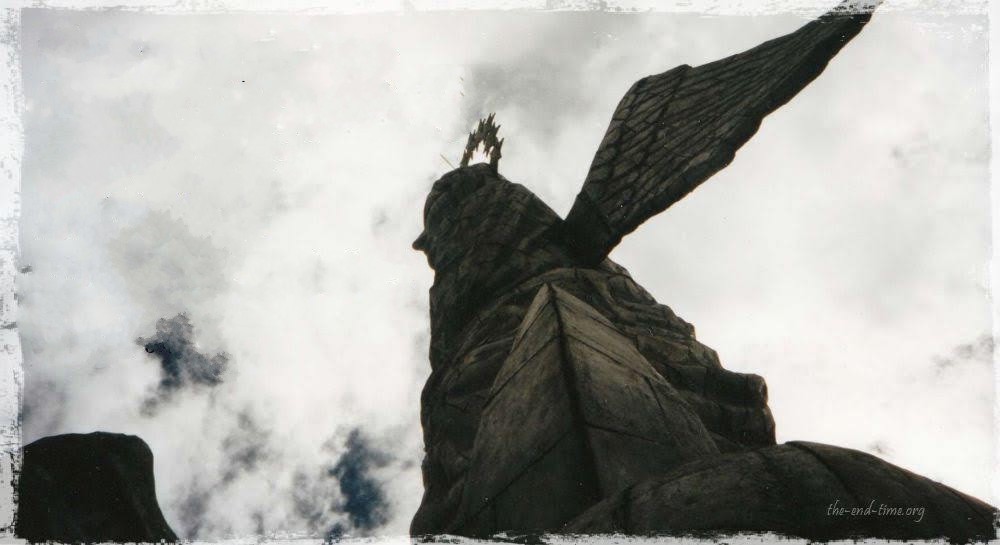
El Panecillo is a tourist attraction in Quito Ecuador. I was in Quito some years back and I snapped a photo of the famous statue. Then I messed with it in Photoshop and it came out like this:

Kind of end of the world doomish, don’t you think? I always titled it in my writings or categorized it in my files as “Angel of Quito”. Here is my original:

angel of quito

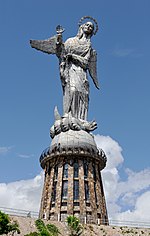
Here is the statue from wikipedia, full-on:

But before I even was saved, or knew Jesus, or knew the background of the statue, I was interested in it. I learned that it was called “The Woman of the Apocalypse.” But then I learned even more about the statue and what I learned made me sad. Because it is all wrong, I tell you, all wrong. Here’s the scoop.

The statue is not of an angel. It is of Mary, Jesus’s mother and termed in Catholic circles, The Madonna. Traditional iconography of Madonna statues is that she is standing on the globe and stepping on a snake, which indeed she is in the Quito statue. More unusual, are the wings. Madonnas are not typically adorned with them. The circle above her head is the circle of twelve stars as referred to in Revelation 12:1–18. Protestants usually interpret the verse describing the woman with 12 stars as mother Israel and her 12 tribes of sons.

However the iconography that the Catholics ascribe to Mary is heinous in the extreme. For example, transferring the commonly understood interpretation of the woman as a sign of Israel, to her instead being Mary is very bad. Secondly, the twelve stars are the tribes, but to Catholic tradition, she is Mary, Queen of Heaven. “The Catholic teaching on this subject is expressed in the papal encyclical Ad Caeli Reginam, issued by Pope Pius XII. It states Mary is called the Queen of Heaven because her Son, Jesus Christ, is the King of Israel and heavenly King of the Universe. The Eastern Orthodox churches do not share the Catholic dogma, but have themselves a rich liturgical history in honor of Mary. The title Queen of Heaven has long been a Catholic tradition, included in prayers and devotional literature, and seen in Western art in the subject of the Coronation of the Virgin, from the High Middle Ages, long before it was given a formal definition status by the Church.” (source).

There is only one Monarch in heaven, Jesus, King of Kings and Lord of Lords.

Mary, of course, is not royalty and her station as shown above the world is a false elevation of who she really was: a forgiven sinner just like us. 

Worst of all are the iconic depictions of her stepping on the snake. In Genesis 3:15 we read, “And I will put enmity between thee and the woman, and between thy seed and her seed; it shall bruise thy head, and thou shalt bruise his heel.” This is the prophetic pronouncement from God to Adam and Eve in the garden of the coming hope, Jesus Christ. Switching HIS work to crush sin and death (Dan 9:24; Rev 20:14) to Mary’s work is idolatry in the extreme.

As Matthew Henry said in his commentary of the crushed snake and bruised heel, “A gracious promise is here made of Christ, as the deliverer of fallen man from the power of Satan.” Mary does not deliver us from sin, though the cumulative iconography and traditional teachings of the Catholic Church is that she does.

So all that time when I was in Quito and I had been looking at this iconography in statuary and paintings, I never knew how wrong it was. After having snapped the photo and worked with it on my computer, I never knew how dishonoring it was to the Lord. But now that I am saved, I detected immediately the erroneous parts that made up a dastardly whole.

I don’t quite know what I’m trying to say here, other than how easy it is to be deceived. As a non-believer of course, the things of God make no sense and that person is not expected to be able to detect the nuances or differences between true and false doctrine, symbols, or idolatry vs. true worship. But as an unsaved person, I absorbed those false views, and after salvation I had to work at dispensing with the false notions that had littered my mind and heart.

Even Christians though, are often fooled by religious works that mirror something that seems full of truth but isn’t really. I have been surprised lately when mentioning some of the false things contained within Roman Catholicism, that fellow believers are not aware that they are even false in the first place, never mind being able to point to the bible on how or where.

Please always stay within the Word, in prayer, and in fellowship with Christians in these troubled days. We need each other, the false is everywhere and the true is harder to find. Bless His name, though, because on the Last Day, He will not be hard to find. He is coming in great power and glory (Rev 1:7) to demonstrate in power and glory (Mt 24:3) that HE IS FAITHFUL AND TRUE! (Rev 19:11). He is the only true God and there is no other. (Is 45:5).

Posted in bold, jesus, street preaching

Street preaching today

By Elizabeth Prata

On Twitter, Chuck O’Neal ‏@ChuckONeal_ said,

While preaching the Gospel to the crowd in front..this man slipped in behind to listen. #SneakyGospelListenersWelcome


What a beautiful photo. A man the Lord has raised up, preaching the Good News fearlessly to a hostile and dying world. But one man is drawn by God to hear His words of everlasting life. Again, a praise. Will the seeds planted by the word fall on hard ground? Thorny ground? Soft ground?

Meanwhile we don’t know where the wind blow. So we preach His Good News everywhere.
The Spirit knows.

The wind blows where it wishes, and you hear its sound, but you do not know where it comes from or where it goes. So it is with everyone who is born of the Spirit. (John 3:8)

Is street preaching an effective evangelism method?

Street preaching, or preaching openly in a public area, has been a method used throughout the history of Christianity for the purpose of evangelizing people who would not typically enter a church. Ever since the apostle Peter preached in the streets of Jerusalem in Acts 2, Christians have used this method to lead many to faith in Christ. Despite the long-standing tradition of street preaching throughout church history, some believe that the practice should no longer be used. They have a variety of reasons for their opinion…

And the master said to the servant, ‘Go out to the highways and hedges and compel people to come in, that my house may be filled. (Luke 14:23)


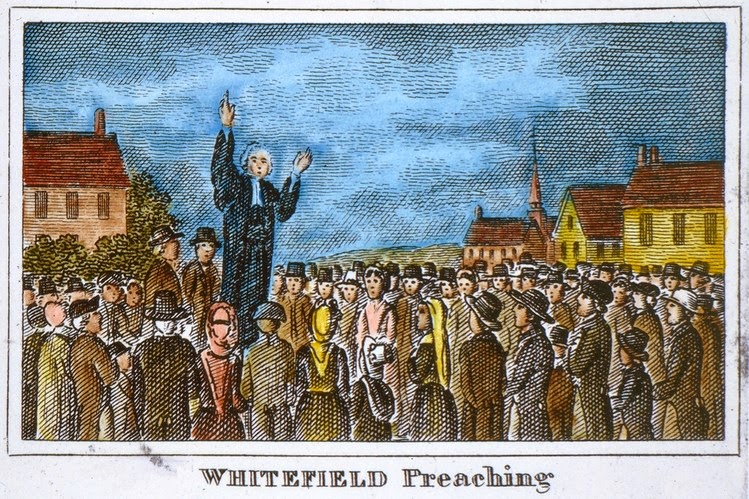
Harken An engraving, ca. 1740, of George Whitefield
preaching in the Americas. Photo: Granger, NYC / The Granger Collection. Source

George Whitefield:

In 1739, Whitefield set out for a preaching tour of the American colonies. Whitefield selected Philadelphia—the most cosmopolitan city in the New World—as his first American stop. But even the largest churches could not hold the 8,000 who came to see him, so he took them outdoors. Every stop along Whitefield’s trip was marked by record audiences, often exceeding the population of the towns in which he preached. Whitefield was often surprised at how crowds “so scattered abroad, can be gathered at so short a warning.”

The crowds were also aggressive in spirit. As one account tells it, crowds “elbowed, shoved, and trampled over themselves to hear of ‘divine things’ from the famed Whitefield.”

Once Whitefield started speaking, however, the frenzied mobs were spellbound. “Even in London,” Whitefield remarked, “I never observed so profound a silence.”

When he returned to London, he found many churches closed to his unconventional methods. He then experimented with outdoor, extemporaneous preaching, where no document or wooden pulpit stood between him and his audience.

The Gospel is always unwelcome, sometimes by those inside churches hearing it from pulpits, usually outside in the world by passersby to whom the message of Life is the aroma of death. No matter. For the one person who is later converted by the words, it will be eternally welcome.

Posted in lot, open door, prophecy, sin

A tale of two doors

By Elizabeth Prata

EPrata photo

I was reading 2 Thessalonians and I read this verse from 2 Thessalonians 2:5-7,

Do you not remember that when I was still with you I told you these things? 6And you know what is restraining him now so that he may be revealed in his time. 7For the mystery of lawlessness is already at work. Only he who now restrains it will do so until he is out of the way.

I’d always focused on extracting the meaning from the part of the verse that says “he who restrains” but this time I was focused on the “mystery of lawlessness.” My mind began to question. “Why is lawlessness a mystery? The Bible speaks of sinfulness often. That’s what sinfulness is, lawlessness. So why is it a mystery? We’ve been living with it for 6000 years…”

I find that asking questions of myself about the meaning helps me dig deeper. I’m not speaking of doubting the meaning. Nor am I suggesting I am questioning God’s judgment. I am asking myself what, who, when, where, why questions like a journalist would do to get at the truth of a story. ‘Why is this word here? Who was Paul writing to? Why is his tone so abrupt? What is the city or geographical location? What was the context?’ Those kinds of questions.

So why is lawlessness a mystery? Let’s hold that thought while I take you down another line of inquiry and then I’ll tie the two together.

I was listening to a John MacArthur sermon last Saturday morning. It was titled, “Heaven: The Future of Christians.” In the sermon MacArthur was talking about salvation and the process of getting into heaven. He explained this verse:

From the days of John the Baptist until now the kingdom of heaven has suffered violence, and the violent take it by force. (Matthew 11:12)

He said of the narrow way, the small door of Matthew 7:14, that it’s hard to go through. “Why? Why is it so hard?” He’d said-

“First, it’s hard to find because it’s small, second, to go through you have to strive. You have to agonize. You have to be violent about it. You have to press into it…”

It is hard to go through the door of repentance. It is the most difficult thing a person will ever do. Turning your back on your own wickedness and lawlessness is agonizing over our sin nature and violence because one is turning one’s back on one’s self. It is hating not just the sin IN us, but our very selves because sin is our very nature.

In a different sermon but on the same verse, Matthew 7:13-14 and the narrow door, MacArthur paints a picture of the struggle to come to repentance and salvation-

So Jesus says in Matthew 11:12, “The Kingdom of heaven suffers violence and the violent take it by force.” What amazing words. There’s a certain violence in coming to salvation. You’re in the throes of a war and a battle with your own soul to release your love of sin and self and pride. It’s a wrenching experience. Luke 16:16 says, “Every man presses into it.”

Becoming a Christian is not easy. It’s hard. Another way to say all that is that the Kingdom opens up to those who seek with all their hearts. You’re not going to sleep your way into the Kingdom. The Kingdom requires earnest endeavor, untiring energy, utmost exertion.

Pressing into the door with all exertion and violence. His word-pictures brought to mind another door that people were pressing into.

The door to Lot’s house at Sodom.

The men who were deep in sin and given over to it were pressing into the door with violence and all exertion. Here is the scene at Genesis 19:9-11.

EPrata photo

But they said, “Stand back!” And they said, “This fellow came to sojourn, and he has become the judge! Now we will deal worse with you than with them.” Then they pressed hard against the man Lot, and drew near to break the door down. 10But the men reached out their hands and brought Lot into the house with them and shut the door. 11And they struck with blindness the men who were at the entrance of the house, both small and great, so that they wore themselves out groping for the door.

The men were immersed in their sin-nature and they exhausted themselves trying to go through the door to perform their sin. They wanted to go through the door from bad to worse. The penitent person wants to go through the door from worse to best.

In referring back to the Matthew 11:12 verse,

From the days of John the Baptist until now the kingdom of heaven has suffered violence, and the violent take it by force.

I’d always pondered over that scene at Lot’s hose. The men had obviously experienced something supernatural, they’d all just been struck blind. But their sin was so potent they still tried to beat down the door with violence. This is a peek at the mystery of lawlessness.

Lawlessness is a mystery because mystery means veiled from our full perception. We know that in 1 Corinthians 13:12 we see through a mirror dimly

For now we see in a mirror dimly, but then face to face. Now I know in part; then I shall know fully, even as I have been fully known.

We can’t fully comprehend the mystery of Jesus, the mystery of the heights and the depths of His glory, the mystery of his perfections. It is partly veiled from us. It is the same with sin. The full height and depth of sin is partially hidden from us. This fullness will come when the Man of Sin is revealed, who is the antichrist. We have a sense of the mystery of lawlessness now, because John said there are many antichrists. We know from history what Hitler did. But sin can be and will be so much worse than that when it’s full expression is revealed in the Tribulation, embodied by the man whose nickname IS sin.

Just as Jesus’ glory is infinitely beautiful, so is sin infinitely gross and putrid. The fullness of sin’s depravity is hidden from us and its full expression is not revealed … yet. We see sin through a mirror dimly.

This essay is the tale of two doors. The door to salvation which the penitent presses into, exerts himself toward with violence. Then there is the door to sin which the impenitent presses into, exerts himself toward with violence. They exhaust themselves groping for the door to the next layer of descending depravity, the depths of which is bottomless like the pit where the worst of the demons are being held in chains, restrained from expressing themselves until the time of Revelation 9:2 arrives.

The path is wide and leads to a big door, or the path is narrow and leads to a small door. My hope is that many more will press into the small gate and change from goat to sheep. Use all exertion, violence and pressing into repentance, forsaking all behind, even yourself.

Posted in theology

Disorder in the churches!

By Elizabeth Prata

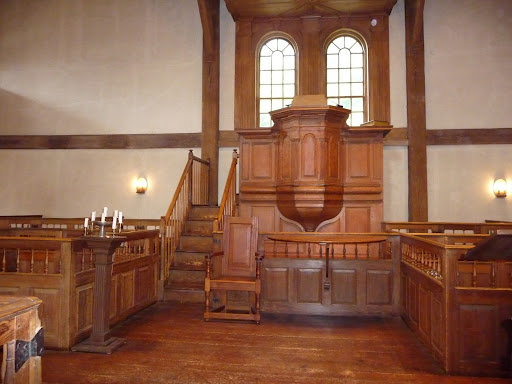
Pulpit

1 Corinthians 14:34-35 says

The women are to keep silent in the churches, for they are not permitted to speak, but are to subject themselves, just as the Law also says. But if they desire to learn anything, let them ask their own husbands at home, for it is disgraceful for a woman to speak in church.

It’s very clear. Women are not to preach, or teach men, (but I do not allow a woman to teach or exercise authority over a man, but to remain quiet says 1 Timothy 2:12.)

As Larry Farlow said of the 1 Timothy verse:

@LarryFarlow: Yep. If someone cannot teach or exercise authority over half the church, they can’t be a pastor.

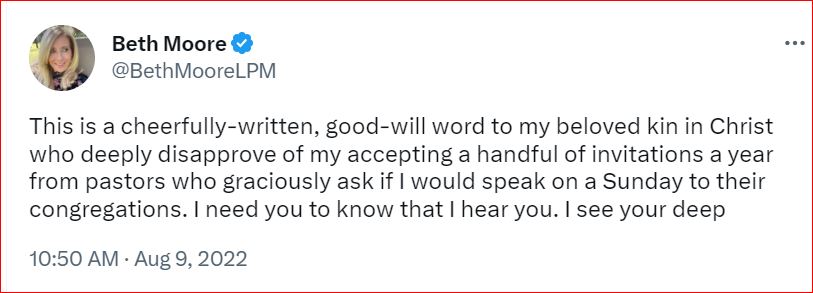
And, using the word speak instead of preach is not the ‘get out of jail’ card rebellious women think it is. The Greek word in the verse literally means speak. So when someone like Beth Moore coyly claims to be “speaking” on Mother’s Day, when she is actually preaching, it’s a double rebellion and thus doubly hypocritical because she tried to cover it up.

Changing “preaching” to “doing” doesn’t fool God. Or anybody else.

The Corinthian church was having special problems with disorders in their public meetings (1 Cor. 11:17–23). The reason is not difficult to determine: they were using their spiritual gifts to please themselves and not to help their brethren. The key word was not edification, but exhibition. If you think that your contribution to the service is more important than your brother’s contribution, then you will either be impatient until he finishes, or you will interrupt him. Add to this problem the difficulties caused by the “liberated women” in the assembly, and you can understand why the church experienced carnal confusion.” Wiersbe, W. W. (1996). The Bible exposition commentary (Vol. 1, pp. 614–615). Victor Books.

Ladies, do you “speak” in church to the congregation? Even if the Sunday School or Bible study leader teacher asks for comment, are you the first to leap in and state your opinions? If so, do you believe what you have to say is more important, more edifying than what the man next to you would say, if he could get a word in edgewise?

Yes, Paul was speaking of disorder in the church, when women who had not even been allowed in the synagogue but had to stand behind a partition if they wanted to hear, now allowed not only in the church but to pray and prophesy (before the canon was closed), caused a melee of chaos. Paul wanted it stopped.

But though Paul was speaking of a certain situation in history, it does not mean all is OK now. The tendency for women to usurp is still present in us. When Paul said women are not to teach or have authority in the church, he followed that up in the next verse by appealing to the creation order. The creation order Paul appealed to still stands. Men lead the church. Women do not. Women are to listen, learn, and submit to their elders and their teaching.

Yet there are so many ministries women are allowed to and even commanded in which to participate. Of course we share the Gospel, that’s for all of us to do. We are hospitable, we support our husbands, we teach women, we teach children, we can help with administering finances, or preparing budgets, we have gifts of mercy and helps… Egalitarian women today make it seem as though if we cannot teach or preach, we’re good for nothing.

Not so. Feminists and egalitarians are eternally discontent. But we find contentment in what the Lord has prepared for us, within His boundaries.

I appeal to you sisters, if you have an unhealthy and unbiblical desire to continually speak in church, in any way, before the gathered, please reconsider. Let the men speak. Listen, pray, sit attentively, to the glory of God and do not be a disgrace. Here is a short video on the subject:

Posted in theology

Tents and tentmaking

By Elizabeth Prata

The Lord has arranged my life so that now, though I have been a classroom teacher in the past, I am now a teacher’s aide. I am grateful because I still get to teach kids, but I have less stress and more energy after school – so that I can focus on ministry. I can support myself, (mostly) so in this way, the para-professional job I do is my tentmaking.

Let’s take a look at tents.

Now, when we speak of tents in the Bible, don’t think of Coleman tents you might use for a weekend in the nearby Park. These were homes. Portable, but heavy, large, and thick. The temple was actually a tent (tabernacle) for many hundreds of years in the Wilderness, then at Shiloh, before a permanent structure was built.

Noah was drunk inside his tent, remember? (Genesis 9:21).
Uh-oh, Lot pitched his tents near Sodom. (Genesis 13:2).
There were rules in case a person died inside his tent. (Numbers 19:14).
Moses would pitch a tent outside the camp and called it the ‘tent of meeting’. (Exodus 33:7).

It wasn’t easy to raise a heavy tent such as the ones used in those days. But it was a woman’s job to raise them, strike them, repair them, and care for them and their supplies like a large wooden mallet for driving in the pegs, and the women became expert in all the phases of making, pitching and striking tents. That is why Jael had a tent peg on her that she used to kill a man while he slept. (Judges 4:17-22).

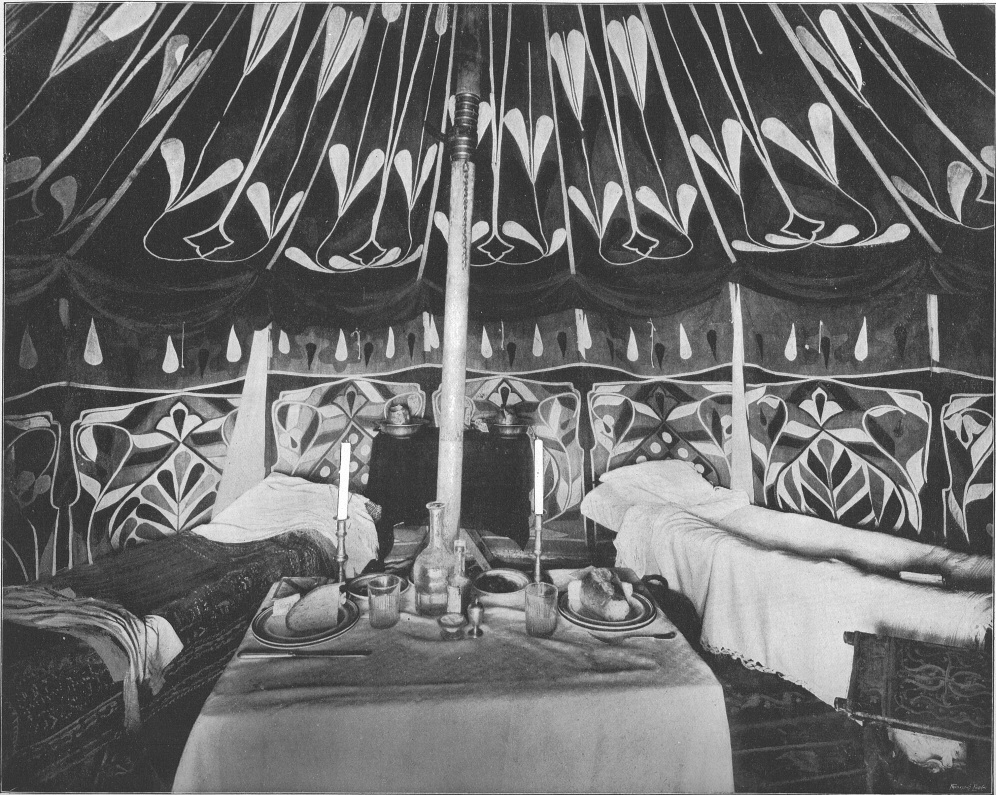
In the late 1800s people from western Europe and America became fascinated with the Holy Lands. They flocked there to visit the sites from the Bible. In 1894 a book was published called Earthly Footsteps of the Man of Galilee (Info at the link about the book itself which is fascinating). Tourists visiting the Holy Land slept in tents each night as their hired dragomen set up camp. (There was no Marriott or Holiday Inn). The photo caption described these tourists “sleeping at night in carpeted tents most comfortably furnished”. Caption and photo below from Earthly Footsteps of the Man of Galilee, 1894.

Manners & Customs of the Bible further explains:

The large tents, still assuming they were made like Arab tents, had nine poles, placed in three rows, covering sometimes a space twenty to twenty-five feet long, ten feet wide, and eight to ten feet high in the middle, with the sides sloping. Such tents often had a curtain hung on the middle row of poles, dividing the tent into two parts, one for the men and one for the women. The poles that held up the tent and divided it into sections were further made useful by having hooks driven into them from which were suspended clothes, baskets, saddles, weapons, and various other articles of daily use. Freeman, J. M., & Chadwick, H. J. (1998). Manners & customs of the Bible (p. 343). Bridge-Logos Publishers.

Paul’s tentmaking

Now, we know Paul carried his cloak, scrolls, and likely quills to write with. Or his amanuensis did. But it is unlikely he also carried bags of goat hair with which to make or patch tents, or needles, and other tent making supplies.

In addition, there were the guilds. They were powerful monopolies, fraternal, and territorial. Guilds mentioned in the Old Testament were- 1 Chronicles 4:21 (linen), Nehemiah 3:8 (goldsmith), even the prophets had a guild (1 Kings 20:35).

In the postexilic period, guilds were powerful organizations and were recognized by the government. A guild could prevent a craftsman from another area from working in its territory. It had a trade monopoly in its particular locality. A guild could monopolize the market. Guild members were insured against loss of tools, animals, and boats used in their business, unless the loss was caused by their own negligence. Guilds had their own religious and social institutions, even their own synagogues, next to which there were burial grounds for the members. In some cases, members of a guild collectively built and operated businesses. Source Bible Gateway

Therefore it is unlikely Paul could waltz into a town and become a freelancer, the guild members would run him out. That he was staying with Prisca and Aquila in Corinth and assisting them (Acts 18:3) likely meant that the couple were members of the guild already, had an established business, and Paul could help them.

What were the supplies needed?

This goat’s hair cloth that is used in making these tents is porous when it is dry, but becomes waterproof after the first rains have shrunk it together. … The material that makes up the Bedouin tent is the same as the sackcloth of Bible days. It must be remembered that this Oriental sackcloth is not at all like the Occidental burlap, but is rather a material made of prickly, coarse goat’s hair. Source: Manners And Customs of Bible Lands

New tents are very seldom made among the Bedouins. About the only time this happens is when a young groom and bride set up housekeeping for themselves in a different location from that of the groom’s parents, and this rarely happens. The usual procedure is to accumulate the goat clippings of a year or so, and with these make a new strip with which to repair the old tent. The women do this work. The section of the tent roof that is most worn is ripped out, and a new piece of the cloth replaces it. The old piece is then used for a side curtain. Each year new strips of cloth replace old ones and the “house of hair” is handed down from father to son without its being completely new or completely old at any one time. Source.

As comfortable as the tents seemed, and by the photographs from the 1800s they do seem comfortable, (at least for the more wealthy desert dwellers) it was still a lot of work to care for tents.