Paul also wrote to you according to the wisdom given him, as he does in all his letters when he speaks in them of these matters. There are some things in them that are hard to understand, which the ignorant and unstable twist to their own destruction, as they do the other Scriptures, (2 Peter 3:15b-16)
The plumb line…God’s word, straight and true-
therefore thus says the Lord God, “Behold, I am the one who has laid as a foundation in Zion, a stone, a tested stone, a precious cornerstone, of a sure foundation: ‘Whoever believes will not be in haste.’ And I will make justice the line, and righteousness the plumb line; (Isaiah 28:16-17).
Oxford Dictionary says a plumb line is “a line with a plumb attached to it, used for … determining the vertical on an upright surface.”
Are you a Bible twister, or are you following God’s plumb line of truth? Are you following a Bible twister, or do you submit to righteous teachers who follow God’s plumb line?
In this chaotic world full of man’s philosophies, I’m grateful to Jesus for His word, God’s plumb line of truth to follow, and to the Spirit for opening my mind to it. It does not matter that the line is narrow, all I need is His strength, and the width of my feet to follow it.
21“Not everyone who says to Me, ‘Lord, Lord,’ will enter the kingdom of heaven, but the one who does the will of My Father who is in heaven will enter. 22Many will say to Me on that day, ‘Lord, Lord, did we not prophesy in Your name, and in Your name cast out demons, and in Your name perform many miracles?’ 23And then I will declare to them, ‘I never knew you; LEAVE ME, YOU WHO PRACTICE LAWLESSNESS.’ (Matthew 7:21-23)
Here, the surprised, shocked, and dismayed false Christians are revealed ‘on that day’. They had been busy for the Lord, laboring in His churches, working and doing religious-type activities. They knew the Lord and they knew His name.
But he didn’t know them. He consigned them to outer darkness.
That set of verses are deeply convicting, scary, and worrisome. All people reading them should examine one’s self to see if they pass the test of faith and assure themselves they will not hear those words. Ask the Spirit to testify to you that you are a child of God.
The Spirit Himself testifies with our spirit that we are children of God, (Romans 8:16).
First of all, too many people today, when they pray, sign off at the end with “In Jesus’ name” as if it is a mantra. It’s not a mantra. It isn’t a magical covering. Michelle Lesley wrote:
♦ If you’re tacking the phrase “in Jesus’ name” on to your decreeing and declaring and binding and rebuking as some sort of way to harness the power of God into making your words a reality, you’re taking God’s name in vain because you’re doing the same thing witches and pagans do when they use incantations and cast spells. “In Jesus’ name” isn’t the Christian version of “abracadabra.” To pray in Jesus’ name means to pray that what God wants – not what we want – will be done.
Now as to the verses: the three religious activities these false Christians hurled at Jesus in desperate attempt to prove their identity as a child of God:
1. prophesy in Your name, 2. in Your name cast out demons, 3. in Your name perform many miracles
These 3 activities were part of the collection of sign gifts. These were the showy gifts whose purpose in the first decades of the new covenant was to affirm the messenger’s authenticity because the canon was not completed yet. The sign gifts also included tongues and interpretation of tongues.
Once the canon was complete, new revelation was not necessary. Believers had the word in print and/or preached to them. Prophesying ceased. Miracles performed by believers ceased. Casting our demons by the hand or word of a believer ceased.
The word prophesy means in the Bible either preaching the word, or foretelling something about the future. The word prophesy as it’s used in the Matthew verse is the latter, foretelling. AKA a sign gift.
Yet these false Christians persisted in faking their prophecies, working at casting out demons (who likely laughed at them, Acts 19:15), and pretending to do miracles. The same continues to this very day. Their efforts are vapor, not done in Jesus’ name, and will be uncovered as false on the day.
Now, let’s contrast their fake religious activity to real religious activity.
They were continually devoting themselves to the apostles’ teaching and to fellowship, to the breaking of bread and to prayer. (Acts 2:42)
1. Teaching & Learning 2. Fellowship 3. Breaking of bread= communion/meals together 4. Prayer
This day-by-day, persevering in spiritual disciplines, is the true religious activity. It was noted in Acts and lauded.
“The foremost of the disciplines is that involving the Word of God and constitutes the reading, study, memorization, and meditation of Scripture.” ~GotQuestions
Notice the false Christians didn’t say, ‘Lord, Lord, didn’t we pray, and study, and memorize scripture, and devote ourselves to worship?’ Not that false Christians don’t do those things too, but just note the three religious activities the false Christians chose to use as their primary defense when trying to argue their way into the Kingdom. The very ones that have passed away. Many will discover this to their eternal regret.
4183 polýs – many (high in number); multitudinous, plenteous, “much”; “great” in amount (extent).
4183/polýs (“much in number”) emphasizes the quantity involved. 4183 (polýs) “signifies ‘many, numerous’; . . . with the article it is said of a multitude as being numerous” (Vine, Unger, White, NT, 113,114) – i.e. great in amount.
It breaks my heart to think of the shock of the MANY as they are confronted by an angry Christ. They are thrown into the fire. (Matthew 7:19).
If you, dear reader or listener, are one who believes you are hearing from Christ, or casting out devils, or performing (fake) miracles, consider those sobering words from Jesus.
If you, dear reader or listener, are growing weary with your spiritual disciplines, thinking that such a ‘insignificant’ walk surely must be displeasing to Christ- it isn’t. It’s laudable. It’s worthy of Him. Devote yourself to the teaching and breaking of bread and fellowship and prayer. And you will rejoice on the Day!
Think of who God really is. Over the years through sermons, pamphlets, Sunday School curricula, podcasts, and books- we see repeated whittling of our august, holy God down to a weak boyfriend pleading with people to walk down the aisle and “accept Him,” or a heavenly butler willing to tolerate anything we say or do and give us our 3 wishes. No.
And it shall be very tempestuous round about him – The word used here – śa‛ar – means properly to shudder; to shiver; and then it is employed to denote the commotion and raging of a tempest. The allusion is doubtless to the descent on Mount Sinai Exodus 19:16, and to the storm accompanied by thunder and lightning which beat upon the mountain when God descended on it to give his law. The whole is designed to represent God as clothed with appropriate majesty when judgment is to be pronounced upon the world.
This scene is going on right now in the throne room of heaven. Isaiah was given a vision of it in Isaiah 6:1-4
In the year of King Uzziah’s death I saw the Lord sitting on a throne, lofty and exalted, with the train of His robe filling the temple. Seraphim were standing above Him, each having six wings: with two each covered his face, and with two each covered his feet, and with two each flew. And one called out to another and said, “Holy, Holy, Holy, is the LORD of armies. The whole earth is full of His glory.” And the foundations of the thresholds trembled at the voice of him who called out, while the temple was filling with smoke.
Yet for all that, if you are a true believer, you are a son of God, His child, given privileges of approaching Him boldly, says Hebrews 4:16.
Therefore let us draw near with confidence to the throne of grace, so that we may receive mercy and find grace to help in time of need.
What grace! To go from His enemy, shaking at His thunder and smoke, standing at the bottom of the quaking mountain, but being WITH Him at His throne, worshiping in love, making petitions, and seeking His guidance via the Holy Spirit. He is not a weak boyfriend, nor a heavenly butler, but a powerful God, Providentially bringing all His plans to fruition, one of them being to sanctify His children and bring us to His dwelling place someday. Amazing!
I work as a teacher aide. Some of the children I work with are in kindergarten. I was working in my small group, and they noticed that some new decorations had gone up. There was a large chick coming out of an egg hanging on the door, and around the school were other eggs, in pastel colors and with some rabbits too. One girl asked about it and I said it’s Easter decorations.
That got them talking about Easter and of course Easter egg hunts. Easter egg hunts are huge for kids. They burbled and chatted.
EPrata photo, Recreation Department Easter Egg Hunt, years ago
When’s Easter anyway? asked a girl. April! answered a boy. Another child asked “What is Easter about?” They all explained; “It’s when you hide eggs with candy in them and hunt for them all around”. I followed up. But what else is Easter for? Again they explained that the “Easter Bunny comes and you find candy and eggs in a basket”. Anything else? One girl explained, “When you go to church…” Yes, yes? I eagerly leaned forward. “…and you hunt for eggs and find candy.” But isn’t it about Jesus? The girl said, “Of course. He lays out the eggs.”
The most beautifully decorated egg pales in comparison to the beauty of Jesus
It’s charming and sad all at once. Seeing the world through a child’s eyes is always funny and they say unexpected things but they also have more truth in them than we like to think. Kid life is all about getting to the next candy bonanza. To them, Easter is just another fairy tale that has fantastical, magical creatures like a rabbit that delivers candy and eggs in a basket filled with fake grass.
It’s one reason not to depend on a child’s assertion that he or she has ‘accepted Jesus into their heart’ because to become a true believer one must understand sin, our position before Christ, His anger over it, and repentance. This isn’t possible with kids who still believe the tooth fairy flies in to your bedroom and takes the tooth from under your pillow. They still believe in Santa.
I never liked Easter Egg hunts. This was because I never found any eggs. Even as a kid I didn’t enjoy competitions, I was slow and ungainly, I didn’t quite understand the point, and there were always lots of bullies intent in shoving you down to get that egg first. I left a grass-stained mess with bruises, hurt feelings and an empty basket.
I did enjoy the wonderful Easter baskets my parents left by the fireplace. They always held crinkly grass, chocolate, and pretty little jelly beans and more. They were always both artful and bountiful.
I enjoyed dyeing the eggs too, a lot. There was always a new dress to wear, with hat and gloves, for Easter. It was one time per year (of the two) we attended a church. The point of the day was the dinner afterwards.
Me, all dolled up for Easter
Yes, it’s all about Jesus. The crinkly grass, baskets, egg hunts, dyed eggs, ham dinners, and Easter outfits aside, the power of the resurrection is a wondrous event to contemplate. We take a special day to praise our Father for His power and His love in resurrecting His son.
I am the first and the last, and the living one. I died, and behold I am alive forevermore, and I have the keys of Death and Hades. (Revelation 1:17b-18)
So…hunt for eggs if you must. But look for Christ.
Believers are ordinary. We serve an extraordinary God.
He might use us in extraordinary ways, but we’re all flawed, sinful, ordinary people. He used ordinary grandmother Lois to raise up young Timothy. He took impulsive sons of thunder James and John and made them evangelizing Apostles. He used fishermen, (Peter, Andrew) sellers of purple (Lydia), teenagers (Timothy, Jeremiah, Mary, David), murderers (Paul). He used ordinary people going about whatever they were doing at the time and transformed them into vessels of activity for His glory.
“God reigns through the stumbling, hobbling service of his people and the rage and malice of his foes to establish his eternal purpose for this world.”
~Derek Thomas, “What is Providence?”
Yet there are some who believe that we must be extraordinary in order to make an impact for the kingdom. The movement of a few years ago when the books Radical, Crazy Love, Wild at Heart came out made many people think that they were ineffective unless they made a big and splashy move for the faith. This is not true. Mary and Martha were simply hospitable. Dorcas sewed. Susannah donated. Acts 4:13 says Peter and John were uneducated and untrained.
Ordinary life: painting. EPrata photo
If you, dear reader or listener, feel marginalized, helpless to DO for God, ho-hum ordinary, then rejoice. Our persevering faith in ordinary lives is just as valuable to God as a martyr uttering eternally known last words. Just as important as the luminary you read about in the Bible. Just as impactful as the hero on the mission field.
They were continually devoting themselves to the apostles’ teaching and to fellowship, to the breaking of bread and to prayer. (Acts 2:42).
Ordinary life: sweeping
What the Spirit inspired Luke to write was not just the extraordinary means of glory we see occasionally in Acts, such as miracles or healings, but the ordinary means of bringing God glory by a consistently faithful church, as seen in the verse above. They devoted themselves to teaching and gathering and prayer. The extraordinary events died away as the miracles ceased, but the faithful never stopped gathering, learning, and praying.
Day by day continuing with one mind in the temple, and breaking bread from house to house, they were taking their meals together with gladness and sincerity of heart, (Acts 2:46).
Ordinary life: selling. EPrata photo
Note that. ‘Day by day’. The ordinary Christian life is one of persevering in spiritual disciplines day by day, accruing spiritual interest in the bank of heaven. I’m sure your parents taught you that putting 5 dollars a week into savings eventually yields dividends. They did not teach you that putting gluts of huge amounts into your bank account in spurts yields dividends. The way to save is to be consistent over time. It’s the same with the spiritual life. Add to your spiritual treasury day by day.
I’m looking forward to meeting these heroes in heaven but I’m just as eager, if not more, to meet the unknowns who brought God glory with their words or their lives.
Here are a few resources to help quell any anxiety anyone might have that their life doesn’t count, just because they are not running barefoot to Bali getting martyred with arrows from cannibals or leading big conferences in arenas filled with thousands of adoring fans.
Here is Michael Horton, who wrote a book called Ordinary: Sustainable Faith in a Radical, Restless World. His book blurb reads as follows:
Radical. Crazy. Transformative and restless. Every word we read these days seems to suggest there’s a “next-best-thing,” if only we would change our comfortable, compromising lives. In fact, the greatest fear most Christians have is boredom—the sense that they are missing out on the radical life Jesus promised. One thing is certain. No one wants to be “ordinary.”Far from a call to low expectations and passivity, Horton invites readers to recover their sense of joy in the ordinary.
Ordinary life: cooking. EPrata photo
If you don’t want to read the entire book, here is Michael Horton with an article on the subject of Ordinary at Ligonier: The Ordinary Christian Life
John MacArthur with a sermon called “The Ordinary Church“. Excerpt: “It was Finney who decided that religion, to be valid, had to have some kind of high impact, high energy emotional element. It was about methods, feelings, experiences, sentimentalism, and it all trumped sound doctrine and theology. Gradual growth, by the normal ordinary means of grace, prayer, the study of the Word, fellowship was exchanged for a radical experience, the anxious bench, and there was introduced into the evangelical world a restlessness of those looking for something extreme.“
Other material that pushes back against the big, splashy, ‘change the world’ mantra are:
Memoirs of an Ordinary Pastor: The Life and Reflections of Tom Carson. D. A. Carson’s father was a pioneering church-planter and pastor in Quebec. But still, an ordinary pastor…
Essay An Unremarkable Faith – “Meet Larry, a thirty-six year old Science teacher. Larry married Cathy 12 years ago. They love each other and enjoy raising their two sons. Larry’s life wouldn’t hold out much interest to the average citizen. His Facebook account doesn’t draw many friends and nobody ever leaves a comment on his blog. In fact, most people would summarize Larry’s life with one word—boring. But not Larry.“
Ordinary Christian Work, essay by Tim Challies. “The questions every Christian faces at one time or another are these: Are Christian plumbers, cooks, doctors, and businessmen lesser Christians because they are not in “full-time” ministry? And what of Christian mothers and homemakers? Can they honor God even through very ordinary lives? Can we honor God through ordinary lives without tacitly promoting a dangerous kind of spiritual complacency?“
Dear Christian sister, if you’re at home with the kids and don’t have as much time to engage in the world with other adults or to get out and about apart from errands, what you are doing is ordinary but extraordinary. It’s ordinary to repeatedly do laundry, dishes, dust, vacuum…mundane, even. But the raising of another human being, flesh-wrapped soul, a gift from God, is extraordinary. The dividends of all those loads of laundry, all those piles of dishes, all those prepared meals is the potential that you are laying the groundwork for another soul to be added to heaven. Extraordinary!
Music is powerful. In my younger and pre-salvation days, I used to use music on purpose to specifically lift my spirits, and I avoided melancholy music when I was feeling down, it affected my mood so much.
It’s not your imagination, music really does affect our mood:
Do you find yourself tapping your foot while shopping? Or having all the feels while watching movies? No matter your race, ethnicity, age or gender, music is a common phenomenon that impacts everyone. Music can be a powerful tool with its ability to evoke strong emotional responses. For example, music may lead to the release of dopamine, a feel-good neurotransmitter. Music is present in everyday life for most people. Here, we answer questions about how music can affect your brain and body. Does Music Alter Moods and Relieve Stress? The short answer is, yes! Says Tallahassee Memorial Health Care
It’s not just the melodies that affect us, but what we are hearing for lyrics. What are we absorbing? If we think we can sing a secular song about certain sins, like adultery (Careless Whisper by Wham!, Tempted by Squeeze, Mrs. Robinson by Simon & Garfunkel…) without it affecting us, then we are fooling ourselves.
The same goes for Christian music. We must be careful what we absorb. Even sweet or innocuous songs can be off just enough to warp our thinking. Let me give you four examples from popular praise songs that I enjoyed a lot in my early post-salvation days.
EPrata photo
The Far Side Banks of Jordan
I like Johnny Cash. His song “The Far Side Banks of Jordan” is about a spouse who worries he’ll die first. He muses on what that would be like to go to ‘the other side’. Here is the first stanza-
I believe my steps are growin’ wearier each day Still I’ve got another journey on my mind Lures of this old world have ceased to make me wanna stay And my one regret is leavin’ you behind
Yup I can relate to the weary part! I know many married couples have concerns about leaving their spouse if they die first, and make efforts to properly provide for them. So far so good.
Here are next few lines –
When it comes your time to travel likewise, don’t feel lost For I will be the first one that you’ll see And I’ll be waiting on the far side banks of Jordan I’ll be sitting drawing pictures in the sand And when I see you coming, I will rise up with the shout And come running through the shallow waters, reaching for your hand
I used to think how sweet it was that one spouse would be faithful to the other and wait for him or her. I pictured the scene in my head as I sang along. But nope…this is wrong. The first one we will see is Jesus. Also, there is no marriage in heaven, our relationship will change. And thirdly, we will be busy worshiping Jesus, not sitting idly around, doodling! The scene as sweet as it seems, is a true Mrs Lot situation. Sitting on the edge of heaven looking back, as opposed to being squarely in the center of heaven looking at Jesus, is wrong. We won’t long for sinful world rather than perfect righteousness in glory.
EPrata photo
In the Garden
I know I know, a lot of people have already mentioned this one as problematic. Really problematic. Its sweetness should not cover the fact that there are some lyrics that just do not jibe with the Bible.
And He walks with me And He talks with me And He tells me I am His own And the joy we share as we tarry there None other has ever known He speaks and the sound of His voice Is so sweet the birds hush their singing
First of all, the joy that Jesus shared Intra-Trinity with God and the Spirit since before the world began till now, is the greatest joy anyone has ever known. And secondly, the joy that ALL departed saints are experiencing right now, is the greatest joy they’ve ever known, because they are with Jesus in person in glory. Certainly it is ridiculous to say none other has ever known the joy of knowing Him.
As for the next part, to say it again, God is NOT TALKING to us. Claiming that God talks with us individually in print, in speech, or in song, is all too common these days. The commonality of it makes it seem like it is happening to everyone, except of course, the ones who do not hear God talk to them. Which He isn’t. But it sets up a disquiet in the heart, that maybe we’re doing something wrong, or in some sort of displeasing sin, and that is why God isn’t talking to me or you.
When He was on the Cross
I understand the lyricist’s desire to present the unfathomable gap between our depravity and his glory; our inability and His great love. But these lyrics are just too probably untrue.
He Whose Glory Makes The Heavens Shine. So Unworthy Of Such Mercy, Yet When He Was On The Cross, I Was On His Mind.
We know a bit about who or what was on His mind when he was on the cross. We know he had a conversation with the thief on the cross next to Him. He told the thief that this very day he will be with Him in paradise. He was thinking about paradise and about the thief. Likely, Jesus prayed for the thief. (John 17:24). We also know that GOD was on His mind. He called out ‘My God My God why have You forsaken me?’ (Matthew 27:46). Possibly the disciples were on His mind, and his mother, he gave his mother’s care to John. (John 19:25-27). But Joe Blow and Suzie Smith? Probably not.
Somebody Touched Me
While I was praying (somebody touched me) Must’ve been the hand of the Lord
It may not have been.
That’s what everyone thinks, you know. That when they ‘hear’ a voice, “it must’ve been the hand of the Lord”. That when they settle down to write and are ‘guided’ by a voice, “it must’ve been the hand of the Lord.” Too many people think that when they experience something they assign as supernatural, it is from the Lord.
Not always so.
An entire dimension exists of the evil supernatural. Think on this: we know that a third of the angels fell with satan (this is how I interpret Revelation 12:4). In any case, we know a myriad of unholy angels fell, and became the demons. Hebrews 13:2 says that when we entertain a stranger we may have entertained an angel and not known it. There are a lot. If we go with the one-third in terms of numbers, we have a 1-in-3 chance of entertaining a demon as opposed to an angel.
Daniel 10:13 speaks of a holy angel being sent to Daniel, but was delayed 21 days in the heavenlies, so much so that Archangel Michael had to be dispatched to let the angel through. Ephesians 6 describes our battles not being against flesh and blood, but against “rulers, against the powers, against the world forces of this darkness, against the spiritual forces of wickedness in the heavenly places.”
There is an entire dimension of evil out there. Why do we never suppose that the ‘hand that touched me’ might be a claw from a wizened, prune hearted evil demon?
Christians cannot be possessed, but we battle against them in the spiritual realms. The ‘hand’ of the LORD is in heaven, but the activity of demons is ongoing. Don’t assume if something ‘supernatural’ happens it’s the LORD. It more than likely isn’t.
We know to avoid Bethel music, Hillsong music and other heretical nests like that. But we don’t need to be mindless about seemingly innocuous songs, either. We always must be wise and discerning about what we absorb. Satan is subtle. But Jesus is GREAT!
Enjoy this Psalm 29. As the MacArthur Commentary explains, it has the earmarks of earliest Hebrew poetry. Its general form is a hymn, proclaiming 3 representative realities of God as supreme and therefore praise belongs to Him alone:
1. Lord’s supremacy over heavenly beings
2. Lord’s supremacy over the “forces of nature” (references pagan gods)
3. Lord’s supremacy over humanity
It builds and in my opinion is a majestic and breathtaking poem/hymn. Happy Lord’s Day!
~~~~~~~~~~~~~~~~~~~~~~~~~~~~~~
Ascribe to the LORD Glory
A Psalm of David.
1Ascribe to the LORD, O heavenly beings,a
ascribe to the LORD glory and strength.
2Ascribe to the LORD the glory due his name;
worship the LORD in the splendor of holiness.
3The voice of the LORD is over the waters;
the God of glory thunders,
the LORD, over many waters.
4The voice of the LORD is powerful;
the voice of the LORD is full of majesty.
5The voice of the LORD breaks the cedars;
the LORD breaks the cedars of Lebanon.
6He makes Lebanon to skip like a calf,
and Sirion like a young wild ox.
7The voice of the LORD flashes forth flames of fire.
8The voice of the LORD shakes the wilderness;
the LORD shakes the wilderness of Kadesh.
9The voice of the LORD makes the deer give birth
and strips the forests bare,
and in his temple all cry, “Glory!”
10The LORD sits enthroned over the flood;
the LORD sits enthroned as king forever.
11May the LORD give strength to his people!
May the LORD bless his people with peace!
A reader contacted me and asked the following question: “Understanding Paul’s instruction for men’s and women’s roles in the church in 1 Timothy, what are your thoughts on women deacons serving the communion elements to the body?”
Hmmm. Good question. In today’s culture, a thorny one too. Let’s first define terms.
Deacons were instituted to take logistical and practical load off the elders/bishops/overseers (AKA pastors) so the elders could concentrate on preaching, teaching, and praying. Deacons are servants who manage the details of running the church and helping the members. They help in practical ways so the elders can do their job of prayer, study, and sermon preparation.
The word deacon means simply a servant. (diakonos). Everyone serves in the church. We’re all servants (deacons) in some way, diakonos-ing, lol. But by Acts 6 the role of general servant of the church was formalized into an office.
Why? The church had grown so much and some things were falling through the cracks. Elders were spending a lot of time serving people and neglecting the study and preparation of the word. Some of the people needing to be served were overlooked. So there needed to be a formalized division of labor. The office of deacon was born.
This is a formal role, where believers are chosen from the congregation to particularly serve, as opposed to the general service unto the Lord are members alle called to do.
The chapter describes “the choosing of the 7” to serve the daily food to the widows. This lifted the burden of the practical serving from the elders so they could serve by studying, preparing, and preaching of the sermons (and prayer). (Acts 6:2). In Acts they said to choose some men to serve at table who were were “from among you” (from that congregation) “seven men” (men) “of good reputation full of the Spirit and of wisdom whom we may put in charge of this task.”
That was the history and explanation of how deacons came about. Now, to the question of female deacons.
I believe the Bible says no to women deacons who occupy the office of deacon. I know the Greek word for deacon is used in reference to women, and in those cases it simply means service or server. Like Phoebe of Romans 16:1. In that verse, the word diakonos is used, and it means, “a waiter, servant; then of any one who performs any service, an administrator.”
First, in Acts, the elders called the brothers and sisters together and were told to select 7 men. In every translation of Acts 6:3, the verse says that though sisters were involved in the selection, the people being selected as deacons were men.
Second, the qualifications for deacons are found in 1 Timothy 3:8–13 and are remarkably similar to the qualifications for overseer/elder (aka pastor). The Bible says deacons ‘are to be men’…’husbands of one woman’… etc.
I know there are arguments around verse 11, and I won’t get into the details and jots and tittles of it, but the overarching thrust of the New Testament is that women are active and valued members of the church but not leaders of the congregation.
Thus, since the Bible does not indicate that deacons in the office can be women, and the consistent biblical stance is that women do not lead men, I think that women serving the communion elements would be a poor decision for any local church.
As for any woman not a deacon simply serving the communion elements, this would also be a poor choice. If the person distributing the elements says a prayer over the congregation first, or explains the verses related to communion, then that would be a woman teaching in the congregation and violating 1 Timothy 2:12 and she would not be silent as 1 Corinthians 14:34 says she must be.
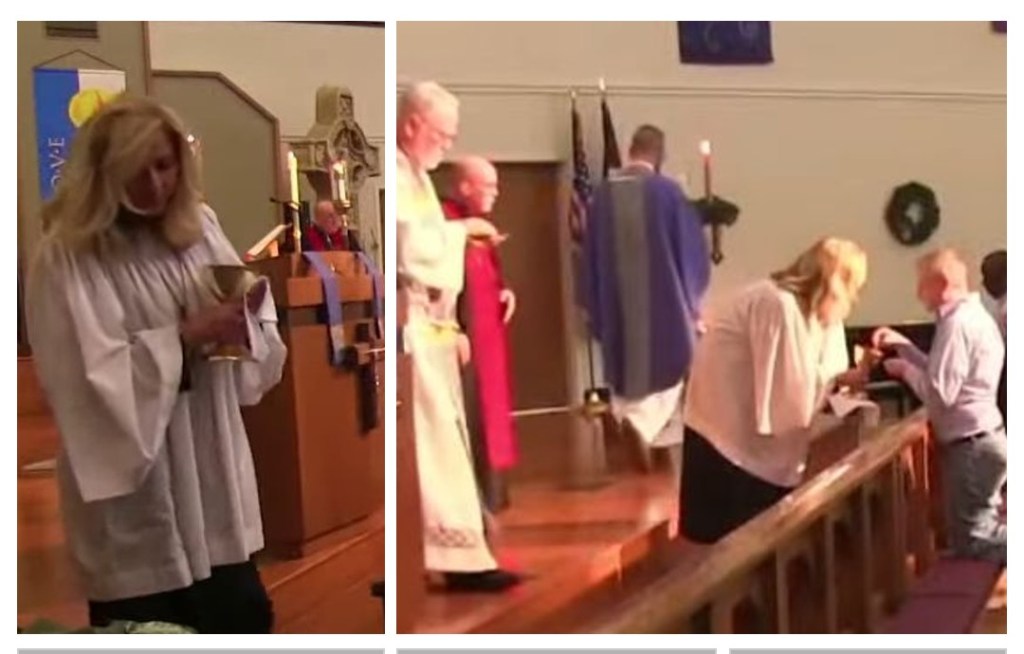
If the woman serving the elements is not explaining or praying over the congregation it’s still tricky. Nothing seems to forbid it in scripture, unless I overlooked a key verse. However, in my opinion, the ‘look’, or the ‘optics’ of a woman offering something to a man who is on his knees and he submissively taking it looks like a role reversal.
Beth Moore in Dec 2021 at her new Anglican church. She had begun visiting in June of 2021, she said
When I broke the news that Beth Moore had become Anglican and was serving the Eucharist at her new church, and posted the photos, it made a huge scandal and discussion across denominations. For example, Church Leaders posted this article, and they were not exaggerating about the meltdown:
Because Moore is so famous and followed by millions, breaking that story brought visuals to the concept of females serving in various, non-biblical ways, such as preaching, and teaching the Sunday Service from the pulpit. Seeing it is startling.
Satan is subtle. He is patient and he incrementally chips away at standards, boundaries, and benchmarks.
A woman serving the communion elements sets up the congregation for further incremental acceptance of the authority of the females leading the congregation in other ways, since they have already become used to women circulating before them and ‘leading.’ The ‘optics’ are bad but once people are used to seeing women circulating in leading roles, they accept further pushing of boundaries.
Ask, does this church want to visually communicate that they are led by men as the Bible commands, or visually communicate that they have crumbled to cultural pressure to have women leading with men over the church? When women are serving the communion elements, does this church want to visually declare there are passive men here?
The Bible says women are to receive teaching quietly. If it is improper for a woman to speak in church as 1 Corinthians 14:35 says, then one must ask why a woman would want to serve communion. Why does she have that desire? If she wants to serve then she should want to do so in ways that aren’t pushing a boundary. She’d want to err on the side of caution, and serve in more biblically sure ways.
In other words, why does she want to be in front of the congregation, when the Bible says she should not be, but rather sitting quietly in the service, receiving instruction and asking her husband at home?
Yet in every mainline denomination, there are not only women serving communion, but actually leading as ordained “pastors”. I did not have to hunt long or hard to find these examples. They are abounding.
No, women should not serve the communion elements. No, there should not be female deacons serving in the office of deacon. No, women should not preach. No, women should not teach men. Yet so many woman complain they are not allowed to do this or that, rather than exult in what we ARE called to do! And there is much we can do to serve the Lord. As Spurgeon said of women in ministry,
Some people can do nothing that they are allowed to do, but waste their energies in lamenting that they are not called on to do other people’s work. Blessed are they who do what they should do. It is better to be a good housewife, or nurse, or domestic servant, than to be a powerless preacher or a graceless talker. ~Charles Spurgeon, sermon, First Healing and then Service
Sister, are you wasting your energy lamenting that you cannot do other people’s work? Or are you joyful in serving within the spheres we are called upon to serve? The choice is yours.
I work with 5 to 8 year old children for my job at a public elementary school. I love children and I contend that I have the best job in the world.
Sometimes it’s a little disheartening, though. I just want the best for every kid, and some kids never get the best.
The Lord is THE most sensitive about children. He spoke much about them and this is recorded in the Bible. We know one of the most famous verses about children:
“Behold, children are a heritage from the Lord, the fruit of the womb a reward. Like arrows in the hand of a warrior are the children of one’s youth. Blessed is the man who fills his quiver with them! He shall not be put to shame when he speaks with his enemies in the gate.” (Psalm 127:3-5)
“Whenever a woman is in labor she has sorrow, because her hour has come; but when she gives birth to the child, she no longer remembers the suffering because of the joy that a child has been born into the world.” (John 16:21).
Therefore you can guess what the Lord thinks of abortion. (Molech)
“Grandchildren are the crown of old men, And the beauty of sons is their fathers.” (Proverbs 17:6)
“And sitting down, He called the twelve and said to them, “If anyone wants to be first, he shall be last of all and servant of all.” And taking a child, He set him before them. And taking him in His arms, He said to them, “Whoever receives one child like this in My name receives Me; and whoever receives Me does not receive Me, but Him who sent Me.”’
Not just what He said but the scene. Picture it in your mind. Jesus had been teaching The Twelve all day and then they came to the house at Capernaum where they stayed. He continued teaching. And to illustrate His point, “He took a child”. So I ask, what child? Where did the child come from? Luke 9:47 says the child “was by His side.” Usually didn’t the children remain outside the adults’ purview, especially when important matters were being discussed? Yet Jesus hadn’t dismissed the child when He continued teaching the Twelve inside the house.
The idea in the verse was that children are weak, powerless and innocent. You come to the Kingdom like that, with no achievements, no portfolio of awards, nothing to commend one’s self. Like a child.
Susannah Wesley, the mother of John and Charles Wesley, raised seventeen children and had these words to say about raising children:
“The parent who studies to subdue [self–will] in his child works together with God in the renewing and saving a soul. The parent who indulges it does the devil’s work, makes religion impracticable, salvation unattainable, and does all that in him lies to damn his child, soul and body forever” (cited in The Journal of John Wesley [Chicago: Moody, n.d.], p. 106).
In other words, children are important to Jesus.
O, come, Lord Jesus, remove us, and the children from the world. Its sinful effects are so towering and so devastating, and wear down the most on those least powerful or able to comprehend.
My library room. I usually sit in the chair on the right and turn on the lamp just over my shoulder.
My Library room, the other side
Joe Carter at The Gospel Coalition (a site I do not generally recommend) wrote an essay on how to build a theological library on a budget. I thought there were some helpful ideas, and so I link it here.
Mr. Carter mentioned some ways to build a library that didn’t work for me. One of the ways he recommended building a library was to focus on access, not ownership. I like owning a book to borrowing one. I stick Post-it arrows, dog ear the pages (gasp!) and sometimes make notes in the margins. Can’t do that with borrowed books. He also mentioned e-books. I am old. My eyes get tired easily. I never adjusted to reading on a screen. I just can’t. Also, he mentioned thinking beyond books, like Theological Journals. Journals are fine, but I like books.
So while I think his tips might work for many people, I wanted to share how I built a theological library of 1000 books on a budget. And by budget, I mean budget!!
1. Be patient.
It took me a long time, 15 years to get to this point. One book at a time. You can build any library fast. Building the library you want takes time. It is also fun, the thrill of the hunt.
2. Be strong. Don’t buy books just because, or when you’re at a low point budget wise. Withstand temptation, and make sure you can afford the book you want.
2a. Mind the format.
That said, also be strong and withstand buying books in a format you dislike, just to buy it. If you prefer ebooks, then withstand temptation to buy hard copy. If you prefer hardcover, withstand temptation to buy paperback. If you hate used books that have been written in or highlighted, same- don’t get it. The idea is to own a library you enjoy.
3. Set aside time to browse
Accumulating books takes time and buying the right book also takes time. Look at the bookshelves at the store carefully. It’s easy to miss a title because you’re hurrying. Set aside time to browse well.
One thrift store I haunt has a wall of books. I take a chair and sit down in front of each section so I can see the bottom shelves and so I won’t get impatient as my arthritic knee kicks up. I’m not in anyone’s way and if I am I just move aside for a while and let others browse.
4. Make an Amazon wish list
People like to help. There was someone on Twitter whose house burned and with it, his entire theological library. People asked him to post a list of books so we could help replace them. It felt good to contribute. If you have some desires for certain books, make a wishlist, Amazon has them and other online booksellers do too. People might enjoy knowing exactly what to get you for Christmas or your birthday. And be sure to contribute once in a while to others’ wish lists!
5. Be focused.
Know what ‘holes’ exist in your library and focus on filling those. What is your focus? Do you have a specific focus in the library you’re trying to build? Commentaries? Christian Life? Missionary bios? If you do, concentrate on titles related to your focus, first. Bring a list if it helps you remain focused. I do. I tend to be like a squirrel in a thrift/bookstore!
6. Repeat your successes
Have a few favorite places on hand where you have had success before. I have a few places I go to first where I am more likely to find inexpensive books in my favored genres. Make it a point to swing by frequently. I go once a month. If you are in an area near where there are a lot of churches or religious people, even better. As pastors dispense with libraries, or seminaries off-load books, as people donate because they’re moving (I live near a college town) scour those places first.
I have real good luck at a re-use store associated with a domestic violence shelter. I learned that 100% of my $ goes toward the store, (where people fleeing an abusive situation can shop with free vouchers to start life again in a new home) so I feel good about spending my money there. Thrift stores in wealthy residential areas work well too and yield fine books.
7. Library book sales
Can’t be beat! Find out when your local library(ies) have their Friends of the Library book sales. Rock bottom prices. I look not just at the table but at the boxes underneath the table. Sometimes I go twice, once near the beginning and once near the end, because they refresh the inventory.
7a. Look for other sales.
I rarely spend more than $5 on a book. But when John MacArthur finished his New Testament Commentaries, Grace To You put it on a celebratory sale. The $500 commentary set was offered for half price. A friend generously gave me half of that as a surprise gift, so I ended up paying $125 for the entire set. Moral of the story is, when you see a good deal, a once in a lifetime thing, don’t be so frugal that you pass it up. Sometimes you gotta spend to save.
8. Be wary & discerning
Just because a book is stocked in the ‘religious’ section or ‘Christian’ section, doesn’t mean it is written by a solid Christian. A lot of false teachers produce books. If you’re unfamiliar with an author, first, look at who recommended the book on the book blurbs on the back. If solid men you’re familiar with recommended the book, it’s a safer bet. If false teachers recommended the book, pass on it. You can also use your phone to google it to see reviews. Thinking that it’s only a dollar so what the hey, I’ll get it and worry about the author later, invites false teachers into your home. Don’t do it. (2 John 1:10). Your soul is worth more than a dollar.
9. Inventory your books
This is a good idea for many reasons. If a flood or fire comes, you can replicate your loss. For homeowner’s or renter’s insurance purposes. (I HIGHLY recommend renter’s insurance if you rent an abode and don’t have this insurance). And for our purposes today, so you don’t buy 2 of the same book. I’ve done that a couple of time and it annoys me because I don’t have extra to spend, and my accidental duplications were on new books!
10. Ligonier’s $5 Friday
Really, books are $5. Other material too like DVDs and audiobooks, sermon/teaching series etc. Watch the shipping though, If you buy a lot of books it spreads the shipping out so it’s still a deal, but buying one or two books, with their shipping fee hovering at $6 or $7, it makes the books regular price. Ligonier.org, every Friday.
11. Chapel Library/Open Library
Open Library is part of the Internet Archive. Go to https://web.archive.org/ and click on BOOKS at the top. They also have videos and audio, all free. I said I hate reading on screen, but there was a book that was out of print, I absolutely could not get it in hard copy. I was wild to read it, and I found it on Open Library at the Web Archive. Phew, that scratched an itch for sure! Blurb-
“The Internet Archive and participating libraries have selected digitized books from their collections that are available to be borrowed by one patron at a time from anywhere in the world for free. These books are available in BookReader format and usually in PDF and ePub formats. You can choose which format you prefer. BookReader editions may be read online immediately in your web browser. No special software is required. Other Internet Archive loans are managed through Adobe Digital Editions and will require software installation on your device.Any book that you can borrow from Open Library is also available in audio form.” Now THAT is a super deal!!
Chapel Library is part of the Mt. Zion Church’s ministry in FLorida. You can read much material for free on screen, or order it in pamphlet form sent thru the mail FREE. There are also periodicals and audio.
“We are often asked about how we select the titles that Chapel Library publishes. After prayer and careful reading, we have made regular additions over the years of tracts, booklets, and paperbacks to our catalogue that now number more than 850 titles. Chapel’s aim is to make available Christ-centered, grace-exalting literature without charge, publishing great teachers and preachers of the past, such as, Spurgeon, Calvin, Luther, Ryle, Bonar, Pink, Bunyan, the Puritans, and many more.”
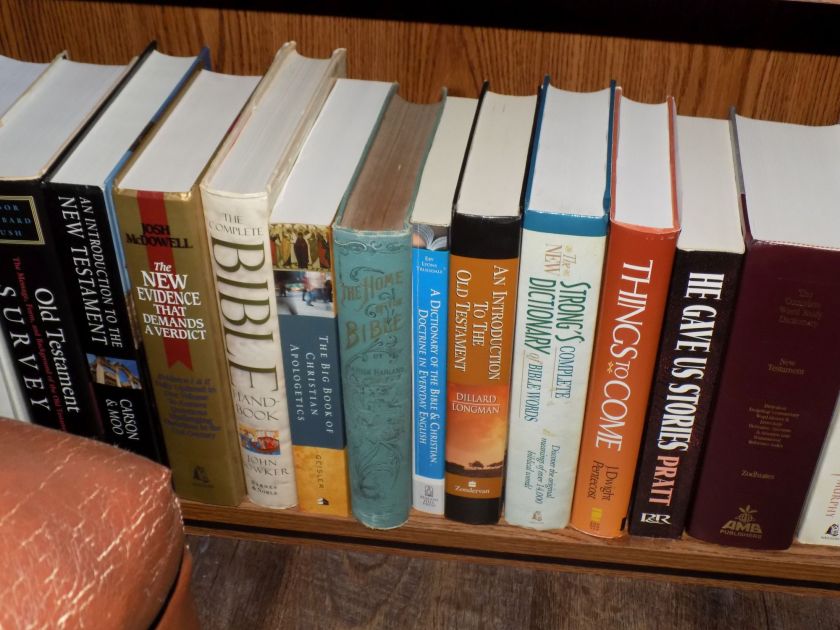
I’ve been asked to show the titles in my library. OK, here you go! I think if you right-click on particular photos you can see them larger in new tab.
OT Commentaries
NT Commentaries
grouped by subject: heaven, grace, prayer etc
heavy reference books on the bottom
Puritans shelf: About Puritans or By Puritans
More Puritans
Left: All Sproul. Right: All Chapel Library pamphlets.
Heavy books on bottom
JMac bookshelf, commentary, complete set
JMac Commentary set
Grace to You: I donate monthly. GTY sends free books
JMac books, and some heresy-for research only books




























































 the-end-time.org