Posted in church, worship

Is your worship exciting? I’m sorry

Source 

Before I was saved I’d attended many concerts and comedy shows. Before the main act appeared, there was always an opening act or as it is known, a “warm-up act”. The intent is to whip up the audience into an excitement. Wikipedia explains,

An opening act, warm-up act, or supporting act is an entertainment act (musical, comedic, or otherwise), that performs at a concert before the featured act, or “headliner”. … The opening act’s performance serves to “warm up” the audience, making it appropriately excited and enthusiastic for the headliner.

When we were at a taping of the Johnny Carson Show (Jay Leno had taken over when we were there) someone came out before the taping began and warmed up the audience. Wikipedia explains the comedy warm-up:

A warm-up comedian or crowd warmer is a stand-up comedian who performs at a comedy club or before the filming of a television comedy in front of studio audience to get the crowd into the mood ready for the show or main act. Their role is to make the audience feel integral to the show and encourage reactions during the show. They usually work alone and perform a comedy routine while also possibly explaining aspects of the show. They will also perform during commercial breaks.

This was the case with us. I don’t remember who the warm-up comedian was, but by the time Jay Leno came out through the curtains with the intro music blaring and asked, “Are you excited?” we could enthusiastically applaud and yell “YES!” The crowd went wild.

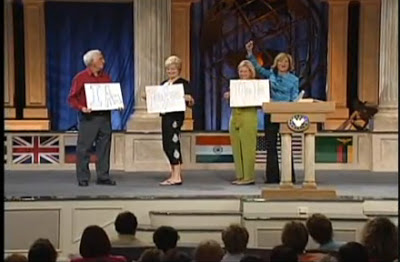
There are many praise bands whose intent is to do the same. By the time the main act arrives on stage (pastor climbing the pulpit) he often asks, “Are you warmed up excited?” Or if the congregation looks a little serious he might say “You all look so serious. We’re in church! Smile! Isn’t it exciting!?”

Is church exciting? Is that the only proper emotion one should express in church? Excitement? What is church worship and how should we express it?

John MacArthur’s series “True Worship” has a definition:

Worship Defined 

What is worship? Let me give you a definition: Worship is “honor paid to a superior being.” It means “to give homage, honor, reverence, respect, adoration, praise, or glory to a superior being.” In Scripture, the word is used indiscriminately to refer to the homage given to idols, material things, or to the true God. So the word in itself is not a holy word, it only describes honor given to a superior being. 

The common New Testament word for worship is proskuneo, which means “to kiss toward, to kiss the hand, to bow down, to prostrate oneself.” The idea of worship is that one prostrates himself before a superior being with a sense of respect, awe, reverence, honor, and homage. In a Christian context, we simply apply this to God and prostrate ourselves before Him in respect and honor, paying Him the glory due His superior character.

Essentially, then, worship is giving – giving honor and respect to God. That is why we, as Christians, gather together on Sunday. We don’t gather to give respect to the preacher or those in the choir, we gather to give honor to God. 
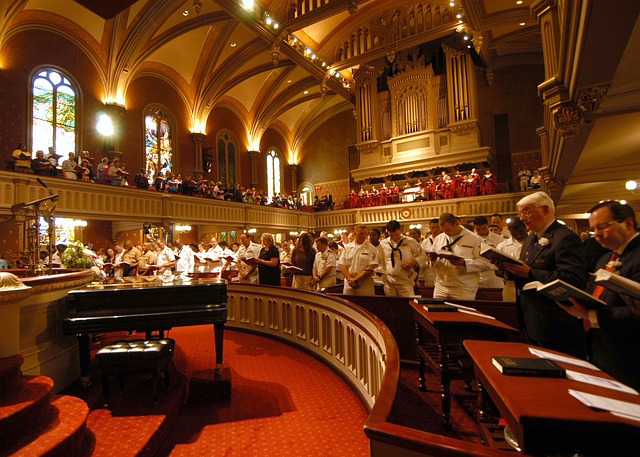
When some people attend church and they look serious it’s for a reason. We are there to pay homage to the supreme Being of the Universe, Yahweh. Did the Temple priests go dancing and prancing into the Temple hooting and hollering? Shouting “Come on, ya’all, bring on the sacrifices, it’s a great day to be in the Temple today!!!” Can’t picture it? That’s for a reason.

Here is Worship Matters on How Exciting Should Our Sunday Meetings Be?

Getting the Goal Right

But our lives aren’t an unending string of exclamation points. Our meetings shouldn’t be either. (Neither should our emails, but that’s another topic).

Strictly speaking, God never says the goal of the church gathering is excitement. It’s edification for God’s glory. We meet to stir up one another to love and good works, not simply to have an emotionally electrifying time. We meet to behold God’s glory in Christ through his Word, responding in ways appropriate to his self-revelation (Heb. 10:24; 2 Cor. 3:18).

That doesn’t mean gathering as the church isn’t meant to be a soul stirring event. We have every reason when we’re together to be excited about what God has done for us in Christ. But that’s not the same as aiming for adrenaline-pumping, professionally produced, high energy, exciting gatherings alone. That approach leaves little room to engage in expressions normal for elect exiles on our way to a new home (1 Pet. 1:1-2). Expressions like disorientation (Ps. 42:1-5). Sorrow for sin (Ps. 38:1-8). Grief (Rom. 12:15). A humble awareness of our creatureliness before our Creator (Ps. 95:6-7). Not to mention reverence and awe (Heb. 12:28).

Our greatest need when we gather is not simply to feel excited, but to encounter God: to engage with the certainty of his sovereignty, the reality of his authority, the comfort of his mercy in Christ, and the promise of his grace. We need to be strengthened for the battles against the world, our flesh, and the devil that will confront us the moment we wake up Monday morning, if not before. Mere emotional excitement, however it might be produced, won’t be sufficient. 

We need God’s Word clearly expounded, God’s gospel clearly presented, and God’s presence clearly experienced. We need well crafted, intentional liturgies that cultivate God-honoring, Christ-exalting thoughts and desires (See Rhythms of Grace and Christ-Centered Worship for more on that). Our efforts to make our meetings exciting can actually end up obscuring what our congregations need the most.

Some people when they go to church are excited in a way that’s more soberly mindful of the gravitas of the situation than the outward hyperactive excitement some churches seem to want or enjoy. Church is profound. We come before our Holy God to repent of sins, to call others to repent, and to praise and worship our eternal Savior. It is awe-inspiring, and yes, exciting, but not in the foot-stomping, hand waving, fervent excitement that some plea for and yes, even demand. Insistence on demonstrating our “excitement” at being present before God and the Assembly in one particular way is not at all liberating, in fact, it’s inhibiting.

The Bible on worship:

Therefore, brothers and sisters, since we have confidence to enter the Most Holy Place by the blood of Jesus, by a new and living way opened for us through the curtain, that is, his body, and since we have a great priest over the house of God, let us draw near to God with a sincere heart and with the full assurance that faith brings, having our hearts sprinkled to cleanse us from a guilty conscience and having our bodies washed with pure water. Let us hold unswervingly to the hope we profess, for he who promised is faithful. And let us consider how we may spur one another on toward love and good deeds, not giving up meeting together, as some are in the habit of doing, but encouraging one another—and all the more as you see the Day approaching. (Hebrews 10:19–25:)

We should aim for a more profound excitement. Here is Worship Matters again:

Towards a More Profound Excitement

The alternative to making our meetings more “exciting” isn’t trying to bore people. But Sunday mornings aren’t New Year’s Eve celebrations. They aren’t rock concerts. They aren’t pep rallies. They aren’t World Cup finals. They’re something much more mundane, and at the same time something much more eternally and cosmically significant. Our plans, lights, smooth transitions, technology, videos, sound systems, visual effects, and creativity don’t make it so. Christ dwelling in the midst of his people through his Holy Spirit makes it so. That’s why if we understand what’s going on, sharing the bread and cup during communion can be one of the highlights of our week, transcending the greatest of world championship sports rivalries in its effect on us.

What a great word. Transcendent. Our worship emanates from a sinful but justified heart, upward through three heavens to arrive at the throne of God.

For thus says the One who is high and lifted up, who inhabits eternity, whose name is Holy: “I dwell in the high and holy place, and also with him who is of a contrite and lowly spirit, to revive the spirit of the lowly, and to revive the heart of the contrite. (Isaiah 57:15).

This is the most exciting thing in the universe, our Holy Spirit in us, dwelling in our very body that is a Temple. I am hugely “excited” over this. Church leaders that insist on a enthusiasm exhibited a certain way, OR produce stage-effects designed to manipulate the congregation into exhibiting the desired enthusiastic exhibitions, should take heed of the 2 articles above.

Come, let us worship and bow down, Let us kneel before the LORD our Maker. For He is our God, And we are the people of His pasture and the sheep of His hand. (Psalm 95:6-7)

—————————————

Further Reading

Dude, Where’s your Gravitas?

Posted in abraham, abram, encouragement, worship

The first worship in the Land

Then the LORD appeared to Abram and said, “To your offspring I will give this land.” So he built there an altar to the LORD, who had appeared to him. (Genesis 12:7)

“By this act, Abram made an open confession of his religion, established worship of the true God, and declared his faith in God’s promise. This was the first true place of worship ever erected in the Promised Land.” ~MacArthur Commentary

“The March of Abraham” József Molnár – 1880

The first true worship in the Land… a worship of a worthy Lord which will never end. We are privileged to proclaim His excellencies forever and ever, in that marvelous Light of the eternal heavens.

But you are A CHOSEN RACE, A royal PRIESTHOOD, A HOLY NATION, A PEOPLE FOR God’s OWN POSSESSION, so that you may proclaim the excellencies of Him who has called you out of darkness into His marvelous light; (1 Peter 2:9)

Posted in queen of sheba, solomon, wisdom, worship

Why did the Queen of Sheba want to visit King Solomon?

The queen of the South will rise up at the judgment with this generation and condemn it, for she came from the ends of the earth to hear the wisdom of Solomon, and behold, something greater than Solomon is here. (Matthew 12:42)

Jesus is talking to the Pharisees here, and the generation He’s talking about was the generation that saw Messiah arrive, work miracles, preach truth, and reject Him.

Solomon and the Queen of Sheba by Giovanni De Min (1789-1859). Wikipedia

Is this verse a prophecy? A promise? A historical incident? All three. Read the beautiful sentiments Matthew Henry shares in his Whole Commentary on the bible:

As a generation that would be condemned by the queen of the south, the queen of Sheba, v. 42. The Ninevites would shame them for not repenting, the queen of Sheba for not believing in Christ. She came from a far country to hear the wisdom of Solomon; yet people will not be persuaded to come and hear the wisdom of Christ, though he is in every thing greater than Solomon.

[1.] The queen of Sheba had no invitation to come to Solomon, nor any promise of being welcome; but we are invited to Christ, to sit at his feet and hear his word.

[2.] Solomon was but a wise man, but Christ is wisdom itself, in whom are hid all the treasures of wisdom.

[3.] The queen of Sheba had many difficulties to break through; she was a woman, unfit for travel, the journey long and perilous; she was a queen, and what would become of her own country in her absence? We have no such cares to hinder us.

[4.] She could not be sure that it would be worth her while to go so far on this errand; fame uses to flatter men, and perhaps she might have in her own country or court wise men sufficient to instruct her; yet, having heard of Solomon’s fame, she would see him; but we come not to Christ upon such uncertainties.

[5.] She came from the uttermost parts of the earth, but we have Christ among us, and his word nigh us: Behold he stands at the door, and knocks.

[6.] It should seem the wisdom the queen of Sheba came for was only philosophy and politics; but the wisdom that is to be had with Christ is wisdom to salvation.

[7.] She could only hear Solomon’s wisdom; he could not give her wisdom: but Christ will give wisdom to those who come to him; nay, he will himself be made of God to them Wisdom; so that, upon all these accounts, if we do not hear the wisdom of Christ, the forwardness of the queen of Sheba to come and hear the wisdom of Solomon will rise up in judgment against us and condemn us; for Jesus Christ is greater than Solomon.

Henry, M. (1994). Matthew Henry’s commentary on the whole Bible: complete and unabridged in one volume (p. 1676). Peabody: Hendrickson.

~~~~~~~~~~~~~~~~~~~~

Further Reading:

All about the Queen of Sheba

Posted in fellowship, first century church, love, worship

Let’s stop idolizing the first century church and love our own churches a little more

It’s fashionable today to hate the church. People like to come across as wise sages, decrying the ecclesiology of the western church. Many people note that church is shallow, entertainment-driven, and lukewarm, with worthless shepherds leading clueless goats. Some even go so far as to say that most churches should be closed. They say they love Jesus but hate religion. They say that they love Christ but disparage the church.

You hear more and more that the First Century church is what we should get back to. Continue reading “Let’s stop idolizing the first century church and love our own churches a little more”

Posted in contemporary music, corinth, pagans, worship

"Is Your Church Worship More Pagan than Christian?"

Todd Pruitt wrote a great article titled, Is Your Church Worship More Pagan than Christian? It begins this way,

There is a great misunderstanding in churches of the purpose of music in Christian worship. Churches routinely advertise their “life-changing” or “dynamic” worship that will “bring you closer to God” or “change your life.” Certain worship CD’s promise that the music will “enable you to enter the presence of God.” … The problem with the flyer and with many church ads is that these kinds of promises reveal a significant theological error. Music is viewed as a means to facilitate an encounter with God; it will move us closer to God. In this schema, music becomes a means of mediation between God and man. But this idea is closer to ecstatic pagan practices than to Christian worship.

Yet in the years since then I have learned some valuable lessons. Chief among them is the realization than an emotional high is no substitute for true spirituality. paperthinhymn
Pruitt continues by explaining the theological errors of churches that use music as a mediator between the people and Jesus. Of course there are further explanations in the article. I recommend it highly. Here are a few more excerpts,

1. God’s Word is marginalized.
In many Churches and Christian gatherings it is not unusual for God’s Word to be shortchanged. Music gives people the elusive “liver quiver” while the Bible is more mundane. Pulpits have shrunk and even disappeared while bands and lighting have grown. But faith does not come from music, dynamic experiences, or supposed encounters with God. Faith is birthed through the proclamation of God’s Word (Rom 10:17).

2. Our assurance is threatened.
If we associate God’s presence with a particular experience or emotion, what happens when we no longer feel it? We search for churches whose praise band, orchestra, or pipe organ produce in us the feelings we are chasing. But the reality of God in our lives depends on the mediation of Christ not on subjective experiences.

3. Musicians are given priestly status.
When music is seen as a means to encounter God, worship leaders and musicians are vested with a priestly role. They become the ones who bring us into the presence of God rather than Jesus Christ who alone has already fulfilled that role. Understandably, when a worship leader or band doesn’t help me experience God they have failed and must be replaced. On the other hand, when we believe that they have successfully moved us into God’s presence they will attain in our minds a status that is far too high for their own good.

4. Division is increased.
If we identify a feeling as an encounter with God, and only a particular kind of music produces that feeling, then we will insist that same music be played regularly in our church or gatherings. As long as everyone else shares our taste then there is no problem. But if others depend upon a different kind of music to produce the feeling that is important to them then division is cultivated. And because we routinely classify particular feelings as encounters with God our demands for what produce those feelings become very rigid. This is why so many churches succumb to offering multiple styles of worship services. By doing so, they unwittingly sanction division and self-centeredness among the people of God.

Source

The pagan music practices to which Mr Pruitt was referring were described in several different ancient writings and modern commentaries.

The cult of Dionysus coming from the northland spread in a great wave of religious enthusiasm over Greece proper, over the island states of the Aegean, and across to the mainland of Asia Minor. At first it met with violent opposition, as the legends of Lycurgus and Pentheus prove. In those early days rarely was the god graciously received as he was, for example, by Icarus in Attica. In spite of opposition, however, the contagious enthusiasm of the wine-god spread with unusual rapidity throughout Greece. In order to restrain Bacchic excesses the city-states of Greece had no other alternative than to adopt the Cult, bring it under state patronage, and by official regulation temper its enthusiasm somewhat. At Delphi Dionysus was associated with Apollo, and there the sacred maidens went mad in the service of the two gods. In Athens he entered into civic partnership with Athena and yearly wedded the Basilinna. At Eleusis he was brought into relation with Demeter and led the march of the candidates along the Sacred Way from Athens. In Teos and Naxos he even became the paramount state deity, the “god of the city” and “protector of the most holy state.”

It was as a private cult, rather than as a state religion, however, that the worship of Dionysus made its deepest impression on both Hellenic and Hellenistic life. In the private brotherhoods, the natural emotions aroused by the cult practices were allowed free play and the guaranties offered to initiates were of a very realistic order; hence the appeal of the cult was strong, particularly to the masses and to women generally. At the beginning of Aristophanes’ comedy, Lysistrate, impatient with waiting, complains that if the women had been invited to the shrine of Bacchus “there would be no getting along for the crowd of timbrels.” Indeed, the prominence of women in the worship of Dionysus is one of the most striking features of the cult. Pagan Regeneration,  A Study of Mystery Initiations in the Graeco Roman World by Harold R. Willoughby, [1929]

Timbrels are an ancient kind of tambourine. The quote meant that if all the women were invited there would be so many clogging the streets with their tambourines, no one would be able to pass by.

The result of pagan cultic worship, especially Dionysian worship, was a frenzied scene at the temple, and a cacophony that permeated the city from on high to down low.

Menander demonstrates women’s role in pagan worship:

‘We were offering sacrifice five times a day, and seven serving women were beating cymbals around us while the rest of the women pitched high the chant (olulugia)’ (Fragment 326).

In Daniel 3:4-6, the passage is talking about King Nebuchadnezzar and his command that all peoples worship him. To that end, he had made a statue and commanded all to worship before it. In the commentary on the verses, James Burton Coffman Commentary (1992) expounds,

the Temple of Aphrodite Pan Demos, located atop the Acro Corinthus, encouraged the patronage of their one thousand sacred prostitutes by a cacophonous blast of instrumental music five times a day, signaling that, the prostitutes had changed their clothes and that another feast on the sacrifices had been made ready. In our own times, with the continued degeneration of the whole science of instrumental music into the vulgar rhythms and noisy cacophony of the current era, such later styles of instrumental music are impossible of reconciliation with any conception whatever of holy worship.

Hear hear. We have come full circle from the days of the AccroCorinth temple worshipers’ ululations and frenzied dancing, to the same today in many Charismatic and other ‘churches’. It wasn’t acceptable then and it isn’t acceptable now. In 1 Corinthians 14:33-34, Paul said,

For God is not a God of confusion but of peace. As in all the churches of the saints, for God is not a God of confusion but of peace, as in all the churches of the saints. The women are to keep silent in the churches; for they are not permitted to speak, but are to subject themselves, just as the Law also says. GotQuestions explains,

The concern of 1 Corinthians 14, and much of the epistle, is order and structure in the church. The Corinthian church was noted for the chaos and lack of order rampant in that assembly (verse 33). It is interesting that no elders or pastors are mentioned in the book, and the prophets who were there were not exercising control (see verses 29, 32, 37). Everyone in the church service was participating with whatever expression they desired, whenever they desired. As a result, those with the gift of tongues were speaking simultaneously, those with a revelation from God were shouting out randomly, and no one was concerned with interpreting what was being said, even if what was said could be heard above the din. The meetings quickly descended into chaos.

The Temple at Corinth and other places in the realm were already hotbeds of female chaos, musical cacophony, and wild dance. Women in the pagan temple were temple prostitutes. Part of their worship used music not only as a call to prostitution but as a method of working themselves up (to madness in many cases) and in a fever pitch, unite with the divine. If music did not have that capability the cult of Dionysius would not have spread so quickly and have been so well-known at Corinth as a synonym for debauchery. Christians must be vigilant about music being used to promote feelings and subjective experiences rather than to explain doctrine and praise the Savior. It all too quickly leads to chaos and worse, as Paul warned and as we see in the pagan cultic worship sessions.

Temple of Athena

Paul urged order in the church and the women to remain submissive. This would be an incredible contrast to what was happening in the immediate culture at the pagan temples, and further give Christianity its distinctive stamp.

So that was a short course in pagan worship and the influence music had on it back in the ancient days. When you read a title like Is Your Church Worship More Pagan than Christian? we can easily see that many of the chaotic, music-inflamed services at many churches, youth conferences, and revivals are indeed exactly like the pagan worship at Corinth, and are exactly what Paul railed against.

The point of the article is that when music is used ‘to bring us closer to God’, it actually separates us from God by instilling a false worship, the worship of emotional highs and subjective feelings. It often is used as an intermediary, or a vehicle, to foment a feeling of closeness with the divine,when all it is really doing is exhausting us with its constant undulations from high to low and high again.

From a youth who has lived the pagan worship and come out alive- barely:

That instead of developing depth it breeds shallowness, immaturity, and confusion. I’ve learned that worship can become the biggest draw for the church, and that worship nights will steamroll over bible studies and adult Sunday school. That a church oftentimes will pour much more resources, energy, thought and time into making a killer worship service than they will into developing deep, thoughtful, meaty, mature, theologically precise and provoking bible studies.

Don’t let that be your church. Music is not worship and it should not substitute for true spiritual depth and relationship with the real intermediary- Jesus Christ.

~~~~~~~~~~~~~~~~~~~

Further reading

How worship music destroyed me. From bitterness to blessing

Posted in false religion, God, jesus, mary worship, worship

"All to Jesus through … Mary?" Catholics are taught to worship Mary as God

A friend was walking in the Italian-Catholic neighborhood of Boston’s North End. He wrote that he passed by an impromptu shrine. He took a photo of it. I read the statement on the bottom of the shrine, which was dedicated to and all about Mary, and it sounded like a creed to me. It was also blasphemy. I decided to look it up.

Why blasphemy? The word of God does not say to “all to Mary” nor does it say to get to Jesus by going through Mary. James 4:7 says submit yourselves to God. Exodus 20:5 says not to bow down to another [besides the one true God]. Ephesians 5:23-24 says Christ is the head of the church and the church submits to Him.

The most successful false teachings are almost the truth. False teachings are like a Peanut M&M. There is an attractive, bright candy coating. There is a layer of velvety chocolate. But buried deep inside is a nut. Picture that nut as the false teaching. False teaching is layer upon layer of goodness with a hidden poison pill buried deep inside.

So often, attention is given to religions that seem like they so far away from Christianity, like atheism and Islam. But all false religions are spiritually the same, because they originate from the same source. However, some false religions seem almost true, because they claim Jesus, they use scriptures so well, and they have a seeming logic to them. But these are the most dangerous of all. For example, int eh Garden of Eden, satan disguised as a serpent didn’t approach the woman by saying, “God is wrong! Don’t listen to Him!” He approached the women by asking questions, insinuating, and blending half truths with lies.

When I searched for “all to Jesus through Mary” I found the following. It is brilliant in its false logic, evilly deadly in its blending of half-truths and full-on lies, you would see if you read the piece in its entirety. It is a Catholic piece written by a Catholic-educated man named Jayson Brunelle, and one of his many books that he has written is titled “The Blessed Mother’s Plan to Save Humanity.” This essay about how Mary is Co-Redemptrix with Jesus appeared in the Homiletical and Pastoral Review last year.

To Jesus, Through Mary, In the Spirit of St. Joseph: The Wheat, the Rose, and the Lily
St. Louis de Montfort and St. Maximillian Kolbe, … have consistently taught that the most appropriate response on our part to Mary’s role as spiritual mother is filial entrustment, or “total consecration” to her. This perfect devotion of total con­secration to Jesus through Mary is truly the most sanctifying of all devotions.”

That was the sub-hed, or the article summary. Let’s take a moment to look at the word ‘consecration” and what it means. It is a word that has a concept that’s wide-ranging, but Easton’s Bible Dictionary explains the basic meaning–

“The devoting or setting apart of anything to the worship or service of God. The race of Abraham and the tribe of Levi were thus consecrated (Exodus 13:2, 12, 15; Numbers 3:12). The Hebrews devoted their fields and cattle, and sometimes the spoils of war, to the Lord (Leviticus 27:28, 29). According to the Mosaic law the first-born both of man and beast were consecrated to God. In the New Testament, Christians are regarded as consecrated to the Lord (1 Peter 2:9).

When something is set apart for holy use, whether a priest of the Old Testament, cattle, or a New Testament modern believer, it means set apart for the Lord’s use, in worship and devotion to Him. To continue with the article “To Jesus through Mary”,

So very few persons, pious Catholic Christians included, realize the tremendous role of the Blessed Virgin Mary in the sanctification of souls. Being spiritual mother of the Mystical Body, she, along with the Holy Spirit, has the tasks of forming Christ in souls, and nourishing her children with the milk of divine grace.

In that passage, the author is putting a sinner, Mary, in equal position with the Holy Spirit, whose ministry it is to point to Christ in souls. (1 Corinthians 2:14). Yes, Mary was a sinner like you and me, in need of a savior. She said as much in Luke 1:27. She is a servant of God, certainly not equal with God, and said so in Luke 1:48. The One who upholds the universe by the word of His power does not make a sinner co-equal in His work! (Hebrews 1:3)

Mary does not dispense divine grace. Only our Trinitarian God does that. As Charles Spurgeon said, “It is the chief office of the Holy Spirit to glorify Christ.” Yet Catholics are taught that Mary sanctifies souls, is our ‘spiritual mother’, and delivers divine grace.

When you speak of these things to a Catholic, they will deny they worship Mary, claiming that ‘venerating’ her is only giving her respect, but this lesson taught by a Catholic theologian destroys that stance in just a few sentences.

Remember, Catholics are not Christians, any more than Muslims are Christians or Atheists are Christians. Their spiritual father is the devil, (John 8:44), while all who believe the true Gospel has a spiritual Father in Jesus.

In this next passage, the author explains how Mary is the Church’s “Spiritual Mother”:

Mary, in giving birth to Christ the Head, also gave birth to the body connected to that Head, which is the Church. Thus, Mary, in giving birth to the source of all grace, can rightly be called “Spiritual Mother” of all who benefit from that grace.

It sounds logical, doesn’t it. We understand the biology of conception, gestation, birth, and nurturing. Jesus used those analogies many times and Paul & Peter both spoke of spiritual nourishment as milk. Yet, it falls apart when we remember that first and foremost, the virgin birth was a supernatural event unlike any other in history ever before or since. And secondly, it denies the Holy Spirit’s role in forming the Church, which occurred at Pentecost, by His indwelling of the believers there (Acts 2:4) who had been appointed to believe since before the foundation of the world. (cf Acts 13:48). Mary had nothing to do with it. She was a vessel being used by God (Luke 1:38).

Continuing with the article, we come to the next section, which the author has titled:

Mary, Mediatrix of all Grace
To understand the logic of total consecration to Jesus through Mary, we must first grasp Mary’s role as Mediatrix of all graces. This is the Church’s doctrine that every grace that comes to us from God comes through the willed intercession of Mary. But this role of Mary as Mediatrix of all grace is really the completion of her role as Spiritual Mother, and follows from her unique cooperation in the redemption of humanity with Christ on Calvary. … But Mary most fully became our mother at the foot of the cross where she, in a completely singular way, participated in the redemption of humanity with Christ. That is why some theologians are wont to ascribe to Mary the title Co-Redemptrix. De Montfort said: “the more a soul is consecrated to Mary, the more it is consecrated to Jesus”

I hope your discernment and knowledge of the Word allowed you to understand that what is being taught in that Catholic Doctrine above, is that Mary is really God, or is above God. If “every grace that comes to us through God” is through Mary’s will, then it is God who is taking the subservient role. In this Catholic doctrine Her will trumps His. But it is not so! It is Christ who pours out graces. (Acts 2:33). Further, this doctrine teaches that Mary is the Intercessor, not Jesus. (Romans 8:34, Hebrews 7:25).

So in just a few short sentences, or in one essay if you read it at the link, we see that Catholics are taught that Mary has a role that trumps all three roles of our Trinitarian God. As dispenser of grace and mother of the church she edges out the Holy Spirit. As intercessor she bumps out Jesus. And as giver of all graces via her own will through God she takes over His role there as well. This is why Catholicism is false. They have another god: Mary.

The Crowning of the Virgin by the Trinity. Velázquez, 1645

I bring these things up so you can be prepared when speaking with a Catholic person. I did a rudimentary and very clumsy job of apologetics here, but I hope it gave you food for thought. The creed adorning the Marian shrine in Boston’s North End is emblazoned with lights and candles, but is in fact bringing a doctrine of darkness. Here is part of the author’s conclusion:

Having established the irrefutable validity of Mary’s role as Mediatrix of all graces, we can now understand the reason for entrusting ourselves to her, which is the essence of Marian consecration.

O, how satan loves to take our eyes off the true Rock, the only Bread, the source of the Living Water, Jesus Christ! We do NOT consecrate ourselves to a sinner named Mary whom God used as a biological vessel. We give ourselves wholly and totally to Jesus, the only worthy one in the universe.

Our church has a mission team heading to Peru next month to witness to the lost, many of them Catholics, and these doctrines saturate the Peruvian hearts and poison their minds away from the beauty and clarity of the true Gospel of Jesus Christ. Please, pray for missionaries in the Catholic regions. Pray for the Light of grace from our true God to be delivered to hearts and minds wrongly focused on Mary, so they may be lifted from the bondage of sin and darkness under which they are laboring.

Mary’s Magnificat was a hymn of praise and joy. Here as Charles Spurgeon explains Mary’s joy at the news of the coming of the Lord, not as Mother of God, but as a sinner graciously saved, in his sermon delivered on Christmas Day 1864, on this text, “And Mary said, My soul does magnify the Lord, and my spirit has rejoiced in God my Savior.” Luke 1:46, 47″

I must close by observing that while her song was all this, yet how very humble it was, and how full of gratitude. The Papist calls her, “Mother of God,” but she never whispers such a thing in her song. No, it is “God my Savior,” just such words as the sinner who is speaking to you might use, and such expressions as you sinners who are hearing me can use, too. She needs a Savior, she feels it; her soul rejoices because there is a Savior for her. She does not talk as though she could commend herself to Him, but she hopes to stand accepted in the Beloved. Let us, then, take care that our familiarity has always blended with it the lowliest prostration of spirit when we remember that He is God Over All, blessed forever, and we are nothing but dust and ashes; He fills all things, and we are less than nothing and vanity.”

Will you sing of His tremendous grace, in joy at how He releases sinners from bondage? Pray for those in bondage to Mary to be released, so they also might sing of how their soul magnifies the Lord and their spirit also may rejoice in the Savior.

Posted in antics, beth moore, circus, dignity, ed young, gramling, inappropriate, Rod Parsley, sober, worship

Men of the Church: Are You Sober?

When you read the New Testament you’d be surprised to read how many times men (and women) are called to be sober. And most time when the word sober is used, it means not only ‘not drunk’ of course, but mentally alert, sharp, thinking clearly with right judgment. Women are called to be sober as well. In many cases for both sexes, particularly church leaders, it’s meant as a call to be dignified. (Proverbs 31:25; 1 Timothy 2:2).

Three years ago, when I first posted about Beth Moore and the trouble I was having with her teaching, one of the things I took issue with is that she isn’t dignified when she teaches. I’d written,

She isn’t dignified. Yes, that’s what I said. Beth Moore is not dignified on her stage. She moves around a lot, quickly delivering scriptures and her interpretations in rapid-fire fashion. She will use tricks like having a wastebasket prop to “throw away” negative behaviors, she presses participants to wear bracelets that supposedly mean certain things (I read this from three blogs) and she will contort, kneel, dance, and generally cut up, sometimes while holding the bible. Laughter is frequent.

A bible lesson is not a comedy routine. I am all for laughter. Our pastor says some funny things sometimes and the congregation will of course laugh. I am among those who laugh loud and I’m sure even the choir can hear me from where I sit. But teaching the bible with respect requires some gravitas. It requires some dignity. It isn’t a prop or a party trick. I shun antics as the main behavior of the teaching session. Funny sometimes, yes. Zany bible teachers? No.

Call me staid (Decorous? Sedate?) but I don’t think Paul hung “I AM” posters
around the necks of hapless volunteers in the synagogues
when he was reasoning with them

Their wives likewise must be dignified, not slanderers, but sober-minded, faithful in all things.” (1 Timothy 3:11)

I took a lot of flak from people about that rebuke. Many people thought I was being too picky, or too staid, or too Northern. Most of those people who said I was wrong had overlooked the clear commands in the bible about behaving soberly in church and out. Even though I posted them, lol. But it’s pretty simple. We’re commanded again and again to be sober.

Many people these days don’t like it when we remind ourselves of a doctrinal standard. (2 Tim 4:3). They really hate it when we remind ourselves that there are behavioral standards, too. ‘Who are you to judge how someone should act?!’ Etc. But it’s not me, it’s God. They are His standards, both doctrinal and behavioral (moral).

As you read all the verses in the NT which mention sobriety, you begin to notice a pattern. Sobriety in behavior comes first because we are clear in our thinking. ‘Be sober-minded’ ‘Exercise sober judgment’. ‘Don’t be drunk, so you can think clearly.’ Like that. We are called to act this way because we hold Jesus up as the highest and most important Person in the universe, worthy to be worshiped. We are serious about this and we are dignified about it too. We want to think clearly, witness accurately, show self-control, love, and patience, and be serious about the King so we can make good decisions. We also do this because we do not want to be a stumbling block to the weak. (1 Corinthians 8:9, Romans 14:21).

With all this in mind, let’s take a look at the spectacle that Christian worship services have become. Are these men sober-minded? Exercising good judgment?

Older men are to be sober-minded, dignified, self-controlled, sound in faith, in love, and in steadfastness…” (Titus 2:2)
source

In the above picture, ‘Pastor’ Troy Gramling set himself ablaze to demonstrate something from his preaching series “Daredevil.” (Why any Christian would want to say he is anything like a devil is beyond me…Christ bought us away from the devil). When Paul wrote to Timothy about the behavioral qualifications of pastors, and thought he had covered it with ‘exercise good judgment ‘ and ‘be sober,’ I don’t think he would have thought he’d have needed to spell it out: “Do not set yourself on fire.”

In the photo below, ‘Pastor’ Ed Young decided to preach about sex. Young and his wife Lisa staged a 24-hour bed-in on the church’s roof to discuss truths about sex before a live Internet audience. When Paul wrote the following words to Timothy…

As for you, always be sober-minded, endure suffering, do the work of an evangelist, fulfill your ministry.” (2 Timothy 4:5)

…I am sure he did not think to include prohibitions about silly stunts in the sun and sex talk in front of the world. ‘Fulfill your ministry by being immodest, a stumbling block to the young and intemperate, and say  things in public that would embarrass your mother. G’wan. Jesus is ‘kay with it.”

‘Pastor’ Rod Parlsey is pastor of World Harvest Church, a large Pentecostal church in Columbus, Ohio. As Stand Up For the Truth describes the now deleted video, “Is it a bird? Is it Tom Cruise? No, it is a pastor! Rod Parsley of World Harvest Church is raising some eyebrows by releasing this now-viral video of himself zip lining through the air over his cheering congregation, and landing onto his pulpit. His band is playing the “Mission Impossible” theme music to kick off its “Mission Possible” sermon series leading into Easter.

Easter!!!

source

The end of all things is at hand; therefore be self-controlled and sober-minded for the sake of your prayers.” (1 Peter 4:7)

At the revelation of Jesus Christ, do you think the Head of our church will look favorably on the ziplining pastor making a mockery out of his House of Prayer? Well, how did He like it the first time? (Matthew 21:13)

Therefore, preparing your minds for action, and being sober-minded, set your hope fully on the grace that will be brought to you at the revelation of Jesus Christ.” (1 Peter 1:13)

In this next example, we’re told not to think more highly of ourselves than we should, but ‘Pastor’ Steven Furtick thinks just as highly of himself as Jesus thinks of the Father.

For by the grace given to me I say to everyone among you not to think of himself more highly than he ought to think, but to think with sober judgment, each according to the measure of faith that God has assigned.” (Romans 12:3).

source

Furtick is building the church? I thought Jesus was doing that. Building it upon a vision Furtick had? I thought the church was being built on the fact that Jesus is savior. And uniting around Furtick’s vision? I thought we were supposed to unite around the Spirit. (Ephesians 4:3)

Simon Peter replied, “You are the Christ, the Son of the living God. … And I tell you, you are Peter, and on this rock I will build my church, and the gates of hell shall not prevail against it.” Matthew 16:16, 18)

Blasphemy. And remember, Furtick was the one who perverted the worship service by seeding planted people in the audience to manipulate congregants into coming forward for a baptism he called spontaneous, but was anything but. It was a total manipulation from start to finish, including the music, teaching the planted people how fast or slow to walk down the aisle and what to say to the baptizees coming forward. Spontaneous, my eye.

“You keep using that word. I do not think it means what you think it means.” ~Inigo Montoya

Strong’s numbered Greek words in the lexicon explain that in most cases in the above verses, ‘sober’ means for the believer to “think shrewdly”, reflecting what God defines is true moderation. In the other cases, it means don’t be drunk. ‘Be sober, unintoxicated’ refers to having presence of mind (clear judgment), enabling someone to be temperate (self-controlled)”.

Jesus is the head of the church. If we can’t picture Jesus doing something or saying something behind the pulpit, then His under-shepherd shouldn’t do it.

I’m not talking about never smiling, never having fun, or never relaxing. In fellowship or casual settings away from church, sure, have fun. Even then, don’t be so wild as to give cause to the unbelievers to slander us. (1 Tim 5:14). But in church or in bible teaching settings, such antics have no place. Why? Because of this verse:

Therefore, my beloved, as you have always obeyed, so now, not only as in my presence but much more in my absence, work out your own salvation with fear and trembling, for it is God who works in you, both to will and to work for his good pleasure.” (Philippians 2:12-13)

Obey. Fear. Trembling. It is all joined at verse 13- ‘for it is God…’ God is in us, working out His will and plan and we work out our salvation because we obey in fear and trembling. Why? Again, because He’s God.

We feel utter joy in knowing He is God and utter gratitude for our salvation. We do feel joy and love and we exhibit it, but it is all rooted in the fear and trembling because He is God, and there is no other. We aren’t flippant, casual, irreverent, zany, ‘devilish’, foolish, or outrageous. Our joy comes from the fear and trembling, the fear of sinning against the Lord, of not being active in our sanctification, and fear of loss of rewards

If you would like to listen to an excellent sermon on the Christian life centered around an exposition of the above Philippians verse, please do so. It is by Dr Steven Lawson, “Christian Living 101: Part 1” Here it is

Meanwhile, remember worship is not a party! Be sober, be mindful, be dignified. This will please Jesus.

Posted in contemporary music, discernment, praise band, rend collective experiment, worship

A review of new contemporary music band: Rend Collective Experiment

Does the kind of music we worship in church matter? Yes, it does.

In researching the state of the contemporary music bands for a blog essay I wrote a month ago, I came across a winsome new band from Northern Ireland called Rend Collective Experiment. Actually, they remind me of In Tua Nua (kudos if you know who they were ;). Rend Collective Experiment (RCE) deliberately used the word rend purposely to point to God who rent the heavens and sent His Son. The word collective is used to emphasize, well, I’ll let the band member explain,

We are a collective of people like a family and not just a band. We want our music to be what we call Organic worship, an honest and natural connection with God, something which is authentic and not artificial. We want to create an environment for people to have genuine encounters with Him and to find themselves singing to Him in ways that they find real.” (source)

So. Whatever that means.

I watched a video in which I enjoyed the song, but for the wrong reasons. This is an example of how and why contemporary praise bands, with all clean eagerness and winsome smiles can be detrimental to the faith.

RCE video “Come On (My Soul)”. She’s looking up.

The song I’d listened to is called “Come on (My Soul).” It is a three-minute song. I enjoyed the video, it was very well done cinematically and stylistically. Attractive youths in a variety of funky garb, nose earrings, and cool haircuts dance around an evening bonfire. Embers fly to the sky. A man displays skill using a flame thrower. The youths dance on the sand around the fire, and they make Chinese Sky Lanterns and light them and launch them aloft as they look up in wonder and ecstatic joy. They twirl. They look sincere. They are having a unique, organic worship experience.

The first thirty seconds are a simple hypnotic percussion beat. Then the singing kicks in. Here are the lyrics. They are sung repetitiously.

Come on my soul
Come on my soul
Let down the walls
And sing my soul
Come on, come on, come on, come on
It’s time to look up

That’s it, there is no more. I searched several other sites to try and find lyrics that would expand the song and give it spiritual meaning and depth, but these are the only words for two-and-a-half minutes. The song is repetitive, hypnotic, and throbbing. It is exactly the kind of music used to enter an altered state, not to prepare the heart for worship. I’m the first to admit that it sounds good and it looks good. But it’s empty!

Cool pagan balloons going aloft!!

 As for the content of the lyrics, they are sung about one’s self, to one’s self, urging one’s self to do something (nebulously). It is not about Jesus and does not prepare the mind to think of Him. This is the kind of music I am talking about in a previous blog I wrote a month ago exploring this issue of vacuousness of today’s contemporary music in general.

I’ve mentioned the form and the content. Let’s look at the images. There is nothing wrong with standing around a bonfire singing. Kumbaya is almost a cliche nowadays, the quintessential campfire song. However look at what the youths are doing. They are lighting sky lanterns, a pagan activity done at pagan festivals. The people look aloft just as the lyrics are sung that ‘it’s time to look up’. Are we looking up to see if Jesus is returning? Or to send prayers to a false god on a pagan lantern? That is precisely the problem with “organic” & “authentic” worship. Everyone does what is right in their own eyes. They do what feels good for them. The scene has no meaning because it could be anything.

Because, what’s a praise song
without a flame thrower?

During the Yi Peng festival, a multitude of lanterns are launched into the air where they resemble large flocks of giant fluorescent jellyfish gracefully floating by through the sky. The most elaborate Yi Peng celebrations can be seen in Chiang Mai, the ancient capital of the former Lanna kingdom. The festival is meant as a time to obtain Buddhist merit.” (source)

The activity seen in a “Christian” band’s video is pagan, and is no different than the Asherah pole Ahab set up which they all danced around. The LORD’S anger was roused at this. (1 Kings 16:33).

Worship is not organic. It has rules and a structure. In the OT Nadab and Abihu discovered the penalty for breaking those rules was instant death. So did Uzzah. So did Korah. In the NT Ananias and Sapphira lied to the Holy Spirit and also died instantly. The Corinthians were rebuked for their “organic” worship, which all too easily turned into a drunken fest similar in behavior to what the pagans were doing, and this is always to the derision of God’s enemies (Exodus 32:25).

The spiritual seeker wants to be free and worship naturally but natural worship always winds up like the dance around the Golden Calf (or a pagan bonfire with Buddhist prayer balloons). God sent a plague to the people who had made the calf (Exodus 32:35) and further promised to visit their sins upon them in the Day of His visit. Some of the Corinthians who had abused the Lord’s table with drunken, gorging behavior had become sick because of it and died. (1 Corinthians 11:30). The Lord is serious about His worship!

As in everything regarding Jesus, in music, watch the small things. Also watch the language. The ethereal language RCE uses is another example of poor worship. God is declarative. He is clear. He is definite. In spiritual realms, there is pressure to offer vague ideals, so that no one will be turned off and all can come and participate. Inclusivity is tantamount, not exclusivity. This is from the RCE song “Second Chance

When sin and ugliness
Collide with redemption’s kiss
Beauty awakens by romance

It sounds good and it can mean whatever you want it to mean. That’s fine, for politics. But not for worship. And romance? People, Jesus is not our boyfriend.

Or this from Shining Star,

The angels watched in mystery
As You bore all our misery

NO! He bore all our SIN. Spell it, S. I. N. Sin sin sin.

In fact, there is no ‘second chance’ that the cross brought. It is the only chance. We are depraved individuals and our default condition from birth is sinner, and at age of accountability, hell upon our death. The cross brought the only chance. And ‘redemption’s kiss’? More like God’s wrath that Jesus feared so greatly He sweat blood.

And this lyric from Christ Has Set Me Free, is just ridiculously stupid:

Christ has set me free From negativity …
You’ve given my soul the space to breathe, 
And discover what it is to simply be.”

Did Joel Osteen write that lyric? Imagine your pastor saying that.Uttering words like that and thinking they are worshipful is just wrong. NO, Christ did not set me free from negativity. He absorbed all of God’s wrath on the cross as the punishment for my and the world’s sin.

If you are a parent looking into who your kids are listening to, look at the band’s videos and see if the images being presented are appropriate. And the lyrics, are the lyrics about self, or about God? Is there a lot of talk about what “I” will do? Is the band’s bio full of post-modern, vague talk, like this from Rend Collective’s Bio?

Their heart is to bring not only a fresh approach to congregational worship, but also a heart and message through the spoken word. Their partnerships and tours with church leaders like Francis Chan, Louie Giglio and Shane Claiborne certainly shows this.”

Any time you hear of a “fresh approach” watch out. If God is the same yesterday today and forever, so is His approach. And since the Word is living and active, He is still fresh. He is not stale. There is no expiration date on Him.

An inherent desire for something spiritually substantive in our increasingly artificial world is exactly what brought the movement of friends together. United by a common purpose, these twenty-somethings began exploring the intersection between God, life and community.”

I still can’t figure out their purpose. That is an indicator also. “Something spiritually substantive” sounds good but is just vague enough not to offend.

I don’t mean to pick on RCE band. Some of their lyrics are good. Some of their songs are good. I liked their song Alabaster. Keep Me Near is also good. As church worship music though, no. Absolutely not. And just because some of their songs are good doesn’t mean that all their songs are. But they are packaged on a CD and if your child is listening to Alabaster then they are listening to Second Chance.

Here is the point of what I’m saying–

1. Don’t underestimate the powerful effect of how today’s praise band lyrics dilute the essential doctrines. Propositional and definite words we’ve used for centuries are substituted for nebulous words, used to a softening effect. Words like sin are deleted for negativity, wrath is deleted for redemption’s kiss, submission is deleted for romance, guide our hearts is included instead of the concept ‘make us holy‘.
2. Don’t underestimate the power of the absence of the essential doctrines. I looked at lyrics of 15 songs and never read the word holy. Not even in “You Bled.”

If Rend Collective Experiment is not in your church yet during ‘worship time’ (AKA contemporary praise music time AKA Organic and authentic worship, unlike the artificial and fake worship everybody else has been doing) then they probably will be soon. It is a sure bet they are on your teenager’s iPod. They’re touring heavily Jan-March 2014 though the central US and south. They are appearing at Billy Graham Training Center at the Cove in May.

Wikipedia commons

Too many contemporary music bands are like shark’s teeth. “Shark teeth are attached to the jaw by soft tissue, and they fall out all the time. This is crucial to the shark’s effectiveness — worn or broken teeth are continually replaced by new, sharper teeth. In some sharks, such as the great white, these teeth are arranged in several rows.” For every Petra that disbands, another one like RCE is pushed forward into the spotlight.

Yes it’s tiring to always monitor your child’s iPod, iPad, computer, CD collection, friends, and social life. “Fathers, do not provoke your children to anger, but bring them up in the discipline and instruction of the Lord.”(Ephesians 6:4). Training up your child in the way they should go is a moment-by-moment, daily, lifetime commitment. (Proverbs 22:6). Keep alert with all perseverance! (Ephesians 6:18).

Posted in christmas, malachi, shepherds, spurgeon, three kings, worship

Christmas, Malachi 1, and the nature of true worship

In Malachi 1:6-14, the LORD our God rebukes the priests and the people for offering polluted worship. Let’s take a look at what proper worship is by first looking at what proper worship isn’t, from the mouth of the LORD. Here is His rebuke in full:

A son honors his father, and a servant his master. If then I am a father, where is my honor? And if I am a master, where is my fear? says the Lord of hosts to you, O priests, who despise my name. But you say, ‘How have we despised your name?’ By offering polluted food upon my altar. But you say, ‘How have we polluted you?’ By saying that the Lord’s table may be despised. When you offer blind animals in sacrifice, is that not evil? And when you offer those that are lame or sick, is that not evil? Present that to your governor; will he accept you or show you favor? says the Lord of hosts. And now entreat the favor of God, that he may be gracious to us. With such a gift from your hand, will he show favor to any of you? says the Lord of hosts.

Oh that there were one among you who would shut the doors, that you might not kindle fire on my altar in vain! I have no pleasure in you, says the Lord of hosts, and I will not accept an offering from your hand. For from the rising of the sun to its setting my name will be great among the nations, and in every place incense will be offered to my name, and a pure offering. For my name will be great among the nations, says the Lord of hosts. But you profane it when you say that the Lord’s table is polluted, and its fruit, that is, its food may be despised. But you say, ‘What a weariness this is,’ and you snort at it, says the Lord of hosts. You bring what has been taken by violence or is lame or sick, and this you bring as your offering! Shall I accept that from your hand? says the Lord. Cursed be the cheat who has a male in his flock, and vows it, and yet sacrifices to the Lord what is blemished. For I am a great King, says the Lord of hosts, and my name will be feared among the nations.”

He said that the priests bring the people’s sick and the lame animals for the altar, not even the Governor would accept these blemished offerings. Yet they bring them to Him, the Holy God of Israel. They sneer at the weight of having to sacrifice, saying it’s a burden. They give no thought to the Lord’s table nor revere Him as King. They don’t even honor Him as Father.

In this day and age, we have come to believe the lie that just because we show up to church, mumble a few prayers, half-heartedly sing a few theology-less songs, and sit through a sermon that’s interfering with the timing of the crock pot, that we have blessed God.

God has standards for everything, including worship. He calls those who bring less than their best a “cheat”. He says that they “pollute” his temple. He refuses to accept their sacrifices. And He says they still expect Him to show them favor. And it shouldn’t be a duty nor a burden, because as He says, “I am a great King, says the Lord of hosts, and my name will be feared among the nations.”

What if God were to expose our worship today? What if He spoke a word from through a person as He did Malachi, saying that we are evil, polluters of His sanctuary, and are not worthy of favor? That we might as well all just leave and close the church doors behind us? That He has no pleasure in us? (Reminiscent of the condemnations in the letters in Revelation 2-3). The church as it is today would probably reject Him! They’d say He is being too mean, not being tolerant or inclusive, and after all, they are doing the best they can and He should just be happy with that. (Revelation 3:20)

Worship is important, but it doesn’t stop at the church doors when we enter in. Showing up isn’t worship. We need to worship in the right way.

Superficial worship, shallow worship, wrong worship cripples, debilitates, robs God of what is rightfully His, limits your usefulness, denigrates your whole Christian experience. We need to worship in the right way, to give God what He is due and to put ourselves in a position of being most useful to God. (source)

I am thinking about true worship on the almost eve of the celebration we offer to God for sending His Son into the world, in flesh. Jesus’ birth is a monumental moment in history, one that culminated with His death and resurrection. Man and God reconciled. Do we offer pure, and good worship to Him? This week of all weeks is a week to worship! What are a few of the positive templates of worship we see in the New Testament?

Adoration of the Shepherds (The Holy Night)
Correggio 1530

I think of the Shepherds to whom the angels appeared with the glad tidings on that night in Bethlehem so long ago.

When the angels went away from them into heaven, the shepherds said to one another, “Let us go over to Bethlehem and see this thing that has happened, which the Lord has made known to us.” And they went with haste and found Mary and Joseph, and the baby lying in a manger. And when they saw it, they made known the saying that had been told them concerning this child. And all who heard it wondered at what the shepherds told them.” (Luke 2:15-18)

The shepherds truly worshiped! First, they listened to the angels. They did not run away and they did not sneer or mock or say “what weariness is this?” They listened with all their heart and souls. We know this from Luke 2:9 when the shepherds feared the glory of the Lord.

Then, they obeyed. They were instructed to get up and go, seek the babe, and they did. “In haste”!! They heard the message and they obeyed it as fast as their feet could carry them. Inertia didn’t keep them on their bedrolls. Weariness from a long day shepherding didn’t stop them. Fear didn’t paralyze them. Resentment at being marginalized from the worship structure of the day didn’t hinder them. They got up, gathered together and they searched for the babe, in haste. This shows us that nothing else was as important to them at that moment. The shepherds worshiped by obeying the word they had heard from on high.

Third, when they saw the sign of the babe in swaddling clothed confirmed, the shepherds went out and told the news. “They made known.” They must have told a lot of people if the angels’ message had become known. They didn’t stop at one or two people, they made it known. This also is worship- to proclaim Him.

Byzantine art usually depicts the Magi in Persian
clothing which includes breeches, capes, and Phrygian caps.
Mosaic, ca. 565. Ravenna, Italy

How about the Kings from the East? “Now after Jesus was born in Bethlehem of Judea in the days of Herod the king, behold, wise men from the east came to Jerusalem, saying, “Where is he who has been born king of the Jews? For we saw his star when it rose and have come to worship him. … ” And going into the house they saw the child with Mary his mother, and they fell down and worshiped him. Then, opening their treasures, they offered him gifts, gold and frankincense and myrrh.” (Matthew 2:1-2; 11).

These kings had come from a distance of what was probably at least 800-900 miles away. In any case, distance was of no matter to them, they set their eyes on the west and walked until they found Him. Would you walk the distance from Atlanta to Oklahoma City because you had heard Jesus was there?

They brought Him their best, best offering. They did not bring a blind lamb and a broken-winged dove! Their worship was that they had known He was coming, and had watched for His appearing. Then they put action to their worship by seeking Him. And do you see the manner of their worship? Unlike those in Malachi, the kings brought best offerings they had. And they fell down.

“Yea, all kings shall fall down before him: all nations shall serve him“. (Psalm 72:11)

As the Christian Courier delves into the discussion between Jesus and the woman at the well, the article discusses true worship:

In drawing the contrast between Samaritan worship and Hebrew worship, Christ emphasized that true worship is more than emotion; it is grounded in knowledge. … Away goes the contention that the format of worship is immaterial, so long as one is sincere.” (John 4:22-23, source)

To properly worship, we must know Who we are worshiping and we must do it in the proper mode. I’m not talking about a list of legalistic rules, but only referring to the templates of worthless worship and proper worship presented to us in His word. It is a heart condition. We no longer have sacrifices to bring, but do we worship sacrificially, with all our heart, mind, and soul? Or do we vow a large tithe but switch it for lesser at the last minute?

Cursed be the cheat who has a male in his flock, and vows it, and yet sacrifices to the Lord what is blemished… (Malachi 1:14)

Do we acknowledge not only the babe in the manger, but the glorious risen KING of Kings and LORD of Lords who is to come?

For from the rising of the sun to its setting my name will be great among the nations, and in every place incense will be offered to my name, and a pure offering…(Malachi 1:11)

Do we know who we are worshiping and why? Do we love Him?

Who among the gods is like you, LORD? Who is like you– majestic in holiness, awesome in glory, working wonders? (Exodus 15:11)

Spurgeon speaks of true spiritual worship.

Christ comes to tell us that now his worship is to be wholly spiritual, even the altar which belongs to antediluvian times is gone, for we have an altar of another kind; even the sacrifice which belonged to the early period has departed like a shadow, because we have the sacrifice of Christ in which to trust. … At any rate, my dear hearers, if you have not with your whole hearts loved and worshipped God, repent over it, and pray the Holy Ghost to make you spiritual. Go to Christ’s cross, and trust in him; then, and not till then, will you be capable of adoring the most High God in a style in which he can accept your worship. God grant that this may be impressed upon the hearts of all of us, that we may worship God in spirit and in truth.