Posted in theology, word of the week

Sunday Word of the Week: Immutability

By Elizabeth Prata

The thread of Christianity depends on a unity from one generation to the next of mutual understanding of our important words. Hence the Word of the Week.

8341e-word2bcloud

Immutability: Is the unchanging nature of someone. To be immutable is to be unchanging. God is unchanging in his character, will, and covenant promises. He does not change His mind, His will, or His nature.

Consider what thou owest to his immutability. Though thou hast changed a thousand times, he has not changed once; though thou hast shifted thy intentions, and thy will, yet he has not once swerved from his eternal purpose, but still has held thee fast. – Charles Spurgeon, The Christian—A Debtor, Sermon #96.

For someone to change, there must have been a point in time where the person was something else, or thought something different, or had alternate plans. Then as time passed, the person changed. Since God is outside of time, He is always the same, from point A to point B.

Also, His attributes are unchanging. He doesn’t add to His character nor subtract from it. He isn’t more loving today than when He was in Genesis 1:1 when our time began. He isn’t more wrathful against sin than when He was 15 years ago or 100 years ago. He isn’t more merciful or less compassionate than when Jesus walked in His incarnation.

What does immutability mean for us, His people?

As we read in Hebrews 6:17-18,

So when God desired to show more convincingly to the heirs of the promise the unchangeable character of his purpose, he guaranteed it with an oath, so that by two unchangeable things, in which it is impossible for God to lie, we who have fled for refuge might have strong encouragement to hold fast to the hope set before us.

It means we should be encouraged that His promises are sure. The joy that is waiting for us in heaven, the reunion with the glorified family as adopted sons and daughters, the glory, the sinlessness, all that, is unchanging because God does not change. He promised this. It will happen.

It means doom for those who will not repent. God will not forsake His holiness and allow rebels into heaven. It means the judgment and subsequent hellish torment awaiting many millions is sure. It will happen.

The gulf between the two eternities is never more stark than when considering His immutability. He has forged those two paths and they will not change. Keep both in mind when pondering His immutability.

1 immutabilty sunday

Posted in theology, word of the week

Sunday Word of the Week: Light

By Elizabeth Prata

The thread of Christianity depends on a unity from one generation to the next of mutual understanding of our important words. Hence the Word of the Week.

8341e-word2bcloud

Normally I write about a little-used word but one that we as believers need to know (and use in our vocabulary). I’ve written about aseity, omnipotence, and justification, for example. But this week’s word will be Light.

It seems like it is an easy word, and it is, but as with all things in the Bible, there are layers of meaning.

The word Light is used in the Bible in several different ways. There is created light, as when God said “Let there be light”…and He separated the light from the dark. This is literal. There is miraculous light, as in the glory light of Jesus when He transfigured. And there is figurative/symbolic Light, as in the Word is a light or when we are ‘in the light’ as opposed to those sinners who are ‘in darkness’, or ‘don’t hide your light under a bushel’.

Once you see the different ways the word light is used you can’t unsee it, nor would you want to, lol.

In the ATS Bible Dictionary, we read,

One of the most wonderful, cheering, and useful of all the works of God; called into being on the first of the six days of creation, by his voice: “Let there be light;” and there was light. No object better illustrates whatever is pure, glorious, spiritual, joyful, and beneficent. Hence the beauty and force of the expressions, “God is light,” 1 John 1:5, and “the Father of lights,” James 1:17; Christ is the “Sun of righteousness,” and “the light of the world,” John 1:9 8:12. So also the word of God is “a light,” Psalm 119:105; truth and Christians are lights, John 3:19 12:36; prosperity is “light,” Esther 8:16; and heaven is full of light, Revelation 21:23-25. The opposite of all these is “darkness.”

The International Standard Bible Encyclopedia explains

The word “light” is Divinely rich in its comprehensiveness and meaning. Its material splendor is used throughout the Scriptures as the symbol and synonym of all that is luminous and radiant in the mental, moral and spiritual life of men and angels; while the eternal God, because of His holiness and moral perfection, is pictured as “dwelling in light unapproachable” (1 Timothy 6:16). Every phase of the word, from the original light in the natural world to the spiritual glory of the celestial, is found in Holy Writ.

The ISBE even goes on to further separate the different concepts of Light into Natural Light, Artificial Light, Miraculous Light, Mental, Moral, Spiritual Light; and explores its symbolism, expressive terms, and more. Check it out!

We first read the word light in Genesis 1:3 and the Bible closes with it in Revelation 22:5. Light. It’s such a simple word, but such a complex theme.

light 1 sunday

Further Resources:

Q&A: What Does it Mean that God is Light?

Devotional: Walk in the Light

Study: Light and Darkness

Blog post: Light of the World

Posted in theology, word of the week

Sunday Word of the Week: Aseity

By Elizabeth Prata

The thread of Christianity depends on a unity from one generation to the next of mutual understanding of our important words. Hence the Word of the Week.

8341e-word2bcloud

Aseity

When we affirm that God is eternal, we are also saying that He possesses the attribute of aseity, or self-existence. … Unlike creation, God is self-existent, uncaused, and independent. ~RC Sproul

What does it mean that He is self-existent? It means in simple language, go down to verse 4, here it is again, four words. I told you John’s economy of words is stunning. “In Him was Life.” In Him was Life. John 5:26 says it again, that in God is life and in the Son is life. This is an amazing statement. Life not bios, not just physical life, but zoe, the biggest, broadest term for all kinds of life. And what it’s saying is this. Life was in Him. What do you mean by that? Well look at it from a negative standpoint. He didn’t receive life from any other source. He didn’t develop life from some other power. This is self-existence. He wasn’t given life, He didn’t receive life, He possesses it as an essential of His nature. In Him was life. ~John MacArthur

Scriptures:

For I am God, and there is no other; I am God, and there is none like Me. (Isaiah 46:9)

I AM who I AM. (Exodus 3:14)

For as the Father has life in himself, so he has granted the Son also to have life in himself. (John 5:26)

The God who made the world and everything in it, being Lord of heaven and earth, does not live in temples made by man, nor is he served by human hands, as though he needed anything, since he himself gives to all mankind life and breath and everything. (Acts 17:24-25)

aseity

Posted in theology, word of the week

Sunday Word of the Week: Heresy

By Elizabeth Prata

The thread of Christianity depends on a unity from one generation to the next of mutual understanding of our important words. Hence the Word of the Week.


Heresy

Two weeks ago in the previous Word of the Week, I’d posted about Orthodoxy. In the religious context, Orthodoxy means truth or doctrine, that is accepted and widely held the global church. Heresy is a teaching or belief that stands in opposition to the orthodox teaching, so much so that to believe it, one essentially declares himself not a Christian. Here is Matt Slick at Christian Apologetics and Research Ministry to explain.

Heresy
by Matt Slick

Heresy is a false teaching. It is a belief or idea that is in contradiction to orthodoxy. In the context of Christianity, heresy is that which deviates from standard biblical teaching. Examples of heresy would be polytheism, a denial of the resurrection of Christ, a teaching that salvation is obtained by works, etc. The Christian church has experienced many attacks by heretics throughout the centuries, but it has fought them successfully – even though many persist. There are modern-day heresies. For example, Mormonism which teaches God is an exalted man from another planet and that we can become gods. The Jehovah’s Witnesses deny the Trinity, deny the deity of Christ, and deny salvation by grace alone through faith alone. Roman Catholicism also and works to salvation and promotes Mary worship.

Error, indeed, is never set forth in its naked deformity, lest, being thus exposed, it should at once be detected. But it is craftily decked out in on attractive dress, so as, by its outward form, to make it appear to the inexperienced (ridiculous as the expression may seem) more true than truth itself,” (Irenaeus Against Heresies 1.2).

The word “heresy” comes from the Greek ‘hairesis’ which means “choosing” or “faction.” At first, the term heresy did not carry the negative meaning it does now. But, as the early church grew in its scope and influence throughout the Mediterranean area, various teachers proposed controversial ideas about Christ, God, salvation, and other biblical themes.

It became necessary for the church to determine what was and was not true according to the Bible. For example, Arius of Alexandar (A.D. 320) taught that Jesus was a creation. Was this true? Was this important? Other errors arose. The Docetists taught that Jesus wasn’t human. The Modalists denied the Trinity. The Gnostics denied the incarnation of Christ. Out of necessity, the church was forced to deal with these heresies by proclaiming orthodoxy; and in so doing, condemnation upon these heresies and the heretics became a reality.

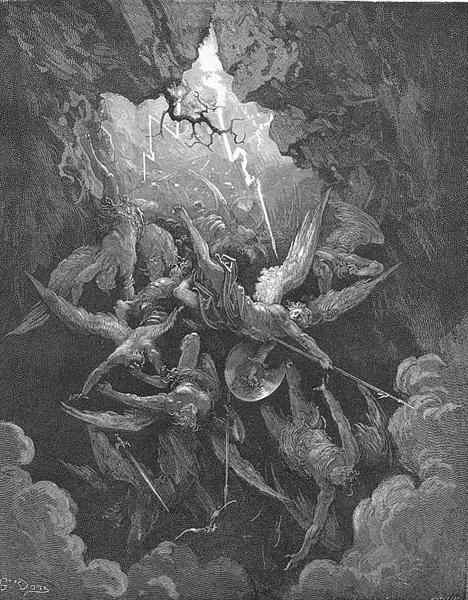
Heretics after death will be cast into hell. Steve Lawson explains further in sermon The Great White Throne Judgment

“Hell at last, Yawning, received them whole”

Gustave Dore illustrator, Paradise Lost by Milton

hell-at-last-yawning-received-them-whole.jpg!Large


~~~~~~~~~~~~~~~~~~~~~~

Further reading

Previous entries in the Word of the Week Series-

7. Orthodoxy
6. Glorification
5. Sanctification
4. Propitiation
3. Immanence
2. Transcendence
1. Justification

Posted in theology, word of the week

Sunday Word of the Week: Orthodoxy

By Elizabeth Prata

The thread of Christianity depends on a unity from one generation to the next of mutual understanding of our important words. Hence the Word of the Week.


Orthodoxy: as defined by Theopedia

The word orthodox comes from two Greek words, ortho + doxa, meaning “right opinion” or “correct thinking.”

In Christianity, it generally means adhering to the accepted or traditional historic Christian faith. Some see “orthodoxy” as that which is defined by the early ecumenical creeds which would include the Nicene-Constantinopolitan Creed, popularly known in the West as the Nicene Creed, that was formally accepted by the second Council of Constantinople in 381 A.D.

Orthodoxy as defined by CARM.org:

Orthodoxy is the belief in the standards of accepted and true doctrines taught in the Bible. That which is orthodox agrees with Biblical teaching and the interpretation of the Christian Church. False religions are not orthodox. They are heterodox.

No one person is completely orthodox because that would mean they are completely correct in all their thinking about all that God has delivered for us to know. Only Jesus was totally orthodox in His thinking.

It is also true that as we define ‘church,’ which are really only segments of the one Church, no local church is totally orthodox, though all churches in the one true Church should be as orthodox as possible. The standard is higher for churches than it is for individuals, because the Spirit dwells in the church in fuller measure. However, without right thinking in highest standard, individual churches would cease to be a segment of the divinely given organization it is called to be.

But even as we see a microcosm of churches across Asia Minor in the first century, as viewed by Jesus in Revelation, none were completely orthodox.

Now and in the past, sme churches attempt to create creeds, declaring a standard of ecumenical orthodox thinking across denominations, and this is acceptable as a method of describing orthodoxy. Others drill down the doctrines of God to essentials, to which an orthodox denomination, church, or individual must adhere, and this is acceptable too.

The mystery of orthodoxy, in my opinion, is at most, difficult to define and at worst, impossible. But the soul knows it when it see its, and rejoices, Similarly the discerning soul knows when it doesn’t see it also.

One day, all will be perfectly orthodox as Jesus claims His bride from the world, raises us to His abode, and glorifies our body. We will know as we are known, and we will no longer see through a glass darkly. We will be perfectly orthodox.

Illustrating orthodoxy is difficult but I am going to use the biblical concept of straight vs. crooked this week. Straight, of course, representing orthodox.

The way of peace they do not know, and there is no justice in their paths; they have made their roads crooked; no one who treads on them knows peace. (Isaiah 59:8)

orthodoxy 1


———————————————-

Further reading:

6. Glorification
5. Sanctification
4. Propitiation
3. Immanence
2. Transcendence
1. Justification


Posted in theology, word of the week

Word of the week: Sanctification

The thread of Christianity depends on a unity from one generation to the next of mutual understanding of our important words. Hence the Word of the Week.

c111c-word2bof2bthe2bweek2bword2bcloud

Justification is the moment that God declares us not guilty and imputes His righteousness to our account. It takes but a moment. It only takes as long as it takes the Judge to bang his gavel.

Sanctification takes the rest of our life on earth. Justification is a declaration, sanctification is a process.

Short version:

Literally refers to the process of setting something apart for a sacred purpose. In Christian theology, it denotes a doctrine concerned with the gradual purification from sin in the life of the believer and a progressive spiritual growth toward Christlikeness. ~The Lexham Glossary of Theology.

Longer version:

SANCTIFICATION Refers broadly to the concept of being set apart as sacred. In Gen 2:3, God “sanctified” the seventh day, meaning He set it apart as sacred. In Leviticus, Yahweh tells the entire people of Israel to maintain being sanctified (Lev 11:44–45). This aspect of the concept of sanctification is closely related to holiness and biblical regulations for maintaining purity.

The New Testament similarly reflects the idea that followers of Christ have been sanctified or set apart as a result of Christ’s holiness (Acts 20:32; 26:18; 1 Cor 1:30; 2 Thess 2:13). This idea that Christians have been made holy before God through their faith in Christ is related to justification. In Christian theology, a distinction is sometimes made between justification and sanctification where justification refers to having saving faith and sanctification refers to the process of gradual purification from sin and progressive spiritual growth that should mark the life of the believer.

This doctrine of sanctification draws on New Testament passages that emphasize a move toward holy and righteous living that characterizes following Christ in faith (1 Thess 4:3–8; Rom 6:19–22).  ~The Lexham Bible Dictionary.

Bullet version, with verses:

1.      Is separation to the service of God. Ps 4:3; 2 Co 6:17.
2.      Effected by
a.      God. Eze 37:28; 1 Th 5:23; Jude 1:1.
b.      Christ. Heb 2:11; 13:12.
c.      The Holy Spirit. Ro 15:16; 1 Co 6:11.
3.      In Christ. 1 Co 1:2.
4.      Through the atonement of Christ. Heb 10:10; 13:12.
5.      Through the word of God. Joh 17:17, 19; Eph 5:26.
6.      Christ made, of God, to us. 1 Co 1:30.
7.      Saints elected to salvation through. 2 Th 2:13; 1 Pe 1:2.
8.      All saints are in a state of. Ac 20:32; 26:18; 1 Co 6:11.
9.      The Church made glorious by. Eph 5:26, 27.
10.      Should lead to
a.      Mortification of sin. 1 Th 4:3, 4.
b.      Holiness. Ro 6:22; Eph 5:7–9.
11.      Offering up of saints acceptable through. Ro 15:16.
12.      Saints fitted for the service of God by. 2 Ti 2:21.
13.      God wills all saints to have. 1 Th 4:3.
14.      Ministers
a.      Set apart to God’s service by. Jer 1:5.
b.      Should pray that their people may enjoy complete. 1 Th 5:23.
c.      Should exhort their people to walk in. 1 Th 4:1, 3.
15.      None can inherit the kingdom of God without. 1 Co 6:9–11.
16.      Typified. Ge 2:3; Ex 13:2; 19:14; 40:9–15; Le 27:14–16.

~Torrey, R. A. (2001). The new topical text book: A scriptural text book for the use of ministers, teachers, and all Christian workers.

4. Propitiation
3. Immanence
2. Transcendence
1. Justification

Posted in Uncategorized, word of the week

Sunday Word of the Week: Immanence

Last week the word was Transcendence. God is apart from His creation, different from it. This week the word is Immanent or Immanence,

God’s immanence refers to His presence within His creation. (It is not to be confused with imminence, which refers to the timing of Jesus’ return to earth.) A belief in God’s immanence holds that God is present in all of creation, while remaining distinct from it. In other words, there is no place where God is not. His sovereign control extends everywhere simultaneously. Source GotQuestions

Immanence: God’s presence and activity within the creation and human history. Source: Biblical Doctrine, MacArthur/Mayhue, p 931

God is so majestic! Mysterious! How can He be both apart from His creation, and present within it?! At the same time? It shows who our God is. It’s why I chose these two words one after the other to demonstrate His essential otherness.

One other notion that is important to emphasize.

Pantheism and deism twist many people’s view of how God relates to His creation. Pantheists believe that everything is God or is a part of God, making Him equal with His creation and unable to act upon it. Deists hold that God is distinct from His creation but deny that He plays an active role in it. Contrary to these and other false views of God, the Bible says that God is both different from His creation and actively upholding it.

We must not stress His immanence at the expense of His transcendence, and vice versa.

That they should seek God, in the hope that they might feel their way toward him and find him. Yet he is actually not far from each one of us, (Acts 17:27).

Note: Modern pantheism is seen in William P. Young’s The Shack, Oprah Winfrey’s promotion of Eckart Tolle, and in Ann Voskamps’s book One Thousand Gifts as an offshoot of pantheism, panentheism. It is easy to twist both immanence and transcendence, either by direct twisting or omitting one in favor of the other. It is why it is important to learn these terms so we retain a balanced view of God.

—————————-

Sunday Word of the Week 1: Justification

Sunday Word of the Week 2: Transcendence

Posted in Uncategorized, word of the week

Sunday Word of the Week 2: Transcendence

transcendence

A theological term referring to the relation of God to creation. God is “other,” “different” from His creation. He is independent and different from His creatures (Isaiah 55:8-9). He transcends His creation. He is beyond it and not limited by it or to it.

Source unknown, found at Bible.org

Transcendence: God’s separateness or otherness from the creation and the human race.

Source Biblical Doctrine, MacArthur & Mayhue Eds

Oh, the depth of the riches and wisdom and knowledge of God! How unsearchable are his judgments and how inscrutable his ways! “For who has known the mind of the Lord, or who has been his counselor?” “Or who has given a gift to him that he might be repaid?” For from him and through him and to him are all things. To him be glory forever. Amen. (Romans 11:33-36).

For my thoughts are not your thoughts, neither are your ways my ways, declares the Lord. For as the heavens are higher than the earth, so are my ways higher than your ways and my thoughts than your thoughts. (Isaiah 55:8-9)

Can you find out the deep things of God? Can you find out the limit of the Almighty? (Job 11:7).


word of the week word cloud