My father died in 2014. He was 81. He had never said “I love you” to his daughter.
Now he never will.
It’s a truth that doesn’t get any easier the older one gets. It’s actually harder to get used to the longer one drifts in time away from his death date, not easier.
He was a hard working man. He was a gifted raconteur. He was a wealthy man. He was a lot of things. But a father? Not so much. His ignoring of his kids as they grew, his intermittent but frequent abandonment of them as adults, his final, legal disownment of them as he aged all were stunning betrayals in the lives of three children, with untold consequences.
Every daughter can tell a different story about her father. Some stories are good, some are bad. Some are neutral. Some are bitter and some are sweet. Fathers, dear reader, have an effect.
There is a short film called The Father Effect. It is good.
The producer of this movie lost his own father to suicide when he was a boy. As he stated in the movie’s Mission page, the resulting film is his attempt
to educate, equip, & encourage men to be the dads God created them to be
Many of the people with whom I am connected through media and in real life have great parents who they honor and feel blessed to have grown up under. Others have disappointing stories they share, either freely or privately. Whatever the case with you, you know fathers have an effect on you for life. I worry for the fatherless who don’t have the solace of Jesus. For those among you who have had a less than blessed childhood, but are now safely home under Jesus’ wings, you know you have a REAL father. Jesus will love you forever, never abandon you, and is in fact, perfect. What a blessing this is. He is not only as Prophet, Priest, and King, but friend, brother, and Father.
The Encouraging Dads Project was an idea that came out of John’s experience in making The Father Effect Movie. As John talked to dads from all walks of life, he heard heartbreaking stories about how dads feel beat up, discouraged, and frustrated with their lives as dads. John was moved to do something to help encourage and inspire dads and The Encouraging Dads Project was born.
Take some time to encourage your Dad. Encourage a dad. Encourage a man who was a dad to you. Encouragement is free, and only takes a few moments. Send a letter, make a phone call, send a text, make a date to take him out for coffee. Tell him how special he is to you.
Dads, do the same for your daughters. If some time has gone by since you talked to her, take a moment to let her know how much she means to you, how proud of her you are, that you love her. My dad in all probability never confessed and repented and probably died outside of Christ. It was a sudden hit in a car crash. Boom. Gone.
He and I will not meet again, and I’m sorrowful for that. Eternity will go on and I will be loved perfectly by many fathers, and THE Father. I will forget the former troubling things, including Dad. He will remember everything, forever. If there is sorrow over your relationship with your dad, if you are on opposite sides of the salvation fence, let that fact weigh on you, and as the men in The Father Effect say, forgive.
Caption: “Our purpose in making this film is to create an awareness in fathers about the significant impact their words and actions have on their children and to help them become better fathers.”
And everyone who has left houses or brothers or sisters or father or mother or children or lands, for my name’s sake, will receive a hundredfold and will inherit eternal life. (Matthew 19:29).
When the Israelites were miraculously delivered from their bondage to the Egyptians, they sang a song of praise. This is known as the Song of Moses. It’s an ode to the one True God, who is all-powerful. The Israelites, led by Moses and Aaron, knew that God was God. They knew who He is.
He is a man of war, who smites enemies. He is a God of wrath, and power, and salvation. He does wonders that make His people tremble. He is King of Kings, who dismays the kings of the earth. He is mighty. He is to be exalted.
Please read this wonderful song.
The Song of Moses, Exodus 15:1-18
“I will sing to the Lord, for he has triumphed gloriously;
the horse and his rider he has thrown into the sea.
2 The Lord is my strength and my song,
and he has become my salvation;
this is my God, and I will praise him,
my father’s God, and I will exalt him.
3 The Lord is a man of war;
the Lord is his name.
4 “Pharaoh’s chariots and his host he cast into the sea,
and his chosen officers were sunk in the Red Sea.
5 The floods covered them;
they went down into the depths like a stone.
6 Your right hand, O Lord, glorious in power,
your right hand, O Lord, shatters the enemy.
7 In the greatness of your majesty you overthrow your adversaries;
you send out your fury; it consumes them like stubble.
8 At the blast of your nostrils the waters piled up;
the floods stood up in a heap;
the deeps congealed in the heart of the sea.
9 The enemy said, ‘I will pursue, I will overtake,
I will divide the spoil, my desire shall have its fill of them.
I will draw my sword; my hand shall destroy them.’
10 You blew with your wind; the sea covered them;
they sank like lead in the mighty waters.
11 “Who is like you, O Lord, among the gods?
Who is like you, majestic in holiness,
awesome in glorious deeds, doing wonders?
12 You stretched out your right hand;
the earth swallowed them.
13 “You have led in your steadfast love the people whom you have redeemed;
you have guided them by your strength to your holy abode.
14 The peoples have heard; they tremble;
pangs have seized the inhabitants of Philistia.
15 Now are the chiefs of Edom dismayed;
trembling seizes the leaders of Moab;
all the inhabitants of Canaan have melted away.
16 Terror and dread fall upon them;
because of the greatness of your arm, they are still as a stone,
till your people, O Lord, pass by,
till the people pass by whom you have purchased.
17 You will bring them in and plant them on your own mountain,
the place, O Lord, which you have made for your abode,
the sanctuary, O Lord, which your hands have established.
18 The Lord will reign forever and ever.”
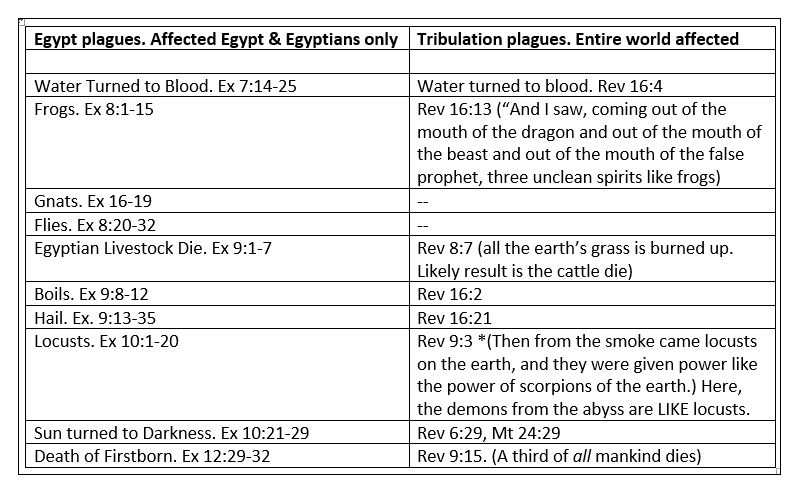
You might recall the ten plagues of Egypt that God placed on Pharaoh and his people. They were step-for-step dethronings of the Egyptian gods. God demonstrated He is the One True God with power over all the false gods the Egyptians worshiped. The plagues were also punishment for rebelling against God.
God has promised that after the rapture, when all the earth’s people who rebel against Him, from kings on down to slaves, they will be punished in wrath for their rejection of Him. (Revelation 6:15-16). At that time He will dethrone not only all false gods, but the false god of all time- satan. God will send to people of the earth plagues that are in like kind to the plagues God sent to Egypt. In Exodus, the plagues occurred just to the Egyptians. Even when the sun was darkened, the Israelites had light inside their own homes. (Exodus 10:23). Even when the Egyptian cattle died, the Israelite cattle lived. (Exodus 9:6). God is that precise.
During this post-rapture time of wrath, called The Tribulation (Or The Time of Jacob’s Trouble, Jeremiah 30:7), all the earth will be affected by these plagues. Everyone. During that time many will come to Christ and be saved, but most of the newly saved believers will be martyred. We read in Revelation, that just as the Hebrews sang the song of Moses in praise to God after their deliverance, the martyred will also sing the Song of Moses. We read this in Revelation 15:2-4
And I saw what appeared to be a sea of glass mingled with fire—and also those who had conquered the beast and its image and the number of its name, standing beside the sea of glass with harps of God in their hands. 3 And they sing the song of Moses, the servant of God, and the song of the Lamb, saying, “Great and amazing are your deeds, O Lord God the Almighty! Just and true are your ways, O King of the nations! 4 Who will not fear, O Lord, and glorify your name? For you alone are holy. All nations will come and worship you, for your righteous acts have been revealed.”
Here is a side by side comparison of the plagues of Egypt with the plagues of the tribulation, in both cases, God’s people were delivered from bondage. Click to enlarge.
Barnes’ Notes explains the parallels between the two circumstances of the singing of the song of Moses, at the commentary of Revelation 15:3,
Barnes’ Notes on the Bible And they sing the song of Moses the servant of God – A song of thanksgiving and praise, such as Moses taught the Hebrew people to sing after their deliverance from Egyptian bondage. See Exodus 15. The meaning here is, not that they would sing that identical song, but that, as Moses taught the people to celebrate their deliverance with an appropriate hymn of praise, the redeemed would celebrate their delivery and redemption in a similar manner. There is an obvious propriety here in referring to the “song of Moses,” because the circumstances are very similar; the occasion of the redemption from that formidable anti-Christian power here referred to, had a strong resemblance to the rescue from Egyptian bondage.
As does Jamieson-Fausset-Brown Bible Commentary
song of Moses … and … the Lamb—The New Testament song of the Lamb (that is, the song which the Lamb shall lead, as being “the Captain of our salvation,” just as Moses was leader of the Israelites, the song in which those who conquer through Him [Ro 8:37] shall join, Re 12:11) is the antitype to the triumphant Old Testament song of Moses and the Israelites at the Red Sea (Ex 15:1-21). The Churches of the Old and New Testament are essentially one in their conflicts and triumphs. The two appear joined in this phrase, as they are in the twenty-four elders.
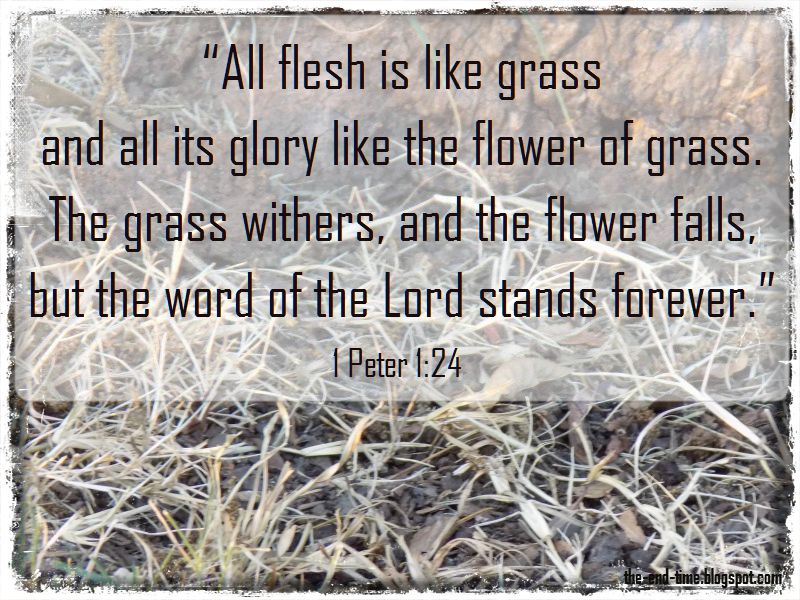
Our pastor preached on the Exodus plagues and the majesty of God this past Sunday. Our pastor has a Spirit-given talent for bringing the listener up to heights to glimpse up close the power and glory of God, which is itself if breathtaking and humbling. One becomes crushed after glimpsing Him through the exposition of scripture in sch a powerful way. After the sermon, I realized that as difficult as it is for me, who is saved, to see God as He really is (through scripture) that the lost people I know will meet Him in their own flesh. How like grass the flesh is! How they will be brought low, to wither as a match against a universal conflagration! When we ‘see’ God, we understand our own position in relation to Him, first as sinner worthy of all punishment, and then gratefully, as adopted sons and daughters of righteousness.
I recommend the sermon, if you have 40 minutes. It’s worth listening to. As for God’s work between the Old Testament and the New, from Egypt to the Tribulation-
But Jesus answered them, “My Father is working until now, and I am working.” (John 5:17)
Exodus and the Glory of God What is the book of Exodus really about? We covered the heart of the book (with a brief summary of the whole) this week. Exodus is about God’s Glory in Salvation through Judgment.
Three years ago I had an inquiry from a sister in the faith about the women of She Reads Truth and the IF:Gathering. In looking at these two organizations, which feature overlap of the ladies who participate in them, I discovered they adhere to a too-forward lifestyle, and teach an aberrant theology that’s unhealthy for women. A series resulted.
Three years later, the IF:Gathering and its women have only embedded themselves deeper into the faith and are tainting even more women with their brand of liberal theology, shaky hermeneutics, usurping lifestyles, and their idol of social justice.
Last week I received two additional, separate inquiries from women who sent me material showing why they were concerned over the IF:Gathering women. I decided to post about this para-church/social justice/liberal organization once again. I am adding new information.
The title “IF:Gathering” comes from their motto, “If God is real, then what?” The purpose statement on their IRS forms is to equip women by having them share their feelings about Bible passages posted online. I’m not joking. Here’s their IRS tax form statement of purpose: (click to enlarge)
Did you notice the ‘like-hearted‘ community? The faith is not about feelings, but about what we know about Jesus. Like-minded.
In any case, these women teach other women, usually younger, based on a foundational question that doubts God’s existence. Their entire activity is one of simply hedging bets.
The ‘gathering’ part is actually brilliant. They purport to disciple women in gatherings at homes and other locales, sometimes churches. They know where to gather through social media, which is employed in a major way. That’s why their embeddedness and vigorous activity is hidden from view and thus their danger is not readily seen. There aren’t posters, advertisements, billboards, pamphlets. etc. There’s texts, social media whispers, person-to-person promotion, all of it done in a way that is more subterranean than any other generation’s activity.
IF:Gatherings are ongoing in living rooms and lawns by the thousands. There are A LOT OF GATHERINGS. Look. This map is three years old and their gatherings are only increasing in number:
The idea to disciple women is a good one. However, that is an activity that the church is responsible for. These gatherings take place outside of the auspices of the local church and its pastoral authority.
The gatherings were born from the mind of a young woman named Jennie Allen. At the first Gathering, she revealed that she had heard God whisper to her, and after a few years decided to step out from her church to enact this so-called God-whispered “vision to gather, equip, and unleash women to live out God’s calling on their lives.” She further wrote that she-
“together with a team of friends, formally established IF:Gathering. … Some of the first friends to believe in her vision put aside their own individual ministries to leverage their collective influence for the glory of God and the good of His Church.” (Source, source).
So they abandoned their local ministries to go online for the good of the global church? Exactly wrong. Here is Jennie Allen claiming direct revelation from God as the catalyst for IF.
They abandoned their ongoing locally accountable ministries, to follow a young woman who’d heard a whisper, in order to establish Bible studies about a God they doubted existed, in order to equip women to discuss feelings about the Bible, enact social justice, reconcile the world, heal the nations, and disciple a generation. Hmmm. I’m not being satirical. All the previous verbiage is from their own statements.
I live in a rural county in Georgia with a population of about 27,000 people spread through five towns in an area of over 286 square miles. My town itself is small, about 1,113 people, and it’s the largest town in the county. And this month there are not one, but two IF gatherings in my town. IF is everywhere, pastors, leaders, and ladies!
In the first two years, our gatherings have reached more than a million women in 50 countries worldwide.
Rather than re-hash the information I’d first published three years ago, I’ll simply offer some new information. First I’ll list some bullet points of concern. Then I’ll post lists of speakers who are involved with IF. Lots of links throughout.
Basic concerns with IF:Gathering:
Founded on Direct Revelation: Founder Jennie Allen said she heard a whisper from God telling her to start a discipleship group. (source, also see above). Direct revelation is hazardous to one’s soul. If you test a direct, audible command from God against the Bible and it’s there, you do not need the audible command. If it is not there, it’s a lie and you don’t need it anyway.
Doubting God: The premise itself is based on study of a God those gathered doubt exist. IF God is real? Doubt is not noble. The Bible says doubt is a destroyer of life. (James 1:5-8).
Lack of male oversight and involvement: Jennie’s husband Zac says he provides theological oversight, but he is listed as working only 10 hours per week at the 501(c) 3 non-profit, and the only other males on the Governing Board are Larry Cotton, who is listed as working 1/hour week and Treasurer Jonathan Harper, who is also listed as a 1-hour a week. The 40-hour/weeks are put in by Jennie and Lindsey. It’s Jennie’s baby, she is listed as Principal Officer on the tax forms. It’s led by Lindsey Nobles who’s listed as CEO. In fact it operates as a para-church organization with little local accountability and pastoral oversight.
IF:Gathering IRS tax return year ending 2015. Source Guidestar
The IF:Gathering’s premise is flawed and so are its goals. Again, from their IRS form, it states that their goals are to foment a ‘global movement’ that ‘promotes healing around the world’. Is that what the Bible says women are to do? Unleash movements? These women are mothers. With children at home. The Bible tells us what we are to do: raise the kids, support the husband. Did even Jesus come to promote healing around the world? And just what IS “healing”, anyway? More on that just below.
Goals are postmodern and extra-biblical: As Tim Challies said, the words reconciliation and healing have a different meaning to the postmodernist liberal than they do to the Christian fundamentalist:
“…perverts the Biblical meaning of “reconciliation.” The Bible does not use this word arbitrarily, but speaks of the reconciliation of man to God and how this can be accomplished. It speaks of redemption! Salvation! Our ministry of reconciliation is not relational healing of myself to my neighbor (right and good as that may be), but the far more important relational healing of a sinful man to a holy God.
The ‘reconciliation’ the IF-ladies mean is the latter, promoting relational healing. Hence their emphasis on feelings and their activity of social justice.
Very good critique from Lighthouse Trails on IF:Gathering. Please read.
Ann Voskamp. Does she even know how to use the English language anymore? Below is a recent tweet. I thought teachers were supposed to be ‘able to teach’. (2 Timothy 2:24). Being able to teach presumes a facility with the language so as to communicate truths in a way that will edify the hearer. Voskamp’s gone beyond #babble all the way to to #Babel.
The remaining list of IF speakers and participants was sent to me by a concerned sister, which I appreciate. I am familiar with many of the women, and I’m unfamiliar with several. I’ve used the links sent to me and also added links and statements from their own bios where applicable. As always, do your diligence and research yourself.
Jenny Yang (self-described “visionary who works on behalf of refugees as the Vice President of Advocacy & Policy at World Relief.” AKA social justice).
Jeanne Stevens: self-described teacher who urges women to “take any opportunity to encourage people to live boldly from the fullest part of themselves”. Rather than die to self and live in the strength of the Spirit? Jeanne is also a Female Pastor -Co-Pastor of Soul City Church with her husband.
B. David Smith: (“B. David loves helping people cultivate their artistic potential and use their gifts, voice, and lifestyle to create God encounters”. What does that even mean?)
Tann Smith (Singer at Andy Stanley’s North Point Church. Need I say more.)
Angie Smith (“Her greatest passion is to make the Bible feel accessible and relevant”. Again with feeling the Bible and not studying/knowing/believing)
Roce Anog (“helps people who don’t speak the majority language to express their worship to God with the use of music, art, dance, storytelling, and food”. So she helps people learn about God through dancing and food? Nope. 1 Corinthians 8 has something to say about that.)
Amena Brown (poetess, which is cool. vision-caster, not cool. Friend to Louie Giglio and Passion conference. Uncool.)
Jo Saxton (Female Pastor. A director of yet another ‘movement’ whose goal is “to CHANGE the world by putting DISCIPLESHIP and MISSION back into the hands of everyday people.” Emphasis theirs. I guess ordinary people haven’t been living and dying for the Gospel these last 2000 years.
Keisha Polonio (helps leaders of Tampa’s microchurches)
Latasha Morrison (“justice fighter, a bridge builder and a champion of people. Through the work of her non-profit Be the Bridge, she is fostering healthy dialogue around the topic of race.” Just like Lydia, Esther, Mary and the Proverbs 31 woman. Oh wait.)
Britt Merrick (pastor, surfer, founder of Reality Churches (multi-campus)
IF God is real, then what? IF:Gathering Hath God said? Satan, Genesis 3:3
I hope any of this information helps you. IF gatherings are occurring every day in living rooms and lawns near you. No town is too small, too rural, too citified or too sophisticated to host an IF:table. The brand of Christianity the women promote is far from the Bible’s due to their emphasis on social causes, feminist living (i.e, gallivanting off to Africa while the kids languish at home), doubting God, and discussing their feelings. I pray you protect your daughters and granddaughters from any and all IF activities.
Chris Powers is creating visual resources for the global church. His resources are free and meant to be shared. Chris creates tract cards, visual exegesis that can be shared separately or through his book Visual Exegesis Vol. 1, study guides and lessons, animations, and more. Please visit his website at fullofeyes.com. He is also on Patreon, and you can donate to his ministry just once or on a recurring basis. He needs $2,000/month to be self-sustaining, and currently the level of giving is $1,947. Won’t you consider being the patron who puts him over the top?
Thank you for reading and if you’re led, sharing his work and/or giving.
Here’s Chris’ explanation of the drawing:
This verse picture is drawn from John 8:28 which has HUGE implications for our understanding of God….essentially, Jesus says that His divine identity will be made known to the world WHEN He is lifted up on the cross.
John 8:28, “When you have lifted up the Son of Man, then you will know that I am He…”
When Jesus says that He’s the Light of the World in John 8:12, I think we are to understand that most primarily as Him being the one who communicates God to the world. Why do I say this? Because in John 1:4, we are told that the (eternal) life that has forever been in the Son is the “light” of mankind. So there we see eternal life and light linked.
Well, what is eternal life? Jesus defines that for us in John 17:3, it is to know the only true God and to know Jesus (which, as John 8:19 or 14:9 make clear, is not knowledge of two different beings, but to know Jesus rightly IS to know God). So, eternal life is to know God, and this knowledge of God–John 1:14 says–is the light of mankind / the light of the world.
This is why I say for Jesus to be the “Light of the World” means that He is the revelation of God to humanity. He is the one who communicates God to us. And in John 8:28, Jesus is saying that we will know Him most perfectly as this revelation of God when He is lifted up on the cross….that is where we will know that He is “I Am” (the “he” is added in English texts, the Greek simply says “εγώ ειμι” which is the wording that you’ll find in the Greek Old Testament’s recounting of Moses meeting YHWH at the burning bush (Exodus 3:14).
So–as I hope I will never tire of saying–if we want to know God, we look to His Son, and if we want to know the Son, we look most definitively to the climactic work of revelatory redemption: the crucifixion and resurrection of Jesus Christ.
35 But someone will ask, “How are the dead raised? With what kind of body do they come?” 36 You foolish person! What you sow does not come to life unless it dies. 37 And what you sow is not the body that is to be, but a bare kernel, perhaps of wheat or of some other grain. 38 But God gives it a body as he has chosen, and to each kind of seed its own body. (1 Corinthians 15:35-38).
An Israeli company named ReWalk has developed a ‘hard ‘exoskeleton’ that aids parapalegics in standing and walking upright. The company has also developed a soft exoskeleton that aids people who have not severed their spinal cord to walk, such as people who have suffered a stroke or other debilitating injury.
The body is amazing. It’s intricate, delicate, and fragile, yet strong, tough, and resilient. As I age, I am more amazed at the changes the body goes through. Some of it is preventable, (weight gain) some of it is not (menopause). Some of it is inevitable (general decline) some of it is not (I can always dye my white hair!).
I lived through the health-conscious aerobic 1980s. I had some friends who were fiends for exercise, and ALL they talked about was looks. They were older than me and they were excessively worried about breast droop, loss of youthful appearance, which clothing made them look younger, and all the things that aging women with nothing else to say grouse about.
I’ve never been especially worried about looks but I am dismayed by my declining energy, tired eyes, loss of skin elasticity, and legs that can’t kick as high as they used to.
How blessed I am to be able to look forward to my new body in heaven! Thanks to the Lord’s grace and gift, I will be outfitted with a permanent body able to dwell in God’s glory. I’ll be strong, perfectly able to do what is necessary to live out God’s plan for my life. My long, long life.
Our associate pastor is a paraplegic and he is looking forward to a new body also. Many friends in church and at work who suffer from ailments from life threatening (such as cancer) to the more minor but painful (migraines) are also looking forward to new bodies. What a joy it will be to have flesh that won’t be susceptible to disease, breakage, or decline!
I wonder what my new body will look like. The Bible says we will know as we are known, so my friends who will be there with me will know me. I don’t suppose I’ll look very different, though I know I won’t have to wear glasses any more. And the crowns and fillings in my teeth will be gone.
Just as we have borne the image of the earthy, we shall also bear the image of the heavenly (1 Corinthians 15:49).
Here is John MacArthur with a short essay on Our New Bodies. It is only one of a million-billion reasons why we look forward to the return of Jesus as our blessed Hope!
A common rebuttal to the doctrine of God’s sovereignty in salvation by people who insist that man can “choose Jesus” is the statement,
“God is a gentleman and would never force Himself on anyone.”
This statement is supposed to support the notion that man can enact salvation for himself by ‘accepting Jesus’ or some such notion. God might make it available, enticing, even, but ultimately, we choose.
Not so.
I wrote about God’s sovereignty in salvation in 2015, rebutting the ‘God is a gentleman’ notion, here:
Today I want to look at other cases besides salvation where God is certainly not a ‘gentleman’ (a foolish statement anyway, because God is God and not man, even a gentle man).
So I ask the question, using reverse logic, if God is a gentleman and never forces someone to convert, then why is He not a gentleman in these situations?
The spirit:
So the God of Israel stirred up the spirit of Pul king of Assyria, the spirit of Tiglath-pileser king of Assyria, and he took them into exile, namely, the Reubenites, the Gadites, and the half-tribe of Manasseh, and brought them to Halah, Habor, Hara, and the river Gozan, to this day. (1 Chronicles 5:26).
The king’s heart is a stream of water in the hand of the LORD; he turns it wherever he will. (Proverbs 21:1).
The heart:
But the Lord hardened the heart of Pharaoh, and he did not listen to them, as the Lord had spoken to Moses. (Exodus 9:12).
for God has put it into their hearts to carry out his purpose by being of one mind and handing over their royal power to the beast, until the words of God are fulfilled. (Revelation 17:17).
The mind:
As Samuel was offering up the burnt offering, the Philistines drew near to attack Israel. But the LORD thundered with a mighty sound that day against the Philistines and threw them into confusion, and they were defeated before Israel. (1 Samuel 7:10).
God can and does intervene in man’s affairs. He governs man’s spirit, man’s mind, and man’s heart. He does so in man’s life, his salvation, and his death. God is God and there is no other.
I will extol you, my God and King,
and bless your name forever and ever.
2 Every day I will bless you
and praise your name forever and ever.
3 Great is the Lord, and greatly to be praised,
and his greatness is unsearchable.
Psalm 145:1-3
Mail call is a big deal (at least it was on M*A*S*H)
We love Jesus and we’re so encouraged when a new Christian or a friend who is older but growing obviously develop fruit of the Spirit. However we also grieve when friends or new Christians go the other direction and begin to stray. One way they stray is by following false teachers. I can’t describe the heartache when I see friends post quotes from false teachers, or when they gush about a Bible ‘study’ that was written by someone who is not to be consumed. It hurts. We are all one body and we want the best for our brethren. False teachers are not the best. They are the worst.
What can we do when we see a friend beginning to be drawn away? They buy the false teacher’s books, they talk about what they ‘learned’ from the false teacher, they start attending a small group of this false teacher’s studies… what can we do?
First, remember we are to be wise as serpents and harmless as doves. (Matthew 19:16). In this case, it means we are wise to the schemes of satan. One of his schemes is to send false teachers. We are aware of the danger they pose and we do not minimize it nor ignore it.
But in dealing with our friend we are to be harmless, innocent, kind, and gentle. Harmlessness does not mean gullibility, but it does mean tact.
When Jesus told the Twelve to be as wise as serpents and harmless as doves, He laid down a general principle about the technique of kingdom work. As we take the gospel to a hostile world, we must be wise (avoiding the snares set for us), and we must be innocent (serving the Lord blamelessly). Jesus was not suggesting that we stoop to deception but that we should model some of the serpent’s famous shrewdness in a positive way. Wisdom does not equal dishonesty, and innocence does not equal gullibility.
Nineteenth-century pastor Charles Simeon provides a wonderful comment on the serpent and dove imagery: “Now the wisdom of the one and the harmlessness of the other are very desirable to be combined in the Christian character; because it is by such an union only that the Christian will be enabled to cope successfully with his more powerful enemies” (Horae Homileticae: Matthew, Vol. 11, London: Holdsworth and Ball, p. 318).
In Matthew 10:16, Jesus taught us how to optimize our gospel-spreading opportunities. Successful Christian living requires that we strike the optimal balance between the dove and the serpent. We should strive to be gentle without being pushovers, and we must be sacrificial without being taken advantage of. (Source GotQuestions)
With that basis, I’d like to offer a few ideas. These are by no means exhaustive. Please comment below with your own success stories of how to engage a friend who is following a false teacher.
I like to ask questions. I ask them in a friendly way what they are getting out of it, or why they enjoy the teacher, or what the study is showing them. If the particular teacher has demonstrated unrepentant disobedience, I might ask them about it and ask if that changes their view of what and how the teacher is teaching them. For example, Christine Caine functions as a self-stated ordained pastor and teaches women that it is OK to step into leadership roles reserved for men. You could ask your friend what she thinks of this. Your friend’s answer could illuminate the direction in which your discussion could go.
If she is unaware that there are some roles reserved for men and others for women, you could explain this to her from the Bible. If she disagrees, then you know from whence her attraction to Caine or the certain teacher is coming from. If she was simply unaware and now agrees, then she’ll likely go away from false teachers who teach opposite to what the Bible says regarding roles, and you have won your sister.
Brothers, if anyone is caught in any transgression, you who are spiritual should restore him in a spirit of gentleness. Keep watch on yourself, lest you too be tempted. (Galatians 6:1).
If the friend is open to these initial probes, I ask if I might share how the false teacher strays from the Word. It is one thing to warn, but it’s more helpful to show how to think about the Word of God and how to compare what a teacher is teaching to the Bible than it is just to say “She’s false.”
For example, Beth Moore relies on personal visions and revelations, and you could show your friend about the canon, why it’s closed, and the true meaning of Paul really meant when he admonished not to despise prophesying. (1 Thessalonians 5:20-21).
It is also good to offer alternatives. Nature abhors a vacuum. The person presumably wants to study the word, and if they desire to study it in Spirit and in truth (John 4:24) then they will want the better option. God knows how to give good gifts.
If you, then, though you are evil, know how to give good gifts to your children, how much more will your Father in heaven give good gifts to those who ask him! (Matthew 7:11)
So then I ask if they are open to receiving some solid material written by good Bible teachers. I accumulate books and CDs and booklets and pamphlets and links, and cache them in my bookcase set aside for the purpose of givine them away when the appropriate moment comes. When the time comes, I just give them the book/essay/CD etc. If I just suggest to them to go buy or acquire a certain resource, they will likely not do it. Sometimes they do. But not usually. I put the material in their hand (or electronic message box) and I have it on hand so I can do it quickly.
We are a discipling body. Christianity is not solitary. Lambs always have a mama sheep nearby. Be involved with the weaker ones, the new ones, the strong ones. Everyone. You could invite the friend to study with you (and your wife if you are a male leader or elder speaking to a woman) or invite him or her come to a group you’re involved with. Personal discipleship and establishing a trusting relationship works wonders.
Pray. Of course this is the best solution, the Spirit knows.
praying at all times in the Spirit, with all prayer and supplication. To that end, keep alert with all perseverance, making supplication for all the saints, (Ephesians 6:18).
Asking the Lord to deliver a sister from the clutches of a false teacher is a wonderful supplication.
Andy Stanley, megachurch pastor and son of noted pastor Charles Stanley, said of the virgin birth, this past December,
A lot of people just don’t believe it. And I understand that. Maybe the thought is, ‘Hey, maybe they had to come up with some myth about Jesus to give him street cred, you know, later on.’ Maybe that’s where that came from.
It’s interesting, because Matthew gives us a version of the birth of Christ, Luke does, but Mark and John – they don’t even mention it. A lot has been made of that….
You’ve heard me say some version of this a million times, so this will be old if you’ve been around for a while. But see, if somebody can predict their own death and then their own resurrection, I’m not all that concerned about how they got into the world.
I was not surprised that Andy Stanley said what he said about the virgin birth. Though S. Lewis Johnson reminds us that the miracle was the conception, the birth itself was bloody, messy, and like every other birth in history. After I heard him preach it, I never thought about the virgin birth the same way again!
In any case, Andy Stanley continues to deny our fundamental doctrines (I’ve kept track and there are may doctrines he denies). The way his church treats worship tells us this, too. Just last month he had go-go dancers as part of the singing.
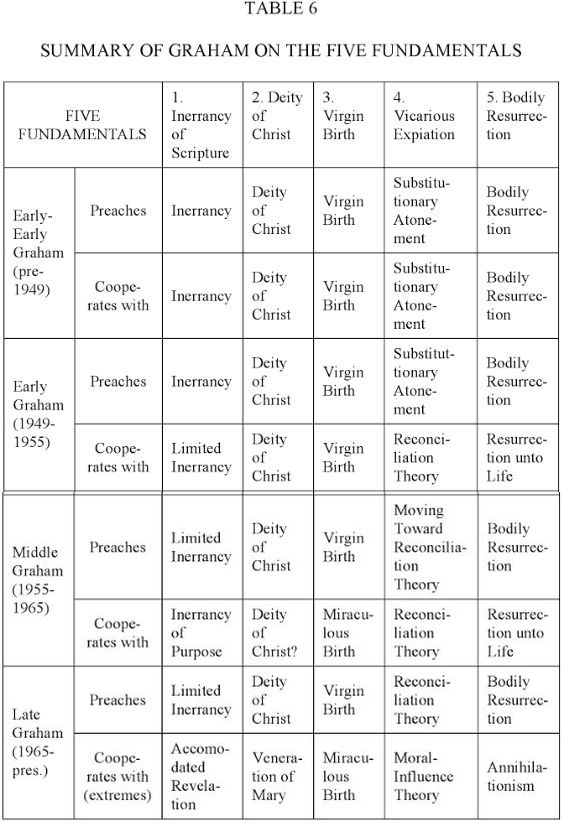
It is not possible either to deny the virgin birth yet accept Christ as holy, sinless deity. When Stanley made his statement, there was quite rightly a hullabaloo over it. However, Stanley is not the first pastor claiming to be conservative who denies the virgin birth as necessary to the faith. Billy Graham also denies the necessity of belief in the virgin birth. Yet there is no hullabaloo over Graham’s denial but only excuses made for his ‘misstatements.’
In my thorough study of Graham, which encompassed listening to sermons from 1949 through to the 1980s, reading several of his books, reading books about him, listening to interviews, and reading two dissertations looking at the evolution of his theology over Graham’s 50 active years, the conclusion is clear to me. In 1993 Graham said to Time Magazine (as codified in Ken Garfield’s book Billy Graham, a Life in Pictures, of the virgin birth specifically,
Graham has said that the virgin birth of Christ is NOT an essential part of the Christian faith. In an interview with a United Church of Canada publication in 1966 (“Billy Graham Answers 26 Provocative Questions,” United Church Observer, July 1, 1966), Graham gave the following reply to a question about the virgin birth of Christ:
Q. Do you think a literal belief in the Virgin birth — not just as a symbol of the incarnation or of Christ’s divinity — as an historic event is necessary for personal salvation? A. While I most certainly believe that Jesus Christ was born of a virgin, I do not find anywhere in the New Testament that this particular belief is necessary for personal salvation.
Graham denied the necessity of the virgin birth not just once but several times in different decades. Graham’s response was a classic example of his penchant for doubletalk. Is there any other kind of salvation, besides the personal? Is there global salvation? Impersonal salvation?
And if we use his silly statement as the basis, “I don’t find anywhere in the New Testament” …we can also say “I don’t find anywhere in the New Testament any specific reference to the Trinity” so therefore “belief in the Trinity is not necessary to personal salvation”.
If Christ be not the virgin-born Son of God, He could not be our Savior. To reject the doctrine of the Virgin Birth is to reject the only Sinless Savior that God has provided for sinners.
Of course Graham’s denial of Jesus as the exclusive way to God, as seen in his adoption of the wider mercy approach, was articulated clearly and affirmed with questioning, at Robert Schuller’s Crystal Cathedral interview in 1997, displays Graham’s saddest denial of all.
As mentioned above, Stanley is not the first impostor to preach that believing the virgin conception is unnecessary as a part of the fundamental beliefs for the faith, Graham got there long before Stanley did.
There are five fundamentals of the faith which are essential for Christianity-
1. The Deity of our Lord Jesus Christ (John 1:1; John 20:28; Hebrews 1:8-9).
2. The Virgin Birth (Isaiah 7:14; Matthew 1:23; Luke 1:27).
3. The Blood Atonement (Acts 20:28; Romans 3:25, 5:9; Ephesians 1:7; Hebrews 9:12-14).
4. The Bodily Resurrection (Luke 24:36-46; 1 Corinthians 15:1-4, 15:14-15).
5. The inerrancy of the scriptures themselves (Psalms 12:6-7; Romans 15:4; 2 Timothy 3:16-17; 2 Peter 1:20).
The fact is, Jesus told us wolves will come in sheep’s clothing. This means they will appear as friendly and soft-spoken. They will seem to adhere to the Bible’s truths, but they are inside ravenous for your soul. Wolves subtly deny God, just as satan did in the Garden. An excellent example of this subtlety is Graham’s statement “I do not find anywhere in the New Testament that this particular belief is necessary for personal salvation. Be wary, friends. Even popular pastors can be wolves. As a matter of fact, especially popular pastors can be wolves.
Jesus was not born in sin; that is, He had no sin nature (Hebrews 7:26). It would seem that the sin nature is passed down from generation to generation through the father (Romans 5:12, 17, 19). The Virgin Birth circumvented the transmission of the sin nature and allowed the eternal God to become a perfect man.
The virgin birth is an underlying assumption in everything the Bible says about Jesus. To throw out the virgin birth is to reject Christ’s deity, the accuracy and authority of Scripture, and a host of other related doctrines central to the Christian faith. No issue is more important than the virgin birth to our understanding of who Jesus is.
Filmmakers are always looking for fodder to make their productions and of late they have discovered the narratives in the Bible. Since the people writing and producing these movies and shows are not saved, of course they get it wrong. This is because In their case the god of this world has blinded the minds of the unbelievers, to keep them from seeing the light of the gospel of the glory of Christ, who is the image of God. (2 Corinthians 4:4).
In the recent series The Bible, there came a moment when Shadrach, Meshach, and Abednego were faced with a decision. Would they bow to a false god statue, or would they stand for Yahweh, thus losing their lives (as Nebuchadnezzar had aid those who disobey his decree to bow will die, Daniel 3:6).
It’s a dramatic moment when you see it in full visual force. Look, here is the clip:
It is not so dramatic when you hear it though. First, read what the men really said, from the real Bible. It is all from Daniel 3. That’s the first part of the lesson- always compare to scripture.
Shadrach, Meshach, and Abednego answered and said to the king, “O Nebuchadnezzar, we have no need to answer you in this matter. 17If this be so, our God whom we serve is able to deliver us from the burning fiery furnace, and he will deliver us out of your hand, O king. 18But if not, be it known to you, O king, that we will not serve your gods or worship the golden image that you have set up.”
The pagan man always seeks to elevate man and diminish God. See how the writers put very different words in the mouths of the three men when they answered to King Nebuchadnezzar.
[Azariah] With all our hearts we follow you. We seek your presence. With all my heart I follow you. I fear you. I seek your presence. Lord hear my cry, though death entangle me, though the anguish of the grave consumes me, do not ignore my tears, I’m overcome by sorrow. I call upon the name of the Lord. Lord save me! Hear my prayer, oh Lord. Hear my cry.
The prayer of the men were self-centered, not God centered. There is a big difference between ‘I will not serve your gods’ and ‘Lord, I seek your presence!’ In the Bible the men accepted the consequence of their fate, because as long as glory was being given to honor God they were satisfied. The TV show could not be more opposite to the actual statement the men made in the real Bible. That’s the second part of the lesson. Once you compare what you’ve read or heard to scripture, test it to see if it gives glory to God only and aligns with His character.
God decided to manifest a miracle in the fire and He saved the men. In the TV show, since the men had prayed to be saved, when they were saved, it looked like it was their own prayer that saved them rather than the sovereignty and power of God.
In the TV show, when the men were delivered from the fire, they emerged declaring “God is with us! People of Judah, rise!” Again, ‘me’-centered.
In the real Bible, honor to God in the highest was given by Nebuchadnezzar.
The hair of their heads was not singed, their cloaks were not harmed, and no smell of fire had come upon them. 28 Nebuchadnezzar answered and said, “Blessed be the God of Shadrach, Meshach, and Abednego, who has sent his angel and delivered his servants, who trusted in him, and set aside[f] the king’s command, and yielded up their bodies rather than serve and worship any god except their own God. 29 Therefore I make a decree: Any people, nation, or language that speaks anything against the God of Shadrach, Meshach, and Abednego shall be torn limb from limb, and their houses laid in ruins, for there is no other god who is able to rescue in this way.” (Daniel 3:27b-29)
I mention this because the scene where the men do not bow, and the scene where the men are delivered in the furnace are well done and moving. In between, though, when the people speak, it is not with Bible words and a humble God-centeredness.
The point here is, do not let emotion cloud your judgment when you absorb non-biblical material. You will most likely be emotionally manipulated when you read a book written by a non-Christian, (The Shack was well done and emotionally engaging for the first 70 pages) or a movie. The scenes in The Bible are moving and close enough to the Bible, but close enough is not good enough. Be wary of letting emotion override the truth with any material you watch or read. Besides, the real word of God is emotional enough!
God is sovereign of the entire universe. He plans what he plans and He does what he pleases.
Our God is in the heavens; he does all that he pleases. (Psalm 115:3).
It’s admittedly hard to understand how God can and does orchestrate all events at once, constantly, over the earth and throughout the stars, so that His plans providentially combine in perfect harmony to enact His will. But He is God and we’re not supposed to understand it! It is also hard to understand how our personal decisions are still personal but also are part of His will and plan and the outcome is predetermined. That our decisions are our own yet are part of a pre-ordained plan that all leads to the cross and beyond is a tension our finite minds can’t comprehend. It is a joy to ponder them though, because in so doing, we come up against God’s power, omniscience, and will.
Here are two things to consider when looking at God’s providence and will, with our decisions and will.
Esther
The book of Esther was not written by Esther but it is about Esther, her Hebrew name was Hadassah. She lived during the time of King Ahasuerus of Persia, also known as King Xerxes. Through a series of providential events, Esther wound up as Queen to Ahasuerus and also was put in a position to save her people. However the saving of her people was at dire risk to her own life. She was discussing what to do with her uncle Mordecai, and Mordecai famously said,
“For if you keep silent at this time, relief and deliverance will rise for the Jews from another place, but you and your father’s house will perish. And who knows whether you have not come to the kingdom for such a time as this?” (Esther 4:14).
Esther could make her own decision. She could risk her life and go in to the King, or she could stay in the harem and not go to the King. Mordecai knew God’s character well enough to know that His promise to keep a remnant of His people alive would indeed happen, whether Esther decided to participate at this particular moment or not. God would keep His promise no matter what Esther decided. The choice was hers. Esther decided to go in and speak to the King even though he had not called for her (usually this meant death). We know the rest, Esther’s action revealed to the King the evil deeds of Haman and Haman was killed instead of the Jews.
Jael
Jael was the wife of Heber the Kenite. Sisera had been cruelly oppressing the Hebrews for 20 years. The people cried out. Deborah was civic leader at that time, prophesying and judging. She sent for Barak, the military leader and told him to go take care of the problem. Barak could freely decide what to do. He could go or he could not go, the choice was his. He said he would not go unless Deborah came with him. (Judges 4:8). His answer was in effect, no. Deborah replied that she would go with Barak, but it would be an embarrassment to him because God would deliver Sisera into the hands of a woman, and Barak would not get the military glory for the victory.
Barak freely made his choice, but now the outcome would occur from another quarter, just as Mordecai had said it would if Esther decided against her action.
Into the story enters Jael. After Barak routed Sisera’s army, Sisera fled. Sisera aimed toward the tent of Heber the Kenite. Sisera knew there was peace between Jabin the king of Hazor (Sisera’s King) and the house of Heber the Kenite. Heber had separated from the Kenites and was settled far from the action. Sisera ran, believing he was safe to go toward the area where there was no fighting and where there was peace between the parties. Normally he would be right, especially since hospitality customs were so strong in protecting those who are invited into the tent. However in this providential case, Sisera was wrong. Jael invited Sisera into the tent, gave him drink, and covered him as he fell asleep.
Note that Sisera fell asleep. He had a hard day of fighting, but even though his life was in peril he felt comfortable enough where he let down his guard and fall asleep. Women in those days were responsible for pitching the tents and so Jael was strong enough and familiar enough with how to efficiently hammer a tent peg into the ground. As Sisera slept, she drove a tent peg into his temple and pinned his head to the ground. The verse succinctly states, “So he died.” (Judges 4:21b).
And behold, as Barak was pursuing Sisera, Jael went out to meet him and said to him, “Come, and I will show you the man whom you are seeking.” So he went in to her tent, and there lay Sisera dead, with the tent peg in his temple. 23So on that day God subdued Jabin the king of Canaan before the people of Israel. (Judges 4:22-23).
Barak had kind of said “I will go” but not really. Placing conditions on your obedience isn’t really obedience to God. I like how the verse says God subdued Jabin.
Whether Esther went in or didn’t go in, God would deliver the Jews from Haman. Whether Barak went to battle or didn’t go to battle, God would deliver the Jews from King Jabin and Commander Sisera. Both Esther and Barak freely decided on a course of action. Yet both outcomes occurred at the providential hand of God.
God is amazing.
Anonymous.
Jael and Sisera
pen drawing — c. 1440 – 1450
Museum Herzog Anton Ulrich Museum, Braunschweig. The name of the drafter is not known. He is thought to be someone close to Van Eyck and his workshop. Source: Art and the Bible