Posted in discernment, Uncategorized

Mail Call #5: My friend is following a false teacher

Mail call is a big deal (at least it was on M*A*S*H)

We love Jesus and we’re so encouraged when a new Christian or a friend who is older but growing obviously develop fruit of the Spirit. However we also grieve when friends or new Christians go the other direction and begin to stray. One way they stray is by following false teachers. I can’t describe the heartache when I see friends post quotes from false teachers, or when they gush about a Bible ‘study’ that was written by someone who is not to be consumed. It hurts. We are all one body and we want the best for our brethren. False teachers are not the best. They are the worst.

What can we do when we see a friend beginning to be drawn away? They buy the false teacher’s books, they talk about what they ‘learned’ from the false teacher, they start attending a small group of this false teacher’s studies… what can we do?

First, remember we are to be wise as serpents and harmless as doves. (Matthew 19:16). In this case, it means we are wise to the schemes of satan. One of his schemes is to send false teachers. We are aware of the danger they pose and we do not minimize it nor ignore it.

But in dealing with our friend we are to be harmless, innocent, kind, and gentle. Harmlessness does not mean gullibility, but it does mean tact.

When Jesus told the Twelve to be as wise as serpents and harmless as doves, He laid down a general principle about the technique of kingdom work. As we take the gospel to a hostile world, we must be wise (avoiding the snares set for us), and we must be innocent (serving the Lord blamelessly). Jesus was not suggesting that we stoop to deception but that we should model some of the serpent’s famous shrewdness in a positive way. Wisdom does not equal dishonesty, and innocence does not equal gullibility.

Nineteenth-century pastor Charles Simeon provides a wonderful comment on the serpent and dove imagery: “Now the wisdom of the one and the harmlessness of the other are very desirable to be combined in the Christian character; because it is by such an union only that the Christian will be enabled to cope successfully with his more powerful enemies” (Horae Homileticae: Matthew, Vol. 11, London: Holdsworth and Ball, p. 318).  

In Matthew 10:16, Jesus taught us how to optimize our gospel-spreading opportunities. Successful Christian living requires that we strike the optimal balance between the dove and the serpent. We should strive to be gentle without being pushovers, and we must be sacrificial without being taken advantage of. (Source GotQuestions)

With that basis, I’d like to offer a few ideas. These are by no means exhaustive. Please comment below with your own success stories of how to engage a friend who is following a false teacher.

I like to ask questions. I ask them in a friendly way what they are getting out of it, or why they enjoy the teacher, or what the study is showing them. If the particular teacher has demonstrated unrepentant disobedience, I might ask them about it and ask if that changes their view of what and how the teacher is teaching them. For example, Christine Caine functions as a self-stated ordained pastor and teaches women that it is OK to step into leadership roles reserved for men. You could ask your friend what she thinks of this. Your friend’s answer could illuminate the direction in which your discussion could go.

If she is unaware that there are some roles reserved for men and others for women, you could explain this to her from the Bible. If she disagrees, then you know from whence her attraction to Caine or the certain teacher is coming from. If she was simply unaware and now agrees, then she’ll likely go away from false teachers who teach opposite to what the Bible says regarding roles, and you have won your sister.

Brothers, if anyone is caught in any transgression, you who are spiritual should restore him in a spirit of gentleness. Keep watch on yourself, lest you too be tempted. (Galatians 6:1).

If the friend is open to these initial probes, I ask if I might share how the false teacher strays from the Word. It is one thing to warn, but it’s more helpful to show how to think about the Word of God and how to compare what a teacher is teaching to the Bible than it is just to say “She’s false.”

For example, Beth Moore relies on personal visions and revelations, and you could show your friend about the canon, why it’s closed, and the true meaning of Paul really meant when he admonished not to despise prophesying. (1 Thessalonians 5:20-21).

It is also good to offer alternatives. Nature abhors a vacuum. The person presumably wants to study the word, and if they desire to study it in Spirit and in truth (John 4:24) then they will want the better option. God knows how to give good gifts.

If you, then, though you are evil, know how to give good gifts to your children, how much more will your Father in heaven give good gifts to those who ask him! (Matthew 7:11)

So then I ask if they are open to receiving some solid material written by good Bible teachers. I accumulate books and CDs and booklets and pamphlets and links, and cache them in my bookcase set aside for the purpose of givine them away when the appropriate moment comes. When the time comes, I just give them the book/essay/CD etc. If I just suggest to them to go buy or acquire a certain resource, they will likely not do it. Sometimes they do. But not usually. I put the material in their hand (or electronic message box) and I have it on hand so I can do it quickly.

We are a discipling body. Christianity is not solitary. Lambs always have a mama sheep nearby. Be involved with the weaker ones, the new ones, the strong ones. Everyone. You could invite the friend to study with you (and your wife if you are a male leader or elder speaking to a woman) or invite him or her come to a group you’re involved with. Personal discipleship and establishing a trusting relationship works wonders.

Pray. Of course this is the best solution, the Spirit knows.

praying at all times in the Spirit, with all prayer and supplication. To that end, keep alert with all perseverance, making supplication for all the saints, (Ephesians 6:18).

Asking the Lord to deliver a sister from the clutches of a false teacher is a wonderful supplication.

~~~~~~~~~~~~~~~~~~~~~

Some resources that might help–

Here is the Gospel Coalition’s essay 7 marks of a false teacher

Here is John MacArthur’s sermon How to treat a false teacher part 1

Here is 9Marks with How I Select and Schedule Discipling Relationships

Another Christian sister who answered the same question way better than I did! Help! My friend follows false teachers
Posted in discernment, Uncategorized

Andy Stanley, Billy Graham, and the Bible on the virgin birth

Andy Stanley, megachurch pastor and son of noted pastor Charles Stanley, said of the virgin birth, this past December,

A lot of people just don’t believe it. And I understand that. Maybe the thought is, ‘Hey, maybe they had to come up with some myth about Jesus to give him street cred, you know, later on.’ Maybe that’s where that came from.

It’s interesting, because Matthew gives us a version of the birth of Christ, Luke does, but Mark and John – they don’t even mention it. A lot has been made of that….

You’ve heard me say some version of this a million times, so this will be old if you’ve been around for a while. But see, if somebody can predict their own death and then their own resurrection, I’m not all that concerned about how they got into the world.

I was not surprised that Andy Stanley said what he said about the virgin birth. Though S. Lewis Johnson reminds us that the miracle was the conception, the birth itself was bloody, messy, and like every other birth in history. After I heard him preach it, I never thought about the virgin birth the same way again!

In any case, Andy Stanley continues to deny our fundamental doctrines (I’ve kept track and there are may doctrines he denies). The way his church treats worship tells us this, too. Just last month he had go-go dancers as part of the singing.

It is not possible either to deny the virgin birth yet accept Christ as holy, sinless deity. When Stanley made his statement, there was quite rightly a hullabaloo over it. However, Stanley is not the first pastor claiming to be conservative who denies the virgin birth as necessary to the faith. Billy Graham also denies the necessity of belief in the virgin birth. Yet there is no hullabaloo over Graham’s denial but only excuses made for his ‘misstatements.’

In my thorough study of Graham, which encompassed listening to sermons from 1949 through to the 1980s, reading several of his books, reading books about him, listening to interviews, and reading two dissertations looking at the evolution of his theology over Graham’s 50 active years, the conclusion is clear to me. In 1993 Graham said to Time Magazine (as codified in Ken Garfield’s book Billy Graham, a Life in Pictures, of the virgin birth specifically,

Graham has said that the virgin birth of Christ is NOT an essential part of the Christian faith. In an interview with a United Church of Canada publication in 1966 (“Billy Graham Answers 26 Provocative Questions,” United Church Observer, July 1, 1966), Graham gave the following reply to a question about the virgin birth of Christ: 

Q. Do you think a literal belief in the Virgin birth — not just as a symbol of the incarnation or of Christ’s divinity — as an historic event is necessary for personal salvation?
A. While I most certainly believe that Jesus Christ was born of a virgin, I do not find anywhere in the New Testament that this particular belief is necessary for personal salvation.

Graham denied the necessity of the virgin birth not just once but several times in different decades. Graham’s response was a classic example of his penchant for doubletalk. Is there any other kind of salvation, besides the personal? Is there global salvation? Impersonal salvation?

And if we use his silly statement as the basis, “I don’t find anywhere in the New Testament” …we can also say “I don’t find anywhere in the New Testament any specific reference to the Trinity” so therefore “belief in the Trinity is not necessary to personal salvation”.

If Christ be not the virgin-born Son of God, He could not be our Savior. To reject the doctrine of the Virgin Birth is to reject the only Sinless Savior that God has provided for sinners.

Of course Graham’s denial of Jesus as the exclusive way to God, as seen in his adoption of the wider mercy approach, was articulated clearly and affirmed with questioning, at Robert Schuller’s Crystal Cathedral interview in 1997, displays Graham’s saddest denial of all.

As mentioned above, Stanley is not the first impostor to preach that believing the virgin conception is unnecessary as a part of the fundamental beliefs for the faith, Graham got there long before Stanley did.

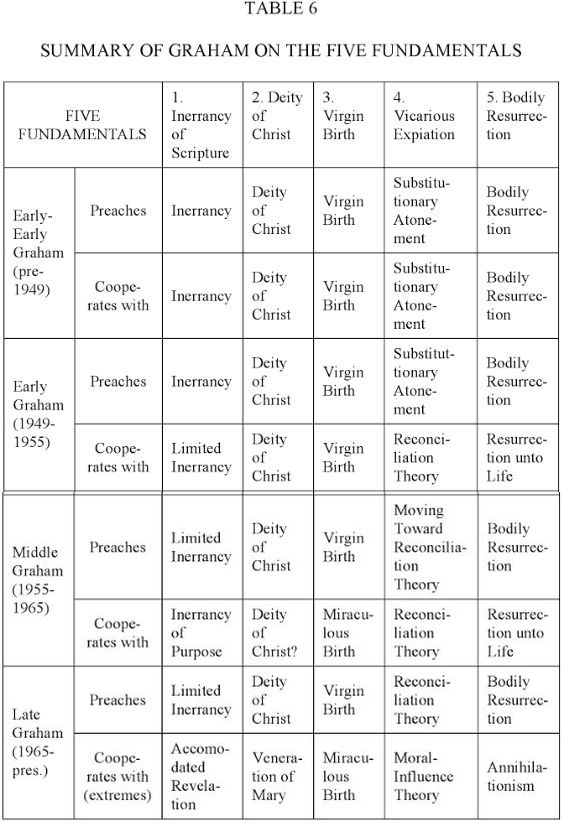
There are five fundamentals of the faith which are essential for Christianity-

1.      The Deity of our Lord Jesus Christ (John 1:1; John 20:28; Hebrews 1:8-9).
2.      The Virgin Birth (Isaiah 7:14; Matthew 1:23; Luke 1:27).
3.      The Blood Atonement (Acts 20:28; Romans 3:25, 5:9; Ephesians 1:7; Hebrews 9:12-14).
4.      The Bodily Resurrection (Luke 24:36-46; 1 Corinthians 15:1-4, 15:14-15).
5.      The inerrancy of the scriptures themselves (Psalms 12:6-7; Romans 15:4; 2 Timothy 3:16-17; 2 Peter 1:20).

Below is a VERY general look at Thomas P. Johnston’s Examining Billy Graham’s Theology of Evangelism, (p. 379) Graham’s four phases of Graham’s life and Graham’s evolution of the five fundamental doctrines.


The fact is, Jesus told us wolves will come in sheep’s clothing. This means they will appear as friendly and soft-spoken. They will seem to adhere to the Bible’s truths, but they are inside ravenous for your soul. Wolves subtly deny God, just as satan did in the Garden. An excellent example of this subtlety is Graham’s statement “I do not find anywhere in the New Testament that this particular belief is necessary for personal salvation. Be wary, friends. Even popular pastors can be wolves. As a matter of fact, especially popular pastors can be wolves.

GotQuestions: Why is the Virgin Birth so Important?

Jesus was not born in sin; that is, He had no sin nature (Hebrews 7:26). It would seem that the sin nature is passed down from generation to generation through the father (Romans 5:12, 17, 19). The Virgin Birth circumvented the transmission of the sin nature and allowed the eternal God to become a perfect man.

Ligonier: Must Christians believe in the Virgin Birth?

Christians must face the fact that a denial of the virgin birth is a denial of Jesus as the Christ


Grace To You: Why the Virgin Birth is Essential

The virgin birth is an underlying assumption in everything the Bible says about Jesus. To throw out the virgin birth is to reject Christ’s deity, the accuracy and authority of Scripture, and a host of other related doctrines central to the Christian faith. No issue is more important than the virgin birth to our understanding of who Jesus is.

Posted in discernment, Uncategorized

Discernment lesson: how secular writers of Biblical material manipulate your emotions

Filmmakers are always looking for fodder to make their productions and of late they have discovered the narratives in the Bible. Since the people writing and producing these movies and shows are not saved, of course they get it wrong. This is because In their case the god of this world has blinded the minds of the unbelievers, to keep them from seeing the light of the gospel of the glory of Christ, who is the image of God. (2 Corinthians 4:4).

In the recent series The Bible, there came a moment when Shadrach, Meshach, and Abednego were faced with a decision. Would they bow to a false god statue, or would they stand for Yahweh, thus losing their lives (as Nebuchadnezzar had aid those who disobey his decree to bow will die, Daniel 3:6).

It’s a dramatic moment when you see it in full visual force. Look, here is the clip:

It is not so dramatic when you hear it though. First, read what the men really said, from the real Bible. It is all from Daniel 3. That’s the first part of the lesson- always compare to scripture.

Shadrach, Meshach, and Abednego answered and said to the king, “O Nebuchadnezzar, we have no need to answer you in this matter. 17If this be so, our God whom we serve is able to deliver us from the burning fiery furnace, and he will deliver us out of your hand, O king. 18But if not, be it known to you, O king, that we will not serve your gods or worship the golden image that you have set up.”

The pagan man always seeks to elevate man and diminish God. See how the writers put very different words in the mouths of the three men when they answered to King Nebuchadnezzar.

[Azariah] With all our hearts we follow you. We seek your presence. With all my heart I follow you. I fear you. I seek your presence. Lord hear my cry, though death entangle me, though the anguish of the grave consumes me, do not ignore my tears, I’m overcome by sorrow. I call upon the name of the Lord. Lord save me! Hear my prayer, oh Lord. Hear my cry.

The prayer of the men were self-centered, not God centered. There is a big difference between ‘I will not serve your gods’ and ‘Lord, I seek your presence!’ In the Bible the men accepted the consequence of their fate, because as long as glory was being given to honor God they were satisfied. The TV show could not be more opposite to the actual statement the men made in the real Bible.  That’s the second part of the lesson. Once you compare what you’ve read or heard to scripture, test  it to see if it gives glory to God only and aligns with His character.

God decided to manifest a miracle in the fire and He saved the men. In the TV show, since the men had prayed to be saved, when they were saved, it looked like it was their own prayer that saved them rather than the sovereignty and power of God.

In the TV show, when the men were delivered from the fire, they emerged declaring “God is with us! People of Judah, rise!” Again, ‘me’-centered.

In the real Bible, honor to God in the highest was given by Nebuchadnezzar.

The hair of their heads was not singed, their cloaks were not harmed, and no smell of fire had come upon them. 28 Nebuchadnezzar answered and said, “Blessed be the God of Shadrach, Meshach, and Abednego, who has sent his angel and delivered his servants, who trusted in him, and set aside[f] the king’s command, and yielded up their bodies rather than serve and worship any god except their own God. 29 Therefore I make a decree: Any people, nation, or language that speaks anything against the God of Shadrach, Meshach, and Abednego shall be torn limb from limb, and their houses laid in ruins, for there is no other god who is able to rescue in this way.” (Daniel 3:27b-29)

I mention this because the scene where the men do not bow, and the scene where the men are delivered in the furnace are well done and moving. In between, though, when the people speak, it is not with Bible words and a humble God-centeredness.

The point here is, do not let emotion cloud your judgment when you absorb non-biblical material. You will most likely be emotionally manipulated when you read a book written by a non-Christian, (The Shack was well done and emotionally engaging for the first 70 pages) or a movie. The scenes in The Bible are moving and close enough to the Bible, but close enough is not good enough. Be wary of letting emotion override the truth with any material you watch or read. Besides, the real word of God is emotional enough!

Posted in discernment, Uncategorized

God’s sovereignty in providence: Esther and Jael

God is sovereign of the entire universe. He plans what he plans and He does what he pleases.

Our God is in the heavens; he does all that he pleases. (Psalm 115:3).

It’s admittedly hard to understand how God can and does orchestrate all events at once, constantly, over the earth and throughout the stars, so that His plans providentially combine in perfect harmony to enact His will. But He is God and we’re not supposed to understand it! It is also hard to understand how our personal decisions are still personal but also are part of His will and plan and the outcome is predetermined. That our decisions are our own yet are part of a pre-ordained plan that all leads to the cross and beyond is a tension our finite minds can’t comprehend. It is a joy to ponder them though, because in so doing, we come up against God’s power, omniscience, and will.

Here are two things to consider when looking at God’s providence and will, with our decisions and will.

Esther

The book of Esther was not written by Esther but it is about Esther, her Hebrew name was Hadassah. She lived during the time of King Ahasuerus of Persia, also known as King Xerxes. Through a series of providential events, Esther wound up as Queen to Ahasuerus and also was put in a position to save her people. However the saving of her people was at dire risk to her own life. She was discussing what to do with her uncle Mordecai, and Mordecai famously said,

“For if you keep silent at this time, relief and deliverance will rise for the Jews from another place, but you and your father’s house will perish. And who knows whether you have not come to the kingdom for such a time as this?” (Esther 4:14).

Esther could make her own decision. She could risk her life and go in to the King, or she could stay in the harem and not go to the King. Mordecai knew God’s character well enough to know that His promise to keep a remnant of His people alive would indeed happen, whether Esther decided to participate at this particular moment or not. God would keep His promise no matter what Esther decided. The choice was hers. Esther decided to go in and speak to the King even though he had not called for her (usually this meant death). We know the rest, Esther’s action revealed to the King the evil deeds of Haman and Haman was killed instead of the Jews.

Jael

Jael was the wife of Heber the Kenite. Sisera had been cruelly oppressing the Hebrews for 20 years. The people cried out. Deborah was civic leader at that time, prophesying and judging. She sent for Barak, the military leader and told him to go take care of the problem. Barak could freely decide what to do. He could go or he could not go, the choice was his. He said he would not go unless Deborah came with him. (Judges 4:8). His answer was in effect, no. Deborah replied that she would go with Barak, but it would be an embarrassment to him because God would deliver Sisera into the hands of a woman, and Barak would not get the military glory for the victory.

Barak freely made his choice, but now the outcome would occur from another quarter, just as Mordecai had said it would if Esther decided against her action.

Into the story enters Jael. After Barak routed Sisera’s army, Sisera fled. Sisera aimed toward the tent of Heber the Kenite. Sisera knew there was peace between Jabin the king of Hazor (Sisera’s King) and the house of Heber the Kenite. Heber had separated from the Kenites and was settled far from the action. Sisera ran, believing he was safe to go toward the area where there was no fighting and where there was peace between the parties. Normally he would be right, especially since hospitality customs were so strong in protecting those who are invited into the tent. However in this providential case, Sisera was wrong. Jael invited Sisera into the tent, gave him drink, and covered him as he fell asleep.

Note that Sisera fell asleep. He had a hard day of fighting, but even though his life was in peril he felt comfortable enough where he let down his guard and fall asleep. Women in those days were responsible for pitching the tents and so Jael was strong enough and familiar enough with how to efficiently hammer a tent peg into the ground. As Sisera slept, she drove a tent peg into his temple and pinned his head to the ground. The verse succinctly states, “So he died.” (Judges 4:21b).

And behold, as Barak was pursuing Sisera, Jael went out to meet him and said to him, “Come, and I will show you the man whom you are seeking.” So he went in to her tent, and there lay Sisera dead, with the tent peg in his temple. 23So on that day God subdued Jabin the king of Canaan before the people of Israel
. (Judges 4:22-23).

Barak had kind of said “I will go” but not really. Placing conditions on your obedience isn’t really obedience to God. I like how the verse says God subdued Jabin.

Whether Esther went in or didn’t go in, God would deliver the Jews from Haman. Whether Barak went to battle or didn’t go to battle, God would deliver the Jews from King Jabin and Commander Sisera. Both Esther and Barak freely decided on a course of action. Yet both outcomes occurred at the providential hand of God.

God is amazing.

Anonymous.
Jael and Sisera
pen drawing  — c. 1440 – 1450
Museum Herzog Anton Ulrich Museum, Braunschweig. The name of the drafter is not known. He is thought to be someone close to Van Eyck and his workshop. Source: Art and the Bible

Posted in encouragement, Uncategorized

YHWH is my Banner

As you head to worship today, if you are reading this on a Sunday, raise your banner of the LORD before you and praise Him, exalt Him, and love Him. If you’re reading this on a weekday, raise your banner of the LORD before you and share His Light in your sphere by your words and deeds.

Chris Powers is an artist, animator, and Bible study writer who makes his products available for free. Please visit his page at fullofeyes.com, or support him on Patreon. Mr Powers is drawing an illustration to a verse per day. I will post them frequently, because they are beautiful, scriptural, and edifying. Visual theology at its beautiful best. Read below for artist’s explanation.

YHWH is my Banner

Mr Powers said:

Today’s verse picture is more of a visual word study (thus the inclusion of verse references within the picture, which I don’t typically do for these). You can take a look at the verses and how they intertwine below:
________

Notice the repeated Hebrew word for Banner/Signal (נס) in the following verses:

Exodus 17:15, “And Moses built an altar and called the name of it, ‘YHWH Is My Banner (נס)” – YHWH as נס

Numbers 21:8, “And YHWH said to Moses, ‘Make a fiery serpent and set it on a pole (נס), and everyone who is bitten, when he sees it, shall live.” – Serpent set on נס

Isaiah 11:10-12, “In that day the root of Jesse, who shall stand as a signal (נס)…[the Lord] will raise a signal (נס) for the nations and will assemble the banished of Israel…” – The Messiah as נס raised to gather the nations…

John 3:14-15, “…as Moses lifted up the serpent in the wilderness, so must the Son of Man be lifted up, that whoever believes in Him may have eternal life.”

John 3:14-15 unites the imagery of YHWH, the curse, the Messiah, and the beacon raised to gather the nations into one–the crucified Son…

Posted in Uncategorized

Surprised by Leviticus

I’ve read most of the Bible. I’ve read through the New Testament all in one swoop, and then I’ve read different Books straight through several times.

I’ve read all of the Old Testament Prophets and loved them. I love Genesis especially. I’ve read Lamentations and Ecclesiastes and loved them too. I’m fascinated by Psalms and Proverbs, even the verses I don’t understand.

I’ve never read Leviticus and Numbers.

Until now.

Going through the Bible in a 90-days Reading Plan does have its upside. I came to Leviticus early on and since this particular plan suggests reading 12 pages a day, I got through Leviticus quickly. I have to say that drinking the Word through a fire hose and moving on while still wet is quite a different experience than sipping it like a hummingbird and then meditating and studying while it digests.

I loved Leviticus. Just as you put anything else off and then finally get to it and it turns out to be not only not bad, but easy and great, and you say “Why did I wait so long to do this?” That was my reaction to Leviticus. Even its repetition was purposeful. I came away with the following reactions:

A renewed appreciation for the blood. Christianity is a bloody religion. All religions are bloody. This one is bloody for a good reason. Christianity  requires sacrifices, blood, and incessant focus on the blood. The reason for this is explained in the short Overview of Leviticus below. Suffice to say, God’s institution of Old Testament ritual and purity laws had great meaning in the original cultural setting. But even today, they have great meaning for us, even though we no longer sacrifice animals. Christianity is ALL about the blood, and in my opinion, in no other book do we gain such an appreciation for this fact.

For the life of the flesh is in the blood, and I have given it for you on the altar to make atonement for your souls, for it is the blood that makes atonement by the life. (Leviticus 17:11)

Secondly, I gained a renewed appreciation for the holiness of God. His purity, power, and holiness is displayed so magnificently in Leviticus. It is not as dramatic as His power in creating the world in Genesis, or when He parted the Red Sea in Exodus, but it is through His relationship with His people that we see His holiness and purity. It’s always great to learn, remember, and ponder His holiness in whatever form He chooses to reveal it, and for me, Leviticus did that.

Why wait? Perhaps you will have the same reaction to Leviticus as I did. It’s almost like, all scripture is profitable for… Wait, there’s a verse for that.

All Scripture is breathed out by God and profitable for teaching, for reproof, for correction, and for training in righteousness, (2 Timothy 3:16).

The Bible Project’s Book of Leviticus Overview. Worth your time either before or after you read.

The Word of God is always wonderful. Always.

Posted in architecture, Uncategorized

Church bell towers soon a thing of the past

I have always loved the sound of church bells. In the olden days when I was a child, we often heard some kind of bell from towers and steeples. We even heard the organs.

No more. Not so much.

One reason is the cost. Steeples and towers and bells require a financial investment to maintain them that is often cost-prohibitive today. Additionally, there aren’t many men going into the profession of steeplejack these days.

Church steeples, aging out of fashion, meet their maker

Atop the tiny, white-columned 1842 church where Glen Likens was baptized, where he married his wife, where their children were baptized, where they still worship on Sundays, the steeple is rotting. St. Mark’s Episcopal in Wadsworth, Ohio, hasn’t dared sound the 2,000-pound bell, which has a broken carriage and patched hammer, for a year. It may not sound again — unless a congregation numbering 58 souls in a good week can come up with $30,000. 

“It’s no easy amount to raise. We absolutely considered taking it off and capping the roof, but voices within the congregation want their bell, their tower. It’s symbolic. It’s part of our church. We want it to be there for our children’s future,” says Likens, who volunteers as St. Mark’s junior warden in charge of maintenance. 

Nationwide, church steeples are taking a beating and the bell tolls for bell towers, too, as these landmarks of faith on the landscape are hard hit by economic, social and religious change. 

Steeplejacks, specialists in clambering up to build or repair the soaring structures, see weather-struck, maintenance-deprived steeples chipped, leaking, even tilting. Architects and church planners see today’s new congregations meet in retooled sports arenas or shopping malls or modern buildings designed to appeal to contemporary believers turned off by the look of old-time religion. 

Steeples may have outlived their times as signposts. People hunting for a church don’t scan the horizon, they search the Internet. Google reports searches for “churches” soar before Easter each year. 

St. Mark’s, which has no website, has never needed to tell the 22,000 people in Wadsworth where it was because, Likens says, “everyone in town knows this is the church with the bell tower.”

Caption photo below: This New England Historic church’s cupola was removed for repair and returned atop the church. It was an lengthy, expensive, and delicate process.

Here is James A. Regester writing about in the Introduction to his 1908 book The Worship of the Church of the history of church buildings.

Churches are designed they way they are for a reason.”As soon as the early Christians were at liberty to build churches according to their own mind, they took pains to make them significant of their religion. Probably at first the Christians took for the purposes of their worship such buildings as they could get, adapting them to their uses as best they might. But when they grew strong enough and independent enough to build as the heart and imagination dictated, then they showed themselves careful to make their houses of God in shape and dimension suggestive of what they believed.” These old builders were Churchmen, and made their Churchmanship and their belief felt in their work.

In this essay on The History of Church Steeples, we read about bells:

Some steeples were used to house the bronze or steel church bell, and that section of the steeple is called the belfry. This area of the steeple would have louvers to emit the sound of the bell on all sides of the steeple, with louver blades tilted downward to help keep out rain. Bells were located in steeples, as this was the highest place on the church; this height helped the sound to travel a farther distance, floating out over the community. The bells were used as a call to worship, to ring the time of day in the community, as a wedding peal, and as a solemn funeral toll to mark the passing of a cherished member. This is why you still see louvers in the midsection of modern steeples even though they may not have a tradition bronze bell. Some churches have replaced the traditional bell with the more versatile electronic carillons that can digitally recreate the sounds of cast bells, played as hymns, angelus, pealing bells and funeral tolls. The louvers also aid in ventilation of the steeple, which extends the durability of the exterior finishes.

I believe a church should look like a church, and that means a steeple and even a bell if possible. I know I’m a dwindling minority. Here is James A. Regester again writing about the history of church buildings in his 1908 book The Worship of the Church. The following about the church bells is from his chapter Symbolism of the Church Building

In the tower are the bells, and what the spire with its uplifted Cross says to us in silent eloquence these say in sound and music. 

The office of the bell in calling to prayer and holy worship was regarded in olden time with much reverence. The use of bells for the purpose of gathering people together in large numbers appears to be of Christian origin. “Large bells hung in a tower seem to have been unknown before A.D.500. They were first made in Campania in Italy, whence the Italian name campana, a bell, and campanile, a bell-tower. 

“Bells in the middle ages were sometimes dedicated to saints. They were christened with all the usual ceremonies and with much pomp; sponsors were provided, the bell was sprinkled at the font, anointed with oil, and robed in a chrisom. Superstitious as these customs would seem now, there is something fine in the simple faith which thus, in those more poetic days, consecrated to God’s service the voices which should proclaim Him far and wide over the land.” In simpler form, the custom is still frequently observed of setting apart by solemn prayer and benediction the bells which are to call men to prayer or to ring out the praises of God. 

Church bells are frequently marked by appropriate inscriptions. The following, for instance, was very common in the middle ages, all these powers being attributed to bells: 

“Funera plango, Fulgura trango, Sabbata pango,
Excito lentos, Dissipo ventos, Paco cruentos.” 

“I mourn the dead, I break the lightning, I announce the Sabbath, I excite the slothful, I disperse the winds, I appease the cruel.”

Here are a couple of campanile photos I took while in Italy

Florence, Italy bell tower
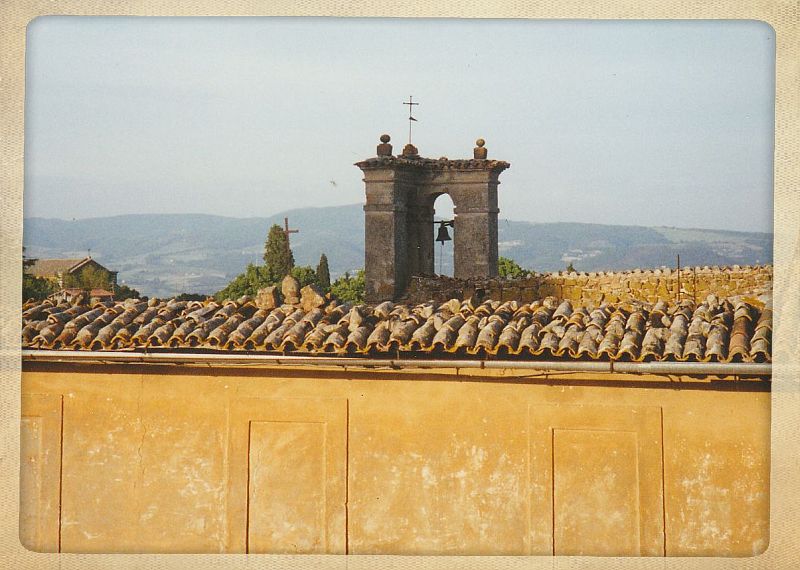
Caption photo below: Orvieto, Italy bell tower. Notice the cross atop the tower, to the left of the tower, and atop the roof of the distant building. Click to enlarge.

If you are interested in Ecclesiastical Architecture as I am, which I have written about a few times before, here is a good series from The Christian Pundit about how and why churches and their interiors look as they do.

Ecclesiastical Architecture (1) Introduction
Ecclesiastical Architecture (2) Pulpits
Ecclesiastical Architecture (3) Sacraments
Ecclesiastical Architecture (4) Baptismal Fonts
Ecclesiastical Architecture (5) Music
Ecclesiastical Architecture (6) Lighting
Ecclesiastical Architecture (7) Pews
Ecclesiastical Architecture (8) Conclusion

Enjoy!

Posted in discernment, Uncategorized

The Herd Mentality v. Self-Control

My grandparents were born in around 1900. The emigrated to the US in their 20s and soon after had accumulated enough money to buy a car. They liked to drive. However they were not so great with directions. When my grandfather didn’t know in what direction to go, my grandmother would helpfully advise, “Follow him. He looks like he knows where he’s going.”

Have you heard of the phrase, ‘herd mentality’? Wikipedia explains it,

Herd mentality, or mob mentality, describes how people are influenced by their peers to adopt certain behaviors.

Or this definition from The Royal Society-

Herding can be defined as the phenomenon of individuals deciding to follow others and imitating group behaviours rather than deciding independently and atomistically on the basis of their own, private information. Article- Herding, social influence and economic decision-making

We see the follow-the-crowd mentality in stock markets and even in home design trends.

Sociologists researched this phenomenon at Leeds University.

Researchers at Leeds University performed a group experiments where volunteers were told to randomly walk around a large hall without talking to each other. A select few were then given more detailed instructions on where to walk. The scientists discovered that people end up blindly following one or two instructed people who appear to know where they’re going. The results of this experiments showed that it only takes 5% of confident looking and instructed people to influence the direction of the 95% of people in the crowd and the 200 volunteers did this without even realizing it. (Source)

Herd mentality is real. Following a crowd in home decor trends is not a dangerous activity, but other follow-the-crowd activities are.

Parents often worry about their teenager falling in with the wrong crowd. That’s because they know how impressionable youths can be and how easily they can be led to certain behavior through peer pressure. It’s one reason I object so strongly to the exclusion of parents or other adults from the youth-oriented Passion conferences. This is a conference where tens of thousands of youths congregate for allegedly spiritual purposes, to receive instruction, and to engage in social justice activities. This last is helped along by the organizers having stationed many ATMs throughout the venue so the youths will donate money to social justice causes. And they do. Of course, donating to charities is not bad, but arming teenagers with credit cards, separating them from their parents, and inoculating them with incessant sermons preaching about donating to social causes, means it’s easy to induce the desired behavior from your captive subjects.

However, the herd mentality phenomenon is not restricted to youths, as the example above from Leeds University shows. Here is an example from the Bible which shows, in my opinion, just how easily led the heart and mind can be. In this example, we see how easily adults can fall prey to blindly following a crowd.

So the city was filled with the confusion, and they rushed together into the theater, dragging with them Gaius and Aristarchus, Macedonians who were Paul’s companions in travel. 30But when Paul wished to go in among the crowd, the disciples would not let him. 31And even some of the Asiarchs, who were friends of his, sent to him and were urging him not to venture into the theater. 32Now some cried out one thing, some another, for the assembly was in confusion, and most of them did not know why they had come together.  (Acts 19:29-32).

The scene is Ephesus, and Paul is preaching. Ephesus was a wealthy city with numerous guilds such as coppersmiths and silversmiths. The smiths were engaged in a monetarily healthy trade in making false idols to the local deity, Artemis. Demetrius, a silversmith, had quickly seen the effect Paul’s preaching had had on the city’s new converts. They no longer bought idols of silver, and his income was affected. This could not stand. Demetrius incited a riot. The city-folk streamed into the amphitheater.

One reason I love the scriptures the way they are written is the Holy Spirit-inspired details. If you read the entire passage in context, It’s pretty dramatic. The scene is vivid. Picture any B-movie from the 1950s where the villagers are storming the castle with pitchforks. The crowd is unruly, loud,angry, and dangerous. They were also intent on making their point and the adrenaline rush of fury and tumult carried them along. But then you see the few words at the tail end of verse 32, lol.

most of them did not know why they had come together

MOST of them
did NOT know why
they were THERE

Not a few of them, not that some of them, MOST of the people did NOT know why they were headed up the hill and sitting at the local colosseum yelling their heads off.

I’m reminded of this past week’s Women March on Washington where thousands of feminists streamed to the capitol to demand nebulous ‘rights’. However, when Christian reporters and theologians who were there interviewed several women and asked them why they came, the women didn’t know. It reminded me of the riot in Ephesus all over again.

If you read to verse 34, it says But when they recognized that he was a Jew, for about two hours they all cried out with one voice, “Great is Artemis of the Ephesians!”

I’m sure you’ve ever been to a high school pep rally or a sports event. The crowd stomps the bleachers and sings ‘We will rock you’, we are the champions’ etc. We have Queen to thank for his everlasting rally cry. Listen, if you will, to the first 35 seconds or so.

I avoid loud gatherings as an adult, but in high school pep rally assemblies were compulsory. I vividly remember the reverberations of the bleachers, the stomping, how quickly the first stomp grew to a unified sound that morphed into the song. It went on for a while, maybe a few minutes. But it didn’t last long. It’s hard for a crowd to remain vigorous in its unified efforts and soon the effort fall apart into distinct voices and scattered stomps, then ended.

In Ephesus, they cried out with one voice for two hours. Just imagine if the entire football stadium was singing ‘We will rock you’ for two hours, solid.

We see another mob mentality moment in Genesis 19:4-11. The scene is Sodom and the place is Lot’s house. The mob surrounded the house where the two angels dwelt and pressed so hard against the door that the angels struck them blind, but they still groped for the door.

Imagine the scene just prior to this, though. The news that two handsome men – strangers – were at Lot’s house spread through the city like wildfire. The verse says that men from all quarters of the city came to Lot’s house. The news spread and it ignited feet. Soon the men were like pillaging villagers ready to storm the castle, or in this case, Lot’s door. An entire population rushed there, yelling, demanding, just as the people did in Ephesus.

I think these examples of herd mentality (and also the example of the angry mob that stoned Stephen in Acts 7) show just how sinful we are. Even after salvation, the tendency to follow the crowd is still present in the heart and mind, because we are still sinners and not glorified yet. I believe this is why so many passages and verses advise wisdom and self-control. I think it’s especially important when a church is considering leaders for their local body. Anyone who consistently engages in self-controlled, measured actions based on wisdom and not an unreasoning follow-the-crowd mentality is definitely leader material.

But the fruit of the Spirit is love, joy, peace, patience, kindness, goodness, faithfulness, gentleness, and self-control. (Galatians 5:22-23).

Strong’s Concordance says of the word self-control here-

egkráteia (1466)  – properly, dominion within, i.e. “self-control” – proceeding out from within oneself, but not by oneself.
For the believer, 1466 /egkráteia (“self-control, Spirit-control”) can only be accomplished by the power of the Lord. Accordingly, 1466 /egkráteia (“true mastery from within”) is explicitly called a fruit of the Holy Spirit (Gal 5:23).

Paul talked about this exact kind of self-control to Felix in Acts 24:25. Peter talked about self-control in 2 Peter 1:5-6,

For this very reason, make every effort to add to your faith virtue; and to virtue, knowledge; and to knowledge, self-control; and to self-control, perseverance; and to perseverance, godliness; 

It’s easy to follow a crowd. All too easy. It’s hard to withstand the stream of thousands of people headed in one direction. It takes self-control to stop either actually or metaphorically as you’re buffeted by people all around you headed in a certain direction and you’re not at all sure you want to go. It takes strength to stand quietly for a moment and think, assess, and pray for wisdom. It is very hard NOT to follow the crowd.

But always remember that self-control is a fruit of the Spirit. Though we have the sinful tendency in us to easily become unreasoning animals and follow whatever crowd is doing, we have the Holy Spirit. Self-control proceeds out from within us, but is not by us. It’s Him. All him. When we rely on the Spirit to induce in us the control we need, Jesus receives glory.

Posted in history, Uncategorized

Forerunner to the Reformation: John Wycliffe

Martin Luther, 1483-1546

It is Reformation year 500. Five hundred years ago this October 31st, Martin Luther nailed his 95 theses to the door of the All Saints’ Church in Wittenberg, Electorate of Saxony within the Holy Roman Empire. Luther wrote,

Out of love for the truth and from desire to elucidate it, the Reverend Father Martin Luther, Master of Arts and Sacred Theology, and ordinary lecturer therein at Wittenberg, intends to defend the following statements and to dispute on them in that place. Therefore he asks that those who cannot be present and dispute with him orally shall do so in their absence by letter. In the name of our Lord Jesus Christ, Amen.

Here are the actual 95 theses if you want to read them:
The 95 theses

History.com sums the Reformation up this way-

Luther spent his early years in relative anonymity as a monk and scholar. But in 1517 Luther penned a document attacking the Catholic Church’s corrupt practice of selling “indulgences” to absolve sin. His “95 Theses,” which propounded two central beliefs—that the Bible is the central religious authority and that humans may reach salvation only by their faith and not by their deeds—was to spark the Protestant Reformation

Is there any event that is not connected in time by a previous event? Isn’t time a constant stream of events, all tumbling one after another, connected by their confinement to the visible riverbanks by the hands of God? Did the Reformation emerge all of a sudden, or were there catalysts and stepping stones laid first? Were there forerunners? I believe so.

As RC Sproul said recently, that before Luther there was Hus, (or Huss, spellings vary) who was preceded by Wycliffe, who was preceded by Augustin who was preceded by Paul who was preceded by Jesus.

The reason there are forerunners to Martin Luther and the Reformation is that Jesus never leaves Himself without a witness, and He as Master Husbandman tends soils so that there is always a soil ready to receive the Gospel. Even in “The Dark Ages”, the Gospel was doing its work in hearts. Salvations were always occurring.

Burk Parsons wrote of this connection from one era to the next, the vine as I envision it. It is planted by God and watered by Him, with men springing up along the vine as forerunners to His particular plan and path regarding the Reformation.

John Wycliffe was the morning star of the Reformation. He was a protestant and a reformer more than a century before Martin Luther ignited the Protestant Reformation in 1517. Through Wycliffe, God planted the seeds of the Reformation, He watered the seeds through John Hus, and He brought the flower of the Reformation to bloom through Martin Luther. The seed of the flower of the German Augustinian monk Luther’s 95 theses was planted by the English scholar and churchman John Wycliffe.

Josh Buice wrote two weeks ago that The Reformation Resulted in an Explosion of Gospel Missions. He started a preaching series in–

–2017 with an emphasis on the Reformation and how our salvation is directly connected to the work of the Reformers. R. C. Sproul writes, “The Reformation was not merely a Great Awakening; it was the Greatest Awakening to the true Gospel since the Apostolic Age.”

During the days that preceded the Reformation, the Bible had been locked away in a dark dungeon by the Roman Catholic Church.  They insisted that the Word of God must be heard by the priests, who would speak it only in Latin. The Roman Catholic Church insisted that the common person was unable to understand the Word of God without the aid of a priest. However, they were unwilling to release control of the Bible, and in order to prevent anyone from getting their hands on the Word of God—they would burn people at the stake as an example to all who resisted their authority.

Under John Calvin’s leadership in Geneva Switzerland, thousands of missionaries were being trained and by 1562, over 2,000 churches had been planted in France. In 1560, the Geneva Bible was published which was greatly used in Europe and was also the Bible that was brought off of the Mayflower by the early Pilgrims of America. Through the Reformation, an explosion of gospel missions took place that shook the world.

Source Wikimedia Commons

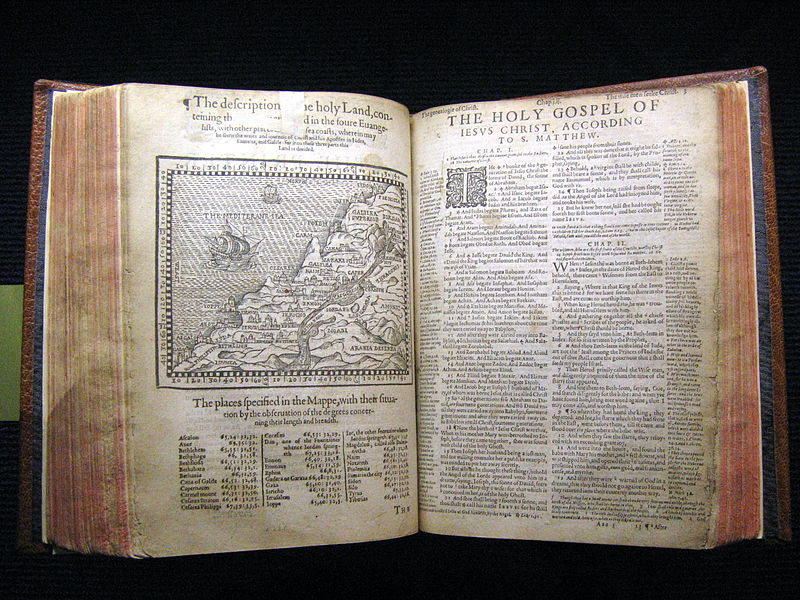
The Reformation is an extremely important part of church history. One would think with the release of the Bible in the people’s language, the explosion of missions, the work of the Gospel in the hearts of many subsequent to the reformation, that our ecclesiology would progress in an upward trajectory. But satan does not like upward, only downward. He fights back. He fought back since the moment the first Geneva Bibles were released. And the Geneva Bible’s history is interesting in itself! It was the first Bible to be translated directly to of the Hebrew. It had extensive notes and cross references, making it the first study Bible. It was translated so that the people could read it. More here.

Sadly, 500 years after the start of The Reformation, there is currently a definite softening toward the Catholic Church by many people who should know better.

Philosopher and poet George Santayana famously said,

Those who cannot remember the past are condemned to repeat it. (The Life of Reason: Reason in Common Sense. Scribner’s, 1905: 284)

We must remain vigilant because we are not unaware of satan’s schemes. (2 Corinthians 2:11). We should learn the past in order to remember the past and to push forward with clear, honest, uncomplicated Gospel evangelization. We shouldn’t ever remain ignorant of what has happened in the past of our church history. This is the 500th year of the Reformation. Here are some resources for you to learn more:

The Heresies of the Catholic Church

Evangelical Syncretism: Rethinking the Reformation

John MacArthur and RC Sproul on Sola Scriptura and the Reformation

Undermining the Headship of Christ (The line between John Hus and Martin Luther is explained here).

A History of the Reformation, article by RC Sproul

Memoirs of a Medieval Woman: this is a biography of Margery Kempe, taken from her dictated autobiography. She was born sometime around 1373 and died after 1438, which makes her a devotee of the Catholic Church at a time when both the rise of the Lollards (Wycliffe followers) was gaining traction and also the incessant Catholic pilgrimages to Jerusalem were occurring. It is also set in the time just prior to the Council of Constance. This Council was held between 1414 and 1418, principally to reunite Christendom from the ‘too many popes’ syndrome (schism) but also to examine the teachings of John Wycliffe and Jan Hus and to reform the RCC as a reaction to the attack on the Church’s authority.

Wikipedia lists her as “an English Christian mystic, known for dictating The Book of Margery Kempe, a work considered by some to be the first autobiography in the English language.” Kempe wrote of it all from a first person perspective. I liked the book for its attention to vivid detail on the practices of the Catholic Church, the realities of the pilgrimage journeys to the middle East, the ecstatic visions and examination of same by any and all church authorities Margery could get to listen (anchorites, priests, bishops, other mystics like Julian of Norwich, lay people…)

Posted in discernment, Uncategorized

“God’s not in control” says Baptist theologian

The excerpt below is not a Babylon Bee article. [Babylon Bee is a satirical Christian online spoof publication). My response to the title of the article, “Theologian says God not in control”, is that if a theologian says God is not in control, he is not a theologian. Also, if God is not in control, He is not God.

And he is before all things, and in him all things hold together. (Colossians 1:17)
Many are the plans in the mind of a man, but it is the purpose of the Lord that will stand. (Proverbs 19:21).

Below is an excerpt from the aforementioned article, then my thoughts follow. The article is based on a new book, Scandalous Providence: The Jesus Story of the Compassion of God, written by long-term professor E. Frank Tupper. Tupper was one of the founding faculty members of the School of Divinity at the Baptist educational institution of Wake Forest, also had taught for many years prior to that in Southern Theological Seminary. He has been teaching for 42 years. He has also been privately struggling with the concept of God’s providence and sovereignty since 1965, when his father died. He later struggled with it again, when his wife Betty was fatally diagnosed with cancer.

Theologian says God not in control

Tupper’s study and experience led him to reject platitudes on suffering such as “God is in control” or “everything happens for a reason.” “I do not believe that God is in control of everything that happens in our world,” he said. “Indeed, I would argue that God controls very, very little of what happens in our world.” Tupper said part of his own struggle has been understanding why God does not act in human life today with the same kind of power and purpose as the mighty acts described in Scripture. “Why does God not act today the way the biblical traditions present God to us, particularly in the New Testament?” he asked. “Why does God not act? Because the resources are not available to God to act.”

In an interview with the Homebrewed Christian Tripp Fullerregarding Tupper’s same book about providence, Tupper said that there have been two historic responses to God’s Providence,

The 2 leading lines for interpreting Providence was ‘well, we do not understand why this has happened’ or, ‘In some sense this is the will of God and we must accept it.’ I rejected both those ideas. Betty Tupper’s experience of suffering with cancer and dying, and the enormous impact it had on my family gave me the courage to say, “I’m going to write and interpret providence in a way that is consistent with my understanding and my faith and I will accept the opposition and the challenges that I’ll experience.” HomeBrewed Christianity podcast 

In his book Scandalous Providence, Tupper categorically rejects the classic verse on Providence, Romans 8:28, that all things work together for the good of those who love God. Tupper says,

No. [Romans 8:28] does not mean: Paul does not mean that God predetermines everything that happens. Not everything that occurs is the design and intention of God.

The main leading line throughout history for the faithful believers in interpreting God’s providence is to, ahem, trust Him. Esther did. The entire book of Esther is an object lesson in trusting His promises when circumstances on the ground clearly are going in the opposite direction. Also, Job. Job trusted God through it all, even when his own wife said he should curse God and die. Shadrach, Meshach and Abednego trusted His promise despite the threat of imminent death. They were providentially delivered, though the men acknowledged that God’s control was such that He might not choose to deliver them. God chose not to deliver Tupper’s father nor his wife, but that does not mean He isn’t in control. However, to Tupper, it does.

What Tupper is really saying here about providence and trust is that, ‘I had an experience that I did not like, therefore I will reinterpret the God of the Bible according to my own desires and understandings, based on my own experiences and not the promises of God as revealed in scripture.’

You can read about Tupper’s book on many different websites. It’s actually not a new book, but a massively updated version of an older one he’d written. As I said, he has been struggling with trusting God through difficult circumstances for a long time.

For this next section of the essay I want to offer insights on two important topics that Tupper’s interpretation of Providence raises. These are issues you should know about because they are so pervasive and because his influence as Seminary professor and molder of young minds is so strong.

1. Open Theism (in Arminian context)
2. Narrative Theology (morphing to to personal experiences)


Open Theism.

Open Theism | Internet Encyclopedia of Philosophy

Open Theism is the thesis that, because God loves us and desires that we freely choose to reciprocate His love, He has made His knowledge of, and plans for, the future conditional upon our actions. [Ed note- more extreme version-]Though omniscient, God does not know what we will freely do in the future.

Classic Arminian, free will theology is basically Open Theism. We choose God, He reacts. The logical conclusion of a theology where we can choose to overcome our own thoroughly depraved heart (Genesis 6:5) by our own decision and not God’s supernatural ordination, is a theology where God is not in control. The first casualty in Arminian/Open Theism is the sovereignty of God. And if God is not Sovereign, the doctrine of Providence falls, too.

Speaking of narratives, it’s popular today to use the fact of Jesus’ storytelling through parables to excuse what is known as narrative theology.

Here is the definition of narrative theology, a wonky theology to begin with, before Tupper further corrupted it by showing his readers how to create a theology based on experience:

Narrative Theology.

Narrative theology

Narrative theology was a late 20th century theological development which supported the idea that the Church’s use of the Bible should focus on a narrative presentation of the faith, rather than on the development of a systematic theology. The Christian faith is thus also to be interpreted by the Christian community, and not by outside scholars or explorers. Narrative theology is typically done by those known as post-liberals.

Tupper’s book relies on narratives within the Bible to offer laypeople access to theology, which he calls “lay theology”. He says he uses narrative theology as a mechanism to communicate the fundamental concerns of scripture to the lay people. As with any mechanism, satan will use it and bring it forward even from its good foundations to foundations made from darkness and poison. So it is with narrative theology. In Tupper’s book, he strays from the straightforward interpretation of parables, (theology) to using parables as an excuse to narrate Jesus’ story, (a liberal stance) to using people’s stories as a narrative to explain Jesus. (a ridiculous stance, but inevitable if adopting narrative theology.)

As with any doctrinal error, there comes a point where its profound error becomes its fatal flaw. If we interpret evil through the lens of our own experiences and worse, construct a narrative to explain it, the skewed vision of who God is becomes fatally wounding.

Why am I going on about what may seem to you to be an obscure theologian, (but isn’t) who in no way impacts your life? Because I want you to understand something. This man has been teaching generations of young people the “truths” of God for 42 years. His journey away from the sovereignty and goodness of God’s toleration of evil means Tupper has also led impressionable youths away from it too. Many seminaries and Christian colleges today are bastions of doubt and unfaith. And I’m talking about the Professors.

God is in control of everything. Solomon says this in Proverbs 16:33,

The lot is cast into the lap, but its every decision is from the LORD.

This means that, we can throw the dice and we can use that as a basis for deduction, but God who sovereign over all things, even controls the roll of the dice. (Alistair Begg)

Here are some resources to help understand God’s sovereignty even in tolerating evil, death, and tragedy.

The Truth about Evil
How can a good and powerful God tolerate all the evil in the world?

In Tupper’s interview with the Homebrewed Christian, Tupper mentioned about God being love (so why does He accept evil and hate in the world…). The verse from 1 John 4:8 which says in its second part that God is love, is explained in this 90-second video from the WWUTT Pastor, Gabe Hughes.

From Ligonier, we find a list of essays dealing with the question Is God in Control?
When pain, suffering, and natural disasters occur, how can we know that God is really in control? Is He really sovereign over all things, including evil?

GotQuestions on narrative theology: Narrative theology is the idea that Christian theology’s use of the Bible should focus on a narrative representation of the faith rather than the development of a set of propositions reasoned from the Scriptures themselves or what is commonly called a “systematic theology.”