The problem of the evil that is in each and every person on earth is troublesome. For many reasons, of course, but for this reason today: we can’t see it all. We don’t see it all.
We point to Hitler as if he was an anomaly. ‘He’s really evil, unlike us’, we think. Wrong. The LORD simply allowed the evil that was in him to emerge into action. The potential for actions like Hitler’s or any other serial killer, child molester, or tyrant like Nero, is there. We are all not as bad as we could be, mercifully. God puts the restraints on us, but evil is there. Often in thought if not deed. And more than we think.
The actual wickedness of men’s lives bears a very small proportion to what is in their hearts. But when lust is inwardly cherished, it will break forth into outward sin. Those who tempt others to drunkenness never can be their real friends, and often design their ruin. Thus men execute the Divine vengeance on each other. Those are not only heated with sin, but hardened in sin, who continue to live without prayer, even when in trouble and distress.
Did you see that first sentence? The actual wickedness of what is in men’s lives bears a very small proportion to what is in their hearts. It’s the old iceberg analogy again. What we see bobbin on the surface is minuscule compared to what is under the surface, hidden from view.
A practical disbelief of God’s government was at the bottom of all Israel’s wickedness; as if God could not see it or did not heed it. Their sins appear on every side of them. Their hearts were inflamed by evil desires, like a heated oven. In the midst of their troubles as a nation, the people never thought of seeking help from God.
God does see it all in us. He knows what is in a man’s heart. God is our very great helper to resist sin and live a holy life. Not just the Israelites, bow often do we in our day forget to turn to God?
We cannot be ‘a good person’ without His help.
Therefore let’s approach the throne of grace with confidence, so that we may receive mercy and find grace for help at the time of our need. (Hebrews 4:16)
And all who were sitting in the Council stared at him, and they saw his face, which was like the face of an angel. (Acts 6:15)
But if the ministry of death, in letters engraved on stones, came with glory, so that the sons of Israel could not look intently at the face of Moses because of the glory of his face, fading as it was, how will the ministry of the Spirit fail to be even more with glory? (2 Corinthians 3:7-8)
And we all, with unveiled face, beholding the glory of the Lord, are being transformed into the same image from one degree of glory to another. For this comes from the Lord who is the Spirit. (2 Corinthians 3:18)
For God, who said, “Let light shine out of darkness,” has shone in our hearts to give the light of the knowledge of the glory of God in the face of Jesus Christ. (2 Corinthians 4:6)
The more we look at Jesus, the more we behold His glory. Then the more His glory changes us into His likeness.
How do we look at Jesus? In prayer, through His word, by resisting sin, by repenting of sin, by obedience to His word in our daily, practical lives.
The first human blood shed in the Bible was a shepherd’s blood, shed by one who rejected God in jealousy and anger.
Now Abel was a keeper of sheep, and Cain a worker of the ground. (Genesis 4:2b) And the Lord said, “What have you done? The voice of your brother’s blood is crying to me from the ground. (Genesis 4:10)
The Death of Abel, by Gustave Dore
The last blood needed for sin’s atonement was the blood of Jesus, The Great Shepherd.
and not through the blood of goats and calves, but through His own blood, He entered the holy place once for all, having obtained eternal redemption. For if the blood of goats and bulls and the ashes of a heifer sprinkling those who have been defiled sanctify for the cleansing of the flesh, how much more will the blood of Christ, who through the eternal Spirit offered Himself without blemish to God, cleanse your conscience from dead works to serve the living God? (Hebrews 9:12-14)
But now in Christ Jesus, you who once were far off have been brought near by the blood of Christ. (Ephesians 2:13)
Chris Powers, fullofeyes.com
Here is a song called The Last Blood. Listen to it entirely. It builds to a devastating climax.
Grace is a concept. But it’s not just a concept. Grace is a gift, but it’s not just a gift. Grace is a force. Think about how powerful grace is. Think about its power as it exists in Jesus, as it is delivered to the saints, its common state as it covers the world, and its special state as it enlivens the saints to do our work.
Here is an excerpt about grace from a sermon from John MacArthur called, Strength Perfected in Weakness, looking at this verse: 2 Corinthians 12:7-10.
or because of these surpassingly great revelations. Therefore, in order to keep me from becoming conceited, I was given a thorn in my flesh, a messenger of Satan, to torment me. 8 Three times I pleaded with the Lord to take it away from me. 9 But he said to me, “My grace is sufficient for you, for my power is made perfect in weakness.” Therefore I will boast all the more gladly about my weaknesses, so that Christ’s power may rest on me. 10 That is why, for Christ’s sake, I delight in weaknesses, in insults, in hardships, in persecutions, in difficulties. For when I am weak, then I am strong.
In speaking of the linchpin part of the passage, ‘my grace is sufficient for you’, MacArthur said,
But grace is not just an inert sort of concept; it is a force, it is a power. It is a power that transforms us. It is a power that awakens us from sleep. It is a power that gives us life in the midst of death. It is a power that is dynamic enough to transform us from the kingdom of darkness to the kingdom of God’s dear Son. It is the power that saves us. It is the power that keeps us, the power that enables us, the power that sanctifies us, and the power that one day will glorify us. You have to look at grace as a force, a divine force that God pours out into the lives of His people at all points to grant them all that they need to be all that He desires.
Grace is a gift. Grace is a state. and… Grace is a POWER.
Because the times are so hard and the world is so dark, I’ve been posting some short essays on worship. Just worship. It’s a way to remind me, and anyone, that “Man’s chief end is to glorify God, and to enjoy Him for ever” says the Westminster Shorter Catechism. Let’s just find ways every day to enjoy God!
I like natural history. It’s God’s creation. I like thinking about how He has created everything from nothing with just a word. I see the intricacy of His creatures and flora and fauna and I’m just amazed.
I walked across my apartment parking lot yesterday when I got home from school. The frigid weather had turned to 68 degrees and it was warm and humid. Halfway across I heard what sounded like a frog. Frogs! I thought it’s way too early for frogs! There is a pond next door butt the sound was coming from high up in the trees on the onterside of the road in the woods.
I went inside and searched for “bird that sounds like a frog” and came up with Hooded Merganser.
But reading natural history books is a two-edged sword. Most are written from a secular point of view, and at some point the constant lies within such books begins to grate, and I abandon them.
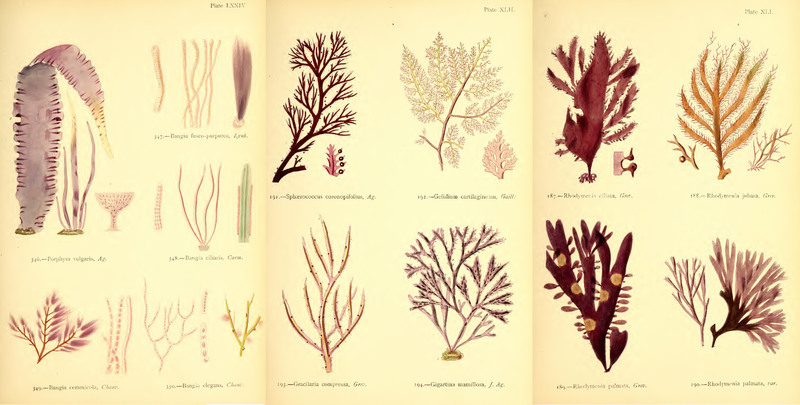
One of the natural history books mentioned in the Atlas Obscura article was a seaweed journal by Margaret Gatty. Atlas Obscura wrote of her,
One of the best known and most dedicated of these so-called seaweeders was Margaret Gatty, a children’s book author who took up the hobby while convalescing in Hastings, on Britain’s southeast coast, in 1848. Gatty’s crowning work of algology, British Sea-Weeds, is an exhaustive compilation of local seaweeds, fully described and illustrated in 86 colored plates.
I did not know there was a whole field of study called ‘algology’. These are selected plates of her seaweed drawings,
Selected plates from Margaret Gatty’s “British Sea-Weeds.” BIODIVERSITY HERITAGE LIBRARY/PUBLIC DOMAIN
I love those colored plates from natural history books from the 1800s. I owned two rare books,
A popular history of the mollusca : comprising a familiar account of their classification, instincts and habits and of the growth and distinguishing characters of their shells, by Mary Roberts, 1851; and
Popular British conchology. A familiar history of the molluscs inhabiting the British Isles, By George Brettingham Sowerby, 1854.
I love the hand colored plates of the plants or animals they carefully drew. I also have several books by Harvard University paleontologist Stephen Jay Gould (secular guy, sigh). There’s French poet-philosopher Paul Valery in his engaging meditation on the aesthetics of the seashell, as Amazon describes his work. Anne Morrow Lindbergh’s musings on shells in her famous Gift from the Sea. And so many other books. I guess now that I’m thinking of listing them, my library contains quite a few natural history books. Rachel Carson, Farley Mowat, John Hay, Abbot & Dance…
In 1664 John Evelyn, diarist, country gentleman, and commissioner at the court of Charles II, produced his monumental book on trees: Sylva, or a Discourse of Forest Trees. It was a seventeenth-century best seller. Evelyn was a true son of the Renaissance. His book is learned and witty and practical and passionate all by turns. No later book on trees has ever had such an impact on the British public.
Hmmm, maybe that’s why the Monty Python comedy troupe mentioned THE LARCH so often…
I love trees. Maybe I’ll get that book.
As much as I love reading about the creation from scientists of various kinds, there’s nothing like reading the Bible, God’s actual account of His world. As poetic as Lindbergh was, as witty as John Evelyn was, as precise as Sowerby or Roberts was, the thrill of reading about the creation from God Himself never fails to thrill me. As familiar as these verses are, they still ignite a reverent awe at His power:
In the beginning, God created the heavens and the earth. 2The earth was without form and void, and darkness was over the face of the deep. And the Spirit of God was hovering over the face of the waters.
3And God said, “Let there be light,” and there was light. 4And God saw that the light was good. And God separated the light from the darkness. 5God called the light Day, and the darkness he called Night. And there was evening and there was morning, the first day.
6And God said, “Let there be an expanse in the midst of the waters, and let it separate the waters from the waters.” 7And God made the expanse and separated the waters that were under the expanse from the waters that were above the expanse. And it was so. 8And God called the expanse Heaven. And there was evening and there was morning, the second day. (Genesis 1:1-8)
Nature displays God’s glory. The best place to read about that is His word, what He, Himself, has declared.
Let the heavens rejoice, let the earth be glad; let the sea resound, and all that is in it. Let the fields be jubilant, and everything in them; let all the trees of the forest sing for joy. (Psalm 96:11-12)
We are glad because as Job 12:10 says,
In his hand is the life of every creature and the breath of all mankind.
Is there any better place to be, if you’re saved? In His hand? Is there any worse place to be, if you’re not saved?
It is a fearful thing to fall into the hands of the living God. (Hebrews 10:31)
Read of His creation. The essays, poems, philosophies of the secular writers and scientists is fine, also good are Natural History books on the Bible such as The Scripture Alphabet of Animals by Mrs. Harriet N. Cook, 1842; The Plants of the Bible by John Hutton Balfour, 1885. But the originator of it all is the one to be worshiped and the best place to do that is read of Him in His word-
Do you not know? Have you not heard? The Everlasting God, the Lord, the Creator of the ends of the earth Does not become weary or tired. His understanding is inscrutable. (Isaiah 40:28)
This is an excerpt from David McIntyre’s The Hidden Life of Prayer, chapter 6. This book, written in 1913, is available for free online, as well as for purchase in regular book or Kindle form.
—-Begin book excerpt—–
The prayer of faith, like some plant rooted in a fruitful soil, draws its virtue from a disposition which has been brought into conformity with the mind of Christ.
1. It is subject to the Divine will-“This is the confidence that we have in Him, that, if we ask anything according to His will, He heareth us” (1 John 5:14).
2. It is restrained within the interest of Christ-“Whatsoever ye shall ask in My name, that will I do, that the Father may be glorified in the Son” (John 14:13).
3. It is instructed in the truth-“If ye abide in Me, and My words abide in you, ye shall ask what ye will, and it shall be done unto you” (John 15:7).
4. It is energized by the Spirit-“Able to do exceeding abundantly above all that we ask or think, according to the power that worketh in us” (Eph. 3:20).
5. It is interwoven with love and mercy-“And when ye stand praying, forgive, if ye have ought against any; that your Father also which is in heaven may forgive you your trespasses” (Mark 11:25).
6. It is accompanied with obedience-“Whatsoever we ask, we receive of Him, because we keep His commandments, and do those things that are pleasing in His sight” (1 John 3:22).
7. It is so earnest that it will not accept denial-“Ask, and it shall be given you; seek, and ye shall find; knock, and it shall be opened unto you” (Luke 11:9).
8. It goes out to look for, and to hasten its answer “The supplication of a righteous man availeth much in its working” (James 5:16, RV).34
—-End book excerpt—–
Pray for your pastors or elders. Pray for your family Pray for your unsaved family. Pray for your political leaders. Pray for the world, for God’s will to be done, for His return. Pray for everything! But pray. It is an act of worship, acknowledging God is sovereign over all things, beginning with your will and soul.
We are at the end of our look at the life of Jesus through scripture. The first section of His life was seen through verses focused on prophecy, arrival, and early life.
The next section of verses looked at Him as the Son, second person of the Trinity.
We are coming toward the end of our look at the life of Jesus through scripture. The first section of His life was seen through verses focused on prophecy, arrival, and early life.
The next section of verses looked at Him as the Son, second person of the Trinity.
We proceeded into looking at Jesus as the Son’s preeminence, His works, and His ministry. Under ministry & works, I chose verses showing His attributes and aspects of being servant, teacher, shepherd, intercessor, and compassionate healer; and His attributes of omniscience, having all authority and power, and sinlessness.
Christmas advent. We are coming toward the end of our look at the life of Jesus through scripture. The first section of His life was seen through verses focused on prophecy, arrival, and early life.
The next section of verses looked at Him as the Son, second person of the Trinity.





 the-end-time.org