Posted in discernment, Uncategorized

This is why we still need The Reformation

Over the past twenty or thirty years, a great ecumenical push has occurred where many so-called “evangelical” pastors and leaders have partnered with the Vatican, the Pope, Bishops, or local priests in spiritual endeavors. These men and women have called the Pope a brother, have blurred the doctrinal lines between us, and have betrayed the faith.

This ecumenical move has occurred at the global, national, and local level. After so many years, nearly a generation, people are now used to evangelical leaders accepting and promoting the Catholic Church to varying degrees. Some say that we can partner with the Catholic Church on social endeavors, such as being against abortion, for traditional marriage, or helping the poor. (Russell Moore). Others say outright that the Catholic Church is Christian, just another “stream” of Christianity and we can and should and do borrow heavily from them in teaching our local congregations. (Tim Keller).

Have no fellowship with the fruitless deeds of darkness, but rather expose them. (Ephesians 5:11)

Whether one has gotten on the continuum and partnered with the Roman Catholic Church in a hold your nose, social justice only gingerly sort of way, or is all-in with promoting the RCC as Christian (and thus not a mission field) doing so is wrong and unbiblical. The Catholic Church teaches a different Gospel, a different Jesus, and holds to many unbiblical practices. It is a counterfeit religion that has nothing to do with our Lord.

Do not be unequally yoked with unbelievers. For what partnership has righteousness with lawlessness? Or what fellowship has light with darkness? (2 Corinthians 6:14).

We are to make a distinction between the true faith and the counterfeit. Failing to do so fails the commands of Jesus to be a people set apart, and tragically erases an entire mission field from existence.

And by that will we have been sanctified through the offering of the body of Jesus Christ once for all. (Hebrews 10:10, sanctified means set apart).

But you are a chosen race, a royal priesthood, a holy nation, a people for his own possession, that you may proclaim the excellencies of him who called you out of darkness into his marvelous light. (1 Peter 2:9).

Yet the ecumenical push continues and in fact has made inroads 30 years later. Ravi Zacharias, the world’s most well-known Christian apologist, refuses to draw a line around fundamental and essential doctrines and exclude the RCC. Beth Moore has taught that the RCC is another denomination and also has taught some Catholic Mystical practices.

Jennie Allen is founder of the massively influential and popular IF:gathering, the most popular interdenominational Christian women’s event in years, and writes this about Catholics:

I was talking with my sister yesterday who is struggling with explaining her view of grace to her friend that is Catholic and wants to know. I told her, we are all just doing the best we can to know and understand God with what we have- our individual views of Him will always be growing and changing as we wrestle through scripture and life.

“Our individual views of Him”? No explaining the Gospel? No drawing distinctive lines between the true faith and the false deception of Catholicism? No explanation of grace by faith alone and not salvation by sacraments, tradition, and wrongly interpreted scriptures? Scriptures that were withheld from people for 1000 years before Tyndale translated and unleashed it? A woman whose template for spiritual gatherings and holy conversations is currently used at this many gatherings in the US alone?

And Jennie Allen has the audacity to reply to her own sister on behalf of a Catholic seeker of the true Jesus not the Gospel of saving faith, but that “we’re all just doing the best we can?”

Jen Hatmaker, a ridiculously popular blogger and author wrote this on her Facebook page:

The article over which she was gushing was that the Pope was headed to a prison where, in front of cameras, he will wash 12 inmates’ feet. She makes the deep gulf between the Catholic and the Protestant seem like a joyful jump over to where ministry is cool and rituals and symbols are fun, not actually blasphemous as they are.

Does she forget that millions of faithful evangelical, Protestant pastors preach the true word, minister, and love in the face of criticism and persecution, daily? With nary a camera in sight? What about gushing over those guys?

Here is another reason we need the Reformation to be vital and fresh, always:

Pope Francis is the perfect example of authenticity and humility. He is doing everything right.” Warren then referred to Pope Francis as “our new pope.” ~Rick Warren, ‘Evangelical’ pastor at Saddleback Church.

Rick Warren believes the Reformation was a mistake and a new reformation will eventually bring us all back together.

“The first Reformation actually split Christianity into dozens and then hundreds of different segments. I think this one is actually going to bring them together… Last week I spoke to 4,000 pastors at my church who came from over 100 denominations in over 50 countries….We had Catholic priests, we had Pentecostal ministers, we had Lutheran bishops, we had Anglican bishops, we had Baptist preachers.” Source Rick Warren, The Pew Forum on Religion & Public Life, 2005.

What the Reformation did was divide those who believed in the Gospel of Jesus Christ from those of Rome perpetuating a false Gospel of works.

And again, Catholicism is not a Christian “denomination.” It is an apostate religion of satan.

Why Rick Warren is important to cite: His church is one of the top 50 megachurches in the US, In 2008 he was invited to give the Inaugural Prayer at the President’s swearing-in and introduced to the world as “America’s Pastor”, and his book Purpose Driven Life was on the bestseller list for 90 weeks and has sold 60 million copies.

Here is another gentleman working hard to retract the Reformation-

Osteen: “I love the fact that he [Pope Francis] has made the church more inclusive.”

After his visit to the Vatican, Osteen said: “You feel that deep reverence and respect for God.”

Why is Osteen important to cite? Lakewood Church has an average weekly attendance of 52,000, and Osteen’s sermons are also televised in more than 100 countries, with an estimated 7 million viewers each week.

Yet another who violates every precept and principle the Reformation stood for:

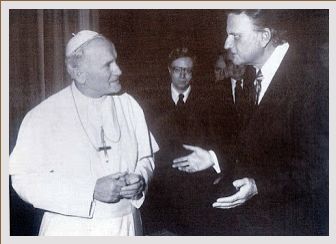
Billy Graham: asked about the Pope’s upcoming 1979 visit to the US,

The visit of Pope Paul II to the United States is an event of great significance not only for Roman Catholics, but for all Americans – as well as the world… In the short time he has been Pope, John Paul II has become the moral leader of the world. My prayers and the prayer of countless other Protestants will be with him as he makes his journey.

Later, asked about the recent pope’s death (Pope John Paul II, 2005) Billy Graham said:

“I think he’s with the Lord, because he believed. He believed in the Cross. That was his focus throughout his ministry, the Cross, no matter if you were talking to him from personal issue or an ethical problem, he felt that there was the answer to all of our problems, the cross and the resurrection. And he was a strong believer.”

Why is Billy Graham important to cite? He has been THE face of Christianity since 1949, his first Crusade. The first Crusade to be broadcast on television was in 1957, and anyone growing up in the latter half of the twentieth-century will have seen the preacher preaching in Crusade after Crusade. Sadly, he would only compromise Jesus’ Gospel later by forming alliances with Rome, and by denying the exclusivity of Jesus as the only way to salvation.

Warren, Graham, Keller, Hatmaker, Allen, Moore, among many others who should know better, don’t care that thousands of God’s people were murdered by the Catholic Church for daring to preach the true Gospel and express faith in the resurrected Jesus, a Jesus who is the only Head of the Church.

And He put all things in subjection under His feet, and gave Him as head over all things to the church, (Ephesians 1:22)

These men and women, and many others I did not cite, are blaspheming against the finished work of Christ.

The doctrinal lines are wide and they run deep. The divide between Catholic and Protestant is eternal and permanent. Thousands of martyrs died to preserve that line, while always inviting and preaching to those on the side of the looming punishment. Unity with falsity doesn’t save. Wiping away the lines of 500 years of blood and persecution by the very church with which they want to unite is perverted and gross.

Lest you think I am too harsh, see what one of very many preachers have said about Rome in their assertion that we must never, ever compromise the Reformation’s values again.

Here is Charles Spurgeon in 1864, from his sermon refuting Baptismal Regeneration (something Billy Graham believes in).

It is a most fearful fact, that in no age since the Reformation has Popery made such fearful strides in England as during the last few years. I had comfortably believed that Popery was only feeding itself upon foreign subscriptions, upon a few titled perverts, and imported monks and nuns. I dreamed that its progress was not real. In fact, I have often smiled at the alarm of many of my brethren at the progress of Popery. But, my dear friends, we have been mistaken, grievously mistaken. It really is an alarming matter to see so many of our countrymen going off to that superstition which as a nation we once rejected, and which it was supposed we should never again receive. I have but to open my eyes a little to foresee ROMANISM rampant everywhere in the future, since its germs are spreading everywhere in the present. I see this coming up everywhere – a belief in ceremony, a resting in ceremony, a veneration for alters, fonts, and Churches – a veneration so profound that we must not venture upon a remark, or straightway of sinners we are chief. Here is the essence and soul of Popery, peeping up under the garb of a decent respect for sacred things.

What would Spurgeon make of today’s evangelical leaders and their acceptance of Rome? No, we need the Reformation. It still matters.


 

Posted in encouragement, Uncategorized

The Reformation shows us why we need expository preaching

With the 500th year anniversary of the Reformation coming upon us October 31, many people are looking to history and learning Martin Luther and his the men that came before him.

Martin Luther is generally acknowledged to have been a main spark to the Protestant Reformation. Protestant comes from the word protest, which Luther’s 95 Theses sparked against the Roman Catholic Church’s excesses of indulgences (sin absolution for hire) and other abuses.

Here, John MacArthur explains in a 1:33 clip How unhindered access to God’s Word changed history.

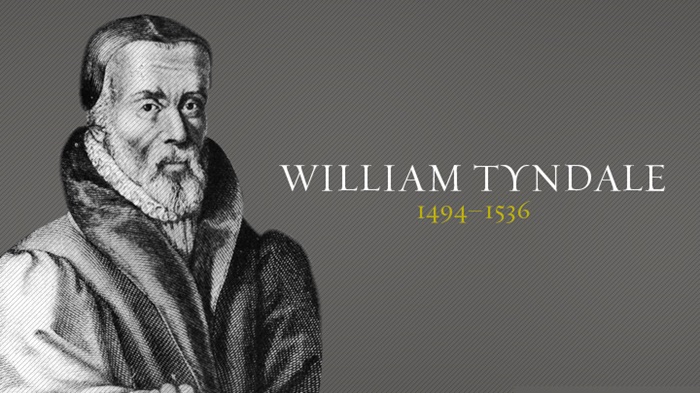
William Tyndale, John Hus, and many others were executed for translating or preaching the Word in the people’s language. The Roman Catholic Church prevented the Catholics from reading the Word themselves and from possessing and reading a Bible. Mass was performed in Latin. The RCC was fearful that if the people got a-hold of the Word, they would be uncontrollable. So it was restricted. For a thousand years.

William Tyndale: “Let it not make thee despair, neither yet discourage thee, O reader, that it is forbidden thee in pain of life and goods, or that it is made breaking of the king’s peace, or treason unto his highness, to read the Word of thy soul’s health—for if God be on our side, what matter maketh it who be against us, be they bishops, cardinals, popes.”Christianity Today

Read the word for thy soul’s health. When push comes to shove, and you are undergoing a tragedy and need comfort, or are under conviction and need some solace, the pastor’s witty anecdote is not going to help you. The pastor’s fad-driven bullet point topical sermon is not going to help you. The greatest help we have is the Word- with the Spirit to illuminate us to our mind. There is nothing like the word, because it is alive.

Let each true church commit to expository preaching. What IS expository preaching?

Expository preaching involves the exposition, or comprehensive explanation, of the Scripture; that is, expository preaching presents the meaning and intent of a biblical text, providing commentary and examples to make the passage clear and understandable. The word exposition is related to the word expose — the expository preacher’s goal is simply to expose the meaning of the Bible, verse by verse. Source

Read the word to the people, explain what it means in context, repeat next Sunday.

Do we need fancy stunts? Do we need extreme stage lights and fog machines? Do we need motivational speeches? Do we need to change the church so we can attract the goats seekers and meet their “felt needs“? Do we need to ditch everything and be radical, wild at heart manly men?
No.

Martyn Lloyd Jones said,

Another argument that I would adduce at this point is that the moment you begin to turn from preaching to these other expedients you will find yourself undergoing a constant series of changes.

Does your church still do the Prayer of Jabez? Undergo 40 Days of Purpose? Wear a WWJD bracelet? Maintain membership in Promise Keepers? Are you still renovating your prayer closet/war room? Do you see how many changes you have to make when you focus on the world and its church fads? If you preach the word, it does not change. It may change you, but it does not change. John MacArthur has been preaching it from the same pulpit for nearly 50 years. He reads the word to the people, explains what it means in context, repeats next Sunday. I hope your pastor does too.

Expositors today preach the Word. The evangelists in the Second and First Great Awakenings preached the Word. The Reformers preached the Word. Apostle Paul preached the Word. Jesus preached the Word. Ezra preached the Word. Noah preached the Word.

Knowing the blood of the martyrs soaks the ground under thousands of stakes, how dare we insert our own words, opinions, fads, and stunts onto the pulpit? Men died for this Word to be preached. Jesus as the Word suffered and absorbed all God’s wrath for the elect so this word would go out and be preached.

Pastors, please exposit the word.

preach the word; be ready in season and out of season; reprove, rebuke, and exhort, with complete patience and teaching. (2 Timothy 4:2)

Posted in encouragement, Uncategorized

The Gospel in one minute- a humbling reminder

Dr Steven J. Lawson hosts a Men’s Bible Study each week, as well as preaches and teaches elsewhere (i.e. Expositor.fm and The Master’s Seminary). Here is a short promo for one of the weekly studies that was held this month. It explains The Gospel in one minute. We all need to preach the Gospel to each other, every day. We are sinful creatures that forget the deep sinfulness of our nature, and we diminish the majesty and humility of Jesus’ torment on the cross. Take one minute to listen, and thank our Lord for being a Suffering Servant to His Father, and for our behalf.

Posted in Uncategorized, visual theology

Chris Powers’ sketches the Beatitudes: Mercy

Matthew 5:7, “Blessed are the merciful, for they shall receive mercy.”

O, Lord, help me to be merciful tho those who doubt, the poor and vulnerable (Jude 1:22, Proverbs 19:17, Matthew 25:40). I received mercy in great measure. Help me to always remember from whence mercy came.

chris powers

Chris Powers is the artist behind Full Of Eyes Ministry. Full of Eyes is creating free visual resources for the global Church.

He produces animations, art, and tracts of Biblical illustrations with verses and explanations, in a powerful way. He is on Patreon (where you can donate) as well as Youtube and the web at fullofeyes.com.

Posted in discernment, Uncategorized

Questions: Preaching Christ from every text?, Muslim dreams, Female submission

Here are answers to some pressing questions I’ve seen asked over the last few weeks.

Should we preach Christ from every text? Answer: no. By Abner Chou, The Master’s Seminary, October 2017.

In essence, the Christocentric hermeneutic attempts to find Christ as the subject or topic of every text. It desires to show that every text relates directly to Christ. Which is why some say it is the only true Christian preaching. The problem ensues when the Christocentric hermeneutic applies that mindset to texts that don’t call for it.

~~~~~~~~~~~~~~~~~~~~~~~~~~~~

Are droves of Muslims coming to faith in Christ via dreams and visions? Answer: No. Gary Gilley explains by comparing to scripture, in this essay from 2016.

Jesus used a variety of approaches when speaking with unbelievers, depending on the individual or group (e.g., Nicodemus, Rich Young Ruler, Woman at the Well), but typically He identified who He was, confronted their sin, called them to repentance, called them to believe in Him, cautioned them to count the cost of discipleship, and admonished them to take up their crosses daily and follow Him. He didn’t state all those elements in every case, but collectively they constituted the thrust of His message

By way of contrast, Isa [Muslim version of Jesus] typically identifies who he is (or the dreamer instinctively knows who he is) and tells the dreamer he loves him and wants him (the dreamer) to follow him (Isa). Sometimes the dreamer is overwhelmed with a sense of love and peace just by being in Isa’s presence (which was never the case with unbelievers in the presence of Jesus). So the message that emerges is one of believing in Isa and following him apparently apart from the Holy Spirit convicting of sin, righteousness, and judgment (John 16:8).

~~~~~~~~~~~~~~~~~~~~~~~~~~~~

Do women have to submit to all men? How can we demonstrate that although the roles of men and women in the church (and the home) are very different, we are equal in value in the sight of God?

To answer your question, women are to submit to their husbands.

Wives, submit yourselves to your own husbands as you do to the Lord. (Ephesians 5:22)

All church members are to submit to their overseers.

Obey your leaders and submit to them, for they are keeping watch over your souls, as those who will have to give an account. Let them do this with joy and not with groaning, for that would be of no advantage to you. (Heb 13:17)

We are all to submit to God.

Submit yourselves therefore to God. Resist the devil, and he will flee from you. James 5:7.

We all have to submit to government. Romans 13:1-7; 1 Peter 2:13-17

Women do not have to submit to random males.

We believers are all of equal value in the sight of God. This value is from above, it is not attached to man-made standards of who has what role. We do not have to demonstrate this love, God already has.

So God created man in His own image; in the image of God He created him; male and female He created them (Genesis 1:27).

But God demonstrates His own love toward us, in that while we were still sinners, Christ died for us. (Romans 5:8).

wedding verse


Posted in discernment, Uncategorized

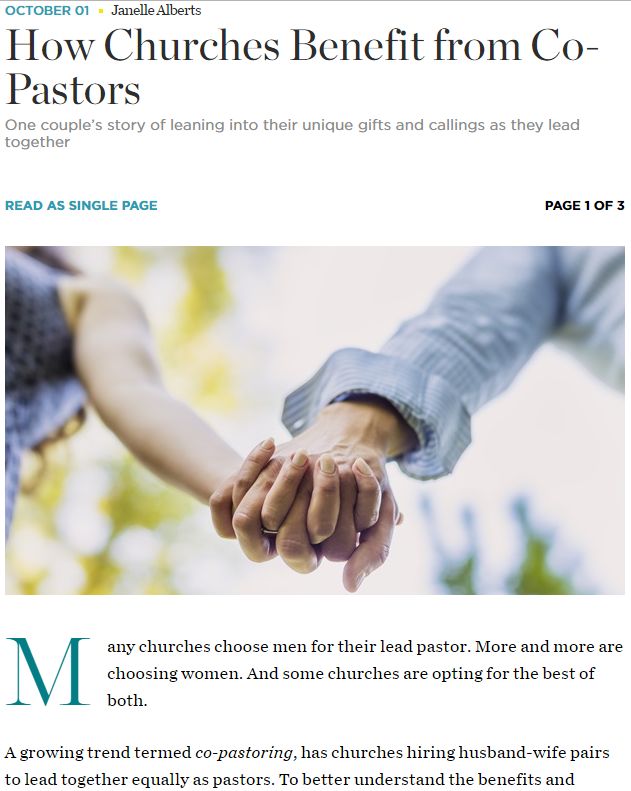
When did co-pastor married couples become acceptable?

In 2007 Thabiti Anyabwile wrote:

It was once a rising trend. It’s now a model for ministry for significant numbers of churches and pastors. It simultaneously offers itself as an example of deep partnership between husbands and wives, and dismisses biblical instruction. What am I talking about? The widespread approach to pastoral ministry where a husband and a wife “co-pastor” a local church.

Co-pastoring in this case refers to churches where the male pastor and his wife are listed as equal pastors of the flock. Since that article above was written ten years ago, co-ed co-pastors are touted as something acceptable – desirable even.

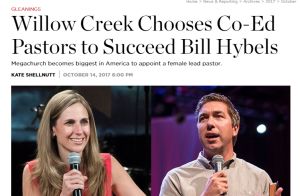
These two are not married but are in a co-ed, egalitarian pastorate.


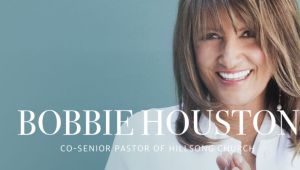
Not just co-pastor, but co-SENIOR pastor. Bobbie loves them titles.
V. Osteen: co-pastoring, which dilutes her motherly duties, is not a good trade.
This article is from Christianity Today. No wonder
the magazine’s nickname is Christianity Astray

I remember the Presidential election of 1992. Bill Clinton was running. His wife is Hillary Clinton. Clinton used to brag that “America was getting two for the price of one.”

It was during the 1992 presidential campaign that Arkansas governor Bill Clinton — the nation’s first baby-boomer presidential candidate, running against President George H. W. Bush — used the phrase “two for the price of one.” This twofer concept was Clinton’s quaint way of bragging (to the delight of feminists) that his wife, Hillary, an accomplished corporate lawyer and fellow Yale Law School graduate, was going to play a major role in his administration well beyond that of a traditional First Lady. (National Review)

How did that work out for them? Hillary led a Health Care Reform that crashed spectacularly and she was publicly humiliated. Then Whitewater Scandal happened and things got worse.

From the moment she dazzled Capitol Hill last autumn (‘In future the President will be known as your husband,’ Dan Rostenkowski, who chairs the House Ways and Means Committee, gushed at one appearance) Hillary has been her plan’s most potent weapon. No longer. In Washington more than anywhere, vulnerability equals weakness. Today Hillary Clinton is vulnerable; so, therefore, is Bill Clinton. ‘Two for the price of one’ has turned from blessing into curse. (The Independent UK, 1994

America was not impressed with the twofer Presidency. Even less so, are Christians impressed with a twofer pastorate.

Simply put, the Bible forbids women preaching. Church teaching is meant for the men to perform. The leading is to be done by the men.

I do not permit a woman to teach or to exercise authority over a man; rather, she is to remain quiet. (1 Timothy 2:12).

Elders/overseers/pastors are to be “above reproach”, and “a man”. (Titus 1:5-8).

Installing a “twofer” pastorate, whether both are paid or not, formal or informal, defacto or explicit, is unbiblical.

At a recent Grace Community Church Q&A a man asked John MacArthur,

“Would you ever allow your wife to preach?”

Posted in discernment, Uncategorized

Homosexuality is still a sin, despite plaudits for the scene in #Victoria

I’ve been watching the TV series Victoria, a series about Queen Victoria and her monarchy. It’s fictionalized, but with episodes focusing on actual historical incidents. The reviews seem to render it historically accurate for the most part. There are a few minor things that aren’t exactly correct, and some things they collapsed in time or for effect. However, there is one scene which, well, isn’t accurate at all.

The homosexual community had heard that season 2 of the series was going to feature a gay sub-story. The LGBTQ’s were happy about this. As it happened, Lord Alfred Paget and Edward Drummond (Prime Minister Robert Peel’s private secretary) have been depicted all season as two men attracted to each other, with longing looks across drawing rooms, yearning among the manicured gardens, loaded innuendo, and sly smiles. The tension between the two men had been building until they exploded into a kiss while ambling along a pond shore.

Sadly, many tweets and messages along these lines emerged afterward:

Source Radio Times

The scene to which I refer today is the one afterward with the Lady in Waiting Duchess of Buccleuch, played by a historically inaccurate 79 year old Diana Rigg (the real Duchess was only 8 years older than the Queen, not 50-plus years.)

Spoiler…

In history, there was an assassination attempt on PM Peel’s life. Peel’s secretary Drummond really was shot by a bullet meant for Peel. He died five days later at home, not instantly as the show depicted. In the show, Drummond heroically leaped in front of the Peel, shoving him aside and saving his life. Creative license for dramatic tension, that’s OK. But Paget was left bereft that his blossoming love affair with Drummond was cut quite short. When the Duchess received the news of Drummond’s sacrificial death, she called for Paget and brought him into a private drawing room. She compassionately told him the news about Drummond’s death. Then she gave sage advice about hiding his grief from the mother and the fiance at the funeral. “They must be the chief mourners”, she said.

The Duchess said with care and concern in her eyes that she may be old but she is not blind, and had seen how the two looked at each other.

This is anachronistic. The British attitude toward homosexuality was that it was repulsive and reprehensible, and a threat to family life. It was immoral, as encapsulated in the various laws that were not eventually repealed in all corners of the United Kingdom until 1992. They even coined a term for it, “The Love That Dare Not Speak Its Name.”

Laws for society combatting same sex relations have dated back to the sixteenth century (Upchurch 14), and much of British society deemed homosexuality as ‘the worst of crimes’ (Upchurch 49). This unspeakable act threatened the stability of Victorian society (Brady 46) so much so that a homosexual identity did not exist in this era (Brady 17). This does not mean that British citizens did not know the characteristics of these types of men, and they had a great distaste for them (Brady 11) during the nineteenth century (Upchurch 13).
Many believed that one could not be moral and have these sexual relations (Upchurch 16), and for this reason homosexuality was the most problematic issue facing British society (Upchurch 16). For this fundamentally British society, it was embarrassing to speak of this sexual issue (O’Connor 112). If it was a wildly spoken of topic, the structure of society would ‘have been shaken at its foundations (Brady 1-2; Brady 24). Source

So a Duchess cooing and comforting a young man devastated at the loss of a homosexual lover would never have occurred, partly because such things were never discussed, and partly because such a co-ed discussion would be considered uncouth.

These modern-day attitudes inserted into historical dramas are a problem. They might make certain powerful lobbies happy, but they aren’t an accurate window of the general attitude of the times. Once we see these kind of anachronistic attitudes often enough, we might start to believe the propaganda.

Though homosexuality has been with us since after the Fall, it might be good to look at what the Bible says about it, rather than listening the constantly pressuring culture. Even though we reject the pressure, at some point it might be making inroads to our mind, which is supposed to be transformed to holiness in the likeness of Christ.

The Bible is clear that God created humans to enjoy sex only within the marriage between a man and a woman. (Genesis 1:27, 28; Leviticus 18:22; Proverbs 5:18, 19). The Bible condemns sexual activity that is not between a husband and wife, whether it is homosexual or heterosexual. (1 Corinthians 6:18).

When Jesus smote Sodom and Gomorrah for homosexuality it was actually an example of judgment that will come upon all those who indulge “unnatural desires.” As Jude 1:7 states,

just as Sodom and Gomorrah and the surrounding cities, which likewise indulged in sexual immorality and pursued unnatural desire, serve as an example by undergoing a punishment of eternal fire.

Romans 1:28-32 shows the progression of sin in an individual heart or a nation’s heart. Homosexuality is nearly last in the progression into darkness, demonstrating how far a society has sunk when they finally begin to engage in the sin of homosexuality.

Because of this, God gave them over to shameful lusts. Even their women exchanged natural sexual relations for unnatural ones. In the same way the men also abandoned natural relations with women and were inflamed with lust for one another. Men committed shameful acts with other men, and received in themselves the due penalty for their error. (Romans 1:26-27)

Homosexuality according to the Bible is detestable, shameful, contrary to sound doctrine, and people practicing it are wrongdoers. (Leviticus 20:13, 1 Corinthians 6:9, 1 Timothy 1:10, Romans 1:27)

God never accepts homosexuality as normal. It isn’t.

However, if you repent, He will forgive you and He sends the Holy Spirit to help resist ungodly lusts.

If you or someone you know are struggling with a loved one who indulges homosexual desires, here are a couple of excellent resources. Though we do not condone any sinful behavior, including homosexuality, we must

Show proper respect to everyone, (2 Peter 2:17a, NIV)

What Letter Would You Write to A Gay Son?

David Murray explains,

Five years ago, Redditor RegBarc “came out” to his father. Shortly afterwards, his dad disowned him in a handwritten letter which RegBarc shared with the world on Tuesday, adding the comment: “This is how hate sounds.”

He’s right, it was a hateful letter. Murray continues,

As I find it hard to believe that a true Christian would ever write such a letter, I’ve drafted a letter that I hope a Christian father would write (although I’m sure we all hope we’ll never have to write it).

The second, hypothetical letter is beautiful. It’s what love sounds like.

The 9Marks Mailbag is the best thing I read online on a consistent basis. Their answers are grace filled and practical, firmly based on a biblical worldview. It’s very helpful. This answer by ex-homosexual Rosaria Butterfield is the most helpful I’ve seen on this subject.

How should parents treat their 18-year-old daughter’s relationship with her girlfriend? How do we love them without condoning their sin?

Posted in encouragement, Uncategorized

Reformation resources for you!

The 500th anniversary of the Reformation is coming up on October 31st. This is the date when, 500 years ago, Roman Catholic monk and professor Martin Luther nailed his 95 Theses to the University of Wittenberg’s chapel door. Nailing a tract on the door was not in itself an act of rebellion, but rather the usual and customary method of starting a discussion among scholars of religious points of the day. It was the 16th century’s version of the internet.

However, Luther’s theses were not just questions and discussion points, but a devastating critique of Roman Catholic practices. Luther had found in his studies that Roman Catholic faith and practice varied greatly from the word of God. Luther was especially upset over the practice of Indulgences, or payment to the Church for reduction or absolution of certain sins. Paying for sins to be forgiven seemed incredibly wrong to Luther. He wrote up his questions, intending to spark a discussion.

He sparked a discussion.

The discussion has been ongoing for 500 years.

The discussion split The Catholic Church and pitted it against those who were protesting, now known as Protestants.

The most confusing thing to me when I was an unsaved person was the Catholic Church. I thought it was a Christian church. Because of its size and longevity, I thought it represented true Christianity. What I didn’t know was that the Roman Catholic Church (RCC) is as far from Christianity as the east is from the west. It does not represent the faith of Jesus, but instead is a false belief system.

The protest Luther made was against certain practices and doctrines of the RCC. For example, the Jesus we know through the inspired scriptures is the central authority, not the Pope or other officials. Practices and rituals and good works do not save. Indulgences are nowhere found in the Bible. Though Luther initially wanted to renew the church, eventually it divided over these and other issues, and the Protestant reformation began.

Here are some Reformation Day resources for you-

Why We’re Protestant: An Introduction to the Five Solas of the Reformation Kindle Edition. A paperback edition exists. By Nate Pickowicz, Foreword by Steven J. Lawson. Nate is a pastor who shepherds a church in New England. His wife Jessica has written a Bible study to go along with MacArthur’s new book, Biblical Doctrine and facilitates a Facebook group regarding the weekly study sessions.

Synopsis: How do you discern true vs. false Christianity? In the days of the Protestant Reformation, the core tenets of the faith were strenuously examined. In the end, the Reformers maintained that at the heart of the Christian faith stood five main credos: sola Scriptura, sola gratia, sola fide, solus Christus, and soli Deo gloria. This book examines these five “solas” and makes a definitive case for why we’re Protestant.

Reformation Women: Sixteenth-Century Figures Who Shaped Christianity’s Rebirth

By Rebecca VanDoodewaard. Rebecca and her husband William used to run a blog I liked, called The Christian Pundit.

Synopsis: Women are an essential element in church history. Just as Deborah, Esther, and the New Testament Marys helped shape Bible history, so the women of the Reformed church have helped to make its history great. In Reformation Women, Rebecca Vandoodewaard introduces readers to twelve sixteenth-century women who are not as well known today as contemporaries like Katie Luther and Lady Jane Grey. Providing an example to Christians today of strong service to Christ and His church, these influential, godly women were devoted to Reformation truth, in many cases provided support for their husbands, practiced hospitality, and stewarded their intellectual abilities. Their strength and bravery will inspire you, and your understanding of church history will become richer as you learn how God used them to further the Reformation through their work and influence.

Long Before Luther: Tracing the Heart of the Gospel From Christ to the Reformation by Nathan Busenitz  (Author), John MacArthur (Foreword)

Synopsis: Where was the gospel before the Reformation?

Contemporary evangelicals often struggle to answer that question. As a result, many Roman Catholics are quick to allege that the Reformation understanding of the gospel simply did not exist before the 1500s. They assert that key Reformation doctrines, like sola fide, were nonexistent in the first fifteen centuries of church history. Rather, they were invented by Martin Luther, John Calvin, and others.

That is a serious charge, and one that evangelicals must be ready to answer. If an evangelical understanding of the gospel is only 500 years old, we are in major trouble. However, if it can be demonstrated that Reformers were not inventing something new, but instead were recovering something old, then key tenets of the Protestant faith are greatly affirmed. Hence, the need for this book.

The Mother of the Reformation: The Amazing Life and Story of Katharine Luther

by Ernst Kroker. Synopsis- The author paints an intimate picture of Katie and of family life in the Black Cloister during the formative years of the Reformation, showing how Katie s marriage to Martin Luther was a multifaceted vocation, with such tasks as household brew mistress, cloister landlady, property overseer, gardener, cow- and pig-herder, and fishwife. Indeed, Katie oversaw their home much like a lord in her kingdom, yet in the midst of it all stood the man to whom her work, concern, and duty were directed.

Resources for children

The Barber Who Wanted to Pray by R.C. Sproul

Synopsis: This imaginative tale from R.C. Sproul, based on a true story, begins one evening with Mr. McFarland leading family devotions. When his daughter asks him how she should pray, Mr. McFarland shares a 500-year-old story about a barber and his famous customer.

Master Peter is a barber well-known to all in his village. One day, when Martin Luther the Reformer walks into his shop, the barber musters up the courage to ask the outlawed monk how to pray. Luther responds by writing a letter to the barber. The barber’s life and many others’ are changed as they encounter a model for prayer by using the Lord’s Prayer, the Ten Commandments, and the Apostles’ Creed.

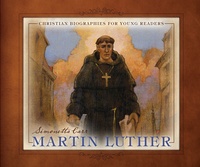
Martin Luther- Christian Biographies for Young Readers, by Simonetta Carr

Synopsis- Five hundred years ago, a monk named Martin Luther wrote ninety-five questions, hoping to start a discussion about sin and repentance at the University of Wittenberg in Germany. In a few months those questions had stirred the nation; a few years later, the continent. Today we know that those questions changed the course of both the Western church and world history. In this volume for children, Simonetta Carr tells the compelling story of this father of the Protestant Reformation, tracing his quest for peace with God, his lifelong heroic stand for God’s truth, and his family life and numerous accomplishments. The Reformer’s greatest accomplishment, she writes, “has been his uncompromising emphasis on the free promise of the gospel.”

Movie

Martin Luther: The idea that changed the world, PBS documentary, 9/2017, as synopsized by Banner of Truth Trust here. The PBS documentary has an extended trailer here. Official website here.


Posted in encouragement, Uncategorized

We’re not THAT bad of sinners, are we??

Who goes to heaven?

“I’m a pretty good person. I’m going to heaven for sure.”

“I’m nice. Definitely I’m going to heaven.”

“I’m certainly not a Hitler! It’s people like serial killers or dictators that won’t go to heaven.”

If you’re like me, you hear comments like that all the time. I used to think that I was nice enough and that I was headed for heaven too.

But then a little worm of doubt would set in. I’m nice, most people are nice, but if that was true why is the world like it is? Why would heaven be any different than earth if all the same people just transfer from here to there?

In witnessing to people and telling them they are sinners as I am, they reject almost instantly the notion that their sins would prevent them from going to heaven. This is because they compare their sins to other people, and always the worst people, of course. Hitler, Idi Amin, OJ Simpson, Jeffrey Dahmer… now those are some bad people. I’m not like them. Ergo, I am heaven bound.

Trying to let people know the level of their depravity is a hard task. Even most Christians don’t truly understand the depths to which our sin have plunged. I’m reminded often by the Holy Spirit that no matter how wretched I know I am, there are still many layers of muck I can sink to. I’m often astonished at how deep my sin goes.

We’re not good. We’re bad. As a matter of fact, we’re a lot worse than we think.

Unsaved people will balk at this truth. We’re wretched, really putrid. Here is an example from the bible of how wretched we are.

As we were going to the place of prayer, we were met by a slave girl who had a spirit of divination and brought her owners much gain by fortune-telling. She followed Paul and us, crying out, “These men are servants of the Most High God, who proclaim to you the way of salvation.” And this she kept doing for many days. Paul, having become greatly annoyed, turned and said to the spirit, “I command you in the name of Jesus Christ to come out of her.” And it came out that very hour.

But when her owners saw that their hope of gain was gone, they seized Paul and Silas and dragged them into the marketplace before the rulers. (Acts 16:16-19).

demons
EPrata collage

Notwithstanding the issue of slavery, the owners of the girl were using her to get rich. She had a demon and that demon could access the world behind the veil and prophesy unknown things. Since people have always been curious about the future and what is hidden to us, they paid good money to hear fortunes told.

When the owners saw that their means of gain was gone, they roused a riot and went to the lawmakers and decision-makers for redress.

They did not celebrate that the girl had been delivered. They were not happy that her very body was now released from use by a potent spirit. They did not care that this young, vulnerable girl had been used by demons. They were only ticked that their fortune was vaporizing.

This is exactly the same situation as a child molester kingpin now ticked that his best girl had been saved out of his grip. Exactly. The. Same. This is deep wretchedness. We are sinners through and through. Do not think for a moment that your sin (and mine) is not as bad. It is and it could and would wax worse and worse had not the Lord saved your soul.

This link goes to a short bio of this young girl from BibleGateway, called All the Women of the Bible: The Demon-Possessed Damsel. It is extremely interesting.

We are wretches, sinners and we are due the righteous penalty for our sin. But God…if not for Him…if not for His proactive election of those who would become His… Oh! Oh!

We love because he first loved us. (1 John 4:19).

He loved us despite our wretchedness. He loved us despite our dirtiness. He loved us anyway. I’m eternally grateful for His love. I’m eternally relieved He has dealt with my sin. It is now forgotten, nailed to the cross, and as far from the east is from the west.

Thank you Lord for dealing with my wretched sin in this magnificent way you have ordained.

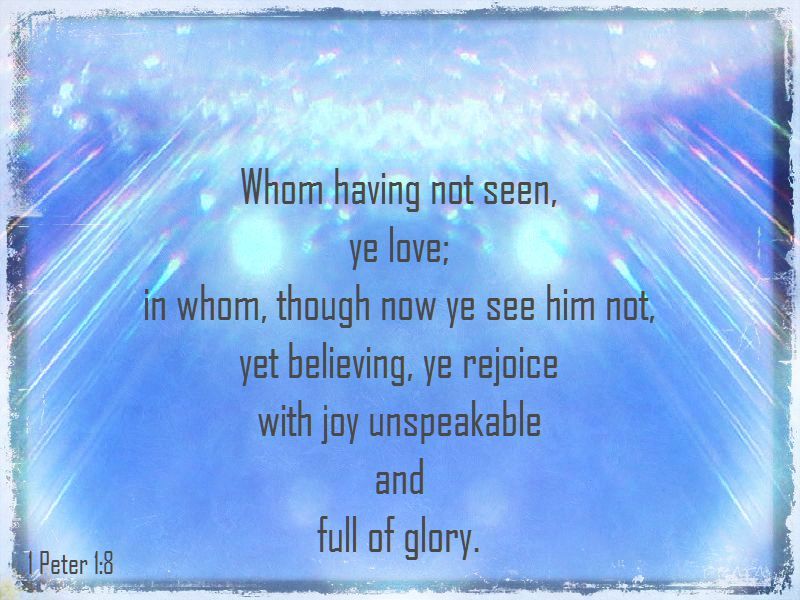
unspeakable glory
EPrata art
Posted in encouragement, Uncategorized

Prayer, an act of worship

Excerpt from David McIntyre’s The Hidden Life of Prayer, chapter 6. This book, written in 1913, is available for free online, as well as for purchase in book or Kindle form.

The prayer of faith, like some plant rooted in a fruitful soil, draws its virtue from a disposition which has been brought into conformity with the mind of Christ.

1. It is subject to the Divine will-“This is the confidence that we have in Him, that, if we ask anything according to His will, He heareth us” (1 John 5:14).

2. It is restrained within the interest of Christ-“Whatsoever ye shall ask in My name, that will I do, that the Father may be glorified in the Son” (John 14:13).

3. It is instructed in the truth-“If ye abide in Me, and My words abide in you, ye shall ask what ye will, and it shall be done unto you” (John 15:7).

4. It is energized by the Spirit-“Able to do exceeding abundantly above all that we ask or think, according to the power that worketh in us” (Eph. 3:20).

5. It is interwoven with love and mercy-“And when ye stand praying, forgive, if ye have ought against any; that your Father also which is in heaven may forgive you your trespasses” (Mark 11:25).

6. It is accompanied with obedience-“Whatsoever we ask, we receive of Him, because we keep His commandments, and do those things that are pleasing in His sight” (1 John 3:22).

7. It is so earnest that it will not accept denial-“Ask, and it shall be given you; seek, and ye shall find; knock, and it shall be opened unto you” (Luke 11:9).

8. It goes out to look for, and to hasten its answer “The supplication of a righteous man availeth much in its working” (James 5:16, RV).34

But, although the prayer of faith springs from a divinely-implanted disposition, there is nothing mysterious in the act of faith. It is simply an assurance which relies upon a sufficient warning.

rejoice in hope prayer