Posted in theology

Attributes of God: Spirituality, Truthfulness, Unity

By Elizabeth Prata

Sundays are a good time to ponder who God is. He is worthy of service and worship. We have been taking a look at God’s attributes each Sunday. Links to previous weeks are below. Most definitions are taken from Tim Challies’ visual theology chart of the attributes of God.

Remember, God’s attributes are not parts that make up a whole. Everything good that there is, is 100% contained in God. He is 100% beauty, 100% aseity, 100% omniscient, etc. He is complete in Himself.

Tim Challies explained: “To study God’s attributes is to study his character, to answer questions like, Who is God? and What is God like? A typical classification of God’s attributes divides them into those that are incommunicable (those that he does not share or “communicate” to anyone or anything else) and communicable (those that he shares with other beings). Like most theological classifications, this one is imperfect but still helpful as we seek to understand what is so far beyond ourselves. God’s communicable attributes can be further categorized into: attributes of God’s being, mental attributes, moral attributes, attributes of purpose, and “summary” attributes (attributes that, in a more particular way, modify each of the others).”

SPIRITUALITY: Attributes describing God’s Being. God is a being who is not made up of matter and who cannot be perceived by our bodily senses.

TRUTHFULNESS: Mental Attributes: God is the true God whose knowledge and words are both true and the final standard of truth.

UNITY: God’s whole being includes all of his attributes at all times. These attributes are never in opposition.

Next week, the series concludes.

Previous weeks

1. Aseity, Beauty, Blessedness
2. Eternity, Freedom, Glory
3. Goodness, Holiness, Immutability
4. Invisibility, Jealousy, Knowledge
5. Love
6. Mercy, Omnipotence, Omnipresence
7. Peace, Righteousness, Perfection

Posted in theology

Potpourri: Books. All about books.

by Elizabeth Prata

Christians are readers, usually. We read THE Book, the Bible. We read devotionals. We read sermons. We read Christian matter from days of old like the Puritans, and modern stuff published today.

I love books. I always have. When I was growing up there were always books around. My father read business books and trade magazines. He had a magazine stand next to “his chair”, and a good lamp to aim the light directly on what he was reading. There were always one or two books on the table next to his chair. I found that same vintage lamp in an estate sale store a few years ago, and I bought it.

My mother always read books and had a floor-to-ceiling library in her house. I often liked to look at all the titles, Leon Uris’ Exodus, John Galsworthy set with Swan Song, The Silver Spoon, etc. Reference books like atlases and books on the Renaissance ignited my imagination. I know many of you love books too.


Anyway, it seems that a treasure trove of Middle Ages books was found in a Romanian church tower! This is so cool!

‘Forgotten archive’ of medieval books and manuscripts discovered in Romanian church


From Romania, we go to Turkey to find that Turkish garbage collectors have created a library from discarded books. This story starts:

“Yes, there is a library in Ankara composed entirely of books thrown out (presumably) by people who hate reading (or who work in publishing). After Turkish garbage collectors began finding more and more trashed books, they decided to start organizing them in an abandoned brick factory—and voila, a library was born.”

“At first, the surplus books were lent out to friends and families, but as the library gained in popularity the garbage collectors opened things up to the public, who also began to donate books. With a collection of over 6,000 books, the local municipality, Çankaya, found room in the budget for a full-time library employee, and has converted a garbage truck into a mobile library that doubles as a donations truck.”

Go here to read the full story.


We have some photos of books I found on Twitter-

Source
Source

Autumn and Books

Source

Books vs. Kindle-


The Old Florida Bookshop in Ft. Lauderdale, FL is the coolest antiquarian bookshop I’ve come across in years. Check out their website: Purveyors of antique maps, rare prints, ephemera, antiquarian books.


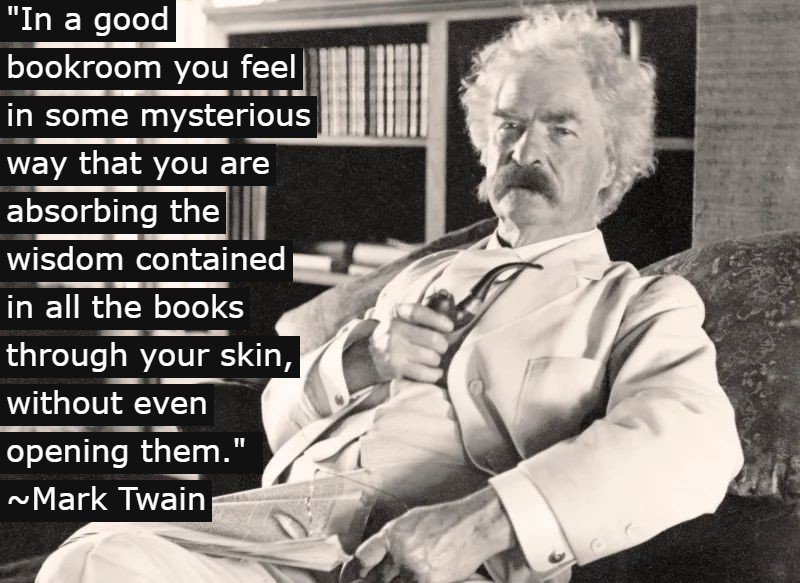
Samuel Langhorne Clemens (1835 to 1910), known by pen name Mark Twain. Photograph taken in his old age.  Universal Images Group/Getty Images – Source

Yup, that’s exactly how I feel in my book room!

Top 2 shelves secular books on various topics. Bottom 3 shelves: Christian Living and Women’s

I hope you all have some time to read a good book today.

Posted in theology

Bullet points on why Joyce Meyer is a false teacher

By Elizabeth Prata

A reader this week suggested making a short list of “What’s wrong with Beth Moore” that quickly shows why people should avoid her teachings. I do have a compendium of links of various types in one place. Some are videos, some are podcasts, some are essays. They’re written by pastors/theologians, women Bible teachers, and me. The critiques start in 2011 and go to the present day.

Anyone can look at the links and pick one that suits the targeted individual the person is trying to help avoid Beth Moore.

But while that is helpful, it might be overwhelming for some people, the reader suggested. So a short list was mentioned. I remembered I had done a bulleted list about Joyce Meyer, below. I also did a fairly short bulleted list about Lysa TerKeurst, here.

So I said to the reader I’d do it for Beth Moore, too. But meanwhile, when I dug this one out to review its format and check over my previous work, I present it to you today.


Bullet points on why Joyce Meyer is a false teacher

Joyce Meyer is a very popular female Bible teacher and preacher. She has been on the scene for decades, and shows no signs of slowing down. She has 10 offices around the world and employs 500 people. Her brand of charismatic/name-it claim it religion has deceived many. This is sad, but the Bible says that many will be deceived by false teachers. I pray that anything here will spark a further Berean investigation by the reader and through prayer, come to the other side of discernment in understanding why Meyer should be avoided.

  1. Joyce Meyer preached that Jesus was a sinner, had been born again, stopped being the Son of God, paid for our sins in hell (from 1991 Booklet called The Most Important Decision you Will Ever Make), and was tormented there. Meyer preaches a different Jesus. She is a heretic.
  2. Joyce Meyer preaches to men and mixed gender audiences in violation of 1 Timothy 2:12.
  3. Joyce Meyer operated as an associate pastor in a church in violation of 1 Timothy 2:12.
  4. Joyce Meyer preaches that it is normal and expected to hear directly from God, when contrary to her claim, the scriptures claim they are sufficient (2 Timothy 3:14-17), and the Word is closed. (Revelation 22:18-19). Yet she teaches that God speaks individually to people today. Example, in essay “It’s not that complicated” (scroll down!) she wrote -“Do you ever wonder if God speaks to people? You’ll be happy to know the answer is yes. But first let me explain how distractions can hinder His voice” and taught more from her book How to Hear from God or in this video.
  5. Joyce Meyer claims she is not a sinner. This is in violation of 1 John 1:8, which says that such people are deceived and the truth is not in them.
  6. There’s more, but these should suffice to illustrate to the reader that Joyce Meyer’s teaching is not edifying.

Please do not allow a teacher’s longevity lull you into thinking they must be good. Please do not allow a ministry’s global breadth to lull you into thinking he or she is good. In fact the Bible says that popularity is often a mark of falsity. (Luke 6:26). The world wants their ears tickled. In 2 Timothy 4:3 we read

For the time will come when they will not tolerate sound doctrine; but wanting to have their ears tickled, they will accumulate for themselves teachers in accordance with their own desires,

If you follow Joyce Meyer, please consider these things. Please stay in the pure, undefiled faith, and find some good Bible teachers to follow, beginning with your own pastor and elders at your own church.

Posted in theology

Science is good when it’s good, but it’s not God

By Elizabeth Prata

Photo by Braňo on Unsplash

Climategate is one of worst but longest lasting scandals of our generation. (But then came Covid-gate).

Climategate was a 2009 expose where “The story was first broken by climate change denialists, who argued that the [hacked and published emails from climate scientists] showed that global warming was a scientific conspiracy and that scientists manipulated climate data and attempted to suppress critics.”

Just like with Coronavirus ten years later.

In both those cases and I’m sure others we could use as an example, rather than being a shining beacon pursuing truth amidst credible data, it reveals instead that a compromised scientific establishment deluded the world. Scientists who are held in positions of trust to pursue truth have instead misused their position to conceal truth, and at the expense of nations and their own consciences.

The issues of whichever-gate, of widespread manipulated scientific information, hidden data, and corrupted peer-review process transcend individual personal ambition and show how deep the corruption can go when arrogant men collude for greedy purposes.

Michael Seifert, CEO of officialpublicsq.com, said yesterday,

“A Pfizer exec admitted that their covid vaccine was never tested to prevent transmission and a study out of Florida found that the mRNA vaccine led to an 84% increase in cardiac related deaths among young men. Forcing it on the world is one of the biggest scandals in history.”

How does this scandalous approach affect the non-believer? How can we Christians use this information to point to God and reveal His works to a seeking heart? Especially now that coronavirus seems to be dying down and we don’t hear the word ‘pandemic’ as much. How are we to sort out our feelings on scientific betrayal, and a betrayal that affected just about everyone on the planet, intimately and sometimes permanently?

God has initiated many ways to reach His lost children. One way the LORD has shown Himself in His world is through science. Romans 1:20 says: “For since the creation of the world God’s invisible qualities—his eternal power and divine nature—have been clearly seen, being understood from what has been made, so that men are without excuse.

Any sensitive heart that has seen a delicate flower bloom, or wondered after the mystery of a colorful sunset, the everlasting sweep of tides, or a butterfly’s wing, has pondered His invisible attributes.

Yet satan has done a good job of separating us from God’s expression through science by deluding many into thinking that science IS God. Often we see that science can be wrong. Ida was hailed as the missing link in evolutionary theory, yet it’s not even a close relative. Do we have ten planets in our solar system? Or only 8? What killed the dinosaurs? Global warming? Or a comet?

Climategate strengthened the notion that we can, and should, question man’s scientific conclusions, especially in the face of evidence in front of us. Covid-gate confirmed it. Trust but verify has dwindled to either derisive untrust on one side or total blind trust on the other.

In many instances, science has failed, but God has never failed. If there is good to come out of these ‘science-gates’, it is that questioning science is essential. In this topsy-turvy world, we have seen people question God and accept science as gospel, when it should be the other way around. “Woe to those who call evil good, and good evil; Who substitute darkness for light and light for darkness; Who substitute bitter for sweet and sweet for bitter!” (Isaiah 5:20).

Science can often be a tool for good. Penicillin, pasteurization, and cancer treatments come to mind. Science by itself is not bad. But when scientific men seek to remove God from the equation, then anything can happen, and anything did. Science and men failed us in Climategate, COVID-gate, but God never does.

Posted in theology

How the invention of the sofa may have contributed to Jonathan Edwards’ firing, part 2

By Elizabeth Prata

Part 1 here

Yesterday I looked at the custom of bundling in New England of the 1600s and 1700s. Jonathan Edwards of Northampton, Massachusetts was grieved over this, and preached against it. Bundling was another custom among the youth, but this time, with parents’ approval. Edwards delicately termed it “company-keeping,” a weird practice that put a courting couple into the same bed together at bedtime, clothed or mostly clothed, sometimes with a board slotted between them, in which they talked and visited with each other through the night.

Bundling made sense to the folks of the time because Sunday was the only day that busy farmer boys could have time off to court women, candles and wood were precious, and since practically the only furniture in the house was a bed, which wasn’t in a bed room by itself, they allowed courting couples to lay on the bed clothed and talk through the night.

So where does the sofa come in?

A 1600s and early 1700s rural home did not have much furniture in it. And nothing was upholstered. People sat on a trunk, or a plank, or the bed, which was rarely sequestered into its own private room. The fireplace provided the only heat, so that’s usually where the bed or trunk or plank was. Additionally, there wasn’t really any place for two people to sit together. If someone had made a chair, it was for one. Sofas were not invented yet. There were no inns or hotels in rural colonial America. Travelers and visitors slept with an accommodating family.

As for courting couples, the visiting beau left the church service, he would be invited to the gal’s home and they would eat supper and visit. Perhaps he would also return with her family to the evening service. By then, it was dark, cold, and late. He would be invited back to the house to visit some more. There was no other time to court women, the farming community was all systems go every other day from dawn to bedtime. Sundays were it.

So as the day drew to a close, they’d continue to court by bundling together in bed. Rather than stay up and use costly candles or precious firewood for visiting into the late night, the courting pair would be allowed to lay down fully clothed under the covers of the bed, which was in view of the family who lived there. Some bundlers had a board slotted between them to discourage bundling too close. The couple could talk into the night and determine if they were compatible.

That was the idea anyway.

You would think that New Englanders would be happy not to have their unmarried sons or daughters lying abed with their courting pal. But no. They deemed it normal.

Atlas Obscura says, “In the heyday of bundling, ideas surrounding marriage and bedrooms were far removed from the privacy we currently hold dear. Bedrooms were semi-public spaces until roughly the late 18th century, and were used for anything from giving birth to entertaining guests. Bundling, which usually involved adolescents, just added one more ritual to the bedroom’s list of uses. Contemporary preacher Jonathan Edwards outwardly spoke against bundling as a risky practice teetering on the edge of dangerous promiscuity.”

Then in New England between 1670 and 1730 there was a burst of creativity with furniture design. Almost every kind of American furniture we commonly see today was invented then, including the upholstered sofa, where two people could sit together and talk intimately.

New Englanders do cling to their traditions, and bundling was, dare I say, embedded in the community. No one blushed and every community that practiced it (usually in rural areas where no hotel or inn or tavern existed) thought nothing of it. Where else would a traveler or a visitor sleep? But then Jonathan Edwards came along and firmly spoke against bundling. We know he did in sermons in 1729, 1741, and 1748 for sure.

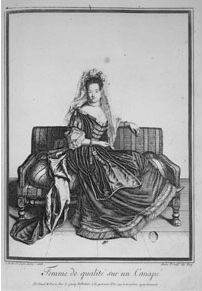
Then the sofa was created. It had been making inroads into living rooms in Europe – but New Englanders considered it too racy for people to sit on it! Why? The New York Times article “Couched in History” explains-

“These [illustrations and] prints also show off something that evolved along with the new furniture, a kind of sofa attitude. The ladies drape their arms over the back, stretch out their legs, tuck up their feet — hardly conventional poses for noblewomen of the 1690s. The images seem to suggest that sofas could make people freer, more relaxed, sexier even.” (Source)

That was a big NO for the Puritans. So the bundling continued.

Below- Lorette, Courtesy of Joan DeJean “Woman of Quality on a Canapé.“ Engraving, French, 1686. Canape was an early word for sofa.

The mindset was that daytime furniture that held more than one person at a time was too new to be trusted. Furniture that allowed for daytime reclining was off the charts mind blowing. And so bundling actually continued through the mid 1800s. It was a 160 year old custom that made total frugal sense to the frugal Yankees.

Eventually the Northamptonites became tired of being preached to about personal holiness. Yankee communities deeply guard their traditions, and take offense to being told to abandon them. Jonathan Edwards was fired in 1750, and one of the reasons often cited is due to his speaking against the bundling issue, among several others. I noted this in the part 1 of this 2-part series.

The takeaways here are:

From the vantage point of the Bible reader or any reader of history, it’s important to look at the context of a particular ritual or custom. It’s not an excuse, but they are often born of necessity and people cling to them for a reason. We shouldn’t judge too harshly or without contextual facts at least.

Maybe we in this day and age should re-think Youth Lock-ins or the Passion Conference…

History moves along in interconnected webs that are spurred along by inventions, discoveries, and world events. The interconnectedness of the New England custom of bundling, Jonathan Edwards’ continual push for personal holiness among his pastorate, and the invention of the sofa combined to make a particular situation in 1750 Northampton come to a head. Researching this reminded me of a 1978 PBS program called Connections. This show presented how-

“discoveries, scientific achievements, and historical world events were built from one another successively in an interconnected way to bring about particular aspects of modern technology”

and further, for example in one episode called “Distant Voices“, the educator looked at

two strands on developments in horse technology. The first on warfare, from the use of stirrups, improving saddles and moving to larger, stronger horses for carrying knights. The high costs of these led to a hereditary chivalry. The second strand, arising from the end of the 9th century with the development of the wheeled plough, the invention of the horse collar and the horseshoe, and the three-field system. The increased ability to use horses for both work and transport opening up the possibility of creating an agricultural surplus, and moving it for sale…

The invention of the stirrup in one part of the world founded a national economy in another. Nothing happens in a vacuum. That’s the takeaway.

If you think about it, that is how the Bible presents God’s work. Three deaths and a famine in one part of the world caused Naomi and Orpah and Ruth to move back to Naomi’s native Bethlehem, where Ruth met Boaz due to the custom of gleaning, and where Ruth and Boaz became part of the genealogy of Jesus in the same field where shepherds centuries later would see angels announcing the birth of the Savior… By the way, adherents of bundling in the 1600 and 1700s used Ruth and Boaz as the original example of chaste bundlers, perhaps stretching the Bible a bit to cover their custom.

God uses all things for the good of those that love Him, but also for His own glory. Therefore, to God be the glory!

Part 1 Here

Posted in theology

How the invention of the sofa may have contributed to Jonathan Edwards’ firing, part 1

By Elizabeth Prata

Jonathan Edwards. Puritanical. Bundling. Church. American Colonial era. Youth. Furniture. It all ties in.

The Puritans founded New England after they departed the European Continent in the early to mid 1600s. Though they are often painted as severe, fun-denying, holier-than-thou type folks, the Puritans were actually leisure-loving folk who took personal holiness seriously. Or, they were people who took holiness seriously, but also knew how to have fun. However, a common practice in Early New England distressed Northampton, Massachusetts preacher Jonathan Edwards to no end: it was called bundling.

As any youth pastor knows, youths’ level of frivolity and hijinks can rise to unmanageable levels in a heartbeat. And it was no different in the mid 1700s when Edwards preached in Northampton. In fact, there were many laws enacted in Massachusetts during that time regarding “nightwalking,” youthful frivolity and hijinks in town which resulted in curfews for youth and fines against parents who allowed their teens to roam at night causing ‘disorder’ and ‘damages’. If the youth’s parents could not give a satisfactory explanation as to the reason for the disorder ‘in the night season’, they’d be fined $17.

Bundling was another custom among the youth, but this time, with parents’ approval. Edwards delicately termed it “company-keeping,” a weird practice that put a courting couple into the same bed together at bedtime, clothed or mostly clothed, sometimes with a board slotted between them, in which they talked and visited with each other through the night. I know. Weird. What were they thinking!? But keep reading, in context, it (might) make sense. At least, it did to the Colonials.

It especially grieved Edwards that these various frivolities often occurred after the Holy Day’s sermon, on Sunday evenings. He blamed the parents, strongly, for being too lenient. In his 1729 lecture “Sin and Wickedness Bring Calamity and Misery on a People,” Edwards said,

And parents are very much to blame in its being thus. There are those practices that parents commonly allow of that lead to uncleanness, that is so evident to the common light of mankind … I believe there is not a country in the Christian world, however debauched and vicious, where parents indulge their children in such liberties in company-keeping as they do in this country…. Such things as are commonly winked at by parents here, trusting in their children that they won’t give way to temptation, would in almost any other country ruin a person’s reputation and be looked upon as sufficient evidences of a prostitute.” Source- The Jonathan Edwards Encyclopedia, Harry S. Stout Editor.

Whoa. Rough. But true. Not one to give up, Edwards capitalized in his 1741 funeral sermon on the community’s shock of a youth’s sudden death, “Youth Is Like a Flower Cut Down”. He urged the listening youth to take holiness seriously, for the number of one’s days may be short. He said,

not only the gross acts of lasciviousness, but such liberties as naturally tend to stir up lust: that shameful lascivious custom of handling women’s breasts, and the different sexes lying in beds together— the custom of frolicking, as it is called; [and] of the so general custom of being absent from family prayer and being out very late in the night, and those of different sexes sitting up great part of the night together

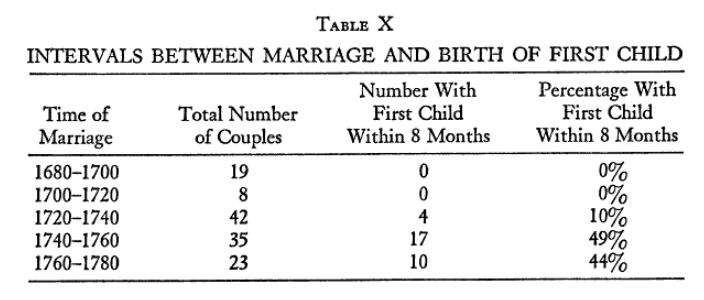
He said almost the same when he reformatted that sermon and delivered it on the occasion of the death of his own daughter, Jerusha, in 1748. Edwards had reason to consistently rail against the widespread custom of bundling. Unwed pregnancies even in strict Northampton where Edwards preached rose to 10%, and the rate of pre-marital pregnancies was much higher elsewhere. “The percentage of couples with a first child born within eight and a half months of marriage jumps from 10 percent from 1720 to 1740 to 49 percent from 1740 to 1760,” writes John Demos in “Families in Colonial Bristol, Rhode Island: An Exercise in Historical Demography” of the folks in Bristol, RI, source below. Any Chaperone to a youth lock-in knows the risks.

John Demos’s research shows a dramatic increase of pre-wedding pregnancies in Bristol, RI, in the heyday of the bundling practice:

Source: The William and Mary Quarterly, Vol. 25, No. 1 (Jan., 1968), pp. 40-57 (18 pages)

Premarital sex was becoming commonplace, thanks to bundling. Even when the parents placed a sack and tied it about the gal’s waist, and left the couple to bundle, sometimes pregnancy still resulted. Imagine that.

Worse, when it resulted in pregnancy, no one thought much about it as long as the couple got married. No stigma was attached. Jonathan Edwards was concerned not only with the bundling practice that resulted in fornication and pregnancy, but the lax attitude regarding these sins. He saw it as a decline in holiness within the family- and said so.

His efforts worked. The sudden death of the youth Billy Sheldon shocked the town’s youth and they gathered with Edwards for prayer meetings and Bible study. He pastorally talked with them and they began to take holiness- and Jesus- seriously. This was the germ of the Great Awakening taking root, which as we know, flew fervently into many hearts in the 1730s and 40s. Praise the Lord for that!

However as the decade of 1740s waned, so had Edwards’ influence.

By 1750, the people of Northampton had grown tired of Edwards’ consistent emphasis on morals and personal holiness. They remembered his stance against bundling, the bad books incident arose, and finally, his refusal to follow the Halfway Covenant (baptizing unconverted children of unconverted parents), caused the the congregation to vote Edwards out in 1750. His stance against bundling is often specifically cited as one of the main reasons for his ouster, as we see from this source-

Fourth, Edwards faced dismissal from his church because of certain moral stands he took while in Northampton. One occurred over bundling, a traditional courtship ritual designed to test the compatibility (and virtue) of a young man and woman by allowing the couple to spend a night together in bed, clothed, usually with only a board between them. While the awakening essentially began as a movement among the youth of Northampton, Edwards’s demise also rested in their affairs. Source: from The Jonathan Edwards Encyclopedia, Harry S. Stout Editor.

The New England folks were certainly attached to the bundling custom. But where does the sofa come in? Part 2 tomorrow!


Posted in theology

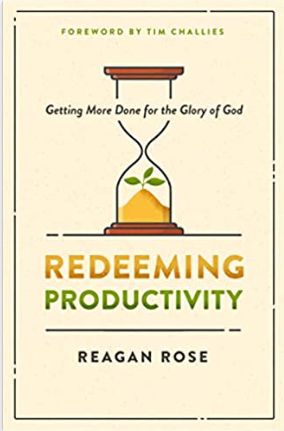
Book Review: Redeeming Productivity

By Elizabeth Prata

*I’ve been following Reagan Rose for a long time. A real long time. His approach to productivity never ceases to amaze me with his insight and his practicality. And his stance on why we need to be productive for Christ has never wavered: it’s for the glory of God.

I’m currently taking his course “Stewardship and Productivity” at the Institute for Church Leadership (ICL) a part of The Master’s Seminary. His Redeeming Productivity website, motto- “Get More Done for the Glory of God”, includes the Academy, Courses, Resources, Newsletter, and of course the podcast. I receive the Newsletter in my email and I consistently enjoy the podcast. I’m familiar with the bulk of Reagan Rose’s work and his work has stood the test of time.

All that to say, this gentleman is solid. His output is consistently helpful. If you want to be more productive in your Christian walk, and for the right reasons, in my opinion, Redeeming Productivity website is THE place to go for help.

Mr Rose now has his second book published, called Redeeming Productivity. His first book was published earlier this year and is another wonderful contribution to the faith. It’s called Track: Gaming: A Student’s Guide to Gaming (Track: A Student’s Guide). The foreword to the new book, Redeeming Productivity, is by Tim Challies, no stranger to the productivity issue, with his own productivity book, Do More Better (also a course at Ligonier, which I completed and can recommend).

Mr Rose sent any people willing to promote his book the first three chapters to read and spread the word on it. I’ve read them and I’m so excited to highly recommend Reagan Rose’s Redeeming Productivity. It is another work that is up to Mr Rose’s usual high standards.

He has structured the book to biblically present a Pillar (theology underpinning his explanations) with a follow up chapter on how to live the pillar out in Practice. Like this:

PILLAR 1 THE ORIGIN OF PRODUCTIVITY: You Belong to God

PRACTICE 1: CRAFT YOUR MORNING ROUTINE

PILLAR 2: THE PURPOSE OF PRODUCTIVITY: You Exist to Glorify God

Under the first pillar, Rose explains that too many self-help books focus on, naturally, the self. But the wrong approach here is that they ignite what is inside all of us, that old “it’s my life” mantra. It is seemingly “my life”, but in reality it’s not for the Christian. It is our life – to use for His glory. It is our life – that’s really now His, because He bought it when He redeemed us.

For you have been bought for a price: therefore glorify God in your body. (1 Corinthians 6:20)

My life in Christ exists to put the self down and live for Him according to His principles.

Rose wrote,

The second way “it’s my life” thinking expresses itself regarding personal productivity is in prioritizing productivity for the wrong reasons. Many people, some Christians included, see productivity merely as a vehicle for helping them create the life that will make them most happy. And this vision of productivity is exactly what most self-improvement resources propagate.

Rose always goes back to the main thing: we live for Jesus and His glory in all we do, and that includes how we walk and what we do with our time. And later that same chapter we read,

Reflecting on the price of your redemption should cause you to weep with joy. But it should also cause you to treat your life not as your own but as a precious stewardship from God.

The second chapter, “Crafting Your Morning Routine” was convicting for me. Rose wrote, “The simple choice of picking up your Bible before you pick up your phone in the morning is a cosmic act of defiance against your own sinful heart.

I often fail at this. I don’t have a phone but I do have a laptop. This chapter was crucial in exposing my selfish heart to the heart of being productive for the glory of God, and I will re-read it time and again, I am sure.

Chapter 3 asks the question, why do you have plans? You have plans, but for what purpose? You can plan to go to the grocery store, but without a list and some discipline, your purposes for making healthy meals will be thwarted. In this chapter we look at the foundational reason behind the fact that we have plans for anything. Rose wrote,

What is the higher purpose of all my goals? What binds them together? If we want to redeem productivity, we have to understand why we are here and what it is we are supposed to be accomplishing with these lives. If the origin of our productivity has to do with whose we are, purpose has to do with where it’s all going. What’s the ultimate point of being productive?

The chapter continues in unpacking these ideas, and much more, with a clarity of thought and an easy flow. The book is easy to read, but hefty in pointed theology and rich with practicality for the Christian who wants to serve our King with honor in all ways.

I recommend Redeeming Productivity by Reagan Rose. On sale at Amazon now.

*I received the 1st three chapters from the author, but used my own funds to purchase the book itself. This reviewer does not work for the author or the publisher in any capacity including as an employee, influencer, or contractor. The statements I made in my review reflect my honest and true opinion of the book which I am reviewing.

Posted in theology

One of the most destructive dangers of all…

Post by *Pastor James Bell

James Bell wrote:

If we developed a list of the ‘top 10 destructive dangers’ facing Christian families and churches in 2022 and beyond— what would be on your list? Matthew 24 reveals a world of wars, famines, pestilences, earthquakes, persecution and the multiplication of wickedness and lawlessness. All of these ebb and flow. They rage in one part of the world while another is basically quiet. Increasingly, these seem to draw closer home to us in America.

However, these are all ‘outside dangers’ impacting and/or seeking entrance.

In addition, in Matthew 24 there are some ‘inside’ dangers which come from within homes and churches— such as deception, false prophets, losing heart/being offended at the price tag for following Jesus and love growing cold.

There is one more ‘inside job’ that really CUTS DEEP!

Not only shall many professing Christians lose heart/fall away from the faith; but they [even family members] shall BETRAY one another and hate one another! How utterly tragic! (Matthew 24:10; Luke 21:12-19)

One of the most common ways of betrayal and hate is by words of slander, gossip and/or discord sowing.

Our words are powerful for good or for evil. The Bible says that a root of bitterness will defile MANY! (Hebrews 12:15)

How can bitterness reach many? Gossip and slander are the vehicles!

The tongue can defile an entire family, neighborhood, nation and certainly a local church! (James 3:6-10) The tongue can be a restless evil and full of the deadly poison of slander.

Sin entered the Garden of Eden via the receiving of a satanic slander against God!

Today, one of satan’s strategies continues to be to get Christians to accuse one another, to be bitter one toward another, to slander one another. BEWARE!

*Pastor James Bell is Pastor of Southside Baptist Church in Gallatin TN since 1975.

Posted in theology

What are sufferings, trials, and afflictions?

By Elizabeth Prata

I started this essay three times and abandoned it three times. Not because I suddenly became disinterested in the topic. It was because I was getting confused. My original approach was to take several of the words (trials, sufferings, afflictions, tribulation etc) and define them and look at their contextual use. I was going to explain in detail exactly what trials and sufferings were.

However I got confused because there are SO MANY words for a Christian’s distress, so many reasons, and so many contexts, I discovered that the approach I chose to writing it would be beyond my time limits and abilities. There is spiritual suffering, physical suffering, suffering from within, suffering from without…each with its own word describing it. I had to stop and re-think each time I sat in my chair and began to research the topic.

If you just think of one Bible person, Paul, and his one list of the things he went through (beatings, sufferings, shipwrecks, danger from robbers, danger from brethren, etc). It was a long list of suffering and trials. (2 Corinthians 11:22-28). And that’s just one spot in the New Testament.

Now, it’s pretty interesting in itself, don’t you think? Jesus promised suffering/trial/trouble/persecution/danger/affliction…see how many words are used to convey the idea that a Christian’s life on this earth will be punctuated with anguish.

We read often in the Bible of our forefathers’ trials, afflictions, and sufferings. Paul writes often about them in the New Testament. Look at Job, Joseph, David in the Old Testament. On the surface, we know and comprehend these words. We understand trials and sufferings and trouble and afflictions well enough. But do we?

A trial is not having difficulty finding a parking space when it’s raining. It’s not that your favorite item at the grocery store is out of stock. It’s not when Amazon fails to deliver in the promised 2 days.

Sufferings, trials, trouble, difficulty, burdens, weights, pressures, afflictions…there are many different words the Bible uses and they each have different nuances. But they all boil down to one thing: the difficulties of living on this earth and dealing with our and others’ sin. Every one of the words I was trying to define has a parent root issue: it’s because of sin.

Suffering is a product of the Fall. Immediately after Adam sinned, mankind fell into affliction. Guilt and blame began in the marriage, arguments and pettiness. In the world, the very ground would fail to yield easily, the animals became hostile, and the climate changed. Childbirth would cause a woman to suffer pain. Grief entered into human life at Abel’s murder. Perfection was no more and the humans on earth began suffering. No matter our location on earth, difficulty comes. No matter the length of time we endure it and no matter the reason, the origin of the human experience of suffering is all due to sin:

 Therefore, just as through one man sin entered into the world, and death through sin, and so death spread to all mankind, because all sinned— (Romans 5:12); and 1 Corinthians 15:21, For since by a man death came, by a man also came the resurrection of the dead.

Continue reading “What are sufferings, trials, and afflictions?”