Posted in theology

Heresy and false doctrine part 3: Can they repent? Will they repent?

By Elizabeth Prata

Heresy vs False Doctrine: What are they? Part 1
Heresy vs False Doctrine: What are they? Part 2

In part 1 I looked at definitions of false doctrine and heresy and whether they were two sides of the same coin, or totally different theological issues. In Part 2 I looked at heresy and named some examples of old and heresies coming around again repackaged, naming some modern people who teach them.

In this part I’ll focus on the issue of repentance for the false teacher and the heretic. Does a false teacher or a heretic ever repent? Can they? Should we even pray for them?


After our salvation, some of us become teachers. It’s a weighty and sober task, for teachers will be judged more strictly.

And because we are all human, sometimes even teachers of the Bible sin. They may sin by teaching error, or promote someone who is a false teacher themselves. It is here that the path diverges. Some of these teachers, when alerted to their error, repent publicly. I have read occasionally of these teachers publicly repenting of their false teaching and/or promotion of false teachers. It’s always encouraging to see this.

Others double down and continue teaching the false. Their path marches ever onward toward destruction. Purposeful persistence in error would seem to indicate a hardening of heart of that person. Repentance becomes more distant possibility, but it’s never out of the realm of possibility- because there is only 1 sin that is eternal, and that is blasphemy of the Holy Spirit.

But is there a moment on that path when a teacher who has taught falsely can return? At what point does God give them over to their error? We know God does this, Romans 1:18-32 describes a hardening process. We know He gave Pharaoh over to his persistent refusal to see or accept God’s truth. We know in the end, judgment comes upon the ungodly heretics (Jude 1:4).

Example: Hymenaeus

We read of Hymenaeus, who is mentioned twice in the New Testament. The first time is in 1 Timothy, written in about A.D. 62-64.

 This command I entrust to you, Timothy, my child, in accordance with the prophecies previously made concerning you, that by them you may fight the good fight, keeping faith and a good conscience, which some, having rejected, suffered shipwreck in regard to their faith. Among these are Hymenaeus and Alexander, whom I have handed over to Satan, so that they will be taught not to blaspheme. (1 Timothy 1:18-20)

We learn that Hymenaeus rejected the faith, made a shipwreck of it, and didn’t keep it. Is he restorable? More on that question in a minute. We learn that Paul put him out of the church for his false teaching.

The second time we read of Hymenaeus it’s a couple of years later in 2 Timothy. This book was written in about 66-67 AD.

Be diligent to present yourself approved to God as a workman who does not need to be ashamed, accurately handling the word of truth. But avoid godless and empty chatter, for it will lead to further ungodliness, and their word will spread like gangrene. Among them are Hymenaeus and Philetus, who have gone astray from the truth saying that the resurrection has already taken place, and they upset the faith of some. (2 Timothy 2:15–18).

Hymenaeus is lumped in with people who promote empty and godless chatter, and what he was teaching was poison (gangrene, other translations, cancer. The Greek word is literally gaggraina). He has gone astray from the truth and is teaching something totally false.

But in the first verse, Paul put Hymenaeus out of the church for a reason. The reason is always restoration. Paul said “so he may be taught not to blaspheme.” So it seems if one can be taught something, there is wiggle room. If someone can be taught something there is room for the light to come and error to be repented of. If he can be taught, the door to restoration isn’t shut, it would seem. Hymenaeus is being punished with a hope for restoration in mind.

EPrata photo

Paul didn’t write, “I put him out so he may be condemned.” Excommunication was a last resort to be sure, a serious consequence of Hymenaeus’ error, but this punishment had the purpose of possibly Hymenaeus learning the truth and perhaps changing his ways.

To that end I have no doubt Paul prayed for Hymenaeus. Paul was a prayer, and a carer of souls.

The situation does not look to be improved a couple years later, Hymenaeus is not recorded as having been restored to the church, but is worse in his teaching. He is persisting in error. This is one of the marks of a false teacher and a heretic.

We also read in 2 Timothy 2:25,

with gentleness correcting those who are in opposition, if perhaps God may give them repentance leading to the full knowledge of the truth,[underline mine]

This word “if” does not refer to God dithering about whether to grant repentance that a person is begging for. He is not in heaven saying, ‘Hymenaeus is repenting, hmmm, shall I accept it? He did make me pretty mad…’Maybe, maybe not…”

It is simply an acknowledgement from the writer that repentance is in the hands of God. (Acts 11:18). HE gives the person a spirit of repentance. We do not know on our side of heaven which false teacher will be given the opportunity to repent and which will persist unto death and condemnation. So we pray for the person who is in error.

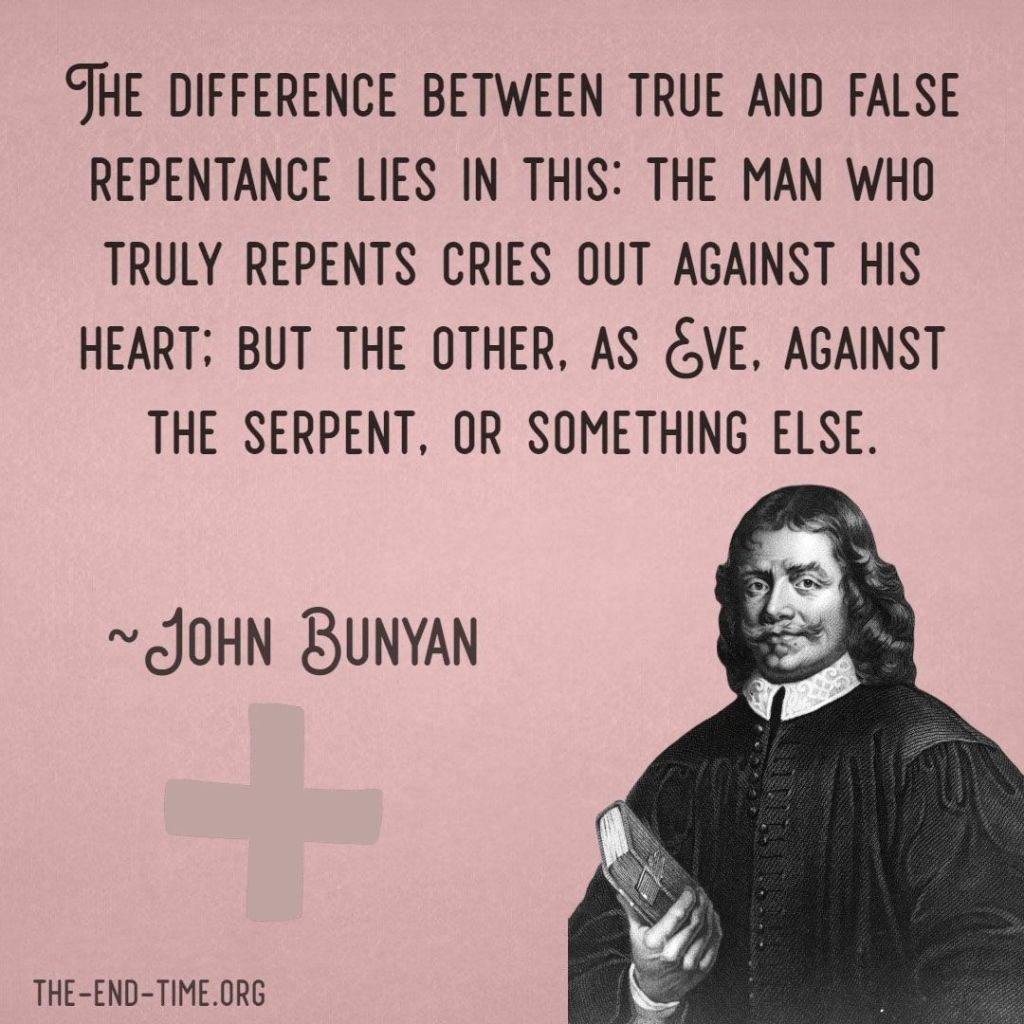
“Repentance of the heart is the work of God the Holy Spirit.” ~Sproul
It is a weighty situation when we see someone sliding into error and then apostasy. We do know that at some point, God gives them over to their error. They will remain in their sin since that is what they have persistently and continuously striven for. God gave Pharaoh over. He gave Saul over. Perhaps He gave Hymenaeus over in between the Books of 1 Timothy and 2 Timothy.

And we know this too, Hebrews 6:4-6 LSB says it is impossible to restore some:

For in the case of those once having been enlightened and having tasted of the heavenly gift and having become partakers of the Holy Spirit, and having tasted the good word of God and the powers of the age to come, and having fallen away, it is impossible to renew them again to repentance, since they again crucify to themselves the Son of God and put Him to open shame.

These verses do NOT mean a person who is saved and has the Holy Spirit indwelling them, can lose their salvation. No. The New Testament is replete with assurances that faith, once given to a penitent, is of God and will never be snatched away by anyone or anything, including God.

You notice the words in the Hebrews verse- the person was enlightened (had cognitive knowledge) was ‘partaking’ of the heavenly gift, (around Godly events, but not indwelled), and ‘tasted’ (not digested, or consumed). These descriptions describe only a surface believer. Remember, many will say to Jesus on the Day, didn’t we do many works in your name? And He will cast them away because He never knew them.

It’s these people, the surface workers, not the committed believers, who will fall away. If a false teacher is genuine, they WILL repent. Same with a heretic. Of the sad people who ‘deconstruct’ their faith and make a once for all rejection of it, they are impossible to restore. They came close to the Light but turned away to darkness, never to see the Light again.

Should we pray for them?

So, if we accept that the spirit of repentance is a gift from above, and if we accept that some are impossible to restore, and we know that God gives some over to their sin, should we pray for false teachers, heretics, and apostates?

YES.

There is only 1 unforgivable sin, and that rejecting Jesus and dying in one’s sin. Jesus prayed to the Father for forgiveness of those blaspheming Him and mocking and spitting on Him on the cross. But if one blasphemes the Holy Spirit & dies outside of the door of Jesus, then…his sin is eternal. Until the person dies, we never know what his or her heart is doing, and we never know what God has in store for them. False teachers, heretics, and apostates are in SUCH danger, we should actually pray for them more!

Throughout his letter, the author of Hebrews warns his audience of this danger. In the past, they have professed faith in Jesus and claimed to embrace him. Now, because of pressure and persecution from unbelieving Jews, they are tempted to abandon Jesus to restore their peace and comfort. They have experienced remarkable measures of grace in association with the new-covenant people of God (Hebrews 6:4–5), but now they are nearing the brink of falling away from Christ — and Hebrews warns them of the peril: having known the truth, and rejected it, are they now coming into a kind of settled hardness of heart from which they no longer will be able to repent and thus be forgiven?

For Christians today, we need not fear a specific moment of sin, but a kind of hardness of heart that would see Jesus as true and yet walk away — with a kind of hardness of heart incapable of repenting. Again, it’s not that forgiveness isn’t granted, but that it’s not sought. The heart has become so recalcitrant, and at such odds with God’s Spirit, that it’s become incapable of true repentance. ~Dave Mathis

Has one persisted so long in their sin that they have become seared to it? THAT person cannot repent.

But do WE know when that moment is? No. When Pharaoh rebelled after the first plague, was he unredeemable? No. Or the second, third, fourth? We do not know the exact moment when God gives a person over to their sin, so we continue to pray.

Prayer changes US. It acknowledges we are finite, helpless creatures who need God to do anything. It also puts the other person on our mind instead of our own selves, prayer in this way helps us be humble and other-centered.

If you see a person sliding into falsity, or someone who has been church-disciplined and put out, pray for them. It is a serious, serious situation with their eternal soul at risk.


Posted in theology

Heresy vs false doctrine: What are they? Part 2

By Elizabeth Prata

Heresy vs false doctrine: What are they? Part 1
Heresy vs false doctrine: What are they? Part 3

I’m often asked discernment questions, which pleases me because that means a woman is thinking about her faith, wants the truth of the Bible, and pursues holiness in her walk. I was recently asked ‘Are false teachers and heretics the same thing, and can they repent? Should we pray for them?’

In the first part, I looked at the question: What is the difference between a false teacher and a heretic? The 3rd part will look at the issue of repentance. CAN a false teacher repent? Can a heretic repent?

Now, in this part 2, let’s look at a definitions of heretic and heresy:

The Heretic is the most prominent and perhaps the most dangerous of the false teachers. … The Heretic is the person who teaches what blatantly contradicts an essential teaching of the Christian faith. ~Tim Challies

And so, heretic is worse than a false teacher: “I think we need to say that there are some absolutely non-negotiable truths that you are false to teach: if you deny the Trinity, if you deny the deity of Christ, if you deny His sinless life and substitutionary death, salvation by grace through faith, the gospel. That’s the drivetrain of truth, saving truth. Those are not negotiable.~John MacArthur

The main characteristic of a false teacher was their teaching springs of off the Bible but is twisted or wrong in some way. They might teach about baptism, but baptismal regeneration. They might teach about food, but introduce food laws. They might teach about fasting, but become legalistic in their teaching of this practice. They might teach about prayer, but slide in some Gnostic practices about prayer. And so on.

The main identification of a false teacher is that when their theological error is pointed out, they display an unwillingness to make a correction. Either when the Spirit points out in scripture, or when another person points it out, if the teacher refuses to listen and continues on teaching it, they are a false.

False teachers reject biblical correction and continue teaching falsely, refusing to repent or even listen.
Photo by Priscilla Du Preez 🇨🇦 on Unsplash

As for heretics, their teaching is not even IN the Bible, it is a doctrine of their own making, from their own mind, and is their choice to believe. They have shown they are divisive. (Titus 3:10) The word ‘division’ in the verse means heretical.

HERESYfrom a Greek word signifying (1) a choice, (2) the opinion chosen, and (3) the sect holding the opinion. In the Acts of the Apostles (5:17; 15:5; 24:5, 14; 26:5) it denotes a sect, without reference to its character. Elsewhere, however, in the New Testament it has a different meaning attached to it. Paul ranks “heresies” with crimes and seditions (Gal. 5:20). This word also denotes divisions or schisms in the church (1 Cor. 11:19). In Titus 3:10 a “heretical person” is one who follows his own self-willed “questions,” and who is to be avoided. Heresies thus came to signify self-chosen doctrines not emanating from God (2 Pet. 2:1). Source for this definition of heresy- Easton’s Illustrated Bible Dictionary.

In around 144 AD Marcion taught that the Old Testament should be rejected and that the God of the New Testament was the true God, the OT God being vengeful and false. This heresy is called Marcionism and it’s alive today. Kevin DeYoung wrote a great article about it and noted that some preachers today teach their followers to “unhitch” from the OT and reject it because Jesus is nicer… that old Marcionic heresy.

Pelagius. From Wikipedia

Sadly, thought is is 2023, many of the ancient heresies – which never disappeared – are making a comeback. Another one is Pelagianism, the heretical belief that denies original sin, and promotes that babies are born innocent. Lori Alexander “The Transformed Wife” believes and teaches this, for example. Lori’s mentor and idol, Michael Pearl, is also a Pelagian, teaching this heresy in these modern days.

Sadly, Alexander and Pearl are not the only heretics believing this, this heresy is more common than one may think. Pelagianism is believed by 71% of respondents according to results of the 2022 Ligonier State of Theology survey.

Another heresy that was surprisingly widely held according to the survey is Arianism. This heretical belief states that Jesus is not God. Whether someone says, “Jesus was a good teacher, but not God” or that “Jesus was a created being” (something the Mormons claim) or any statement that denies His divinity, it’s Arianism and a heresy.

Tim Challies “The False Teachers: TD Jakes

In another modern example, TD Jakes is a heretic because he teaches and believes that God is One but is also ONE person, not three persons in one. Jakes says God manifests Himself in different modes. This heresy is called Modalism. This is a concept striking at the heart of the Trinity, and therefore is a heresy.

Challies: “Modalism has long been labeled as a heresy meaning that if you believe it in place of the biblical understanding of the Trinity, you are not and cannot be a true Christian.” 

More here by Chris Rosebrough on the heresy of Modalism and modern people who teach it.

Phil Johnson has preached a 6-part series on old heresies that aren’t really old, they are alive and well today. Here is Phil Johnson’s introduction to his series A Survey of Heresies:

“It’s important for Christians to have a grasp of heresies that the church has battled over the centuries, because they often return with new clothing, and the unprepared Christian is likely to fall into these old pits. Phil does an excellent job of looking at some of the major heresies that are revisiting the church today: Socinianism, Arianism, Pelagianism, Gnosticism, and Judaizing. This is an excellent 6 part series that will shore up some weak points in the church today.”

The Judaizers
The Gnostics
The Arians pt1The Arians pt2
The Pelagians
The Socinians


Heresies are serious. Heresies are alive and well today. They are completely distinct from anything taught in the Bible and are dangerous because they draw the unwary into sinful teachings on the road to apostasy and/or condemnation.

False teachings turn to heresy when they lift off from the Bible and become a doctrine completely separate from anything that can be found in God’s word. You think it might not happen to you, but see how many millions of people believe today in Pelagianism, Modalism, Arianism, Marcionism, Modalism, and so on. There are many warnings in the Bible about not falling for myths.

People believe these dastardly things because there is some kind of sin in them that rears its desire (2 Timothy 4:3) and the sin attaches itself to the false doctrine with tentacles that can only be pried apart by repentance. Heretics would not have an audience unless their followers propped them up. Notice the phrasing in the 2 Tim verse, “accumulated for themselves” these heretics.

It’s one reason we need to stay ‘repented-up’ all the time. Sin desires to have us and it’s not only sinful actions but sinful minds that enjoy false doctrines and heresies.

In the next and final part, we will look at repentance. What it is, whether a false teacher can repent, and whether a heretic can repent.


Heresy vs false doctrine: What are they? Part 1
Heresy vs false doctrine: What are they? Part 3

Sources consulted in researching this essay:

The Bible

John MacArthur Commentary on 2 Timothy 2:24-25

RC Sproul Critical Questions: What is Repentance?

Nathaniel Vincent: Puritan Treasures for Today: Turn and Live

Logos 9 resources such as The International Standard Bible Encyclopaedia, Matthew Henry Full Commentary, etc.

Posted in theology

Heresy vs false doctrine: What are they? Part 1

By Elizabeth Prata

Heresy vs false doctrine: What are they? Part 2
Heresy vs false doctrine: What are they? Part 3

Should we pray for false teachers?
Are false teachers and heretics the same thing?
Can a false teacher repent?
Can a heretic repent?

I’m asked these questions now and then. Since I do a third of my ministry here as discernment, it’s logical I get asked discernment type questions. I’ve wondered the same thing myself. I’ll answer in three parts. I’ll look at false teachers, then heretics, then whether either or both of them can repent.

First, let’s look at the question:

What is the difference between a false teacher and a heretic? Is there a difference?

God’s truth, it is the only thing that matters, the sole standard by which we live.. Yet from the beginning, satan has energized people (or serpents) to pollute the truth.

But false prophets also arose among the people, just as there will also be false teachers among you, who will secretly introduce destructive heresies, even denying the Master who bought them, bringing swift destruction upon themselves. And many will follow their sensuality, and because of them the way of the truth will be maligned. (2 Peter 2:1-3)

The distinctions between what makes a teacher false and what makes a heretic can be muddy. Suffice to say, both are bad, but heresy is worse. Here, Mark Jones at Reformation 21 wrote:

What makes someone a heretic? This topic may be more important than we might think, especially in the world of online discourse. There is a distinction between willfully committing a soul-destroying heresy and committing a theological error.

Yet also this:

To call someone a “false teacher” is to say they are unsaved (see 2 Peter 2:1). …

But then again, Jones said, All heresies are errors, but not all errors are heresies I understand heresy in the way described by George Gillespie, a Scottish commissioner to the Westminster Assembly:

The key words above are “voluntarily” (not ignorantly) and “factiously” (not quietly, but “stubbornly” [see Ames]) in terms of the manner in which a heretic promotes his or her view(s). Conversely, we may hold to an error, but (thankfully) that error is not sufficiently severe enough that it overthrows the fundamental articles of the Christian faith. –end Mark Jones quote.

The Bible speaks a great deal on false prophets (Old Testament), false teachers (New Testament), and false doctrine. Every New Testament book except Philemon warns or says something about falsity.

As to the difference between a teacher teaching falsely and a teacher who is a heretic, for example, there’s Pelagianism (a notion that original sin did not taint human nature) which is a heresy, but teaching that one must eat or not eat certain foods is a theological error. It’s a false teaching but not necessarily a heresy that makes one outside orthodoxy.

A biblical example is Peter briefly ‘behaving’ falsely. Because his behavior had a teaching component, his behavior undermined the Gospel. Therefore, Paul said he must oppose Peter to his face. Denny Burk said, “In Galatians 2, Paul says that he opposed Peter for not being “straightforward about the truth of the gospel” (Galatians 2:14).”

As a side note I’ll mention here that Peter’s brief foray into falsity was a behavioral action. He was impacting the truth of the Gospel by his behavior- he withdrew from the Gentiles, not sitting with the Gentiles out of fear of man. Often when I write about a truly false teacher’s behavior, her defenders come out of the woodwork screaming that her behavior is an untouchable component because it’s (supposedly) ‘private’, i.e. separate from her teaching. No.

‘Stop judging our favorite false teacher’s behavior and lifestyle! It’s none of your business!’ Oh, yes it is, screeching harridans. Yes it is…

A Bible teacher’s or minister’s behavior is never separate from their identity in Christ, life AND doctrine matters, as Peter’s brief deviation into falsity shows and Paul’s immediate reaction to it.

Apollos briefly taught falsely. “Apollos was a man mighty in the scriptures who taught accurately about Jesus but who nevertheless was only familiar with John’s baptism. In Apollos’ case, his deficient teaching was an error of omission.~Denny Burk

Neither Peter nor Apollos could really be termed a false teacher because their theological error was brief and they immediately corrected themselves eagerly with open heart and with humility.

False teachers exist on a spectrum. They can be detected of course by examining their teaching, but if they have been confronted with truth to slay their error and they take some time to consider this, pray. If they take a long time and come out the other side with still believing and teaching the falsity, then they are false. If Peter and Apollos had continued teaching what they taught, after a while we must accept that they are not correcting their error and are false.

When is a false teacher a false teacher? It’s when he teaches falsehood. And the chief characteristic of his teaching is falsehood. ~RC SProul

In modern times, we have seen several known false teachers claim to repent. Naïve Christians should be wise as a serpent but harmless as a dove in these matters. Too many people take these claims of a false teacher’s supposed repentance at face value without a proper measure of wisdom and patience to see of they truly correct over time.

Costi Hinn here with a 1-minute tip on how to detect if a teacher’s repentance for teaching something in error is real or not. Remember, the chief characteristic of a false teacher is that their teaching is identified with error, i.e. “its chief characteristic.”

I would just add that I think there is in the New Testament a clear reservation of that title [false teacher] not just for one who teaches falsely but for one who is uncorrectable and who resists correction. ~Al Mohler

Next part: Heretics, what is heresy and what makes a person a heretic?


Heresy vs false doctrine: What are they? Part 2
Heresy vs false doctrine: What are they? Part 3

Sources consulted in researching this essay:

The Bible

John MacArthur Commentary on 2 Timothy 2:24-25

RC Sproul Critical Questions: What is Repentance?

Nathaniel Vincent: Puritan Treasures for Today: Turn and Live

Posted in theology

Little Known Bible Characters #3: Trophimus

By Elizabeth Prata

Little Known Bible Characters #8: Tryphena and Tryphosa
Little Known Bible Characters #7: Salome
Little Known Bible Characters #6: King Chedorlaomer
Little Known Bible Characters #5: Harbonah the Eunuch
Little Known Bible Characters #4: Eutychus
Little Known Bible Characters #3: Trophimus
Little Known Bible Characters #2: ‘The List of Offenders’
Little Known Bible Characters #1: Iddo

Paul made three major missionary journeys. Acts 20 records the 3rd. He had spent 3 months in Greece, then planned to get on a boat in Corinth and set sail for Jerusalem via Syria, but he learned that some Jews were plotting to grab him for nefarious purposes on the voyage, so he decided to return to Macedonia by land. So Paul went from Corinth to Berea, Thessalonica, and Philippi, caught up with Luke again and observed Passover.

From Philippi, Paul and Luke set sail for Troas, arriving there five days later and meeting Paul’s traveling companions who had gone ahead of them: Timothy, Sopater, Aristarchus, Secundus, Gaius, Tychicus, and Trophimus. This is where we meet Trophimus.

And he was accompanied by Sopater of Berea, the son of Pyrrhus, and by Aristarchus and Secundus of the Thessalonians, and Gaius of Derbe, and Timothy, and Tychicus and Trophimus of Asia. (Acts 20:4).

Miletus was about 36 miles from Ephesus. Map source

Trophimus was mentioned three times in the Bible, in verse above in Acts 20:4, and also Acts 21:29, and 2 Timothy 4:20.

For they had previously seen Trophimus the Ephesian in the city with him, and they supposed that Paul had brought him into the temple. (Acts 21:29).

Erastus remained at Corinth, but Trophimus I left sick at Miletus. (2 Timothy 4:20).

Trophimus was from the Roman province of Asia and was living in or was from Ephesus. He was a Greek Christian. As we saw from the first mention of him in the verse, Trophimus was one of seven disciples mentioned by name who accompanied Paul on his return to Macedonia (Acts 20:3–4), meaning, the others to whom Paul was writing probably knew Trophimus personally, or knew OF him. These seven men formed an envoy from the various churches at Asia. They protected Paul, as it was better to travel in numbers. They also helped deliver the contributions from the churches of Asia to the saints in Jerusalem at the end of Paul’s third missionary journey (2 Corinthians 8:2–3). The delegation left Paul in Macedonia and traveled to Troas to wait for Paul and Luke to join them (Acts 20:4–6).

When they met up again, the men, including Trophimus, stayed together for a week. Imagine the theological conversations they must have held! The joy of being together!

Next time we read of Trophimus, it isn’t so joyous. We read of poor Trophimus being accused of having gone into the Temple with Paul, which uncircumcised Gentiles were not allowed to do. The Jews at that time were insisting that one had to become a Jew first in order to become a Christian. They leaped on the opportunity to accuse Paul of bringing Trophimus into the temple in order to get to Paul. And they did as much, dragging Paul out to be murdered. Of course, the accusation was false, but Trophimus’ name was used for evil purposes and he was innocently at the center of this controversy.

The modicum of fact lying at the root of this false accusation was that they had seen Paul and T. in each other’s company in the city. On this slender basis “they supposed” that Paul had brought T. past the barrier or middle wall of partition (Eph 2:14; see PARTITION), beyond which no Gentile was allowed to penetrate on pain of death. They supposed that T., who was neither a Jew nor a proselyte, but a gentile Christian, had been introduced into the temple itself by Paul—which would have been profanation. Hence their fury against the apostle. Source: The International Standard Bible Encyclopaedia (ISBE),. 1915.

Sometimes being Paul’s friend was dangerous!

The third time we read of Trophimus is when he had become too sick to travel. Paul had to leave him in Miletus.

As a side note: IF the miracle gifts had still been ongoing, why didn’t Paul just lay hands on his friend so he could continue the mission? Why doesn’t the verse say “Trophimus was sick in Miletus but I laid hands on him and by grace of God he used me to heal my friend.” Or something to that effect. 2 Timothy was written in 64/65 AD, and the sign gifts were well and truly dying out by then. The were for a sign to authenticate the Apostles and since it was nigh on 30 years since Jesus had departed and at least 20 years since the first NT book was written, the need to authenticate the ministers of God was lessening by the day.

In the previous book, 1 Timothy 5:23 written a few years before, Paul had advised Timothy to take wine for his stomach ailments.

Anyway, Trophimus was sick a few years after we last read of him, we know not with what, but was serious enough to cause Paul to have to leave T. behind. But not alone. We read in Acts 20:17 Paul had previously sent for some elders to come from Ephesus, which they did. It was an easy travel jaunt. Therefore, Paul was not abandoning his trusted friend and traveling companion to the wilds,

Trophimus, therefore, in his sickness, could easily reach Ephesus, or his friends from that city could quickly come to him at Miletus, and give him whatever attention and nursing he might require.” ISBE

Keep in mind that these people we read about in the Bible are real people. They are alive now. We will meet them in heaven and commune with them. We can sit with Trophimus and talk with him about his sickness, his association with Paul at the temple, his missionary journeys. That’s why I write about the ‘little known’ Bible characters. Someday we will fully know them, and they will fully know us. What a day that will be.

Little Known Bible Characters #8: Tryphena and Tryphosa
Little Known Bible Characters #7: Salome
Little Known Bible Characters #6: King Chedorlaomer
Little Known Bible Characters #5: Harbonah the Eunuch
Little Known Bible Characters #4: Eutychus
Little Known Bible Characters #3: Trophimus
Little Known Bible Characters #2: ‘The List of Offenders’
Little Known Bible Characters #1: Iddo

Posted in theology

A Day in the Life of: A Professional Mourner

By Elizabeth Prata

I created a series called “A Day in the Life of”. Here are the entries in that series:

A Day in the Life Of: A Roman Centurion
A Day in the Life of: A Fisherman
A Day in the Life of: A Potter
A Day in the Life of: A Scribe
A Day in the Life of: A Shepherd
A Day in the Life of: A Tanner
A Day in the Life of: A Seller of Purple
A Day in the Life of: Introduction

Our teaching pastor went over a section in Matthew 9 on Sunday. The passage had a mention of mourners.

Professional mourner was a job in ancient Palestine. In our culture we are self-contained. We don’t sob at the Wake or the Memorial. We try to keep a stiff upper lip and contain the tears at funerals.

In ancient Palestine, it was considered acceptable, even required, to sob loudly, wail, and express one’s self with high emotion upon the occasion of a death. Professional mourners were brought in to help create an atmosphere of bereavement, and they didn’t hold back.

Mourning: The practice of grieving through crying and vocalization, most typically for the loss of someone.

Family members’ mourning typically involved sitting on the ground and trembling, tearing one’s clothes, putting ashes on one’s head, wearing sackcloth, or walking barefoot. Family members on a rotating basis would stay with the body so it was not left unaccompanied. Burial was rapid, as embalming was not a customary practice among Jews.

Until burial, though, during the grieving period, “To enhance the atmosphere of grief professional women mourners would be invited (Jer. 9:17).” Negev, A. (1990). In The Archaeological encyclopedia of the Holy Land.

Professional mourners were usually women, who tend to express emotions more easily and was more socially acceptable for that gender. Professional mourning was actually an acceptable job for a woman in ancient Israel. It was a good way to make money if a woman needed to. The more professional mourners there were the wealthier a family was seen to be. Hired mourners helped the family through their grief and offered comfort.

And when Jesus came into the official’s house, and saw the flute-players and the crowd in noisy disorder, (Matthew 9:23).

The word in the verse, ‘disorder’ is from the Greek thorubeó and it means “to make an uproar”.

Their job was to make a clamor. They wailed, lamented, chanted praises in death songs, played instruments. You can imagine the noise with all this lamentation, crying, flute-playing, plus the regular noise any crowd makes as people talk, cry, and move about.

“These mourners are neither somber nor reserved. “Commotion” is from the Greek root word thorubos which means noise, clamor, and public disorder. “Wailing” is from the Greek root word alalazo. It’s the “alala” sound soldiers made when rushing into battle, similar to what is referred to as ululation.” Source: BibleRef.com.

Jeremiah 9:17 mentions professional mourners, one of many places in the Bible that mentions this job: “Thus says Yahweh of hosts, “Carefully consider and call for the mourning women, that they may come; And send for the skillful women, that they may come!

The amount of time spent mourning for the dead varied in the Bible from person to person. Jacob was mourned seventy days (Genesis 50:3); Aaron (Numbers 20:29) and Moses (Deuteronomy 34:8) were mourned thirty days; and for Saul only seven days (1 Samuel 31:13). In 2 Samuel 3:31-35, we have a description of the great mourning for the death of Abner. (Source Christians Answers).

Also Amos 5:16, Mark 5:38 mention professional women who mourn on behalf of a family. Professional mourning as a job was quite common, very normal. Here is a short Youtube clip of some professional mourners in Sardinia, filmed in 1963. This gives you an idea of the ‘clamor and disorder’ mentioned in the Matthew verse above:

Professional Mourners of Sardinia, from “Women of the World”. Filmed around 1963, from the Italian documentary “La Donna Nel Mundo” and is narrated in English by Peter Ustinov. Clip is 1:55. Sardinia is a large Island of Italy in the Mediterranean sea and north of Tunisia.

https://youtu.be/kJUQxelrZX4?si=8oULIyYVP4nASlA8

It also gives rise to a question in my mind. Death came frequently in ancient Israel. Sickness and tragedy were common. In the clip, it was stated that this group of professional mourners left their hired place of mourning at 4:00 am so as to attend another mourning job in a different village. What was it like to spend one’s days crying and lamenting? Was it hard to work up tears after a while? Or easier? Did their natural outlook become depressed and gloomy, since their entire professional career was to express sadness and grief? Did it take a toll on the emotions of the woman after a while?

In any case, the custom of professional mourning women was a thriving job for these women who chose it. It was a job for which there would always be a need.

I long for the day when death will be no more! No more wailing, crying, no more funerals, no more professional mourning industry! What a day that will be.

Funeral passing by below our hotel room, Elba, Italy

Fun fact: the name for professional mourners is moirologists 

Posted in theology

Introducing: Correct-A-Meme

By Elizabeth Prata

I’ll do an occasional entry in this new series, looking at memes and where they take our mind from Jesus and put it on wrong tracks.

Where does false doctrine happen? The Bible warns us repeatedly to make sure we are absorbing healthy doctrine and not taking in any polluted doctrine. Our souls need it. Staying as doctrinally pure as possible is best for our spiritual health. And yet, we are often confronted with false doctrine.

‘But my pastor preaches solid sermons!’ I can hear you saying. If that’s so, then wonderful! But sermons are not the only place we can unfortunately absorb poor doctrine.

‘I read good Christian books by credible authors!’ I can hear you saying. That’s great! But sermons and books are not the only places we can unwittingly absorb false doctrine.

False doctrine is sneaky. Jude 1:4 says “For certain people have crept in unnoticed,” these are the false teachers who craftily twist the truth in subtle ways and in subtle places.

Like in music? Yes, music.

You might or might not go about your day with scripture verses popping into your head and circling around your brain, but chances are, you’ll more than likely have a song lyric that sticks with you. Like this one-

And he walks with me and he talks with me
And he tells me I am his own
And the joy we share as we tarry there
None other has ever known

No. Just no. The joy Jesus shared with the Spirit and the Father is like no joy anyone else has ever known- because it was perfect, sinless joy. And, guess what? Jesus doesn’t talk with us.

Another insidious place false doctrine comes in is through memes. Memes are especially dangerous because they are put in front of everyone. Your pastor is probably solid, you can carefully choose your own books to read, you switch radio stations when something bad comes on, but memes are ubiquitous. They are on the sides of web pages, in friends’ threads, just everywhere.

They are subtle because they are short and pithy with logical sounding statements. They don’t take much thought, they’re not supposed to. This is why they are dangerous. After you read one, you go, ‘Oh! That makes sense!’ but…does it?

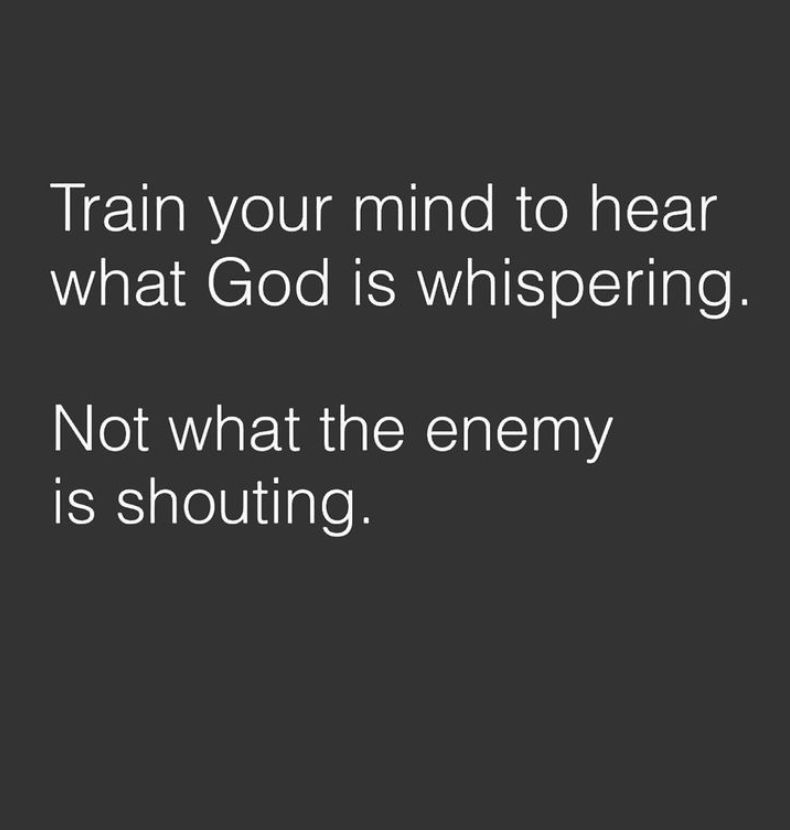
Like this one.

I’ll take it apart bit by bit.

“Train your mind”. Correct. Our sanctification begins in the mind. The scriptures transform the mind and then we gradually become more like Jesus, the whole point of sanctification. The mind is the battlefield.

And do not be conformed to this world, but be transformed by the renewing of your mind, so that you may approve what the will of God is, that which is good and pleasing and perfect. (Romans 12:2)

Ephesians 4:23, to be renewed in the spirit of your minds;

1 Peter 1:13, Therefore, having girded your minds for action, being sober in spirit, fix your hope completely on the grace to be brought to you at the revelation of Jesus Christ.

The first few words of this short meme are good. So you keep reading. Here is where we get into trouble. It’s trouble because it’s partly true. Most memes are half true. Charles Spurgeon said of discernment, “Discernment is not the ability to tell the difference between right and wrong; rather, it is telling the difference between right and almost right.”

Satan does send fiery darts into our mind. (fiery darts of Ephesians 6:16 are thoughts). But here are a few more errors:

God isn’t whispering to us.
God doesn’t only whisper in the Bible, He thunders, shouts, uses creation to speak, and more.
The devil doesn’t only shout.

Memes will often pit one thought against another thought when both are true. Or neither. Yes, we should not listen to the devil, and we should ‘listen’ to God- in His word. We also should not listen to our flesh, where in fact most of our wrong thoughts come from, not the devil.

Anyway, watch out for Christian memes. They are often either outright wrong, or subtly wrong. They often are the exact fiery darts we are warned about!

Posted in encouragement, theology

Amazing Grace, so amazing

By Elizabeth Prata

My favorite doctrines are Grace, followed by Providence.

Grace that is extended by our loving God is shocking and amazing and wonderful. I was saved later in life and I remember what it felt like to live a sinful life in rebellion against God. It was confusing and upsetting, most of the time.

I read a lot, and enjoyed historical books and the world’s myths. As I read books, all the world’s made-up gods were capricious or unloving or dismissive of humans. That seemed weird to me. Even when I read of the Founding Fathers and learned about their deism, that god also seemed weird to me. The deist god created everything – including humans – but then retreated from humankind’s affairs and let us wind down of our own accord. I could not reconcile that. No one creates something only to walk away from it. Weird.

But I was pretty OK with a god who created me but left me alone to do what I wanted. As long as ‘he’ didn’t interfere with my life.

Grace given by a loving God was foreign to me and unthinkable. Because that would mean He was involved with humans, lovingly.

But that and only that God is the one true God.

He pre-existed since forever, but at the appointed time set by the Father, He came in the form of a baby who grew to be a man-God, teaching and loving and performing miracles. He died for our sins and absorbed the wrath of God on our behalf.

Amazing Grace! how sweet the sound
It was not a sweet sound to me then, but it is now.

That saved a wretch like me
I used to close my mouth if I happened to be at a Church service, like at Christmas, and this hymn came on. I wasn’t a wretch!, I’d mumble. And close my mouth, refusing to say the lyrics.

I once was lost, but now am found
I didn’t know I was lost and I didn’t know I needed to be found.

Was blind but now I see
I didn’t know I was blind. Revelation 3:17 may apply here:
For you say, I am rich, I have prospered, and I need nothing, not realizing that you are wretched, pitiable, poor, blind, and naked.

That the Lord of All would stoop to save a wretch like me, covered in mud and dwelling with the pigs, like the Prodigal, is amazing. That He would walk into Jerusalem, knowing the cries of Hosannah! would turn bloody and hateful a week later. That He went toward his kangaroo trials, his scourging, and his death, even death upon a cross, to save filthy sinners, is amazing. What grace!

Thank you Lord, for your grace!! How wonderful that even when we’ve been there 10,000 years, we’ve no less days to sing God’s praise than when we first begun. An eternity praising You is not enough, but what grace that I am able to do so in the first place.

Was blind but now I see…

Not by works of righteousness which we have done, but according to his mercy he saved us, by the washing of regeneration, and renewing of the Holy Ghost; Which he shed on us abundantly through Jesus Christ our Saviour; That being justified by his grace, we should be made heirs according to the hope of eternal life. (Titus 3:5-7)

Posted in theology

Apostasy again: We say goodbye to Aimee Byrd

By Elizabeth Prata

https://open.spotify.com/episode/38h2uxJaT9sn05xljbGPxA?si=127bd0344b434f2c

Introduction

This is an essay that chronicles the rise and fall of an influential person who was formerly in the faith. Among other topics, I use this blog platform to chronicle modern-day discernment issues and compare to the Bible. I did with Beth Moore. I followed up with: Beth Moore’s Spiritual Biography. I did also with Francis Chan. And Ravi Zacharias.

Now we see a departure from the faith with Aimee Byrd. This essay, like those others, is meant to illustrate how false teachers happen, or how it is that a once seemingly solid Bible teacher goes astray.

I finish with a warning from the Bible.

Apostasy in the Bible

We all know the story about Demas.

for Demas, having loved this present age, has deserted me and gone to Thessalonica; Crescens has gone to Galatia, Titus to Dalmatia. (2 Timothy 4:9-10).

Apostasy in 3 verses. In Philemon 1:24 Demas was a ‘fellow worker’ with Paul. In Colossians 4:14 Luke sent warm greetings to Demas. In 2 Timothy Demas fled to the world because he decided he loved it so much.

Philemon was written in about 57-62.
Colossians was written in about 60-62.
2 Timothy was written in about 64-65.

If we take the earliest writings to the latest writings as time brackets, the falling away of Demas played out in about 7 years.

Judas departed from the faith. His story played out in about 3 1/2 years.

Other people in our current times may take a short while to apostatize, or longer. We understand and accept apostasy stories like Demas and Judas because they are in God’s holy word. Seeing apostasy happening in today’s time is often harder. We have a difficult time believing or accepting that a famous person who seems so solid is a false convert.

But it’s the same. Some people are self-deceived that they are in the faith. (Matthew 7:21-23). They never were. Their veneer of belief erodes and reveals the unsaved person that they are. This leads us to the sad story of Aimee Byrd. Joining Demas, Judas, Chan, and so many others, Aimee Byrd is a gone girl.


Apostasy’s Progression

In 2013, Presbyterian Aimee Byrd published her first book. It was titled “Housewife Theologian: How the Gospel Interrupts the Ordinary” and the blurb says, “This book is for women—for all women who want to explore beneath the superficial and get to know God, and themselves, better.”

She had been writing a blog for a while and used the blog as the platform to get her material out there. She wasn’t an academic or a church staff person at the time, just a wife who wanted to write. She became known as The Housewife Theologian.

Wow! Great!

The book’s contents got the attention of Carl Trueman and Todd Pruitt. She was interviewed on their podcast, Mortification of Spin. It went well. She was asked to join the 2 guys on the podcast as a co-host. She began blogging for Alliance of Confessing Evangelicals, too. (ACE).

The Alliance is a broad coalition of evangelical pastors, scholars, and churchmen from various denominations, including Baptist, Congregational (Independent), Anglican (Episcopal), Presbyterian, Reformed, and Lutheran who hold the historic creeds and confessions of the Reformed faith and who proclaim biblical doctrine in order to foster a Reformed awakening in today’s Church. (Source)

Her first book was followed up by a second, Theological Fitness: Why We Need a Fighting Faith. Then two years after that, a third, No Little Women: Equipping All Women in the Household of God. So far so good.

Then in 2018 she published Why Can’t We Be Friends? : Avoidance Is Not Purity about male-female friendships among believers and how we should not avoid them just because sometimes ‘the sex part gets in the way’. Hmmm. Gender stuff. Hmmm. The brilliant and astute Carl Trueman was still providing recommendation blurbs for her books, and Aimee was still co-hosting the podcast. Yet Trueman called Why Can’t We Be Friends “provocative.” The Gospel Coalition issued a mild warning in their review of the book, which was generally positive:

Byrd is eager to destigmatize male-female friendship in the church, particularly friendships that involve time spent one-on-one. But she so frequently references sharing car rides and meals that it feels like she goes beyond defending those activities to almost implying people who don’t engage in them aren’t experiencing true friendship. (Source).

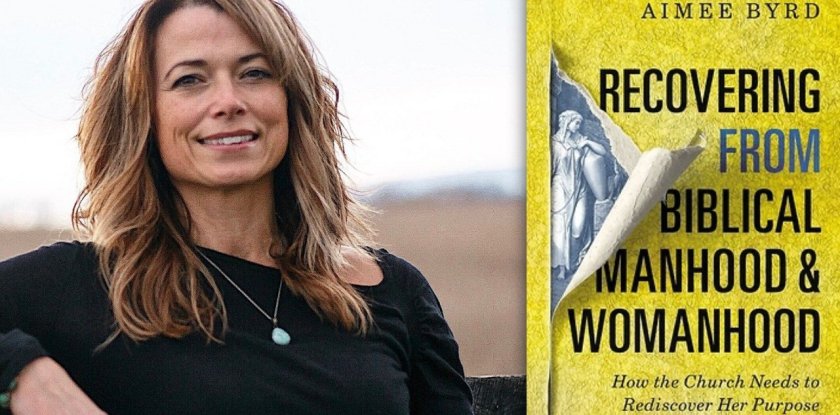
Byrd had become an important and influential voice in evangelicalism. A female voice, podcasting with the big boys (and Pruitt and Trueman are renowned minds in the faith). In 2020 when Byrd published “Recovering from Biblical Manhood and Womanhood: How the Church Needs to Rediscover Her Purpose” it hit like a bomb. Here is the blurb:

This book dismantles every mistruth that you’ve heard about the role of women in the Bible, her place in the church, and the patriarchal lie of so-called “biblical manhood and womanhood.” In its place, Aimee Byrd details a truly biblical vision of women as equal partners in Christ’s church and kingdom.

What was noted to be “conspicuously absent from Recovering from Biblical Manhood and Womanhood” is any mention of 1 Timothy 2:12. A women may not teach or exercise authority over a man, but to remain quiet. This was a stance Byrd had formerly proclaimed, one she said believed in and lived by. But apparently no more.

We see the tip-off word in that blurb – patriarchy. Another signal word, equality. Byrd was then asked to step away from the Alliance of Confessing Evangelicals, (ACE), the Mortification of Spin podcast, and her blogs were removed from the blog section (which has a rotating panoply of writers, not just Byrd).

The ACE was not outright opposed to the theological ideas contained in Byrd’s new work, they said they understood the book to be polemical. They said they knew their Alliance contained a variety of flavors of theologies (within certain limits). But they did ask her Nine Questions about her new stance. Byrd answered, but in the ACE view, it was an ungracious and unsatisfactory defense. I’d suggest reading the above links in their entirety to get the flavor of the ACE’s dismissal of Byrd from their platforms.

Her denomination was in an uproar for a year. Divided and upset.

History Lesson:
–metaphorical Jezebel of Rev 2 split her church. Charge: False prophesying, misleading the church.
–Puritan Anne Hutchinson split the Massachusetts Bay Colony. Caused massive uproar. Charge: Teaching men, and claiming direct revelation.
–Beth Moore caused massive uproar in the SBC denomination. Charge: False prophesying, claiming direct revelation, & teaching men.
–Aimee Byrd, Denomination elders said her new stances caused a disruption of the peace of the church, rejecting biblical gender roles.

Yes, women are strong. But when strength is used in the wrong way, when we do not submit and remain in our roles, our strong will causes disruption to the peace of the church.

Byrd began writing about being a “survivor”. Of being “reviled”. Of not “being valued.” Of “abuse in the church.”

Discerning people began issuing warnings.

Like this prediction from Denny Burk in 2020- Denny Burk said of Byrd, “I predict arguments like Byrd’s will prove over time to be a briefly held way-station on the movement from narrow complementarianism to egalitarianism. Readers who do not wish to take that journey should be cautious about Byrd’s book.

Like this one from Mike Myers in 2021, “My concern is that the writings of Mrs. Byrd have gradually drifted from helpful, orthodox, and godly, to harmful, heterodox, and worldly.” (Source)

Like this one from CBMW in 2022- “But as some reviewers argued at the time, the position offered by Byrd’s book is a kind of way-station to egalitarianism. Even still, many dismissed these warnings as defensive or overblown” stated the Council of Biblical Manhood & Womanhood in noting Byrd’s reversal of positions.

Side Note: When your mature theologians or credible discernment people issue warnings like those, please consider them seriously. We see the trends. We know the trigger words. We have the Holy Spirit’s wisdom in this particular gift to discern the crack in the foundation. You don’t have to wait till the house crumbles to begin testing a person’s theology and comparing it to the Bible.

Now cut loose from the ACE, Byrd formed “a new nest” (blogging platform). Soon after, she preached her first sermon. Once a hard and fast complementarian, a ‘housewife theologian’, in 2022 Byrd stood behind a pulpit on a Sunday morning to exposit the word to a congregation.

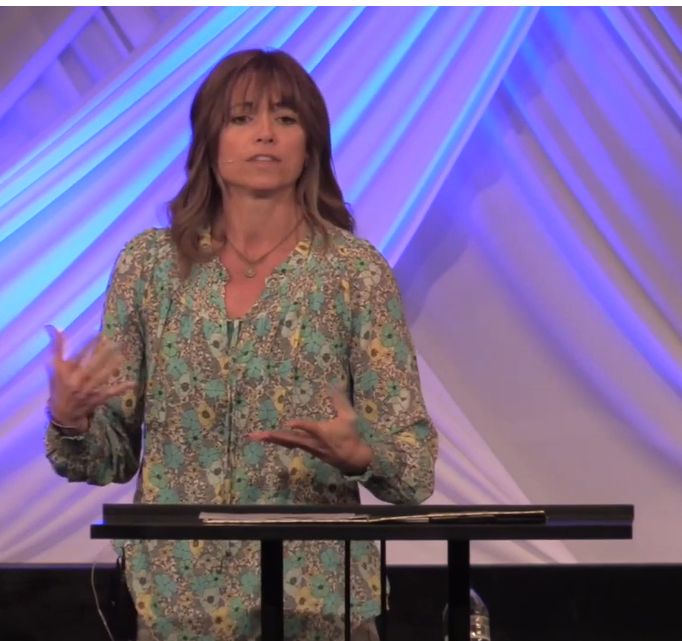
Aimee preaching at Covenant Baptist Church in Shepherdstown, West Virginia, a SBC church btw.

This is in direct violation of the 1 Timothy verse and her own previously stated beliefs:

Aimee in 2013: “There are many roles for women in the church, but Scripture makes it clear that the office of elder and pastor is not one of them (1 Tim. 2:12). Not only that, most men are never called to this position (1 Tim. 3:1-7). I believe God has ordained this for our good.

Ten years after the lauded and doctrinally solid Housewife Theologian was published, Byrd has in 2023 become an abomination to God. Strong words? In 1 Corinthians 14:34-35 we read,

The women are to keep silent in the churches, for they are not permitted to speak, but are to subject themselves, just as the Law also says. But if they desire to learn anything, let them ask their own husbands at home, for it is disgraceful for a woman to speak in church.

The word disgraceful means base, sordid, shameful, dishonorable.

I again show you Aimee Byrd preaching, and therefore disgraced, shamed, and sordid in the eyes of God:

But that is not where it ends. There’s more, and it’s worse. Worse than being sordid and polluting God’s pulpit? Yes.

Applauding other women who preach in God’s pulpit. (Romans 1:32).

Byrd wrote this week (September 2023) an essay she titled, “What a Woman Pastor Showed Me.” As with so many egalitarian heathens, like Beth Moore, they drop out of their denomination and seek places where their ears and heart can be tickled with sin. Byrd left the Presbyterian denomination of which she had long been a member, but could not find a church home for an extended period of time, despite visiting around “desperately”.

On the advice of a friend, Byrd recently checked out the Methodist church near her town. Byrd wrote that she never had thought she’d attend a Methodist church, saying of herself she’d been a “Reformed elitist”.

Rebuttal: dismissing churches which teach false doctrine isn’t elitist, it’s mature discernment and proper separation from theological pollution.

Byrd went on, noting that the congregation was small, older, and all-white. Byrd wrote, “But the all-white part is disappointing.”

Rebuttal: The Spirit sends whom He will send if it’s a real church. If He sends all white folks then so be it. They’re family. Period. If the church isn’t a true church, the people will congregate where they want due to their ears desire tickling.

Side note: I viewed or scanned through 35 of the services in the church that Aimee is gushing over. Aimee had noted the church’s demographics: small in number, mature, all-white, only a few families. One thing she didn’t mention that I noticed in these videos: the congregation seems to be composed mostly of women.

Byrd wrote: “The liturgy was refreshing. Christ was there. The whole service was saturated in the gospel. The pastor is a woman.”

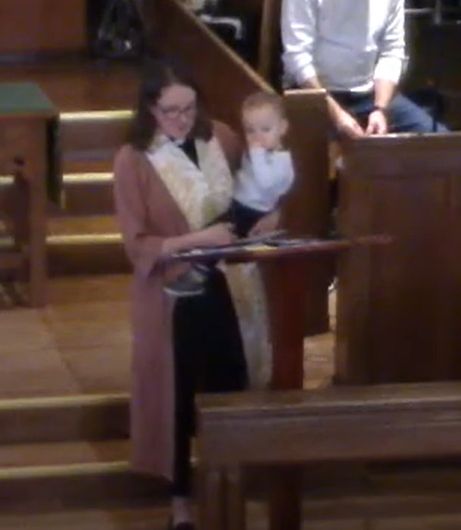
“Reverend” Katie O’Hern Hamilton preaching with her son on her hip

Rebuttal: the place Byrd was in was not a church and they know not any Gospel. Christ was definitely not there. Christ does not affirm what He abominates and calls by His Spirit “sordid.”

Byrd wrote: She then dismisses the little ones who want to go to the children’s time outside of the sanctuary and transitions behind the pulpit with baby Wilbur still on her chest. I watched a woman deliver a wonderful sermon with a baby attached to her.

Rebuttal: I mourn the example Katie O’Hern Hamilton is giving her children, I mourn the congregation’s inability to see that this is disgraceful, I mourn the lost time her children are divided from attention from their mother, I mourn them when they grow up thinking this is OK. I am actually aghast and offended with this.

I mourn the loss of Aimee Byrd from the faith.

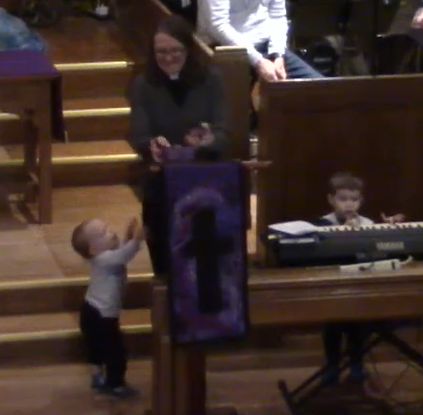
Above, this speaker whom Aimee Byrd believes is actually a pastor qualified to give sermons, her child is trying to get her mom’s attention during the service while this woman who thinks she’s a pastor is trying to give directions to the undiscerning congregation. Another child, perhaps Kate’s other boy, is playing the keyboard while the lady next to him tries to stop him. This is during the service.

1 Timothy 3:4 says in the qualifications for pastor, “He must be one who manages his own household well, [notice the he] keeping his children under control with all dignity (but if a man does not know how to manage his own household, how will he take care of the church of God?),” emphasis mine.

Obviously, the dignity of the service is out the window with the “pastor’s” kids interrupting service, crawling all over, and distracting the congregation. Aimee revealed that the older child “likes to distract, be heard” and said, “Howard, the outspoken toddler, bypassed daddy and ran straight to pastor-mom as she raised her arms, yelling, “No, mommy; no, mommy; no mommy!” over and over through the entire benediction. How hilarious!”

Jesus does not think it’s hilarious. Not at all. “But I have this against you, that you have left your first love. Therefore remember from where you have fallen, and repent and do the deeds you did at first. But if not, I am coming to you and will remove your lampstand out of its place, unless you repent.” (Revelation 2:4-5).

Fallen!

Aimee Byrd went from professing Christ and all His word true, including his ban on women preaching, to disillusionment with the church, and finally to identifying with the “marginalized, oppressed, and disillusioned“, rejecting churches with “patriarchal hierarchy,” landing in a church that is not a church, led abominably by a woman, and exulting in finding where her itching ears can be tickled.

The Danger of Apostasy

Do you know how many, MANY verses in the Bible warn of apostasy? Many. I would repeat them all but there are so many and this essay is already long. See here. Believers are repeatedly warned to check one’s self to make sure we are in the faith.

But the Spirit explicitly says that in later times some will fall away from the faith, paying attention to deceitful spirits and doctrines of demons... (1 Timothy 4:1)

1 Timothy 4:16 says “Pay close attention to yourself and to your teaching; persevere in these things, for as you do this you will save both yourself and those who hear you.”

Do you think it doesn’t happen in these days? Think again! Do you think it cannot happen to you? Think again. Sin is crouching at the door waiting to have you!

Hebrews 6:4-6, For it is impossible, in the case of those who have once been enlightened and have tasted of the heavenly gift and have been made partakers of the Holy Spirit, and have tasted the good word of God and the powers of the age to come, and then have fallen away, to restore them again to repentance, since they again crucify to themselves the Son of God and put Him to open shame.

How many who did not pay close attention to their life or doctrine (1 Timothy 4:16) will try and appeal to Jesus on the Day by shouting about their works? (Matthew 7:21-23)

Do not be fooled. Apostasy exists and it hides WELL.

Apostasy, er, Angle Shades moth camouflage

In fact, Philip the Evangelist, who presumably had experience detecting a true and sincere testimony, traveled with Simon the Sorcerer after Simon’s baptism, only for Simon to unmask himself before Peter when Simon asked to buy the Holy Spirit. (Acts 20).

The Disciples were told at the Last Supper that there was one would betray the Son of Man, and the men were so sure of Judas that they questioned themselves before asking if it was Judas.

Byrd is egalitarian now. Sin doesn’t end there. Amy Spreeman said of these sad, well-trod paths away from Christ, “Egalitarianism appears to be the gateway drug for total [homosexual] affirmation”. That’s what’s next. It always happens. In fact, Aimee’s new church which is led by a woman is having a class of a “detailed study of the Bible passages most commonly cited in the church’s disagreement about same-sex marriage and LGBT+ inclusion.”

It is not clear which side this particular UMC will fall on…but with a Princeton Seminary graduate as a female pastor teaching this class, I am not hopeful that it will be biblically correct.

Sin leads down, to the abyss. Repentance leads up, to Christ. Ladies, watch your life and doctrine closely.


Further Resources

CBMW: That Was Then, This Is Now: Aimee Byrd Preaches Her First Sunday Morning Sermon

The End Time: Markers on the way-station of downgrade: Exhibit A, Aimee Byrd

The End Time: They make such excuses: Exhibit B, Aimee Byrd

Posted in theology

Why doesn’t God answer my prayer? Should I quit praying it?

Elizabeth Prata

We pray for things near to our heart. We pray and pray and pray. Years go by. There is no answer. Does God listen? I’m feeling hurt, is that OK? Do I keep praying?

These are questions many women ask, think about, or feel. What do we do when God seemingly isn’t hearing our pleas?

Ladies, I am sorry if your prayer has not been settled in your mind and heart with an obvious answer as yet. It’s especially hard when our petitions to Jesus are aligned with what would please Him, such as salvation for another, or to strengthen a husband, or a stronger faith in one’s self; something along clear biblical lines.

The first thing we should do is, reassess your petition. Ensure it is something the Lord would bless and/or something that would bring Him glory. Is it near and dear to HIS heart? If it is, no worries:

And this is the confidence which we have before Him, that, if we ask anything according to His will, He hears us. And if we know that He hears us in whatever we ask, we know that we have the requests which we have asked from Him. (1 John 5:14-15)

Then make sure of your motivations. Are you praying like the Pharisees did, to be seen by others? Are you making long prayers for a show?

Woe to you, scribes and Pharisees, hypocrites, because you devour widows’ houses, and for a pretense you make long prayers; therefore you will receive greater condemnation. (Matthew 23:14).

Next, don’t worry about the time it seems to be taking for your prayer to be fulfilled. With the Lord, a thousand years as if a day, and a day as if a thousand years…so 2 years or 4 years or decades is long to us but mere “seconds” in time for the Lord…His timing is always perfect.

Anna was widowed at a young age, probably around 21, and decided to remain at the temple and praying and fasting night and day, at age 84 speaking to one and all who were also waiting for the redemption of Israel. “She never left the temple, serving night and day with fastings and prayers” says Luke 2:36-38. We all can’t literally be Anna, devoting ourselves totally to praying, fasting and looking up for our redemption, but the concept is there:

PERSIST.

Marie Durand was a Huguenot who was imprisoned in 1738 for 38 years in the Tower of Constance for her faith. The powers-that-be wanted her to recant Christianity and turn Roman Catholic. Every single day for 38 years they came to her cell and asked her to recant. Every single day for 38 years, she didn’t. She even scratched RESISTEZ on the wall of her cell with a knitting needle.

We hear much from sermons, memes, quotes and of course the Bible about persevering. “The Perseverance of the Saints” is a phrase we are familiar with. Prayer IS perseverance. If you are still praying, you are still persevering. Keep praying!

In the Parable on Prayer in Luke 18, the “Persistent Widow” was lauded. She kept after the Judge asking for justice. Jesus said in His conclusion to that parable,

“Now, will God not bring about justice for His elect who cry to Him day and night, and will He delay long over them? I tell you that He will bring about justice for them quickly. However, when the Son of Man comes, will He find that faith on the earth?” (Luke 18:7-8).

Meaning, don’t give up. Don’t stop praying in despair or discouragement that God isn’t listening, or somehow doesn’t care about your issue. Have faith.

Look up the verses that discuss prayer. You can go to Bible Gateway and search for “prayer” and Old Testament and New Testament verses will come up, all organized into the books of the Bible that mention it. Then read up from the verse and down from the verse to get the context, and then believe.

God delights in the prayers of the upright- Proverbs 15:8. So as long as you are praying you are persevering. You are also pleasing Him!

Pursue God relentlessly. Prayer is part of that pursuit.

Prayer is a mechanism thru which He promised to reward us. Matthew 6:6->
But as for you, when you pray, go into your inner room, close your door, and pray to your Father who is in secret; and your Father who sees what is done in secret will reward you.

Our Intercessor brings those prayers to the Father. No matter if it is yes, no, or wait, our prayers keep us submitted to Him (the very act of praying signals that we know we need Him), delights Him, He acts as intercessor on our behalf…

The answer might be YES in 10 years or tomorrow. it might be NO in ten years or tomorrow. We just don’t know. But everything He does is good and is for our good, says Romans 8:28. So even this time of praying and waiting IS for our good. He heard the cry of Hagar in the wilderness and He hears your cry, too. And He has compassion for it.

Here are some good resources:

Praying With Perseverance

Ligonier devotional: Consistent, persevering prayer

Ephesians 6:18
praying at all times with all prayer and petition in the Spirit, and to this end, being on the alert with all perseverance and petition for all the saints,

Posted in theology

The very small!

By Elizabeth Prata

Yesterday I wrote about very large things in the Bible. The Anakim, large giants of the antediluvian Flood, (and afterwards too), The Ark, large armies killed in a single night. The observable universe is said to be 95 billion light years across. So just imagine how big God is to be transcendent from that.

And in typical squirrel fashion, I then thought about the opposite of Very Large Things, what’s in the Bible that is very small? Of course, the mustard seed was the first small thing I thought of. Let’s take a look at the verses and the facts about this very small seed.

He presented another parable to them, saying, “The kingdom of heaven is like a mustard seed, which a man took and sowed in his field; and this is the smallest of all seeds, but when it is fully grown, it is the largest of the garden plants and becomes a tree, so that the birds of the air come and nest in its branches.” (Matthew 13:31-32).

[Mt 13:31Mk 4:31Lk 13:19Mt 17:20Lk 17:6]): The minuteness of the seed is referred to in all these passages, while in the first three the large size of the herb growing from it is mentioned. In Mt 13:32 it is described as “greater than the herbs, and becometh a tree” (cf Lk 13:19); in Mk 4:32 it “becometh greater than all the herbs, and putteth out great branches.” Several varieties of mustard (Arab. khardal) have notably small seed, and under favorable conditions grow in a few months into very tall herbs—10 to 12 ft.

From The Plants of the Bible by JH Balfour:

Professor Hackett tells us that when crossing the plain of Akka, in Palestine, he saw before him a little grove of trees. On coming nearer they proved to be a grove of mustard-plants. Some of the trees were full nine feet high, with a trunk two or three inches in circumference, throwing out branches on every side. He wondered whether they were strong enough for the birds to “lodge in the branches thereof.” Just then a bird stopped in its flight through the air, alighted on one of the limbs, which hardly moved beneath the weight, and began to warble forth a strain of sweetest music. The professor was delighted with the incident. His “doubts were charmed away;” the “least of all seeds” had actually grown into a substantial tree.

Balfour, J. H. (1885). The Plants of the Bible (p. 61). T. Nelson and Sons.


Four things are small on the earth, But they are exceedingly wise: 25The ants are not a strong people, But they prepare their food in the summer; The shephanim [shy, furry mammals, field mice, some think] are not a mighty people, Yet they make their houses in the cliff; The locusts have no king, Yet all of them go out in rank; The lizard you may grasp with the hands, Yet it is in kings’ palaces.

Who would admire an ant? it’s an insect, of no account, small but as Matthew Henry says, “yet they are very industrious in gathering proper food, and have a strange sagacity to do it in the summer, the proper time. This is so great a piece of wisdom that we may learn of them to be wise for futurity, ch. 6:6. When the ravening lions lack, and suffer hunger, the laborious ants have plenty, and know no want. [Henry, M. (1994). Matthew Henry’s commentary on the whole Bible: complete and unabridged in one volume (p. 1024). Hendrickson.]

The same admiration in different ways for the field mice, locusts, and lizards. Thus, these small things are not of no account, but the writer was inspired by the Holy Spirit to include these for meditation on their admirable aspects.


A small boy. Matthew, Mark, and Luke all record this miracle but only John mentioned its catalyst was a small boy. (a lad, a young child; Greek paidarion)

“There is a boy here who has five barley loaves and two fish, but what are these for so many people?” (John 6:9).

The loaves were barley loaves, a lesser grain than the fine wheat grown in Palestine. He had only 2 loaves, and likely they were the usual ‘cakes’ and likely they were small enough for the lad to be able to carry them. Same with the fishes- small so he could carry them. But from the small boy carrying small loaves and smaller fish, Jesus multiplied it to a largesse unknown before that moment- feeding 5000 men, who were probably married, so that’s 10000, who probably had kids, so maybe as many as 15,000 people there received the blessing from the ‘small’ boy and his ‘small’ meal.


Conclusion

For who has despised the day of small things? But these seven will be glad when they see the plumb line in the hand of Zerubbabel—these are the eyes of Yahweh which roam to and fro throughout the earth. (Zechariah 4:10).

God sees the heart, not the externals. Saul was seen to be head and shoulders above the rest, but God knew Saul’s heart. It didn’t matter that Saul was impressively large. It didn’t matter that David was small and young. David was to be king, not Saul.

It didn’t matter that the widow was an at-risk person in that culture, often overlooked and/or poor. The Persistent widow was lauded, so was Anna. Dorcas’ sewing needle mattered to God as much as Paul’s pronouncements in amphitheaters to Kings and leaders. In fact, God allowed Dorcas to be raised from the dead.

Hagar was a cast-off slave girl, but God saw her pain in the wilderness and personally ministered to her.

The walls of Jericho were large and impressive, but they fell flat when God moved His hand. Nothing is hidden from Him.

Large or small, impressive or seemingly overlooked, God sees all. It’s the heart that matters. He counts every hair on our heads, He knows every dust mote that wafts in the wind, he is intimately involved with every soul whether they are reserved for wrath or for blessing.

God is amazing!

Further resources

No wonder they were grasshoppers in their sight: The Very Large

What does it mean when it says God looks at the heart?