Posted in theology

John the Baptist ate locusts, ew

By Elizabeth Prata

EPrata photo

I was pondering the ‘strain out a gnat, swallow a camel’ verse yesterday (Matthew 23:24). That blog essay is here.

There is an Old Testament link in Leviticus 11:20, 23, 41, and 42 that mention winged things as detestable. The people were not to eat them. Some Laws are easy to follow…

Oh no, did John the Baptist sin by eating locusts? He, a scrupulous Nazirite, and who Jesus called the greatest of men?

Maybe it’s true. I mean, Lot sinned much and yet was still called righteous. It could happen … No. I need to look into this.

If you read the Old Testament Law in Leviticus, indeed, the people were not to eat bugs. They were declared unclean. Here is the verse,

All the winged insects that walk on all fours are detestable to you. (Leviticus 11:20).

and,

Cicada. EPrata photo

Now every swarming thing that swarms on the earth is detestable, not to be eaten. 42Whatever crawls on its belly, and whatever walks on all fours, whatever has many feet, in regard to every swarming thing that swarms on the earth, you shall not eat them, because they are detestable. 43Do not make yourselves detestable through any of the swarming things that swarm; and you shall not make yourselves unclean with them so that you become unclean. (Leviticus 11:41-43).

Four times in a short amount of time, God called detestable. OK, we get it. Insects are unclean.

So, did John the Baptist sin by eating locusts?

No.

There was an exclusion to the ‘no bugs’ rule!

Yet these you may eat among all the winged insects that walk on all fours: those which have jointed legs above their feet with which to jump on the earth. These of them you may eat: the locust in its kinds, the devastating locust in its kinds, the cricket in its kinds, and the grasshopper in its kinds. But all other winged insects which are four-footed are detestable to you. (Leviticus 11:21-23).

Ew. EPrata photo. Grasshopper

So it was allowable to eat grasshoppers, crickets, and locusts. I wonder how they taste? Business Insider has an article about “5 Bugs you Can Eat” including the ‘beginner bug’.

High in protein, zinc, and iron, locusts can be pan-fried, deep-fried, or even covered in chocolate, as noted in BBC. Locusts are said to have a sort of shrimpy, nutty flavor. They were even renamed “sky prawns” during an Australian swarm, according to Bugsfeed.

‘Sky prawns,’ lol. How to cook them? These 5 countries eat locusts as a delicacy

Locust is also the only creature that’s considered kosher. They fry the winged creatures and even serve it as desserts. … So Israelis prefer to drop the locusts in a boiling broth, clean them off, roll them in a mixture flour of coriander seeds, garlic chili powder, and finally deep fry them.

They are often served on a skewer as street food. This picture is in China but the same can be seen in the Middle East. They are a delicacy to many people groups in the world, not a novelty like they are to us in America.

They are nutritious, say Nutritionists. The ones mentioned in the Bible that are allowed to eat are easy to catch. When they swarm, there are plenty to eat, preserve, and feed to one’s livestock. We can envision John the Baptist in the desert grabbing up a handful, skewering them, and cooking over a small fire. Or maybe not envision it…

The fact that John made his food of them is emblematic of his poverty and simple, humble life.

THE LOCUST. In The Scripture alphabet of animals, by HN Cook, 1842

The locust is called an insect, as well as the ant and the bee, but instead of being harmless, as they usually are, it does a great deal of injury. It is also much larger than they; for it is generally three inches long, and sometimes as much as four or five. The plague of the locusts was the eighth that God sent upon the Egyptians, because they would not let the children of Israel go, as he commanded; and it was a very terrible one indeed. The Bible says, “They covered the face of the whole earth, so that the land was darkened; and they did eat every herb of the land, and all the fruit of the trees which the hail had left; and there remained not any green thing in the trees, or in the herbs of the field through all the land of Egypt.” This is the way they often do in those countries, though perhaps it is not common for so many to come at once.

They fly in companies of thousands together, and so close that they look like a great black cloud. When they alight on the ground they all come down in a body, and immediately begin to devour the grass and grain; they also eat the leaves of the trees, and every green thing they can find. The people dread them more than they do the most terrible fire or storm; because though they are so small, they destroy all the food, and leave the people ready to starve. When the inhabitants see them coming over their fields, they try to drive them away by making loud noises or by kindling fires; but this does little good.

It is said that a great army of locusts came over the northern part of Africa about a hundred years before the birth of Christ. They consumed every blade of grass wherever they alighted; also the roots, and bark, and even the hard wood of the trees. After they had thus eaten up every thing, a strong wind arose, and after tossing them about awhile, it blew them over the sea, and great numbers of them were drowned. Then the waves threw them back upon the land, all along the sea-coast, and their dead bodies made the air so unwholesome that a frightful pestilence commenced, and great numbers of men and animals died.

Many travellers have seen these great clouds of locusts, and describe them in their books. One says that he saw a company consisting of so many that they were an hour in passing over the place where he was. They seemed to extend a mile in length and half a mile in width. When he first noticed them, they looked like a black cloud rising in the east; and when they came over head, they shut out the light of the sun, and made a noise with their wings like the rushing of a water-fall. Another swarm is mentioned which took four hours to pass over one spot; and they made the sky so dark that one person could not see another at twenty steps off.

You can now understand two or three passages from the Bible which I will mention. David says in the 23d verse of the 109th Psalm, “I am tossed up and down as the locust;” that is, as the clouds of locusts are tossed about by the wind. In the first chapters of Joel God threatens to send the locust among the people, because of their wickedness; and he says of them, “Before their faces the people shall be much pained; all faces shall gather blackness. They (the locusts,) shall run like mighty men; they shall climb the wall like men of war. They shall run to and fro in the city; they shall run upon the wall; they shall climb up upon the houses; they shall enter in at the windows like a thief.” An English clergyman who visited countries where the locusts are found, a few years ago, says that these verses describe them exactly as he has himself seen them.

Cook, H. N. (1842). The Scripture alphabet of animals. American Tract Society.
Posted in theology

Strain a gnat, swallow a camel

By Elizabeth Prata

Ye blind guides, which strain at a gnat, and swallow a camel. (Matthew 23:24)

EPrata photo

What I love about the puns, parables, and sayings of the ancient Palestinian world in the Bible is that you can understand the main concept it’s presenting on the face of it. But if you dig a bit, there is always more meaning to be gained. By looking into the context, history, and natural history we can learn more.

In Matthew 23:24, gnat means gnat or mosquito- something small. We immediately see the contrast, big vs. small. Jesus was saying the Pharisees work hard at getting something small out of the way while ignoring something big.

But if we dig, and ask ourselves, ‘Why would the Pharisees work at straining out a gnat?’ there is more understanding to be gained…

Looking further, there is an Old Testament link to this. Leviticus 11:20 23, 41, and 42 mention winged things as detestable. They were not to eat them.

EPrata photo

All the winged insects that walk on all fours are detestable to you. Yet these you may eat among all the winged insects that walk on all fours: those which have jointed legs above their feet with which to jump on the earth. (Leviticus 11:20-22).

So in the New Testament, the Pharisees, hyper-keepers of the Law, so intent on arranging their lives so as to show they were precise in keeping it, used a cloth to strain out any insects that may have fallen into their drink, so they would not be breaking the law. Here is a Jamieson-Fausset-Brown Bible Commentary comment on that:

Ye blind guides, which strain at a gnat—The proper rendering—as in the older English translations, and perhaps our own as it came from the translators’ hands—evidently is, “strain out.” It was the custom, says Trench, of the stricter Jews to strain their wine, vinegar, and other potables through linen or gauze, lest unawares they should drink down some little unclean insect therein and thus transgress (Leviticus 11:20, 23, 41, 42)—just as the Buddhists do now in Ceylon and Hindustan—and to this custom of theirs our Lord here refers.

and swallow a camel—the largest animal the Jews knew, as the “gnat” was the smallest; both were by the law unclean. End Jamieson-Fausset-Brown Bible Commentary.

EPrata photo

In his magazine The Sword and Trowel, Charles Spurgeon wrote in 1877,

“The note on this in the “Pictorial Bible” is valuable:—”In the East, where insects of all kinds abound, it is difficult to keep clear of insects liquors which are left for the least time uncovered; for which reason it was and is usual to strain the wine before drinking, to prevent insects from passing into the drinking vessel. Beside the common motive of cleanliness for this practice, the Jews considered that they had another and more important one—that of religious purity. For as the law forbade them to eat ‘flying creeping things,’ they thought themselves bound to be particularly careful in this matter . . . The Talmud contains many curious explanations and directions relating to it.”

In thinking about this idea of smaller-to-larger even further by making a connection with the mention of taking the splinter out of a brother’s eye but ignoring the plank in our own. Do we strain out the little things in our life, but ignore the big things? Do we have a hyper fixation on attending church (as a show) but fail to slay any lustful thoughts? Do we make a show of tithing but fail to give mercy to those who need it? Do we stalwartly refuse to take a pen home from work even accidentally, but cheat on the taxes? And so on.

The Bible’s parables and sayings are interesting parts of the Lord’s word. ALL the Bible has meaning, whether you skim and understand on the surface, or dig deeper. Either way, the key is to THINK about what you read, and not just the ‘big things’ like doctrinal commands, but the ‘little things’ too- whether it’s a doxology, a list of greetings, a seemingly murky proverb or parable, or anything else; and ask the Spirit to absorb it into your heart and transform your mind.

Posted in encouragement, theology

Encouragement: Keeping our conscience tender

By Elizabeth Prata

I hope this fine late spring week has offered you beautiful glimpses of God’s creative intellect and His wonderful power. Once, I saw a rainbow extending from left to right directly in front of me, and for the first time I even saw the end of the rainbow pooling in colors right there on the ground. (No pot of gold, sorry 😉

I’m semi-not looking forward to the weather easing into summer. Summers in Georgia can be brutal like a hot box. But the upside is that school is out and I can stay home and read and write and blog and podcast and listen to sermons and nap!

We always enjoy the march of the seasons. “He appointed the moon for seasons: the sun knoweth his going down.” (Psalm 104:19, KJV).

Wherever we are in the world, reading this blog, we see and understand the times and seasons. In spring, we look for the robin, the crocus, the ladyslipper. In summer we look for puffy clouds, rain showers, cicadas. The orderliness and consistency of the seasons since His ordination of them is a comfort. Yet even in Jeremiah 8:7 it is said of the seasons, meaning HIS season,

Yes, the stork in the heaven knows her appointed times; and the turtle and the crane and the swallow observe the time of their coming; but my people know not the judgment of the LORD.”

In the natural history of Israel, Barnes notes explains, “Jeremiah appeals to the obedience which migratory birds render to the law of their natures. The “stork” arrives about March 21, and after a six weeks’ halt departs for the north of Europe. It takes its flight by day, at a vast height in the air (“in the heaven”). The appearance of the “turtle-dove” is one of the pleasant signs of the approach of spring.”

As for the part of the Jeremiah verse which speaks to His judgments, Matthew Henry holds sway here:

“Sin is backsliding; it is going back from the way that leads to life, to that which leads to destruction. They would not attend to the warning of conscience. They did not take the first step towards repentance: true repentance begins in serious inquiry as to what we have done, from conviction that we have done amiss. They would not attend to the ways of providence, nor understand the voice of God in them, ver. 7.

They know not how to improve the seasons of grace, which God affords. They would not attend to the written word. Many enjoy abundance of the means of grace, have Bibles and ministers, but they have them in vain. They will soon be ashamed of their devices. The pretenders to wisdom were the priests and the false prophets. They flattered people in sin, and so flattered them into destruction, silencing their fears and complaints with, All is well. Selfish teachers may promise peace when there is no peace; and thus men encourage each other in committing evil; but in the day of visitation they will have no refuge to flee unto.”

How perfect and prescient His Word is! Let us enjoy the seasons of grace that Jesus offers His children.

In Numbers, where God is dispensing instruction to the Priesthood, God said, “I am giving you the service of the priesthood as a gift.” (Numbers 18:7b). It is a gift to serve Him. It is a gift to dedicate one’s life to Him. It is a gift to be close to Him. It was a gift to the people who needed priests. He also gave the Prophets as a gift and in the New Testament, the gift of prophecy/preaching is also a gift. (1 Corinthians 12:10; Romans 12:6).

I feel deeply for Jeremiah the Prophet, who was known as The Weeping Prophet. Jeremiah lived in a time when the People’s pride was dragging them backward into sin and away from the LORD. (Jeremiah 13:15-27; “Pride precedes captivity”.) He lived when the people’s sins had piled up. Jeremiah was the last prophet sent to preach to the Southern Kingdom. The searing effects of their sins had hardened them so much that no one ever listened to Jeremiah. He never had one convert. “Yet they did not obey or incline their ear, but followed the counsels and the dictates of their evil hearts, and went backward and not forward.” (Jeremiah 7:24). Seasons of sin means seasons of bondage.

We speak of His love these days and His joy, peace in knowing Him. All these things are good to have and feel and be. But where is the grief? Where are our weeping prophets (Christians) today? Do we repent in grief for our sins?

Our conscience is a gift too. Let us keep it in good order in every season.

Meanwhile, keep up the good fight, persevere. Repent of the big things and the little things. Keep a tender conscience. Enjoy the gift of His Spirit and His people, and His church, and His word. Soon enough, our faith will be made sight, and we shall see Him as He is. What a day that will be!

hope 7
EPrata photo

Further resources:

John MacArthur, book, The Vanishing Conscience

RC Sproul 4-min devotional, Don’t Waste Your Conscience

Monergism, selections on the conscience by Puritans, essay by JI Packer: The Puritan Conscience

Posted in theology

In the presence of God with great joy?

By Elizabeth Prata

Now to Him who is able to keep you from stumbling, and to make you stand in the presence of His glory blameless with great joy. (Jude 1:24).

How will we be presented? We shall be presented blameless.

Matthew Henry commentary, Now, our faults fill us with fears, doubts, and sorrows; but the Redeemer has undertaken for his people, that they shall be presented faultless. Where there is no sin, there will be no sorrow; where there is the perfection of holiness, there will be the perfection of joy.

We will not only experience great joy when we are finally glorified and presented to God, but also God will have great joy-

Then shall our hearts know a joy beyond what earth can afford; then shall God also rejoice over us, and the joy of our compassionate Saviour be completed. (MHenry)

We read in Hebrews 12:2a that Jesus is the “originator and perfecter of the faith, who for the joy set before Him endured the cross”. And what is His joy? To receive a Bride to Himself given by the Father.

Isn’t it astonishing to think the God on high will be joyous over us? Not that we have any internal merit to warrant His joy, but that He redeemed us through His Son, kept us from stumbling, persevered us to the end, and now has a blameless humanity with which to present His Son. His joy is joy for His Son through us.

God promises to present His people to Himself blameless and joyful. Left to ourselves none of us is blameless. Only those who have been washed in the blood of the Lamb will be made to stand blameless on the day of judgment. Though Adam and Eve lost the joy of living in the presence of God when they sinned, Christ has taken away the guilt of our sin and removed the fear of judgment. We will rejoice in that day because we stand clothed in His righteousness and will have been fully set free from sin. Additionally, God personally rejoices to bring us to Himself in glory. The writer of Hebrews tells us that “for the joy that was set before Him” Jesus died to bring us to glory. (12:2). ~HB Charles, Jr. “Blessing and Praise: Benedictions and Doxologies in Scripture” Study Guide

“Robe of Righteousness” by Lars Justinen
Posted in theology

The future, AI, and EM Forster’s novella “The Machine Stops”

By Elizabeth Prata

In 1909 a novella was published by EM Forster, he of the novels A Room with a View (1908), Howards End (1910) and A Passage to India (1924). His novella, again reminding the reader it was published in 1909, was called The Machine Stops. It is a view of the long trajectory of humanity that the author envisioned where humans have become totally dependent on The Machine, even worshiping it. They live underground and are suspicious of those who want to go above. Eventually, travel to the surface is banned. His novella explored overreliance on technology, as well as the impacts of perpetual social isolation and separation from the natural world.

The plot of the novella is below containing spoilers, so skip it if you do not want to know, and scroll down to the next part of this essay. Licensing to reproduce the Wikipedia plot recap is here. The novella is incredibly, INCREDIBLY prescient, predicting the internet, video-conferencing, instant messaging, and more.

Plot summary: The Machine Stops

The story describes a world in which most of the human population has lost the ability to live on the surface of the Earth. Each individual now lives in isolation below ground in a standard room, with all bodily and spiritual needs met by the omnipotent, global Machine. Travel is permitted, but is unpopular and rarely necessary. Communication is made via a kind of instant messaging/video conferencing machine with which people conduct their only activity: the sharing of ideas and what passes for knowledge.

The two main characters, Vashti and her son Kuno, live on opposite sides of the world. Vashti is content with her life, which, like most inhabitants of the world, she spends producing and endlessly discussing secondhand ‘ideas’. Her son Kuno, however, is a sensualist and a rebel. He persuades a reluctant Vashti to endure the journey (and the resultant unwelcome personal interaction) to his room. There, he tells her of his disenchantment with the sanitised, mechanical world.

EPrata photo

He confides to her that he has visited the surface of the Earth without permission and that he saw other humans living outside the world of the Machine. However, the Machine recaptures him, and he is threatened with ‘Homelessness’: expulsion from the underground environment and presumed death. Vashti, however, dismisses her son’s concerns as dangerous madness and returns to her part of the world.

As time passes, and Vashti continues the routine of her daily life, there are two important developments. First, individuals are no longer permitted use of the respirators which are needed to visit the Earth’s surface. Most welcome this development, as they are skeptical and fearful of first-hand experience and of those who desire it. Secondly, “Mechanism”, a kind of religion, is established in which the Machine is the object of worship. People forget that humans created the Machine, and treat it as a mystical entity whose needs supersede their own.

Those who do not accept the deity of the Machine are viewed as ‘unmechanical’ and threatened with Homelessness. The Mending Apparatus—the system charged with repairing defects that appear in the Machine proper—has also failed by this time, but concerns about this are dismissed in the context of the supposed omnipotence of the Machine itself.

EPrata photo

During this time, Kuno is transferred to a room near Vashti’s. He comes to believe that the Machine is breaking down, and tells her cryptically “The Machine stops.” Vashti continues with her life, but eventually defects begin to appear in the Machine. At first, humans accept the deteriorations as the whim of the Machine, to which they are now wholly subservient, but the situation continues to deteriorate as the knowledge of how to repair the Machine has been lost.

Finally, the Machine collapses, bringing ‘civilization’ down with it. Kuno comes to Vashti’s ruined room. Before they both perish, they realise that humanity and its connection to the natural world are what truly matters, and that it will fall to the surface-dwellers who still exist to rebuild the human race and to prevent the mistake of the Machine from being repeated.

Here are a few quick reviews of the novella:

In such a short novel The Machine Stops holds more horror than any number of gothic ghost stories. Everybody should read it, and consider how far we may go ourselves down the road of technological ‘advancement’ and forget what it truly means to be alive;” rating the story as 10 out of 10.” ~The Fantasy Book Review

“‘The Machine Stops’ is not simply prescient; it is a jaw-droppingly, gob-smackingly, breathtakingly accurate literary description of lockdown life in 2020.” ~Will Gompertz, BBC, 2020

1909: E.M. Forster publishes ‘The Machine Stops,’ a chilling tale of a futuristic information-oriented society that grinds to a bloody halt, literally. Some aspects of the story no longer seem so distant in the future.” ~Randy Alfred, Wired magazine, 2010.


EPrata photo

I read The Machine Stops a few years ago. One thing the plot recap nor the reviews mentioned is the impact of over-reliance on technology on the mind. The inhabitants of the underground world ceaselessly delivered lectures to each other by a vast network akin to our video-conferencing today. But the ideas contained in the lectures were derivative of each other, endlessly recycled and repackaged. New ideas were non-existent. This is because there was no input from external stimuli, neither in-person social conversation nor inspirations from nature and the organic world. Everything was sanitized, pneumatic, and sterile. Soon enough their minds were too dulled to create connections to new ideas and did not produce art, music, literature, science, etc.


Reading this essay below reminded me of The Machine Stops. The author is a Christian professor discussing how AI is impacting his life of teaching, but he also related the overall issue of derivative thinking to our faith, the sin problem, and morality.

He said, and I agree, that technology in and of itself is morally neutral. Immorality stems from an individual’s desire to live a life apart from God. The immoral person disbelieves he is going to be judged by a morally perfect God, and errantly believes that God’s behavioral standards do not apply to him. Autonomy from God is the root of all sin. Two examples are mentioned- climate ‘control’ and transhumanism:

Like Frankenstein, these technocrats will seek to replace God by altering nature. Silicon Valley leaders seek immortality in transhumanism. Their goal is an unending life apart from God.” ~Owen Anderson

Most technology invented is one that seeks to give humanity a life of ease. Washing machines, smartphones, automobiles… do make our lives easier.

Work that involves toil and drudgery can be done by technology so that humans can spend their mental efforts on creativity instead.” ~Owen Anderson

Except, they don’t spend their mental efforts on creative endeavors instead. Every time a new invention hits the market it seems that it will be the thing to release us from work-work-work, but then the hours fill in with more work, somehow.

EPrata photo

Many people are unaware of this, but when settlers first came to America, they saw many of the different Native tribes’ leisure time as scandalous. The Native Americans had very little ‘technology.’ Of course, they worked hard for their means, but once accomplished, they actually had copious amounts of time to do as they pleased. They lived lives of leisure with competitive sports, games, gambling, songs, dances. They had much free time and they used it for enjoyment of life.

They viewed the whites’ lives as one of drudgery that was grim and joyless, filled with wealth-building. Benjamin Franklin once said of ‘the savages’, “Having few artificial wants, they have abundance of leisure for improvement by conversation. Our laborious manner of life, compared with theirs, they esteem slavish and base…” “Remarks Concerning the Savages of North America” (1784).

Technology has afforded us in this and the previous generation the ability to proclaim Jesus across the globe. O, how the early missionaries may have envied us this day and age where at the press of a button, an entire whole Bible can be delivered to anyone who wants to receive it, in their language. Where sermons can be heard from a wealth of living and passed on preachers. Church history at the fingertips… and so much more.

But the biggest industry online is porn.

As Mr Anderson said in his essay, “Sinners make tools to sin more effectively. Instead of aiming at the chief end of glorifying God and enjoying him forever, unregenerate humans will seek our own ends.

And what ARE those ends? Satisfying various lusts. Only and forever.

I’d encourage the reader to read Forster’s novella. It is only 46 pages, and can be bought inexpensively as a paperback, read on Kindle, or read for free online. Then compare with Mr Anderson’s thoughts on AI.

AI and the future of technology is a subject worthy of pondering for the Christian, and to come to a settled conviction of how we each approach it. Daniel 12:4 says

But as for you, Daniel, conceal these words and seal up the book until the time of the end; many will go to and fro, and knowledge will increase.

It is true, knowledge has increased, but has wisdom? Critical thinking? No. It has actually declined. I wrote a bit about that here.

I am personally skeptical of AI. I am leery of anything that does my thinking for me. I am old enough to have seen the invention of many things, wonders of science and positive additions to our lives. But by the grace of God post-salvation I now also know the human tendency to use these things for evil purposes. These things are a boon to our lives but at the same time provide yet another temptation we need to guard against.

For example, social media is great for sharing doctrine but also a platform that tempts us to intemperate speech. Smartphones to communicate at a distance with loved ones, but also time-waster TikTok viewing. Streaming platforms to view edifying material, but also lascivious movies we should avoid.

One day all the machines will stop. Then we will worship God and dwell sinlessly in His kingdom. Any technology present that we see or use will be solely for the glory of God! What a day that will be!

Posted in theology

Attributes of God: Goodness, Holiness, Immutability

By Elizabeth Prata

Any day is a good time to ponder who God is. He is worthy of service and worship.

Tim Challies created a visual theology of God’s attributes. Remember, God’s attributes are not parts that make up a whole. Everything good that there is, is 100% contained in God. He is 100% beauty, 100% aseity, 100% omniscient, etc. He is complete in Himself.

A typical classification of God’s attributes divides them into those that are incommunicable (those that he does not share or “communicate” to anyone or anything else) and communicable (those that He shares with other beings). Blue text attributes are incommunicable. For example, humans can seek to be good, but we can never be immutable. We can be wise, but we can never be omniscient.

GOODNESS: Moral attributes: God is the final standard of all good, and all he is and does is worthy of approval.

HOLINESS: Moral attributes: God is separated from sin and he is committed to seeking his own honor.

IMMUTABILITY: Incommunicable attribute: God cannot change in his being, perfections, purposes, and promises.

Other essays about God’s attributes-

1. Attributes of God: Aseity, Beauty, Blessedness
2. Eternity, Freedom, Glory

Further reading

What is the Immutability of God? from GotQuestions
The Immutability of God TableTalk Magazine from Ligonier

By Tim Challies. Right click to open larger in new tab. Or here to download your own

Previous weeks-1. Aseity, Beauty, Blessedness
2. Eternity, Freedom, Glory
3. Goodness, Holiness, Immutability
4. Invisibility, Jealousy, Knowledge
5. Love
6. Mercy, Omnipotence, Omnipresence
7. Peace, Righteousness, Perfection
8. Will, Wisdom, Wrath

Posted in theology

Encouragement again

By Elizabeth Prata

I am posting a few encouraging essays this week (at least I hope they are encouraging to you), because I think we need to absorb some positivity based on glorious promises from the Bible. It’s a rough week for many people.

There is such inexpressible and perpetual activity in the holy realms, it is breathtaking to think of. All heaven is working under command of our Holy God to ready for the Time. What time? The time when God says to Jesus, “Go get your bride!” And His deposit of our inheritance will be redeemed in full! (Ephesians 1:142 Corinthians 1:22).

All of time, history, prophecy, and Holy Sovereign Decree has been moving toward the time of fulfillment of the promises of Jesus to His Bride and the promises of God to His people the Jews. Everything.

But back to the Bible’s pictures of activity. Didn’t Jesus say, “In my Father’s house are many rooms. If it were not so, would I have told you that I go to prepare a place for you?” (John 14:2).

Things are being prepared, right now. Our lodging in New Jerusalem. Our feast. He is preparing. He is engaged in activity to ready for the moment when a flood of redeemed souls enter glory to dwell with Him forever.

He is also preparing for the moment when His promises to his people the Jews come to fulfillment and the Kingdom Comes. Here is one specific glimpse of that preparation:

A Vision of a Man with a Measuring Line
“And I lifted my eyes and saw, and behold, a man with a measuring line in his hand! Then I said, “Where are you going?” And he said to me, “To measure Jerusalem, to see what is its width and what is its length.” (Zechariah 2:1-2).

Zechariah had been awakened and was shown a series of 8 astounding visions all in one night. One of them is that God sent a surveyor (likely The Angel of the LORD, Jesus) to measure the place where the final Jerusalem will be, its exact size and placement! Rejoice O Jerusalem! “Rejoice with Jerusalem, and be glad for her, all you who love her; rejoice with her in joy, all you who mourn over her;” (Isaiah 66:10).

Right now Jerusalem is split and under contention. Later it will be called Egypt and Sodom, (Revelation 11:8), but someday it will be cleansed, and it will become the holy city God intended it to be.

Look! He is so gracious, He showed Ezekiel also! “In the visions God brought me to the land of Israel, set me on a high mountain in which there was a structure like a city on the south. And he brought me there and behold there was a man whose appearance was like the appearance of bronze with a line of flax in his hand and a measuring reed and he stood in the gate.” (Ezekiel 40:2).

Measuring … preparing … So much activity:

William Blake, Jacob’s Ladder

“And he [Jacob] dreamed, and behold, there was a ladder set up on the earth, and the top of it reached to heaven. And behold, the angels of God were ascending and descending on it!” (Genesis 28:12).

Going and coming … ascending and descending … Not just in the Old Testament but the activity continues in the New:

“He then added, “I tell you the truth, you shall see heaven open, and the angels of God ascending and descending on the Son of Man.” (John 1:51).

The Sovereign God, His Perfect Son, and the Holy Angels are working to bring about the fulfillment of all the glorious promises of the Bible. I know we know the judgment promises will come true. The world and the heavens will be UNcreated in a reverse orderly progression that mirrors the 6 days in the Creation. Mountains will crumble. Rivers will dry up. Sun will blink out. Stars will fall. People will die.

But to the positive, He is also readying His universe for the new heavens and the new earth, for the moment when the Father says, “Son, it is time for you to be married. GO GET YOUR BRIDE!”

Is there any doubt that the preparations will have been completed and the glowing glorious heavens will be inexpressibly beautiful? No, no doubt.

And I saw the holy city, new Jerusalem, coming down out of heaven from God, prepared as a bride adorned for her husband. And I heard a loud voice from the throne saying, “Behold, the dwelling place of God is with man. He will dwell with them, and they will be his people, and God himself will be with them as their God. He will wipe away every tear from their eyes, and death shall be no more, neither shall there be mourning, nor crying, nor pain anymore, for the former things have passed away.” (Revelation 21:2-4)

Our Savior who saves by grace, our Father, the architect of the earth and the universe, the author of our faith, the redeemer of souls, the Chief of all the Holy Hosts, is preparing…for us.

Posted in theology

Artificial Intelligence (AI) voice impersonations and the Antichrist

By Elizabeth Prata

Read the book of Revelation. There are some symbols in it, but most of them are already explained elsewhere in the Bible (scripture interprets scripture). Admittedly, there are some symbols that are hard to figure out at first pass. But those don’t diminish the overall majesty and awe-provoking wonder of the book, nor its intended meaning. It takes study, like any Bible book. It’s not harder than Romans…IMO

When the Antichrist, Man of Perdition, appears, it will be a devastating time on earth. Jesus Himself said it will be the worst time on earth there ever has been or ever will be. (Matthew 24:21). Satan will have come to the climax of his eons-long effort to de-throne God and to take over the world. He will indwell the Man of Perdition, and so there will be mostly only sin upon the earth. Sin will prevail- for a time.

In former times, people could not understand how certain things would occur that are described in Revelation. Like, for example, the verse that says all peoples will look upon the bodies of the slain Witnesses in the streets and not allow their bodies to be buried, and they will make merry and exchange gifts.

As a temporary aside, the unsaved HATE Christianity and all it represents. When sin is allowed its full measure on the earth, look how that hate is finally fully expressed: instead of Christmas celebrating the Babe with gift exchange, the world celebrates the Two Witnesses’ deaths and putrefying bodies with gifts. Instead of celebrating life, they will celebrate death.

Never think we can ‘woo the seeker’ with soft words. Only the actual Gospel will serve, and the world will love the Two Witnesses’ deaths because, as the scripture says, the world was ‘tormented’ by their words. (Revelation 11:10-11). The Gospel offends.

Anyway, before television was invented, before even film, radio, telegraph, the old timey people wondered, HOW would the whole world see this spectacle? There is no doubt that it will occur, but the means by which it will be fulfilled was beyond their imaginations.

But now technology has advanced so we say ‘Oh, satellite/cable/cellphones/wifi… THAT’S how.’

And now we come to another technological crossroad. You have heard of AI. AI stands for Artificial Intelligence. AI can generate art or literature based on key word inputs. It can also mimic voices. It is getting better at voice fakes. AI is even about to be able to produce 3D-holograms that can be done on a smartphone.

There is a verse in Revelation that people can’t really decide on how to interpret:

And he makes the earth and those who live on it worship the first beast, whose fatal wound was healed. He performs great signs, so that he even makes fire come down out of the sky to the earth in the presence of people. And he deceives those who live on the earth because of the signs which it was given him to perform in the presence of the beast, telling those who live on the earth to make an image to the beast who *had the wound of the sword and has come to life. And it was given to him to give breath to the image of the beast, so that the image of the beast would even speak and cause all who do not worship the image of the beast to be killed. (Revelation 13:12b-15)

Wut? Is the Antichrist killed? Is he dead? Not dead? Dead but resurrected?

Does it matter? With deep fakes and holograms, and AI that can mimic the person’s voice, any of the above is possible.

I thought about this from Revelation 13 when I came across a news story about a High School Principal who was framed by a staff member under investigation who used AI to make it seem like the principal had engaged in a racist rant. The swift circulation of this supposed clip caused significant disruption to the school and its students, a devastating impact to the man’s reputation, and a huge risk of harm to the principal and his family from others. But it was AI and only a fake from the disgruntled staffer.

The technology person interviewed in the news story said that there were clues in the audio that let police know this was a fake. He said that the person making it seemed a bit rushed, “but, if he had taken a bit more time, it would have been impossible for naked ears to tell the difference” between the fake and the real voice. I was interested to see that the AI voice fake was generated by the staffer who was a PE teacher. He wasn’t an underground shadowy guy like you see on the spy shows using massive technical materials in the ‘deep web’. He was just a regular teacher who created the fake easily. But it fooled people for a time.

AI is causing issues. I hear that scammers have latched onto AI to use voice mimicry to pose as grandchildren to ask Grandma for her banking details in order to ‘help’ her. Below is a quote from New York Department of Consumer Affairs:

As advancements in artificial intelligence and machine learning continue to impact many aspects of our lives, consumers should keep up to date with the newest types of scams that may target them and their loved ones. Scammers may try to impersonate your family and friends using AI voice-cloning technology to ask for money or personal information. Scammers may also use deepfake technology to alter pictures or video to impersonate public figures or loved ones. “Scammers are becoming increasingly more creative and using new technologies, like AI, to prey on consumers,” said DCWP Commissioner Vilda Vera Mayuga.

In January, CNBC reported a faked AI robocall allegedly from President Biden to urge voters not to participate in the New Hampshire primary.

You know the adage, ‘a picture is worth a thousand words’? No more. Anything and everything can be faked. Is it any wonder the Antichrist will easily perform lying signs and wonders at the height of his popularity?

He performs great signs, so that he even makes fire come down out of the sky to the earth in the presence of people. And he deceives those who live on the earth because of the signs which it was given him to perform in the presence of the beast, (Revelation 13:13-14a).

Matthew 24:24 warns that these signs will be so realistic that if it was possible, even the elect would be deceived.

It is more important than ever to cling tightly to Jesus in prayer, in the Word, and in holy living. Work to increase your sanctification. Pray for protection from the deceptions of the day. Jesus is Truth, the source of Truth in His word and the only place these days you can trust 100%.

We should be grateful we do not have to navigate these earthly treacherous waters unaided. The Holy Spirit in us preserves us and daily transforms our mind to the mind of Christ. If I were you, and I’m preaching to myself too, I’d ramp up our walk to a run and strive harder for a closer walk with Him. He is the high ground, the Rock, the safe zone. In Him, we cannot be deceived away from the truth.

EPrata photo
Posted in theology

What is an ‘Indian praying town’ and who was John Eliot?

By Elizabeth Prata

Portrait of John Eliot 1604 – 1690

When I was researching for my series on Puritan Wives entry on Margaret Winthrop, I read this in a footnote and followed it up to the source. “In 1640, Margaret Winthrop was deeded 3,000 acres of land at the mouth of the Concord River, which was later sold for establishing Wamesit, an Indian Praying Town.” Source

Wait, wut?! An Indian Praying Town? I need to know more about this please. It all starts with Puritan John Eliot.

Eliot left England, the land of his birth, in 1631 as a young Puritan pastor. He worked in Boston for a year, then established a church five miles away in Roxbury, where he remained for 58 years, until his death. From the beginning he established an excellent relationship with the Narragansett Indians in the area and gradually also with other peoples speaking related languages.Source

It seems that shortly after settling in Massachusetts, the Puritans recognized the need to evangelize the Native Americans. The language barrier was a difficulty, though. John Eliot was particularly burdened for these souls, and attempted a sermon in 1646 which was a failure, mainly due to the butchered language. Nevertheless, Eliot continued to meet with the leader (sachem) of the Massachusetts tribe, Cutshamekin, and soon he converted.

But the language barrier bothered Eliot, and he decided to do something about it. The Pequot Cockenoe, who had been captured in the 1637 Pequot War between the colonists and the Indians, served Eliot as translator and teacher. In return, Eliot taught Cockenoe how to write. The first things Eliot transliterated was the Lord’s Prayer and the Ten Commandments, plus some other prayers. By the late 1640s, Eliot was preaching to the Indians in their language. The earliest converts were from Eliot having conducted sermons and visited Native American homes, these were the earliest ways of propagating the gospel. But it was slow and cumbersome, and there was only one of Eliot.

Eliot wrote to England for help. In 1649, the government in England chartered the “Corporation for the Promoting and Propagating the Gospel of Jesus Christ in New England”. The Act endowed the parties with an official Corporation, complete with President and Treasurer. It was allowed to collect and send money to the Puritans in New England for the purpose of missions to the indigenous peoples on this side of the Atlantic. They raised 12,000 English pounds! That is equivalent to 2million dollars in today’s currency (according to one history calculator).

As converts increased, Eliot then set about finding acreage for these newly converted Indians to live, called “praying Indians”. He wanted to separate them from their tribal obligations and mode of dress, and reduce temptations. He also wanted to have the Native Americans and Colonists mix more.

This is where the acreage mentioned at the top of this essay comes in. The Winthrop acreage established an “Indian Praying Town”. It was and to this day is called Natick, Massachusetts. Eliot taught them how to establish a Christian community.

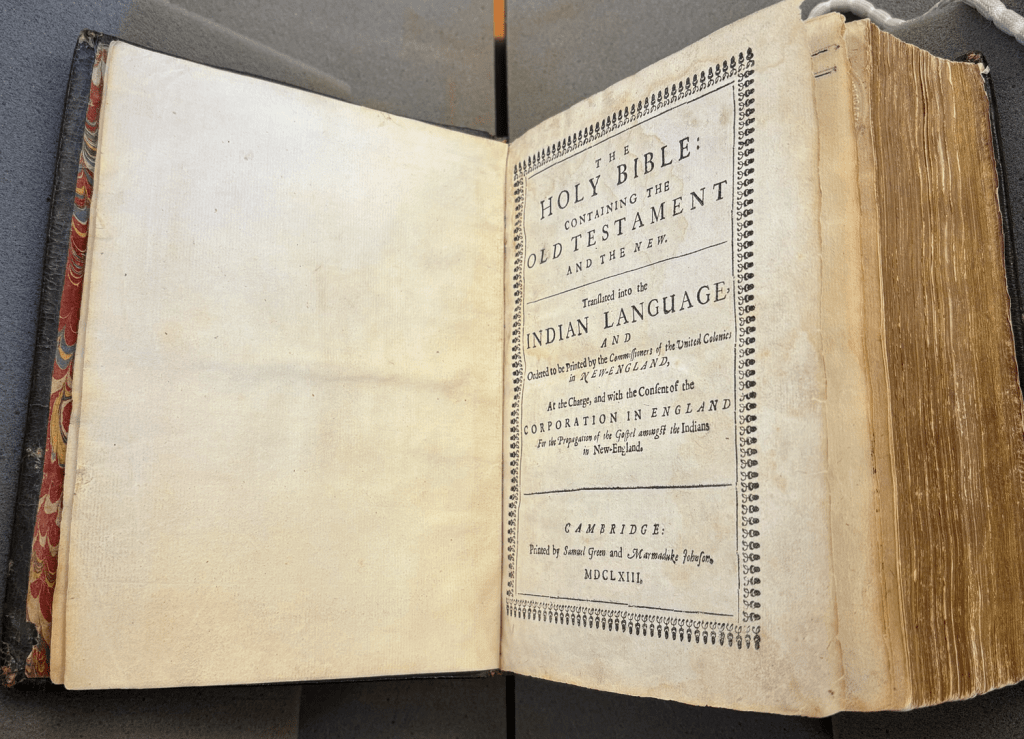
Eliot then ramped up his commitment to translate the Bible into their language, Algonquin. No easy task, there was no Algonquian alphabet! Eliot had to devise one, and thus became a lexicographer and grammarian in their language. He spent the next 14 years doing this but eventually in 1663, published “Mamusse Wunneetupanatamwe Up-Biblum God”.

The Eliot Indian Bible, published in 1663 as the first Bible printed in North America, was published with the support of the Society

Three years later, The Indian Grammar Begun was published also.

Now that it was translated, the Bible needed to be printed. Eliot wrote to the Corporation-

“I shall not trouble you with anything at present save this one business of moment, the printing of the Bible in the Indian language, which business sundry of the elders did petition unto the Commissioners, moving them to further it, as a principal means of promoting religion among them. … [Please send a printer] to New-England at the press in Harvard College, and work under the College printer, in impressing the Bible in the Indian language and with him send a convenient stock of paper“. (Source- The early Massachusetts press, 1638-1711, by George Emery Littlefield)

And the Corporation did just that, sending professional printer Marmaduke Johnson, 100 reams of paper, and 80 pounds of new type for the printer.

Eliot was the only missionary to devise a new alphabet from an unwritten language for the purpose of teaching and preaching the scriptures“, we read in The American Puritans by Benge and Pickowicz. Eliot helped found the first missionary society in the New World, printed the first Bible in the New World, and was known as ‘Apostle to the Indians.’

Meanwhile, the “Indian Praying Towns” were multiplying. Eliot’s son John Jr. was now helping, then his son-in-law came to serve as well. There were 14 Indian Praying Towns in Massachusetts and 3 in Connecticut at the height. Eliot also established schools for the Christian Indians, established churches, and encouraged commerce between the Natives and the Puritan colonists. All was going well until…

Metacomet (English name: King Philip, 1638 – 1676) was chief of the Wampanoag people. The King Philip War – the most devastating war (1675 – 1676) between the colonists and the Native Americans in New England – is named according to him. Wood engraving, published in 1884. Source

King Philips War ended things abruptly. King Philip was actually a Native American called Metacom who started a war in 1675 until 1676 between a group of Indians and the English Colonists & their Native allies. Metacom’s father was Massasoit, you may remember, the Native American who helped the earliest Pilgrims who landed at Plymouth. Massasoit helped them avoid starvation. After Massasoit passed away, Metacom was not as friendly, claiming violations of the English in the treaties, and encouraged raiding parties. Eventually as tensions increased, war broke out.

Praying Indians offered to aid the Colonists in this war but were rejected. Many were either confined to their towns or relocated to Deer Isle. When the war was concluded relations among any and all Native Americans’ including the Praying Indians, was permanently damaged. It was said that it was a violation to even speak well of an Indian.

In 1675, when Philip’s war broke out, the English inhabitants generally were jealous of the praying Indians, and would have destroyed them, had not General Gookin and Mr Eliot stepped forth in their defence. Source, “History of the town of Natick, Mass. : from the days of the apostolic Eliot, MDCL, to the present time” by William Bigelow, 1830.

Things never got back to the height of the well-thought-of Praying Town. Ten of the original fourteen MA towns were disbanded. A few stragglers filtered back to Natick, the original Praying Indian Town, but it was closely supervised by the colonists.

John Eliot poured out his life for the Native Americans in his sphere. He was earnest for these souls and in return was beloved by the people he helped convert. Tokkohwompait was one of these men. At the end of Eliot’s life, he wrote to John Eliot,

God hath made you to us and our nation a spiritual father, we are inexpressibly engaged to you for your faithful indefatigable labors, and love, to us and for us, you have always manifested the same to us as well in our adversity or prosperity, for about forty years making known to us the glad tidings of salvation of Jesus Christ.”

What a testimony for the name of Jesus Christ. What a well-done life poured out on behalf of pagan souls. Many do not know of John Eliot’s missionary endeavors, but I encourage you to search further and read up on this inspiring man.

Sources:

Massachusetts History

Book- The American Puritans by Dustin Benge and Nate Pickowicz

Wikipedia Indian Praying Towns

Native Northeast Portal: John Eliot

Native Northeast Portal: Margaret Tyndal Winthrop

The early Massachusetts press, 1638-1711, by George Emery Littlefield

Boston University/ History of Missiology: Puritan minister and pioneer missionary among Native Americans

Posted in theology

Discernment lesson: ‘I don’t agree with everything she says, but let’s not attack her’

By Elizabeth Prata

When tolerance isn’t warranted

This is a common comment from women responding to discernment issues: “I don’t agree with everything she says, but let’s not attack her”. Also, “I don’t agree with all that she teaches, but she’s a sister so let’s treat her like one.”

Both of these comments indicate that the person needs a deeper understanding of what discernment is. They also need more fully to understand the words attack and agree.

The REAL attack

What these women don’t know, or refuse to see, is that the false teacher is actually the attacker. She is attacking the faith either overtly as a ravenous wolf, or covertly as a moth chews in the dark and only when exposed to light we see the garment is full of holes. The discernment people are the ones shining the light and saying, ‘she’s a wolf, devouring the unwary!’ or, ‘she’s a moth, destroying the fabric of someone’s faith!’

False teachers are spoken of in every New Testament book (except Philemon). Thus, the Holy Spirit obviously spent much time advising, warning, and teaching about the dangers of these wolves and moths.

“The word “moth” occurs 7 times in the Old Testament, in Job, Psalms, Isaiah and Hosea, always in figurative expressions, typifying either that which is destructive (Job 13:28; Psalms 39:11; Isaiah 50:9; 51:8; Hosea 5:12) or that which is frail (Job 4:19; 27:18).” The mother moth lays the eggs, but “the adult is only indirectly harmful, as it is only in the larval stage that the insect injures clothing.” Source Bible Study Tools

So that means at first you don’t see the damage. It’s done invisibly. By the time you see the adult moth, the damage has been done. This is why the Spirit dispensed a spiritual gift of discernment to some, who can see the larvae before they do the damage. They can see the wolves lined up in the shadows of the tree line before they devour the faithful.

It’s why you should listen to your discernment people. Not blindly, but take heed.

We are all familiar with the verse in Matthew 7:15, “Beware of the false prophets, who come to you in sheep’s clothing, but inwardly are ravenous wolves.” The false ones come in sheep’s clothing. They say and do things that attempt to make them blend in. But so did Judas. They will say they love Jesus- repeatedly. They will appear to be godly- consistently. They spout scripture. So did satan when tempting Christ.

They do things that on the surface seem appropriate for a sheep. But if you look carefully, they have dregs of meat in their teeth. Do sheep eat meat? No. If you listen to their utterances, there will be a howl behind that bleat, it doesn’t sound like a normal bleat. This is what sheep’s clothing means.

Another verse that spells it our further is that one from 2 Corinthians 11:14-15, No wonder, for even Satan disguises himself as an angel of light. Therefore it is not surprising if his servants also disguise themselves as servants of righteousness, whose end will be according to their deeds.

They masquerade. Their show of godliness is only a put-on. It’s a show. No matter how effective the mask and costume, there are always hints that it’s not real. Look for those hints, eventually they grow into flags and then you can unmask the deceiver.

Too many women accept a false teacher’s profession of faith on the face of it, putting more weight on the profession from the false teacher than they put in the scriptures that show how to discern the wolf from the sheep, the moth from the butterfly.

The deceiver, the false teacher is ATTACKING you. She is ATTACKING the faith. Wolves like Lori Alexander, Beth Moore, Jennie Allen of IF:Gathering and so on, are the attackers. They are attacking Jesus.

The seem gentle and nice and helpful, but they are among those “who will secretly bring in destructive heresies.” (2 Peter 2:1b).

See? They operate secret agendas that are in fact destructive to the faith because they are heresies.

If anyone advocates a different doctrine and does not agree with sound words, those of our Lord Jesus Christ, and with the doctrine conforming to godliness, 4he is conceited and understands nothing; but he has a sick craving for controversial questions and disputes about words, from which come envy, strife, abusive language, evil suspicions, 5and constant friction between people of depraved mind and deprived of the truth, who suppose that godliness is a means of gain... (1 Timothy 6:3-8)

See? These women are conceited, puffed up, they love quarrels and strife, they’re ignorant (understands nothing), and are actually sick, nosōn, in craving strife.

They are attackers, destroyers, assaulters. When discerning people point out their destructiveness, we are not attacking them. We are defending the faith, protecting the sheep, warning the sisterhood that there is danger. It must be said, if you defend a false teacher for any reason, please examine where your real allegiance lies.

This is important: 2 Timothy 4:3 says that false teachers don’t just appear out of nowhere for no reason. They appear and stay because the undiscerning with diverse lusts prop them up. If you defend a false teacher, you’re part of the problem.

For the time will come when they will not tolerate sound doctrine; but wanting to have their ears tickled, they will accumulate for themselves teachers in accordance with their own desires,

The real ‘agreeing’

It’s not a matter of “agreeing”. It’s a matter of submitting.

First of all, no one at any time or anywhere in any sphere agrees with “everything they say.” Do you agree with everything your boss says? Your mother? The President? No, of course not. You likely don’t even agree with everything your pastor says or does. Uniformity of content is a phantom. So stop prefacing a defense of a false teacher by saying, “I don’t agree with everything she says but…” You have failed even before you get to the ‘but’.

But what? You are willing to taste her meal even though there’s poison in it? If there was a pan of brownies served to you and the baker said, ‘I mixed a little poop in here but you should be all right to eat from this corner.’ Would you? No! You throw the WHOLE PAN out because the whole pan is polluted. ‘A little leaven spoils the whole lump’.

Did Paul accept the true words from the demon-possessed slave girl? “She followed Paul and us and cried out repeatedly, saying, “These men are bond-servants of the Most High God, who are proclaiming to you a way of salvation.” (Acts 16:17)

No! Why not? The words are true but Jesus doesn’t need truth to come from lying lips. So whatever parts you may “agree” with the false teacher just remember it comes from polluted lips.

Many people say “I don’t agree with what they teach but she’s a sister…” This is backward. It is not a matter of agree or not agreeing with the teacher. Its a matter of submitting to what the word of God says.

The agreement part should be “I don’t follow this teacher because what she teaches does not AGREE with the Bible.”

Now here’s an interesting notion: Even IF a teacher teaches all that is correct in the Bible, if she lives a life at odds with behavioral standards, she is a false teacher. She must be humble, teachable, living in peace and harmony with others, or good character. Numerous verses attest to this. The primary one is that anyone who is not these things cannot “teach what is good” because they are living bad.

If someone is preaching heaven but living like hell, avoid her. Doctrine matters, and so does behavior.

Ladies, a false teacher who won’t see her error and won’t repent is not a sister. There are ONLY sheep and goats. If a teacher has been teaching something that is pointed out to her as error, the Holy Spirit inside them will prick their conscience and illuminate the scriptures to them. She will correct it. She will hasten to correct it – because Jesus is too precious to her.

If it’s a false teacher, there is no Holy Spirit in her and she will continue teaching falsely. Do you suppose that a teacher who has the Spirit in her can or would resist Him and continue to teach falsely for decades? No. Not possible. Holy Spirit absolutely would not allow this.

If there is a teacher who refuses correction, is unteachable, proud, she is false, not a sister.

Peacemakers

Women tend to be peacemakers, nurturers, and relational. Many women are hesitant to engage in something controversial. Women like to look for the good in someone. In discernment, we have to overcome these natural tendencies sometimes, and engage in warfare, which is always uncomfortable.

Discernment is spiritual warfare. Not against people, and many times not even against external philosophies (though it is, says Ephesians 6:12), but warfare is to suppress our own tendency to overlook sin and to paper over what should remain a schism. We gird ourselves with the truth that offends.

Discernment means wrestling and striving, resisting any philosophies, concepts, or traditions that oppose Jesus. If a person resists delving into why so many people are saying this women or that women is false, then sadly, you might have an idol. NOTHING should come between you and your Savior. If you do delve and notice more than a few errors, but still support the false teacher, sadly, you may have an idol. Do you love the false teacher more than Jesus? Examine yourself.

For most women, discernment simply means working toward consuming meat and training one’s self in distinguishing the healthy from the unhealthy. Most women don’t need to wade into controversies online or raise issues at their home church. Romans 16:17 says of the false teacher to turn away from them. Just don’t consume their output, don’t follow them online, don’t attend parachurch meetings where they’re taught, leave Facebook groups that promote them. 2 Thessalonians 3:6 says to keep away from the undisciplined brother (and sister).

Pray for discernment, stay in the word of God, fellowship with wise saints, and all this will become easier over time. Then finally, heaven! No false teachers will be there and nothing will impugn the good Name of Jesus ever again!