Posted in theology

What if my marriage is to a difficult man?

By Elizabeth Prata

EPrata photo

This week I’ve been looking at marriage. I wrote about what submission is and isn’t, I posted a sweet testimony about persevering in marriage, and I recommended a site called Confidently Called Homemakers that has a lot of encouragements and resources for the women who work at home.

Today we’ll look at marriage to a difficult man. I know what you’re thinking, lol, ‘They’re ALL difficult!’ And they are! And so are we women. As part of the curse, God said that the desire for women would be for their husbands, and the husbands in turn would have a tendency to rule over us. This is ripe ground for conflict. Before the fall, Adam and Eve’s was the only perfect marriage. All of them since have had difficulty. In Genesis 3 Adam and Eve started blame-shifting and bickering. (Where do I get the bickering from? I am supposing…the leaf-sewing went something like this: “You’re not doing it right! That leaf isn’t big enough! Just give it here!”)

Continue reading “What if my marriage is to a difficult man?”
Posted in theology

What are the biblical qualities God desires in a woman teacher? Not the ones Beth Moore exhibits

By Elizabeth Prata

EPrata art

Beth Moore, biblically, is a teacher #fail

Did you know that for men who desire to teach, pastor, or lead, there are many more Biblical standards addressing their behavior than there are skill-level credentials? There’s just one mentioned skill: Men must be “able to teach”. But there are many more verses outlining how they are to behave. If they fail to adhere to any of the standards, including behavioral, they are disqualified from the position.

It’s the same for women. There are many more behavior and lifestyle standards than skills. If God were grading on a curve, behavior would weigh more than skills or talents. Here some of them are in Titus 2:3-5. The passage opens with admonishment for women to be reverent and ends with warnings that failure to be reverent will dishonor God’s word.

Older women likewise are to be reverent in their behavior, not malicious gossips nor enslaved to much wine, teaching what is good, so that they may encourage the young women to love their husbands, to love their children, to be sensible, pure, workers at home, kind, being subject to their own husbands, so that the word of God will not be dishonored.

I think we all understand what it means to be reverent, not a malicious gossip, and not a drunk. What does sensible mean in this context? It is to be self-controlled and of sound mind. Mark that, I’ll come back to it. What does it mean to “dishonor” God’s word? The Greek here is blasphēmētai 987: “to slander, hence to speak lightly or profanely of sacred things.” It is to be irreverent.

Now that we know what God expects, let’s take a look at who fails the test, and why.

Continue reading “What are the biblical qualities God desires in a woman teacher? Not the ones Beth Moore exhibits”
Posted in theology

Recommending “Confidently Called Homemakers”

By Elizabeth Prata

Hey, Ladies, SAHMs: I recommend Jennifer Ross’ site “Confidently Called Homemakers”. She has tons of resources and encouragements for you. Incidentally, she interviewed me on the topic of ‘Does God Speak with us Audibly’? and the podcast is up!

Her site: http://confidentlycalled.com/

Her interview with me: is #30, http://confidentlycalled.com/2021/04/20/doesgodspeakwithusaudibly/

Other great discussions on the following topics:

29. Life after Deleting Social Media with Grace Wagler

28: Learn to Manage Your Time Well with Sue Nelson

27: How Stay at Home Moms Can get Involved in Standing up for God-Given Freedoms with Sheri Graham

26: Practical Home Management with Marci Ferrell

25: How Pursuing a Career Cost Me 3 of my 4 Children with Guest Sherry

24: Living for Jesus as a Stay At Home Mom with Karen DeBeus

23: Eternal Impact in the Everyday Mundane with Kelly Crawford

22: Coming Out of the Chaos with Meg Dickey

21: Starting from Scratch in Homemaking with Jami Balmet

And much more on the podcast and the blog! http://confidentlycalled.com/

Posted in theology

Culture calls this a dirty word

By Elizabeth Prata

There are two worlds. The seen and the unseen. The world and the heavens. The devil’s kingdom and the Messiah’s. That’s it.

We will never get an unsaved person to believe this, because these things are spiritually discerned. 1 Corinthians 2:14 says, But a natural person does not accept the things of the Spirit of God, for they are foolishness to him; and he cannot understand them, because they are spiritually discerned.

Those who are in the flesh cannot please God. (Romans 8:8)

It is nonetheless true. Other truisms come with this knowledge, such as the fact that the world systems vs the heavenly kingdom each have its own unique vocabulary. Nowhere is this more spelled out than in Isaiah 5:20, which reads,

Woe to those who call evil good, and good evil; Who substitute darkness for light and light for darkness; Who substitute bitter for sweet and sweet for bitter!

Matthew Henry says of the Isaiah verse,

Continue reading “Culture calls this a dirty word”
Posted in theology

Prata Potpourri: Walking, Thinking, Staging, Hating, Witnessing, Dying, more

By Elizabeth Prata

I thought this photo of the dogwood in my yard is a good example of how spring SPRINGS up, seemingly reaching for the sun, in joy and boundless energy

EPrata photo

It’s been a busy work week here in my world of public elementary school. We are entering the last phase of the year, the time of final reviews, state testing, longer recesses, ‘fun packets,’ and huge lines at the water fountain. It’s getting warmer day by day, and the pollen is finally blowing away until next year. At home, my cat Sully likes to sit by the open window and watch the activity in the yard. There are lots of chipmunks, squirrels, birds, and neighborhood cats to keep an eye on. My mind is turning to summer, when I have two months of summer vacation. Remember when you were a kid, summer seemed soooo long? LOL, it is still pretty nice to have the time off. I value it.

I was thinking the other day how the Lord re-created my life down here in Georgia after I moved from Maine at age 45. After a brief stint writing for the daily newspaper, I returned to education, this time as a teacher’s aide instead of as a teacher that I’d been in Maine. I enjoy the lower levels of stress as an aide, and less responsibility than a classroom teacher has. That aspect has turned out to be important as I enter my 60th decade. I like the time off when the different breaks come around on the school calendar, also important as I age, because my energy stutters and hiccups and isn’t to be counted on from one day to the next. The job has just enough of a salary to sustain me so I can concentrate on my ministry. On the practical side, I have health care coverage, yet the job also gives me personal joy and professional fulfillment. My church is wonderful. It’s really quite perfect. Looking back over this last 15 years I can clearly see the providential hand of Jesus working in my life.

We often can’t see His providence at the time, but in hindsight we look back and see how our decisions matched up with His plan and how He works things for our good and His glory.

Now on to some edifying content from the brothers and sisters that I’ve found this week for your reading and listening pleasure-

Continue reading “Prata Potpourri: Walking, Thinking, Staging, Hating, Witnessing, Dying, more”
Posted in theology

The sea is restless

By Elizabeth Prata

But the wicked are like the tossing sea; for it cannot be quiet, and its waters toss up mire and dirt. (Isaiah 57:20)

[The ungodly are] wild waves of the sea, casting up the foam of their own shame; wandering stars, for whom the gloom of utter darkness has been reserved forever. (Jude 1:13)

The sea is an apt metaphor for the restlessness of the ungodly. They toss and turn, go to and fro, casting up muck and mire with ungodly thoughts and deeds. In Jude, he is speaking of infiltrating false teachers, but the metaphor is apt also to apply in general to the ungodly, their foaming spray prevents clear vision and in fact has no substance.

Continue reading “The sea is restless”
Posted in theology

The Carpenter

By Elizabeth Prata

Yesterday I wrote about the importance of reading old books. I’d found out about a 1900s missionary William Borden, and in a biography Borden mentioned attending a sermon by Campbell Morgan. Curious about Morgan and the sermon that impacted this burgeoning missionary, I followed up. What I found was wonderful. I wrote about the evangelist Campbell Morgan yesterday, but today I’d like to share with you about the sermon he preached, one of hundreds I’m looking forward to learning about.

I think we’re all curious about Jesus in his “hidden years at Nazareth” as Morgan called them. We see much about the baby when he was born, and then when he was about two years old when the Magi worshiped him in the house. We see nothing else of Jesus until he was twelve and at the temple questioning the priests and listening to them. That was the incident when the caravan left Jerusalem to return to Nazareth but Jesus wasn’t among them. Joseph and Mary had to return and look for the boy. Then…nothing until he stepped foot in the Jordan at John the Baptist’s baptism of Him.

What was Jesus like in the in-between? In his sermon, Morgan said there were two verses from which we could glean much. The Hidden Years at Nazareth is based on his sermons from Mark 1:11 and 6:3, “This is my beloved Son in whom I am well pleased”, and “Is this not the carpenter’s son?” we learn of man’s view and God’s view. Morgan said that the 18 years between Jesus entering manhood and seen questioning the elders at the temple, and his step into public ministry at the baptism are the hidden years, but that we have much to learn from the silence and the one or two Bible verses about it.

We think of the triumph of the cross but that would not have been a triumph if Jesus had sinned along the way. With Easter just passed we rightly focused on the cross, but we often gloss over the import of the part where we say “He lived a sinless life.”

Morgan wrote: “Let us, then, try and see Him in those eighteen hidden years. The two verses that I have read are the only two that give us any definite or detailed account of what Jesus was doing from the time He was twelve until He was about thirty. Take the two statements and fix them on your minds for a moment: “Thou art My beloved Son, in whom I am well pleased.”  “Is not this the carpenter?”  These two passages supply the story of the eighteen years. Jesus was a carpenter pleasing God.” end Morgan quote.

Jesus was baptized, overcame the temptation in the wilderness, then returned and ascended the teaching seat in the synagogue and read from Isaiah. The men assembled in that solemn Sabbath day said, “Is this not the carpenter?”

As Jesus stood between the dividing line of his hidden life and his public ministry, God spoke from heaven, saying, “This is my beloved Son, in whom I am well pleased.” Was God’s pleasure in Jesus on the cross? It was yet to be. Was it of his temptation in the wilderness? That was still to happen. Morgan makes the case that what God was pleased with was Jesus’ daily life in common work- as a carpenter.

Campbell Morgan again: “For the greater part, then, of the life of Jesus, He worked with His own hands for His own living. That brings the Son of God, in living, pulsating life, close to every man who works. The man Jesus rose at daybreak, and, picking up His tools, made yokes and tables in order that He might have something to eat, and that, not for a brief period, but for eighteen years. He was an apprentice boy, a young man improving His craft, a master in His little shop with the shavings round Him and the tools about Him.”

Picture this scene in Nazareth 2000 years ago. Note that the men in the synagogue said is this not THE carpenter? It was not likely that a small town such as Nazareth would have had more than one carpenter. Jesus was THE single carpenter, toiling in this manual labor daily.

“Sometimes we have overshadowed the carpenter’s shop with Calvary’s cross. We have no right to do it. We have come to forget the fidelity of the Son of God in the little details of life as we have gazed upon His magnificent triumphs in the places of passion and conflict.” ~Campbell Morgan

It means that for all those 18 years between 12 and 30, Jesus never once did “shoddy work.” It was always his best work for the customer. He never once became impatient with a customer. He never cut a corner. He was never late with an order.

Morgan said in addition to His common work, Jesus was perfect in his relations with his community. “In the second place, the divine approval meant that the influence of the life had been pure and bright and good. You all know the effect of influence. What sort of influence has He exerted? Pure and strong! But he would have lived a bright, strong, glad life before Him, for no life ever touched the life of the Son of God but was the brighter and purer and stronger for the contact; and so, when the years of the carpenter’s shop are over, God sets His seal of approval upon them, first, because the work has been well done; and secondly, because the influence of the life has been true and right and noble.”

It was Jesus’s delight to do the will of His Father, and for those 18 years the will of God was for Jesus to labor in obscurity in the carpenter’s shop…to live a perfect life, and to produce good goods, be pure in heart, and honorable to all. Why? Why not incarnate and go right to the cross? No! It was the daily accumulation of the steps toward that pinnacle that Jesus must tread. He had his foot on the neck of every sin, every day, as he toiled.

Morgan: “Let me put it superlatively, and say, Calvary’s cross would have been nothing but the tragic ending of a mistaken life, it had not been for the carpenter’s shop! In that carpenter’s shop He fought my battles. My hardest fight is never fought when there is a crowd to applaud or oppose, but when I am alone. There was necessity for it, and because of Nazareth’s shop there came Gethsemane’s garden and Calvary’s cross, and so, abiding in the will of God, by victory upon victory, He won His final triumph, and so opened the kingdom of heaven to all believers. The carpenter’s shop made Calvary not a battle-field merely, but a day of triumph that lit heaven and earth with hope.”

Let us not dare to think our work in the common hours is meaningless. Our tentmaking jobs, the jobs in which God is pleased to serve us as His will, are the steps t the place of triumph. Stay at home mothers, for you, as well, the daily grind of overcoming temptation to impatience, to sloth, to shoddy work, are the jewels in the crown that Jesus shares with you.

For we do not have a high priest who cannot sympathize with our weaknesses, but One who has been tempted in all things just as we are, yet without sin. (Hebrews 4:15). Does this verse now have more meaning as we picture Jesus in his carpenter shop, toiling daily for years upon years, living the grind of life, step by step climbing over the temptations as he exudes purity and honor among all who see Him? It pleased God to station us as cleaners, plumbers, manufacturers, stay at home mothers, God having served up to us a daily toil in obscurity where we meet life with honor and purity and overcoming temptations. Let us be walking daily toward our reward in heaven, living the common life in our toil, toward the Carpenter who will receive us with the words that show He, also, is pleased with us.

Further Reading

Christian Tentmaking

Campbell Morgan’s Hidden Life at Nazareth, a .pdf

Posted in theology

Here’s why we should read old books

By Elizabeth Prata

I’m reading a biography of the short missionary life of William Borden, turn of the last century. It’s called Borden of Yale ’09 by Mrs. Howard Taylor. It’s considered to be a good bio of the young millionaire who gave it all up to be a missionary, but tragically died before he reached his intended field. It’s a good book that paints a sweet picture of a godly man raised in a godly family. As a boy, Borden attended Moody Church in Chicago and sat under the preaching of RA Torrey. At home, he was under the influence of his mother, who had a vibrant prayer life. He went to the academy at The Hill in PA and then to Yale for college, hence the title of the biography. Borden had an incredible missionary influence at his own sphere in college while he was training to be a missionary.

When he was a teenager at The Hill academy, Borden heard a sermon by G. Campbell Morgan, Martyn Lloyd Jones’ mentor. I was intrigued by Borden’s short summary of the sermon, as recorded in his letter home to his mother. I had never heard of Campbell Morgan.

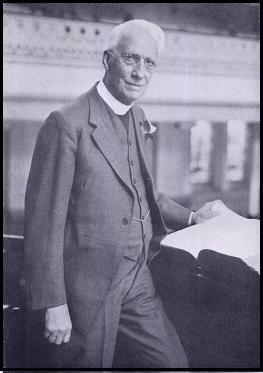
G. Campbell Morgan

G. Campbell Morgan, 1863-1945 –

"A contemporary of Rodney "Gipsy" Smith, Morgan preached his first sermon at age 13. He was the pastor of Westminster Chapel in London from 1904 to 1919, pausing for 14 years to teach at Biola in Los Angeles, and returning to the Chapel from 1933 to 1943 when he handed over the pastorate to the renowned Martyn Lloyd-Jones, after having shared it with him and mentored him for some years previous". (Source Wikipedia).

In 1910 Morgan contributed an essay entitled The Purposes of the Incarnation to the first volume of The Fundamentals, 90 essays which are widely considered to be the foundation of the modern Fundamentalist movement. (source StudyLight)

Morgan is considered an excellent expositor, some calling him the prince of biblical expositors. His 10-volume “Analyzed Bible” is considered culturally important and a wonderful addition to the body of commentaries. Most of Morgan’s sermons, booklets, and books can be found online and are accessible for free. One place is the Internet Archive. Did you know that the Internet Archive not only caches web pages, but stores books in an open library, available to read online for free? (Also audio, TV programs, and movies). Here is the Open Library at the Internet Archive for Campbell Morgan (including The Analyzed Bible).

I had no idea of this 20th century expositor, and one who was friend to Charles Spurgeon and mentor to Martyn Lloyd Jones. This week I’ll be writing about the sermon that so impacted young William Borden, which can be found in Campbell Morgan’s booklet “The Hidden Years at Nazareth”. I had discovered Borden a few months ago by reading another ‘old book’ which led me to Borden of Yale ’09, and now mention of G. Campbell Morgan led me to that great expositor, is another reason to hold onto these saints’ books from the past. They are written about for our edification and instruction, and for an encouragement of learning about past deeds for Christ.

Read old books. They have a lot to tell us.

Posted in theology

Negotiating with God

By Elizabeth Prata

In the early 2000’s, Priceline, the discount travel outfit, produced a series of ads starring William Shatner as “The Priceline Negotiator.” You’d see him negotiating for lower prices on hotels, air flights, and so on. They were funny ads. C’mon, you’re hearing the jingle in your head right now, aren’t you 😉

I’ve never been good at negotiating. I’ve always been intimidated by it. Even where it was expected, like in places abroad where I’ve traveled, I didn’t bargain and I just always paid the price set.

I think most of us are familiar with the verse from James 2:19 that says, You believe that God is one. You do well; the demons also believe, and shudder.

Continue reading “Negotiating with God”
Posted in theology

I died … to the law

By Elizabeth Prata

Such is the confidence we have toward God through Christ. Not that we are adequate in ourselves so as to consider anything as having come from ourselves, but our adequacy is from God, who also made us adequate as servants of a new covenant, not of the letter but of the Spirit; for the letter kills, but the Spirit gives life. (2 Corinthians 3:4-6).

In this 2 Corinthians verse, Paul is explaining that following the ‘letter’ of the law is a shallow, external conformity to the commands of the Law and not an internal faith and belief. Think: Pharisees. The Pharisees were rebuked for swallowing a camel but straining out a gnat. It means they were hyper-vigilant over little things (going after a gnat), but ignored the big need- forgiveness from sin. They tithed cumin but their sacrifices to God were empty. They observed rites and ceremonies to the letter but missed the spiritual significance of its intent- to demonstrate their need for a Savior.

They adhered to the letter of the Law but entirely missed its intent: which was to make a person recognize his sinfulness and total inability to reach the Law’s required perfection. Anyone who relied on the Law for salvation would die (i.e the Law/letter kills). Paul admitted his own inability to reach perfection after salvation, seeing in hindsight that his adherence to the Law was only shallow works that meant nothing to God, it was all rubbish.

Paul explains further in Galatians. He is re-teaching the Galatians that justification is by faith alone, apart from the works of the Law of Moses. Legalistic Jews had insisted that Christians must keep the Mosaic Law and their stance had confused the Galatians. Galatians 2:19 says –

For through the Law I died to the Law, so that I might live for God.

Barnes’ Notes says of that verse’s meaning:

that by contemplating the true character of the Law of Moses itself; by considering its nature and design; by understanding the extent of its requisitions, he had become dead to it; that is, he had laid aside all expectations of being justified by it.”

Or, if you’re Italian like me, “the Law is dead to me!” It’s all of grace!

Knowles in The Bible Guide says,

The key question is this: did they receive the Holy Spirit by following the law or by receiving the gospel? And if keeping the law can achieve salvation, why did Jesus go to the cross? The answer is, of course, that they have come to spiritual life only through the death of Jesus and faith in the gospel.

I’m reminded of the Dagon incident of 1 Samuel 5. Dagon was a false deity in the form of a half-man, half-fish. He was supposedly the father of Baal. The Philistines were feeling joyful because they had captured the Ark of the Covenant and put it in their temple next to Dagon. When they got up the next morning, the Dagon statue was on its face. They set it right. The next morning, the Dagon statue’s trunk was in its place, but the head and hands had been cut off and were on the threshold. Gulp! They were so spooked, “This is why the priests of Dagon and all who enter the house of Dagon do not tread on the threshold of Dagon in Ashdod to this day.” (1 Samuel 5:5). Whether a false god is a fish or any other image, it is empty. Clinging to the Law as a work for salvation is just as empty as the mere block of wood that Dagon was.

People have been trying since Cain to approach God in the way they want to, not in the way He demands. The Gentiles think they will be heard for their many words repeated in prayers. The modern version of this is Contemplative prayer, or for Catholics, penance (repeating the same prayer a certain number of times, or doing a work, or making an offering). The Judaizers thought that works like circumcision were the pathway to God. The modern version of this is Oprah’s good works and generosity religion being one pathway to God – among many. (Oprah’s words- “There are many paths to what you call God. Her path might be something else, and when she gets there she might call it the Light, but her loving and her kindness and her generosity, if it brings her to the same place it brings you, it doesn’t matter whether she calls it God or not.”) Mystics think that pursuing wisdom and higher knowledge will get them to God, as satan said to Eve in the Garden, ‘you will be wise’.

Satan is the originator of all the paths to God that aren’t Jesus, and he recycles them over and over. Why? Because they are successful on the unwary. There are two religions. Jesus as the way to God, and all the others which are satan’s. In those ways, satan has twisted even the New Testament’s Gospel into a killing letter. Matthew Henry said:

But even the New Testament will be a killing letter, if shown as a mere system or form, and without dependence on God the Holy Spirit, to give it a quickening power. (2 Timothy 3:5).

Faith is through grace alone. Beware of twisting even the good and great Gospel into mere rites and ceremonies and form letters. The power of the Spirit quickens us, enlivens us, gives power and might to live according to all that is holy and right. “Such is the confidence we have toward God through Christ.

Letter of the Law