Posted in prophecy, Uncategorized

Holy Week: A Personal God

God is a personal God. Even the thunderous, Mt. Sinai, pestilence-bringing, smiting God of the Old Testament. Yes. Especially the Old Testament God. And of course in the New Testament God is a personal God, too. We see Him in Jesus, who is both fully man and fully God. He had come to serve. He did so meekly and humbly, even washing feet.

We read in Genesis that God created the worlds, He did it personally and carefully, with precision. He spoke them into life.

‘In the beginning, God said’… He spoke.

And God said, And God said, Genesis 1:3, 6, 9, 11, 14, 20, 24.

When it came time to form man, God did not speak. He did it Himself, personally, and with His own breath.

then the LORD God formed the man of dust from the ground and breathed into his nostrils the breath of life, and the man became a living creature… (Genesis 2:7)

Therefore, we see that God’s intimate formation of the world got even more intimate when He made man.

It gets even better.

Because of the life, death, and resurrection of Jesus, we have an even more intimate relationship with Him and He with us. We are His body, His blood covers us. We are IN Him.

It is holy week, so it bears thinking about Him on a special level. We are “in Christ”. We read it in 1 Peter 5:14; Philippians 1:1; Romans 8:1, Colossians 3:3. We have it explained in Galatians 3:26-28-

for in Christ Jesus you are all sons of God, through faith. For as many of you as were baptized into Christ have put on Christ. There is neither Jew nor Greek, there is neither slave nor free, there is no male and female, for you are all one in Christ Jesus.

John MacArthur explained about what it means to be “in Christ” in his inimitable way in the sermon, Under the Law, or In Christ? He opened the salient portion of the sermon this way before going on to spend time expounding what it means to be In Christ. I recommend the sermon.

To ask the question, “What is a Christian?” That question is simply answered, right here. A Christian is one who is in Christ. That’s all. You can imagine following the teachings of Buddha, following the teachings of Confucius, or following the teachings of Muhammad, but you can’t imaging anyone saying, “I’m in Confucius. I’m in Buddha. I’m in Muhammad.” There’s no such thing as a Christian who isn’t in Christ. You see, we’re not following the teachings of a man, we’re in union with Him. If that boggles your brain, you haven’t heard anything yet. In Christ.

We have a personal God. We have a loving God. He is expressly concerned with His creation, and particularly concerned with His children.

It is holy week. Hallelujah to the Lamb!

Posted in prophecy, Uncategorized

Predestination means people are elected as vessels of wrath, too. Part 3

Vessels of Wrath Part 1 here
Vessels of Wrath Part 2 here

A few days ago I’d posted an essay about predestination. This is the doctrine where the Bible teaches that God is completely sovereign over everything that happens, including individual salvations. He elects people to salvation, independently and apart from foreknowledge of any decision they make. It’s all His grace, and not our decision.

People dislike that doctrine and fight against it. One of the reasons people resist the plain truth of the doctrine is that people want to think that somewhere in their heart or mind, they chose God. However, we are dead in sins and trespasses and have no ability to choose God, or ‘make a decision’ about our salvation. It is granted to us. (Galatians 3:22). We have no part in it, except the resulting gratitude and service in His name.

The verse to consider today is from Romans 9:21-24

Has the potter no right over the clay, to make out of the same lump one vessel for honorable use and another for dishonorable use? 22 What if God, desiring to show his wrath and to make known his power, has endured with much patience vessels of wrath prepared for destruction, 23 in order to make known the riches of his glory for vessels of mercy, which he has prepared beforehand for glory— 24 even us whom he has called, not from the Jews only but also from the Gentiles?

There are vessels of mercy, and there are vessels of wrath. Considering anything regarding God is weighty and should fill the saved and the non-saved with awe and humility. But to really consider His work of judgment should bring to mind the famous comment attributed to martyr John Bradford, “There but for the grace of God go I”.

Here is M’Cheyne preaching on the Romans verse. In my opinion, it’s brilliant. The full sermon is here.

——————————–

The Vessels of Wrath Fitted to Destruction
by Robert Murray M’Cheyne

I come now to the third point–the reason given why believers are saved. Verse 23 – “And that he might make known the riches of his glory on the vessels of mercy, which he had afore prepared unto glory.” One reason why there are vessels of wrath fitted to destruction is, that God may show by contrast the riches of his grace on the vessels of mercy. You know, brethren, we learn many things best by contrast: for example, the rainbow is never seen so bright as in the bosom of a dark cloud. So, brethren, we shall never see the love and com passion of God in them that are saved so gloriously displayed as when we see his wrath poured out on the vessels of wrath. This, then, is one reason why there are vessels of wrath.

I believe that the “riches of glory” here spoken of are the whole rainbow of the divine attributes displayed in the salvation of souls. It was for this reason that God provided that there should be vessels of wrath fitted for destruction. This may appear to you very awful: it is so to myself. I could not and dare not speak of it if it were not here in God’s own Word.

I would just show you one or two of his attributes that will be brilliantly illustrated in the salvation of souls. One is, the sovereignty of God. I have often told you of this. Many of you do not believe it; but there is a day coming when God will put it beyond a doubt. There are whole churches – whole bodies of professing Christians – that deny it; but there is a day coming when there will be none in heaven, or earth, or hell, that will deny it. Suppose that day were come, and this congregation divided, some on the left hand, some on the right, will you not see then God’s sovereignty in the contrast? You were once all the same. You were under the same condemnation. Some of you came out of the same womb – were nursed at the same mother’s breast; yet it will be seen that some will be taken and some left. What made the difference? Every creature will see that God made the difference, that he had “mercy on whom he would have mercy.”

Another is, the pardoning attribute of God. At present this is denied; but, brethren, in that day it will be made known. God will make known the riches of his glorious mercy on the vessels of mercy. O brethren, when one vessel is cleansed and taken up to glory, and another is left to perish, and when you see that they were equally sinful, then you will see that it was blood that made the difference. God will make known the riches of his mercy in the vessels of mercy, as well as his wrath in the vessels of wrath fitted to destruction.

Let us learn a few lessons from this subject. And –

1st. All will not be saved. It is a fearful delusion among you – I do not say you avow it, but you practically say, you believe – that there will be no hell. It was God’s plan that there should be vessels of wrath as well as vessels of mercy. Brethren, it is better it should be so. O do not dream! All will not be saved. There are vessels of wrath as well as vessels of mercy. Some of you, I think, are going to hell, and some, I trust, are going to heaven; and doubtless it is best it should be so, though I cannot explain the reason of it. The net has good and bad fishes: some will be taken into the vessel, and some will be cast away.

2nd. Every one of you will be to the glory of God. You will be made to glorify him in one way or another. You will either do it willingly or unwillingly. You must form a step to his throne. Ah, brethren! I believe each of you will yet be a beacon or a monument – either a beacon of wrath or a monument of mercy, “He hath made all things form himself; even the wicked for the day of evil.” Yes, wicked man, you would rob God of his glory if you could, but you cannot. If you come to Christ, you will show forth his glory in saving you; but if you do not, God will show forth his power in destroying a vessel of his wrath.

3rd. There is a third lesson we may learn. It is, the chief end of God in the world to manifest his glory. Many think, especially infidel men, that God’s chief end is the happiness of his creatures; but, from deep study of the Word of God for years, I see that it is not so. If that were his chief end, all would be happy. His chief end is diverse – it is self-manifestation. Had it not been for this, God would have remained alone in awful solitude. I would desire to speak with deep reverence on such a subject. This seems to be the reason why there are vessels of wrath as well as of mercy – that they might be mirrors to reflect his attributes. And I believe, brethren, when creation is done, and when redemption is done, that there will then be a complete manifestation of the glory of God.

4th. Another lesson we may learn is, God is longsuffering to the vessels of wrath. I remember a person who once argued with me that she must needs be a child of God on account of his goodness to her. She enumerated many blessings she had received – how God had protected her in a foreign country, how many trials she had been delivered out of, and how many domestic comforts she had enjoyed. My only answer to her was, “The goodness of god leadeth thee to repentance.” It is no proof that you are a child of God that God has borne long with you. There would be many children of God here, if this were the case. Ah, brethren! Strange though it may seem, he does not want any to perish – he does bear long with you.

Last of all, the destruction of the vessels of wrath will be no grief to the vessels of mercy. I once spoke to you of this before; but I would again remind you of it. The redeemed will have no tears to shed; and here is the reason – the very destruction of the wicked makes known the riches of divine grace. O my believing brethren, it will be an awful day when we shall not weep to see them perish. The day is hastening on – the day when no more rivers of waters will run down our eyes because they keep not God’s law. But, O brethren, till that day come let us weep on; for, although God will be glorified in the destruction of the vessels of his wrath, he will be more glorified in making them vessels of mercy. The Lord bless his own Word. Amen.

—————–end——————

perfect love moon verse

Further Reading

Is Predestination Biblical?

Doesn’t John 3:16 mean that anyone can believe?


Posted in prophecy, Uncategorized

Predestination means people are elected as vessels of wrath, too. Part 2

The verse to consider today is from Romans 9:21-24

Has the potter no right over the clay, to make out of the same lump one vessel for honorable use and another for dishonorable use? 22 What if God, desiring to show his wrath and to make known his power, has endured with much patience vessels of wrath prepared for destruction, 23 in order to make known the riches of his glory for vessels of mercy, which he has prepared beforehand for glory— 24 even us whom he has called, not from the Jews only but also from the Gentiles?

There are vessels of mercy, and there are vessels of wrath. Considering anything regarding God is weighty and should fill the saved and the non-saved with awe and humility. But to really consider His work of judgment should bring to mind the famous comment attributed to martyr John Bradford,”There but for the grace of God go I”.

Here is Scottish pastor Robert Murray M’Cheyne preaching on the Romans verse. In my opinion, it’s brilliant. I’ll post M’Cheyne’s point 3 tomorrow, Lord willing. Part 1 is hereM’Cheyne’s full sermon is here.

~~~~~~~~~~~~~~~~~~~~~
The Vessels of Wrath Fitted to Destruction

I come now to the second reason why any are left to perish–it is, that God may show his power. “What if God, willing to make his power known?” We are frequently told in the Bible of the power of God. He said to Abraham, “I am the Almighty God.” We are told in the ninety-third Psalm, that “the Lord on high is mightier than the noise of many waters; yea, than the mighty waves of the sea.” We are frequently told of his almighty power; and not only so, but we have brilliant examples of it.

The first upon record is creation. “God said, Let there be light: and there was light.” “He spake and it was done – he commanded and all things stood fast.”

Another example of the same thing is, the constant providence of God. “In him we live, and move, and have our being.” He rides on the swift wings of the wind.

Another example of the power of God is, his restraining and bridling of the wicked. “Be ye not as the horse, or as the mule, which have no understanding, whose mouth must be held in with the bit and bridle.” – Psalms 32:9. This is the way in which God holds the wicked.

Another way in which God makes his power known is, in the conversion of souls. “Not by might, nor by power, but by my Spirit, saith the Lord.” This is said to be “the wisdom of God and the power of God.” I believe the converting of a soul is something greater than the making of the world.

Brethren, there is one exhibition of divine power that yet remains – it is, the destruction of the wicked. “What if God, willing to shew his wrath, and to make his power known, endured with much longsuffering the vessels of wrath fitted to destruction?” I believe, dear friends, that the reason why God has raised up Pharaohs is to show his power in them. He said to Pharaoh, “For this cause have I raised thee up, that I might show my power in thee.” No, I say, in regard of those of you in this congregation who will die unsaved, that God has raised you up, to show his power in you. Thus, it is said in Isaiah 62, “I will tread them in mine anger, and trample them in my fury; and their blood shall be sprinkled upon my garments, and I will stain all my raiment.” And then in Revelation 18, “She shall be utterly burned with fire; for strong is the Lord God who judgeth her.” And we are told by our Lord in Matthew 10:28, to fear God, “who is able to destroy both soul and body in hell.” You will notice in this passage that he says, “God is able to destroy”; and therefore, brethren, it is plain that there must be some great power exercised in his destroying the wicked; and I think it is to consist in this – God will destroy their well-being, but not their being. Here, then, is another exhibition of the power of God.

When lately in the north of Scotland, I stood on the sea-shore, and saw the rocks standing out of the sea. It was very remarkable to stand and see the mighty waves dashing upon the rocks. There were two things remarkable in it: first, the greatness of the rocks on which the waves dashed: second, the rocks remaining unmoved – no force of the waves could move them. Brethren, this scene is an emblem of what will be witnessed another day, when God shall pour out his wrath on the wicked. Ah, brethren! will it not be fearful to see God put out his power upon the wicked – to see him upholding them with one hand, and pouring out his wrath upon them with the other? Surely, brethren, the power of God’s wrath is very great. If any of you have seen a great furnace, you will have seen the power that the fire has; but fire is God’s creature. What must his power be who is the Creator?
——————————–

Further Reading

Predestination means people are elected as vessels of wrath, too. Part 1
Predestination means people are elected as vessels of wrath, too, part 3

Jesus’ Predestined Life

Is Predestination biblical?

Posted in prophecy

Predestination means people are elected as vessels of wrath, too. Part 1

A few days ago I’d posted an essay about predestination. This is the doctrine where the Bible teaches that God is completely sovereign over everything that happens, including individual salvations. He elects people to salvation, independently and apart from foreknowledge of any decision they make. It’s all His grace, and not our decision.

People dislike that doctrine and fight against it. One of the reasons people resist the plain truth of the doctrine is that people want to think that somewhere in their heart or mind, they chose God. However, we are dead in sins and trespasses and have no ability to choose God, or ‘make a decision’ about our salvation. It is granted to us. (Galatians 3:22). We have no part in it, except the resulting gratitude and service in His name.

The verse to consider today is from Romans 9:21-24

Has the potter no right over the clay, to make out of the same lump one vessel for honorable use and another for dishonorable use? 22 What if God, desiring to show his wrath and to make known his power, has endured with much patience vessels of wrath prepared for destruction, 23 in order to make known the riches of his glory for vessels of mercy, which he has prepared beforehand for glory— 24 even us whom he has called, not from the Jews only but also from the Gentiles?

There are vessels of mercy, and there are vessels of wrath. Considering anything regarding God is weighty and should fill the saved and the non-saved with awe and humility. But to really consider His work of judgment should bring to mind the famous comment attributed to martyr John Bradford, “There but for the grace of God go I”.

Here is M’Cheyne preaching on the Romans verse. In my opinion, it’s brilliant. I post ed M’Cheyne’s point 2 here. I’ll post point 3 tomorrow and the next day, Lord willing. The full sermon is here.

~~~~~~~~~~~~~~~~~~~~~

The Vessels of Wrath Fitted to Destruction

The following sermon preached on the afternoon of March 12, 1843, was the author’s last in St. Peter’s. “It was observed, both then and on other occasions,” says Andrew Bonar, “that he spoke with peculiar strength upon the sovereignty of God.” The following evening McCheyne’s illness commenced and on Saturday, March 25, he went to the Saviour whose glory he lived to proclaim.
“What if God, willing to shew his wrath, and to make his power known, endured with much longsuffering the vessels of wrath fitted to destruction: and that he might make known the riches of his glory on the vessels of mercy, which he had afore prepared unto glory?” – Romans 9:22,23

In a former discourse, brethren, I attempted to show you that the reason why God will punish the wicked eternally is, because he loveth righteousness. It is said in the eleventh Psalm, “Upon the wicked He shall rain snares, fire, and brimstone, and an horrible tempest: this shall be the portion of their cup, for the righteous Lord loveth righteousness.” I then tried to show you, that God has created hell, and will maintain it for ever, not because He loves human pain – I believe it is not so, nor is it because He is subject to passion, as men speak of passion – but because the righteous Lord loveth righteousness.

And I showed you, as you will remember, what a certainty hell is to the wicked. If it had its origin in the love of human pain, then you might have hoped that it would have an end; or, if it proceeded from passionateness, then it might cool; but ah! when it proceeds from Jehovah’s love of righteousness, I see, brethren, in that a reason why “the worm dieth not, and the fire is not quenched.”

There is a second question which no doubt has occurred to you: why are there any left unpardoned at all? Why was Adam left to fall? Could God not have held him up? Or, if it was necessary that Adam should fall, in order that Christ might die, why are not all saved? Surely there is efficacy in the blood of Christ to pardon all – why, then, are not all saved? There are many answers to that question which we will know in a higher state of being; but here is one; “What if God, willing to show His wrath and to make His power known, endured with much longsuffering the vessels of wrath fitted to destruction: and that He might make known the riches of His glory on the vessels of mercy, which He had afore prepared unto glory?” You will notice, brethren, that in these words the apostle Paul tries to give an answer to that question. He does not answer it directly, he employs a “what if”.

Let us enter into this subject a little more deeply. There are three reasons set down here why men are allowed to perish.

I. The first is, that God was willing to show His wrath. These words are terrible. We are told frequently in the Bible of the wrath of God. It is not like human wrath: it is calm, settled – it consists principally in a regard to what is right. This is the wrath of God. We are told a great deal about it in the Bible. It is revealed against all sin. “For the wrath of God is revealed from heaven against all ungodliness and unrighteousness of men, who hold the truth in unrighteousness.” – Romans 1:18 Observe the word “all” – it is against all sin. Then Colossians 3:6, “For which things’ sake the wrath of God cometh on the children of disobedience.” We are told also, brethren, that this anger is constant. “God is angry with the wicked every day.” – Psalms 7:11. The bow of God’s justice is, as it were, already bent against the wicked, the arrow of God’s is already on the string against the wicked. And then we are told that His wrath is intolerable. In the Psalm which we were singing (Psalms 90:11), it is said, “Who knows the power of thy wrath?” And we are told in Revelation, “The great day of His wrath is come, and who shall be able to stand?”

But we learn more by example than even by these declarations. We have many examples of God’s wrath and its consequences. The first example we have is, his casting the angels out of heaven. We are told by Jude, “That the angels which kept not their first estate, He hath reserved in everlasting chains, under darkness, unto the judgment of the great day.” And we are told by Peter, “That God spared not the angels that sinned, but cast them down to hell, and delivered them into chains of darkness, to be reserved unto judgment.” Now, brethren, in several respects this was one of the greatest examples of divine wrath we have, for it seems to have happened in one day. One day these angels were in heaven – the next in hell. One day they were angels of light – the next fiends of darkness. And then this made it fearful, when the Lord left them no room for repentance. One thing the universe might have learned from this was, that God will certainly punish sin.

Another example of God’s punishing sin was not in heaven, but one earth, when He sent the deluge upon it. “God saw that the wickedness of man was great in the earth, and that every imagination of the thoughts of his heart was only evil continually. And it repented the Lord that He had made man on the earth, and it grieved Him at His heart. And the Lord said, I will destroy man, whom I have created, from the face of the earth.” And so it came to pass: “The flood came, and carried them all away;” and it has left traces on our world still, to show that God will not fail to punish sin.

Another example of divine vengeance was, when God destroyed Sodom. “Now, the men of Sodom were wicked, and sinners before the Lord exceedingly.” The cry of its wickedness went up to heaven, and God sent down two angels, to see if it was according to the cry that came up; and they found it even so; and, when they had taken out just Lot, God rained fire and brimstone upon the devoted city; and he has left traces of it there to this hour.

There was yet another exhibition of divine wrath on earth – it was the death of God’s dear Son. If ever there was a time when God could have said that he would forego his wrath it was surely this. It was this for two reasons. First, because the object of that wrath was dear to God. There never was on in the universe so dear to God as his Son. And another reason was, Christ had no sin of his own. Just as his robe was seamless, so was his soul sinless. Nay, brethren, that one act of his – laying down his life, was so glorious, as an exhibition of God’s justice, that the universe never saw its “marrow”. “Yet it pleased God to bruise him.” These words do not give the least shadow of his suffering from God on account of our sin. Brethren, if any thing in the world can show that God will punish sin, it was the death of his dear and sinless Son.

There is one exhibition of his wrath yet to come. Verse 22 – “What if God, willing to shew his wrath, and to make his power known, endured with much longsuffering the vessels of wrath fitted to destruction?” God is yet to destroy the souls that he has made–not the angels that fell, for he has done that already, when he cast them into hell, but the souls on which he has waited. There is to be a new exhibition of wrath that the world never saw the like of before. He is going to show what he will do to the despisers of his Son – to those who despise his gospel. it will be a new thing when “God will be revealed from heaven in flaming fire, taking vengeance on them that know him not, and that have not obeyed the gospel.” God waits to show his wrath. Ah, brethren! it will be fearful to feel it – it is fearful even to think of it. so I believe it will be with the wicked: they will be beacons, to show how God will punish sin.

~~~~~~~~~~~~~~~~~~~~~
Posted in prophecy, Uncategorized

The second best moment in all the universe

But the day of the Lord will come like a thief, and then the heavens will pass away with a roar, and the heavenly bodies will be burned up and dissolved, and the earth and the works that are done on it will be exposed. Since all these things are thus to be dissolved, what sort of people ought you to be in lives of holiness and godliness, waiting for and hastening the coming of the day of God, because of which the heavens will be set on fire and dissolved, and the heavenly bodies will melt as they burn! But according to his promise we are waiting for new heavens and a new earth in which righteousness dwells. (2 Peter 3:10-13)

Waiting….waiting…

The best moment in all of the universe through all of time, of course, is when Jesus arose from the grave, victorious over death and sin and Hades. The second best moment in my opinion, will be the culmination of all things, when God puts an end to sin and refreshes the universe by scrubbing it from His presence forever. This will include destroying the old heavens and earth and making a new heavens and a new earth.

The end of this world is a good thing. Jesus will regenerate the earth, He will cleanse us from our sins by glorifying our bodies, He will heal us completely, He will resurrect the saved, He will restore the damaged children, He will appear to us in His full glory, and much more. Who wouldn’t wish for that?

We are blessed, yes, blessed to be watching the Lord of the Universe work visibly in the world. He gave us the Word, and He is allowing us to see His word alive, organic, living and breathing coming true before our eyes in His providence and in His people. He regenerates hearts and His children bear fruit before our eyes. He transforms lives and we watch it before our eyes. The cycle of seasons march through years, and we see His hand ordaining and sustaining it all.

His promises are true, and though no one likes to see hunger and pain and grief, but we do see through those hardships that His promises are true. His promises that trials will come also include all of the above as well- the glory and the justice concluded and the conclusion of His work in the Church Age.

And in addition, when the day comes for your death, or the rapture, you will say as Paul did, “For I am already being poured out like a drink offering, and the time for my departure is near. I have fought the good fight, I have finished the race, I have kept the faith.  (2 Timothy 4:6-7).

There is no shame in longing for His appearing!

Henceforth there is laid up for me the crown of righteousness, which the Lord, the righteous judge, will award to me on that day, and not only to me but also to all who have loved his appearing. (2 Timothy 4:8)

Do not be embarrassed at wishing for His will to be done! There is glory! His glory, made manifest in us who walk the earth doing His will, pointing to the only Hope!

We are waiting…waiting…

Posted in prophecy, Uncategorized

We live our lives in a waiting room

Life is a waiting room

It might seem strange to say this, but we are not living to live. Living is not the point of our living. Waiting is. We live while we’re waiting.

For the grace of God has appeared, bringing salvation for all people, 12training us to renounce ungodliness and worldly passions, and to live self-controlled, upright, and godly lives in the present age, 13waiting for our blessed hope, the appearing of the glory of our great God and Savior Jesus Christ, (Titus 2:11-13).

Paul is giving Titus some instructions and reminders as to our duties as Christians, to be done while we wait.

Matthew Henry’s Commentary on the Whole Bible reminds us also that this life is a preparatory for the one to come.

To look for the glories of another world, to which a sober, righteous, and godly life in this is preparative: Looking for that blessed hope, and the glorious appearing of the great God and our Saviour Jesus Christ. Hope, by a metonymy, is put for the thing hoped for, namely, heaven and the felicities thereof, called emphatically that hope, because it is the great thing we look and long and wait for; and a blessed hope, because, when attained, we shall be completely happy for ever.

In today’s time it’s not considered mature to speak of prophecy. I believe that’s wrong. I believe that because so many verses stress that we are to look forward, to hope in His coming promises, to wait for His return. I can’t think of a better encouragement than to dwell on His prophecies. This life is difficult. (John 16:33). It’s full of evil people and seducers waxing worse and worse. (2 Timothy 3:13). It’s full of disease, strife, challenge, and vigilance. (1 Corinthians 11:30, 2 Corinthians 12:7-10, Proverbs 28:25, Psalm 46:1,1 Peter 5:8).

We are being trained while we wait. But waiting is our task, our joy, our hope. We should look to His return for encouragement. He is the blessed hope!

Illustration by Chris Powers
Posted in prophecy, Uncategorized

The quality of charisma many wolves possess

Introduction

This week GraceLife Pulpit’s pastor Phil Johnson tweeted out a link to a Nautilus magazine article in a positive light. I usually like what Pastor Johnson likes, so I thought his positive remark to the article might be worth a read. It was. The article is titled “The Anatomy of Charisma“.

I first began hearing the word ‘charisma’ as a very young person. After President Kennedy was assassinated, which occurred when I was nearly three years old, the word became indelibly attached to Kennedy and then the Presidency itself. I used to hear it a lot. This Japan Times article notes that Kennedy set the bar for charisma and the Presidency.

It’s interesting to note that ‘charisma’ and ‘presidency’ are usually intertwined. Or any national leadership position. Truly charismatic people do not remain unknown. Their peculiar light ends up shining more and more brightly to ever widening audiences, until the top levels of leadership – or notoriety – have been reached. This happens due in part of course to the times, and the man, but also to his possession of the quality we are examining today: charisma.

Defining charisma

So what is charisma?

Laying aside the interesting article above for a moment, we read the straight definition of the word:

compelling attractiveness or charm that can inspire devotion in others.

If it sounds like possessing a charismatic personality can be dangerous to others, it is. ‘Inspiring devotion’ usually means the person receiving the charismatic’s shining light makes emotional decisions, not rational ones. The article opens with this paragraph:

For weeks I had been researching what science has to say about the power of charisma. Why do some people so clearly have it and others don’t? Why do we fall so easily under its influence? Charismatics can make us feel charmed and great about ourselves. They can inspire us to excel. But they can also be dangerous. They use charisma for their own purposes, to enhance their power, to manipulate others.

The article goes on to quote a Christian-turned atheist, Bart Campolo, son of  preacher Tony Campolo. Bart uses his charismatic personality for manipulative purposes and in the article Bart plainly tells how.

Humanist chaplain Bart Campolo knows the dark side of charismatic leaders: “The essence of demagoguery is recognizing that appealing to people’s emotions is the most rational way to move them. After all, that’s where people make their moral decisions.”

The best way to inoculate one’s self against falling for a charismatic personality is to stay in the Word. The word is of the mind, it’s where truth resides. An effect from learning the truth can be an emotional one, but the first pass is always the mind. Truth sheds light and clarity on the Christian mind, and if we keep putting the Word in it, we can stay safeguarded against manipulation.

Charismatic people in Christianity

The second straight definition for charisma was: “a divinely conferred power or talent.” Many charismatic leaders do seem to infer possession of a divinely conferred gift. At least, they don’t deny it when their loyal followers intimate as such. Or say it right out. The Nautilus article goes on,

The early 20th-century German sociologist Max Weber wrote charisma is a quality that sets an individual “apart from ordinary men,” and causes others to treat him as “endowed with supernatural, superhuman, or at least specifically exceptional powers or qualities.” Such qualities, Weber wrote, “are not accessible to the ordinary person, but are regarded as of divine origin or as exemplary, and on the basis of them the individual concerned is treated as a leader.”

Pastor Johnson tweeted out the link to the Nautilus article from the angle of being interested in how one goes apostate. He wrote,

Atheistic “chaplain” Bart Campolo makes some telling analyses of charisma, his dad’s influence, & his own apostasy:

As I read the article though, another famous charismatic leader kept popping into my mind. The antichrist. I began to think how the pinnacle of charismatic leadership will be encapsulated in this man prophesied to come and delude the whole world.

Charismatic Antichrist

I’m fascinated with this figure the Bible prophesies will appear in the very last days of the end time, during the Tribulation. He will delude the entire world, duping men from east to west and leading them into perdition. He will be the devil’s best and most successful tool, right until the moment Jesus decides enough is enough and comes back to earth to stop him.

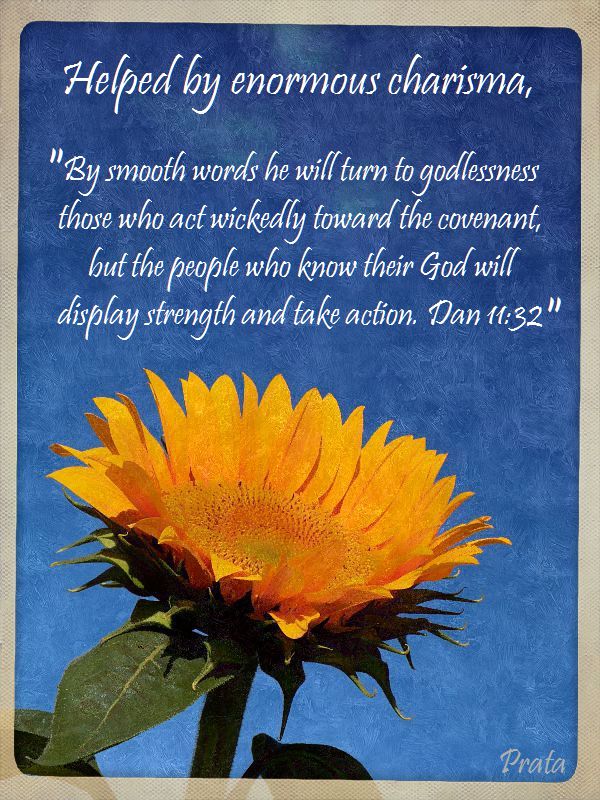
In Daniel 11:21 we learn that the coming world dictator will obtain the kingdom by flatteries. This word actually means slippery. I think we have all read about or even have known someone we dubbed “slippery tongued’. Some say silver tongued. That will be the antichrist, using language to bamboozle and appeal to the emotions, where all rational thought will slide right out of their brains.

He will be a master of intrigue, Daniel 8:23 records. The word means dark intrigue, riddles. Once again the antichrist will use language to manipulate, a feature of all charismatic people.

He will deceive the whole world. (Revelation 13:14).

The fact that the entire world will be deceived (except post-rapture saints) is indicative of his powerfully charismatic personality. The world will be spellbound, taken in by his smooth words, flatteries, facility with language to confuse and deceive them.

Even though the world has not seen THE antichrist yet, many antichrists have already gone out into the world (1 John 2:8). Many charismatic men come along to deceive and twist the Word, to the detriment of the health of the sheep. Paul noted this in Romans 16:17-20,

Now I urge you, brethren, keep your eye on those who cause dissensions and hindrances contrary to the teaching which you learned, and turn away from them. 18 For such men are slaves, not of our Lord Christ but of their own appetites; and by their smooth and flattering speech they deceive the hearts of the unsuspecting. underline mine

In this second Nautilus article about charisma, Why Joel Osteen, “The Smiling Preacher,” Is So Darn Appealing, we learn that charisma is not only an inborn quality, it can also be taught and then used as a tactic.

But there’s a small but growing group of individuals who have another explanation. Using brain-scan technologies and modern statistical techniques, a band of committed academics in recent years have set out to decipher that mysterious quality from which legendary leadership is born. And some have reached what a previous generation of observers might have considered a dubious conclusion: That it’s possible not just to reverse-engineer charisma, but that it’s something, at least in part, we might learn to master.

During the Tribulation, the coming antichrist will delude all the people who do not have Christ. Even today with the church on earth, we see how easy it is to be taken in by wolves, especially charismatic wolves who manipulate your emotions and use rhetorical tactics that confuse the mind. So what’s the antidote?

Protecting yourself against charismatic wolves

1. The Word of Christ.

In addition to all, taking up the shield of faith with which you will be able to extinguish all the flaming arrows of the evil one. 17And take THE HELMET OF SALVATION, and the sword of the Spirit, which is the word of God. (Ephesians 6:16-17)

The sword of the word of God is both an offensive weapon and a defensive one. Staying in the Word is the best protection against the wolves, no matter who they are, whether they be charismatic or dull.

2. Vigilance

We are also to take heed and be on guard. The Christian life requires vigilance. Many, many verses urge us to be on guard, stay sober, be vigilant. That means admitting that wolves exist, expecting them to come, and testing them against the word, no matter how popular or well-liked they are. Do this every time. It’s what vigilance means.

3. Avoid them

Paul said in Romans 16:17 that of those who cause dissensions and strife, and teach what is contrary the Gospel, avoid them. Don’t dabble. Don’t eat the meat and spit out the bones. Don’t entertain them on TV or in books or go to their movies. Don’t rationalize that they might be OK. Avoid them. The word actually means ‘to turn away from’ which is a stronger action that passively avoiding. It’s a deliberate turning of your back to the wolves.

4. Submit to elders

Acts 20:28 tells the pastors and overseers to take care for the flock. Hebrews 13:17 tells us to have confidence n the overseers and submit to them. I know that many of you cry out that your elders are not doing their jobs, that they allow false doctrine in all the time. But in any case, the Bible tells us what to do. Pray for them, help them, and submit to them. We know what to do even if they do not. And if they do, all the better. God raised them up for a reason.

I’m sure if we scoured the Bible we’d find lots of directions for how to protect one’s self against the false ones. But these are top of the list. Pastors and preachers with charisma come along all the time. They come and go. Osteen has had some staying power, others are flashes in the pan. But there will be one particular religious seeming man who will possess all the charisma and power and signs satan can give him (2 Thess 2:9). He, and the ones preceding him, will be easily spotted if you do what we’re supposed to do, and compare what he says to the word of God. Not how he says it, not how he looks when he says it, but his actual words.

As always, it always comes down to God’s word. Praise the Lord He revealed Himself in it and to us!

Posted in prophecy, Uncategorized

Mail Call #6: What can you tell me about Australian Prophecy Teacher David Asscherick?

Mail Call was always exciting on the TV show M*A*S*H

Occasionally I receive email or Facebook messages asking questions about various topics and issues within the faith. Here is a question I received recently about a phenomenally popular teacher Down Under, David Asscherick. Continue reading “Mail Call #6: What can you tell me about Australian Prophecy Teacher David Asscherick?”

Posted in prophecy, Uncategorized

What you seek after, you will be conformed to…

Chris Powers of FullofEyes.com creates a picture verse every day. His work in animation, illustration, tracts, and other manner of visual theology (as well as writing study guides to accompany the graphical work) is astounding and encouraging. Here is yesterday’s entry. Please share, his work is free and meant to be shared. If you feel led, contribute on Patreon.

Sharing Destinies

By Chris Powers-

Here’s the picture for today. I’m reading through Revelation as part of my morning times and was struck today by the truth that we will share the destiny of our God (big or little “g”). Humans seemed to be created such that, whatever they worship, they image (theologian GK Beale presents this idea most clearly)….

So, our sanctification (becoming like Christ) is fueled by our beholding and enjoying the glory of God in Christ (2 Cor.3:18), while our “diabolification” is fueled by our beholding and enjoying the God-opposing things of the world (Romans 6:19a, 2 Peter 2:19-20, etc.).

In like manner, we will share the eternal destiny of our God….either the joy of fellowship within the Trinity that has eternal been the gladness of God Himself (John 17) OR the horrors of being eternally an enemy of God, eternally the object of His love’s war against all that opposes the Beloved, aka, of His wrath.

An awesome, hopeful and sobering truth.

So, below are the relevant verses and short explanation.

___________________________

Revelation 20 “(10)…the devil who had deceived them was thrown into the lake of fire…(15) And if anyone’s name was not found written in the book of life, he was thrown into the lake of fire.”

Revelation 3:21, “The one who conquers, I will grant him to sit with me on my throne, as I also conquered and sat down with my Father on his throne.”

To our joy or horror, we share the destiny of the one we worship.

Posted in prophecy, Uncategorized

Prophecy: They sang the song of Moses in Exodus AND Revelation

When the Israelites were miraculously delivered from their bondage to the Egyptians, they sang a song of praise. This is known as the Song of Moses. It’s an ode to the one True God, who is all-powerful. The Israelites, led by Moses and Aaron, knew that God was God. They knew who He is.

He is a man of war, who smites enemies. He is a God of wrath,  and power, and salvation. He does wonders that make His people tremble. He is King of Kings, who dismays the kings of the earth. He is mighty. He is to be exalted.

Please read this wonderful song.

The Song of Moses, Exodus 15:1-18

“I will sing to the Lord, for he has triumphed gloriously;
the horse and his rider he has thrown into the sea.
2 The Lord is my strength and my song,
and he has become my salvation;
this is my God, and I will praise him,
my father’s God, and I will exalt him.
3 The Lord is a man of war;
the Lord is his name.
4 “Pharaoh’s chariots and his host he cast into the sea,
and his chosen officers were sunk in the Red Sea.
5 The floods covered them;
they went down into the depths like a stone.
6 Your right hand, O Lord, glorious in power,
your right hand, O Lord, shatters the enemy.
7 In the greatness of your majesty you overthrow your adversaries;
you send out your fury; it consumes them like stubble.
8 At the blast of your nostrils the waters piled up;
the floods stood up in a heap;
the deeps congealed in the heart of the sea.
9 The enemy said, ‘I will pursue, I will overtake,
I will divide the spoil, my desire shall have its fill of them.
I will draw my sword; my hand shall destroy them.’
10 You blew with your wind; the sea covered them;
they sank like lead in the mighty waters.
11 “Who is like you, O Lord, among the gods?
Who is like you, majestic in holiness,
awesome in glorious deeds, doing wonders?
12 You stretched out your right hand;
the earth swallowed them.
13 “You have led in your steadfast love the people whom you have redeemed;
you have guided them by your strength to your holy abode.
14 The peoples have heard; they tremble;
pangs have seized the inhabitants of Philistia.
15 Now are the chiefs of Edom dismayed;
trembling seizes the leaders of Moab;
all the inhabitants of Canaan have melted away.
16 Terror and dread fall upon them;
because of the greatness of your arm, they are still as a stone,
till your people, O Lord, pass by,
till the people pass by whom you have purchased.
17 You will bring them in and plant them on your own mountain,
the place, O Lord, which you have made for your abode,
the sanctuary, O Lord, which your hands have established.
18 The Lord will reign forever and ever.”

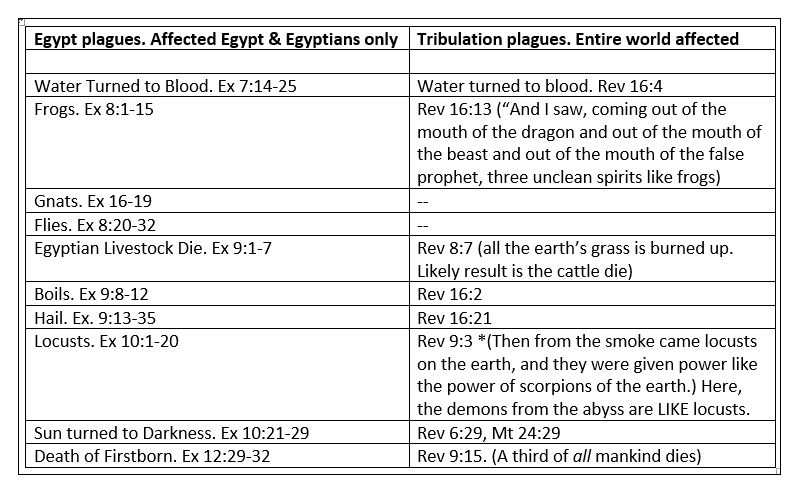
You might recall the ten plagues of Egypt that God placed on Pharaoh and his people. They were step-for-step dethronings of the Egyptian gods. God demonstrated He is the One True God with power over all the false gods the Egyptians worshiped. The plagues were also punishment for rebelling against God.

God has promised that after the rapture, when all the earth’s people who rebel against Him, from kings on down to slaves, they will be punished in wrath for their rejection of Him. (Revelation 6:15-16). At that time He will dethrone not only all false gods, but the false god of all time- satan. God will send to people of the earth plagues that are in like kind to the plagues God sent to Egypt. In Exodus, the plagues occurred just to the Egyptians. Even when the sun was darkened, the Israelites had light inside their own homes. (Exodus 10:23). Even when the Egyptian cattle died, the Israelite cattle lived. (Exodus 9:6). God is that precise.

During this post-rapture time of wrath, called The Tribulation (Or The Time of Jacob’s Trouble, Jeremiah 30:7), all the earth will be affected by these plagues. Everyone. During that time many will come to Christ and be saved, but most of the newly saved believers will be martyred. We read in Revelation, that just as the Hebrews sang the song of Moses in praise to God after their deliverance, the martyred will also sing the Song of Moses. We read this in Revelation 15:2-4

And I saw what appeared to be a sea of glass mingled with fire—and also those who had conquered the beast and its image and the number of its name, standing beside the sea of glass with harps of God in their hands. 3 And they sing the song of Moses, the servant of God, and the song of the Lamb, saying,

“Great and amazing are your deeds,
    O Lord God the Almighty!
Just and true are your ways,
    O King of the nations!
4 Who will not fear, O Lord,
    and glorify your name?
For you alone are holy.
    All nations will come
    and worship you,
for your righteous acts have been revealed.”

Here is a side by side comparison of the plagues of Egypt with the plagues of the tribulation, in both cases, God’s people were delivered from bondage. Click to enlarge.

Barnes’ Notes explains the parallels between the two circumstances of the singing of the song of Moses, at the commentary of Revelation 15:3,

Barnes’ Notes on the Bible
And they sing the song of Moses the servant of God – A song of thanksgiving and praise, such as Moses taught the Hebrew people to sing after their deliverance from Egyptian bondage. See Exodus 15. The meaning here is, not that they would sing that identical song, but that, as Moses taught the people to celebrate their deliverance with an appropriate hymn of praise, the redeemed would celebrate their delivery and redemption in a similar manner. There is an obvious propriety here in referring to the “song of Moses,” because the circumstances are very similar; the occasion of the redemption from that formidable anti-Christian power here referred to, had a strong resemblance to the rescue from Egyptian bondage.

As does Jamieson-Fausset-Brown Bible Commentary

song of Moses … and … the Lamb—The New Testament song of the Lamb (that is, the song which the Lamb shall lead, as being “the Captain of our salvation,” just as Moses was leader of the Israelites, the song in which those who conquer through Him [Ro 8:37] shall join, Re 12:11) is the antitype to the triumphant Old Testament song of Moses and the Israelites at the Red Sea (Ex 15:1-21). The Churches of the Old and New Testament are essentially one in their conflicts and triumphs. The two appear joined in this phrase, as they are in the twenty-four elders.

Our pastor preached on the Exodus plagues and the majesty of God this past Sunday. Our pastor has a Spirit-given talent for bringing the listener up to heights to glimpse up close the power and glory of God, which is itself if breathtaking and humbling. One becomes crushed after glimpsing Him through the exposition of scripture in sch a powerful way. After the sermon, I realized that as difficult as it is for me, who is saved, to see God as He really is (through scripture) that the lost people I know will meet Him in their own flesh. How like grass the flesh is! How they will be brought low, to wither as a match against a universal conflagration! When we ‘see’ God, we understand our own position in relation to Him, first as sinner worthy of all punishment, and then gratefully, as adopted sons and daughters of righteousness.

I recommend the sermon, if you have 40 minutes. It’s worth listening to. As for God’s work between the Old Testament and the New, from Egypt to the Tribulation-

But Jesus answered them, “My Father is working until now, and I am working.” (John 5:17)

Exodus and the Glory of God
What is the book of Exodus really about? We covered the heart of the book (with a brief summary of the whole) this week. Exodus is about God’s Glory in Salvation through Judgment.

May God and God alone be praised!!