Posted in prophecy, Uncategorized

Holy Fear: The Great Earthquake, part 2/3

This series first appeared on The End Time in March 2011
Part 1 here

The events of late summer-early Fall in New England, described in Part 1 of this three-part essay, were fear-inducing to a high degree. The strange events culminated in an earth-shaking display of mighty power, ripping into the consciousnesses of thousands of slumbering Colonials at a quiet moment in the middle of the autumn night. People ran shrieking out of their homes in their night-clothes, never having experienced such an earthquake before.

Then as now, people try to make sense of the events. Many a preacher was spiritually burdened to preach about it on the next Sunday, and one such was the New England preacher, John Cotton. (1693-1757). The old Puritan preachers were learned, well-versed in the bible, and devout. Most importantly, they preached the correct response to an earth-shattering event: Holy Fear.

We don’t evidence much Holy Fear these days, it is not a popular topic. But Rev Cotton did, and here are a few excerpts to his eminently readable and wonderful sermon. I encourage you to read it in its entirety. Part 3 of this essay will examine how the people of today respond to a similar earth-shaking event. In his sermon, Rev Cotton lays out the procession of thought throughout:

————-begin John Cotton sermon————–


DOCTRINE. The condition and circumstances of a people may be such that their flesh may well tremble for fear of God, and they may wisely be afraid of His judgments. In the prosecution of this doctrine I will show:
1. What is meant by the judgments of God and what judgments we are exposed to that we ought to be afraid of.
2. What is meant by trembling for fear of God and being afraid of His judgments.
3. That our condition and circumstance are such that we have abundant reasons and occasions to tremble and be afraid.

A Holy Fear of God and His Judgments
by John Cotton (1693-1757); Preached November 3, 1727
My flesh trembleth for fear of Thee; and I am afraid of Thy judgments” (Psalm 119:120)

To fear God means that we adore His sovereignty and righteousness even in His awful dispensations and that we employ our serious, devout, and solemn thoughts on these an other glorious excellencies and perfections of Almighty God displayed in His judgments. They must be the subject of our frequent and solemn meditations so that we may always maintain in our hearts suitable apprehensions of the great God who sends His judgments upon us.

Surely the consideration thereof should fill us with the greatest fear and concern of spirit that God has been so provoked that He has had to come out against us in His anger and to threaten our utter ruin and desolation

Did we ever have more reason to stand trembling before God under fearful apprehensions of impending vengeance when we consider the many scandalous, provoking evils abounding among us including oppression, injustice, fraud, deceit, falsehood, evil speaking, pride contention, intemperance, drunkenness, unchastity, excessive and inordinate love of the world, and may I add, the rudeness and profaneness of young people? God Himself, and our duty to Him, is evidently neglected and forgotten by many, and a form of godliness is maintained and kept up without the life and power of it. The sacred and dreadful name of God is dishonored and blasphemed by profane cursing and swearing. His holy Sabbaths, instead of being strictly observed and sanctified, are very much profaned by idle, vain, trifling and unsuitable conduct. Some forsake the house of the Lord, frequently neglecting and needlessly staying away from the public worship of God. Has not manifold contempt been put upon the Lord’s holy ordinances and institutions? Are there not many who disregard coming to them in a serious and worthy manner? Must we not acknowledge that mutual Christian love and charity grow cold? Are not both the love of men to God and the love of men to their neighbors treated with a visible coldness and indifference that clearly mark the lack of the power of godliness? Alas, for this people!

Are not the iniquities I have just described, and many more, prevailing among us and testifying against us, loudly proclaiming our impiety and great degeneracy, declaring that we are an impenitent, incorrigible, and unreformed people still, ripening rapidly for a destruction without remedy? Surely then, if this is the case with us, we have reason to tremble for fear of God and to be greatly afraid of His judgments. We might wisely be afraid of temporal plagues and judgments of a far heavier and sorer nature than we have yet been visited with, for the transgressions of God’s covenant people are exceedingly provoking to Him and richly deserve to be severally punished. I beg of you, do not forget that our sins are the more offensive and provoking to God for we are a people in covenant with Him.

What awful symptoms there are of blindness and hardness of heart right in our midst. Ought we not to fear that men are dreadfully blinded and hardened in their sins when there is not so much as external reformation in connection with such an awful judgment of God as this earthquake?

We learn from this text that it is not cowardly to be afraid of God’s judgments but very agreeable to true Christian courage.

God is no fit match for us to contend with. No one has ever hardened himself against Him and prospered (Job 9:4). He is our Creator, we are His creatures. We are as clay in the hands of the potter. He is the King of Kings and the Lord of Lords. God cannot err on His end, as the princes of this world may in the execution of their displeasure through impotency or want of knowledge, for He is infinite in knowledge, wisdom, and power, and there in no comparison between infinite and finite. It is not cowardly then to fear God. Our Saviour advises us,

Fear not them which kill the body, but are not able to kill the soul; but rather fear Him which is able to destroy both soul and body in hell.” (Matthew 10:28)

Such wise fear is agreeable to true Christian courage. This should be expressed in our lives by maintaining a reverential fear of God upon our minds, in fighting against the enemies of our salvation; in mortifying our lusts; in steadfastly persevering in all the duties of our holy religion; in not disobeying His commands, despising His judgments, scorning His rod or setting ourselves in opposition to His threatening, which is the most daring and prodigious folly and madness and will be found so in the end.

How very surprising and amazing was the first sudden shock and convulsion we felt! Our houses and beds were shaking, and the earth was trembling and reeling under us like, I suppose, none ever felt in this part of the world before. And how many times has the awful noise been repeated, though not to such a fearful degree? Well may the people in this city and in the country round about be filled with the surprise and consternation of which we see and hear. Multitudes seem to be under great conviction, distress, and concern about their soul and eternity. Oh, that the impressions might abide until conversion to God is accomplished and the great work of their salvation is completed.

————-end Cotton sermon—————-

Rev Cotton was fearful that the initial impressions regarding a just, angry, and powerful God would diminish in the light of day and diminish even further as time passed. How well the Reverend knew the sinful nature of craven men. But the response Cotton preached is the ONLY proper response to a God who is wroth with us. He is the Creator, we are His creatures! We are clay in the hands of the potter. We should fall down before Him, seeking forgiveness as we entreat Him to forgive our sins. But do we? Part 3 coming up.

cracked sidewalk

Posted in prophecy, Uncategorized

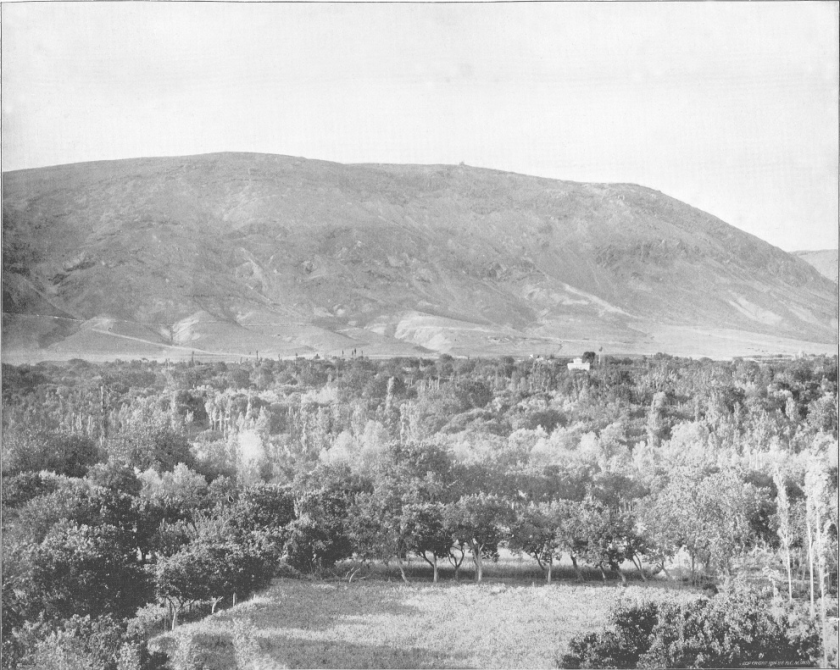
‎Gardens of Damascus

‎Gardens of Damascus

No wonder the Moslems look upon Damascus as an earthly paradise. It is encompassed by gardens and orchards. These cover an area of over twenty-five miles in circumference. Here grow olive, fig, walnut, apricot, poplar, palm, cypress and pomegranate trees. In the above view we have a scene taken from the Jerusalem road in the western part of the city, and looking to the north a ridge of Anti-Lebanon is seen straight before us. In the richness of its soil, in the salubrity and semi-tropical character of its climate, in its varied vegetation, we find the reason for the constant association of Damascus with the thought of gardens.

It has been for four thousand years a garden. It is surrounded for miles with this splendor of verdure. Its gardens and orchards and far-reaching groves, rich in foliage and blossoms, wrap the city around like a mantle of green velvet powdered with pearls. The apricot orchards seem to blush at their own surpassing loveliness, and the gentle breezes that rustle softly through the feathery tops of the palms are laden with the perfume of the rose and the violet. Tristram, in his account of what he saw, says:

“Tall mud walls extended in every direction under the trees, and flowing streams of water from the Barada everywhere bubbled through the orchards, while all was alive with the song of birds and the hum of bees. The great apricot trees were laden and bent down under strings of ripe golden fruit.” Whatever changes may be made by the hand of man in Damascus, whatever changes in government and in commercial activities, the city is sure to be for all time a paradise of fertility and beauty.

Vincent, J., Lee, J., & Bain, R. E. M. (1894). Earthly Footsteps of The Man of Galilee and the Journeys of His Apostles. New York, NY;St. Louis, MO: N. D. Thompson Publishing Co.

gardens

Posted in prophecy, Uncategorized

Throwback Thursday: Keep Your Eyes on the Prize!

fixing our eyes on Jesus, the author and perfecter of faith, who for the joy set before Him endured the cross, despising the shame, and has sat down at the right hand of the throne of God. (Hebrews 12:2 NASB).

I press on toward the goal for the prize of the upward call of God in Christ Jesus. (Philippians 3:14) NASB)

 The above two verses remind us to keep our eyes and attention fixed on the prize: which is Jesus! When we shift our gaze from Jesus to the things around us, we lose strength, energy, and focus. The example below is used a lot in sermons and devotionals to demonstrate this concept. It is an oldie but a goodie. The following was published on The End Time in July 2010.

Florence Chadwick was a young woman in 1952 but had already swum the English Channel, both ways, and broke records doing it. That morning in 1952 she stood on the shores of California with intent to swim the 26 miles to Catalina Island. It was foggy. She was used to fog, rough water, and cold, having swum in these conditions since when was 11 years old so she was prepared for any conditions that may beset her on the long swim. It was so foggy that Florence could not see the support boats motoring around her to scare away the sharks. However after 15 hours of rough water stroke after stroke, she felt like she wasn’t getting anywhere. Despite encouragement from her mother and others in the support boat next to her, Florence wearied and asked to be taken out of the water. She soon discovered that she was half a mile from her goal.

Above, the Lubec Maine shoreline. There is lighthouse in this photo. Can you see it? 
[Photo by EPrata]

At a news conference the next day Florence said, “All I could see was the fog.…I think if I could have seen the shore, I would have made it.”

Florence tried again two months later. This time, she made it because she said that she kept a mental image of the shoreline in her mind while she swam.

This is the same scene as above after the fog rolled away. [Photo by EPrata]

Prophecy is not meant to BE the fog. It is knowable, profitable, and given to us for all education. It is a light to keep in our heart as to the immutable existence of God, His eternal promises, and the goal for every believer, to reach the eternal Lighthouse. Jesus meant for prophecy and His promises to the believer to be the mental image for us to hold dear as to the goal. Do not give up half a mile from the finish line! He is near, He is coming. Do not wander, drift, be swept away by currents taking you far from the goal. May every stroke of your swim toward eternity be as vigorous as the one before. Pray for that vigor. The Holy Spirit is there to help us:  “And I will pray the Father, and he shall give you another Comforter, that he may abide with you for ever;” (John 14:16)

If you knew that the Rapture was tomorrow would it change your decision not to study the Bible today? Not to pray? Not to help someone? If you knew it was next week, or next year, how differently would you act as a Christian? You’re tired. We are all tired. The wages of sin splash up on us, and sometimes splash into us. It is wearying holding firm against the current. But keep the goal in mind! Some fine morning,t eh call will come, and the fog will lift and we shall see Him clearly, in blazing glory and light!

What a day that will be!

Posted in prophecy, Uncategorized

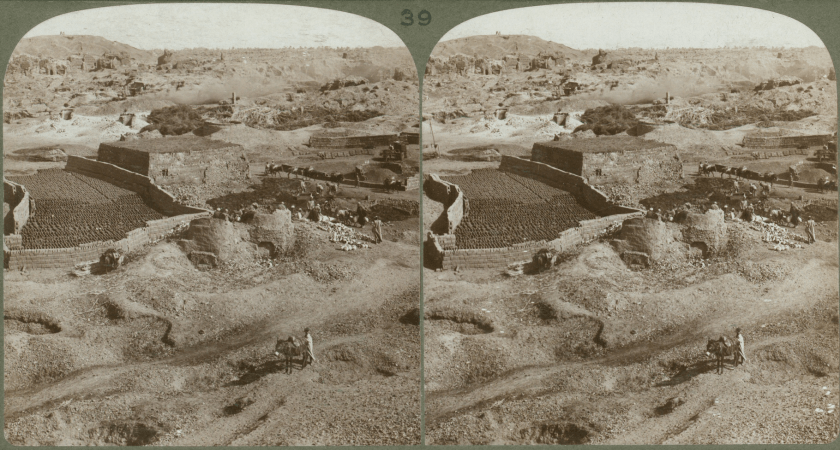
Ancient brick making in Palestine: Photo

So the same day Pharaoh commanded the taskmasters over the people and their foremen, saying, “You are no longer to give the people straw to make brick as previously; let them go and gather straw for themselves. But the quota of bricks which they were making previously, you shall impose on them; you are not to reduce any of it. Because they are lazy, therefore they cry out, ‘Let us go and sacrifice to our God.’ Let the labor be heavier on the men, and let them work at it so that they will pay no attention to false words.” (Exodus 5:6-9)

Photos from Palestine from the late 1800s an early 1900s are a joy to view, because the methods of the people, dress, and vistas were largely unchanged from the days Jesus walked. It was only in the 1930s and 40s that development began in earnest and especially after Israel became a nation again in 1948 that things began to modernize and the old ways were vanishing.

In the 1800s, as travel became easier with trains and modern steam ships, many upper class men and women in Britain or America took a Grand Tour of Europe. Interest grew and soon many expeditions to Palestine took place. The Ottoman lands were such a curiosity that a plethora of Travelogues to the Middle East burgeoned in the 1700s to early 1900s.

Travelogues of Palestine are the more than 3,000 books and other materials detailing accounts of the journeys of primarily European and North American travelers to Ottoman Palestine. An in depth survey of Palestine topography, and demographics was done by the Cartographer, Geographer, Philologist. The number of published travelogues proliferated during the 19th century, and these travelers’ impressions of 19th-century Palestine have been often quoted in the history and historiography of the region…

One such travelogue book in my Logos Software is Earthly Footsteps of the Man of Galilee, and another is the one I’ve quoted below, Egypt Through the Stereoscope. The stereoscope is “a device for viewing a stereoscopic pair of separate images, depicting left-eye and right-eye views of the same scene, as a single three-dimensional image.” That’s why the image below is a double image.

I’m going through Dr Abner Chou of The Master’s Seminary lectures on Exodus. (Note- that link will expire on July 31, 2018, as Wikispaces is closing and hosted lectures will go away unless you download them prior). I find it interesting to see what the brick making operation might have looked like and enjoyed this view from a hill above an Egyptian brick-making operation taken from a Travelogue Expedition in the early 1900s written by Dr James Breasted. The book is available today and is considered culturally important.

Anyway, enjoy this long-ago view of making bricks in Egypt, and imagine thousands of years ago the cries of the Hebrews as they toiled under the merciless overseers and merciless baking sun. Then the Lord raised up Moses…

brick making

Caption-

‎Just north of the chief ancient city of the Fayum, we stand looking nearly eastward over the ruins of Crocodilopolis. Behind us stretches the Fayum, rising at last to the vast waste of the Sahara, spreading out to the far Atlantic. Beyond the trees that mark the sky-line before us the Nile is twenty-five miles away.

‎Deep down under these ancient crumbling walls lie the scanty remains of a town at least as old as the twelfth dynasty kings, who 2,000 years before Christ recovered this district from the waters of the lake. They built a temple here sacred to the crocodile god Sebek, after whom the city was called by the Greeks, Crocodilopolis.… When the Greek kings, the Ptolemies, came into power, they used the rich fields of the Fayum as gift lands with which to reward their soldiers.… Some of the greatest products of Greek thought have turned up among the house ruins, such as the Constitution of Aristotle, poems of Sappho and innumerable fragments of Homer.…

‎We see here modern natives engaged in brick-making by the same methods that were employed five thousand years ago. The soft mud is being fixed under the feet of a fellah, while another at a table molds it into bricks. These are taken while still in the molds and carried to the yard by a third native who gently detaches them from the molds and leaves them to dry in long rows.… In spite of the lack of firing they make a very desirable wall; in a practically rainless climate they stand well.

‎From Egypt Through the Stereoscope, by James H. Breasted, Ph.D., with twenty patent maps and plans, 1905

Posted in prophecy, Uncategorized

Why eschatology matters (and hopefully making a comeback)

As you know, this blog is called The End Time, because we are in the end time. This is the period between Jesus’ first and second comings, where He is building His church. When His church is complete, He will call the Church home. It take it as a duty given by command in the Bible to be fervent with His message, since His return is (always) imminent and our duty then shall be no more. Redeem the time and act with eagerness every day, because the end time will end some day.

For the Lord Himself will descend from heaven with a shout, with the voice of the archangel and with the trumpet of God, and the dead in Christ will rise first. Then we who are alive, who are left, will be caught up together with them in the clouds to meet the Lord in the air, and so we will always be with the Lord. (1 Thessalonians 4:16-17).

Eschatology often gets a bad reputation as a doctrinal field of study because of the plethora of ‘theologians’ who either dismiss it entirely in dusgust, or who set dates, add newspaper eisegesis to it, or who are just plain “Kooks & Barneys“, as Pastor Mike Abendroth says. For some reason this field draws out the less solid teachers.

Other Christian fields of study such as Pneumatology, Hamartiology, Theology Proper / Paterology, Christology, Bibliology, Soteriology, and Ecclesiology don’t seem to draw out the kooks as much. Apologies to those of you who ARE solid expounders of ‘last things’! But it’s true. Eschatology gets a bad rap and quite often, it’s warranted.

I’ve noticed in the last ten years that it seems to be to be a low point in Eschatological study, maybe because of different -ologies falling in and out of favor. However in these last few weeks I’ve noticed credible ministries teaching on it. The Master’s Seminary had a series recently, from which I captured this screen shot from Dr. Nathan Busenitz teaching an introductory lesson to his series. One of the important reasons to study Eschatology is because as is stated below, one’s view of last things reveals one’s approach to interpreting scripture.

Holiness –  “Our future hope promotes present obedience.”

The Master’s Seminary also put forth an essay titled 7 Reasons Your Church Should Take Eschatology Seriously, an essay worth reading, for sure! Reason #1 of the seven:

People are interested in the future

Christians are interested in what the future holds. But if we do not teach eschatology, we are denying important biblical information for those who want to know what the Bible has to say about the future. We are also withholding a major source of the hope that the Scripture wants us to have.

At the Grace To You website, a blog series is underway, today’s installment is called The Eschatology of the Thief by Cameron Buettel

Eschatology is a hotly debated subject among modern believers. It concerns the study of the “end times,” last things, or future events in God’s redemptive plan. Its scope includes Christ’s return, the rapture, the millennium, future judgment, and God’s kingdom. Those are all broad and important issues—it’s understandable why a lot of ink has been spilled by people staking out their particular positions.
But there’s also an intensely personal aspect to our eschatological views. And that concerns the only two possible eternal destinations for every person who has ever existed.

I hope Eschatology as a Christian field of doctrinal study and preaching is making a comeback. Meanwhile please bookmark these three resources and enjoy their offerings so far on eschatology!

new jerusalem verse

Posted in prophecy, Uncategorized

The sun in prophecy

It’s spring. At this time of year here in the south the weather can be just as turbulent as my former home up in New England. In the south, spring means many days of cloudy and rainy weather. I can’t remember the last time we saw the sun, and we have had indoor recess for too many days to count.

I love the sun. When it comes out all bright and warm, it feels so good, doesn’t it! The golden hour at dawn and sunset is beautiful, when the sun’s shadows lengthen and the air seems to turn to liquid gold. The fluffy clouds sailing along against the blue sky seem to frame the yellow orb as it makes its way through the sky from low to high then low again. It’s an orderly celestial march, one we take for granted, even when the sun is hidden behind clouds. We know it will come back.

Except, one day, it won’t.

When we think of God we often think of Jesus, of God’s glory, His majesty or sovereignty. He is Creator, of course, but if we think of Him in this way we often restrict our thoughts to Genesis, when creation was first made.

His creative work wasn’t restricted solely to creating it. He sustains it, (Hebrews 1:3, Colossians 1:17), and He will UNcreate it. (Revelation 6). Then He will make all things new. (Isaiah 65:17, Revelation 21:5).

The sun is featured prominently in end time prophecy. In the first set of judgments, the Seal Judgments, the sun goes black as sackcloth. (Revelation 6:12). In Revelation 8:12 the Trumpet judgments, we read-

Then the fourth angel sounded: And a third of the sun was struck, a third of the moon, and a third of the stars, so that a third of them were darkened. A third of the day did not shine, and likewise the night.

Can you imagine how scary that will be?

When the demons are allowed to leave the pit in Revelation 9:2, there are so many of them that the sun is blotted out by the cloud they make. In Revelation 16:8 the sun grows so hot that men are scorched just by being outside. In Revelation 19:17 an angel stands in the sun to pronounce judgment, and finally in Matthew 24:29 we read that after the end of the Tribulation, the sun, moon, and stars go completely dark.

This phenomenon of the sun going completely dark is mentioned not just in Revelation and Matthew, but Isaiah 13:10, Ezekiel 32:7, Joel 2:31, Joel 3:15, Amos 8:9, and Zechariah 14:6. And the sun is not dark for a moment or two but a period of time, likely days or even a few weeks. Do you see how important the sun is in prophecy?

God made the sun for us as a helper. In Genesis 1:14-16,

Then God said, “Let there be lights in the firmament of the heavens to divide the day from the night; and let them be for signs and seasons, and for days and years; and let them be for lights in the firmament of the heavens to give light on the earth”; and it was so. Then God made two great lights: the greater light to rule the day, and the lesser light to rule the night.

With no sun or moon or stars, the darkness of the Tribulation people will endure will mirror the total sinfulness on earth. It will truly be a time of darkness, spiritually AND physically. The sun shines at His will and pleasure, and it is benign as a light giver as it was intended to be in Genesis or as hostile as a scorcher in judgment against us in Revelation. Again, at His will and pleasure. He is sovereign over all the universe, and the sun bends to his will.

The sun, our friend since the very first days that has given us light, seasons, and warmth, will behave in increasingly erratic ways until the very end of the end when “there shall be no more sun” at all. (Revelation 22:5). But this time, it will be because the glory of God will shine brightly, and there will be no more need of the sun.

And night will be no more. They will need no light of lamp or sun, for the Lord God will be their light, and they will reign forever and ever.

What a day that will be!

sun
EPrata photo
Posted in prophecy, Uncategorized

Spring bounty and God’s prophecies

The spring has been gentle and the Lord is providing bounty from the earth. The summer garden crops are about to be planted in and they will be plenteous. The figs leaves are coming in. The muscadine vines are thriving. It reminds me in particular of two verses in the Bible. They are promises. That is what prophecies are, you know. Promises of positive things the Lord has in store for the people who love Him and promises of negative things to come for those who don’t love Him.

vine.jpg
EPrata photo

Every man will sit under his own vine and under his own fig tree, and no one will make them afraid, for the LORD Almighty has spoken. (Micah 4:4)

In that day, declares the LORD of hosts, every one of you will invite his neighbor to come under his vine and under his fig tree. (Zechariah 3:10)

In the Bible, vines (usually grape) and fig trees were emblematic of agricultural abundance and that abundance bespoke wealth. Many fig trees meant prosperity. The promised land was described in Deuteronomy 8:8 as “a land of wheat and barley, and vines and fig-trees and pomegranates.” It was not described as a land flat and therefore ripe for land prospecting development. It was not described as a land full of silver and gold mines. It was not described a land of great cities producing a rich population with guilds and markets. The prosperity the land promised was riches from a bountiful earth. Remember that after the Fall, Adam was cursed with toil, and that the land would not yield unless he toiled with sweat and labor. What was it like before the Fall? I can’t wait to find out, and that is what these prophecies promise.

Cursed is the ground because of you; through painful toil you will eat of it all the days of your life. It will produce thorns and thistles for you, and you will eat the plants of the field. By the sweat of your brow you will eat your food until you return to the ground, (Genesis 3:17b-19b).

That curse will be reversed and the land will pop with generous abundance. Remember the two spies who came back, in Numbers 13:23 reporting that they saw huge grapes and figs and pomegranates?

Doesn’t sitting under our own fig tree and our vine and sound relaxing? Refreshing? Cool? Like walking with God in the garden in the cool of the day. And Jesus said, I am the vine; you are the branches. Whoever abides in me and I in him, he it is that bears much fruit, for apart from me you can do nothing. (John 15:5).

grapes
EPrata photo

And look what Jesus did! He did everything! He accomplished redemption for mankind, by breaking His own body and allowing it to be poured out! We are His branches, connected to the Great Gardener whose vine covers us, and which provides all sustenance.

When you’re out haying this summer, sweat running down your face, or you’re out mowing this summer, and thirsting because of the heat, or you’re gardening and battling the bugs who are killing your bean plants, remember the prophecies.

My people will live in peaceful dwelling places, in secure homes, in undisturbed places of rest. (Isaiah 32:18).

I will sing for the one I love a song about his vineyard: My loved one had a vineyard on a fertile hillside. (Isaiah 5:1).

As for the saints in the Church, our dwelling place will be New Jerusalem, and it will be just as beautiful as earth’s bounty, glittering and pure.

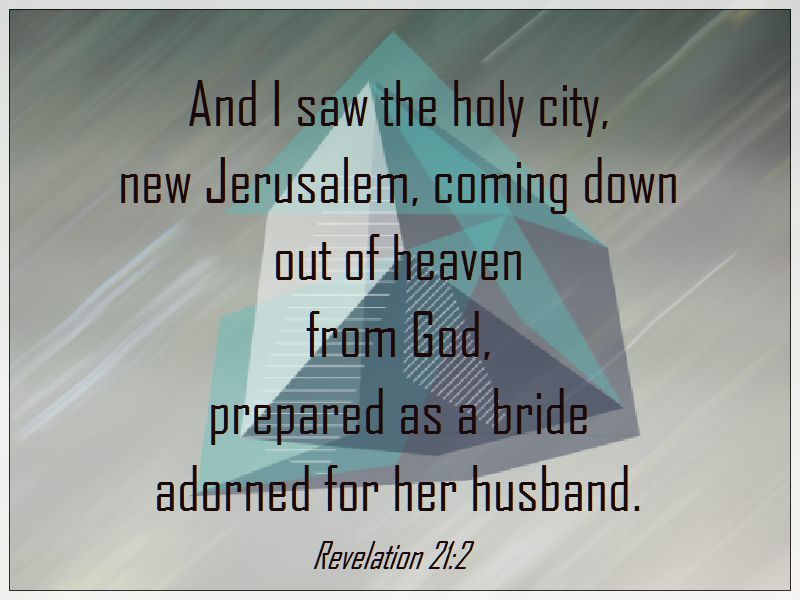
And he carried me away in the Spirit to a great, high mountain, and showed me the holy city Jerusalem coming down out of heaven from God, 11 having the glory of God, its radiance like a most rare jewel, like a jasper, clear as crystal. 12 It had a great, high wall, with twelve gates, and at the gates twelve angels, and on the gates the names of the twelve tribes of the sons of Israel were inscribed— 13 on the east three gates, on the north three gates, on the south three gates, and on the west three gates. 14 And the wall of the city had twelve foundations, and on them were the twelve names of the twelve apostles of the Lamb. (Revelation 21:9-14)

How beautiful the relationship. We are the branches, closely grafted into the true vine. The true vine covers us, and we sit under it in peace and abundance. The abundance comes from the Vine Dresser who is the Father (John 15:1), who cares for the true vine in love and cares for his children, the branches.

Our God is a tremendous God!!!!!

Posted in prophecy, Uncategorized

Living in interesting times

columns 2
EPrata photo

Praise the Lord, we live in interesting times!*

There is a proverb/curse of alleged Chinese origin, “May you live in interesting times.” The implication is that a life lived in interesting times is less desirable than one lived in peace and tranquility. To be sure, the danger and uncertainty and lack and want of these years are difficult to manage sometimes, but surely it is better to live in interesting times than uninteresting. Why? Jesus.

We could change that phrase to “May you live in prophetic times” and it would be better applicable for the believer. For those who are IN the Lord, believers in Jesus and saved by His grace, we know that though difficult, the times that are more “interesting” offer more growth in sanctification than times when everything is going along peacefully.

The tremendous opportunity we have to actually watch God at work in the world in such an interesting and visible way fuels my love for Him and my amazement at His sovereignty. Providentially, He sustains the world and universe in general. Providentially, He specifically ordains each and every breath, event, and movement for all His creatures, human and otherwise. How can we not be satisfied with that, when we know that whatever happens is for our good and His glory?

Yes, a life in a previous time might well have been more peaceful, but less astonishing. And the difficult times offer us the opportunity to grow in Jesus. He is the Potter. He sanctifies us and shapes us through trials and challenges. And my, what challenges these times offer. There is such violence in the world- hate, persecution against Christians and His church. Therefore the growth in Christlikeness would be even greater than when living in uninteresting times.

We give thanks to you, O God; we give thanks, for your name is near. We recount your wondrous deeds. “At the set time that I appoint I will judge with equity. When the earth totters, and all its inhabitants, it is I who keep steady its pillars. (Psalm 75:1-3).

*Part of this essay appeared on The End Time in 2012.

Posted in prophecy, Uncategorized

Stephen Hawking, coffins, & other thoughts

Noted theoretical physicist Stephen Hawking died this week. He was brilliant, no doubt about that. His nickname in school was “Einstein”, and he lived up to name by contributing mightily to the areas of cosmology, particularly in Big Bang Theory and Black Holes.

He died of a rare form of Lou Gehrig’s disease (ALS) in that it progressed very slowly. He was 76.

Mr Hawking applied his mind in attempting to unlock the secrets of the universe, its forms and origins, functions and future. Though he made many discoveries, he never discovered the basic truth: God made it. In fact, the further Hawking went along, the more entrenched he became in denying the Designer and Sustainer of life. He made flatly rejecting statements about God and religion, such as these quoted in The UK Guardian in 2011-

The belief that heaven or an afterlife awaits us is a “fairy story” for people afraid of death, Stephen Hawking has said. In a dismissal that underlines his firm rejection of religious comforts, Britain’s most eminent scientist said there was nothing beyond the moment when the brain flickers for the final time.

“I regard the brain as a computer which will stop working when its components fail. There is no heaven or afterlife for broken down computers; that is a fairy story for people afraid of the dark,” Source

‘There is no heaven’. This is a true statement- for Mr Hawking- if indeed he maintained his rejection of God to the end.

‘There is no afterlife’. This is an untrue statement for Mr Hawking. He is discovering now that he is indeed alive, and further, has been granted a fresh body, albeit one that will be withstanding the fires and punishments of hell for all eternity (if indeed he did not repent at an unknown time.)

Hawking was the smartest man, as smart as than Einstein…seeking the mysteries of the universe all the days of his life- it was only death that revealed those mysteries to him. Sadly, it is too late.

Hawking went the way of all flesh (with a nod to Samuel Butler). The way of all flesh is death, either to resurrected life in glory with Jesus, or to eternal death & punishment apart from Jesus. Answers In Genesis has a sensitive and thoughtful epitaph on Mr Hawking’s life, here.

It’s times like these, when a famous atheist dies, that one ponders hell all over again. Hell is a monstrous doctrine. Not monstrous as in evil, for God is holy and just and all those who are sent there deserve it. Even those who are forgiven, like me, deserve it. It’s only the imputed righteousness of Jesus that diverts us from our fleshly final fiery resting place.

I mean monstrous as in the definition of “extremely and dauntingly large; as in, “the monstrous tidal wave swamped the surrounding countryside”.

It’s a huge thing to ponder hell, because it is for all eternity. Who can know?

In a similar vein, I saw this photo on Facebook this week.

Some people around here think it’s funny, others amusing, others intrigued. I never knew how much the idol of college football was alive and active until I came to Georgia. The University of Georgia Bulldogs’ arena is the Temple and the ‘Dawgs’ are worshiped by thousands of adoring fans.

I don’t think it’s amusing. I think it’s blasphemous. Sure, people, bring your idol with you to eternity. What could go wrong?

When my husband and I were in Puyo, Ecuador, a town then on the edge of the Amazon Rainforest and very remote, we spent a week. There were few industries in this one-dirt-road town. It truly was a frontier town, with one main road, plank sidewalks, a lonely hotel, and a few stores. One industry was coffin making. The people in that part of the South American country loved their highly decorated coffins. They would be made of heavy wood, and at the corners, one or all four, there would be clear glass. Inside the headlight-like small alcove would be blinking lamps, candles, statues of Mary, jewelry, or just lights. Perhaps they thought the lights could aid Charon as he guided the casket across the river Styx to the abode of the dead.

Do you know what I wish? I wish that all coffins would have two pictures on them, one at either end. One, a picture of glory and the New Jerusalem. The other, a picture of the Lake of Fire. That would give funeral-goers something to contemplate. There is an afterlife, and all flesh is consigned to one of them.

The difference is your position on Jesus. If you believe He is your risen God, having trusted in Him as savior and repented of sins which He forgave, you go to heaven. If you have rejected Him and failed to repent of your sins, you go to the Lake of Fire to be punished for your sins. You have committed cosmic treason, which must be justly punished..

Hell is a big subject. So is heaven. We will all have an eternity to contemplate it. After death it is too late to change your location. Repent now, while it is still day

Therefore having overlooked the times of ignorance, God is now declaring to men that all [people] everywhere should repent, because He has fixed a day in which He will judge the world in righteousness through a Man whom He has appointed, having furnished proof to all men by raising Him from the dead.” (Acts 17:30-31).


Posted in prophecy, Uncategorized

Prophecy: The restrainer and salt

Now concerning the coming of our Lord Jesus Christ and our being gathered together to him, we ask you, brothers, 2not to be quickly shaken in mind or alarmed, either by a spirit or a spoken word, or a letter seeming to be from us, to the effect that the day of the Lord has come. 3Let no one deceive you in any way. For that day will not come, unless the rebellion comes first, and the man of lawlessness is revealed, the son of destruction, 4who opposes and exalts himself against every so-called god or object of worship, so that he takes his seat in the temple of God, proclaiming himself to be God. 5Do you not remember that when I was still with you I told you these things? 6And you know what is restraining him now so that he may be revealed in his time. 7For the mystery of lawlessness is already at work. Only he who now restrains it will do so until he is out of the way. (2 Thessalonians 2:1-7).

I posted the full passage so that you can read the main verse under discussion today in context. For the mystery of lawlessness is already at work. Only he who now restrains it will do so until he is out of the way.

The Second Letter to the Thessalonians was a very early letter. Paul wrote it in about AD 51, just a few months after he had written his first letter to the church at Thessalonika. In his first letter to the Thessalonians, Paul had obviously spent some time teaching the new Christians in their new church about the end times. Now, there’s proof positive that eschatology is not only for the mature, nor is it a marginal doctrine to be learned after all the other, more important doctrines have been taught. Paul launched right in to teaching about the rapture and the Day of the LORD (The Tribulation) to the newest Christians. He reminded them in the 2nd letter about the important points, probably to refute false teachers who had come in to tell the Thessalonians that the Day of the LORD had come.

dr nathan busenitz

By the way, this is another proof the rapture will happen before the Tribulation. If the sequence of events was that the rapture happens at the end of the Day of the LORD, why were the Thessalonians so concerned and sought Paul’s advice? They should have been happy. And encouraged.

Why did Paul have to calm them down and remind them of what he had already taught? And further, the pre-tribulation rapture was supposed to be an encouragement. (1 Thessalonians 4:18) if the sequence was post-tribulation rapture then they should have been encouraged, not concerned, becuase it was almost here.

Today’s verse involves the One who restrains. In the passage above, Paul is describing someone who is powerful enough to restrain the man of Sin (antichrist) and to restrain sin itself. Who is powerful enough to do that? No human, certainly. The Holy Spirit.

Paul is saying here that when the Holy Spirit ceases His ministry of restraining sin, the Man of Perdition will be revealed. The Tribulation will come into full swing.

Barnes’ Notes describes the restraining ministry’s effect:

It was some power which operated as a check on the growing corruptions then existing, and which prevented their full development, but which was to be removed at no distant period, and whose removal would give an opportunity for these corruptions to develop themselves, and for the full revelation of the man of sin.

Did you ever stop to think about the restraining power the Spirit does while He is inside of us,the Church, while we are on earth?  We hear people say that America is or was “A Christian Nation.” No, we never were. But it seemed like we were because so many people were Christians. Many of those were not, of course, but they modeled the precepts and behaved morally because so many other Christians were around. They might have had poor motivations to behave as a Christian, for business purposes, or for a social network, of for help with provision, but nevertheless, they adopted an external morality because that was the way to get along in society. Cultural pressure was brought to bear. The real Christians acted as salt.

We see this in 2 Corinthians 10:15. “We do not boast beyond limit in the labors of others. But our hope is that as your faith increases, our area of influence among you may be greatly enlarged,” When the crisis at Corinth as resolved, Paul expanded the ministry to new areas.

Salt is preservative holding back decay. We are that salt. Each Christian with the Holy Spirit in him or her, acts as salt in the world. Salt prevents flesh from putrefying. When the Holy Spirit ceases His major ministry of restraining sin, and then He takes us out of the world in the rapture, each of us as a little salt crystal-Christian will disappear. There will be nothing left to stop the remaining flesh from corrupting. When we are removed the sin of the flesh will blossom, and quickly.

To be sure, the Holy Spirit is the power. We’re not. But us as little salt sprinkles around the world…when we AND the Spirit are removed out of the way, pow! Sin will be unrestrained in the world. Just think on it.

salt