The preaching of the true word of God always pierces hearts.
“So those who received his word were baptized, and there were added that day about three thousand souls.” (Acts 2:41)
Subtract
However, taking away from that word will bring condemnation to those who subtract from it:
“and if anyone takes away from the words of the book of this prophecy, God will take away his share in the tree of life and in the holy city, which are described in this book.” (Revelation 22:19)
Multiply
We love God’s word so much we share it, not sparingly but liberally. To His own glory, the Lord multiplies what is needed in the sower so they can return and multiply their doing good again and again–
“He who supplies seed to the sower and bread for food will supply and multiply your seed for sowing and increase the harvest of your righteousness.” (2 Corinthians 9:10)
Barnes Notes explains, “Multiply your seed sown – Greatly increase your means of doing good; make the result of all your benefactions so to abound that you may have the means of doing good again, and on a larger scale, as the seed sown in the earth is so increased that the farmer may have the means of sowing more abundantly again.”
Divide
But make no mistake, proclamation of, living by, and protecting the word will bring division. Doctrine DOES divide.
“Do you think that I have come to give peace on earth? No, I tell you, but rather division.” (Luke 12:51)
In efforts not to have “division” but a (false) unity based on a watered down version of the Gospel, you really have nothing. Nothing from nothing leaves nothing, said Billy Preston.
John MacArthur on doctrine dividing, from his sermon A Call for Discernment: “When you don’t even lay down clear doctrine at the level of the Gospel, where are you going to go from there? And the cry is, as one man said to me when my book on The Gospel According to Jesus came out, he said, “Your book is divisive!” You want to know something? He’s right. He’s right. Want to know something else? Doctrine divides. People say, “Oh doctrine divides … doctrine divides.” I say, “Amen, preach it, doctrine divides.” You know what it does? It confronts error. It separates true from false. It makes judgments. Today’s climate, however, of unity in the priority of relationships, that’s not tolerable.”
But here is the new math of God’s kingdom: His infinitely extravagant grace! There is no counting it and no end to it. Praise the Lord that His grace and mercies fall on us every day. I can’t add the number of times I’ve been a grateful recipient of it.
“Our Lord is great, vast in power; His understanding is infinite.” (Psalm 147:5)
“Yes, everything else is worthless when compared with the infinite value of knowing Christ Jesus my Lord.” (Philippians 3:8).
The church is one body, formed by the Spirit, who places each believer intentionally. Like a pointillist painting, individual lives lived further afield may seem indistinct, yet from God’s perspective every placement contributes to a unified, beautiful masterpiece completed in heaven according to His sovereign design.
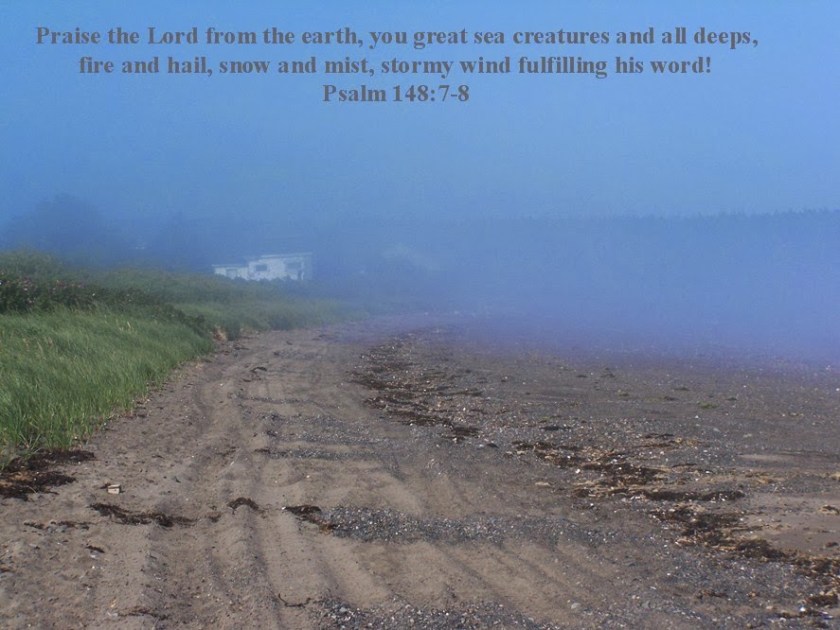
Isn’t it comforting to know that God ordains every single thing that happens, even every droplet in the fog bank rolling over the beach roses at the easternmost point of a nation.
Chris Martin used to write at his blog Millennial/Evangelical, which is now defunct. FYI, Hardcover or paperback books never go defunct, but online essays come and go like milkweed seeds in the wind. OK, old lady rant over, lol.
EPrata photo
In 2015 he wrote a piece called 3 Bad Reasons to Leave Your Church which is in archive mode now. The link works. Mr Martin is currently content director for Moody Radio and keeps a substack instead of a blog now.
I had not read a great quantity of articles at his site, but I did enjoy this piece. At the bottom of it, he has a link to a companion piece called 3 Good Reasons to Leave Your Church. Here is his archived essay ‘3 Bad Reasons’ opening paragraph:
“Stop treating your local church like your high school girlfriend, and start treating it like the bride of Christ.”
“You don’t leave the church when it doesn’t share the same musical interests, when it hurts your feelings, or when a newer, more popular one catches your eye.“
“The people of God, the Church around the world, is the bride of Christ, and the bride of Christ deserves the faithfulness of a bride, not the summer crush you bailed on when you were a jerk in college.“
And in like manner Mr Martin did indeed write about 3 ‘good’ reasons to leave your church. In the former (the bad reasons) they were trivial and self-serving. But sometimes there arises an issue in one’s church which violate one’s conscience, harms the sheep, or otherwise provide a basis for a holy reason to leave. Here are his opening paragraphs about ‘good’ reasons to leave:
On Wednesday I shared “3 Bad Reasons to Leave Your Church.” That sort of piece is common, almost a rite of passage for Christian bloggers these days. As I was brainstorming some blog posts the other day, I realized that I’ve read a bunch of posts on why not to leave your church, but I’ve read very few on reasons why you should leave your church. Allow me a bit of disclaimer as well: even among these “good” reasons to leave your church—it is my hope, as one who deeply cares about the local church, that even these problems wouldn’t cause you to leave. My hope is that somehow you could work through the problems listed below, stay at your church, and see them through to health and new life. However, not everyone is in a position to enact major change in their churches, so leaving may be the best option, unfortunately. Here are three good reasons to leave your church…
I recently left my church. I left in good standing and with recommendations from my elders to the church I’m currently a member of now. It was a plant to which I’d been a member since before the first service when we were praying and organizing. One of the elders who planted it had been my Sunday School teacher for 5 years prior to that. It was very hard to leave. I miss him so much to this day.
EPrata photo. Leaving your church is hard. It SHOULD be hard, anyway.
I left for 3 reasons. I’d had an issue since 2 years into the plant, then another issue cropped up 5 years later, then a final issue which cemented my decision to depart. I’d prayed for the elders and been a submitted member the entire time I was wrestling with my issues, but eventually, the Spirit in me made it clear in the way He makes it clear, that it was acceptable to depart. My first and longest-lasting issue was my church’s eschatology.
This week on Twitter/X I saw a poll and a discussion about eschatology which brought to mind this issue of whether to leave a church over its eschatology. The question was, “If your church required a specific end-times view to become a member, would you agree with that policy, though you held that same view of the end-times?“
I haven’t thought through the part about a membership requirement, but it brought to mind the issue of a church member believing differently on Last Things than their church teaches.
I noticed two things about the replies. Everyone called Eschatology (Doctrine of Last Things) a ‘secondary doctrine’. In purely theological terms a secondary doctrine is one that isn’t salvific, that is, requires a person to believe in if they are to be considered saved. The Deity of Christ is an Essential Doctrine. In addition, most of the Essential Doctrines contain a biblically stated penalty for NOT believing. CARM.org calls them Essential Doctrines and outlines them here.
Then there are Secondary Doctrines, AKA Non-Essential Doctrines that don’t touch on one’s salvation. Believing in the timing of Jesus’ return or the specific sequence of end-time events, isn’t a doctrine that illustrates that a person is unsaved. It’s not that the doctrine isn’t important when we call it ‘Secondary’ or ‘Non-essential’, but that it isn’t a biblical mandate to believe.
EPrata photo
CARM asked this question about secondary doctrines: Women pastors is not an essential doctrine, so why worry about it?Shouldn’t we just let those with whom we disagree go ahead and believe what they do about women pastors and not worry about it? The answer is that we should be concerned – very concerned. The reason is that in order to justify having women pastors and elders, several Scriptures need to be reinterpreted.”
If you’re interested, CARM has a Doctrine Grid here. Last Things is classified on CARM’s page as a secondary non-essential, “Any of them can be denied or affirmed, and regeneration is not questioned.”
But that does not mean these secondary non-essentials are insignificant. They are significant. All doctrines in the Bible are tied together with a thread, all of them touch on all the others. In order to believe certain stances, the interpreter needs to change his interpretive method and/or blatantly discount other clearly stated verses. So though a Last Things doctrine isn’t salvific, it comprises a third of the Bible and are a hinge point for many other interpretations and doctrines. It informs the preacher’s hermeneutic, that is, the WAY they interpret all the scriptures. And the way your pastor interprets the scriptures touches every person under his authority.
The second thing I noticed about the Twitter discussion of Last Things and membership was that though most people said ‘nah, do not require a specific eschatological stance for membership, don’t divide over non-essentials…EXCEPT…’ and then the person would state his exception. ‘Except if they believe preterism…except if they want to become a leader…except if they become divisive over it…’
I agree that Eschatology isn’t salvific, but it’s more important than one would think. The Prophets taught on it. It’s taught in the Gospels, referenced in Corinthians, Thessalonians, 2 Peter, and of course Revelation, among other mentions.
Eschatology informs us as to what to think and how to act when certain things come to pass. Eschatology makes certain demands and commands of us, as in Matthew 24, 2 Peter 3, and 1 Thessalonians.
Also, believing alternately from your elders and your church friends creates difficulties and temptations for the member. Several of the Twitter comments referenced this. When one signs on the dotted line to become a member of a church, often there is a clause with asks the prospective member to submit to the church’s teaching.
EPrata photo
In my case, as some of my friends studied and came to eschatological conclusions different from the teaching of our church, they came to me to ask about it. I always referred them to the elders if they had questions. We had open and approachable elders, a blessing. If they insisted to know my stance, I told them in general, but again strongly referred to the elders. If a member goes around teaching something different behind the Elders’ backs, it is divisive and causes confusion and a stumbling block.
This caused me a temptation to teach differently. My conscience was caught between needing to be a submitted member, which the Bible tells us to be, and my conscience in referring people to a teaching I honestly believe is error. A hard go.
Another issue is that the member who believes alternately from his or her church’s teaching on Last Things is muzzled. I wanted to joyfully shout the doctrines and exult in the Lord’s plan. I could not. Eschatology is a third of the Bible that I could not speak to, proclaim, or even encourage. After a while, this hurt my conscience so much.
Why did I join such a church, you ask? It was a plant by a then-young minister who had not completely cemented his personal reconciliation about the Doctrines of Last Things. Two years into it, he had, coming down on an opposite side of what I believed from my own 10 year study of the Old Testament first then the New Testament. What did I do? I was disappointed, but I focused on all the positive things my church did well, and there was a lot to be joyful about.
Until some other issues piled up. Until my conscience issue about the three issues I was having made it impossible and it as clear that I needed to go, not just for myself but for my church family. Let them be joyful in their interpretation, and I’ll go somewhere else and be joyful in mine.
Our church family is family. I know that blood ties feel strong, but they are only fleshly ties. Emotional, yes. Long lasting, yes. But the church family is eternal. It’s a family that is united not by our blood but by the infinitely holy blood of Jesus. Our union is with Him, through Him, and with Him. Leaving one’s church should not be a trivial matter, nor should it be casual.
Here are a few ‘church search’ sites that help you find a church according to the search directory.
TMS church search lists churches led by or planted by The Master’s Seminary Graduates. If you know the doctrinal stances of TMS then you fairly well know the doctrinal stances of these churches. Plug in your zip code or city info and a radius and it brings up a map and a listing. There are links for each search result that bring you to their website with contacts so you can check further:
There are good reasons for leaving a church and there are good reasons for staying. Pray it through, don’t be hasty, honor the Head of the Church and the under-shepherds (your pastors), and may the Lord bless your decision.
The unchangeability of God. In biblical theology God is described as unchanging in His nature and in His character. This includes God’s being (essence), purposes, and promises.
Psalm 102:25–27 contrasts God’s unchanging nature with that of the created order. Numbers 23:19 and 1 Sam. 15:29 indicate that God changes neither His plans nor His actions, for these rest on His unchanging nature. James finds assurance of God’s future blessings in that there is in God “no variation or shadow cast by turning” (James 1:17 HCSB). After referring to His constant patience, long-suffering, and mercy, God concludes with a general statement of His immutability: “For I, the LORD, do not change” (Mal. 3:6 NASB).
Source: Johnson, W. (2003). Immutability of God. In Holman Illustrated Bible Dictionary
I am the Lord, I change not; therefore ye sons of Jacob are not consumed.” (Malachi 3:6)
Since God never changes, we like to think more about His unchanging nature as expressed in endless patience, constant mercy, persistent protection, etc. We love to ponder the ‘good’ outflows from His immutability. In his Sermon #1 delivered at New Park Street Chapel in 1855, Charles Spurgeon chose to preach on the immutability of God. After an introduction of extolling what immutability means in terms of the outflow of His other ‘positive’ attributes, Spurgeon said, “But now comes one jarring note to spoil the theme.”
To some of you God is unchanging in his threatenings. If every promise stands fast, and every oath of the covenant is fulfilled, hark thee, sinner!—mark the word—hear the death-knell of thy carnal hopes; see the funeral of thy fleshly trustings. Every threatening of God, as well as every promise shall be fulfilled. Talk of decrees! I will tell you of a decree: “He that believeth not shall be damned.” That is a decree, and a statute that can never change. Be as good as you please, be as moral as you can, be as honest as you will, walk as uprightly as you may,—there stands the unchangeable threatening: “He that believeth not shall be damned.” What sayest thou to that, moralist? Oh, thou wishest thou couldst alter it, and say, “He that does not live a holy life shall be damned.” That will be true; but it does not say so. It says, “He that believeth not.”
Here is the stone of stumbling, and the rock of offence; but you cannot alter it. You must believe or be damned, saith the Bible; and mark, that threat of God is an unchangeable as God himself. And when a thousand years of hell’s torments shall have passed away, you shall look on high, and see written in burning letters of fire, “He that believeth not shall be damned.” “But, Lord, I am damned.”
Nevertheless it says “shall be” still. And when a million ages have rolled away, and you are exhausted by your pains and agonies, you shall turn up your eye and still read “SHALL BE DAMNED,” unchanged, unaltered. And when you shall have thought that eternity must have spun out its last thread—that every particle of that which we call eternity, must have run out, you shall still see it written up there, “SHALL BE DAMNED.”
The National Atmospheric and Oceanographic Administration, AKA NOAA, advised yesterday that an ‘extreme’ geomagnetic storm was gong to hit the US last night. They issued a rare severe geomagnetic storm warning of ‘G5’ (highest) when a solar outburst reached Earth on Friday. The effects include glowing lights in the northern sky, colors of ethereal and jaw dropping beauty.
My friends here in Georgia are excited. Northern Lights are rarely seen this far south! Indeed, as I awoke this morning many of them had posted photographs of the Lights in the sky. One social media account posted seeing them as far south as Key Largo, Florida!
I’ve seen the northern lights three times in my life, two times in Maine and once in Canada.
In ME, it was a cold late fall night, I was driving home late from Graduate class, when in the sky a curtain of red started waving. I was mesmerized.
Another time in ME I was standing on a hill in a blueberry barren. The Aurora was green and I heard electrical sounds (which they said I was crazy but turns out 5% of Auroras have buzzing or hissing accompanying it. It’s the ions crackling, or something).
In Canada I was on an ice breaker ferry coming into port. A man kept speaking in French and gesturing to the north, so I looked and suddenly the sky split open with color. I can never get over the curtain waving. The northern lights are AMAZING. This morning, my Christian friends who posted photographs also posted verses praising God the creator.
In Romans 1, the famous passage in which Paul under the inspiration of the Holy Spirit describes the pagans’ reaction to experiencing the God of Creation, begins in verse 18.
For the wrath of God is revealed from heaven against all ungodliness and unrighteousness of men, who by their unrighteousness suppress the truth. For what can be known about God is plain to them, because God has shown it to them. For his invisible attributes, namely, his eternal power and divine nature, have been clearly perceived, ever since the creation of the world, in the things that have been made. So they are without excuse. (Romans 1:18-20)
How does this play out, exactly? How are His invisible attributes seen and known? How is it that what can be known about God is made plain to people whose minds are darkened?
I was watching a very excellent documentary called “Antarctica: A Year On Ice”. It follows the people who live and work through a year’s cycle at the various scientific stations on the most remote and brutal continent on the planet. The continent is staffed with about 1100 people at various international stations up and down the Antarctic coast. The largest is the United States’ McMurdo Station. In most documentaries, they show the scientists working. Penguins, climate change, volcanic action, geology…but this documentary features the people who staff the stations in support of the scientists’ work.
The documentary features the many hundreds of regular people who both work there during the summer, and who “winter over.” They man the store, staff the fire station, fix tractors, cook the meals, wash the dishes, take inventory of all the equipment, etc. When the last plane out at the end of summer leaves, they stay. Thus, the wintering over experience is unique to only a few individuals each year, as the full swell of 1100 during summer dwindles to only about 200 souls spread out among 30 scientific stations during winter in the Antarctic.
Living where there is no hope of departure for 6 months, in brutally cold and windy conditions, in darkness as the sun disappears below the horizon, with only a few dozen people around you…is something that only a few are allowed to experience.
Screen shot from “Antarctica: A Year On Ice”. Aurora Australis
Interestingly most of the people who “winter over” in the Antarctic love it. The landscape under the moon has a stark and glowing beauty. There is an astounding resplendence in the sky that only a few people are privileged ever to see. The stars, planets, Milky Way, moon, and of course the Southern Lights (Aurora Australis) dance across the sky in majestic processions, all the time, for there is no sun to hide their glories.
Now here comes the Romans 1 passage lived out among a Gentile. One of the workers described her experience seeing all this for the first time. As the Aurora Australis glowed above her, she was overcome. Here is what she said:
I was out on the sea ice, and all of a sudden comes rolling these waves and waves of green like fairy dust. Giant curtains of fairy dust, just kind of undulating over me. It filled the whole sky and moved in waves across the sky. And I thought this is either what it looks like when aliens are about to abduct you…lol, because this is the green stuff coming down and you feel like you can reach up and touch it. Or if you are a person who believes in heaven, maybe this is what you see in heaven. I’m not sure.
But it was really an emotional, life-changing experience for me. I found myself, not believing I’d done it, when I’d figured out where my body position was, I was actually on my knees crying. That’s how beautiful it was to me.
She sounds like every other person who had an encounter with the Living God. She didn’t directly meet the Living God like John, Paul, Isaiah, or Ezekiel did, but she experienced His power through His creation. When you do, you grope for words. You fall on your face. She have a mental reaction and a physical reaction. In her interview, she stuttered for words and then just cried.
First, you notice she described her experience in supernatural terms. It was either aliens, and in context it was clear she was joking, or it was God (“heaven”). Here she was more serious. The blinded mind does see and know of the Living God when they perceive His qualities through His creation, and her description was exhibit A in this process.
She lives and works with scientists in a place that only exists to perpetuate science and to discover scientific reasons for the way the planet is and how it works. All her conversations with people on McMurdo are founded from that basis. That is why they are there in the first place. Yet when she encountered the creation power of the Living God, her first thought was heaven. She did not say “Wow the Big Bang all those billions of years ago manifested itself in perfectly organized ions that traveled over millions of miles in a beautiful display!” She said “heaven” … and who lives in heaven? God.
Secondly, you notice her physical reaction. She was so overwhelmed with glory of His creative power she became insensate. She didn’t know if she was ‘in the body or out of her body’. She had to ‘come to’ and when she did, noticed she had fallen to her knees. Do we fall on our knees when we detect a scientific principle at work? Are we so awed by the process of pasteurization that we cry tears of joy on our knees? Maybe Louis Pasteur did, but anyone else? No.
I know a man in Christ who fourteen years ago was caught up to the third heaven—whether in the body or out of the body I do not know, God knows. (2 Corinthians 12:2)
Such was the appearance of the likeness of the glory of the Lord. And when I saw it, I fell on my face, and I heard the voice of one speaking. (Ezekiel 1:28b)
screen shot from the documentary. McMurdo station under southern lights
In the Bible men and women fell down when they experienced the direct glory and power of the LORD. Peter fell to his knees when Jesus brought all the fish to the boat, for example. Isaiah fell down in his vision seeing the heavenly throne room. However, people also fell down when they encountered the near-glory of God, experiencing the things sent from heaven. John fell down at the angel’s feet. Cornelius fell down at Peter’s feet. Saul Saul, he fell down when the light from heaven shone around him. The difference as the Romans verse reminds us, is that we are not to worship the creation, not angels nor light nor other men, which are all created. We are not to worship southern lights or the sun or birds of the air nor creeping things.
But those who encounter a direct power from God through the creation react. This reaction is from a conscience which knows what they are seeing is from God and that He exists. This is what the Romans verses mean.
When Apostle Paul witnessed, he always began in the synagogue when giving the Gospel to Jews, reasoning from the scriptures. (Acts 17:2-3). With the Gentiles though, he always started with creation. He did this with the Lycaonians (Acts 14:6, 15) and the Greeks (Acts 17:22–31). Paul started with Creation and God’s attribute as Creator, and he exhorted Gentile listeners to see what can be seen in nature as the evidence for this.
Now I am speaking to you Gentiles. Inasmuch then as I am an apostle to the Gentiles, I magnify my ministry. (Romans 11:13)
That is because they know the truth. They know God has created all, but they suppress it. Knowing but suppressing, understanding but denying, is an ongoing mental and emotional struggle inside each and every Gentile. It takes energy to suppress the truth that manifests itself in unwanted forms, such as falling to one’s knees, becoming insensate, or crying. The question is, what will they do with the information afterwards?
That’s where we as Christians can bring some more pressure to bear on their internal emotional and physical tension. We are witnesses to the God of creation. Before I was saved I lived unplugged close to the land and on the sea, experiencing the natural world in many ways. It became obvious to me that there IS a God. Nothing of what I was seeing in His creation could have come about through haphazard bangs and solar wind and evolution. So, I knew God is real because I was seeing His invisible attributes. But that is where I became stuck. What now? What does it mean? Who is this God and what does He want from me?
That is where we can be effective in sharing the next step for the questioning pagan. That next step is sharing knowledge of Jesus, sin, and judgment. Paul used but switched their concept of the God of creation to the God of intimate, loving involvement in their lives, a God who demands holiness but provided the way to achieve the holiness that we could not. That is what the pagans need to know.
“And one called to another and said: “Holy, holy, holy is the LORD of hosts; the whole earth is full of his glory!” (Isaiah 6:3).
Holiness is a quality of perfection, sinlessness, and inability to sin that is possessed by God alone. As Christians we are called to be holy (1 Pet. 1:16). But this does not refer to our nature. Instead, it is a command of our practice and thought. We are to be holy in obedience (1 Pet. 1:15). God has made us holy through his Son Jesus (Eph. 1:4; 1 Pet. 2:9). (source)
Our LORD is holy. We so often focus these days on His friendship with us, His provision to us, His loving-kindness … that we could always use a refresher on His holiness, I think.
“so that the priests could not stand to minister because of the cloud, for the glory of the LORD filled the house of God. (2 Chronicles 5:14)
“Moses could not enter the Tent of Meeting because the cloud had settled upon it, and the glory of the LORD filled the tabernacle.” (Exodus 40:35)
Our LORD is holy! How wonderful it must have been to be so overcome with His holiness that they could not even stand!
The flip side of His holiness is His wrath. He is angry over sin. On the day of His wrath, which is His anger over sin released, no one will be able to stand, either. His holy fury will overtake the sinful world.
They were “calling to the mountains and rocks, “Fall on us and hide us from the face of him who is seated on the throne, and from the wrath of the Lamb, 17for the great day of their wrath has come, and who can stand?” (Revelation 6:16-27).
His sinless perfection is offended at putrid sin. The following is a 10-minute sermon jam from Paul Washer on the Wrath of God. Remember, the flip side to God’s holiness is wrath over sin.
Wrath “Biblically, wrath is the divine judgment upon sin and sinners. It does not merely mean that it is a casual response by God to ungodliness, but carries the meaning of hatred, revulsion, and indignation. God is by nature love (1 John 4:16), however, in His justice He must punish sin. The punishment is called the wrath of God. It will occur on the final Day of Judgment when those who are unsaved will incur the wrath of God. It is, though, presently being released upon the ungodly (Rom. 1:18-32) in the hardening of their hearts.”
“Wrath is described as God’s anger (Num. 32:10-13), as stored up (Rom. 2:5-8), and as great (Zech. 7:12). The believer’s deliverance from God’s wrath is through the atonement (Rom. 5:8-10). “For God has not destined us for wrath, but for obtaining salvation through our Lord Jesus Christ,” (1 Thess. 5:9).” (source)
Praise Lord Jesus that He will accept you if you repent, and you shall be cleansed and redeemed to His bosom. No wrath will be upon you. GO HERE if you want to learn how to be saved from the wrath of God.
The spring months are among my favorites of the year. The hot-hot-hot summer is not here yet. The skies display clarity, before summer haze sets in. The stars are bright at night. There is a new vigor and freshness of the days and a crispness to the evening where it feels just so good to draw up your blanket and cuddle.
The Lord ordained the seasons in their progressions since the very beginnings. The cycle is one that is both useful and beautiful. He could have made everything gray and rectangular. But He didn’t. The diversity of foods, lands, stars, trees, and seasonal changes is gloriously gorgeous. The display of leaves during fall, the harvest bounty, the stars glittering above in the clear night sky…all useful, yes, for signs and growing and timing … but beautiful too.
Our God is creative and His works are to be praised.
And God said, “Let there be lights in the expanse of the heavens to separate the day from the night. And let them be for signs and for seasons, and for days and years, (Genesis 1:14)
EPrata photo
While the earth remains, seedtime and harvest, cold and heat, summer and winter, day and night, shall not cease.” (Genesis 8:22)
For everything there is a season, and a time for every matter under heaven: a time to be born, and a time to die; a time to plant, and a time to pluck up what is planted; (Ecclesiastes 3:1-2).
EPrata photo
He made the moon to mark the seasons; the sun knows its time for setting. (Psalm 104:19)
Six days you shall work, but on the seventh day you shall rest. In plowing time and in harvest you shall rest. (Exodus 34:21)
EPrata photo
He has made everything beautiful in its time. Also, he has put eternity into man’s heart, yet so that he cannot find out what God has done from the beginning to the end. (Ecclesiastes 3:11)
After a terrible natural disaster, people often wonder, “Where was God in all this?” Others wonder “Did God cause it? Did He allow it? Did Satan do it? Was it just the natural outcome of a fallen world?” And the biggest question, “Why?”
In the Garden, He would walk in the cool of the day. (Gen 3:8). With Moses He spoke face to face. (Exodus 33:11). Or through a bush! (Exodus 3:1).
He spoke to the the prophets (Jeremiah 36:2). In this way He sent the Law and then later He sent the Spirit to inspire the words of the bible, written down by the chosen apostles and disciples. (1 Corinthians 2:12-13; 2 Timothy 3:16-17). He sent angels with messages (Acts 8:26; Luke 2:9). He speaks to us through discipline (Hebrews 12:5-11) and trials (1 Peter 1:6-7). Sometimes He even uses a donkey (Numbers 2:28).
He uses symbols. “And God said to Noah: I will make a covenant with you. Never again will all men die because of a flood. This is my token to remind you of my promise. I will set a rainbow in the sky.” (Genesis 9:11-17). Bread is a symbol of Jesus’ life sustaining eternal truth. “And Jesus said unto them, I am the bread of life…” (John 6:35)
If you think about the myriad ways God spoke to us in the past, it is amazing. There is another way He speaks. He uses ‘natural’ events. Earthquake, fire, hail, thunder, drought…are all ways God had sent His people His word and expresses His will.
In today’s time He still allows or causes natural disasters, but unlike the Israelites of the past, we can’t know that THIS disaster is specifically tied to a judgment or exactly what God might be saying through it. We do know He is sovereign over it all, and when it happens, we should acknowledge that God is sending or withholding the rain- for whatever reason.
God is the creator of the earth and all the universe. (Psalm 24:1). He can and does use anything in it to get His point across. In Revelation we see 100 pound hailstones, a sun that turns up the heat, earthquakes, and at one point, no rain for three and a half years. (Revelation 11:6).
Remember that everything that happens on the earth, God either indirectly allows to happen, or directly causes to happen. Allows, or causes. That’s it. When people mock the notion that a particular natural disaster event was due to God, they are wrong. We don’t always know the reason behind the event’s occurrence but because God is sovereign, He either caused it or allowed it. Here is God causing an event:
“Then the LORD’s anger will burn against you, and he will shut the heavens so that it will not rain and the ground will yield no produce, and you will soon perish from the good land the LORD is giving you.” (Deuteronomy 11:1)
Let’s focus on drought as one of God’s vocabulary words. Drought is not a sudden cataclysmic event like an earthquake. It takes a long time to happen and its build-up is more creeping than instant. That is what makes it even more amazing. Only God who knows the end from the beginning, knows how to start a drought years prior and allow its progression to increase to the point of pain just at the moment the people need to be pricked. That is the heavenly dynamic.
“While much of the weather that we experience is brief and short-lived, drought is a more gradual phenomenon, slowly taking hold of an area and tightening its grip with time. In severe cases, drought can last for many years, and can have devastating effects on agriculture and water supplies. … In general, drought is defined as an extended period–a season, a year, or several years–of deficient rainfall relative to the statistical multi-year average for a region.”
Australia is susceptible to droughts– “Why are droughts dangerous? When there is a drought, there is less water available for growing crops, farming animals, industry and our cities. Droughts also impact the environment by causing erosion, harm animals by destroying their homes and cause people to pay more for food and affect our water supplies. Droughts are hard to predict and also hard to live with.” (Source)
Places in Africa are in a terrible drought. “Two of Africa’s impoverished drylands – the Horn of Africa in the East and the Sahel in the West – have experienced devastating droughts and famines in the past two years: the rains never came, causing many thousands to perish, while millions face life-threatening hunger.”
This verse is a direct example in the Bible of how He had uses the language of drought to squeeze His people and warn them they need to repent-
“When I shut up the heavens so that there is no rain, or command the locust to devour the land, or send pestilence among my people, if my people who are called by my name humble themselves, and pray and seek my face and turn from their wicked ways, then I will hear from heaven and will forgive their sin and heal their land. Now my eyes will be open and my ears attentive to the prayer that is made in this place.” (2 Chronicles 7:13)
God is telling us a few things here. First, He controls the heavens and allows or disallows rain. Second, when God shuts up heaven and prevents rain it was because they have turned their faces away from Him. Third, He makes a promise, if they repent and turn their faces toward Him, He will re-open heaven. What a blessing! God is holy- He hates sin. God is kind, He warned His people.
In this next biblical example, God is telling us that His decision to send drought or rain is extremely precise. He is very much in control.
“I also withheld the rain from you when there were yet three months to the harvest; I would send rain on one city, and send no rain on another city; one field would have rain, and the field on which it did not rain would wither;” (Amos 4:7).
Annie Vallotton Amos 4:7 illustration Good News Bible “Still you did not come back to Me”
In the book Famine and Drought by Ellis, R. B. (2003), we read:
Drought was the most common cause of famines mentioned in the Bible. Drought caused famines in the time of Abraham (Gen. 12:10), Isaac (Gen. 26:1), Joseph (Gen. 41:27), and the judges (Ruth 1:1).
Famine and Drought as the Judgment of God God created the world as a good environment that would normally provide ample water and food for mankind (Gen. 1). However, the productiveness of the earth is related to people’s obedience to God. For example, the sins of Adam, Eve, and Cain resulted in unfruitfulness of the earth (Gen. 3:17–18; 4:12).
Israel’s relationship with God also directly affected the fertility of the promised land. When the people obeyed God, the land was productive (Deut. 11:11–14).
However, when they disobeyed, judgment came on the land by drought and famine (Lev. 26:23–26; Deut. 11:16–17; 1 Kings 8:35). Furthermore, the NT reports that famine will be a part of God’s coming judgment of the earth in the last days (Matt. 24:7; Rev. 6:8).
While the Bible states that some famines and droughts are the judgment of God (2 Sam. 21:1; 1 Kings 17:1; 2 Kings 8:1; Jer 14:12; Ezek. 5:12; Amos 4:6), not all such disasters are connected to divine punishment (Gen. 12:10; 26:1; Ruth 1:1; Acts 11:28).
When God did send drought and famine on His people, it was for the purpose of bringing them to repentance (1 Kings 8:35–36; Hos. 2:8–23; Amos 4:6–8). Moreover, the OT contains promises that God will protect His faithful ones in times of famine (Job 5:20, 22; Pss. 33:18–19; 37:18–19; Prov. 10:3). See Ben-hadad; Jerusalem; Nebuchadnezzar; Samaria; Water. Bob R. Ellis. Famine and Drought. (2003).
God either directly causes or indirectly allows each thing to happen on this earth and in heaven. Every drop of rain is noted by Him. Each arid seed blowing down a Kansas drought-stricken path is seen by Him. God speaks to us in many ways, praise His name! One way is through what the secular world calls ‘natural disasters’…but I call it the loving Hand of an angry God who seeks to turn His rebellious children from their sinful ways, One who sends the rain to bless the obedient and the sinful alike.
Yesterday I started a short series on the Language of God in Natural Disasters. I explored the questions of where is God when a tsunami happens? Does God send the hurricane, or is it merely the result of the proper meteorological elements coming together?
Today I want to start looking at some specific disasters that happened in the Bible, and today we’ll start with hail.
Two summers ago I looked long and hard for a reasonably priced, reasonably reliable used car. I finally found one with the help of a church buddy, and when I saw it I loved it. Lowish miles, good engine, clean interior. The only thing wrong was it had hail damage. The roof and hood was pockmarked with lots of tiny dents, and the side was scratched. Cosmetically the car wasn’t tip top, but I could live with it.
Living in a town, hail doesn’t bother me much. If I was a farmer, hail would bother me a lot. Hail can ruin crops. It can kill animals. Hail is a problem. Hail are ice particles that fall from the sky in various sizes. The meteorologists have a rating scale for when they talk about hail. Weathermen relate the size of the hail to food or familiar objects when discussing it. The following chart is from the National Weather Service:
Pea Size (1/4 inch) Mothball, peanut, USB Plug Penny Size Nickel Size Quarter Size Half Dollar Size Ping Pong Ball Size Golf Ball Size Lime or medium sized Hen Egg Tennis Ball Size Baseball Size Large Apple Softball Grapefruit (4 1/2 inches)
The NWS said if a hailstone is bigger than 4 1/2 inches, well-
4 1/2 Probably a record sized hailstone for Idaho or Oregon Freeze it, Measure it, Notify the NWS.
If you’re still alive that is. They consider anything from pea sized to nickel sized as non-severe. From quarter sized to lime sized, “At this size, a hailstone can fall from approximately 25-40 mph, which is enough to tear up crops, dent vehicles, crack windows, damage housing, and injure both humans and animals alike.“
Hail stones from tennis ball to grapefruit sized are considered high-end severe. Hail at that size can fall from upwards of 100 miles per hour. They can shatter windows, tear up the roof, or kill things outside.
How does God get our attention? Through many ways, and one of them is hail. God uses hail to demand attention, it is one of His signature calling cards. It behooves us to return to the Bible to see when and how He used hail to make His name known.
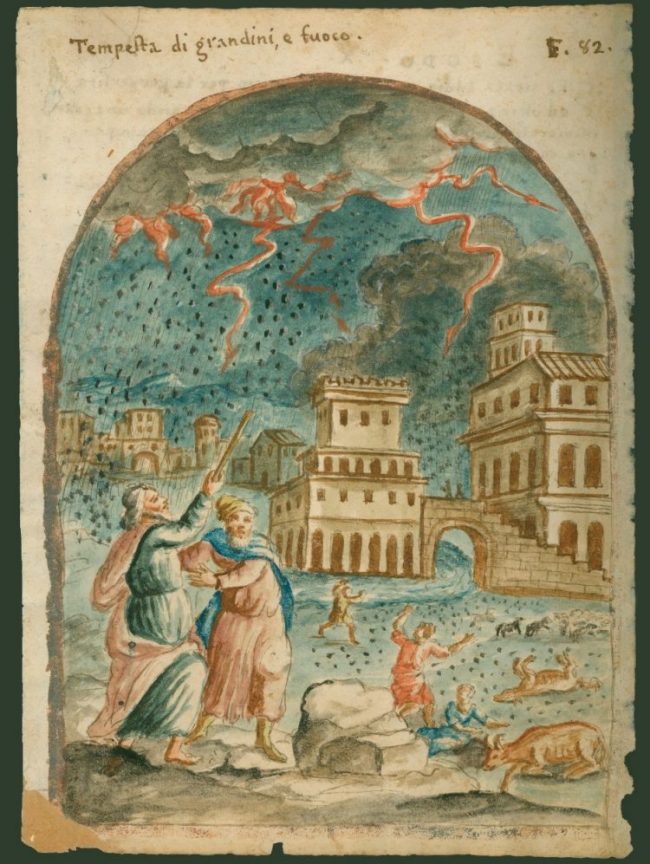
“Hailstorm Plague”. Page from Old Testament Bible manuscript, hand painted watercolor. N. Italian, c. 1650. Herbert Kraft Collection – MSS 0029. Courtesy of Archives and Special Collections. Source
The most famous case of hail was the one God promised to send to Egypt. God told Moses to visit Pharaoh and tell him-
Behold, about this time tomorrow, I will send a very heavy hail, such as has not been seen in Egypt from the day it was founded until now. 19So now, send word, bring your livestock and whatever you have in the field to safety. Every person and animal that is found in the field and is not brought home, when the hail comes down on them, will die. (Exodus 9:18-19).
And it was so. Even the trees were shredded, all the crops smashed, and any living still outside died.
“Throughout Egypt hail struck everything in the fields–both men and animals; it beat down everything growing in the fields and stripped every tree.” (Exodus 9:25)
Initially awed by God’s power, Pharaoh acknowledged that he had sinned. However when the rain and hail stopped, He sinned again. God specifically used a massive hailstorm to indicate His power over the earth, and to know that the earth is the LORD’S. Pharaoh did not acknowledge God’s sovereignty.
God has storehouses of hail (Job 38:22). It’s a metaphor. I don’t think there are barns in heaven with iced-up hail waiting to be unleashed (by angels? With shovels?) No, lol. But the metaphor is picturesque, something we finite humans can understand.
God uses hail to warn the unrepentant to come back to Him. “‘I smote you and every work of your hands with blasting wind, mildew and hail; yet you did not come back to Me,’ declares the LORD.” (Haggai 2:17).
He uses hail to render justice upon the wicked. “I will make justice the measuring line and righteousness the plumb line; hail will sweep away your refuge, the lie, and water will overflow your hiding place.” (Isaiah 28:17). In one example, the LORD hurled hail down onto the Amorites at Azekah, as a vengeance against the wicked. (Joshua 10:11)
God plans to use hail again in the future: “The great city was split into three parts, and the cities of the nations fell, and God remembered great Babylon, to make her drain the cup of the fury of his wrath. And every island fled away, and no mountains were to be found; and great hailstones, heavy as a hundred-weight, dropped on men from heaven, till men cursed God for the plague of the hail, so fearful was that plague.” (Revelation 16:18-21).
In today’s times we have weather forecasters alerting us to foul weather, and we can prepare. We board up the windows for a hurricane, put the cars in the garage for hail, and buy ice-melt for the coming blizzard. Imagine the shepherds in the fields, they did the best they could predicting the weather by looking at the signs in the sky (Matthew 16:3). But when severe hail began to fall, they had nowhere to run. Farmers mourned the loss of crops and animals. I’m sure that some might have died.
Terrible hail storms have always been and will be part of God’s language to an unrepentant and wicked people. But in today’s times we simply do not know that THIS hail storm was a judgment or THAT hailstorm was a warning or if it was just a collision of air masses. We do not have prophets explicitly telling us God’s mind and plans in these days but we do have the completed canon to look to for comfort over anxiety with coming bad weather or after a disaster.
Yahweh also thundered in the heavens, And the Most High gave forth His voice, Hailstones and coals of fire. (Psalm 18:13)
When or if a severe hailstorm happens near you, what we can do in these modern days is look to the sky and acknowledge God’s sovereign hand over the weather and humankind, and praise Him for His involvement in the world. It may be hard to do if your car is crushed or your flock has been killed, but all things work together for good for those who love God.













 the-end-time.org