Posted in encouragement

What about a Christian’s Weakness?

There’s weakness, and then there’s weakness. It depends on which kind you’re talking about.

Christian women are noted as the weaker vessel. (1 Peter 3:7). GotQuestions explains in this excerpt:

This is not a popular idea among many women or even many men. However, the Scripture tells us that the woman was deceived (1 Timothy 2:14), she is subject to her husband (1 Peter 3:1) and that she is a “weaker” vessel. That women are usually physically weaker is undeniable, but the implication of the fall is that by virtue of her being deceived by Satan, women may also sometimes be weaker in other ways. That definitely does not mean she is less valuable (Ephesians 1:6) or that she does not have equal access to grace (Galatians 3:28). 

As for Christian weakness in general, we’re all weak, we are supposed to be. Paul said that Jesus replied to him,

‘My grace is sufficient for you, for My power is perfected in weakness.’ Therefore I will boast all the more gladly in my weaknesses, so that the power of Christ may rest on me. That is why, for the sake of Christ, I delight in weaknesses, in insults, in hardships, in persecutions, in difficulties. For when I am weak, then I am strong. (2 Corinthians 12:9-10).

There’s weak because we’re laden with sin that makes us weak. That is one reason we strive not to sin. We pick up our cross daily and slay it. When we do sin, it’s important to address it by repenting to Jesus and making things right with theother person, if you had involved another person in your sin. Sin is one reason we become weak and ineffective.

There’s weak because we understand our depravity and seek the Spirit’s strength. There’s weak when we see how powerful Jesus is, and understand our own powerlessness in the face of His omnipotence. There’s physically weak, due to illness temporary or permanent.

In some cases, God gives us weakness. He gave to Paul a “thorn in the side” both to keep Paul humble, and to demonstrate that all we need is His grace (not our own strength). (2 Corinthians 12:7)

In America where I’m from, strength is valued. Strength, bravado, and self-sufficiency are nationally recognized attributes, idols, even. In addition, American Feminism has also contributed to a national consciousness that we woman are supposed to have it all together and be capable of all things at all times. “I can bring home the bacon AND fry it up in a pan” and so on.

The attributes of weakness, meekness, and humility aren’t as valued as they are in other nations. But it’s OK to be weak. It’s good. Why?

It’s God who strengthens us. I can do all things through him who strengthens me. (Philippians 4:13).

Wouldn’t you rather have His strength than your own strength, anyway? 🙂

~~~~~~~~~~~~~~~~~~~~~~~~~~

Further Reading

Here are a few resources on our weakness.

Desiring God: Don’t Waste Your Weakness

The End Time: Are you a weak woman, or are you a weak woman?

Grace To You blog post: God’s Sufficient Grace

Ligonier Devotional: Power in Weakness

Posted in encouragement, Uncategorized

The Sad Story of the Wind Phone

The lost are in the night, the cold, the outside. The lost are stumbling around, leading each other into a pit. They know not what they do. They dwell in a land of darkness with no hope.

For that reason, we can have compassion and pity.

This week I read an article that pulled at my heart strings. It was one of those articles that evoked pity, but also gratitude. I say gratitude because the Lord transferred me from the Kingdom of Darkness into His kingdom of Light. I have hope for an afterlife, the assurance of His more sure word on what is going to happen.

The phone of the wind. CC BY-SA 4.0

Wind Telephone
A disconnected rotary phone for “calling” lost loved ones offered a unique way of dealing with grief in disaster-stricken Japan.

When Itaru Sasaki lost his cousin in 2010, he decided to build a glass-paneled phone booth in his hilltop garden with a disconnected rotary phone inside for communicating with his lost relative, to help him deal with his grief.

Only a year later, Japan faced the horrors of a triple disaster: an earthquake followed by a tsunami, which caused a nuclear meltdown. Sasaki’s coastal hometown of Otsuchi was hit with 30-foot waves. Ten percent of the town died in the flood.

Sasaki opened his kaze no denwa or “wind phone” to the now huge number of people in the community mourning the loss of loved ones. Eventually, word spread and others experiencing grief made the pilgrimage from around the country. It is believed that 10,000 visitors journeyed to this hilltop outside Otsuchi within three years of the disaster.

The article goes on to assure the reader that the wind phone is meant to be used as a one-way communication. In other words, the people dialing the rotary dial and speaking their grief to the wind do not expect to hear anything in return at all. It’s just a symbol, a process, and an activity to help people feel more in control during their time of grief.

But we do not want you to be uninformed, brothers, about those who are asleep, that you may not grieve as others do who have no hope. (1 Thessalonians 4:13).

Not knowing about what happens after death is a number one issue for the unsaved. They might utter it, or they might never utter it, but we know that the gaping maw that is the great, unanswered question of eternity always lurks behind their thoughts. We know this because they are children of wrath (Ephesians 2:3) and the wrath abides on them all the time. (John 3:36). As Paul said, If our hope in Christ is for this life alone, we are to be pitied more than all men. (1 Corinthians 15:19).

We Christians have the assurance of a sinless, perfect afterlife with Jesus. We also have the promise of loving attention by a God who hears our prayers. (Psalm 34:15). We do not need a wind phone, we have the ear of the Almighty God! What praise there is in that! We are encouraged to take our supplications to Him, He hears us from His mighty temple. (Psalm 18:6).

Doesn’t it just tug your heart strings to see something like a wind phone atop a lonely hill in Japan? Doesn’t it pierce you, knowing the sadness and grief of the lost will not be salved? But doesn’t it also pierce you (as it does me) to have the ability to pray to the Holy One, and not? While the lost are installing phantom phones to whisper their grief into the wind, we are assured we have the ear of the High Priest at our disposal.

Pray more. Jesus is the God who sees and hears. He knows the voices of His sheep. Our griefs, supplications, petitions, cares, burdens, praises, and joys reach Him even though He is an unutterable distance away. But He is this close, too, inside us, knowing our sinews and heartbeats. He knows what we will ask before we ask it. He knows the need to be comforted even as we clasp our hands and open our mouth. He is great, attentive, wise, and concerned. Pray more. And tell the lost before they need a wind phone, that there is One who will listen, if they repent.

——————————————-

Further Reading

The Master’s Seminary: When an Unbeliever Dies: Offering Comfort without Distorting the Truth

Desiring God: How Do You Deal with the Death of an Unsaved Loved One?

Posted in encouragement, Uncategorized

David’s brave prayer

In Matthew 16:24-26 we read,

Then Jesus told his disciples, “If anyone would come after me, let him deny himself and take up his cross and follow me. 25 For whoever would save his life will lose it, but whoever loses his life for my sake will find it. 26 For what will it profit a man if he gains the whole world and forfeits his soul? Or what shall a man give in return for his soul?

We know that passage means we turn our back on the kingdom of darkness and everything it represents, including self-aggrandizement, self-absorption, selfishness, anything self, &etc. We know we are supposed to die to self. We know we are supposed to hold others in higher regard than ourselves. We know it is written that we should be willing to lay down our life for our friends.

It’s hard.

Very hard.

Oh, does the flesh rebel against this.

We read in Psalm 7:3-5, the following prayer by David.

O Lord my God, if I have done this,
if there is wrong in my hands,
if I have repaid my friend with evil
or plundered my enemy without cause,
let the enemy pursue my soul and overtake it,
and let him trample my life to the ground
and lay my glory in the dust.

In that section of the Psalm, David is saying that if he has violated his Godly principles and done evil to a friend, may the Lord crush him. He is saying that if he has done evil to an enemy without cause, may him be trampled to the ground without honor.

Barnes Notes explains,

repaid friend with evil – The meaning here is simply that if he were a guilty man, in the manner charged on him, he would be willing to be treated accordingly. He did not wish to screen himself from any just treatment; and if he had been guilty he would not complain even if he were cut off from the land of the living.

plundered enemy without cause – The allusion here is to the manner in which the vanquished were often treated in battle, when they were rode over by horses, or trampled by men into the dust. The idea of David is, that if he was guilty he would be willing that his enemy should triumph over him, should subdue him, should treat him with the utmost indignity and scorn.

No wonder David was a man after God’s own heart. It is a hard thing to pray. Because, God will do it.

Sometimes I try to pray this kind of prayer. The words stick in my throat. Or, as the words come out, I soften them. I am a weakling when it comes to the battle between myself and others. ‘Lay my glory in the dust’? I am far from mastering that.

Praise God for the Psalms. They are comforting yes, but they are convicting too. Lord, help me by giving me the strength to more deeply obey Your principles. As I take up my cross today and go down the dusty road, give me the strength to truly care for others beyond myself, in spite of myself, denying myself.

EPrata photo
Posted in encouragement, Uncategorized

Chris Powers: In This Is Love

Full of Eyes is a support-based ministry of exegetical art that creates still and moving images intended to point people to the beauty of God in the crucified and risen Son. All art and animations are done by Chris Powers. Powers’ goal is to help people see and savor the faith-strengthening, hope-instilling, love-kindling beauty of God in Christ. And he does this by creating free exegetical art in the form of pictures, animations, and discussion guides. His work is at http://patreon.com/, Youtube, and his website fullofeyes.com

———————————————–

In This Is Love.
Artist’s statement
By Chris Powers:

1 John 4:10, “In this is love, not that we have loved God, but that He loved us and sent His Son to be the propitiation for our sins.”

Today, from 9am to 3pm, Jesus–fully man and fully God–would swallow all of our death and hell and horror and hopelessness into Himself so that we could be drawn into eternal fellowship with God.

May we be given grace to know the love of Christ that surpasses knowledge and so be filled with all the fullness of God.

———————————————–

I wish you all a happy Good Friday. Because of Jesus’ life, death, and resurrection, our sins can be forgiven. We can be reconciled to God. Praise the Lamb!

And they shall mock him, and shall scourge him, and shall spit upon him, and shall kill him: and the third day he shall rise again. (Mark 10:34).

For as Jonah was three days and three nights in the whale’s belly; so shall the Son of man be three days and three nights in the heart of the earth. (Matthew 12:40)

Posted in encouragement, Uncategorized

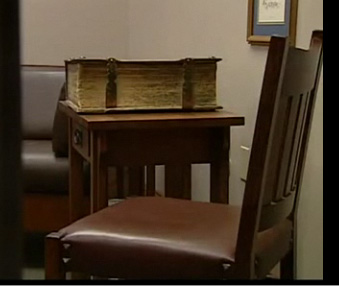
Throwback Thursday: 340 year old bible found, reminds me of Hilkiah’s finding the Law in the temple

This was first published in January, 2011 at The End Time

——————————–
Here is a small thing that is good and nice. It is a news piece out of Wisconsin, ripped from 2 Kings 22. First, the modern version:

“A centuries old relic has been discovered in a Bonduel (WI) church, tucked away for decades. No one realized it was even there, or what it was. In a cramped, rarely seen safe, no bigger than a kitchen pantry, at St. Paul Lutheran Church are heaps of old books and pamphlets. Many of which are more than 100 years old and in foreign languages. Most of the artifacts wouldn’t fetch a high price at auction, but represent the church’s nearly 150 year history and heritage. Now, one item kept there for an unknown length of time has taken the entire congregation by surprise. “This is an authentic 340-year-old Bible. We don’t know how we got it. We don’t know how it got into the safe. We’ve been asking some of our elderly folks and people in the nursing home and nobody seems to remember,” said Pastor Timothy Shoup.” source

How amazing! A beautiful original bible from over three centuries ago! How could they forget that it was there? Here is a bit more:

“A 340-year-old bible discovery can attest to the fact that they sure don’t make things like they used to. The German bible was discovered by a sixth grade teacher inside an old safe in a small Lutheran church school where she works in Bonduel, Wisconsin. “I was looking for the old baptism records to show my students and then up here in the corner was where the Bible was tucked,” explained Court, not realizing what a rare find she stumbled upon.”

Imagine, in a dusty closet of the church, lay the precious treasure, there all along but quite forgotten.

And a bit more:

“How the book ended up in Bonduel is still a mystery. But either way, Pastor Shoup says the 17th century discovery has brought him closer to his faith.”

How beautiful that the revealing of the Word caused the pastor such a sensitive and blessed reaction.  Did you know that the Old Testament records another, similar instance? I’m not making a huge doctrine out of it, I believe that the news spot out of Wisconsin is a nice event that happens more often than we know. But the similarities with the bible’s discovery and our Sunday School lesson focusing on Hilkiah, Huldah, and King Josiah was too sweet to ignore drawing some parallels. In Josiah’s reign, a long and evil, corrupt line of kingship was coming to an end. Josiah’s grandfather and father were terrible kings that did much evil in the eyes of the LORD and provoked the LORD greatly. His people had not only fallen away, had forgotten Him and His word, but they engaged in perverse and horrible worship practices to other gods. Finally came Josiah, a good king of Israel, was endeavoring to have the Temple repaired. As you can imagine, no one really used the Temple for real worship and had not for a very long time. Here is the biblical piece about it:

The Lost Book (2 Kings 22:8-11)

Then Hilkiah the high priest said to Shaphan the scribe, “I have found the book of the law in the house of the LORD.” And Hilkiah gave the book to Shaphan who read it. Shaphan the scribe came to the king and brought back word to the king and said, “Your servants have emptied out the money that was found in the house, and have delivered it into the hand of the workmen who have the oversight of the house of the LORD.” Moreover, Shaphan the scribe told the king saying, “Hilkiah the priest has given me a book.” And Shaphan read it in the presence of the king. When the king heard the words of the book of the law, he tore his clothes…”

As the workmen were moving furniture around and inventorying items, this book of the Law was found! Hilkiah the Priest wasn’t sure what exactly it was, and Shaphan the scribe wasn’t exactly sure, either! The two men, along with three others searched high and low at the king’s command, so they could inquire of the LORD. (2Kings 22:13) They found Huldah the Prophetess, who told them.

Huldah Predicts (2 Kings 22:14)

“So Hilkiah the priest, Ahikam, Achbor, Shaphan, and Asaiah went to Huldah the prophetess, the wife of Shallum the son of Tikvah, the son of Harhas, keeper of the wardrobe (now she lived in Jerusalem in the Second Quarter); and they spoke to her.”

Ahikam was Shaphan’s son, a helper. Achbor was an officer of Josiah, as was Asaiah. Shaphan was a scribe of King Josiah. It is shame and a testament on the men that though they held lofty positions in the religious hierarchy, none felt they had the ear of the LORD, and they went to find someone who did, ending up with Huldah. Huldah is named as “keeper of the wardrobe”, and wardrobe then is as it is now: a closet for storing clothes. 2 Kings 10:22 is another example of the keeper of the wardrobe: “And Jehu said to the keeper of the wardrobe, “Bring robes for all the ministers of Baal.” So he brought out robes for them.”

The small closet where the bible had been stored

Huldah was also a prophet. She told the men that the LORD said that since Josiah had been repentant and tender in his heart toward the LORD, the LORD would stay His wrath upon Judah until Josiah was laying peacefully in his grave.

It is interesting to note that the King’s faith deepened upon finding the Word. Tearing of clothes was an act that was meant to convey either great grief or great righteous indignation. The custom was also done as a symbolic removal of authority i.e. the tearing of a king’s royal robe. Here is a link to a short study on the biblical act of tearing of clothes, by Wayne Blank. Josiah was immediately convicted upon hearing the words of the LORD, and he tore his clothes. He sent out a search for a person who could relate the meaning of the words and help them come into obedience to them. It is also interesting to note that the Wisconsin Pastor’s faith deepened upon finding the word. Finding the precious treasure that is God’s word is always a blessing.

Josiah’s men found the Scriptures in an old wardrobe when doing routine repairs and inventory, and the School teacher found the word of the Lord while doing routine rummaging in a forgotten closet in search of old records. The LORD reveals Himself when and where He chooses, and at unexpected times!

I think about the bible itself, being twenty pounds. It’s huge! Someone carried that bible all the way from Germany across Europe, across the Atlantic Ocean, across half the American continent! Look at it, its size and heft. Yet, the Word of God meant so much to him that he took the trouble and expense to bring it with him , on horseback, in canoes, in ships, by hand…and protected it so well all along the way!

I hope that if you own several bibles, that none of them are laying on the back of the car window, fading as the sunlight drains the print away. I hope that your bible is meaningful to you and that it is used daily, lovingly, reverently. I hope that you do not travel so far away from the Word that you forget what it says and have trouble even finding a person who can relate its meaning to you.

The Wisconsin Pastor said of the find, “To hold something that tells us in 1670 the same message of God’s grace in Christ, that tell one another other today helps me be even more thankful.” Yes, the best lesson out of all of this is God’s word is eternal! (Mt 24:35)
Posted in encouragement, Uncategorized

O to see ourselves as others see us! Or maybe not…

Robert Burns was a Scottish poet who lived in the second half of the 1700s. You might know his work from singing Auld Lang Syne on New Year’s Eve, or “my love is like a red, red rose.” Holden Caulfield famously misquoted Burns’ poem Coming’ Thro the Rye as Catcher in the Rye.

Another famous poem Burns wrote is “To A Louse.” Many people don’t know the title nor the context of the poem, but they remember the most famous line:

O would some Power with vision teach us
To see ourselves as others see us!

The context is that Burns was attending church service one Sunday, sitting behind a lovely young

Vintage-Lady-Easter-Bonnet-GraphicsFairy2
source thegraphicsfairy.com

lady dressed in all her finery. His attention drifted from the sermon to the lady’s hat and ribbons, as Burns became captivated with watching a louse (plural, lice) wander indiscriminately through her hear, hat, and ribbons.

The bulk of the poem is wryly suggesting that the louse go off to fine more customary living grounds, perhaps a housewife’s flannel tie, or maybe on some ragged boy’s pale undervest. But on a lady’s bonnet? Surely you jest!

The lady had dressed in all her finery and frippery that morning, and had traveled to church to see and be seen in it. She was sitting in the pew, with gloves and best dress, scrubbed and looking splendid. She was, of course, completely unaware that a louse was traversing her elaborately coiffed curls. She thought she was looking good. The man sitting behind her saw the louse that she could not. The embarrassing pestilential creature ruined the entire carefully crafted public presentation the lady had no doubt taken many pains to complete.

Burns’ finals stanza with the pertinent line, To see oursels as ithers see us! is a plea which has been heard.

1. The Lord see sees us as Burns saw the lady, except worse. He sees us as we are. He sees the metaphysical lice crawling all over us, which are the sins we preform, traversing our body like the “hair fly”. He sees the rubbish as Paul would say, the dung clinging to us in our natural state. He loved us anyway.

2. He allows us to see ourselves as He sees us, thorough the written word. The Bible is a reflection of us, in our sin and depravity, and it is a reflection of Him, in His glory and power. We see ourselves as He sees us when we go into a woman who is another man’s wife, as David did. When we murder Christians because we are a religious zealot in a false religion, as Paul was. He shows us our lice ridden selves when Peter denied Christ to save himself in his own cowardice. In Cain who murdered, in Eli who was complicit in blasphemy, in Abraham who lied.

When we do see ourselves as He sees us, we cry out, O! It is too much! I cannot stand it! I am too corrupt! perverted! deviant! degenerate! debased! immoral! unprincipled!

In truth, the lice are actually better than the natural man, ‘For the creation was subjected to futility, not willingly’ (Romans 8:20a) but Adam chose to Fall.

As we would crumble into instant dust if in the natural we saw God’s glory, we also would crumble if we saw ourselves as truly depraved as we are. Sinners, all. The Bible reveals it, confirms it, shows it so any who care to look.

The cross is the place where depravity met glory. He loved us so much, He sent His Son, to live, teach, and die for sinners, who are in truth no better than the louse on the lady’s hair, though we try to dress up. With every heartbeat, love flowed through His veins.

Lord, thank you for opening your veins and sharing Your love with us.

During this week upcoming to Resurrection Sunday, please be in prayer to thank the Lord for shielding us from the true depths of our own depravity and from the true heights of Your glory, both of which if we saw in the natural, we would instantly die. And yet because of the cross, we live.

Posted in encouragement, Uncategorized

New England’s mission drift

I saw a series of unrelated tweets and Facebook statuses which got me thinking about New England…again.

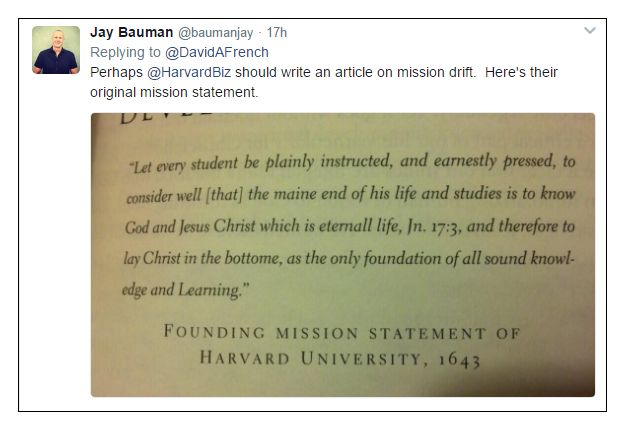
Here is the first tweet:

When Christ came to America, it was to a region later known as New England. In 1620 the Pilgrims actually landed at Provincetown, not Plymouth. They anchored and took 2 weeks to long-boat around the area to scout a suitable harbor and final settling spot. That ended up being Plymouth, and they later expanded outward to Boston and Cambridge.

The Puritans later spanned out across the region, bringing Jesus with them. The reason they left Holland and England was to find a place where they could worship in peace, and they came to the new world to do so. The fire was in their belly and Jesus was in their heart and evangelism was on their mind. With that, by 1636 they had begun a College, established for the express purpose of educating young men in Christian ways and doctrine, so as to become godly leaders of families and good witnesses to the natives for His name. That University was Harvard. Princeton and Yale soon followed.

Wikipedia has the origins of Harvard:

With some 17,000 Puritans migrating to New England by 1636, Harvard was founded in anticipation of the need for training clergy for the new commonwealth, a “church in the wilderness.” Harvard was formed in 1636 by vote of the Great and General Court of the Massachusetts Bay Colony. It was initially called “New College” or “the college at New Towne”. In 1638 the school received a printing press‍—‌the only press in North America until Harvard acquired a second in 1659.

In 1639, the college was renamed Harvard College after clergyman John Harvard, a University of Cambridge alumnus who had willed the new school £779 pounds sterling and (perhaps more importantly) his library of some 400 books

New Light Presbyterians founded the College of New Jersey, later Princeton University, in 1746 in order to train ministers dedicated to their views.

Yale was founded in 1701 in Saybrook Colony to train Congregationalist ministers.

New England was ground zero for religious evangelism and training, but by 2017, the original mission has drifted off center by miles. New England is he most ‘godless’ section of this nation

Back to Harvard. Its original mission and motto was:

Harvard’s “Rules and Precepts,” adopted in 1646, stated (original spelling and Scriptural references retained):

Let every Student be plainly instructed, and earnestly pressed to consider well, the maine end of his life and studies is, to know God and Jesus Christ which is eternal life (John 17:3) and therefore to lay Christ in the bottome, as the only foundation of all sound knowledge and Learning. And seeing the Lord only giveth wisedome, Let every one seriously set himself by prayer in secret to seeke it of him (Prov. 2:3).

Every one shall so exercise himselfe in reading the Scriptures twice a day, that he shall be ready to give such an account of his proficiency therein, both in Theoreticall observations of Language and Logick, and in practical and spiritual truths, as his Tutor shall require, according to his ability; seeing the entrance of the word giveth light, it giveth understanding to the simple (Psalm 119:130).

The motto of the University adopted in 1692 was “Veritas Christo et Ecclesiae” which translated from Latin means “Truth for Christ and the Church.

Yet today (well actually in 2015) according to a major new Pew Study as reported in the LA Times,

The U.S. has become notably less Christian in the last few years, but the shift has come unevenly, with New England and the Pacific Northwest at the leading edge of the social transformation and the South holding fast to more traditional religious beliefs.
Among the 10 states with the largest percentage of adults who profess no religion, New England has four — Maine, New Hampshire, Vermont and Massachusetts — and the other six are in the West, according to a major new study by the Pew Research Center.

Which is all very sad, but not surprising. After the first wave of original apostles, do we hear much about the churches there? Is there a church at Sardis? Corinth? By the time John was an aged man, Jesus gave the Revelation to him and several of the 7 churches in Asia Minor received no commendation from Jesus at all. They were charged with coasting on reputation, having their love for Him gone cold, of allowing false prophetesses to flourish uncorrected, and worse. And that was just within the lifespan of one apostle. After nearly three hundred years, of course if left unchecked, or if compromise had proceeded unaddressed, the churches of New England would falter and die.

Here are some interesting articles about New England’s decline in fervor for Jesus.

Harvard, Yale, Princeton, Oxford—Once Christian?

Most of the colleges in the United States that started over 300 years ago were Bible-proclaiming schools originally. Harvard and Yale (originally Puritan) and Princeton (originally Presbyterian) once had rich Christian histories…

Harvard was named after a Christian minister. Yale was started by clergymen, and Princeton’s first year of class was taught by Reverend Jonathan Dickinson. Princeton’s crest still says “Dei sub numine viget,” which is Latin for “Under God she flourishes.”

The cracks first appeared in the late 1700s and early 1800s, culminating with the influence of Charles Lyell’s three volumes of Principles of Geology in the 1830s. Belief in an old-earth seriously wounded widespread acceptance of the Flood and the biblical chronology, and Lyell just “finished off the victim and nailed the coffin shut,” as AiG historian Dr. Terry Mortenson says.

This old-earth belief permeated universities by the mid 1800s, setting the stage for Darwin’s evolutionary model in 1859 (Origin of Species) and his later work on human evolution The Descent of Man (1871), both of which required long ages. After Christian universities adopted these compromises, the slide from biblical Christianity to naturalism soon followed.

The End Time, July 2014:

Mission New England, the city on a hill where the light has (almost) gone out

No matter where we are in the world, spiritual decline is inevitable. Fear not! The world hates Jesus. (John 15:18). No matter what the type of beginning a nation had, high or low, sacred or profane, all will fall. All parts of all nations will fall. Satan is working mightily to try and overthrow heaven’s gates. The areas we hold dear, where we grew up, or where we live now, will some day be renewed! Every Christian who dwells in the places that are so dark now, will cry with joy when the Light comes. Jesus will revive every ember, bursting into glory light of pure and holy truth.
Until then, pray for New England.

Nate Pickowicz wrote a good book called Reviving New England. Google Books has more

At one time in history, New England was a light to the nations. From its origination, the Northeast region has been a spiritual powerhouse, leading the way for Christianity to flourish in America and beyond. However, after three centuries of vibrant Christian influence, it encountered a perfect storm comprised of false doctrine, liberalism, and materialism, which crippled the church, and plunged the region into spiritual darkness. In Reviving New England, Nate Pickowicz makes a case for the inestimable value of the region, and offers a series of biblical prescriptions for faithfulness. Revival is desperately needed-a mighty work of the Spirit of God to stir the hearts of the people. Now, more than ever, the church must devote herself to the Lord. Not only will the reader be encouraged and spurred on, but Reviving New England offers plausible steps for churches to rededicate themselves, be revitalized, or be planted anew. This is a passionate call to action! (Endorsed by: Mike Abendroth, Hershael York, Dave Jenkins, Todd Friel, Scott Christensen, Terry Wragg, Jimmy Snowden, Ves Sheely)

Whatever your mission statement is or was, whether it was in your church plant, your foreign mission field, your seminary studies, your New Year’s resolution, whatever it was, cherish your mission statement. Be aware of compromises that cause a drift from Christ. Be wary of making decisions that are founded on something other than Jesus and His cross. Be mindful of letting your love grow cold as you seek man’s approval. Mission drift is going to happen. (Revelation 2:4, Revelation 2:14-15, Revelation 2:20, Revelation 3:1, Revelation 3:16, Galatians 1:6, 2 Corinthians 11:4…)

Pray strongly. Stay with Christ. Cling.

Posted in encouragement, Uncategorized

Salvation shall never pass away: art by Chris Powers

Full of Eyes is a support-based ministry of exegetical art that creates still and moving images intended to point people to the beauty of God in the crucified and risen Son. All art and animations are done by Chris Powers. Powers’ goal is to help people see and savor the faith-strengthening, hope-instilling, love-kindling beauty of God in Christ. And he does this by creating free exegetical art in the form of pictures, animations, and discussion guides. His work is at Patreon.com, Youtube, and his website fullofeyes.com

My Salvation Will Be Forever

Isaiah 51:6, “Lift up your eyes to the heavens, and look to the earth beneath; for the heavens vanish like smoke, the earth will wear out like a garment, and they who dwell in it will die in like manner, but my salvation will be forever, and my righteousness will never be dismayed.”

This is one of those simple and yet profoundly beautiful and paradigmatic truths–the vastness and solidity of the heavens will pass away like smoke in the wind, and the depth and strength of the earth will wear out like the knees in my blue jeans. We live in a world of mist. As Paul said, everything that we see around us is transient (2 Cor.4:17-18). And God calls us to remember this, indeed, here in Isaiah the reason for looking at the heavens and earth is precisely to remember that they will not remain. YHWH intends for us to live with the ever present recognition that the world around us is not eternal, it is not forever, it will not always be as it is now, it is passing away.

But….the salvation of YHWH, the righteousness of YHWH–this is everlasting (because He is everlasting), this is sure, this is unshakable and will never pass away.

Oh, to get this into our heads and hearts and imaginations! The world is a tossing surf of change and uncertainty, but the strong rock of YHWH’s Name and Character and of the salvation He works for His people–that is where our hope is to be found, that is where we are to cling and hold and hide and hope. And note also that if the Lord’s salvation is forever, the implication is that those who are saved by this salvation will, in some way, be forever also. This is not a fully developed doctrine of the resurrection and eternal state of new creation (though I think that Isaiah does think in those categories), but it certainly hints in that direction.

And how will the Lord work this everlasting salvation? How will He reveal this never-dismayed righteousness? Through the Suffering Servant, through the gospel of the glory of Christ who is the image of God, the gospel that is the power of God unto salvation to all who believe because in it the righteousness of God is revealed. The surrounding passages in Isaiah introduce the Servant (50) and move into a foretelling of His suffering, death, and resurrection (52-53), this is how the eternal salvation of God breaks into the transient world of humanity…..And we cling to Him!…..we lay hold of this rock of salvation, this anchor of righteousness and are unmoved…….those who trust in YHWH–who trust in the crucified and risen Son–will sing songs of joy and see visions of beauty long ages after the sun has burned down and Everest has blown away in the wind.

Posted in encouragement, Uncategorized

Powers’ work in visual exegesis & Challies’ book “Visual Theology” come with study guides

Even at the beginning, when God ordered the Israelite craftsmen to build the tabernacle, He instructed the men to create objects that were not merely functional, but beautiful. Some of the items were not functional at all, but solely for beauty’s sake. Most people enjoy things that are more beautiful rather than less beautiful. Since then, people created beautiful things dedicated to God through paintings, drawings, or sculptures intended to honor Him by beautifying their church. The beautiful theological visual is not an oxymoron, nor it is unorthodox. Here is RC Sproul on beauty as one of the legs of the stool we include as foundational to faith, in his essay For Glory and Beauty

The Christian faith is like a stool with three legs, but we have a tendency to make our stools with only one or two legs. The three legs that properly belong to the Christian faith, the three elements of the faith, are the good, the true, and the beautiful. It is obvious that God is concerned about goodness, for He is the fountainhead of everything that is good (Gen. 1:31; James 1:17). As His people, we are called to mirror and reflect who He is, which means we are called to reflect the good. Likewise, God is deeply concerned about truth, for He is Himself the essence of truth (Isa. 65:16; John 14:6). Therefore, we are to be people who love and practice truth. Finally, as we have seen, God is highly concerned about that which is beautiful. As we read and study the Scriptures, we have to come to the conclusion that there is an ultimate source of beauty — the character of God. Just as the normative standard for goodness and truth is God, so the ultimate standard of beauty is God, and He is very interested in beauty in His creation.

John Bunyan is credited with making the first visual theological chart, his Ordo Salutis. In today’s time, there have recently been two books published which explore visual theology.

Chris Powers’ book Visual Exegesis, Vol. 1; and Tim Challies’/Josh Byers’ Visual Theology. As Justin Taylor said in his review of the Byers/Challies’ book,

Most theology books merely convey what we are to believe, but this one uses creative and beautiful design to capture and portray these crucial truths.

By themselves, both these books are worth your time. However what I wanted to point out also is that the Challies book comes with an 80-page study guide. And many of Powers’ animations as well as all his still pieces also come with written guides and explanations from scripture, which you can find at his site fullofeyes.com. The pictures plus the study guides, make these books valuable group teaching tools as well insightful as for individual learning.

As Chris Powers explains,

Imagery will always be secondary when it comes to declaring the glory of God in Christ, and so I want to make an explicit link between the imagery I am sharing and the words of scripture from which they spring

Westminster Books is offering until April 7, 2017, a free printed study guide with each purchased book Visual Theology ($11). If you miss the deal, or already own the book, you can download the Visual Theology Study Guide for free, here.

Posted in encouragement, Uncategorized

Behold the Works!

On Sunday, our pastor was preaching through Galatians 5. Paul is reminding the Galatians about the grace that saved them, and how they have fallen away from it by adding works (of the Law-circumcision). Our pastor spent some time dwelling on this.

Galatians 5:2-6:

Look: I, Paul, say to you that if you accept circumcision, Christ will be of no advantage to you. 3 I testify again to every man who accepts circumcision that he is obligated to keep the whole law. 4 You are severed from Christ, you who would be justified by the law; you have fallen away from grace. 5 For through the Spirit, by faith, we ourselves eagerly wait for the hope of righteousness. 6 For in Christ Jesus neither circumcision nor uncircumcision counts for anything, but only faith working through love.

At one point he was talking of how we must remember how utterly depraved we are in the sight of Jesus. Our sins are dirty, polluted, corrupted and our sins dirty, pollute and corrupt everything and anything we try to do for Jesus, unless we are saved by Grace. Even if we try to preach that salvation is grace PLUS works, it is still a dirty doing. People think they can be saved by works, or add works to grace, because they forget just how holy Jesus is, and how filthy we are. The Galatians certainly did.

Our pastor said it’s like a master artist, who had painted a glorious masterpiece, and someone came along and added to it. Someone thinks, “Let me just add to this…” and wrongly believes that Jesus will accept or even needs our help. How could we even possibly believe that even one atom of our help could be added to a work of Jesus and not immediately pollute it?

When he said that, it reminded me of the very real event that had occurred a few years ago in Spain. What happens when you have an old church, an elderly woman, and a fresco that needs restoring?

An elderly woman has unintentionally destroyed a valuable piece of artwork after she decided to ‘restore’ the painting herself. The painting was a 19th century Spanish fresco titled “Ecce Homo” by painter Elias Garcia Martinez. It was donated to the Centro de Estudios Borjanos in Borja, Spain, by the painter’s granddaughter, according to the Telegraph. The centro reportedly holds an extensive archive of regional religious paintings. The woman, a neighbor of the church reportedly in her 80s, thought she would save the church both time and money by restoring the painting herself. The Telegraph described the restoration as, “a botched repair where the intricate brush strokes of Martinez were replaced with a haphazard splattering of the octogenarian’s paint. Years of carefully calculated depth of expression simply washed out by copious amounts of red and brown.” (source)

Cecilia Ginenez, the octogenarian aforementioned, truly was sincere in her attempts to “help” the painting. She was not out to ruin it. But she thought more highly of her ability and works than she ought. And so, her results made the painting worse for the wear.

Three versions of Ecce Homo: left, the original version;
center, the deteriorated fresco; right, the attempted restoration by Cecilia Giménez

Wikipedia describes the event:

The Ecce Homo (Behold the Man) in the Sanctuary of Mercy church in Borja, Spain, is a fresco painted circa 1930 by the Spanish painter Elías García Martínez depicting Jesus crowned with thorns. …[I]ts fame derives from a good faith attempt to restore the fresco by Cecilia Giménez, an untrained elderly amateur, in 2012. The intervention reinterpreted the painting and made it look similar to a monkey, and for this reason it is sometimes known as Ecce Mono (Behold the Monkey).

No…we are saved by glorious grace alone. We do not add works to our salvation as part of the initial justification event. Afterward, of course, while we are being sanctified, we work for Jesus because we obey Him, we love Him, and we are grateful to Him. But before justification, our works are nothing but filthy rags, rubbish, dung, and counts for nothing toward righteousness. What a relief that Jesus does it ALL. Otherwise, take heed, or you will Behold the Monkey!

—————————————–
Further Reading:

What Role do Works have in Salvation?

Is Salvation by Faith Alone, or faith plus works?

Are we saved by faith alone, or do we need works, too?