Posted in encouragement, Uncategorized

Who was Asaph?

We read the Psalms and think of David. Slayer of giants, musician, singer, King, David was a man after God’s own heart. He was multi-talented and wrote many of the Psalms, which are songs. But did you know that David wrote only half of the Psalms? Solomon, David’s son and successor wrote 2 of them. Moses is assigned authorship of Psalm 90, a prayer. The sons of Korah wrote 11 psalms while Psalm 88’s authorship is attributed to Heman, and one is assigned to Ethan the Ezrahite.

Another group of 21 psalms is ascribed to the Asaph and his descendants. Asaph is assigned authorship of Psalms 50 and 73-83. So, who was Asaph?

Asaph was a Levite music leader, leading the Tabernacle choir. (1 Chronicles 6:33, 39). His name means “to gather together” which is a great name for a congregational music leader. He is mentioned along with David as skilled in music, and of course not only did he write songs and play instruments but he was also a skilled singer. Interestingly, Asaph is also a seer, (2 Chronicles 29:30) which is a prophet who sees visions.

SEER (chozeh). Generally synonymous with the role of the prophet (e.g., 2 Sam 24:11; 1 Chr 21:9; Amos 7:12). However, at times, it is used as a distinct term from that of prophet (2 Kgs 17:13). Seer, by connotation of the Hebrew word affiliated with it being connected to the idea of receiving a vision (חֹזֶה, chozeh), may be more connected to the idea of visions than the prophetic word, although this is not necessarily the case in all usages. Barry, J. D. (2016). Seer. The Lexham Bible Dictionary. Bellingham, WA: Lexham Press.

In Psalm 73, of Asaph, we read that the author was angry and discontent with the sleekness and seeming prosperity of the wicked. He mourned their health and prosperity, and wondered if his own efforts at a narrow walk and holiness were in vain. Then comes the turning point of the Psalm at verse 16-17-

But when I thought how to understand this,
it seemed to me a wearisome task,
until I went into the sanctuary of God;
then I discerned their end
. (Psalm 73:16-17).

It is this way with us. Until you enter the prayer closet, or the sanctuary, and inquire of God, you will be disgruntled. Communing with God in prayer or song relieves the stormy heart and soothes the troubled mind.

We’re grateful that the Spirit inspired the Psalms and included them in the Bible for us to be refreshed by. We see that the human condition of faltering, wondering, coveting the wicked’s prosperous way are not new. We see also that our faithful God is always there, and can and does comfort us. As Asaph ended his Psalm,

For behold, those who are far from you shall perish;
you put an end to everyone who is unfaithful to you.
28But for me it is good to be near God;
I have made the Lord GOD my refuge,
that I may tell of all your works
.

Let us tell of Jesus’ works today.

old harp singing
EPrata photo

Posted in encouragement, Uncategorized

His Mercy is More

Our music leader introduced a new-to-us song this past Sunday. This is a new-ish contemporary hymn written by Matt Papa and Matt Boswell. I loved it. I am not a fan of new music, not because it is new, but because it is theologically light, theologically aberrant, or too hard to sing congregationally. The Boswell/Papa duo write songs that are the opposite of those negatives. This is one of the good new songs.

I positively like this song. I commend it to you.

Have a merciful day!

Live recording of “His Mercy is More”, a powerful new congregational worship song by Matt Boswell and Matt Papa. Filmed and recorded live at Providence Church in Frisco, Texas with worship leader Matt Boswell and Boyce College Choir.


VERSE 1
What love could remember no wrongs we have done
Omniscient, all knowing, He counts not their sum
Thrown into a sea without bottom or shore
Our sins they are many, His mercy is more

VERSE 2
What patience would wait as we constantly roam
What Father, so tender, is calling us home
He welcomes the weakest, the vilest, the poor
Our sins they are many, His mercy is more

VERSE 3
What riches of kindness he lavished on us
His blood was the payment, His life was the cost
We stood ‘neath a debt we could never afford
Our sins they are many, His mercy is more

CHORUS
Praise the Lord
His mercy is more
Stronger than darkness, new every morn
Our sins they are many, His mercy is more

Posted in encouragement, Uncategorized

The House on the Rock

The Ocean State is aptly named Growing up in Rhode Island in the 1960s was a fun experience. The nation’s smallest state is beautiful and the ocean and bay is never far from anyone who lives there. We happened to live just a few miles from the ocean and most Sundays we took a drive south to Saunderstown, crossed the Jamestown bridge, and then took the ferry to Newport. Dad would drive us around the island on Ocean Drive past all the mansions, and then we’d have a picnic by the sea at the Park.

There was no Newport Bridge at that time. On the bridge and the ferry, we passed boats, the islands with lighthouses, and other sights. One sight always captured my attention.

Clingstone.

Clingstone
Source. CC BY-SA 4.0

Clingstone is a house built in 1905, perched atop a small, rocky island in an island group called “The Dumplings” in Narragansett Bay, near Jamestown, Rhode Island. It withstood the devastating 1938 Hurricane, (though was damaged) faced other hurricanes, storms, decay, renovation, and more. The house is known by locals as “The House on a Rock”.

Even to my young eyes the house looked strong. I mean, it’s built on a rock! I often wondered what it was like to live there.

I don’t have to wonder any more what it is like to build my house on the rock. In His grace, He saved me and taught me to cling to the rock. I have my own Clingstone now. Isn’t it funny how life goes. Jesus, who was so far from my mind for over 40 years, is my All in All now. The little girl with big eyes looking at the House on a Rock, has one of her own now.

The verses below are familiar but please slow yourself and read them carefully. Then really think about it for a minute, before you go on to other things. The verses are soul-soothing. Be encouraged.

Everyone then who hears these words of mine and does them will be like a wise man who built his house on the rock. 25And the rain fell, and the floods came, and the winds blew and beat on that house, but it did not fall, because it had been founded on the rock. (Matthew 7:24-25).

Posted in encouragement, Uncategorized

What Does Prayer Do?

Sometimes we pray and we feel energized and sense that the presence of the Lord is close by. Other times, we feel dry and cracked, parched. We feel that the Lord is distant.

He is always near, of course. (Psalm 145:168). How we feel about it or what we sense doesn’t matter much and doesn’t alter the fact that He is always near. (Psalm 34:18, Matthew 28:20).

However sometimes these feelings do tend to color and tinge our communion with Him. We’re human. That means we’re sinful and we have an inclination to follow our deceitful heart with its emotions, rather than in trust and knowledge of the faith in God and His promises.

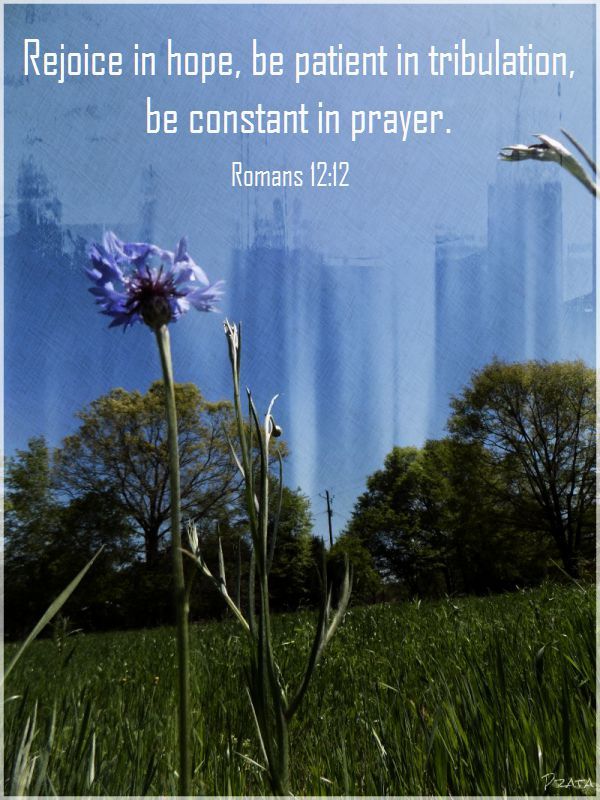
rejoice in hope prayer

What does prayer do, actually? Whether we feel Him near or whether we don’t, prayer is prayer and it avails much when uttered from a righteous man. (James 5:16).

1. Prayer combats discouragement.

The conclusion is clear: therefore confess your sins to each other and pray for each other. A mutual concern for one another is the way to combat discouragement and downfall. The cure is in personal confession and prayerful concern. Source: The Bible Knowledge Commentary: An Exposition of the Scriptures

2. Prayer gives strength both spiritual and sometimes physical.

In times of affliction Christians are to pray to God for help and strength. In times of blessing believers are to praise God instead of congratulating themselves (5:13b). In instances of critical sickness the sick person was to summon the leaders of the church for prayer. Prayer for the sick could result in either physical healing or spiritual blessing. In times of sin and struggle mutual intercession could promote spiritual victory. Elijah prayed with such force that God withheld rain from the earth for three and a half years and gave it again at his request. Source: Holman concise Bible commentary

3. Prayer gives us good gifts.

Don’t shrink from this. We are told we have a Father who gives good gifts to His children. (Matthew 7:11). If we do not have good gifts it is because we do not ask. (James 4:2b).
Spurgeon spoke eloquently of Achsah, daughter of Caleb, who asked.

She was newly-married and she had an estate to go with her to her husband. She naturally wished that her husband should find in that estate all that was convenient and all that might be profitable. And looking it all over, she saw what was needed. Before you pray, know what you are needing. That man, who blunders down on his knees, with nothing in his mind, will blunder up, again, and get nothing for his pains. When this young woman goes to her father to ask for something, she knows what she is going to ask. She will not open her mouth till first her heart has been filled with knowledge as to what she requires.

4. Prayer is part of the process the Spirit uses to transform our minds. (Romans 12:2). People can externally exhibit morality as if they’d put it on as a garment, without having their minds transformed as the mind of Christ. The new creation is not just a new soul, but a new mind so that we can think in righteousness and in truth. Prayer helps this transformation along.

What then do we do in obedience to Romans 12:2, “Be transformed in the renewal of your mind”? We join the Holy Spirit in his precious and all-important work. We pursue Christ-exalting truth and we pray for truth-embracing humility. … And form the habit of meditating on the perfections of Christ. And in it all pray, pray, pray that the Holy Spirit will renew your mind, Piper, The Renewed Mind

5. Prayer nourishes us.

Prayer is the way that the life of God in us is nourished. Our common ideas regarding prayer are not found in the New Testament. We look upon prayer simply as a means of getting things for ourselves, but the biblical purpose of prayer is that we may get to know God Himself. Oswald Chambers, The Purpose of Prayer

6. Prayer is a love offering to Christ.

“But” someone says, “I don’t feel that I have any special things to pray about.” Ah! My dear friend, I don’t know who you are, or where you live, to not have any thing to pray about, for I find that every day brings either a need or trouble, and that I have every day something to ask of my God. But if we still insist that have no troubles, that we have attained to such a level of grace that we have nothing to ask for, then I ask, do we love Christ so much that we have no need to pray that we may love him more? Spurgeon, True Prayer-True Power

Of course there are many, many more ways that prayer works in us, in our lives, and as a method of communion with God. What are some ways you can think of?

————————————————-

Further resources:

The Hidden Life of Prayer, free online book by David MacIntyre (1859-1938)

The Hidden Life of Prayer PLUS study guide and 8-week free course

4-part Sermon series, John MacArthur, Elements of True Prayer

Valley of Vision, excerpt from

The Prayer of Love
Grant me more and more
to prize the privilege of prayer,
to come to thee as a sin-soiled sinner,
to find pardon in thee,
to converse with thee;
to know thee in prayer as
the path in which my feet tread,
the latch upon the door of my lips,
the light that shines through my eyes,
the music of my ears,
the marrow of my understanding,
the strength of my will,
the power of my affection,
the sweetness of my memory.

Posted in encouragement, Uncategorized

Husband feels the call to pastor, wife is reluctant

The gift from Jesus of a Godly husband is one that is among the highest in all of Christendom. I was reading the 9Marks Mailbag, where people send in questions to that ministry and receive answers online. The questions are related to church polity, the main issue the ministry deals with.

In this question, a Christian man who teaches and leads many ministries in his church feels the call to be a pastor. Others have confirmed he has the gift. However the man’s wife is resistant. The man wrote to 9Marks on how to deal with a call to pastoring in your life but a reluctant wife in your home.

9Marks’ answer is passionately loving and scriptural. I hope it encourages you, if you are a wife. Jesus sent your husband to you as a shepherd and a guide and a leader. This is the example to which husbands aspire, for you good and on your behalf. Encourage your husband today.

In turn, if your husband feels the call to change your lives to fulfill a ministry to which you feel reluctant, whether it entails a move, or more selfless service, or being a missionary, etc, please examine whether your reluctance is originating from a selfish seed in the heart, or a true opposition to something where you don’t feel the pull. You’re a help-meet, which means either helping your husband adjust to his new ministry, or helping your husband be a husband by doing what the 9Marks essay advises…

Life isn’t easy. Married life is doubly hard. However with the advice in the Bible, prayer, and the Holy Spirit’s guidance, your marriage can be a shining light of vice-versa service and humility, in Jesus’ name.

wedding verse

Dear 9Marks,

I have a desire to serve as a pastor. I have been afforded opportunities to teach in my church, to preach at other churches in the area, and even participate in a internship for aspiring pastors at my church. I meet the biblical qualifications including an inward desire and an outward confirmation from some of our elders and mature men in my church.

But here’s the problem: my wife doesn’t support me in becoming an elder. She is fearful for herself of being thrust into the spotlight, so to speak, and having any attention put on her. This has become a point of contention between us and I know I must sacrifice for her and love and pray for her. I’ve tried to reassure of some of her fears, but she doesn’t believe this will be the case. Admittedly I am frustrated and angry over what I perceive to be a calling from God and her unwillingness to support me. What advice can you give me to help love her and deal with her in a godly way?

—Troy

Dear Troy,

God is not calling you to be a pastor. If you don’t have your wife’s support, you are not called.

Or rather, he’s calling you to pastor your wife and only your wife. So, live with her in an understanding way. Cherish her as a weaker vessel and fellow heir. Wash her with the water of the word. Love her like you love your own body. Do not despise her. Do not nurse self-pity. Do not tell yourself that you are mature, and that she is immature, and that she is hindering you. God has purposes to work out in your life, too. Good ones! Do not tell yourself that she stands in between you and God’s big plans for you. She is God’s big plan for you. And what a remarkable plan she is, more than you deserve and better than anything you could have planned for yourself. God is good. God loves you. And he means to love you right now through the lessons and joys of pastoring her, and being loved by her. What a privilege you have!

Meanwhile, brother, share the gospel. Encourage younger people in the faith. Disciple. Pray for the church regularly. Take any teaching opportunities that she’s happy for you to take. You can pastor without being a pastor. The lack of a title is no threat to your identity. Your identity is secure in Christ. Your lack of a paycheck for being a pastor is no threat to the church. The church’s victory is certain.

One day, brother, Jesus will visibly walk into her life. You want her to recognize him because she’s spent years watching you. Your job is to get her ready for him. And he’s the one who put on the form of a servant and humbled himself to death on a cross in order to love you and her both. Will you love her like that?

Posted in encouragement, Uncategorized

Seeking Jesus: My experience with ‘life between lives’ hypnotherapy

Popular Christianity makes it seem like entering the Kingdom of God is easy. You float airy-fairy into it, light and happy and joyful and basking in love. The narrow road is lined with posies and helpful angels applaud your way in. Or, you raise your hand in the congregation, walk peacefully down the aisle, appear in front to sign a card, and you’re in.

That’s not how it was for me. And it’s not how it is for most, I don’t think. My entrance was full of anger, doubt, confusion, anxiety, fervency, seeking, and striving. I was dragged into it, a pawn in a spiritual battle with one side’s bony claw clutching at my clothes, doing anything and everything to keep me in darkness. The other side full of power and light and irresistible grace, which I tried to resist, but at the same time tried to understand and desired with all my being. Agony.

Here is John MacArthur on a seeker’s journey in Which Way to Heaven?

You must enter, you must enter the narrow gate, you must enter alone. Listen to this one: you must enter with great difficulty – with great difficulty. Now, I know that shocks some people, because we hear all the time that getting saved is easy. All you have to do is just believe, sign on the dotted line, walk the aisle, raise your hand, go to the prayer room, whatever. And we’ve made it easy.

In Luke 16:16, the Lord said, “Every man who comes into the Kingdom presses his way into the Kingdom.” Now, this is not what you hear, but this is what Jesus said. The Kingdom is to those who seek it with all their hearts. The Kingdom is to those who strive, who agonize to enter it, whose hearts are shattered over their sinfulness. Who mourn in meekness, who hunger and thirst, and unquenchably satisfied, long for God to change their life. It’s not for the people who come along in a cheap way and want Jesus without any alteration of their living. When Jesus emphasized that one cannot sleep his way into the kingdom, Jesus was saying, “In order to be in My Kingdom you must have earnest endeavor, untiring energy, utmost exertion.”

I knew there was a heaven. Too many cultures spoke of an afterlife to deny the internal, global human urge to accept that there’s an afterlife. So many people had reported after-death or near- death experiences with a white light, experiences that seemed likely to validate a continuation of life after death. I mean, if there wasn’t life after death, what was the point of life? Did we evolve only to live a mere 50 or 60 or 70 years then turn to dust for all eternity? It seemed incredibly inefficient.

God’s existence seemed obvious- the earth in its beauty and complexity didn’t form from a Big Bang and a void and tumble together perfectly so as to give life to forms in a delicate balance of perfect biology. It seemed like a pretty sure bet we possessed a soul. No, God existed.

But who was He? Where was His heaven? How do we get there? And my most burning question, what was the entry requirement? It’s also obvious that humanity is evil. We’re terrible. I never believed the cultural mantra that “we’re all basically good.” There is an entire human history showing that we’re not. Stalin, pogroms, Jew-hatred (which always perplexed me), tyrants, dictators, wars, genocide. And even close to home, thievery, adultery, lying, cheating, killing. No, people are bad. So if we go to heaven, what made it heaven? If we all just transfer to heaven, it’d be just like earth. That seemed inefficient, too.

Before salvation, we are all sinners, (Romans 3:23 Ecclesiastes 7:20) in bondage to our sin nature (2 Timothy 2:26, 2 Peter 2:19, Acts 8:23 (and loving the darkness because we love our sin. (John 3:19).

I had tried Wicca, other earth pagan religions, New Age, (I had my aura photographed Kirlian photography), Buddhism, and self-righteous attempts at goodness. Nothing worked. I felt trapped in what I called “my badness.” I did not grow up Christian, never had attended church, nor was I familiar with any of the Christian terms, like sin or repent. I just knew people were bad, I was bad, and I wanted to be good. Frustratingly, nothing I tried swung me to the good side, or if it did, I never seemed to be able to maintain it.

I had read a book called Journey of Souls by Dr Michael Newton. The book deals with the eternal questions, why are we here on Earth? Where we go after death? What will happen to me when I get there? The book presupposes that we have a soul and that it goes somewhere after death. It also presupposes that our soul comes back to earth in a reincarnation. But what about in between? Dr Newton seemed to have the answers.

Dr Newton realized through his research that people (under hypnosis) could recall what they were doing between lives, and decided to create a cottage industry of trained hypnotherapists to help people unearth their between states. I thought that submitting to such hypno-therapy would help me see what was what, celestial-soul wise. I made an appointment with a Newton-trained hypnotherapist in San Mateo, CA,and off I went. I’m from Maine, so this was quite a jaunt. Talk about placing all my marbles in one basket.

His office was normal, no crystals in sight or anything like that. I sat in a large recliner, and he gave me a type of intake interview. I’d wanted to find out what happened to our souls after death and before the next life. (I wasn’t sure I subscribed to the reincarnation theory, but I went with it for now). I forget exactly what he did to “put me under”, but under I went, deeply. I could sense the physical environment around me, and hear him asking questions and prodding, but my mind also enlivened itself with vivid visions and details of past lives.

Later, I realized that under hypnosis I was recalling details of past “lives” but none were “between lives” For example, in the 1800s I was a captain’s wife aboard a sailing ship, and I fell off and drowned. In another I was a farmer’s daughter in the Netherlands grinding wheat at a mill. Where was the insight into what happened BETWEEN lives? The soul journeys? As advertised?

life between lives

I have no idea where the details about past lives came from, as we all know we only live one, long, eternal life. I was never a medieval Netherlands farmer nor a whaling wife. No such thing, but my mind presented these lives (and others, I forget now) quite vividly. I was simply a sinner seeking eternal answers in all the wrong places.

I came out from under hypnosis in what felt like 5 minutes, but it had been five hours. He made a CD of all that was said and gave it to me to take home. I never listened to it.

The weekend wasn’t a washout, I visited San Francisco and enjoyed that. I saw the Golden Gate Bridge, ate at a great Asian restaurant, etc. But my seeking was not satisfied and my questions remained. I was in slavery to my sin and the only answer was casting myself upon Jesus, our Savior, who died for our sins and took my wrath unto Himself. I didn’t know that yet. I still thought I could “figure it out.” Entering the door through Him is the only way, and it’s narrow. Rattling my cage for answers only got me more questions.

No, it’s when you come to the brokenness, and the recognition that you of yourself cannot do it, then Christ pours into you grace upon grace to strengthen you for that necessary agonizing to enter it. In your brokenness, His power becomes your resource. You must enter, you must enter the narrow gate, you must enter alone, you must enter with difficulty, and next, you must enter naked. You can’t go through a turnstile with luggage. Have you ever noticed that?  It’s a mess; can’t do it.  It is the gate – watch it – of self-denial. It is not the gate that admits the superstars, who want to carry all their garbage in. It is a gate where you strip off all of self, and self-righteousness, and sin, and immorality, and everything. You unload it, or you don’t come through it. JMacArthur

Posted in encouragement, Uncategorized

The Plain of the Jordan, then and now

I love the old photos of the Holy Lands. Here we have a approximately 117 year old stereoscopic photo of a shepherd and a boy overlooking the plain of the Jordan. (Stereoscopic Images of the Middle East).

plain of the jordan

The caption from the book says,

‎We are looking southeast, across the northern end of the Dead Sea, six miles to the south, over the mountains east of the Jordan.

‎Yonder on the right we can see the head of the Dead Sea, and beyond it the long line of the hills of Moab. There is the Jordan, after its long wandering, finding rest in the sea. See the once fruitful plain of the Jordan with only stunted trees and bushes growing upon it. Do you notice where the plain rises, nearer us, into a higher plateau, over which a path runs? There stood the Old Testament city of Jericho. All that is left of it now are those ruined heaps, and those are later than the Jericho of the Old Testament. This part of an old aqueduct on which these men are resting was probably here in Christ’s time, as its foundation can be traced out over the plain to the site of the New Testament Jericho, on the extreme right of our view. To the left in the distance are the few buildings that make up modern Jericho.*

‎Vivid pictures of the past surge before our mental vision as we look out over this site of once proud cities. We see Old Jericho defying the attack of Joshua (Joshua 6:1); we see the collapse of those sturdy walls under the strongest assault history records (Joshua 6:3–20). We see Elijah and Elisha walking down yonder path toward the river, while by the banks of Jordan waits the fiery chariot that shall part them. Centuries later we see Jesus coming up to the gate of another Jericho, while blind Bartimeus cries out to him from the wayside, and eager Zaccheus looks down upon him from the sycamore tree.

‎*See “Traveling in the Holy Land through the Stereoscope,” by J.L. Hurlbut, D.D.

The plain of the Jordan figures is in several passages. Here is one,

Lot looked around and saw that the whole plain of the Jordan toward Zoar was well watered, like the garden of the Lord, like the land of Egypt. (This was before the Lord destroyed Sodom and Gomorrah.)So Lot chose for himself the whole plain of the Jordan and set out toward the east. The two men parted company: (Genesis 13:10-11 NIV).

That area was home to five cities of the plain, not just Sodom and Gomorrah. Admah and Zeboiim, and also of course Zoar (AKA Bela) to which Lot and his daughters fled when the brimstone came down on Sodom.

Though the plain is a sulfurous wasteland now, once it was grassy and watered like Eden’s garden. And once again it will be!

And wherever the river goes, every living creature that swarms will live, and there will be very many fish. For this water goes there, that the waters of the sea may become fresh; so everything will live where the river goes. Fishermen will stand beside the sea. From Engedi to Eneglaim it will be a place for the spreading of nets. Its fish will be of very many kinds, like the fish of the Great Sea. (Ezekiel 47:9-10).

Praise the Lord that what was once fresh and vibrant and living and beautiful, that now has become salty, dead, and barren, will once again be renewed. It will become “very good” again. (Genesis 1:31; 2:10-14)

Posted in encouragement, Uncategorized

Who else longed to look into the Gospel besides angels?

We’re familiar with the part of the verse that tells us that angels long to look into these things. The full context of that verse is pasted below, it’s from 1 Peter.

Apostle Peter, formerly Simon, formerly a fisherman, is nearing the end of his life. It’s about the early 60s and Peter had been a leader of the church. The elect to whom Peter addressed his letter were beginning to suffer persecution, and his letter, which was to be circulated, was aimed at encouraging them. Peter strongly urges them to link doctrine and practice, a point he makes in chapter 1:12, 15, and he begins in the first chapter with elevating the glory of the Gospel. Here is where we remember that the Gospel is so great, so mysterious, that angels long to look into it.

Concerning this salvation, the prophets who prophesied about the grace that was to be yours searched and inquired carefully, 11inquiring what person or time the Spirit of Christ in them was indicating when he predicted the sufferings of Christ and the subsequent glories. 12It was revealed to them that they were serving not themselves but you, in the things that have now been announced to you through those who preached the good news to you by the Holy Spirit sent from heaven, things into which angels long to look.
(1 Peter 1:10-12).

In reading the passage I realized that not only angels longed to look into the mystery of the Gospel, its wonder, atonement, wrath, crucified and sinless God-Man. The Prophets also wanted to know about it. They, who had the Spirit in them, inquired of the LORD as to the aspects of this religion they were required to speak. Here is the wonderful Barnes with his Notes:

Of which salvation – Of the certainty that this system of religion, securing the salvation of the soul, would be revealed. The object of this reference to the prophets seems to be to lead them to value the religion which they professed more highly, and to encourage them to bear their trials with patience. They were in a condition, in many respects, far superior to that of the prophets. They had the full light of the gospel. The prophets saw it only at a distance and but dimly, and were obliged to search anxiously that they might understand the nature of that system of which they were appointed to furnish the comparatively obscure prophetic intimations.

They were writing to us and for us. It was revealed to them that they were serving not themselves but you, Peter wrote. Us. The elect saints in the church age would be the recipients of the further information than myriads of angels- who live with God- . and prophets – who personally spoke with God – longed to look.

Next time someone says they “want a fresh experience” or desire the Spirit to fall down and manifest some kind of event, or that they wish to hear Jesus personally calling, or that they feel stale and covet a miracle, please remind them of this glorious truth. We already have the benefit of the most glorious experience of all, the understanding of the plan of God with regard to His Son. The angels and the Prophets wanted to know about Him, who He would be, what would be his life and doctrine and character, and what would be the nature of the work which He would perform on behalf of the people. They didn’t know. They wished to know. They asked to know. They did not know. We do.

As Barnes says of verse 12,

By them that have preached the gospel unto you – The apostles, who have made known unto you, in their true sense, the things which the prophets predicted, the import of which they themselves were so desirous of understanding.

knowing that you were ransomed from the futile ways inherited from your forefathers, not with perishable things such as silver or gold, 19 but with the precious blood of Christ, like that of a lamb without blemish or spot. 20 He was foreknown before the foundation of the world but was made manifest in the last times for the sake of you 21 who through him are believers in God, who raised him from the dead and gave him glory, so that your faith and hope are in God. (1 Peter 1:18-21)
Have a blessed day, pondering these truths into which angels and Prophets inquired and longed to look.

Posted in encouragement, Uncategorized

Of Jesus’ love: My Value’s Fixed

Keith Getty’s song “My Worth Is Not In What I Own” is a lovely song. As Mr Getty describes the song at The Gospel Coalition, it

is a song that speaks to the subject of worth by reminding us that true significance is found in our identity in Christ. Kristyn and I recently wrote it with our good friend, Graham Kendrick, in an attempt to reclaim two glorious truths. The first is that we, as men and women created in the image and likeness of the Creator, are created with intrinsic worth.

But there’s another truth we want to convey: given our pervasive rebellion—what R. C. Sproul calls “cosmic treason”—against the king, we are all unworthy of the value with which he crowns us. Yet God sent his Son so our worth might be found in something far grander than ourselves. In Christ, no longer do we look to our own accomplishments and achievements to find significance. We look instead to his perfect work on our behalf, and there our souls find the true sense of identity we so crave. The chorus of our song draws from the rich imagery of 1 Peter, which depicts Jesus as an inheritance and treasure far greater than anything this world has to offer.

Getty goes on to describe some of the many themes within the song, but notes that the original thought was the phrase “my worth is not in what I own.”

However, another idea came to me that focuses on another part of the lyric. The value of the Gospel is inestimable. In 1 Peter, the passages from which Getty took the thoughts and doctrines for his song, angels and the Prophets longed to look into the glorious coming of the Savior. They were told they were serving not themselves but us. (1 Peter 1:12). They were extremely humbled and intrigued by the notion of the Savior and His coming in Gospel times.

In that sense, we who dwell in the Church Age, AKA the Age of Grace, AKA Gospel Times, have an inexpressible value, because we are saved by grace through faith in the Gospel. Since the Gospel is inestimably precious, we are inestimably precious. As the song says, “my value’s fixed.”

For those who struggle with low self-esteem, let this song and its lyrics and the verses behind it comfort you. Your value is fixed. Your identity is sure. After salvation, our value is linked to the Gospel which saved us by faith through the work of Jesus. Jesus cannot love us any less or any more than He does at this moment or since before the foundation of the world when He chose you. (Ephesians 1:4). His love for you is fixed and perfect.

If you struggle with a high self-esteem, then the same is true again. His cannot love you any less or any more than He does now. Your value is fixed. Nothing you say or do or work at or accomplish or are noted for will cause in Him an atom’s worth of further love, deeper love, or less love than expressed through His lovely Gospel and His saving. His love for you is not based on your worth, but His worth.

Be comforted by this. Be released from worry that anything you might say or do will cause a decrease in His love for you. Be released from the notion that anything you say or do will help yourself to greater love by Him. Your value is fixed in the palm of the One who already loves perfectly and completely.

14For this reason I bow my knees before the Father, 15from whom every familyc in heaven and on earth is named, 16that according to the riches of his glory he may grant you to be strengthened with power through his Spirit in your inner being, 17so that Christ may dwell in your hearts through faith—that you, being rooted and grounded in love, 18may have strength to comprehend with all the saints what is the breadth and length and height and depth, 19and to know the love of Christ that surpasses knowledge, that you may be filled with all the fullness of God. (Ephesians 3:14-18).


My Worth Is Not In What I Own

Keith Getty

My worth is not in what I own
Not in the strength of flesh and bone
But in the costly wounds of love
At the cross

My worth is not in skill or name
In win or lose, in pride or shame
But in the blood of Christ that flowed
At the cross

Refrain:
I rejoice in my Redeemer
Greatest Treasure,
Wellspring of my soul
I will trust in Him, no other.
My soul is satisfied in Him alone.

As summer flowers we fade and die
Fame, youth and beauty hurry by
But life eternal calls to us
At the cross

I will not boast in wealth or might
Or human wisdom’s fleeting light
But I will boast in knowing Christ
At the cross

Refrain

Two wonders here that I confess
My worth and my unworthiness
My value fixed – my ransom paid
At the cross

Refrain

Posted in encouragement, Uncategorized

Think about what Paul said- “We always thank God, the Father of our Lord Jesus Christ, when we pray for you…”

We always thank God, the Father of our Lord Jesus Christ, when we pray for you, 4since we heard of your faith in Christ Jesus and of the love that you have for all the saints, 5because of the hope laid up for you in heaven. (Colossians 1:3-5).

One of our pastors preached on Colossians last Sunday. He noted the above introduction in Paul’s letter. Paul prayed to Jesus in thanks for the saints.

Our pastor said, ‘What if we prayed like that? Instead of when we pray and getting straight to our petitions, or even instead of getting straight to thanking Jesus for what He’s given ourselves or done for us, we thank Him for our brethren?’

When was the last time I prayed in thanks for the saints around me, the saints around the world, the saints that have come before on whose works I rely? Hmmm, it’s been a while I think.

I am thankful for our elders. We have a Teaching Pastor, an Associate Pastor and two elders who lead us in preaching, confession time, prayers, and devotionals. They are Godly men, humble, and filled with a heart of love for Jesus and service to Him. I know I am blessed to be growing under such men, and I do thank Jesus for them. Therefore I say,

We always thank God, the Father of our Lord Jesus Christ, when we pray for you, 4since we heard of your faith in Christ Jesus and of the love that you have for all the saints, 5because of the hope laid up for you in heaven.

We have a cadre of elder folks who are seasoned, mature, kind, doctrinally solid, and constant in their attendance, devotions, and service. They aren’t coasting, they take nothing for granted, and they are always willing to lead, teach, encourage, or just silently be present. Therefore I say,

We always thank God, the Father of our Lord Jesus Christ, when we pray for you, 4since we heard of your faith in Christ Jesus and of the love that you have for all the saints, 5because of the hope laid up for you in heaven.

youths
Some of our members on a retreat. http://www.nacathens.org

In a most remarkable blessing, the largest demographic of members and attendees in our church are youngsters. These are youths aged from upper teens to mid twenties. The college crowd. Many are in undergraduate or graduate school in the area. Their eagerness and fervor is a boon to us elder folks. Their zeal to serve is refreshing. Most of all, they love Jesus and devour His word. Despite a heavy class load or demanding work schedule, they arise before dawn or stay well after dark to attend Bible groups. They faithfully attend church services. They drive 40 minutes and stay two hours just to seek advice from an older member. They happily jump in to serve by setting up or taking down, the drudge jobs. They love each other and they joyously submit to leadership. They are amazing. Therefore I say,

We always thank God, the Father of our Lord Jesus Christ, when we pray for you, 4since we heard of your faith in Christ Jesus and of the love that you have for all the saints, 5because of the hope laid up for you in heaven.

Next time, I won’t lightly skim the intro to a letter, but as our elder preached, I’ll stop and truly ponder what the writer is saying. Paul dwelled on praise to Jesus for the brethren, and I want to adopt that same mindset in prayer by thanking Jesus for them both in my sphere and across the world.