Posted in encouragement, theology

Staying afloat from all the negativity

I publish a scripture picture every day on my personal Facebook, my The End Time Facebook page, Instagram, and Twitter. Also Pinterest if I think of it. I usually tie the daily pictures to a theme for the week. Recently, I’ve been writing a Sunday Biblical Literacy essay (“Word of the Week”) explaining one of the foundational words of the faith. I’ve written essays on Justification, Transcendence, Immanence, Propitiation, Sanctification, Glorification, Orthodoxy, Heresy, Omniscience, Perspicuity, and Aseity. All the Scripture Pictures for that week with verses match each Word of the Week.

You likely don’t know the themes and thought that I put into each picture of the week. You might not even notice that I have a theme for the scripture pictures. You don’t have to, it’s not expected.

On another topic, I’ve been reading a lot about social justice recently. I read the race baiting and anger and accusations from Social Justice Warriors (SJW). I anticipated then read MacArthur’s sermons and blogs on the topic. I read the massive Statement that came out. I read tweeted garbage against the originators of the statement, particularly against Justin Peters this week. Disheartening for sure. I thought through whether I’m going to sign or not, and answered several emails and messages asking me just that.

I am proud of the men who met and prayed and researched and edited and ultimately stood for Jesus and His Gospel by issuing the Social Justice Statement. It was needed, and they did it. Good job.

However, with all the negativity surrounding it, and all the back and forth about theological nuances and philosophies of man and heated debates, it’s gotten really negative. By necessity, contending does that. Satan never sleeps. I felt I needed simply Jesus. I decided that my scripture picture the theme for this week will be “Jesus.”

Let’s get back to Him. Who He is, His work, His character. Whenever I feel the ‘garbage’ mounting up against me, swirling, and ready to turn my attention and heart away from the simple things, I go back to Jesus.

So the theme for my Scripture Pictures this week will be Jesus. The verses will flow from who He is to my favorite aspects about Him-

Only begotten Son of God, John 3:16

A Man of Sorrows, Isaiah 53:3

The Lamb of God, John 1:29

Jesus Christ the Righteous, 1 John 2:1

The Shepherd of the Sheep, Hebrews 13:20

The Lily of the Valley, Songs 2:1

So that is my little insight. It’s important to stay current with the theological news and debates, of course. I might be a simple person, but I think it’s also more important when things start to get heated and complicated to always go back and focus on just Jesus. He is the ultimate recalibration.

grace grace grace

Posted in encouragement, theology

Many Christian Celebrity Moms are Distorting Biblical Motherhood; Part 2

By Elizabeth Prata

Part 1 here


Photo: Susannah Spurgeon with her twin boys, Thomas and Charles


Yesterday in part 1
I looked at the problem: how the images and life-lessons of many celebrity self-identified Christian women tout a feminist lifestyle, often in the process neglecting their biblical duty as mother. I named names and offered their own words. No, these women don’t say they live like feminists, but their actions show that they have willingly or unwittingly adopted that philosophy of womanhood, including mothering.

The problem with celebrity in Christian circles is the same as celebrity everywhere: that’s the image you’re going to see most often. Christian moms don’t see the real model of biblical motherhood as often because they are at home, working. These celebrity-feminist living women are on television, portrayed in media interviews, talk shows…they write books, they speak at conferences, they publish devotionals and Bible lessons etc, so the images of motherhood we see and we hear from them are ones of distortion. At the least, it’s confusion. Christian women read what their role is in the Bible, then see what seems to be many women identifying as Christian going off on social justice projects in Africa, traveling across the country on media interviews, using day care and nannies so they can write at home… about being a mom, all without note or rebuke from elder men of the faith. By default it seems that that kind of CEO-busy-mom lifestyle is accepted. It’s confusing for women. It’s discouraging, too.

I was raised by a divorced, feminist mother during Second Wave Feminism sweeping the country in the 60s and 70s. I was told that women could and should go into the public spheres of work and career if they wanted to, and to go as high as they desired according to their desires and skills.

My goal prior to my conversion, was to be a teacher and a wife. I wanted to help children, then arrive home before my husband and make a nice homelife for him, and do the same during the summer when school was out of session. I was mocked by feminists for wanting to orient my life at home. For wanting this lifestyle, I was discouraged, bullied, and dismissed as a ninny.

So I have a bit of an idea of what it is like for Christian wives and mothers who declare their intent to stay at home, raise their children, and live a godly life according to the Bible (which includes society’s hated word “submission”.)

~~~~~~~~~~~~~~~~~~~~~~~

So what IS biblical motherhood, not according to the Christian celebrity culture, but according to the Bible?

and so train the young women to love their husbands and children, 5 to be self-controlled, pure, working at home, kind, and submissive to their own husbands, that the word of God may not be reviled. (Titus 2:4-5).

Eve acknowledged that children are from the LORD, He gives that gift to women.

Now the man had relations with his wife Eve, and she conceived and gave birth to Cain, and she said, “I have gotten a manchild with the help of the LORD.” (Genesis 4:1)

Behold, children are a heritage from the Lord, the fruit of the womb a reward. Like arrows in the hand of a warrior are the children of one’s youth. (Psalm 127:3-4).

Why do so many women accept gifts from God such as the fruit of the Spirit, or their prosperity, or their physical home, with joy and in gratitude and due obedience to shepherd them well, but fail to do the same with their children? It should not be so. Therefore:

1. A Christian mother acknowledges her children are a gift from God,
not solely a production of biology.

It’s hard to be a mom. It takes skill, wisdom, patience, hard work, mental energy, persistence, and so much more. CEO’s managing several hundred employees multi-task daily chores, balance a complicated schedule, budget the company’s funds, and train the staff. Moms do the same. Motherhood is the most demanding job on the planet. Kings have a slew of counselors, Presidents have their Cabinet, CEO’s have their staff, but a mom mainly works at home alone all day. Her husband helps, but mainly it’s a thankless and lonely job- only noticed if she fails. Therefore:

2. A Christian mom relies on help from Jesus. She acknowledges it is He who is her main support, and praises Him for it.

My help comes from the Lord, who made heaven and earth.” (Psalm 121:2, NASB).

A Christian mom knows that what she says is important, but what she does is equally as important. Children watch like hawks and know hypocrisy when they see it. Their minds are patterned after what they absorb, part of which is what they see mom and dad doing. Children watch parents so moms must live what she says. She is a model, from which a child can learn by watching the most important people in the world to them live a life of of Godly living. (Deuteronomy 4:9,  Proverbs 11:3; Psalm 37:18, 37; Philippians 4:6-7).

To that end, a Christian mom is submissive to her husband. The numerous verses about this fact gives some idea of the import God lays on this concept of submission. (Ephesians 5:22, 24; Colossians 3:18; Titus 2:5; 1 Peter 3:1, 5). The husband is the leader of the home. The husband and wife complement each other in their roles. It works because it is designed by God. Therefore:

3. A Christian mom lives and models the complementarian lifestyle the Bible commands, which includes submission to the husband.

By the way, I thought this was funny:

A submissive wife is a call to arms in today’s society. It is an act of war even to say the word. The world hates it. Since the Christian church has been infiltrated by so much of the world, many Christian moms who desire to follow the biblical model for marriage and parenting will receive opposition to both the word and the act of submission. Prepare for it. This is where your warrior princess comes into play. Yes, you are a warrior princess, but not the sword-wielding boisterous woman striding the world, slaying dragons and forming companies. It is an act of courage against satan & his world to withstand his temptations to be assertive/domineering.

Wives, be subject to your husbands, as is fitting in the Lord. (Colossians 3:18).

A Christian wife/mom loves her husband. You might notice I’ve written a lot so far about how a Christian mom operates according to the Bible but nothing about children yet. This might seem counterintuitive, but it’s actually the proper order.  Number 1 & 2 dealt with the Christian wife/mom’s identity in Christ. She acknowledges him as primary in her life and relies on Him for all. Then we moved to #3, the husband/marriage. A Christian mom is a wife before she is a mom. It is her early days of marriage where she learns submission. Yet in submission, a Christian wife/mom never loses her identity (something the world threatens us with when we use the dreaded s-word). She remains a daughter of the King, a child of God always. Her identity is secure, no matter what.

4. A Christian mom will love her husband, show it, choose it,
and display it through her actions.

So a Christian mom loves her husband. This sometimes is a tough one. The people we are closest to are the ones we tend to be most aggravated by or feel it’s easy to correct. Familiarity breeds contempt is a secular proverb meaning “extensive knowledge of or close association with someone or something leads to a loss of respect for them or it.” Also, “People do not respect someone they know well enough to know his or her faults.” There is no one a wife or mom will be more familiar with than the man with whom she shares a bed.

So often she will begin to lose respect for him, and the familiarity if their intimate relationship will allow her to feel free to criticize or nag. Children easily pick up on atmospheres of tension, resentment, and discord. A Christian mom is responsible for creating an atmosphere of security, love, and harmony.

A song of ascents. Of David.
How good and pleasant it is when God’s people live together in unity! It is like precious oil poured on the head, running down on the beard, running down on Aaron’s beard, down on the collar of his robe. (Psalm 133:1-2)

Don’t nag. Love is a choice. If loving one’s husband is such a given, why does the Bible have to say it so often? If loving one’s husband is so easy, why are elder women commanded to “train” the younger women to love their husbands? (1 Peter 4:8; Ephesians 4:2-3; Titus 2:4). It’s hard to love him sometimes. Therefore,

Above all, keep fervent in your love for one another, because love covers a multitude of sins. (1 Peter 4:8)

Spending time with your children is so important. Helping them walk, reading to them, playing peek-a-boo, watching their sports games, working on a school project together…these are the things that children long for, need, and remember. It’s basic that spending time with the children plural and one-on-one time with them offers opportunities for teachable moments. It gives them self-esteem, creates family unity, and is a marker of love. You spend time with those you love. Children are a joy.

Whenever a woman is in labor she has pain, because her hour has come; but when she gives birth to the child, she no longer remembers the anguish because of the joy that a child has been born into the world. (John 16:21)

He makes the barren woman abide in the house As a joyful mother of children. Praise the LORD! (Psalm 113:9)

5. A Christian mom will educate her children

I’m not speaking of homeschooling. That’s a choice each parental couple makes. I’m speaking of educating the children in the Lord.

Stay at home mothering is cumulative. You don’t see the effects until the child is grown, and sometimes not even until after then. You build a widget, you see a widget. You raise a child, and it might take 20 years to see what unfolds in his or her character once for all.

It is here, in the spiritual realms,mothers have a tremendous impact, especially on their sons.

In his series Christian Men and their Godly Moms, Tim Challies wrote:

It may surprise us, though, to learn how many of our Christian heroes were shaped by the attentiveness and godliness of their mothers. Even though they may have had fathers who were present, involved, and godly, still they would insist that their primary spiritual influencer had been their mother. One of history’s greatest preachers would say with affection, “I am sure that, in my early youth, no teaching ever made such an impression upon my mind as the instruction of my mother,” while one of its most committed evangelists would say, “I learned more about Christianity from my mother than from all the theologians in England.” An eminent theologian would state, “To our mother, my brother and myself, under God, owe absolutely everything.”

A great defender of the faith would write about an overwhelming moment of doubt, then relate how he found deliverance: “My mother [spoke to me] in those dark hours when the lamp burned dim, when I thought that faith was gone and shipwreck had been made of my soul. ‘Christ,’ she used to say, ‘keeps firmer hold on us than we keep on him’.”

Train up a child in the way he should go; even when he is old he will not depart from it. (Proverbs 22:6)

It is so counter-cultural today for a mother to orient her life primarily toward her husband and children, that author and podcaster Rachel Jankovic created a webinar titled “Motherhood: A Call to Arms. The webinar is described thus:

As mothers who seek to honor the Lord in our callings, it is important for us to be thoughtful and clear headed about our ultimate goal: raising men and women who love the Lord.

A good understanding of how God uses mothers who fear Him will help equip us to cheerfully accomplish our daily work, keeping our eyes on the goal. Without a big vision for our work we can become lost in the details, losing perspective and becoming vulnerable to all kinds of discouragement.

In this webinar we are going to look at what Scripture has to say about us, our work, and children, and we will talk about how we can practically apply those things in our everyday dealings with our future men and future women.

She titled her webinar in military language because she believes that motherhood is on the offensive. Normally when we read about motherhood it’s phrased in sentimental language urging peaceful harmony. Jankovic’s language is deliberately military.

Parents, especially mothers, “You are as much serving God in looking after your own children, training them up in God’s fear, minding the house, and making your household a church for God as you would be if you had been called to lead an army to battle for the LORD of Hosts!” ~Charles Spurgeon

She said, “Christianity in recent years has been dominated by a sentimental approach to motherhood.” We see constant scriptures with hazy fields of flowers and calling everything precious. “Motherhood is not like that. Motherhood is real.” She believes women need to know both the reality of motherhood and the joy.

From the mouth of infants and nursing babes
You have established strength
Because of Your adversaries,
To make the enemy and the revengeful cease
(Psalm 8:2), (commentary here)

Jankovic said, “We have been taught …the culture has worked very hard to make us believe that ’empowered women’ are women who have somehow risen above their own fertility. The world’s women are so desperate to teach us that if you have detached yourself – no matter the means – [abortion] from your own fertility, that you have a better shot at being your own true self, and I would say, your most valuable self.”

Motherhood is important because as Rachel Jankovic’s husband said, ” ‘This is the only work you’re doing that will last forever- is those children.’ It’s true. Nothing else I will ever do is eternal.”

Christian moms, your children are your contribution to God’s Kingdom.

———————————–

Many Christian Celebrity Moms are Distorting Biblical Motherhood; Part 1

———————————–

For further reading

Tim Challies: Christian Men and their Godly Moms (entire series)

John MacArthur: God’s High Calling for Women (topical series)
John MacArthur: God’s High Calling for Women (study guides)

Answers in Genesis: The Role of a Godly Mom

Compelling Truth: What Should a Christian Mother be like According to the Bible?
Posted in encouragement, theology

An encouragement: Keep a tender conscience

By Elizabeth Prata

I hope this fine late summer week has offered you beautiful glimpses of God’s creative intellect and His wonderful power. I posted the other day about a rainbow extending from left to right directly in front of me, and how for the first time I even saw the end of the rainbow pooling in colors right there on the ground. (No pot of gold, sorry 😉

I’m looking forward to the weather easing into fall. Though this summer was quite mild, not brutal like those hot box summers in Georgia of the recent past, I’m still looking forward to pumpkins, fall leaves, and cooler temperatures.

We always enjoy the march of the seasons. “He appointed the moon for seasons: the sun knoweth his going down.” (Psalm 104:19, KJV).

Wherever we are in the world, reading this blog, we see and understand the times and seasons. In spring, we look for the robin, the crocus, the ladyslipper. In summer we look for puffy clouds, rain showers, cicadas. The orderliness and consistency of the seasons since His ordination of them is a comfort. Yet even in Jeremiah 8:7 it is said of the seasons, meaning HIS season,

Yes, the stork in the heaven knows her appointed times; and the turtle and the crane and the swallow observe the time of their coming; but my people know not the judgment of the LORD.”

In the natural history of Israel, Barnes notes explains, “Jeremiah appeals to the obedience which migratory birds render to the law of their natures. The “stork” arrives about March 21, and after a six weeks’ halt departs for the north of Europe. It takes its flight by day, at a vast height in the air (“in the heaven”). The appearance of the “turtle-dove” is one of the pleasant signs of the approach of spring.”

As for the part of the Jeremiah verse which speaks to His judgments, Matthew Henry holds sway here:

“Sin is backsliding; it is going back from the way that leads to life, to that which leads to destruction. They would not attend to the warning of conscience. They did not take the first step towards repentance: true repentance begins in serious inquiry as to what we have done, from conviction that we have done amiss. They would not attend to the ways of providence, nor understand the voice of God in them, ver. 7.

They know not how to improve the seasons of grace, which God affords. They would not attend to the written word. Many enjoy abundance of the means of grace, have Bibles and ministers, but they have them in vain. They will soon be ashamed of their devices. The pretenders to wisdom were the priests and the false prophets. They flattered people in sin, and so flattered them into destruction, silencing their fears and complaints with, All is well. Selfish teachers may promise peace when there is no peace; and thus men encourage each other in committing evil; but in the day of visitation they will have no refuge to flee unto.”

How perfect and prescient His Word is! Let us enjoy the seasons of grace that Jesus offers His children.

In Numbers, where God is dispensing instruction to the Priesthood, God said, “I am giving you the service of the priesthood as a gift.” (Numbers 18:7b). It is a gift to serve Him. It is a gift to dedicate one’s life to him. It is a gift to be close to Him. It was a gift to the people who needed priests. He also gave the Prophets as a gift and in the New Testament, the gift of prophecy is also a gift. (1 Corinthians 12:10; Romans 12:6).

I feel deeply for Jeremiah the Prophet, who was known as The Weeping Prophet. Jeremiah lived in a time when the People’s pride was dragging them backward into sin and away from the LORD. (Jeremiah 13:15-27- “Pride precedes captivity”.) He lived when the people’s sins had piled up. Jeremiah was the last prophet sent to preach to the Southern Kingdom. The searing effects of their sins had hardened them so much that no one ever listened to Jeremiah. He never had one convert. “Yet they did not obey or incline their ear, but followed the counsels and the dictates of their evil hearts, and went backward and not forward.” (Jeremiah 7:24). Seasons of sin means seasons of bondage.

We speak of His love these days and His joy, peace in knowing Him. All these things are good to have and feel and be. But where is the grief? Where are our weeping prophets (Christians) today? Do we repent in grief for our sins?

Jeremiah begged them not to succumb to the false gods who lulled them into security and which did not make them feel guilty or convict them of sin. They did not listen, and they were destroyed. It shall be so again.

Meanwhile, keep up the good fight, persevere. Repent of the big things and the little things. Keep a tender conscience. Enjoy the gift of His Spirit and His people, and His church, and His word. Soon enough, our faith will be made sight, and we shall see Him as He is. What a day that will be!

hope 7

Posted in encouragement, rainbow, theology

Driving through a rainbow

By Elizabeth Prata

We had a marvelous church service this afternoon. We meet at 3:00 to 4:30, talk a while after, then head to small groups at various locations. We have 4 elders. The main teaching elder is Mark, and the other three men rotate doing a confessional/devotional before the sermon. Our order of service goes like this:

Opening prayer by Mark
Two hymns, stand, all sing
Confessional, where one of the elders speaks briefly, asks us questions, to which we respond in our pews silently by confessing our sins before God and praying. This helps prepare our hearts to hear the word.
Song. We remain sitting and can either sing along with the musicians on stage or continue praying/confessing silently.
Sermon.
Two more hymns.
Prayer and dismissal

Anyway we are going through the book of John and we’re all loving it. Afterward I was headed home and one of those summer rain showers came along. The pavement was dry and then sprinkles dotted the windshield then rain-soaker with wipers on high then dry again. Repeat. Ahead I saw the largest rainbow arcing across the road starting at the ground and making a bow from left to right. It stayed for the longest time. I thought of the verses in Genesis 9:12-16-

And God said, This is the token of the covenant which I make between me and you and every living creature that is with you, for perpetual generations:

13 I do set my bow in the cloud, and it shall be for a token of a covenant between me and the earth.

14 And it shall come to pass, when I bring a cloud over the earth, that the bow shall be seen in the cloud:

15 And I will remember my covenant, which is between me and you and every living creature of all flesh; and the waters shall no more become a flood to destroy all flesh.

16 And the bow shall be in the cloud; and I will look upon it, that I may remember the everlasting covenant between God and every living creature of all flesh that is upon the earth.

As I approached the next rainshower I noticed that the colors on the left side of the rainbow, the side closest to me, could be ween slicing down among the trees, and even to the ground! I have never see the spot where the rainbow touches down, but tonight I did. I looked and looked and then since the road curved, soon I drove right through it.

It felt cool to be driving physically <i>through</i> the colors of the rainbow. I enjoyed pondering God in His work of Creator, and His work of mercy in sending His Son in order to spare us His wrath, and His work of faithfulness to His promises. The LORD is magnificent and good.

Let the Redeemed of the LORD Say So

1Oh give thanks to the LORD, for he is good,
for his steadfast love endures forever!
2Let the redeemed of the LORD say so,
whom he has redeemed from troublea
3and gathered in from the lands,
from the east and from the west,
from the north and from the south.

4Some wandered in desert wastes,
finding no way to a city to dwell in;
5hungry and thirsty,
their soul fainted within them.
6Then they cried to the LORD in their trouble,
and he delivered them from their distress.
7He led them by a straight way
till they reached a city to dwell in.
8Let them thank the LORD for his steadfast love,
for his wondrous works to the children of man!
9For he satisfies the longing soul,
and the hungry soul he fills with good things.
Psalm 107:1-9

rainbow
I took this pic through the tinted front windshield of my car. It was vivid in real life. The bow extended across the entire sky


rainbow to ground
Look at the left and follow the rainbow down to the ground
Posted in encouragement, theology

A Good Funeral, Part 2

By Elizabeth Prata

A Good Funeral, Part 1

I went to a funeral last weekend.

There’s something different about a Christian funeral.

Backing up some, growing up, our family’s business was Funeral Homes. My great-grandfather, grandfather, and father were funeral directors. They guided the grieving families through the process of giving over the body, preparing the body, planning the funeral, and the burial. They were involved in embalming, casket selection, flowers, music, location, and interment.

They knew all about the process of dying. They were intimately involved in the showpiece theater of the send off. They recognized the gravity of the graveside service. However, it was at that point that all their knowledge stopped. They did not know what happens after the last clump of dirt was thrown on the plot, the last guest departed the cemetery. When all was said and done, they didn’t know what happened after death. That was a terrifying, black, unknowable void of which they could not comprehend.

How can a person give encouragement, hope, or even momentary advice to a grieving family member when the knowledge of Jesus and His plan is absent from their mind and life? They can’t. One can only offer secular quotes, whose impact falls flat as soon as the words are out and fall thudding to the floor. One can only pat the person’s shoulder and mindlessly repeat, without conviction, “They are in a better place now,'” or, “He didn’t suffer.” Eyes skitter away from the grieving person the moment one utters those platitudes, because one knows that the words are are useless.

How can a person salve the vacuum left behind when a person who was in your life a moment ago, has now left it? How can one deal with the fact that their leaving has pulled all ties to you with them and even now, mere days later, those ties are just fading gossamer threads in an ever-dimming memory of what their face actually looked like? They have gone to that place where they are now, wherever that is or whatever that is like. Or even more hopelessly as some believe, their body, once alive with laughter and love, is now simply and only a husk to be buried in the ground and to decompose ignominiously along with grass and leaves and dirt.

Is this all there is?

No.

There is something different about a Christian funeral.

There is grief, yes. There are tears, and sadness and pats on the shoulder. There is standing at attention when the casket is rolled down the aisle, and the body, now devoid of movement and life, is just a shrunken husk with makeup. But the body was only a temporary cloak. The life and laughter of that dead person is ongoing, it is simply happening in a different location. The life and laughter of the people solemnly standing at attention will someday resume with that person, who is not dead, but alive!

O death, where is your victory? O death, where is your sting?” (1 Corinthians 15:55)

Jesus was in glory and He left glory to live in a fleshly cloak on earth., he did it because His Father God needed a sacrifice. Jesus was to live a perfect life in holiness and righteousness, be accused without cause, die in humiliation on the cross, and absorb all God’s wrath for elect sinners. He was buried and lay in the tomb for three days.

Pleased with His Son, God raised Jesus from the dead! Death is conquered!

Satan Does Not Hold the Keys to Death 

Above all suffering and death stands the crucified and risen Lord. He has defeated the ultimate enemy of life. He has vanquished the power of death. He calls us to die, a call to obedience in the final transition of life. Because of Christ, death is not final. It is a passage from one world to the next. Ligonier Ministry

Grieving friends and family of the departed one do feel sad but ultimately, we have hope, we do not fear, and we enjoy peace. Jesus gave us that hope of seeing them again, because He conquered death and invites us, His children, to participate in eternal life with Him. We need not fear death because we know it has lost its sting.

As the preacher said at the funeral, if a bee stings you it loses its stinger, and you can now put that little bee in the hand of even an infant and it will not harm the babe, only tickle his palm or land sweetly on his nose.*


And which now has been manifested through the appearing of our Savior Christ Jesus, who abolished death and brought life and immortality to light through the gospel, (2 Timothy 1:10)

We have peace because we are in Him, never to be forsaken or separated. If our loved one is also in Him we will reunite with them.

There is something different about a Christian funeral.

The difference is the mighty and glorious Jesus.

——————————————————

*Only honeybees die after they sting. Other species continue to live after they use their stinger

Posted in encouragement, theology

An Encouragement

By Elizabeth Prata

I greet you all and with good news that He loves us and is waiting to call us, His bride, home to Him soon. He is preparing the place in which we will dwell for all eternity, untainted by sin at last. We will gaze at one another through the spotless lens of the Holy One who redeemed us to Himself, and we will love Him and each other perfectly. His light will shine upon us untainted by clouds, pure as the blazing Light that shines supreme, transcendent, unmatched, our eyes shining as the reflection of His matchless glory. Angels will sing praises to Him and we will join in, love glowing out among all creation in glory. Why He chooses to share Himself with us, I will never know. Why He desires communion with sinful people (made holy), I’ll never understand. But that knowledge and fact only makes me love Him all the more. He saved a wretch like me, and changed me from sinful creature to daughter of God!

I sincerely hope you all are well. If you are not, then I hope that good news of what awaits us revives you, that we have the perfect assurance of the incomparable riches of His grace. His grace is sufficient for me, and if I feel this overwhelmed with it now on earth, what will it be like when I get there? Think on that brethren.

“Beloved, these things are true, these things are noble, these things are just, these things are pure, these things are lovely, these things are of good report, there is virtue and they is praiseworthy—meditate on these things”. (Phil 4:8-9 paraphrased)

God will judge the unrighteous. But we love Jesus and love casts out all fear. Whoever is in Jesus has no fear, because He is GOOD! His promises are true. His mercy endures forever. See these promises-

The LORD is good to those whose hope is in him, to the one who seeks him; (Lamentations 3:25)

Wait for the LORD; be strong and take heart and wait for the LORD. (Psalm 27:14)

In that day they will say, Surely this is our God; we trusted in him, and he saved us. This is the LORD, we trusted in him; let us rejoice and be glad in his salvation. (Isaiah 25:9)

Are you glad in His salvation? We wait, and we love, and we endure, but are we glad? He saved us! The most important Person in the universe who was and is and is to come, came down from his Holy Mountain to serve us, teach us, and save us. He left glory to give us His righteousness so we could dwell with Him in glory. Be glad in it. Even as we wait for the trumpet call, we have more days to rejoice in the hope in us, and to be the light to others in that hope.

dandelion milkweed verse

Posted in encouragement, theology

How to obtain faith

By Elizabeth Prata

This post first appeared on The End Time in September 2011. It’s been slightly edited.

————————————–

Many people believe in a god. If, as people say, ‘a god’ does exist, then it stands to reason He is far above us in ways and thoughts. And if He is far above us in ways and thoughts it stands to reason that He is perfectly holy, just, and wise. For He is our peace, who made both groups one and tore down the dividing wall of hostility. (Ephesians 2:14).

It also stands to reason that if He is so far above us, then we are below Him in ways and thoughts and wisdom. We are not equals, that is for sure.

Now, the standout attribute of our God (not ‘a god,’ because He is the only one, of course) is that He is holy. Holiness is described as “A quality of perfection, sinlessness, and inability to sin that is possessed by God alone.”

What is it that makes Him holy and us not holy? Our sin. Sin is anything we think, say, or do that displeases God. It is cosmic treason, as RC Sproul said. It is disobeying His holy Law.

Since we cannot go through life perfect, then we sin, and we displease God. Our sins keep us from having a relationship with Him because He is holy and we are not. Every sin we commit is a brick in a wall between us and Him. If we die with that wall there, it stays there for eternity and we will go to hell and be separated from Him forever. There.we are punished for those sins we had committed while alive on earth.

But He made a way for us, sinful though we are, to have a relationship with Him. He desires communion with His people. The way He made, is through His son Jesus. He said to His Son, (Hebrews 5:5; Psalm 2:7) in effect, ‘I am going to ask you to set aside your divinity, pour yourself into human flesh, and live a life on earth, be accused though you are sinless, and die a terrible death on the cross. You will exhaust all My wrath for sin, being the sacrificial Lamb in the people’s stead.  Once your blood is shed, it will pay the debt humanity owes me for their sins and they will be covered.’ Jesus said ‘OK.’

After Jesus died on the cross and was buried, on the third day God made Him come to life again. He ascended and dwells with God in heaven. He welcomes believers home to Him when they die! (Hebrews 1:3) It is simultaneously a beautiful and a horrific plan.

What I just said is re-stated from Ephesians 2.

What a person has to do to find faith is to believe that Jesus was and is the son of God, died for our sins, and rose to life again. If you believe that then by default you also believe that you know you’re a sinner and you ask Him to forgive the sins. Because His blood covers you, your confession and belief will enact your pardon. The brick wall will come down. We are justified and regenerated.

Jesus says that once you believe, THEN He makes all the truths of the Bible come alive in your brain. The Bible will no longer be a dry, dusty, incomprehensible book but the Living Word from a Living God who loves us. You know what else He does for us after a you believe? He sends the Holy Spirit to be inside us to help us resist sin and temptation. Oh, we still sin, we’re human after all. But the more we submit to the Spirit’s leading, the less we WANT to sin, and the more He helps us resist it. Like I said, it is a relationship.

For that relationship to begin, you must first understand that you sin. Do you believe this?

How can a person obtain faith? “So then faith cometh by hearing, and hearing by the word of God.“—Romans 10:17. Charles Spurgeon preached on this topic, “How can I obtain faith?“. Click the link to read the whole sermon. He began with saying this:

It is difficult to make men understand that the salvation of the gospel is not by works but entirely by grace, that it is not presented to men as the reward of their own endeavors, but is given to them freely upon their accepting it by an act of simple faith or trust in Jesus Christ.

That is all there is. Faith comes by hearing the Word of God. We obtain faith by grace. It is all His grace given to us.

Faith comes by hearing the Word. “For He is our peace, who made both groups one and tore down the dividing wall of hostility.” (Ephesians 2:14).

wall verse

Posted in encouragement, theology

How to read the Puritans

On blind spots…JD Greear said,

Our Christian forebears were fallible men and women, but so are we. And we fool ourselves to simply assume that we would have had the courage to act differently when every societal pressure was pushing one direction. They had blind spots which we see clearly now. But we too have blind spots that our children and grandchildren will speak of with shame.

Greear was specifically speaking of slavery, but his concept applies to theology too. There has never been a time when the fundamentals and the tangential items of the faith were completely settled. During Jesus’ day, His ‘new’ theology, which was really the original theology, was misapplied, misunderstood, and rejected. Even Nicodemus, THE Teacher of Israel, whiffed the concepts of suffering servant/sacrificial atonement/new birth. The Pharisees certainly didn’t get it and at one point even John the Baptist, who’d had the Spirit in him since the womb, asked if Jesus was the one or should they wait for another.

During the Apostolic age, there were many points of theology to be settled, and the succeeding councils during the centuries after to hash them out are testament to the fluid nature of man’s understanding of the Kingdom. Early church fathers were certainly fallible men. Origen’s theology (c. 184-c. 253) was hailed either as the “height of faithful theology or the depth of horrendous error.

Augustine (354-430) adhered to many theologies that were solid but he clung to many that were not. Hailed as a brilliant thinker, at the same time, his philosophies “also considerably skewed the Christian vision.”

I could go on, but far be it for anyone to think that the faith delivered once for all to the saints is understood widely by all the saints for all time. In every era men struggle with certain elements of it due to their cultural blind spots of the time in which we live.

jedwards
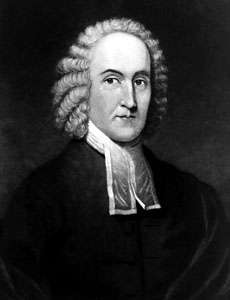
Jonathan Edwards

By the time of the Reformation, the understanding of the faith delivered once for all to the saints had been polluted beyond saving, and the Puritans started afresh, breaking completely with the Roman Catholic Church.

Suffice to say that the theologians in each era were duly conscientious of their thinking, striving to understand all that is required, and to explain it in ways the common man could understand, too. But they had blind spots, being products of their own generation. This is the way of it. We in this era have blind spots too, being products of our own generation. When we read a modern book, we nod and say, yes, yes, not realizing that the constructs of our own culture and time are blinding us to this or to that. Our grandchildren will look at our books of the millennium na shake their heads at us.

This is why it is important to read the products of the ancient and historical thinkers. We see their blind spots clearly, and we are happily exposed to theology that can and does enhance our understanding of the faith.

But oftentimes the ancients and historical fathers are difficult to read as well. Language changes. When reading Spurgeon, (1834 –1892) his words seem quaint. Backing up a hundred years, Jonathan Edwards (1703-1758) is a bit more difficult. By the time we get to the Puritan John Owen, (1616-1683) his works present comprehension difficulties nearly impossible to overcome. Even the great theologian JI Packer called Owen “cumbersome” and Kris Lundgaard took an hour to read just 8 or so pages of Owen, re-reading sentences three and four times and using a dictionary to look up certain words. The common man who finds these hurdles insurmountable miss out on great thinkers and founding fathers of the past.

What to do?

I have a few tips on how to grapple the ancients and the historical men who’ve contributed mightily to the faith but whose works present difficulties.

I’ve found that pairing books helps. For example, this summer I read John Bunyan’s spiritual autobiography Grace Abounding to the Chief of Sinners paired with A Pilgrim Who Made Progress, the Life Story of John Bunyan, by William Deal. I found that Deal’s book offered historical information that helped me understand some of Bunyan’s spiritual choices. That Deal’s book is aimed at the Youth demographic was actually a help.

If you’re interested in Augustine’s Confessions, the biography by Peter Brown is a good pairing. Brown’s treatment of Augustine seems to have become THE standard bio of Augustine since its publication nearly fifty years ago. Augustine of Hippo: A Biography.

Another kind of paring I’ve done is for example, I read Kris Lundgaard’s The Enemy Within paired with John Owen’s Indwelling Sin. Lundgaard’s book is essentially a re-write/Cliff’s Notes to Owen’s towering work. My version of Owen’s book was from the Puritan Paperback series. Where Lundgaard’s is a total re-write using modern examples, the PP series is a slightly edited and slightly modernized version of the original Puritan work. It’s put out by Banner of Truth Trust, an organization, you can, well, trust!

Fra_angelico_-_conversion_de_saint_augustin-e1440725829425
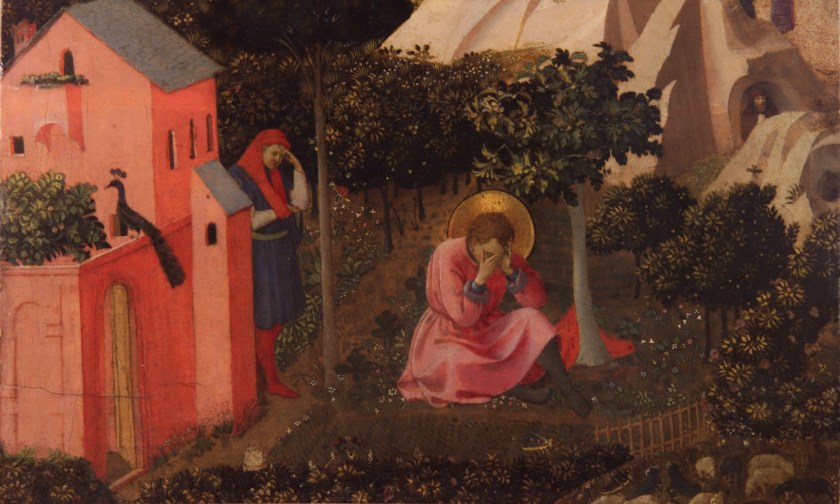
Fra Angelico, The Conversion of St. Augustine

I read Lundgaard on Mondays and the same Owen chapter the next day. I found that Lundgaard’s version helped me prepare my heart and my mind for the depth of the main meal Owen serves up.


Lundgaard also wrote Through the Looking Glass: Reflections on Christ that Change Us as a modernized re-write of Owen’s Glory of Christ, so that could be another pairing.

For Moby Dick, a theological but difficult book, (1851) there are many are study guides online. I used this one as I read the book itself.

For Pilgrim’s Progress, (a 1678 Christian allegory) there are study guides also. I bought The Pilgrim’s Progress Study Guide by Maureen L. Bradley.

Ligonier also has a wonderful teaching series on video by Derek Thomas, as well as a hard copy study guide by the same author. Ligonier says of the teaching series:

The Pilgrim’s Progress, written by John Bunyan over 300 years ago, is one of the most widely-circulated books ever to be published in the English language. In spite of its popularity in the past, many people today are not familiar with this masterpiece. Join Dr. Derek Thomas as he leads a guided tour of this allegorical work, showing that Christians have as much to gain from this book today as they did hundreds of years ago.

The first video is free. The remainder of the series are fee-based.

So, you can pair books with re-writes of books. Or you can pair books with a biography of the author you’re trying to read. You can use a study guide. Go through a teaching series. Buy a Puritan Paperback which is lightly modernized and abridged.

Any way you do it, don’t let the classics languish. There is a multitude of good theology in them we should not lose our connection to. I’ve offered some ways to ease the difficulty so to speak. If you have ideas, please do share them.

Posted in encouragement, theology

A Beautiful Interlude: David’s Exultation

By Elizabeth Prata

During the summer several of our regular Thursday night discussion groups disbanded. In their place, the elders instituted a Tuesday night  class going through the first 8 chapters of Romans. It has been a wonderful study. In the hour before the class starts, the elders are also raising up younger men by allowing them to select a short text and teach it to a smaller audience. Though the period is jokingly referred to as The Inferno, the men receive comments and encouragement after, not criticism.

This week, one of the younger guys taught through several texts centering on the concept of Christians being sojourners. That concept is worthy of a lengthier study and I’ll be doing that later this month. But one of the texts he mentioned was from 1 Chronicles 29 and it is beautiful.

To set the context, the Israelites have been repatriated. The building of the temple is commissioned. The kingdom is transitioning Israel from warlike kingship (David) to Solomon and the ongoing worship at the newly built temple. The people had gathered incredible offerings in exultation of this fact.

David’s Prayer

So David blessed the LORD in the sight of all the assembly; and David said, “Blessed are You, O LORD God of Israel our father, forever and ever. “Yours, O LORD, is the greatness and the power and the glory and the victory and the majesty, indeed everything that is in the heavens and the earth;

Yours is the dominion, O LORD, and You exalt Yourself as head over all. “Both riches and honor come from You, and You rule over all, and in Your hand is power and might; and it lies in Your hand to make great and to strengthen everyone. “Now therefore, our God, we thank You, and praise Your glorious name.

“But who am I and who are my people that we should be able to offer as generously as this? For all things come from You, and from Your hand we have given You.” (1 Chronicles 29:10-14 NASB).

Jamieson-Fausset-Brown Bible Commentary says of the 1 Chronicles passage:

10-19. Wherefore David blessed the Lord—This beautiful thanksgiving prayer was the effusion overflowing with gratitude and delight at seeing the warm and widespread interest that was now taken in forwarding the favorite project of his life. Its piety is displayed in the fervor of devotional feeling—in the ascription of all worldly wealth and greatness to God as the giver, in tracing the general readiness in contributing to the influence of His grace, in praying for the continuance of this happy disposition among the people, and in solemnly and earnestly commending the young king and his kingdom to the care and blessing of God.

The fact that God is sovereign, and delivers all that we have, without Him we would have nothing, reminds us of the verse in James 1:17,

Every good gift and every perfect gift is from above, coming down from the Father of lights, with whom there is no variation or shadow due to change.

And Jesus reminded Pontius Pilate that he had no power in himself,

Jesus answered him, You would have no authority over me at all unless it had been given you from above. (John 19:1a).

Let our life and prayers be infused with a warm and effusive gratitude for not only the things God has given us (from common grace all the way to salvation and adoption) but a gratitude for being allowed to worship Him in spirit and in truth. What we have to give him, comes from Him. Our tongues to utter prayers, the air filling our lungs, the tithes and offerings from our work, all of which He has given us.

But who am I and who are my people that we should be able to offer as generously as this? Who am I? Indeed, a sinner, redeemed by His grace, and who are the people? a Body of worshiping, forgiven sinners united in knowledge that apart from Him we can do nothing. All that we are and all that we have is from Him. He is GREAT! And worthy to be praised- and thanked.

praising god

Posted in encouragement, theology

Prata Potpourri: Men acting like men, women acting like women, wrath, resurrection, ascension

By Elizabeth Prata

It’s a hot one, mid-summer in Georgia, and many of my friends and colleagues are out in the world somewhere on their vacations. Though we are only a little past the Fourth of July, the idyllic time at home on summer break from school is rapidly coming to a close. In twenty more days and I will be sitting in a large auditorium with 500 other school system colleagues, listening to an address by our new superintendent, and then heaving myself to my school, changing into scrub clothes and moving furniture to set up the classroom. Though the summer days are surely precious and annually awaited, there is an undeniable eagerness in starting a new school year. It affords me a time to start fresh, work with new children, forge ahead in a new cycle with my teacher, and alternately be challenged and fulfilled each day.

Meanwhile, summer marches on. It’s a fun time of pool noodles, fireflies, sandy flip flops, BBQs, ball games, family, and rest. Here are a few essays I hope you enjoy.

~~~~~Men & Women~~~~~

Here are some good links looking at the current issues of the day through the lens of gender.

Men: Act like Men

Today, we continue to see the Church of Jesus Christ suffering from a lack of manliness. This has been the result of the radical feminist attack as well as the problem of perpetual adolescence that continues to prevent men from rising up and taking lead within the local church. These problems together create added friction over offices, giftedness, and the need for strong leadership. We would do well to remember Paul’s words to the church in Corinth—”act like men.”

Women: Act like Women

If I could only leave five “how-tos” to the next generation of Christian women coming up behind me, ‘how to be an apologist’ would be one of them. The benefit and joy that can come from this work is hard to measure.

~~~~~Wrath of God~~~~~

Here are a couple of links focusing on the wrath of God. I don’t enjoy the wrath but I feel it is a responsibility of every Christian not to cave in to the demands of liberal Christianity never to mention it. It’s real. It already abides on all who are not saved. (Romans 1:18; Matthew 3:7). It looms ahead for all who will not repent. (Luke 21:23; Revelation 6:16).

The Destruction of Sodom

God is forgiving, gracious, merciful, and loving, but we cannot ignore that He is also the wrathful Judge. God is holy and just and cannot ignore sin. God demands perfect justice and this requires all sin to be punished. The price of sin will be satisfied either in eternity in hell or through Christ’s blood.

THE quintessential sermon examining the wrath of God:
Sinners in the Hands of an Angry God, read by Tom Patton.

So that thus it is, that natural Men are held in the Hand of God over the Pit of Hell; they have deserved the fiery Pit, and are already sentenced to it; and God is dreadfully provoked, his Anger is as great towards them as to those that are actually suffering the Executions of the fierceness of his Wrath in Hell,

~~~~~Resurrection~~~~~

I appreciate DebbieLynne Kespert’s writing. Here she begins a study through 1 Corinthians 15 and the resurrection of believers. As of today, she is up to #8 in the series. Enjoy.
According To Scripture: Study #1 On The Resurrection

Yet typical Gospel presentations in today’s evangelical culture virtually ignore the resurrection, instead emphasizing substitutionary atonement. As vital as it is to understand that Jesus died for our sins, however, it’s just as vital to embrace the fact that He has risen from the dead.

I’m always surprised at how many of my Reformed brethren interpret the pertinent passages of the resurrection events such as the coming kingdom symbolically, or replace Israel with the Church. If it please the reader, this is not so.

The First Resurrection in Revelation 20

As noted in a previous article, Revelation 20 has long been considered the clearest and most convincing argument for the eschatology of premillennialism. But in recent years, an increasing number of amillennial voices have insisted that Revelation 20 actually provides more compelling evidence for their own view.

~~~~~Ascension~~~~~

There is lots of focus on the death, burial, and resurrection of Christ. But little on His ascension. Just start looking for credible essays on it. You’ll see.

The Ascension of Christ in Hebrews

Evangelicalism, properly conceived, has been from the beginning cross and gospel centered. But let us consider this question: does the doctrine of the ascension get minimized or neglected in our evangelical theologizing?

What is the meaning and importance of the ascension of Jesus Christ?

It is plain from Scripture that Jesus’ ascension was a literal, bodily return to heaven. He rose from the ground gradually and visibly, observed by many intent onlookers. As the disciples strained to catch a last glimpse of Jesus, a cloud hid Him from their view, and two angels appeared and promised Christ’s return “in just the same way that you have watched Him go” (Acts 1:11).

Let’s be kind to each other today.

quote reasons to be happy