Posted in encouragement, theology

Throwback: Lot Received So Much Mercy

I’m doing a Throwback today and tomorrow. Happy Thanksgiving everyone!

This first appeared on The End Time one year ago, 11/21/2017
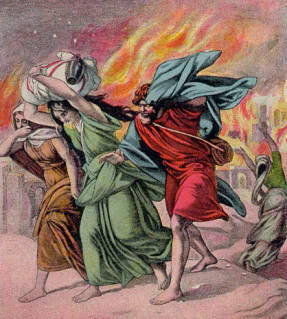
Picture by Violet Nesdoly, patterned after
“Escape for thy life” by Julius Schnorr von Carolsfeld

The story of Lot is an interesting one. Abraham’s nephew, we’re familiar with Lot’s origins from Genesis 11:27,

Terah became the father of Abram, Nahor and Haran; and Haran became the father of Lot.

When Haran died, Terah took in Lot and raised him. Later when Abram heard God and prepared to leave his home in obedience, Lot went with his uncle Abram. (Genesis 12:4).

Much later as their joined herds grew so large that the pastures would not feed them all, Lot chose the plain toward Sodom and Abram let Lot have that choice and Abram went the other way. The two separated. It wasn’t long after that Lot was living IN Sodom and had become one of its elders sitting at the gate. You know all this. Lot received mercy through all these choices and his downward spiral.

Now, when the outcry against Sodom had grown terrible, God sent Jesus and two angels to destroy Sodom and the other 4 cities of the plain (Gomorrah, Admah, Zeboiim, and tiny Zoar). Abram pleaded to save Sodom for the sake of ten righteous people that may live in it. Unfortunately, the city was so wicked, ten righteous could not be found, and its destruction was scheduled. The Lord again offered mercy to Lot and here are the examples.

He sent the two angels into the city to warn Lot, his wife, and any family members. We see again that Lot’s character isn’t the best. Lot knew the angels were from God and he understood that judgment was coming. He even had seen the angels perform a miracle by striking all the men of the lustful mob blind. Even at the very last moments of Sodom’s life as a city, Lot was still making incredibly bad choices.

Pleading with the mob, he offers them his virginal daughters to rape instead. That was a craven and unconscionable thing for a father to do.

Behold, I have two daughters who have not known any man. Let me bring them out to you, and do to them as you please. Only do nothing to these men, for they have come under the shelter of my roof. (Genesis 19:8).

Then when Lot attempted to warn his sons-in-law, Lot’s witness was so poor that they thought he was joking. Lot was not spiritually convincing in the least.

So Lot went out and said to his sons-in-law, who were to marry his daughters, “Up! Get out of this place, for the Lord is about to destroy the city.” But he seemed to his sons-in-law to be jesting. (Genesis 18:14).

Even then, Lot lingered. We all know that Mrs Lot turned her head and looked back, violating the angels’ command, but Lot lingered in Sodom too!

But he lingered. So the men seized him and his wife and his two daughters by the hand, the Lord being merciful to him, and they brought him out and set him outside the city. (Genesis 19:16).

Even through all this, the Lord is still offering Lot mercy. But when the angels told Lot to run and go fast away from Sodom to the hills, he whined and complained that he couldn’t! He asked instead to be allowed to run to Zoar.

I’d like to think that if two of God’s holy angels arrived and told me to leave because the place where I lived was about to be destroyed, I’d listen. Moreover, I’d like to think that I wouldn’t disobey, and would not be bold enough to negotiate the terms! But Lot did.

Behold, your servant has found favor in your sight, and you have shown me great kindness in saving my life. But I cannot escape to the hills, lest the disaster overtake me and I die. 20 Behold, this city is near enough to flee to, and it is a little one. Let me escape there—is it not a little one?—and my life will be saved. (Genesis 19:20).

And finally, even though the angels told Lot that they would not overthrow the little town Lot spoke of, Lot was still afraid!

Now Lot went up out of Zoar and lived in the hills with his two daughters, for he was afraid to live in Zoar. So he lived in a cave with his two daughters. (Genesis 19:30).

In 2 Peter 2:7 Lot is called righteous. Three times.

Take comfort from Lot’s string of decisions. I am sure that I have made such poor decisions in my Christian life, one after another. I surely would have deserved death. But the Lord strove with Lot and allowed the angels to grant him favor after favor. The Lord loves whom He loves and He has mercy upon whom He has mercy.

Do you know why Lot was called righteous by Peter under the inspiration of the Holy Spirit not just once but three times in the verses from 2 Peter?

“because he was oppressed by the sensual conduct of unprincipled men, for by what he saw and heard that righteous man while living among them felt his righteous soul tormented day after day with their lawless deeds.” (2 Peter 2:7)

Lot hated sin.

That’s it. The Lord has mercy on fathers who fail their daughters, on morally weak men, on stumblers and whiners and bumblers. Like I am, and you are. When we hate sin, our own and others’, we are on the right side of God – for He is holy.

Take comfort in Lot’s example. Hate sin, love God, and trust that He has mercy for those who strive to holiness and fight against sin.

 

Posted in encouragement, theology

Gratitude abounds, the LORD is so worthy to be loved and praised!

By Elizabeth Prata

From electing love to glorifying love, you are loved by God. You were chosen in Him before the foundation of the world. He loved you in Christ before time began, and He will love you in Christ when time is over. The committed love of God for His people is as eternal as God is. There’s no time with God. He doesn’t learn anything. He doesn’t arrive on a new idea. He doesn’t come up with new people to redeem. He has always loved His own as long as He has existed. ~John MacArthur, Remembering All His Benefits

gratitude 2

This is an incredible sermon about the praise and gratitude of Psalm 103. Psalm 103 has had more music sung about it or from it than any other (except perhaps Psalm 23). The only name mentioned in the Psalm is YHWH. There is no historical note or context. It is pure praise and love and devotion toward Yahweh.

Bless the Lord, O my soul,
And all that is within me, bless His holy name.
2 Bless the Lord, O my soul,
And forget none of His benefits;
3 Who pardons all your iniquities,
Who heals all your diseases;
4 Who redeems your life from the pit,
Who crowns you with lovingkindness and compassion;
5 Who satisfies your years with good things,
So that your youth is renewed like the eagle.

6 The Lord performs righteous deeds
And judgments for all who are oppressed.
7 He made known His ways to Moses,
His acts to the sons of Israel.
8 The Lord is compassionate and gracious,
Slow to anger and abounding in lovingkindness.
9 He will not always strive with us,
Nor will He keep His anger forever.
10 He has not dealt with us according to our sins,
Nor rewarded us according to our iniquities.
11 For as high as the heavens are above the earth,
So great is His lovingkindness toward those who fear Him.
12 As far as the east is from the west,
So far has He removed our transgressions from us.
13 Just as a father has compassion on his children,
So the Lord has compassion on those who fear Him.
14 For He Himself knows our frame;
He is mindful that we are but dust.

15 As for man, his days are like grass;
As a flower of the field, so he flourishes.
16 When the wind has passed over it, it is no more,
And its place acknowledges it no longer.
17 But the lovingkindness of the Lord is from everlasting to everlasting on those who fear Him,
And His righteousness to children’s children,
18 To those who keep His covenant
And remember His precepts to do them.

19 The Lord has established His throne in the heavens,
And His sovereignty rules over all.
20 Bless the Lord, you His angels,
Mighty in strength, who perform His word,
Obeying the voice of His word!
21 Bless the Lord, all you His hosts,
You who serve Him, doing His will.
22 Bless the Lord, all you works of His,
In all places of His dominion;
Bless the Lord, O my soul!
(Psalm 103)

He has forgotten all our sins! Let us always remember Him and all His kindnesses toward us, each day. Please take a look at the 16 items that come in just The Salvation Package. And the LORD gives so much more.

Then please take a listen to this sermon that will no doubt ignite your gratitude and cause singing from the wellsprings of your soul. John MacArthur upacks Psalm 103 and in so doing makes God’s love toward His people real and devastatingly poignant. And then,

[N]othing more clearly demonstrates our remaining sin than the ease with which we forget such staggering love and blessing.

This sermon will help you remember all His blessings, and gratitude will flow and praise will come and worship will happen. I promise.

Sermon:

Remembering All His Benefits

Lord, May there always be a fountain of praise and worship from my soul to Him!

Posted in encouragement, theology

Lord, give me strength to be valiant

By Elizabeth Prata

The greatest gift is Jesus and His greatest gift to us is eternal peace with Him and the right to be called His brothers. That is pretty amazing if you think about it. One of my favorite Bible books is the Book of Hebrews. In it, it is written-

Both the one who makes men holy and those who are made holy are of the same family. So Jesus is not ashamed to call them brothers. He says, “I will declare your name to my brothers; in the presence of the congregation I will sing your praises.” And again, “I will put my trust in him.” And again he says, “Here am I, and the children God has given me.” ( Hebrews 2:11-13 )

I hope your week, month, life is happy because you know Jesus. If you do, I hope your walk with Him is full of Light and joy. If you don’t then I hope you consider them when you read the Word all year. It is a sweet thing to be a child of God and not an enemy of God.

spurgeon.jpg

Posted in encouragement, theology

Abecedarium, Bestiary, and Emblem books: What do they have to do with the Bible?

By Elizabeth Prata

“I don’t have time to read.” I hear this a lot. I say this a lot. I used to read widely and incessantly before I was saved. Nowadays I am working a day job and ministering/serving at night, with Bible reading too. That leaves me either no time to read other books or tired eyes if I do have time. The pile of books grows high and the finished pile is small.

I’m preparing an essay “On Reading” for later this week, but in researching for it, and in researching for another essay I’m doing on a scene from Pilgrim’s Progress, I am discovering some things that inform my background on reading and the importance of immersing one’s self in a variety of types of literature.

Let this essay be considered an introduction to “On Reading” that I’ll write later this week.

We know that John Bunyan wrote Pilgrim’s Progress. We also know that it is the second-best selling book in the English language. The book is an allegory. What is an allegory?

An allegory is: a story, poem, or picture that can be interpreted to reveal a hidden meaning, typically a moral or political one. “Pilgrim’s Progress is an allegory of the spiritual journey”

Bunyan’s book contains literary devices and genres within it of which we may not be familiar. These are are good to know as we read his amazing allegory. What are some other types of literature? Abecedarium, Bestiary, Emblem books were popular at Bunyan’s time and before.

Abecedarium: (plural abecedaria)

A book used to teach the alphabet; alphabet book; primer. An inscription consisting of the letters of an alphabet, almost always listed in order.

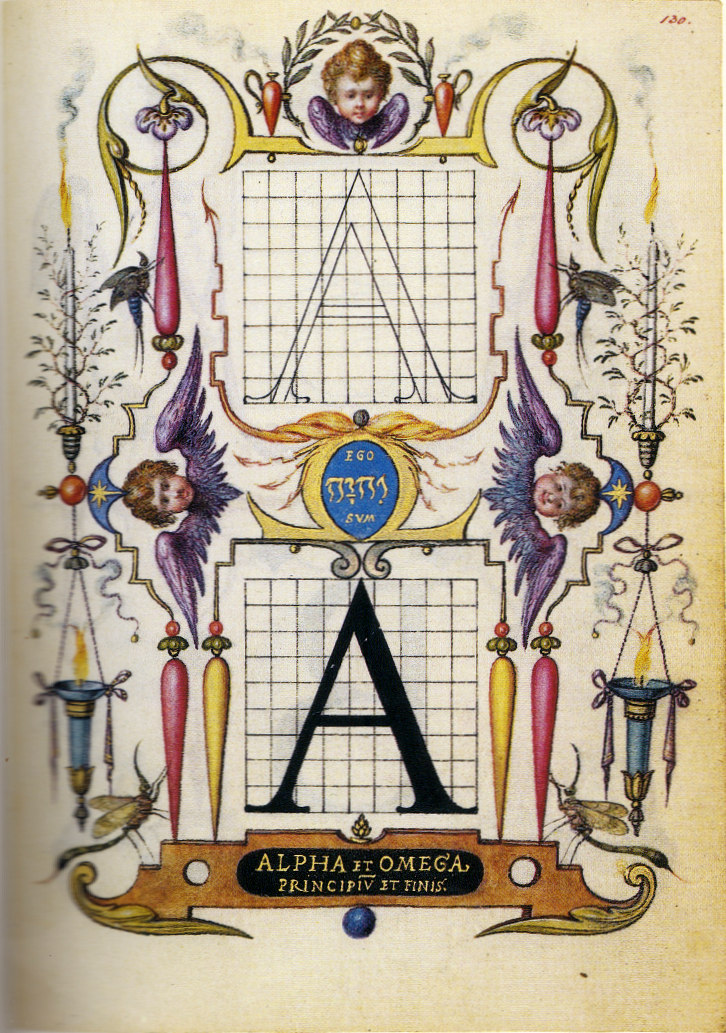
In past eras childrens’ abecedaria lessons included Bible lessons and verses. I have an abecedarium (of course I do!) and here is its first page. It is an illuminated alphabet from the court of Emperor Rudolf II.

Rudolf II (1552 – 1612) was Holy Roman Emperor, King of Hungary and Croatia, King of Bohemia and Archduke of Austria. He was a member of the House of Hapsburg. The illuminated ‘A’ and picture represents a verse from Revelation 1:8,

I am the Alpha and the Omega,” says the Lord God, “who is and who was and who is to come, the Almighty.”

The explanation of the picture from the abecedarium is that: “the first written symbol pays homage to God, the ruler of heaven and earth, the “beginning and the end”. The biblical verse, accompanied by the tetragram of Gods’ name is quoted within a stylized Omega in the middle of the page and in a cartouche at the bottom margin. With this verse, the first letter of the Greek alphabet simultaneously refers to the last one. The blue medallion containing the tetragram of his name occupies the the center of the folio. It connects the constructional drawing of the letter A with its executed version and is surrounded by the Omega, which generates flashes of lightning and thunderheads as symbols of God’s might.”

“In the upper margin, a cherub is surrounded by a laurel wreath, a sign of God’s fame, and flanked by incense burners. This angel praises the Lord along with the cherubim at the right margins. At both left and right, eternal lights burn in praise of God, as so candles entwined by olive branches, which symbolize his peace, Four demonic winged insects (the two antennae on the abdomens of the upper ones indicate that they are Ephemerae, whose life span is a single day) are attracted by the flames.”

A children’s book can be very sophisticated. Another antique book style was a Bestiary.

Bestiary is “a descriptive or anecdotal treatise on various real or mythical kinds of animals, especially a medieval work with a moralizing tone. The natural history and illustration of each beast was usually accompanied by a moral lesson. This reflected the belief that the world itself was the Word of God, and that every living thing had its own special meaning. For example, the pelican, which was believed to tear open its breast to bring its young to life with its own blood, was a living representation of Jesus. The bestiary, then, is also a reference to the symbolic language of animals in Western Christian art and literature.

Illustration from from the Oxford Bestiary; Perindens, a magic tree and keeper of the birds.

Another kind of book that was popular when Bunyan was writing Pilgrim’s Progress was the Emblem Book:

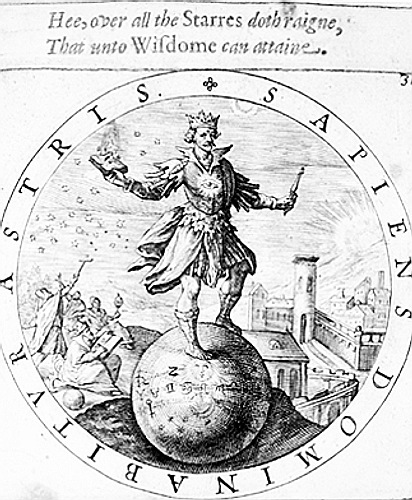
An emblem book is a book collecting emblems (allegorical illustrations) with accompanying explanatory text, typically morals or poems. This category of books was popular in Europe during the 16th and 17th centuries.

In part 1 and in part 2 when Christian and Christiana are in the House of the Interpreter, there seems to be a similarity to the scenes Bunyan records there with an Emblem Book. This Wiki entry explains.

“Many of the pictures in the House of the Interpreter seem to be derived from emblem books or to be created in the manner and spirit of the emblem. … Usually, each emblem occupied a page and consisted of an allegorical picture at the top with underneath it a device or motto, a short Latin verse, and a poem explaining the allegory. Bunyan himself wrote an emblem book, A Book for Boys and Girls (1688) …”, cf. Sharrock, p. 375.

Right, Wisdom – from George Wither’s Book of Emblems (London 1635)

So…that is all pretty interesting. We know that the Bible itself contains many different kinds of literary styles. From GotQuestions’ list

historical literature (1 and 2 Kings),
dramatic literature (Job),
legal documents (much of Exodus and Deuteronomy),
song lyrics (The Song of Solomon and Psalms),
poetry (most of Isaiah),
wisdom literature (Proverbs and Ecclesiastes),
apocalyptic literature (Revelation and parts of Daniel),
short story (Ruth),
sermons (as recorded in Acts),
speeches and proclamations (like those of King Nebuchadnezzar in Daniel),
prayers (many Psalms),
parables (such as those Jesus told),
fables (such as Jotham told), and
epistles (Ephesians and Romans).

I recently read an epistolary novel, The Guernsey Literary and Potato Peel Pie Society. I read Pilgrims Progress part 1 this summer and I’m reading part 2 now, which is an allegory. I’m reading poetry, a book of short stories, and a non-fiction historical. This past summer I read Moby-Dick, which is a little of every genre, I think!

Reading widely in various genres helps the Christian when s/he reads the Bible. Reading the Bible with its many genres helps the Christian when s/he reads widely. It works both ways. Christians should be readers. Challies explains why. An abecedarium might not be your cup of tea, neither a bestiary or an emblem book, but there are many different kinds of books besides the standard Christian novel or the non-fiction theology book. Try one! I had a hard time at first with Pilgrim’s Progress because I don’t connect well to abstractions like symbolism or allegory, but I’m glad I stuck with it. The skill helps me when I read the Bible. The word pictures in the allegory also stay with me.

Let me know what different genre you tried and how you liked or didn’t like it!


Posted in encouragement, theology

Throwback Thursday: Do You Pass The Smell Test?

This first appeared on The End Time in January 2010

By Elizabeth Prata

“But thanks be to God, who always leads us in triumphal procession in Christ and through us spreads everywhere the fragrance of the knowledge of him. For we are to God the aroma of Christ among those who are being saved and those who are perishing. To the one we are the smell of death; to the other, the fragrance of life. And who is equal to such a task?” (2 Corinthians 2:14-17)

This is a beautiful passage, with many layered and deep elements. First, Christ uses His believers to spread the fragrance of knowledge of Him. Christ as the ultimate fragrance. The word “fragrance” can have many nuances, each with their own evocation of meaning. ‘Odor’ evokes something unpleasant, and the word ‘smell’ is simply utilitarian. But fragrance is a perfume…that is a sweet and wonderful aroma, evoking lightness and sweetness, as Christ is, of course.

Second, the verse moves from Christ as the fragrance to the believers themselves as having fragrance. Any believer is in Christ and as such, has His aroma as well. To God, this is most pleasing.

Last, the one who is perishing smells the odor of death instead of the perfumed fragrance of Christ. Why? They are perishing.

To the perishing, the knowledge of Christ is an odor unto death. They writhe under it, flee from it. If trapped with it, they try to cover it with anything handy, air freshener, orange peels…(as a metaphor) but the smell of Christ can never be covered up. The aroma remains the same, only its effects differ upon the receiver.

In this passage, Paul was evoking a common sight, the triumphal procession. The order of the participants in the procession was standard, from the generals to the soldiers carrying the spoils, to the captives in chains. Behind them, the priests come swinging the incense bowls. The captives in chains knew they would be executed soon. What was the incense smell of victory to those lining the streets was the smell of death to those in chains.

How’s your aroma? Is it pleasing to God? Are you in the triumphal procession? His fragrance through us spreading everywhere the knowledge of Him? Do you pass the smell test?

botanical garden flowers