
By Elizabeth Prata
What is the definition of sin? – Got Questions
Matthew Henry on Matthew 1:18-25
Thirty Days of Jesus series
By Elizabeth Prata
What is the definition of sin? – Got Questions
Matthew Henry on Matthew 1:18-25
Thirty Days of Jesus series

Introduction/Background
Day 1 post
Day 2 post
Challies: Five verses on adoption
Ligonier: Adoption into God’s Family by Iain Campbell
Answers In Genesis: Adopted into God’s Family
Thirty days of exalting Jesus though selected verses with pictures representing the prophecy, life, death, resurrection, and Second Coming of our Savior.
More information and background on this series, here

Day 1: The Virgin Shall Conceive
Ligonier: A Shoot from Jesse’s Stump: Devotional
I’m doing a Throwback today and tomorrow. Happy Thanksgiving everyone!
This first appeared on The End Time one year ago, 11/21/2017
 |
| Picture by Violet Nesdoly, patterned after “Escape for thy life” by Julius Schnorr von Carolsfeld |
The story of Lot is an interesting one. Abraham’s nephew, we’re familiar with Lot’s origins from Genesis 11:27,
Terah became the father of Abram, Nahor and Haran; and Haran became the father of Lot.
When Haran died, Terah took in Lot and raised him. Later when Abram heard God and prepared to leave his home in obedience, Lot went with his uncle Abram. (Genesis 12:4).
Much later as their joined herds grew so large that the pastures would not feed them all, Lot chose the plain toward Sodom and Abram let Lot have that choice and Abram went the other way. The two separated. It wasn’t long after that Lot was living IN Sodom and had become one of its elders sitting at the gate. You know all this. Lot received mercy through all these choices and his downward spiral.
Now, when the outcry against Sodom had grown terrible, God sent Jesus and two angels to destroy Sodom and the other 4 cities of the plain (Gomorrah, Admah, Zeboiim, and tiny Zoar). Abram pleaded to save Sodom for the sake of ten righteous people that may live in it. Unfortunately, the city was so wicked, ten righteous could not be found, and its destruction was scheduled. The Lord again offered mercy to Lot and here are the examples.
He sent the two angels into the city to warn Lot, his wife, and any family members. We see again that Lot’s character isn’t the best. Lot knew the angels were from God and he understood that judgment was coming. He even had seen the angels perform a miracle by striking all the men of the lustful mob blind. Even at the very last moments of Sodom’s life as a city, Lot was still making incredibly bad choices.
Pleading with the mob, he offers them his virginal daughters to rape instead. That was a craven and unconscionable thing for a father to do.
Behold, I have two daughters who have not known any man. Let me bring them out to you, and do to them as you please. Only do nothing to these men, for they have come under the shelter of my roof. (Genesis 19:8).
Then when Lot attempted to warn his sons-in-law, Lot’s witness was so poor that they thought he was joking. Lot was not spiritually convincing in the least.
So Lot went out and said to his sons-in-law, who were to marry his daughters, “Up! Get out of this place, for the Lord is about to destroy the city.” But he seemed to his sons-in-law to be jesting. (Genesis 18:14).
Even then, Lot lingered. We all know that Mrs Lot turned her head and looked back, violating the angels’ command, but Lot lingered in Sodom too!
But he lingered. So the men seized him and his wife and his two daughters by the hand, the Lord being merciful to him, and they brought him out and set him outside the city. (Genesis 19:16).
Even through all this, the Lord is still offering Lot mercy. But when the angels told Lot to run and go fast away from Sodom to the hills, he whined and complained that he couldn’t! He asked instead to be allowed to run to Zoar.
I’d like to think that if two of God’s holy angels arrived and told me to leave because the place where I lived was about to be destroyed, I’d listen. Moreover, I’d like to think that I wouldn’t disobey, and would not be bold enough to negotiate the terms! But Lot did.
Behold, your servant has found favor in your sight, and you have shown me great kindness in saving my life. But I cannot escape to the hills, lest the disaster overtake me and I die. 20 Behold, this city is near enough to flee to, and it is a little one. Let me escape there—is it not a little one?—and my life will be saved. (Genesis 19:20).
And finally, even though the angels told Lot that they would not overthrow the little town Lot spoke of, Lot was still afraid!
Now Lot went up out of Zoar and lived in the hills with his two daughters, for he was afraid to live in Zoar. So he lived in a cave with his two daughters. (Genesis 19:30).
In 2 Peter 2:7 Lot is called righteous. Three times.
Take comfort from Lot’s string of decisions. I am sure that I have made such poor decisions in my Christian life, one after another. I surely would have deserved death. But the Lord strove with Lot and allowed the angels to grant him favor after favor. The Lord loves whom He loves and He has mercy upon whom He has mercy.
Do you know why Lot was called righteous by Peter under the inspiration of the Holy Spirit not just once but three times in the verses from 2 Peter?
“because he was oppressed by the sensual conduct of unprincipled men, for by what he saw and heard that righteous man while living among them felt his righteous soul tormented day after day with their lawless deeds.” (2 Peter 2:7)
Lot hated sin.
That’s it. The Lord has mercy on fathers who fail their daughters, on morally weak men, on stumblers and whiners and bumblers. Like I am, and you are. When we hate sin, our own and others’, we are on the right side of God – for He is holy.
Take comfort in Lot’s example. Hate sin, love God, and trust that He has mercy for those who strive to holiness and fight against sin.
By Elizabeth Prata
From electing love to glorifying love, you are loved by God. You were chosen in Him before the foundation of the world. He loved you in Christ before time began, and He will love you in Christ when time is over. The committed love of God for His people is as eternal as God is. There’s no time with God. He doesn’t learn anything. He doesn’t arrive on a new idea. He doesn’t come up with new people to redeem. He has always loved His own as long as He has existed. ~John MacArthur, Remembering All His Benefits
This is an incredible sermon about the praise and gratitude of Psalm 103. Psalm 103 has had more music sung about it or from it than any other (except perhaps Psalm 23). The only name mentioned in the Psalm is YHWH. There is no historical note or context. It is pure praise and love and devotion toward Yahweh.
Bless the Lord, O my soul,
And all that is within me, bless His holy name.
2 Bless the Lord, O my soul,
And forget none of His benefits;
3 Who pardons all your iniquities,
Who heals all your diseases;
4 Who redeems your life from the pit,
Who crowns you with lovingkindness and compassion;
5 Who satisfies your years with good things,
So that your youth is renewed like the eagle.
6 The Lord performs righteous deeds
And judgments for all who are oppressed.
7 He made known His ways to Moses,
His acts to the sons of Israel.
8 The Lord is compassionate and gracious,
Slow to anger and abounding in lovingkindness.
9 He will not always strive with us,
Nor will He keep His anger forever.
10 He has not dealt with us according to our sins,
Nor rewarded us according to our iniquities.
11 For as high as the heavens are above the earth,
So great is His lovingkindness toward those who fear Him.
12 As far as the east is from the west,
So far has He removed our transgressions from us.
13 Just as a father has compassion on his children,
So the Lord has compassion on those who fear Him.
14 For He Himself knows our frame;
He is mindful that we are but dust.
15 As for man, his days are like grass;
As a flower of the field, so he flourishes.
16 When the wind has passed over it, it is no more,
And its place acknowledges it no longer.
17 But the lovingkindness of the Lord is from everlasting to everlasting on those who fear Him,
And His righteousness to children’s children,
18 To those who keep His covenant
And remember His precepts to do them.
19 The Lord has established His throne in the heavens,
And His sovereignty rules over all.
20 Bless the Lord, you His angels,
Mighty in strength, who perform His word,
Obeying the voice of His word!
21 Bless the Lord, all you His hosts,
You who serve Him, doing His will.
22 Bless the Lord, all you works of His,
In all places of His dominion;
Bless the Lord, O my soul!
(Psalm 103)
He has forgotten all our sins! Let us always remember Him and all His kindnesses toward us, each day. Please take a look at the 16 items that come in just The Salvation Package. And the LORD gives so much more.
Then please take a listen to this sermon that will no doubt ignite your gratitude and cause singing from the wellsprings of your soul. John MacArthur upacks Psalm 103 and in so doing makes God’s love toward His people real and devastatingly poignant. And then,
[N]othing more clearly demonstrates our remaining sin than the ease with which we forget such staggering love and blessing.
This sermon will help you remember all His blessings, and gratitude will flow and praise will come and worship will happen. I promise.
Sermon:
Lord, May there always be a fountain of praise and worship from my soul to Him!
By Elizabeth Prata
The greatest gift is Jesus and His greatest gift to us is eternal peace with Him and the right to be called His brothers. That is pretty amazing if you think about it. One of my favorite Bible books is the Book of Hebrews. In it, it is written-
“Both the one who makes men holy and those who are made holy are of the same family. So Jesus is not ashamed to call them brothers. He says, “I will declare your name to my brothers; in the presence of the congregation I will sing your praises.” And again, “I will put my trust in him.” And again he says, “Here am I, and the children God has given me.” ( Hebrews 2:11-13 )
I hope your week, month, life is happy because you know Jesus. If you do, I hope your walk with Him is full of Light and joy. If you don’t then I hope you consider them when you read the Word all year. It is a sweet thing to be a child of God and not an enemy of God.

By Elizabeth Prata
“I don’t have time to read.” I hear this a lot. I say this a lot. I used to read widely and incessantly before I was saved. Nowadays I am working a day job and ministering/serving at night, with Bible reading too. That leaves me either no time to read other books or tired eyes if I do have time. The pile of books grows high and the finished pile is small.
I’m preparing an essay “On Reading” for later this week, but in researching for it, and in researching for another essay I’m doing on a scene from Pilgrim’s Progress, I am discovering some things that inform my background on reading and the importance of immersing one’s self in a variety of types of literature.
Let this essay be considered an introduction to “On Reading” that I’ll write later this week.
We know that John Bunyan wrote Pilgrim’s Progress. We also know that it is the second-best selling book in the English language. The book is an allegory. What is an allegory?
An allegory is: a story, poem, or picture that can be interpreted to reveal a hidden meaning, typically a moral or political one. “Pilgrim’s Progress is an allegory of the spiritual journey”
Bunyan’s book contains literary devices and genres within it of which we may not be familiar. These are are good to know as we read his amazing allegory. What are some other types of literature? Abecedarium, Bestiary, Emblem books were popular at Bunyan’s time and before.
Abecedarium: (plural abecedaria)
A book used to teach the alphabet; alphabet book; primer. An inscription consisting of the letters of an alphabet, almost always listed in order.
In past eras childrens’ abecedaria lessons included Bible lessons and verses. I have an abecedarium (of course I do!) and here is its first page. It is an illuminated alphabet from the court of Emperor Rudolf II.
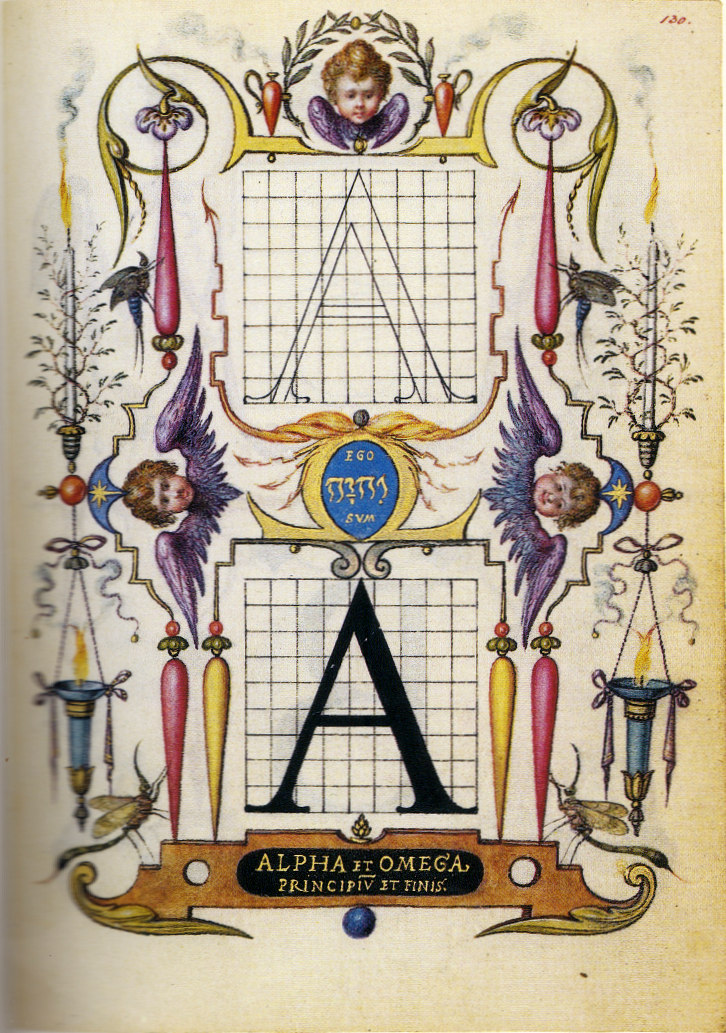
Rudolf II (1552 – 1612) was Holy Roman Emperor, King of Hungary and Croatia, King of Bohemia and Archduke of Austria. He was a member of the House of Hapsburg. The illuminated ‘A’ and picture represents a verse from Revelation 1:8,
“I am the Alpha and the Omega,” says the Lord God, “who is and who was and who is to come, the Almighty.”
The explanation of the picture from the abecedarium is that: “the first written symbol pays homage to God, the ruler of heaven and earth, the “beginning and the end”. The biblical verse, accompanied by the tetragram of Gods’ name is quoted within a stylized Omega in the middle of the page and in a cartouche at the bottom margin. With this verse, the first letter of the Greek alphabet simultaneously refers to the last one. The blue medallion containing the tetragram of his name occupies the the center of the folio. It connects the constructional drawing of the letter A with its executed version and is surrounded by the Omega, which generates flashes of lightning and thunderheads as symbols of God’s might.”
“In the upper margin, a cherub is surrounded by a laurel wreath, a sign of God’s fame, and flanked by incense burners. This angel praises the Lord along with the cherubim at the right margins. At both left and right, eternal lights burn in praise of God, as so candles entwined by olive branches, which symbolize his peace, Four demonic winged insects (the two antennae on the abdomens of the upper ones indicate that they are Ephemerae, whose life span is a single day) are attracted by the flames.”
A children’s book can be very sophisticated. Another antique book style was a Bestiary.
Bestiary is “a descriptive or anecdotal treatise on various real or mythical kinds of animals, especially a medieval work with a moralizing tone. The natural history and illustration of each beast was usually accompanied by a moral lesson. This reflected the belief that the world itself was the Word of God, and that every living thing had its own special meaning. For example, the pelican, which was believed to tear open its breast to bring its young to life with its own blood, was a living representation of Jesus. The bestiary, then, is also a reference to the symbolic language of animals in Western Christian art and literature.
Illustration from from the Oxford Bestiary; Perindens, a magic tree and keeper of the birds.

Another kind of book that was popular when Bunyan was writing Pilgrim’s Progress was the Emblem Book:
An emblem book is a book collecting emblems (allegorical illustrations) with accompanying explanatory text, typically morals or poems. This category of books was popular in Europe during the 16th and 17th centuries.
In part 1 and in part 2 when Christian and Christiana are in the House of the Interpreter, there seems to be a similarity to the scenes Bunyan records there with an Emblem Book. This Wiki entry explains.
“Many of the pictures in the House of the Interpreter seem to be derived from emblem books or to be created in the manner and spirit of the emblem. … Usually, each emblem occupied a page and consisted of an allegorical picture at the top with underneath it a device or motto, a short Latin verse, and a poem explaining the allegory. Bunyan himself wrote an emblem book, A Book for Boys and Girls (1688) …”, cf. Sharrock, p. 375.
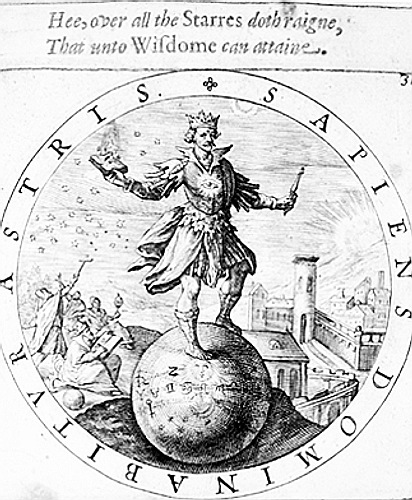
Right, Wisdom – from George Wither’s Book of Emblems (London 1635)
So…that is all pretty interesting. We know that the Bible itself contains many different kinds of literary styles. From GotQuestions’ list
historical literature (1 and 2 Kings),
dramatic literature (Job),
legal documents (much of Exodus and Deuteronomy),
song lyrics (The Song of Solomon and Psalms),
poetry (most of Isaiah),
wisdom literature (Proverbs and Ecclesiastes),
apocalyptic literature (Revelation and parts of Daniel),
short story (Ruth),
sermons (as recorded in Acts),
speeches and proclamations (like those of King Nebuchadnezzar in Daniel),
prayers (many Psalms),
parables (such as those Jesus told),
fables (such as Jotham told), and
epistles (Ephesians and Romans).
I recently read an epistolary novel, The Guernsey Literary and Potato Peel Pie Society. I read Pilgrims Progress part 1 this summer and I’m reading part 2 now, which is an allegory. I’m reading poetry, a book of short stories, and a non-fiction historical. This past summer I read Moby-Dick, which is a little of every genre, I think!
Reading widely in various genres helps the Christian when s/he reads the Bible. Reading the Bible with its many genres helps the Christian when s/he reads widely. It works both ways. Christians should be readers. Challies explains why. An abecedarium might not be your cup of tea, neither a bestiary or an emblem book, but there are many different kinds of books besides the standard Christian novel or the non-fiction theology book. Try one! I had a hard time at first with Pilgrim’s Progress because I don’t connect well to abstractions like symbolism or allegory, but I’m glad I stuck with it. The skill helps me when I read the Bible. The word pictures in the allegory also stay with me.
Let me know what different genre you tried and how you liked or didn’t like it!
This first appeared on The End Time in January 2010
By Elizabeth Prata
“But thanks be to God, who always leads us in triumphal procession in Christ and through us spreads everywhere the fragrance of the knowledge of him. For we are to God the aroma of Christ among those who are being saved and those who are perishing. To the one we are the smell of death; to the other, the fragrance of life. And who is equal to such a task?” (2 Corinthians 2:14-17)
This is a beautiful passage, with many layered and deep elements. First, Christ uses His believers to spread the fragrance of knowledge of Him. Christ as the ultimate fragrance. The word “fragrance” can have many nuances, each with their own evocation of meaning. ‘Odor’ evokes something unpleasant, and the word ‘smell’ is simply utilitarian. But fragrance is a perfume…that is a sweet and wonderful aroma, evoking lightness and sweetness, as Christ is, of course.
Second, the verse moves from Christ as the fragrance to the believers themselves as having fragrance. Any believer is in Christ and as such, has His aroma as well. To God, this is most pleasing.
Last, the one who is perishing smells the odor of death instead of the perfumed fragrance of Christ. Why? They are perishing.
To the perishing, the knowledge of Christ is an odor unto death. They writhe under it, flee from it. If trapped with it, they try to cover it with anything handy, air freshener, orange peels…(as a metaphor) but the smell of Christ can never be covered up. The aroma remains the same, only its effects differ upon the receiver.
In this passage, Paul was evoking a common sight, the triumphal procession. The order of the participants in the procession was standard, from the generals to the soldiers carrying the spoils, to the captives in chains. Behind them, the priests come swinging the incense bowls. The captives in chains knew they would be executed soon. What was the incense smell of victory to those lining the streets was the smell of death to those in chains.
How’s your aroma? Is it pleasing to God? Are you in the triumphal procession? His fragrance through us spreading everywhere the knowledge of Him? Do you pass the smell test?

I publish a scripture picture every day on my personal Facebook, my The End Time Facebook page, Instagram, and Twitter. Also Pinterest if I think of it. I usually tie the daily pictures to a theme for the week. Recently, I’ve been writing a Sunday Biblical Literacy essay (“Word of the Week”) explaining one of the foundational words of the faith. I’ve written essays on Justification, Transcendence, Immanence, Propitiation, Sanctification, Glorification, Orthodoxy, Heresy, Omniscience, Perspicuity, and Aseity. All the Scripture Pictures for that week with verses match each Word of the Week.
You likely don’t know the themes and thought that I put into each picture of the week. You might not even notice that I have a theme for the scripture pictures. You don’t have to, it’s not expected.
On another topic, I’ve been reading a lot about social justice recently. I read the race baiting and anger and accusations from Social Justice Warriors (SJW). I anticipated then read MacArthur’s sermons and blogs on the topic. I read the massive Statement that came out. I read tweeted garbage against the originators of the statement, particularly against Justin Peters this week. Disheartening for sure. I thought through whether I’m going to sign or not, and answered several emails and messages asking me just that.
I am proud of the men who met and prayed and researched and edited and ultimately stood for Jesus and His Gospel by issuing the Social Justice Statement. It was needed, and they did it. Good job.
However, with all the negativity surrounding it, and all the back and forth about theological nuances and philosophies of man and heated debates, it’s gotten really negative. By necessity, contending does that. Satan never sleeps. I felt I needed simply Jesus. I decided that my scripture picture the theme for this week will be “Jesus.”
Let’s get back to Him. Who He is, His work, His character. Whenever I feel the ‘garbage’ mounting up against me, swirling, and ready to turn my attention and heart away from the simple things, I go back to Jesus.
So the theme for my Scripture Pictures this week will be Jesus. The verses will flow from who He is to my favorite aspects about Him-
Only begotten Son of God, John 3:16
A Man of Sorrows, Isaiah 53:3
The Lamb of God, John 1:29
Jesus Christ the Righteous, 1 John 2:1
The Shepherd of the Sheep, Hebrews 13:20
The Lily of the Valley, Songs 2:1
So that is my little insight. It’s important to stay current with the theological news and debates, of course. I might be a simple person, but I think it’s also more important when things start to get heated and complicated to always go back and focus on just Jesus. He is the ultimate recalibration.

By Elizabeth Prata

Yesterday in part 1 I looked at the problem: how the images and life-lessons of many celebrity self-identified Christian women tout a feminist lifestyle, often in the process neglecting their biblical duty as mother. I named names and offered their own words. No, these women don’t say they live like feminists, but their actions show that they have willingly or unwittingly adopted that philosophy of womanhood, including mothering.
The problem with celebrity in Christian circles is the same as celebrity everywhere: that’s the image you’re going to see most often. Christian moms don’t see the real model of biblical motherhood as often because they are at home, working. These celebrity-feminist living women are on television, portrayed in media interviews, talk shows…they write books, they speak at conferences, they publish devotionals and Bible lessons etc, so the images of motherhood we see and we hear from them are ones of distortion. At the least, it’s confusion. Christian women read what their role is in the Bible, then see what seems to be many women identifying as Christian going off on social justice projects in Africa, traveling across the country on media interviews, using day care and nannies so they can write at home… about being a mom, all without note or rebuke from elder men of the faith. By default it seems that that kind of CEO-busy-mom lifestyle is accepted. It’s confusing for women. It’s discouraging, too.
I was raised by a divorced, feminist mother during Second Wave Feminism sweeping the country in the 60s and 70s. I was told that women could and should go into the public spheres of work and career if they wanted to, and to go as high as they desired according to their desires and skills.
My goal prior to my conversion, was to be a teacher and a wife. I wanted to help children, then arrive home before my husband and make a nice homelife for him, and do the same during the summer when school was out of session. I was mocked by feminists for wanting to orient my life at home. For wanting this lifestyle, I was discouraged, bullied, and dismissed as a ninny.
So I have a bit of an idea of what it is like for Christian wives and mothers who declare their intent to stay at home, raise their children, and live a godly life according to the Bible (which includes society’s hated word “submission”.)
So what IS biblical motherhood, not according to the Christian celebrity culture, but according to the Bible?
and so train the young women to love their husbands and children, 5 to be self-controlled, pure, working at home, kind, and submissive to their own husbands, that the word of God may not be reviled. (Titus 2:4-5).
Eve acknowledged that children are from the LORD, He gives that gift to women.
Now the man had relations with his wife Eve, and she conceived and gave birth to Cain, and she said, “I have gotten a manchild with the help of the LORD.” (Genesis 4:1)
Behold, children are a heritage from the Lord, the fruit of the womb a reward. Like arrows in the hand of a warrior are the children of one’s youth. (Psalm 127:3-4).
Why do so many women accept gifts from God such as the fruit of the Spirit, or their prosperity, or their physical home, with joy and in gratitude and due obedience to shepherd them well, but fail to do the same with their children? It should not be so. Therefore:
It’s hard to be a mom. It takes skill, wisdom, patience, hard work, mental energy, persistence, and so much more. CEO’s managing several hundred employees multi-task daily chores, balance a complicated schedule, budget the company’s funds, and train the staff. Moms do the same. Motherhood is the most demanding job on the planet. Kings have a slew of counselors, Presidents have their Cabinet, CEO’s have their staff, but a mom mainly works at home alone all day. Her husband helps, but mainly it’s a thankless and lonely job- only noticed if she fails. Therefore:
“My help comes from the Lord, who made heaven and earth.” (Psalm 121:2, NASB).
A Christian mom knows that what she says is important, but what she does is equally as important. Children watch like hawks and know hypocrisy when they see it. Their minds are patterned after what they absorb, part of which is what they see mom and dad doing. Children watch parents so moms must live what she says. She is a model, from which a child can learn by watching the most important people in the world to them live a life of of Godly living. (Deuteronomy 4:9, Proverbs 11:3; Psalm 37:18, 37; Philippians 4:6-7).
To that end, a Christian mom is submissive to her husband. The numerous verses about this fact gives some idea of the import God lays on this concept of submission. (Ephesians 5:22, 24; Colossians 3:18; Titus 2:5; 1 Peter 3:1, 5). The husband is the leader of the home. The husband and wife complement each other in their roles. It works because it is designed by God. Therefore:
By the way, I thought this was funny:

A submissive wife is a call to arms in today’s society. It is an act of war even to say the word. The world hates it. Since the Christian church has been infiltrated by so much of the world, many Christian moms who desire to follow the biblical model for marriage and parenting will receive opposition to both the word and the act of submission. Prepare for it. This is where your warrior princess comes into play. Yes, you are a warrior princess, but not the sword-wielding boisterous woman striding the world, slaying dragons and forming companies. It is an act of courage against satan & his world to withstand his temptations to be assertive/domineering.
Wives, be subject to your husbands, as is fitting in the Lord. (Colossians 3:18).
A Christian wife/mom loves her husband. You might notice I’ve written a lot so far about how a Christian mom operates according to the Bible but nothing about children yet. This might seem counterintuitive, but it’s actually the proper order. Number 1 & 2 dealt with the Christian wife/mom’s identity in Christ. She acknowledges him as primary in her life and relies on Him for all. Then we moved to #3, the husband/marriage. A Christian mom is a wife before she is a mom. It is her early days of marriage where she learns submission. Yet in submission, a Christian wife/mom never loses her identity (something the world threatens us with when we use the dreaded s-word). She remains a daughter of the King, a child of God always. Her identity is secure, no matter what.
So a Christian mom loves her husband. This sometimes is a tough one. The people we are closest to are the ones we tend to be most aggravated by or feel it’s easy to correct. Familiarity breeds contempt is a secular proverb meaning “extensive knowledge of or close association with someone or something leads to a loss of respect for them or it.” Also, “People do not respect someone they know well enough to know his or her faults.” There is no one a wife or mom will be more familiar with than the man with whom she shares a bed.
So often she will begin to lose respect for him, and the familiarity if their intimate relationship will allow her to feel free to criticize or nag. Children easily pick up on atmospheres of tension, resentment, and discord. A Christian mom is responsible for creating an atmosphere of security, love, and harmony.
A song of ascents. Of David.
How good and pleasant it is when God’s people live together in unity! It is like precious oil poured on the head, running down on the beard, running down on Aaron’s beard, down on the collar of his robe. (Psalm 133:1-2)
Don’t nag. Love is a choice. If loving one’s husband is such a given, why does the Bible have to say it so often? If loving one’s husband is so easy, why are elder women commanded to “train” the younger women to love their husbands? (1 Peter 4:8; Ephesians 4:2-3; Titus 2:4). It’s hard to love him sometimes. Therefore,
Above all, keep fervent in your love for one another, because love covers a multitude of sins. (1 Peter 4:8)
Spending time with your children is so important. Helping them walk, reading to them, playing peek-a-boo, watching their sports games, working on a school project together…these are the things that children long for, need, and remember. It’s basic that spending time with the children plural and one-on-one time with them offers opportunities for teachable moments. It gives them self-esteem, creates family unity, and is a marker of love. You spend time with those you love. Children are a joy.
Whenever a woman is in labor she has pain, because her hour has come; but when she gives birth to the child, she no longer remembers the anguish because of the joy that a child has been born into the world. (John 16:21)
He makes the barren woman abide in the house As a joyful mother of children. Praise the LORD! (Psalm 113:9)
I’m not speaking of homeschooling. That’s a choice each parental couple makes. I’m speaking of educating the children in the Lord.
Stay at home mothering is cumulative. You don’t see the effects until the child is grown, and sometimes not even until after then. You build a widget, you see a widget. You raise a child, and it might take 20 years to see what unfolds in his or her character once for all.
It is here, in the spiritual realms,mothers have a tremendous impact, especially on their sons.
In his series Christian Men and their Godly Moms, Tim Challies wrote:
It may surprise us, though, to learn how many of our Christian heroes were shaped by the attentiveness and godliness of their mothers. Even though they may have had fathers who were present, involved, and godly, still they would insist that their primary spiritual influencer had been their mother. One of history’s greatest preachers would say with affection, “I am sure that, in my early youth, no teaching ever made such an impression upon my mind as the instruction of my mother,” while one of its most committed evangelists would say, “I learned more about Christianity from my mother than from all the theologians in England.” An eminent theologian would state, “To our mother, my brother and myself, under God, owe absolutely everything.”
A great defender of the faith would write about an overwhelming moment of doubt, then relate how he found deliverance: “My mother [spoke to me] in those dark hours when the lamp burned dim, when I thought that faith was gone and shipwreck had been made of my soul. ‘Christ,’ she used to say, ‘keeps firmer hold on us than we keep on him’.”
Train up a child in the way he should go; even when he is old he will not depart from it. (Proverbs 22:6)
It is so counter-cultural today for a mother to orient her life primarily toward her husband and children, that author and podcaster Rachel Jankovic created a webinar titled “Motherhood: A Call to Arms“. The webinar is described thus:
As mothers who seek to honor the Lord in our callings, it is important for us to be thoughtful and clear headed about our ultimate goal: raising men and women who love the Lord.
A good understanding of how God uses mothers who fear Him will help equip us to cheerfully accomplish our daily work, keeping our eyes on the goal. Without a big vision for our work we can become lost in the details, losing perspective and becoming vulnerable to all kinds of discouragement.
In this webinar we are going to look at what Scripture has to say about us, our work, and children, and we will talk about how we can practically apply those things in our everyday dealings with our future men and future women.
She titled her webinar in military language because she believes that motherhood is on the offensive. Normally when we read about motherhood it’s phrased in sentimental language urging peaceful harmony. Jankovic’s language is deliberately military.
Parents, especially mothers, “You are as much serving God in looking after your own children, training them up in God’s fear, minding the house, and making your household a church for God as you would be if you had been called to lead an army to battle for the LORD of Hosts!” ~Charles Spurgeon
She said, “Christianity in recent years has been dominated by a sentimental approach to motherhood.” We see constant scriptures with hazy fields of flowers and calling everything precious. “Motherhood is not like that. Motherhood is real.” She believes women need to know both the reality of motherhood and the joy.
From the mouth of infants and nursing babes
You have established strength
Because of Your adversaries,
To make the enemy and the revengeful cease
(Psalm 8:2), (commentary here)
Jankovic said, “We have been taught …the culture has worked very hard to make us believe that ’empowered women’ are women who have somehow risen above their own fertility. The world’s women are so desperate to teach us that if you have detached yourself – no matter the means – [abortion] from your own fertility, that you have a better shot at being your own true self, and I would say, your most valuable self.”
Motherhood is important because as Rachel Jankovic’s husband said, ” ‘This is the only work you’re doing that will last forever- is those children.’ It’s true. Nothing else I will ever do is eternal.”
Christian moms, your children are your contribution to God’s Kingdom.
———————————–
Many Christian Celebrity Moms are Distorting Biblical Motherhood; Part 1
———————————–
For further reading
Tim Challies: Christian Men and their Godly Moms (entire series)
John MacArthur: God’s High Calling for Women (topical series)
John MacArthur: God’s High Calling for Women (study guides)
Answers in Genesis: The Role of a Godly Mom
Compelling Truth: What Should a Christian Mother be like According to the Bible?
 the-end-time.org