Posted in encouragement, theology

Glory Be!

By Elizabeth Prata

*Jesus came for God’s glory. (Hebrews 1:3). Jesus said this over and over. He came for us, of course, to seek and save the lost, but Jesus came to increase God’s glory. God is passionate about His glory, “I am the LORD, that is My name; I will not give My glory to another, Nor My praise to graven images.” (Isaiah 42:8)

God’s glory is increased when He redeems sinful man to Himself. It is the single greatest act of a Holy God. Redeeming. Sinful. Man. THAT is the expression of His highest glory in the most glorious act, and that His Son would incarnate (not just for 33 years, but forever) and live a human life and die a horrendous death, and in between would seek God’s glory at every moment. This is something admirable to ponder.

Philippians 4:8 – “Finally, brothers, whatever is true, whatever is noble, whatever is right, whatever is pure, whatever is lovely, whatever is admirable—if anything is excellent or praiseworthy—think about such things.”

Think on the admirable things.

1 Corinthians 10:31 – “Whether therefore ye eat, or drink, or whatsoever ye do, do all to the glory of God.” This verse is saying that even if we are not missionaries leading thousands to Christ, even if we are not fiery preachers speaking before thousands, even if we are not teachers publishing hundreds of books, we, the small and mundane, should do everything we do for the glory of God. The small tasks, the routine, the everyday, are glorious to Him if performed with Him in mind as the utmost audience. Do all with an awareness that you are doing it for God. And it will be a fragrant aroma unto Him.

and walk in love, just as Christ also loved you and gave Himself up for us, an offering and a sacrifice to God as a fragrant aroma.” (Ephesians 5:2).
So think on the admirable things.

glory hebrews verse

*A version of this post first appeared on The End Time in 2011

Posted in encouragement, theology

Thinking about reunion

By Elizabeth Prata

I have worked in a school almost exclusively my entire adult professional life. I was a teacher, a daily substitute, a long-term substitute, and now I’m a teacher’s aide.

I love kids very much. They are my favorite people. I love how they are so open, and loving, and funny. I love their quirks, and their knock-knock jokes, and their earnest attempts to please. I love how when they arrive at school they’re all dressed and combed and tucked in. By the end of the day they’re a wreck, ketchup stains on the shirt, shoes untied, hair bow gone, things spilling out of unzipped backpack as they plod to the door at car riders. Life hits little kids hard.

I love helping them in any way throughout the day. When a friend  hurts their feelings, I cheer them when they cry. To see that smile break through is heart-melting. When they struggle with tying their shoe, or can’t open a mustard pack at lunch, or when the door is too heavy, I can help them. When they need help sounding out a word or adding some numbers, I can help them. I can smooth their path throughout the day, in big or little ways, as they contend with all the little-kid obstacles in front of them.

After the two-week Christmas break or on the first day of school, when we haven’t seen our kids for a long while, it’s exciting to be reunited.

They come thru the door from the car or the bus, down the long hallway, and they spot us on duty. They start running. They throw themselves full bore around our waist and fling their arms around us. We hug back, and look down into their little faces, smiling ear to ear. “I love you!” “I missed you!” we say. We bend down to hear all their little stories about the puppy they got or the tooth they lost. Hugs pile-up as the momentum of the kids streaming back into the school increases, and we love it. We eagerly look down the hall to see the next child come through the door, listening for the door squeak to know it’s opening again. The relief we feel when we see they are safe and happy and back in our school again is a precious feeling.

When the National Emergency due to the COVID-19 pandemic was declared, it was a surprise. The kids left school on a Thursday in advance of a three-day weekend due to Friday being a Teacher Work Day. But then the leaders decided to close school for disinfecting and to comply with guidelines for no gathering, so as not to spread the virus. We’d said goodbye on Thursday like usual, but then it felt like we fell off a cliff. We took for granted that we would see them again a few days later. We cling to the school year calendar as a given, in cement. But it wasn’t. For the first time, it was an unexpected closure, and not for a snow day.

Had we known we would not see our children for over a month, would we have given a more fervent goodbye? Looked a little longer in their eyes as we said ‘see you later!’ Hugged them a little tighter? We have regrets. We can’t wait to see them again.

One thing that is common to all of us educators and bus drivers is that we MISS THE KIDS. We long for the day when we are reunited and see their little smiles and know they are back into a routine. Kids thrive on routine. We want them to thrive and learn, and know they are loved by the other adults in their life.

OK, all this earnest emotion and angst and feels is for a reason. If we who work with children feel so eager to see ‘our kids’ again, imagine how Jesus feels. He is a Father, waiting to reunite with his children. He is a Teacher, we are His kids, and He is longing to see us, be with us.

In Matthew 23:37 Jesus lamented over Jerusalem, saying He had longed to gather His children together as a hen gathers her brood under her wings..

The Bridegroom anticipates His bride,

For as a young man marries a young woman, so shall your sons marry you, and as the bridegroom rejoices over the bride, so shall your God rejoice over you. (Isaiah 62:5).

He is waiting for us until that time, (Hebrews 10:13). He is expectantly waiting for the Father to say ‘go get your Bride’. And when God does, the picture of the Father in the parable of the Prodigal Son comes to mind,

But while he was still a long way off, his father saw him and felt compassion, and ran and embraced him and kissed him. (Luke 15:20).

He runs to us.

He is going to rejoice over us with gladness; He will quiet us by His love; He will exult over us with loud singing. (Zephaniah 3:17; Isaiah 62:5; Jeremiah 32:41).

No matter how lonely you feel in your place during this isolation time, remember that as much as you long to see your adult kids, grandkids, colleagues, extended family, students…Jesus longs to see you even more! He anticipates that great reunion, when we will look up into His face as the children we are, and eagerly tell Him of our lost tooth or our new puppy, and He indulgently has all the time in the world to listen, love, and be with us.

rejoice verse

Posted in encouragement, theology

Encouragement: You’re not a bird

By Elizabeth Prata

morning 4

It’s a beautiful day out there. The birds are singing, they’re building their nests. They don’t know there’s a pandemic. They don’t know to quarantine. But the Lord takes care of them, dumb beasts though they are. How much more does He take care of His children? He gives good gifts. He brings all things about for the good of those who love Him. He sent His Son for us so we could have a relationship with Him (if we repent).

Even the ‘negative’ things are to give us the gift of reflection so as to humble ourselves, rely on Him all the more. He gave the wandering Hebrews clothes and shoes that didn’t wear out during Exodus. (Deuteronomy 29:5). He gave them bread when they were hungry. (John 6:31). He gave them water when they were thirsty. (Exodus 17:6). Will He do less for His children on the other side of the cross? Continue reading “Encouragement: You’re not a bird”

Posted in encouragement, theology

I don’t want to go back to my normal life

By Elizabeth Prata

These days are certainly strange. Mandated home sheltering, no going out except for minimal and pressing reasons, economy shuttered, the world staggering from a virus that sweeps through a population like wildfire.

For many people, it’s strange to be at home for these lengthy times. No school, no work, being apart from extended family, uncertain financial future.

People say, “I want my normal life back!” Continue reading “I don’t want to go back to my normal life”

Posted in encouragement, theology

Be like the poppies

By Elizabeth Prata

100_1908 poppies

I took that picture 15 or 20 years ago. It’s still one of my favorites. I had it enlarged and framed. It hangs on my living room wall.

It’s a photo of a B&B along Water Street in Lubec, Maine. The street is so named, as you might guess, because it faces the Atlantic Ocean. In fact, it’s on a narrow inlet and a stone’s throw across the inlet is Canada. The town is in a region of Maine that Mainers call Downeast. Far away and the edge of nowhere, but a small city that enjoys the spring and summer, short as it might be. The town is very close to the 45th parallel, halfway between the equator and the north pole. Continue reading “Be like the poppies”

Posted in encouragement, theology

You are not alone

By Elizabeth Prata

As we are forbidden to gather today to worship our Lord with joy and companionably as a Body, we might be feeling sad. I know I am. We might be feeling worried about elderly parents or grandparents we cannot visit. We might be anxious about not being able to get to our adult children who live far. We ourselves might be lonely in our abode, alone and not being able to see our friends in person.

I think of Hagar often. She was badly used, rejected, mocked, and cast out. She ran off, and sat down all alone in the wilderness. Yet, despite being alone, the Lord (in a pre-incarnate visit) personally attended to her. He reassured her. Continue reading “You are not alone”

Posted in encouragement, theology

Emotional Fallout of the COVID-19 Lockdown

By Elizabeth Prata

golden hour2

Introduction

Today is one week since we heard that school would be closed for a lengthy period, and a week since the President called a National State of Emergency, a week since coronavirus patients started exponentially increasing.

I haven’t seen (too much) complaining about government asking churches to suspend operations. I’ve seen churches comply in the spirit of Romans 13:1. Continue reading “Emotional Fallout of the COVID-19 Lockdown”

Posted in encouragement, theology

Encouragement for those alone: You are not alone

By Elizabeth Prata

“May you live in interesting times”.

You may have heard this phrase attributed to the Chinese as an ancient blessing. It’s actually a curse, that living in UNinteresting times is more of a blessing than so-called interesting ones, which usually involve war, famine, or other disruption of some kind.

It never was a Chinese saying at all, whether curse or blessing. The closest the phrase came from is remarks made by Frederic R. Coudert at the Proceedings of the Academy of Political Science, 1939: Continue reading “Encouragement for those alone: You are not alone”

Posted in encouragement, theology

“To the city of refuge!”

By Elizabeth Prata

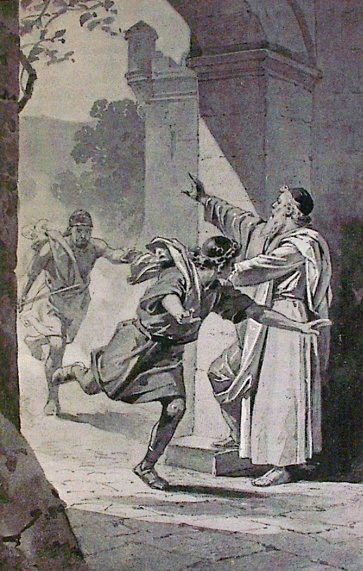
Left, Illustrator of Charles Foster, The Story of the Bible, 1884, “City of Refuge”.

Asylum. Sanctuary Cities. Manslaughter. Innocent. These are judicial terms that are not new, the men of Bible times knew them and we know these terms today.

Our God is a God of justice. He knows what is in a man, and it’s sin. He knows we hate and murder. He knows that when blood is shed, blood must pay. Therefore, God made it possible for wrongful shedding of human blood to be avenged. The nearest relative of the wrongfully killed person (“murderer”) may hunt the perp down and kill him with no repercussions to himself. (Numbers 35:19, 21, Deuteronomy 19:12).

However, there are times when blood is shed accidentally, or unknowingly. This person is called a “Manslayer” as opposed to the aforementioned ‘murderer’. If a man accidentally killed another man, God made a way for that person to be able to flee to a City of Refuge, so called in the Bible, and hurl himself upon the judicial investigation of the priests or elders of that city. Here’s how Charles Spurgeon explains it:

You will remember that when the children of Israel were settled in Canaan, God ordained that they should set apart certain cities to be called the Cities of Refuge, that to these the man-slayer might flee for security. If he killed another unawares, and had no malice aforethought, he might flee at once to the City of Refuge; and if he could enter its gates before the avenger of blood should overtake him, he would be secure.

Cities of Refuge were carefully selected at strategic locations so that no person living in the Land would have to run far to access it. They were equally spread out. A person anywhere in the Land could reach them in a day or less. The Cities of Refuge were open to strangers, too.

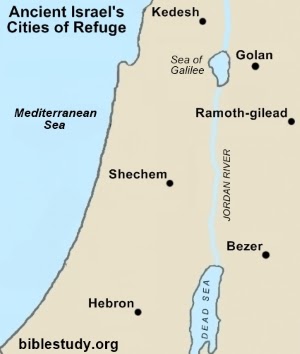
Cities of Refuge (source Smith’s Bible Dictionary) were six Levitical cities specially chosen for refuge to the involuntary homicide until released from banishment by the death of the high priest. (Numbers 35:6,13,15; Joshua 20:2,7,9) There were three on each side of Jordan.

Source

Kedesh, in Naphtali. (1 Chronicles 6:76)

Shechem, in Mount Ephraim. (Joshua 21:21; 1 Chronicles 6:67; 2 Chronicles 10:1)

Hebron, in Judah. (Joshua 21:13; 2 Samuel 5:5; 1 Chronicles 6:55; 29:27; 2 Chronicles 11:10)

On the east side of Jordan –

Bezer in the Wilderness, in the tribe of Reuben, in the plains of Moab. (4:43; Joshua 20:8; 21:36).

Ramoth-Gilead, in the tribe of Gad. (4:43; Joshua 21:38; 1 Kings 22:3)

Goolan in Bashan, in the half-tribe of Manasseh. (4:43; Joshua 21:27; 1 Chronicles 6:71)

What you had to do, if, say you were chopping wood and your axe head flew off and killed the man next to you, is run to the city. Upon arrival, you would have to tell the elders what happened. You’d have to make it there before the ‘avenger of blood’, usually the nearest next of kin to the dead man, gets you and kills you.

The elders would provide you a place to stay and food, until they met to discuss your case.

If the case is adjudicated as accidental, you would be allowed to remain in the city of refuge freely until the High Priest died. After that you could go home. If you left the city of refuge prior to the death of the High Priest, the avenger of blood could perform the death penalty without penalty to himself.

I find all this amazing, that God provided opportunities for justice in these cases. What I find even more fascinating is just how seriously the Israelites took the cities of refuge.

These cities of refuge were a fact, real cities with real roads leading up to them. The roads leading up to it would need to be maintained. They erected signs at intervals so that the fleeing man-slayer would know where to go. They maintained the signs regularly also. Spurgeon again from the same link as above:

We are told by the rabbis that once in the year, or oftener, the magistrates of the district were accustomed to survey the high roads which led to these cities. They carefully gathered up all the stones, and took the greatest possible precautions that there should be no stumbling-blocks in the way which might cause the poor fugitive to fall, or might by any means impede him in his hasty course. We hear, moreover, and we believe the tradition to be grounded in fact, that all along the road there were hand-posts with the word “Refuge” written very legibly upon them, so that when the fugitive came to a crossroad, he might not need to question for a single moment which was the way of escape; but seeing the well-known word “Refuge,” he kept on his breathless and headlong course until he had entered the suburb of the City of Refuge, and he was then at once completely safe. Spurgeon

It’s true about the roads and the signs, not just tradition. This is from the Jewish Encyclopedia, written after Spurgeon preached that message:

Corresponding to the care for the proper location of these cities were the other ordinances referring to them. The roads leading to them were marked by sign-posts at the crossroads, with the inscription “Miḳlaṭ” (Refuge); the roads were very broad—32 ells, twice the regulation width—smooth and level, in order that the fugitive might not be hindered in any way (Sifre l.c.; Tosef. l.c. 5; Mak. 10b; B. B. 100b). The cities chosen must be neither too small nor too large: in the former case a scarcity of food might arise, and the refugee might consequently be forced to leave his Asylum and imperil himself; in the latter case the crowds of strangers would make it easy for the avenger of blood to enter undetected. There were other measures of precaution in favor of the refugee. Dealing in weapons or implements of the chase was forbidden in the cities of refuge. Furthermore they had to be situated in a populous district, so that a violent attack by the avenger of blood might be repelled, if necessary. Jewish Encyclopedia, 1906

God is incredible the way He set up society in those days. I look forward to the real, actual Millennial Kingdom, the 1000 year kingdom when God fulfills His promises to Israel and we live with Him on earth- Jesus as King and David ruling as under-King.

Meanwhile, the spiritual lesson is this: though there are sanctuary cities on earth today, there is one city to which every person on earth should flee. Or sins are high crimes against a Most Holy God. We all deserve the death penalty. However, if we flee to Jesus the High Priest, we may throw ourselves at His feet and plead His blood to cover our sins. If we repent and trust Him as Savior, He will forgive the crime and we will escape the penalty- which is death.

And since Jesus as High Priest never dies, we will live without fear of death forever.

Hallelujah!