By Elizabeth Prata
The extra time at home for many of us during this pandemic quarantine period is allowing for a more stress free, mind uncluttered, time to read the Bible. You night be venturing into uncharted waters, trying some of the books of the Old Testament for the first time. If you are, good for you! The foundations set in Genesis 1-11 are thrilling. The ‘severe compassion’ seen in Nahum is incredible, and who doesn’t love that big fish story of Jonah?
But admittedly, there are books of the Old Testament that are difficult to read for a variety of reasons. The constant woes and judgments of Jeremiah are emotionally hard to take. They were for Jeremiah, who cried fountains of tears until his eyes could produce no more, and then he wrote Lamentations! The prophetical denseness of Obadiah or Daniel are hard to follow, or the history of various nations and their old names in Chronicles makes for a lot of looking up in the atlas.
The Old Testament is filled with books of various genres. Though the Bible is one book, it contains many different genres of writing styles. There are books of prophecy, poetry, history, wisdom literature, and Law. If you’ve ever read the novel Moby-Dick, you know that that book contains switches from one genre to another. The Old Testament (and the New) are like that. So when you read an OT book of poetry like the Psalms there will be more imagery, a prophetical book will have more symbolism. History is straight history, though sometimes the timeline jumps around. You have to prepare your mind to read differently in different books. More on that below.
The Old Testament overview: (source Ligonier)
Genesis (the history of Creation, the fall, and God’s covenantal dealings with the patriarchs)
Exodus (the history of Israel’s liberation and formation as a nation)
Joshua (the history of the military conquest of the Promised Land)
Judges (Israel’s transition from a tribal federation to a monarchy)
1 Samuel (Israel’s emerging monarchy under Saul and David)
2 Samuel (David’s reign)
1 Kings (Solomon and the divided kingdom)
2 Kings (the fall of Israel)
Ezra (the Israelites’ return from exile)
Nehemiah (the restoration of Jerusalem)
Amos and Hosea (examples of minor prophets)
Jeremiah (an example of a major prophet)
Ecclesiastes (Wisdom Literature)
Psalms and Proverbs (Hebrew poetry)
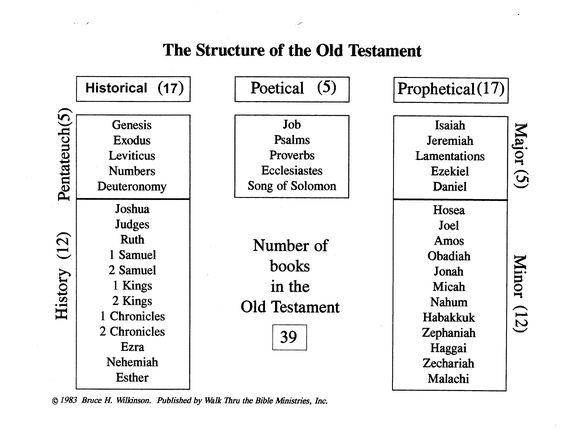
Here are the OT books divided by genre. This split-up is generally accepted. The Major vs. Minor prophets are not due to importance, but length.
Why is reading the Old Testament hard(er)?
First, because many churches today don’t preach from it. Congregants aren’t familiar with it.
Why does unfamiliarity of the text matter?
Ah, here’s where I explain about the mind and its ability to receive new genres or new types of information. It’s not your imagination and it’s not your lack of mental ability that sometimes people find reading the Old Testament a bit harder than the New. If you’ve ever tried to read a non-fiction book on a new subject, and you’re reading along and understanding the words themselves but can’t figure out the topic? Like, if you’ve picked up a biology book or a natural history book and you can parse each word but nothing is making sense overall?
It’s because we don’t have prior knowledge. Prior knowledge refers to all the knowledge of the world we have so far, cataloged in our memories.
Picture your brain like a bank of file cabinets. When you absorb something, your brain puts it in the file cabinet set up for that topic. There, the information you’ve just absorbed connects to information that’s already there. It’s like a ball of velcro floating through your brain, coming to settle and attach to other velcro balls in that file cabinet.
Comprehension, or understanding a text, involves constructing a relationship between what we already know about a topic and what is in the text. So your understanding, or comprehension, of a topic grows as you add more velcro balls to it. Picture a model of a molecule:

So comprehension involves drawing on prior knowledge, linking the new knowledge to the known, and classifying and organizing your new information.
Several things impact your ability to process new information. One is called concept density. When as a first or second grader and you read a lot of fiction books, there was a rhythm to it that you were familiar with. It began with once upon a time, introduced characters, presented a problem, worked through the problem, and resolved, usually with ‘happily ever after’ or some familiar ending. Reading fiction was like putting on an old blanket.
When you transitioned in 3rd grade to reading non-fiction, the rhythm, or schema, changed. There was no rhythm! Instead, you were given a lot of concepts right away, with no context. Something like, the subject of the Explorers in social studies, Magellan, Columbus, Drake, de Gama, Hudson, Vespucci…all at once and in short order. It was concept dense. Reading unfamiliar, concept dense texts is like wearing a hair shirt!
Add to that you were given lots of new vocabulary, all at once. Circumnavigate, passage, voyage, navigate, expedition, maroon, fleet, scurvy… phew. It’s a lot. With all the new information and all the unknown vocabulary, you have nothing to ‘hang your hat’ on so to speak. All this new information is floating in your brain as a velcro ball but it has no place to attach.
Talking about vocabulary and concept density, how about this example:
“There’s a bear in a plain wrapper doing flip-flops around the 77 and passing out green stamps.”
You likely know each word in that sentence individually, but as a whole? It doesn’t make sense. You understand how to read it mechanically but you can’t create meaning out of it unless you have prior knowledge of CB radios (concept) and trucker lingo (vocab).
That sentence means that there is a policeman in a plain car on Rt 77 driving up and down passing out tickets.
So is there hope for reading the Old Testament? Or the New, if you’re completely new to Christianity? Yes and for one huge reason.
The Holy Spirit. It’s His ministry of Illuminating the Bible to our minds. Here is the definition of illumination. (Please read this great article for what illumination is, and is not.)
Illumination is that ministry of the Holy Spirit whereby He develops in the believer a clearer understanding of, a stronger certainty in, a deeper love for, and a greater obedience to the meaning of the text of Scripture. Source
The Holy Spirit makes the Bible clear to us. Not perfectly, and it’s hard work, but the LORD didn’t inspire the scriptures and then trick us by making it too hard to understand. Mary was a young teenaged peasant girl who understood the Old Testament’s presentation of us as sinners and her need for a coming savior. (Luke 1:46).
The Reformers rebutted the Roman Catholic’s assertion that lay people couldn’t understand the Bible, saying “the Bible was clear enough for all believers to study and understand (the doctrine of the perspicuity of Scripture), and that the Holy Spirit was given equally to all who are born of God (the doctrine of the priesthood of all believers”). source.
There are two new vocabulary words for new concepts for you: Illumination and Perspicuity.
Here is an example of John the revelator attempting to put into words something completely new, in relating what he was seeing in the apocalyptic vision in the Book of Revelation. In this first set he makes a direct comparison that readers will understand because they can connect the new to the known. We all know what trumpets, furnaces, and emeralds are like:
a loud voice like a trumpet
The hair of His head was white like wool, as white as snow
His eyes were like a blazing fire
His feet were like polished bronze refined in a furnace
His voice was like the roar of many waters.
His face was like the sun shining at its brightest.
The One seated there looked like jasper and carnelian
a rainbow that gleamed like an emerald encircled the throne
In this second set, he tries to make a direct comparison but struggles, saying instead ‘something like’ because what he was trying to comprehend was SO out of the realm. Still, connecting the new to the known is possible, even with things in the Bible that are nearly incomprehensible:
And before the throne was something like a sea of glass, as clear as crystal
And I heard what sounded like a voice from among the four living creatures, saying…
something like a great mountain burning with fire was thrown into the sea.
And the locusts looked like horses prepared for battle, with something like crowns of gold on their heads
And I saw something like a sea of glass mixed with fire
Tips:
What you can do is, read the Old Testament! Pray before you begin, for help from the illuminating ministry of the Holy Spirit. Then just read. If you don’t understand, that is OK. If you ever lived or adventured where there is a lot of snow, you know the first time you walk through thigh-high snow it’s hard. You’re cutting the trail. The second time you benefit from the broken trail and it is easier.
That’s how it is with reading unfamiliar texts. You have to start somewhere, sometime. Cut the path. The things you don’t understand the first time you will gain a bit more clarity on the second, and so on. The more you tread the path, the more you will find your non-comprehension turning to comprehension.
Reading the Old Testament or even the New Testament is hard. It takes work. The Holy Spirit’s illuminating ministry doesn’t drop huge swathes of clarity to your mind as we sit there and go ‘Ohmmm’. We participate in our relationship with Christ by being diligent and studying the scriptures. Even Peter said there are things in the scriptures that are hard to understand. (2 Peter 3:16.) We won’t attain perfection but the sanctification process drives us ever forward in weaving a tapestry of understanding.
What to read? I’d suggest starting with Ruth or Jonah. Both are short and straightforward. Neither require a lot of knowledge of of history. Jonah can be paired with Nahum, which is the second part of the prophecy of Jonah, or, ‘what happened after’. If you read Ruth and the first 11 chapters of Luke you may see the similarities of the types being presented. Pairing some books is one way of connecting new to the known.
The entire Bible is inspired for our education, correction, and advancement of sanctification. All of it is profitable. (2 Timothy 3:16-17). So, go for it! Just read, plunge in and wade in the waters of truth and refreshment!