Posted in dead church, discernment, doctrine, gangrene, jesus

Do you know how fast false doctrine spreads?

and their talk will spread like gangrene. Among them are Hymenaeus and Philetus,” (2 Timothy 2:17)

In the book of Second Timothy, Paul realizes that his time on earth is short. He is pouring as much Spirit-inspired knowledge into his protegee, Timothy, as he can. The concern and love Paul has for his men and his churches is evident. Paul warned Timothy about two things mainly, remain in passionate love for Christ, and stay in true doctrine. These two things are linked.

Artist’s depiction of Paul Writing His Epistles,
16th century (Blaffer Foundation Collection, Houston).

After Paul warned Timothy to stay in true doctrine (and there are 25 imperatives in this letter) Paul said next in verses 15-18 for Timothy to avoid error. This brings us to the verse quoted above. False teachers’ talk spreads and it spreads fast. It is like a wildfire. Strong’s Concordance defines gangrene as it is used in the verse:

a gangrene, a disease by which any part of the body suffering from inflammation becomes so corrupted that, unless a remedy be seasonably applied, the evil continually spreads, attacks other parts, and at last eats away the bones

Barnes Notes explains,

This word – gangraina – occurs nowhere else in the New Testament. It is derived from graiō, grainō, to devour, corrode,” and means “gangrene” or “mortification” – the death of a part, spreading, unless arrested, by degrees over the whole body. The words rendered “will eat,” mean “will have nutriment;” that is, will spread over and consume the healthful parts. It will not merely destroy the parts immediately affected, but will extend into the surrounding healthy parts and destroy them also. So it is with erroneous doctrines. 

They will not merely eat out the truth in the particular matter to which they refer, but they will also spread over and corrupt other truths. The doctrines of religion are closely connected, and are dependent on each other – like the different parts of the human body. One cannot be corrupted without affecting those adjacent to it, and unless checked, the corruption will soon spread over the whole.”

We all know what gangrene does, even if we are not medically trained. Anyone who saw the Lonesome Dove television miniseries knows. It is a disease that spread fast and destroys. As you read this definition of how gangrene kills medically, apply these words spiritually to your mind. Physiologically, gangrene kills the living organism by cutting off the blood supply. To reverse the effects of the poison, a debridement must occur. According to Merriam-Webster, Debridement is “the usually surgical removal of lacerated, devitalized, or contaminated tissue. Let’s stop and consider the importance of a healthy blood flow to the members of the faith:

For the life of the flesh is in the blood, and I have given it for you on the altar to make atonement for your souls, for it is the blood that makes atonement by the life.” (Leviticus 17:11)

The Crucifixion, seen from the Cross, by James Tissot, 19th century

If allowed to progress, the tissue dies and then the entire appendage becomes contaminated. Remedies now must include an amputation. At this point, it’s interesting to consider these words from Matthew 5:30,

And if your right hand causes you to stumble, cut it off and throw it away. It is better for you to lose one part of your body than for your whole body to go into hell.”

If no remedy is applied by this time, the organism dies. The gates of Hell shall never prevail against His world-wide church, but parts of the body can die. Individual congregations die. Revelation 3:1 records one such dead church: Sardis.

Abandoned church in NM, by Emma, Wikimedia Commons

And to the angel of the church in Sardis write: ‘The words of him who has the seven spirits of God and the seven stars. “I know your works. You have the reputation of being alive, but you are dead.'”

There is so much here to ponder. First, this cements beyond all discussion that parts of the body can and do die. Where is the church at Ephesus? The church at Thyatira? Sardis? They died.

Second, Jesus knows the outside and the inside. He knows what is in a man. (John 2:24). Do you read the word reputation? That’s what we humans see. Have you ever seen a bustling church, read the long list of ministries on their web page, attended ‘Trunk or Treat’ and watched hundreds of little kids running around and smilingly indulgent parents standing by? It is a sure bet that somewhere a church like that is dead. Their reputation is one of acclaim, successful ministries, being busy, and even salvations, but Jesus knows the fact of the matter.

Third: churches that look alive can be in fact, dead.

Chickens run around for a while after their heads are cut off. So do churches. The end result is the same for churches that have been strangled by gangrenous doctrines that cut off the blood. Jesus hates false doctrines! (Revelation 2:6). Jesus’s Gospel IS doctrine, and without it, any individual or congregation will die. Therefore if Jesus as Truth is not the Head of the church, the church will die. First for a little while after they have left their first love, (Revelation 2:4) they’ll go on. Then they will exclude Jesus completely and put Him outside, (Revelation 3:20). Even if the the heartbeat of the church continues for a while the only end result will be death because they have slowly and painfully and maybe even unknowingly swapped true doctrine for false.

That is what false doctrine does. It kills.

The Good News is that Jesus said His church will never fail. (Matthew 16:18). Jesus made a charge to the Church at Ephesus when He said they had left their first love. However, before it is too late, there is always a remedy!

Remember therefore from where you have fallen; repent, and do the works you did at first.” (Revelation 2:5a).

Excise that false doctrine immediately, get it out of the Bride, before it can kill even one living cell in the body. Repent and He will forgive. 

If not, I will come to you and remove your lampstand from its place, unless you repent.” (Revelation 2:5b)

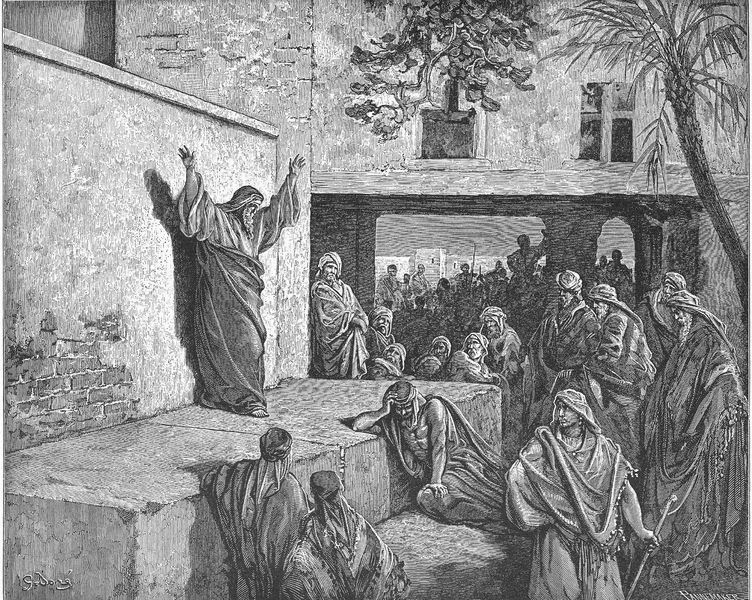
Micah Exhorts the Israelites to Repent, Gustave Dore, 1866, Wiki CC

Paul told Timothy later in the letter,

I charge thee therefore before God, and the Lord Jesus Christ, who shall judge the quick and the dead at his appearing and his kingdom; Preach the word; be instant in season, out of season; reprove, rebuke, exhort with all longsuffering and doctrine.” (2 Tim 4:1-2)

Remember the lesson of gangrene: is is poison,  it spreads fast, and it ultimately kills. Doctrine matters!

~~~~~~~~~~~~~~~~~~~~~~~~~
For further reading:

9 Marks: How does inattention to sound doctrine kill churches?

Thom Ranier: Autopsy of a Deceased Church: 11 Things I Learned

GotQuestions: Why do some churches thrive while others die?

Grace to You Article, Does doctrine really matter?

Ligonier Ministries: Drawing the Line: Why doctrine matters

Posted in charismatic, doctrine, error, God in a box, personal revelation, truth

Help! God is in a box! We have to get Him out!

This week I read a book to the kids at school called “Not A Box” by Antoinette Portis. It is a book about imagination. An unseen narrator asks a rabbit, “Why are you sitting in that box?” The ensuing pages record the rabbit’s responses, insisting it is not a box, whilst the illustrations show indeed that in the rabbit’s mind, the box is indeed something else and the rabbit is busy outside of it.

I write frequently of the absolute integrity and truthfulness of scripture and that the only reason we can say the bible is absolutely true is because it is the revealed word from a living and holy God. His word is contained in the bible and nowhere else. To be sure, we can see His qualities in creation, which revealed His creative power and His divine nature (Romans 1:19-20). But His revealed will to humans? In the bible and the bible alone.

However, Charismatics rely on experience as a standard of what God is revealing to them. They put their experience as high or even higher than the Word as revealed in the bible. If something spiritual happened to them, they believe it is real, and it therefore really reveals something God is doing, or saying, or thinking, or whatever.

When I show that that charismatic experiences count as nothing, that they are unbiblical and unworthy of attention, I receive responses saying, “Don’t put God in a box!” Or, “Don’t limit God!”

Let’s take a look at what a person is really saying when they say those things.

The issue: IS God in a box?

First, God cannot ever be ‘put in a box’ nor can God ever be ‘limited’ by humans. The thought is simply absurd. However, as He has chosen to reveal Himself and His will, He is confined to pages of scripture. Secondly, experience never trumps scripture. Ever. You can have all the “passion” you want for God, to the point that at spiritual events you jerk around so much look you like bacon in a fry pan, but that is not truth, it’s not doctrine, and it’s not from God. That isn’t even passion. It’s only impulses, and you’re being led astray. (2 Timothy 3:6).

If a person has a dream or a vision that is especially vivid, they say it is from God, that God is talking directly to them (And I mean YOU, Beth Moore…Sarah Young…Kim Walker Smith…). They ascribe all due spiritual gravitas to their experience and go about replaying it for any and all who would listen (and many who would not). They make themselves the hero of the story.

If confronted with the fact that though the Spirit is alive and working in sanctified Christians, but that tongues and miracles and signs have ceased, that is when they trot out the charge that by our denying their experience as perfectly and uniquely sent to them by God, we are putting God in a box, and we are limiting Him.

We know He is limitless, that is not the issue. However He has said He will operate in certain ways. During this Church Age He has said that He will use the Spirit to grow us in sanctification and will illuminate the scriptures for us. (John 16:13-14 ). He won’t suddenly decide to sky-write the messages He wants us to know. He can. But He won’t.

He has said that He listens to prayer as a method of communication. (Philippians 4:6). However, He won’t suddenly put notes in our mailbox (like in The Shack) or call us personally. He can. But He won’t.

Though we know He is alive, He is in heaven and will not come back until the Day. (Matthew 26:64). He won’t appear in our bathroom while we are shaving and put His arm around us. He can. But He won’t.

We know He CAN do those things, but we have confidence that He won’t. Why? He speaks through His word, His Son, and His Spirit. (2 Timothy 3:16, Hebrews 1:1-2, John 14:17, 1 Corinthians 3:16). He has said how He will operate. He spoke through men to write down His inspired word. And He doesn’t break His promises.

Inspiration is the doctrine that the Bible was written by the influence of God. It is, therefore, without error in the original documents. It is accurate and authoritatively represents God’s teachings (2 Tim. 3:16). As such it is a revelation from God which implies direct knowledge about God, creation, man, salvation, the future, etc. It is an illumination in that it shows us what we could not know apart from it. “

We cannot know apart from it. That includes knowing something of God because He supposedly rained gold dust down, or put a thought in your head or seemed to heal a guy at a faith crusade.

Yet the Charismatic will cite John 21:25, “Now there are also many other things that Jesus did. Were every one of them to be written, I suppose that the world itself could not contain the books that would be written.” And they will say that “See? Jesus did many other things. We can’t limit Him!”

We are not limiting Him by acknowledging what scripture says, that He performed many other wondrous things during His incarnation. It’s just that we don’t know what they were. Any speculations on what those things were is just that: speculation, guesswork, and vaporous estimations. If God had wanted us to know them, He would have put them in scripture. That He didn’t is no excuse to make some up. He told us not to go beyond what is written. (1 Corinthians 4:6)

The truth of the matter:

The problem is, the people who take God out of the box are really people who want to make God into what they want Him to be. It sounds all humble and everything to claim that it is limiting God by sticking to who He says He is in pages of holy writ. But it is really not humility. It’s pride. It is pride in their vision, pride in their alleged special relationship to Christ, who, after all, gave them a second blessing when they asked to be ‘filled with the Spirit.

His sovereign will is different from His revealed will. He has hidden from us some things He intends to do. The most glaring examples of His inscrutability on some matters are:
–what He was doing before creation and also,
–what we will do in eternity.

His revealed will, however, is just that: revealed. He has set down in words through men via the Spirit what He wants us to know about Him and what He wants us to know about what He plans to do and what he wants us to know to do for Him.

Therefore God IS IN A BOX, at least, as far as the pages of scripture go. And there He will stay this side of the veil.

Because, you see, once we take God out of the box, we make Him into whatever we want Him to be in our imagination. Once you take Him out of the pages of scripture, you say, ‘It’s not a box. It’s a highrise. My God is a fireman.”

Erroll Hulse wrote in his book, “The Blessings, Main Problem and Dangers of the Charismatic Experience,” that many Charismatics have a “Preoccupation with experience.”

During 1977 a believer described two revivals which he had witnessed in Borneo. The first was classical in the sense that it was typical of revivals down through the centuries. Preaching, conviction of sin, repentance and transformation of life were the predominating features. The second revival which followed a couple of years later was Charismatic in character. The speaker himself reflected the impact that the second revival had made upon him personally. He gave description after description of visions, exorcisms, healings, spirit baptisms and sensational events such as preservation in the jungle and the moving of lights in meetings. One felt while listening to this account that the Word of God had been supplanted by all the externals. It is possible to become so enamoured with the extraordinary and with excitements and sensational happenings that such matters become the daily diet of believers. Eventually it is all they can talk about which is the hallmark of most Charismatic books. Scripture is supplanted by the narration of events which goes on ad infinitum.

When you take God out of the box (pages of scripture) then you can say “It’s not a box. My God is a robot. But that’s OK if your God is a fireman. It would be limiting God by making Him be a definite thing.”

Many Charismatics who want God out of that box claim that by us conservatives sticking to scripture, we are denying the powerful work of the Holy Spirit. Not so. The great theologian J. Gresham Machan wrote,

Meanwhile we have the Holy Spirit, and we have the Scripture of the Old and New Testaments that the Holy Spirit uses. Much mischief has been wrought in the church by false notions of ‘the witness of the Spirit’; it has sometimes been supposed that the Holy Spirit makes us independent of the Bible. Just the opposite is the case.

The Holy Spirit is the Spirit of truth. He does not contradict in one generation what He has said in another. He does not contradict the Scriptures that He himself has given. On the contrary, what He really does is to make the words of Scripture glow with a heavenly light and burn in the hearts of men. Those Scriptures are placed in your hands. You may not say with the prophets of old: ‘God has spoken directly and independently to me; I appeal to no external authority; when I speak it is “Thus saith the Lord.”’ But you can do something else. You can mount your pulpit stairs; open reverently the Bible on the desk; pray to the gracious Spirit to make plain the words that He has spoken; and so unfold to needy people the Word of God.

Taking God out of the box (pages of scripture) opens one up to all sorts of mischief, as Machen wrote. We ascribe works to Him that He did not do. We ascribe attributes to Him He does not possess. We ascribe writings to Him He did not inspire. Taking God out of the box once too often, and you may find that it is satan you have loosed in your life, and not the Holy Spirit.

Hulse concludes,

Source

Jesus is Lord indeed. He has been exalted, crowned, celebrated and is adulated because he has procured our justification by the agonies on the cross. Any obscuring of that, his greatest achievement, is to defame his glory. If experience is permitted to gobble up doctrine, if love is allowed to devour principle, if sentiment is suffered to obscure justification by faith only — then how will the world’s multitudes be saved? How can Jesus be Lord for them? Satan will continue to have his dominion over them. Those who are ready to unite on the basis of love and common Charismatic experience at the expense of Justification should remember that in doing so they will be celebrating the lordship of Satan, not the Lordship of Christ.

~~~~~~~~~~~~~~~~~~~~~~~~

Further Reading

What We Talk About When We Say “You Can’t Put God in a Box (essay)

Is Experience a Valid Test of Truth? (sermon series)

One clear reason why Beth Moore is a false teacher:
Examining Beth Moore’s vision: the ‘Bride is paralyzed by unbelief’

God in a Box: Limiting Miracles is not Limiting God, Pt 1 (essay)

Posted in doctrine, post-modernism, rachel held evans

Can we ever know doctrine for certain?

“Beware of false prophets, who come to you in sheep’s clothing but inwardly are ravenous wolves. You will recognize them by their fruits. Are grapes gathered from thornbushes, or figs from thistles? So, every healthy tree bears good fruit, but the diseased tree bears bad fruit. A healthy tree cannot bear bad fruit, nor can a diseased tree bear good fruit. Every tree that does not bear good fruit is cut down and thrown into the fire. Thus you will recognize them by their fruits.” (Matthew 7:15-20)

I’ve often written about this passage, showing the process of recognition via the example Jesus gave. In other words, emphasizing the fruit. In this essay I want to focus on one simple thing.

The word will.

In today’s mushy, emergent, false humility-filled, intolerant of certainty world, people say you cannot know doctrine for certain, and to attempt to do so is arrogance. It’s popular to say that “Truth for me means…but I can’t be sure…I’m open to other interpretations…”

It is extremely unpopular to be dogmatic today. Yet if we cannot know good doctrine with any certainty, then that means we can’t know bad doctrine for certain, either. What they are basically saying is that it is never possible to know if a doctrine is false. This is very convenient for the false teachers out there because this would mean that they can never be identified.

But this is not what the bible says.

The verses above tell us that false prophets will come. False prophets (false teachers) bring false teachings. We know that. The word in the verse for false prophet is “pseudoprophētōn” and you notice the ‘pseudo’ right away. The definition of the word is “a false prophet; one who in God’s name teaches what is false.”

So watch out, they will come.

But have no fear, because … and here is the good news … you WILL recognize them. The verse states that plainly. It then sums up with its re-statement that you will recognize them. Jesus is assuring us that we will recognize the ones who come bringing false teachings and if they bring a false teaching then they are false themselves.

It doesn’t say, “You may recognize them.” It doesn’t say “Sometimes, in the right light, you could recognize them.” It doesn’t say “On a good day, it’s possible to recognize them.” It says, “You will recognize them.”

How do we recognize them? By their fruits- their teachings.

No wonder the emergent crowd so longs to bring disrepute to the certainty of understanding what is false and who is false! If all doctrine is potentially valid, then the ones bringing them are also valid, and should be listened to. This gives satan a toehold in your mind to widen that crack of doubt, plant false seeds, and confuse you. When Satan asked Eve, “Hath God said?” in Genesis 3:1, instead of being dogmatic and responding, “Yes, God hath said…” she answered with a confused doctrine that she had added to. Satan ran with that and persuaded her to bite the fruit. The rest is our sad history.

By saying we will recognize them, I don’t think it means that every believer will recognize every false teacher instantly at all times. We are a body. That means we are organic and mutually working together for the glory of God within the scope of each of our gifts the Spirit dispensed.

Just as a body, though one, has many parts, but all its many parts form one body, so it is with Christ.” (1 Corinthians 12:12)

Some were given discerning of spirits, others the gift of helps. Where those with discernment cry out that a wolf has infiltrated, others busy helping perk up and take heed. Where those with the gift of helps can earlier identify one who needs support, those who are watching for wolves may be slower to spot the need. We work together for His good and glory through the dispensing of the gifts.

Being dogmatic can be good and it can be bad. By dogmatic, I mean having studied, prayed, and come to a certain knowledge of a certain doctrine. We can never be casually dogmatic, or unintelligently dogmatic. Ever. But a person can be certain of right doctrine and can know when a doctrine is false for sure, too.

I’ll use the doctrine of hell. I mentioned in an earlier post that very early on in my walk I studied all the different interpretations of hell. Some people who teach from the bible, say that we go to hell for a period of time and after a length of punishment, are annihilated, never to exist again and released from their torment. Others who teach from the bible say that unbelievers go to hell and remain there forever enduring the wrath of God. Both use the bible but both cannot be right. One of these stances is contrary to the other.

The bible does not offer confusion nor does it contradict itself. In this way, I know that one of those doctrinal stances is wrong. I prayed for wisdom and studied further and it was a short while after that where I understood that hell is eternal conscious punishment. (Revelation 14:11). Therefore I no longer need to entertain the thought that annihilation is a possibility. I don’t need to be “open.” I know it to be false, because eternal punishment is true. I’m closed on the topic. The bible is black and white like that.

However being dogmatic about your uncertainty is dishonoring to Jesus, because you have entertained a false doctrine and haven’t sought to reconcile them via the Spirit, prayer, and study. Mrs Rachel Held Evans wrote of her ‘evolution’ away from the traditional doctrines of the bible in her book, “Evolving in Monkey Town.” The book describes that she learned “in order for her faith to survive in a postmodern context, it must adapt to change and evolve.” Her evolution was unfortunately away from the traditional biblical doctrines of young earth, eternal hell, and so on. Mrs Evans said to me today that “My point is that Christians disagree on the clarity of the issues you bring up. I think Fudge makes a good case…” She was referring to a well-known theologian Dr. Edward Fudge who teaches an annihilation view on hell.

Of course they make a good case. If they made a bad case we wouldn’t have any discord, but be of one mind and on the same page. Additionally, just the fact that disagreement exists does not mean that all viewpoints are valid nor are they true. It also doesn’t mean we stop seeking clarity, thinking, well, if so many disagree, then there must not be one truth about this.” No, never let it be so!

When teachers use the bible to make a good case but that case is at odds with another good case, stop, study, and pray. It is up to us to recognize that pre-tribulation rapture, mid-tribulation rapture and post-tribulation rapture cannot ALL be true. Traditional view of the Trinity and Modalism both cannot be true. If one refutes the other, it is up to us to seek wisdom from the Holy Spirit. He will guide me into truth. That I don’t seek clarity isn’t even under contention, though some fail at that first step. Once the Spirit delivers the answer, I am grateful and can then ponder the doctrine, think of all the verses that go with it, and better get to know Who my Savior is.

If you allow yourself to exist in a perpetual state of doctrinal confusion, then you will always be confused about who Christ is.

John 8:44 says that satan is the author of lies. As God is not the author of confusion (1 Corinthians 14:33) then satan IS the author of confusion and discord. Just because there are lies does not mean we cannot know the truth. Being careful to handle the word rightly, (2 Timothy 2:15) asking for wisdom (James 1:5) and discernment, and through the Holy Spirit, we can have comfort in knowing His truth.

You will recognize them. You will.

“But the wisdom from above is first pure, then peaceable, gentle, reasonable, full of mercy and good fruits, unwavering, without hypocrisy.” (James 3:17 NASB).

Posted in doctrine, emergent church, false christians, focus on the family

Focus on the Family, Bono, & who is a Christian; Part 3

Bono on his Co-Exist tour wearing his Co-Exist headband

Last week, President of the Christian organization Focus on the Family Jim Daly sat down with U2 rocker Bono. Mr Daly emerged from that interview trumpeting Mr Bono as a Christian, and write a glowing piece for Focus on the Family’s website and also published in the Washington Post called Why Orthodox Christians Should Appreciate An Unorthodox Bono“.

In parts one and two of the series of three parts, I looked at–

1. Focus on the Family’s increasing apostasy
2. Whether Bono is a Christian

And now in part 3 we’ll look at the lack of discernment in Christians today. Not everyone who claims Jesus is a Christian and it is important to understand that. I’ll tell you why.

–Accepting unquestioningly all people who claim Christianity but who obviously are not, blurs the lines of the faith.
–We are supposed to share truth to a lost and dying world. Non-Christians, including false Christians we accept as genuine, do not have that truth to share.

As GotQuestions states, “The evidence of a true Christian is displayed in both faith and action. “If anyone is in Christ, he is a new creation; the old has gone, the new has come!” (2 Corinthians 5:17). James says, “I will show you my faith by my works” (James 2:18). Jesus put it this way: “I am the light of the world. Whoever follows me will never walk in darkness, but will have the light of life” (John 8:12). A true Christian will show his faith by how he lives. Despite the wide variety of beliefs that fall under the general “Christian” label today, the Bible defines a true Christian as one who has personally received Jesus Christ as Savior, who trusts in the death and resurrection of Jesus Christ alone for forgiveness of sins, who has the Holy Spirit residing within, and whose life evinces change consistent with faith in Jesus.”

We are supposed to care who says they are a Christian because Christians are supposed to have the truth of Jesus in us and abide by the Spirit. If we do then we’re brethren, and we build each other up, pray for each other, and help each other. If they are not, we know to evangelize them with our words, witness to them with our lives, and separate from them in our spirit. Mindlessly accepting everyone who utters “Jesus” like a magic password, blurs those lines and foils the notion that we are supposed to be separate, holding onto the only truth in a dying world of relativism. This unwillingness to engage in what is at root a problem of discernment is the number one problem in the church.

John MacArthur said,  “People ask me this all the time, “… What do you see as the biggest problem in Christianity? The biggest problem in the church? It’s simple for me to answer that. The biggest problem in the church today is the absence of discernment. It’s a lack of discernment. It’s the biggest problem with Christian people, they make bad choices. They accept the wrong thing. They accept the wrong theology. The are prone to the wrong teaching. They’re unwise in who they follow, what they listen to and what they read.”

He continues, “I’m afraid that is pretty typical of the contemporary evangelical scene. There is a lack of precision in thinking, there’s a lack of consistency, there’s a lack of integrity. It’s just a hodgepodge, listening to anybody and everybody, reading anything, making no particular judgments. In fact, to make a judgment may be seen as unchristian. Boundless, endless credulity, anything and everything except there’s got to be good in all of it, how dare you question anybody’s view on anything. And I really believe that because of this pervasive attitude, evangelical Christianity, biblical Christianity as we know it is fighting for its life. Amazing to think about.”

Bertrand Russell had a lot to say about our lack of consistency and lack of integrity to the truth, as we’ll see below.

The reason biblical Christianity is fighting for its life is related to something that Martyn Lloyd Jones predicted 40 years ago. Martyn Lloyd-Jones wrote in his 1970 book ‘Romans: An Exposition of Chapters’:

Martyn Lloyd-Jones

“Disapproval of polemics in the Christian Church is a very serious matter. But that is the attitude of the age in which we live. The prevailing idea today in many circles is not to bother about these things. As long as we are all Christians, anyhow, somehow, all is well. Do not let us argue about doctrine, let us all be Christians together and talk about the love of God. That is really the whole basis of ecumenicity. Unfortunately, that same attitude is creeping into evangelical circles also and many say that we must not be too precise about these things. If you hold that view, you are criticizing the Apostle Paul, you are saying that he was wrong, and at the same time you are criticizing the Scriptures. The Scriptures argue and debate and dispute; they are full of polemics.”

Polemics defined is: contentious arguments that are intended to establish the truth of a specific understanding and the falsity of the contrary position. (source). That is Christianity in a nutshell, isn’t it! Jesus is the only way to heaven…you must repent or die…Jesus is God and there is no other… These are polemical arguments.  A polemic is one definite controversial thesis. Debate is the second cousin to polemics. Debate is not so definite, debate allows for common ground between the two disputants. A polemic is intended to establish the truth of a point of view while refuting the opposing point of view. In polemics, there is one truth only. In debate, there is compromise and common ground. That is why we cannot debate and compromise in Christianity.

The problem today is that people debate. They don’t engage in polemics. A polemicist says, “There is only one truth and here it is, there is no other name by which you many be saved than that of Jesus. If you do not claim that name in repentance, you will go to hell.” (Acts 4:12, 2 Thessalonians 1:8-9). Saying that truth today is becoming increasingly radical. Also radical is marking the boundaries of Christianity and claiming that such and such a person is outside of it.

Christianity is itself a polemic. The book of John establishes right and wrong, good and evil, light and

Source

dark. There is either or. Jesus is either God or He isn’t. You are of this world or you are not. Yet today there is a refusal to state the one truth, polemically, and this has allowed all manner of untruths to creep in. For example,

“But there are some things in the Word of God that are very clear and those are the things that are at the heart of our faith. And one of them is to understand who is a true Christian. And it’s astonishing to me how confused people are. I talked to one of the students at the college who went to Amsterdam 2000 this summer, this convocation of thousands of evangelists. And he is a college student, he said to me, “I couldn’t believe what I heard. The thing was opened by a Roman Catholic priest, and there was a man there who denied the resurrection of Jesus Christ and they all received applause and a standing ovation.” By evangelicals? And when somebody steps in and says, “Stop this charade, this pretense of Christianity, let’s get down to who’s really a Christian,” you get vilified and marginalized and alienated. But that’s okay because what matters is the truth. So we’re trying to deal with the truth.” (source)

Christianity by nature of its polemical stance, is divisive. It is supposed to be. I am not saying that people are supposed to be divisive on purpose by being disagreeable for the sake of being disagreeable. However, stating the truth divides. Didn’t Jesus say,

Source

“The Sword of the Gospel”
“Think not that I am come to send peace on earth: I came not to send peace, but a sword. For I am come to set a man at variance against his father, and the daughter against her mother, and the daughter in law against her mother in law. And a man’s foes shall be they of his own household.” (Matthew 10:34-36).

So no, Bono by believing in other religions is not a Christian. It is important to say these things. So how do you tell who a Christian is, here is MacArthur again:

“And the way to understand who a Christian is, I’ve concluded after a long time trying to get to this point, is to understand deliverance, the theology of deliverance. You can tell a Christian because they’re delivered. That’s what the Bible teaches.”

“The first category of deliverance is those who are really Christians have been delivered out of error into truth. Now listen to what I say. No one is a Christian who does not understand, believe, embrace and love the truth. What truth? The truth that we call the gospel. …When the Spirit of truth regenerates, He moves people from error to truth. He brings the sinner the understanding of, belief in, embracing of, and total commitment to the truth.”

You can tell a Christian because they know the truth and a non-Christian doesn’t. Simple.

It is important if we are a Christian be clear about any interlopers in our midst. Look at poor Bertrand Russell. The philosopher Bertrand Russell gave a lecture in 1927 in London, called “Why I am Not a Christian.” In it, he bemoans the watering down of what the definition of Christianity is, and mocks those of us who are holding the hose.

Bertrand Russell

“As your chairman has told you, the subject about which I am going to speak to you tonight is “Why I Am Not a Christian.” Perhaps it would be as well, first of all, to try to make out what one means by the word “Christian.” It is used in these days in a very loose sense by a great many people. Some people mean no more by it than a person who attempts to live a good life. In that sense I suppose there would be Christians in all sects and creeds; but I do not think that that is the proper sense of the word, if only because it would imply that all the people who are not Christians — all the Buddhists, Confucians, Mohammedans, and so on — are not trying to live a good life. I do not mean by a Christian any person who tries to live decently according to his lights. I think that you must have a certain amount of definite belief before you have a right to call yourself a Christian. The word does not have quite such a full-blooded meaning now as it had in the times of St. Augustine and St. Thomas Aquinas. In those days, if a man said that he was a Christian it was known what he meant. You accepted a whole collection of creeds which were set out with great precision, and every single syllable of those creeds you believed with the whole strength of your convictions.”

Having certainty and conviction of clear doctrines was something that atheist Russell could respect, even get behind. Ultimately, so can Jesus.

“‘I know your works: you are neither cold nor hot. Would that you were either cold or hot! So, because you are lukewarm, and neither hot nor cold, I will spit you out of my mouth.” (Revelation 3:15-16).

Russell says our definition of Christian is too elastic, and he is right to wonder about the whole shebang of Christianity when we let so precious a truth become elasticised and stretched beyond recognition! It is his way of saying, “If they don’t care what Christianity is, why should I?” And when the false professors we have allowed into our midst fall away, and they always do, then what?

Phil Johnson

Phil Johnson of Grace Community Church and Executive Director, Grace to You, was assigned the task of explaining and critiquing the emerging church movement in one of the 75-minute sessions at the 2006 Shepherd’s Conference The resulting paper is titled, “Exposing the Postmodern Errors of the Emerging Church”. (a .pdf).

Pastor Johnson said the emerging church movement is an “irrational agglomeration of unorthodox ideas”, and of Bono, Johnson said he is one of the prime leaders of it. “This may help you more than anything I have said so far to understand the flavor of the “emerging church movement”: Bono—the Irish rocker and politico of U2 fame—seems to be the unofficial icon of the movement. If you’ve been tuned into pop-culture at any time over the past two decades and know anything about Bono, that might help you to grasp something about the look and feel of the movement”. … emergent types seem to quote Bono all the time. I would say that he sometimes seems to be the chief theologian of the “emerging church movement,” but in all fairness, that honor belongs more to John R. Franke and Stan Grenz. .. But he and Franke are the two academic theologians who have done more than anyone else to blend postmodernism and theology into a kind of quasi-evangelical doctrine”.

And that is what we have today. We have a long-standing organization such as Focus on the Family promoting an icon in Bono who represents a false movement which is bringing quasi-evangelical doctrine to quasi-evangelical Christians. On the other side we have an elder of the faith in Pr. Johnson who says that movement Bono represents is full of irrational agglomeration of unorthodox ideas, has contempt for biblical authority, breeds doubt about the perspicuity of Scripture, and sows confusion about the mission of the church.

At the January 2013 Convocation of the Bangor Theological Seminary in Maine, Rev. Steven Lewis noted that there are indicators that the religious landscape of North America has radically changed. “That landscape change includes a spiritual revival and renewal afoot but it is not religious, the Rev. Steven Lewis, academic dean of Bangor Theological Seminary, said in January in the opening session of Convocation. He called it “humanitarian spirituality.”

Who wouldn’t be confused about who’s really a Christian when seminaries are graduating theologians who are told these terrible things? It is exactly this ‘humanitarian spirituality’ which Bono exemplifies-that Jesus will vomit out His mouth. As blogger Elliott Nesch said of the Daly-Bono meeting and the resulting version of Christianity which was unfortunately validated through it, “Philanthropy is no substitute for the Gospel of Jesus Christ! … Bono is embraced and given the upper-hand in both religious and political spheres of influence. Many are following Bono in social justice but throwing the Gospel out the window. Bono’s hip Christianity will inspire many Christians to embrace ecumenism and apostasy in the cloak of philanthropy. This is a politicized social Gospel which is contrary to the doctrine of Christ.”

And THAT’S why we care about who is a Christian.

————————–
Focus on the Family, Bono, & who is a Christian Part 1

Focus on the Family, Bono, & who is a Christian? Part 2
Posted in doctrine, scripture, theology

Is your doctrinal screw loose?

The tiny screw fell out of my glasses this week. I was standing in the kitchen and all of a sudden the lens to my glasses popped out and fell to the rug. I took off the frames and saw that the screw at the end of the bow had come out. This released the frame to widen itself, and they no longer held in the lens.

It is a very, very tiny screw. I got on my hands and knees with a flashlight and used my other hand to gently sweep all over the entire rug. Of course the screw is the same color of the rug, and it’s about 1/32nd of an inch long. I never found the screw.

Without the screw that holds the frame together that holds the lens on the glasses that go on my head that allow me to see…I can’t see. I have severe astigmatism and I cannot see things even a few feet away. I’m not allowed to drive without glasses, either. I have a spare pair but the lens prescription is a bit outdated, but they had to do until the next morning when I went to the Dollar Store and bought an eyeglasses repair kit.

I got to thinking about the small, tiny thing that holds it all together. Once you take the small thing out, it all starts to unravel.

I’d written about this concept in March 2011 but from a different angle I am taking it today.

The pair of glasses are a system, unified, whole, and each part of it depends on the other for its entire integrity. When all parts are there, the whole thing works

The glasses are like the bible.

If you remove part of it, the whole thing falls apart.

I am NOT saying that the Word of God is in any way insubstantial, tenuous, or will falter. “Is not my word like fire, declares the Lord, and like a hammer that breaks the rock in pieces? ” (Jeremiah 23:29)

His Word upholds the universe and it will ever pass away. (Matthew 24:35).

I am talking about OUR belief in the Word. When you start picking and choosing this little part to believe and that little part not to believe, the unity and perfection of the word is such that each verse relies on the other. Your belief will start to crumble the moment you say something like this (and a church leader actually said this to me:)

“I’m not sure about the whole Jonah and the fish thing. As a matter of fact, I just take the whole Old Testament with a grain of salt!”

Picture the story of Jonah being swallowed by the whale as that little screw. Initially, you might think that not believing that small section of scripture won’t harm your entire theology. It’s just a few verses in a very short book after all. But if you doubt the Jonah story, then what about this:

“For just as Jonah was three days and three nights in the belly of the great fish, so will the Son of Man be three days and three nights in the heart of the earth.” (Matthew 12:40).

Do you doubt what Jesus was saying? If you doubt the verse in Jonah 1, then you must doubt the verses in Matthew 12. And now your theological hold just got wider, and the screw in the glasses frame just got looser.

(Depiction of Jonah and the “great fish” on the south doorway of the Gothic-era Dom St. Peter in Worms, Germany.)

You might give room in your mind to the possibility of theological evolution – as Billy Graham does – and that ultimately to settle that belief in a literal version of the creation story “makes no difference.” But oh, it surely does. Graham said:

“I believe that God created man, and whether it came by an evolutionary process and at a certain point He took this person or being and made him a living soul or not, does not change the fact that God did create man. … whichever way God did it makes no difference as to what man is and man’s relationship to God.” – [Billy Graham: Personal Thoughts of a Public Man, 1997. p. 72-74]

Because Graham gave room in his mind for the possibility of evolution, then he made his hole bigger because Paul said “Thus it is written, “The first man Adam became a living being”; in 1 Corinthians 15:45, and in 1 Timothy 2:13 Paul said “For Adam was formed first, then Eve;”. Does a person discount those verses, too? One must, if he believes God could have evolved man and not created him, as Graham does.

In the end, Graham decided that all people go to heaven, even those who never heard about Jesus, as he told Robert Schuller and Larry King at different times. His slide away from the faith was long and slow, but just as damning.

Noah’s Ark, by Edward Hicks, Wikipedia

Some people say they do not believe the ark story, the animals could not possibly have fit onto a boat. But then one must discount what Peter said in 2 Peter 2:5- “if he did not spare the ancient world, but preserved Noah, a herald of righteousness, with seven others, when he brought a flood upon the world of the ungodly;”

The point is, you must believe all of it, or none of it.

I can’t afford to go get more glasses. I decided it is more prudent to periodically make sure my glasses frames don’t have a screw that’s loose. If I have a screw loose, it could all too easily come breaking apart, and we would not want that to happen, would we! I’m pretty fond of seeing.

Henry II suit of armor,
Wikimedia Commons

Same with our doctrine. Periodically check to make sure you are using proper discernment. Pray to God for Him to sanctify you daily. Put on the full armor of God and pray ceaselessly (thus oiling the armor) so you will be protected from satan’s screwdriver that will try to find a loose screw to unhinge it.

“Therefore we must pay much closer attention to what we have heard, lest we drift away from it.” (Hebrews 2:1)

“John Jefferson Davis writes:

Even though Calvin believes that regeneration is irreversible . . . he does not conclude that the Christian has any cause for spiritual complacency. Persevering in God’s grace requires, on the human side, “severe and arduous effort.” . . . The believer needs to continually feed his soul on the preaching of the Word and to grow in faith throughout the whole course of life. Since it is easy for the believer to fall away for a time from the grace of God, there is constant need for “striving and vigilance, if we would persevere in the grace of God.” Calvin thus balances his theological certitudes with pastoral warnings. . . . The believer must continually exercise faith and obedience to make “his calling and election sure.” (Davis, “The Perseverance of the Saints: A History of the Doctrine,” 222.)

Believe all of it. If you doubt, ask the Holy Spirit to help you. That is one of His ministries!

In the end belief in what some claim are the more the more fantastical parts of the Word boil down to this:

“All Scripture is breathed out by God and profitable for teaching, for reproof, for correction, and for training in righteousness,” (2 Timothy 3:16)

The scriptures doesn’t say some parts are good, or a few parts, or even most parts. It says all scripture. Check to see if you have a screw loose. The lens could pop out and then you will not be seeing clearly. But regular maintenance of your eye-wear will result in seeing clearly, and beholding Jesus is the most beautiful thing you could ever hope to view. Having a right view of scripture is that beautiful perspective.

PS: I did fix my glasses. It was very difficult and it took a long time, and many tools. The screw is so small, I needed to use tweezers to even pick it up. I gripped too hard and the thing went flying off somewhere. Repeat the search on hands and knees with flashlight and hand feeling around everywhere. Not to be found.

I spent about 45 minutes reconstructing the frames, setting the lens on the thin frame just right, squeezing the clamp together, trying the different size screws, using the teeny screwdriver, had to use the tweezers again at the end to hold the clamp tight enough so the lens would be securely held. Let me tell you, the whole thing was such a pain that it is WAY easier to make sure that it is tight in the first place than to re-do the whole thing at time, expense, and frustration, and risking having to spend even more to get new glasses!

Posted in discernment, doctrine, last days

Discernment: Why is it important?

Justin Peters is an ordained minister and preacher, but is more well-known for his creation of the seminar “A Call for Discernment”. It is an in-depth, biblical critique of the Prosperity Gospel/Health-Wealth false gospel. This false gospel is also known as a Word Faith Movement, perpetuated by Benny Hinn, Joel Osteen, Joyce Meyer and many others.

His bio says that as a teenager, Justin himself attended faith-healing services in hopes of being delivered from his Cerebral Palsy. Though the potential was there to shake his faith in the Lord, in the long run, these experiences had the opposite effect. He says he has learned that his CP is a blessing because it keeps him dependent on God in his own weakness.

What is Discernment and why is it important? Are we supposed to “judge” or not? Are we told to discern even if we do not have the spiritual gift of discernment? In this seminar, Peters shows that discernment is a duty for all Christians, not only to detect issues in Word-Faith preaching, but in all aspects of a Christian’s life.

You might have heard people say, “I don’t need to know doctrine. I am not a theologian. I just loooove Jesus.” Peters says, that is a foolish statement. You cannot know someone unless you study them and know who they are. If you want to love Jesus, become a student of Him, and study His word. It is a false humility to say you don’t need doctrine.

Here is a link to the session’s .pdf outline that you can read along with the seminar clip below.

If you don’t want to or don’t have time to watch the entire video above, here is Todd Friel of Wretched Radio & TV, interviewing Justin Peters, discussing the Word of Faith movement in this 7-minute clip.

The Lord is gracious and kind. He gave us His word in the bible so we would not be unaware of satan’s schemes (2 Corinthians 2:11). I believe the battle is growing more deep and fierce. Satan is scheming mightily to make the unwary drift away (Hebrews 2:1-4). Keep your anchor dug in- the anchor is Jesus. He is the rock, the foundation of our faith. There is no greater joy than in clinging to Him. Never fear: no one can ever snatch us out of His hand. (John 10:29).

Love Jesus by getting to know him, in His word. Doctrine matters. So does discernment. Ultimately the scriptures tell us why doctrine and discernment are important:

“For whatever was written was given to us for our learning, that through patience and comfort of the scriptures we might have hope.” (Romans 15:4 KJV)

HOPE! What a blessed word in dark days! Light shines and hearts melt and love reigns. Hope! Hope in Him, learn about Him, He is the treasure!

Posted in doctrine

Adorning His doctrine

We read in the “Pastoral Epistles”, Titus and Timothy, what to do that is consistent with sound doctrine. The pastoral epistles are: “those letters written by Paul to Timothy and Titus in the New Testament. So, they are 1 and 2 Timothy and Titus. They are called pastoral because they are letters with instructions for pastors, congregations, and general functions within the church.”

We read what people are supposed to do in order to display the highest qualifications for behavior and character.

I want to note the first sentence of Titus 2:1-10,

But as for you, teach what accords with sound doctrine. Older men are to be sober-minded, dignified, self-controlled, sound in faith, in love, and in steadfastness. Older women likewise are to be reverent in behavior, not slanderers or slaves to much wine. They are to teach what is good, and so train the young women to love their husbands and children, to be self-controlled, pure, working at home, kind, and submissive to their own husbands, that the word of God may not be reviled. Likewise, urge the younger men to be self-controlled. Show yourself in all respects to be a model of good works, and in your teaching show integrity, dignity, and sound speech that cannot be condemned, so that an opponent may be put to shame, having nothing evil to say about us. Slaves are to be submissive to their own masters in everything; they are to be well-pleasing, not argumentative, not pilfering, but showing all good faith, so that in everything they may adorn the doctrine of God our Savior.

Paul is telling Titus to teach according to sound doctrine. Paul does not particularly outline what the sound doctrine is, at this point because the point of the letter is to encourage Titus to display and hence his flock to display certain behavioral attributes. In displaying these attributes in life, they will be acting consistently with sound doctrine.

In an interesting parallel, Paul gives Timothy a list of behavioral attributes, too. The difference is, Paul’s list to Timothy includes behaviors that are contrary to sound doctrine. Here is the list:

Now we know that the law is good, if one uses it lawfully, understanding this, that the law is not laid down for the just but for the lawless and disobedient, for the ungodly and sinners, for the unholy and profane, for those who strike their fathers and mothers, for murderers, the sexually immoral, men who practice homosexuality, enslavers, liars, perjurers, and whatever else is contrary to sound doctrine, in accordance with the gospel of the glory of the blessed God with which I have been entrusted. (1 Timothy 1:8-11)

Anyone displaying these negative attributes in their behavior are acting against sound doctrine.

The second thing to focus on is the reason we are to behave consistent with the good doctrine we have been taught. It is so that the name of Jesus will not come under reproach. If we behave against sound doctrine, the adversary (satan, that old dragon) will be able to use us to bring reproach upon Jesus’ name.

In the unbelieving world, it is very easy to avoid Christians. Their mind is darkened, so they do not see us.

“Now this I say and testify in the Lord, that you must no longer walk as the Gentiles do, in the futility of their minds. They are darkened in their understanding, alienated from the life of God because of the ignorance that is in them, due to their hardness of heart.” (Ephesians 4:17-18)

Two kingdoms are co-existing side by side, locked in a war. The opponents are- satan’s army and his unbelievers whom he influences, and Jesus’s army and His saved believers. The unbelievers do not really see us but they are aware of our presence. What I mean is, unbelievers as a whole do not think about Christians in their daily lives. It is very easy to have no contact with Christians, be unaware and uncaring about Christian life, and go for long periods of time not hearing or seeing Christian language or behavior. It is like oil and water. As we know, oil and water may occupy the same space in a glass, but they do not mix.

And also as we know, the kingdom of Jesus is not of this earth. (John 18:36). It is in heaven. So how will the unbeliever see the kingdom of God?

When we behave in the sterling way as Paul outlined to Titus, the veil parts. The unbeliever sees the Kingdom. He sees it because the Light is so bright! He cannot avoid seeing the Kingdom that dwells among them because the Light is so bright!

“for behold, the kingdom of God is in the midst of you.” (Luke 17:21b)

We ARE the kingdom, the veil parts, they see us when we act according to kingdom attributes. How will the unbeliever see the King, unless they see the Kingdom? Jesus is in heaven on His throne, but the kingdom He created is within us for this present age. The unbeliever will see it if we act according to sound doctrine, as Paul urges Titus.

Never let anyone tell you that ‘doctrine doesn’t matter.’ It does. It is not just head knowledge but it expresses itself through behavior that brings the Kingdom forward and lets the blind to see the unreproached name of Jesus.

Paul ended that paragraph by saying that we may adorn the doctrine of Christ the Savior. The word adorn id defined – “properly, to beautify; to adorn, make compellingly attractive, very appealing (inviting, awesomely gorgeous).

We are not gorgeous but Jesus in us is gorgeous! Let us pray for the strength and wisdom to go forward each day so that we may adorn Him, and be compellingly attractive in the eyes of those who are living in such darkness. We have been told how to act, and how not to act.

In 1415, Henry V was severely outnumbered as they prepared for battle at Agincourt. This battle was dramatised by William Shakespeare in the play Henry V featuring the St. Crispin’s Day Speech in which Henry inspired his much outnumbered English forces to fight the French. It was a stirring moment in the film adaptation when actor Kenneth Branagh gave the speech. It was the speech when the King said, once more into the breach, dear friends. I was inspired to jump up and fight against the opposing forces! It was unusual for a king to call his army men ‘friends.’

Our King has given us a stirring speech, too. It is the bible. His doctrine is the inspiration for us to leap up and go into battle. But our battle is not in flesh and blood nor with swords. Our battle is through our behavior and our words, and the love we carry for our King, a remarkable eternal king who calls US His friends. Would you fight for Him in kindness and gentleness so that we may adorn Him?

Posted in challies, conflict, doctrine, voskamp

In which Tim Challies realizes Ann Voskamp is a real person

Canadian pastor and writer Tim Challies is a book reviewer. He runs a very successful and widely read website at Challies.com. Many people, including myself, read his book reviews of Christian books with eagerness, because he is loving, credible, and discerning. As for discerning, Tim wrote the book on discernment, literally. He is a good writer and a gentle Christian even when he writes a negative review.

Last week Mr Challies reviewed Ann Voskamp’s book “One Thousand Gifts“. He gave it a ‘not recommended,’ stating at the first paragraph of his three paragraph conclusion, “Though One Thousand Gifts is not without some strengths, in its own subtle way I believe that it can and will prove dangerous, at least to some. Many will read it, embrace their need for gratitude, and genuinely be more grateful to God. This is well and good. There are many books that contain valuable takeaways even if they also contain significant weaknesses. It doesn’t make you a bad person or an immature Christian if you’ve read it and enjoyed it. But perhaps you’d do well to make sure you haven’t bought into it all the way.” He goes on to praise its strengths but overall he cautions the discerning reader because the book fails to “more clearly display the power of Scripture to show us our shortcomings and display the gospel’s power over them.” He noted what many have noticed, the book’s drift toward Gnosticism.

Okey dokey then.

Then a day later Mr Challies received an invitation to lunch at Mrs Voskamp’s house, two hours away. Gulp. Having to face her as a person so shortly after his review of the book, he wrote a retraction essay titled, “In Which I Ask Ann Voskamp’s Forgiveness…

He wrote, “Having said all of that, something happened inside me when I saw Ann’s name in my inbox, and that’s what has compelled me to write this little article. Seeing her name brought a sudden and surprising realization and with it a twinge of guilt and remorse.”

He makes it clear he had no moral qualms about not recommending the book, but rather that his guilt lay in the fact that he perceived that he treated a sister in the faith badly. He said, “Yet in my review I had treated her as if her words mean less than mine, as if I was free to criticize her in a way I would not want to be criticized.”

Now you lost me.

Perhaps I am a mean and unloving person, insensitive to the more nuanced expressions of empathy and oblivious to the tender affections emanating from others. I must be, because I read nothing in Mr Challies review that lacked sensitivity or indicated he had approached the task of reviewing a sister’s book with anything less than full bore mental acuity tempered with affection and mindfulness of our sanctified position before Christ.

Therefore when I read the forgiveness essay I was dismayed for two reasons. First, because of what he wrote here:

“Looking back at my review, and perhaps even more, the process of writing it, there are at least two things that concern me. The first is that I would have said certain things differently had I known that she and I might soon be sharing a meal together.”

Of course we would write or say things differently if we knew that we’d be facing the person within the next week. That’s the problem. The point is NOT to write or say things differently if we knew we would be seeing them the next moment but to prayerfully approach the task and write as the Spirit leads, speaking the truth in love. And then standing by it. Mr Challies wrung his hands over language he intimated he thought borders on hate-speech regarding Ms Voskamp’s literary style, here, “There is clearly a kind of appeal to it so that those who don’t hate it, love it.”’

Seriously? A commenter stated “I read your review of her book and found nothing wrong with it. You, of all people, do not need to worry about sounding unloving. I sure hope Rob Bell never invites you over for a BBQ.”

Exactly.

Far be it for me to say one way or another how a person feels about things they have said or done, and obviously Mr Challies felt remorse and so did what he did, which is publicly seek forgiveness for language he felt was too strong. I do not feel it was unloving language, but he did. So be it. It was his subjective call to make.

But the second front on which I felt dismay for this public hand-wringing is based on a more objective observation: the general climate of discernment within Christian circles. Christians these days are already assaulted with appeals to never say anything bad about anyone for any reason, especially against teachings a fellow believer brings- even if the teachings are false! The climate is to stay ‘unified’ and remain above the fray so as to avoid conflict. His forgiveness essay sets those of us back who do not hold to that ecumenical, let’s all get along at all costs mentality, and in a big way.

Later, in the comments section, a Reg Schofield commented, “I’m a bit confused here Tim. The review itself was not a direct attack on her as a person but on what you perceived as her weakness in how she handles scripture and certain views of the gospel narrative. Now it is true that what one writes is a reflection of ones soul but if what is written shows some problems, they have to be taken to task. I have read enough of the book to see some truly troubling elements, which she needs to be called out on. Any writer who get published must be willing to be scrutinized. I don’t see the need to ask for forgiveness. So if Joel Osteen sends you a e-mail to do lunch, are you going to do the same.”

Mr Challies responded, “I guess that is exactly part of the problem; in my mind I was equating the Joel Osteen’s of the world and the Ann Voskamp’s of the world–lumping all “outsiders” together. There are some people who deserve the harshest kinds of rebuke from Christians; there are others who do not. I have not been careful enough to distinguish between them.” And later, he wrote, “I would want to draw a distinction between T.D. Jakes and Ann Voskamp. T.D. Jakes subscribes to heretical theology; I have never seen anything from Ann Voskamp that would label her a heretic. That’s a crucial distinction!”

No it isn’t. The implication he makes here is that we musn’t say negative things about believers who are bringing false doctrine. It may not be what he intended, but that is the implication.

There are many examples in the bible of speaking plainly to and in front of believers who need correction. I am NOT saying it isn’t good to examine our language occasionally to see if we could be serving Christ better with our words. But feeding into the current cultural mentality that we must pick and choose words so as to never hurt another’s feelings harms the stand we must sometimes make for Christ. It elevates feelings above the advancement of the Kingdom. Let’s contrast what I just said with the biblical examples:

Picture Paul sitting at his desk in Canada. He gets an email reporting that there is sexual immorality in one of his churches. He writes back, “It is actually reported that there is sexual immorality among you, and of a kind that is not tolerated even among pagans, for a man has his father’s wife. And you are arrogant! Ought you not rather to mourn? Let him who has done this be removed from among you.”… a couple of verses later he called for them “To deliver such an one unto Satan for the destruction of the flesh, that the spirit may be saved in the day of the Lord Jesus.” (1 Cor 5:1-2, 5)

He called the people of the congregation arrogant! Paul told them to put the man out of fellowship so satan could deal with him! Now let’s picture Paul receiving an invitation to sup with the perpetrator of the immorality the next day, and this prompts him to write what Mr Challies wrote: “I did poorly here and I can see that I need to grow in my ability to critique the ideas in a book even while being kind and loving to its author.”

Or Galatians 2:1 where Paul said this: “But when Cephas came to Antioch, I opposed him to his face, because he stood condemned.”

How dare a fellow believer say another believer is condemned! But Paul did, and he didn’t retract it later just because he was invited to have a sandwich at Peter’s house. Paul made no ‘crucial distinction’ about the person he said it to. And it was language that was a lot rougher than Mr Challies. Yet it is in the bible. Paul said what he said so that doctrine would be upheld, and so that the watching believers, and Peter himself, would return to purity. Did Paul second guess his language, wondering as Mr Challies wrote, “…I can’t deny that somewhere in my mind lurks this insider and outsider kind of thinking which somehow encourages me to extend greater courtesy to one group than another”?” Yet there is no doubt that Paul loved Peter, and extended every courtesy to him.

Peter charged Ananias, a fellow believer, with having a heart filled with satan. He charged Sapphira, Ananias’s wife with the same, being a liar.

Paul wrote to Timothy, saying pastors of the church Hymenaeus and Alexander were “blasphemers”. (1 Timothy 1:19b-20).

Paul wrote to Timothy again, charging Hymenaeus and Philetus with being irreverent babblers whose false teaching will spread like gangrene and upsets the faith of some. (2 Tim 2:16-19). Strong language!

Paul did not later retract and write the following: “There is value in engaging the ideas in any [teaching], and especially a [teaching] about this Christian life, but the desire to uphold truth has no business coming into conflict with love for another person. Truth and love are to be held together as friends, not separated as if they are enemies. In my desire to say what was true, I failed to love. I ask [Hymenaeus and Philetus’s] forgiveness for this.”

And herein lies the problem. The current cultural Christian mentality is that speaking against false doctrine is unloving.

In some cases, we are called to conflict. Conflict is loving, when it has the ultimate goal of restoring some to the faith, or of warning others of false doctrine. Mr Challies’ statement above unfortunately advances the false notion that conflict is to be avoided at all costs.

Have we all become so sensitive that we receive the gentle words Challies utters as hate speech to be immediately retracted on the flimsy premise that we will soon have a BBQ together? Yes. And here is the result.

Beth Moore ‏tweeted, “Thank you for this important piece. Sometimes I think God’s point with us is more toward mutual esteem than agreement.”

Mutual esteem is more important to God than Christian agreement on doctrine? Esteem?

Doctrine always brings disagreement. Avoiding it means you avoid standing on it. Period. But the ‘let’s all get along crowd’ is going to leap on Mr Challies’ highly public hand wringing, forgiveness sensitivity training exercise and run with it. You mark my words.

To be clear, I am not for conflict as a rule. In a verse before the one where Paul charged Hymenaeus and Philetus with being irreverent babblers, Paul wrote, “Remind them of these things, and charge them before God not to quarrel about words, which does no good, but only ruins the hearers. Do your best to present yourself to God as one approved, a worker who has no need to be ashamed, rightly handling the word of truth.” (2 Tim 2:141-5).

The key is rightly handing the word of truth- and knowing when a quarrel advances the kingdom and when it doesn’t. Paul was much more straightforward and blunt in his charges against believers, and Mr Challies is anything but blunt. It is my opinion Mr Challies’ forgiveness essay, as gentle as it was to begin with, rather than advance the call for discernment and exhortation against falsity, ultimately harms it.

Posted in doctrine, magi

Pharisees & Magi, a tale of two intellectuals

Here is the text I’m considering today:

Wise Men from the East
“Now after Jesus was born in Bethlehem of Judea in the days of Herod the king, behold, wise men from the East came to Jerusalem, saying, “Where is He who has been born King of the Jews? For we have seen His star in the East and have come to worship Him.” When Herod the king heard this, he was troubled, and all Jerusalem with him. And when he had gathered all the chief priests and scribes of the people together, he inquired of them where the Christ was to be born. So they said to him, “In Bethlehem of Judea, for thus it is written by the prophet:
‘But you, Bethlehem, in the land of Judah,
Are not the least among the rulers of Judah;
For out of you shall come a Ruler
Who will shepherd My people Israel.’”

“Then Herod, when he had secretly called the wise men, determined from them what time the star appeared. And he sent them to Bethlehem and said, “Go and search carefully for the young Child, and when you have found Him, bring back word to me, that I may come and worship Him also.” When they heard the king, they departed; and behold, the star which they had seen in the East went before them, till it came and stood over where the young Child was. When they saw the star, they rejoiced with exceedingly great joy. And when they had come into the house, they saw the young Child with Mary His mother, and fell down and worshiped Him. And when they had opened their treasures, they presented gifts to Him: gold, frankincense, and myrrh. Then, being divinely warned in a dream that they should not return to Herod, they departed for their own country another way.” (Matthew 2:1-12).

This was the beginning of the long journey of hate between Jesus and the Sadducces, Pharisees, and scribes. Today we will be comparing them against the Wise Men, and look to the lesson we can learn from both of the groups’ different responses to learning doctrine.

The chief priests of the day were from the highest class. They were the most learned men, the most advantaged, the richest, and the most powerful. Their role was to perform sacrifices, serve at the altar, and of course bless and teach the people.

The scribes were also higher class and powerful. They were learned men whose main job was the transmit the holy writings and to interpret them. Because of the intensive proximity to the holy writings, they became thoroughly familiar with them. They were held in esteem and they held authority of leadership.

The ancient writings contained information about the promised Messiah’s coming. Christ is all throughout the Old Testament. There are ancient scriptures that describe what the Messiah will come to do, will be like, even when He was coming. The specific timetable is found in Daniel 9:24-27.

I mentioned that the relationship between the Sadducees, Pharisees, and scribes was a journey of hate because they hated Jesus from the moment his birth was announced in the above scriptures and really ramped up during His adult ministry, culminating in their plot to kill Him.

That was a thumbnail sketch of the chief priests and scribes. Now let’s turn to the Magi.

The Magi, or wise men as they are known, were a sect of men in Persia, history indicating were a priestly tribe of people from among the Medes. Their main point of existence was to study astronomy (the heavens and the bodies within it) and astronomy (divination by those celestial bodies). They were such an ancient people and so learned that they became part of the highest classes and were powerful and well-respected. They had the king’s ear. Their priestly line, like the Jewish Priests, was hereditary.

Now it came to pass that the Jews were taken into captivity to Babylon and the rising star among those taken captive so to speak was Daniel. Eventually, Daniel attained a very high place. When Daniel interpreted the King’s dream, Nebuchadnezzar made Daniel master over all the Magi (Dan 2:48). There never was a more Godly man influencing a pagan people than Daniel.

Daniel’s influence was so great that the Magi kept alive the knowledge of the future coming Messiah-King from generation to generation. They kept this information alive for 600 hundred years! The Magi went on, learning and learning, but always holding that important information from Daniel foremost, until the signs came to pass, and the star appeared. When the Magi saw it, they knew.

Let’s contrast the pagan Magi with the “holy” chief priests and scribes. What you have are two groups of intellectuals. They both have kept information about the coming Messiah intact for hundreds of years. However, that is where the similarity ends.

The chief priests and scribes were caught flat-footed. When the Magi showed up, there is no scripture saying that the scribes or chief priests had been celebrating the Messiah’s birth.

When the Magi saw the sign, what did they do? They put their knowledge into action. They packed up, assembled gifts, and set off across 900 miles of desert.

When the chief priests and scribes heard the news, what did they do? They were troubled. Later, they conspired against Jesus. (Matthew 27:1; John 11:57).

The Magi’s response to the news of His arrival was proper: giving gifts, prayer, worship and adulation. (Mt 2:11). The took the knowledge they had protected through generations, and put it into action.

The chief priests and scribes were more interested in heaping up their treasures for themselves, retaining honor, and taking. The knowledge they protected through generations they used to feed their egos, pocketbooks, and through their inaction, ultimately squashed their faith into a dead, putrid thing.

Learning is good. We need to know doctrine, theology and proper principles for interpreting His word. But what will we DO with the information? Will we put it into action? Or will it rule us, and we become haughty with the knowledge but never reaching the heart? The faith the knowledge is supposed to inspire having become cold?

The lesson is clear: knowledge can be used for good or for ill. It can stiffen into something as hard and brittle as bones. It could be said that the chief priests and scribes were coprolites, petrified dung. It can be said that the Magi, the pagan diviners of a foreign culture, were a caravan of torches, marching across the pages of the bible from beyond the Euphrates to the little house in Bethlehem where the Messiah child lived- in search of the worthy King and object of worship.

Doctrine is all about the motivation for which you learn it and whether one uses that knowledge to exalt Him or to exalt the self. Do we take the knowledge we’ve gained and say “He’s so wonderful?” Or do we say, “I’m so smart!” The chief priests and scribes took knowledge of God and made a fortress out of it, eventually preventing themselves from being able scale their self-imposed walls and meet the Messiah. The chief priests and scribes are good examples of the warning Paul gave to Timothy: always learning and never able to come to knowledge of the truth.’ (2 Tim 3:7). The Magi were motivated to learn about the coming Messiah and took that knowledge and were led to worship.

My prayer for you is that what you learn about Jesus today inspires you to put the knowledge of Him into action, to exalt Him, worship Him, to give to Him, and to praise Him. We must be ever learning, coming to the knowledge that He IS truth.