Posted in beth moore, devotionals, discernment, jesus calling, Joyce Meyer

Our roles as woman in the faith part 3: be discerning about our theology. This keeps us strong, AND helps the men in our lives

This is part 3 of a three-part series on woman of the faith and how satan is exploiting our specific vulnerabilities in order to infiltrate the faith with false doctrines.

In part 1 I looked at what the female’s vulnerabilities are, from scripture.

In part 2 I looked at places where satan is operating in order to bring these false doctrines. Women are in the home, and so satan brings the doctrines into the home, as it is stated in 2 Timothy 3:6, “For among them are those who creep into households and capture weak women, burdened with sins and led astray by various passions,

Instead of these false teachers accomplishing their leaven-spreading, via personal visiting inside homes as the scripture indicates was done in biblical days, in today’s world, false teachers come into the home via Facebook, Pinterest, Twitter, and blogs. And unlike the old days when there were designated male teachers and elders matured in the faith over time and learned under an educational setting or from another elder, now anyone can become an instant Christian pundit and theologian, including women. And unlike the old days where in order to listen to these teachers, one had to attend a church or revival speech, buy a book, or go to seminary, now these false teachers’ reach is anytime and anywhere at the click of a button. Of course satan makes hay with this and promotes his doctrines of demons very easily today.

Tickled ears leads to dead faith. Wikimedia commons

One of the most influential false teachers worming her way into homes to seduce women into false beliefs is Joyce Meyer. Joyce Meyer’s reach on social media is astounding. She receives more re-tweets on Twitter than the Miami Heat and CNN Breaking combined.

In this 2012 article titled “How Joyce Meyer Dominates Twitter”,

The pillars of social media are YouTube, Facebook, Disney … and Joyce Meyer Ministries, according to a ranking released this week. Social media analytics group Track Social ranked the top public Twitter brands and found that @JoyceMeyer was retweeted more often than any other brand, topping ESPN, the Miami Heat and CNN. That’s right – Fenton-based Joyce Meyer Ministries was hotter than Jeremy Lin last month.”

Their top 10 ranking of retweets per day:

1. Joyce Meyer Ministries
2. ESPN
3. Joel Osteen Ministries
4. Miami Heat
5. Breaking News
6. NBA
7. CNN Breaking News
8. Los Angeles Lakers
9. Chicago Bulls
10. BBC Breaking News

In 2012 Meyer had 750,000 followers and 11 months later, by November 2013, she had 2.5 Million, by April 2014 it was up to 2.75 million. Do you believe that?!?! I was astounded myself when I read it. Meyer’s message goes out tonearly 3 million people per day. Besides ranking “first in retweets, Joyce Meyer Ministries ranked first in overall social media marketing, first in social engagement and first in social buzz.”

I know that after my departure fierce wolves will come in among you,
not sparing the flock; Acts 20:29. Wikimedia Commons

What makes the Joyce Meyer Twitter feed so popular? The account only tweets a handful of times a day, but the tweets’ messages – “We’re never hopeless with God. All things are possible through Him!” – give the direct inspiration that all 750,000-plus followers can share.”

Ear tickling. She has the same thing other false teachers have, a winsome personality, Christian-sounding language, and friendly approach to sin, with rare talk of holiness. Add a mega dose of word faith prosperity and you have a winning combination. Apparently.
We should inculcate a desire for women to increase their knowledge of God’s word and the Lord and to be more competent theologians. ~Mortification of Spin.

This reach should be a God-given blessing. Imagine the power of the Gospel infiltrating millions of homes, and minds! But the Gospel is not the message Joyce Meyer promotes. She tickles ears and presents doctrines of demons, there fore this reach is not a blessing. It is a curse.

The following excerpt is from a pastor who became fed up with the false message of this woman and called her out from the pulpit. I agree with doing that, because many of the congregation read or follow false teachers, without their pastor knowing who is reading what. It is good once in a while to make a blanket warning about the false ones so that the sheep know who the wolves are. In 2012, Pastor Jim Murphy did this in a message called The Subtlety of Satan, (and included Beth Moore in the stuff he planned to root OUT of the Sunday School curricula, bookstore, and library).

Why I Called Out Joel Osteen and Joyce Meyer
By Rick Henderson, August 5, 2013
I have been preaching for 20 years. Yesterday I did something that I have never done before in a sermon. I publicly called out false teachers and named them by name. I said,

If you listen to Joel Osteen and Joyce Meyer, if you take what they teach seriously, it will not be good for you. It will be detrimental to your long-term growth as a follower of Jesus.

And that is why we press upon you so hard, because ultimately these false teachers want your destruction. They will make a shipwreck of your faith. We care about you so deeply we are willing to risk your ire and our friendship to tell you these things.

If a book is on the Christian bestseller list, you probably shouldn’t buy it. ~Todd Pruitt, Mortification of Spin.
Pastor Henderson continued, and I agree with this completely…I haven’t written about Meyer before now because I thought it was so obvious she’s false, but no. I was wrong.

I used to think that their error was so blatantly obvious that they could just be ignored. I was wrong. They are massively growing in popularity in the evangelical world and are seen as credible and helpful. …When I first heard her tell her story I was deeply moved and impressed. She is an amazing example of overcoming hurts and abuse. She will forever have my admiration and respect in that regard. Furthermore, she gives spectacular advice. If my wife or if one of my daughters went to her in a moment of crisis, I believe they would return with magnificently helpful advice. If they went to her for teaching, they would return with deadly heresy.”

And that is how Meyer – and all false teachers – hook you. Satan appeared to be helping Eve in the garden. The false ones use the bible. Of course they will have a bible in their hand, quote it, use it. If they failed to quote the bible it would be obvious they were false. If they quoted Buddha or the Koran, it would be obvious. But they use the bible. It is a matter of HOW they use the bible that makes discernment difficult. Charles Spurgeon said discernment isn’t just detecting between right and wrong it is discerning between right and almost right.

But here is why I thought it would be obvious Meyer is false. Meyer has said,

“God rose up from His throne and said to demon powers tormenting the sinless Son of God, ‘Let Him go.’ Then the resurrection power of Almighty God went through hell and filled Jesus… He was resurrected from the dead – the first born-again man.”

Listen to Meyer actually saying her many heresies here, and here, or go to Pr. Henderson’s link above for the full explanation. More links will follow below.

But in just the 100 words above, Meyer is denying the —
•Location of the atonement, (Meyer says it was the cross AND hell)
•The sufficiency of the cross in the atonement (the cross wasn’t enough, Jesus had to go to hell also)
•Sinlessness of Jesus (you only need to be born again if you’re a sinner, Jesus was never born again, He was sinless. Hebrews 4:15)

And we haven’t even discussed Meyer’s word-faith/prosperity gospel nor her failure in financial accountability with the millions she has raked in.

Husbands, brothers, pastors, your women are vulnerable to satan in massive ways in this technological day and age. Your message from the pulpit is only one of many she listens to each day. You compete with Facebook, Twitter, Pinterest, mommy blogs, radio while she is commuting, tv preachers while she is folding laundry at home, and the doctrinally disastrous music of her teenage children.

~~~~~~~~~~~~~~~~~~~~~~~~

Miss Auras By Sir John Lavery ca 1900

So what can we do?

Pastors, guard your flock. Actively. Name names. Be aware of the books and other material people are placing in the church library. Do a once-over of the Sunday School curriculum now and then. Apostasy is rising so fast, curricula that were acceptable even five years ago are no longer. I refer you to Jim Murphy’s sermon above, “The Subtlety of Satan.” As Carl Trueman mentions on the radio show linked here and below, (“Extra Special Revelation“), don’t do it in a cavalier manner that offends, but in a way that provokes interest and further questions.

Husbands, guard your wives. Check in with her on her spiritual needs in terms of books and devotionals. Sarah Young’s Jesus Calling devotional is currently sweeping Christian circles and it is a devotional that is not only blasphemous but is rank heresy. Same with Ann Voskamp’s devotional. Same with anything by Beth Moore. And Joyce Meyer. Help her be discerning and select appropriate spiritual material. It is one of the joys of male leadership and one of your duties too. (1 Timothy 3:12).

Women, you don’t HAVE to choose books or devotionals just because a woman wrote them. As a matter of fact, there are many great books and devotionals out there that men wrote and I guarantee they are usually meatier. Randy Alcorn’s “We Shall See God” is great. I contains Spurgeon devotions on heaven intertwined with Alcorn’s devotional thoughts. It is a good way to be introduced to Spurgeon AND eschatology. It’s eating meat but in little bites.

Wives, becoming theologically sharper prepares you to help your husband and also demonstrates your devotion to him and his spiritual well-being. (1 Peter 3:1; Ephesians 5:33).

How can we challenge women to be good theologians? Housewife Theologian Aimee Byrd Aimee Byrd was asked on the Mortification of Spin show

“There are no books telling men how to take out the trash for God but there seem to be a lot of books out there for women on how to get skinny for God, how to do the laundry better. … Theology is a very practical thing. What we believe about God shapes our decisions every single day. Pastors, elders, and the church in general should be encouraging to women to be growing in their theological study.

Byrd (she’s good!!) recommends for women, the Abridged John Owen book “Communion with God.” Rather than the treacle that passes for spiritual meat by Sarah Young of Jesus Calling, if you want to commune with God, this abridged and modernized paperback is a great start. It is also a great way to be introduced to the Puritans.

Training Hearts, Teaching Minds: Family Devotions by Starr Meade is also recommended
There is not a lot of teaching in Jesus Calling about the person of God and the work of Jesus Christ.
~Aimee Byrd

On the 30 minute Mortification of Spin radio show, a recent discussion by Carl Trueman, Todd Pruitt, and Aimee Byrd revolved around women and their desire to “hear more from God”, Jesus Calling, and why women are falling for these kinds of books and what pastors can do about it.

Men and women, it’s good to ponder the following question: how can the church help women be more discerning? Our church’s Discipling pastor said “Pray for like-minded women.”

Prayer! In addition to requesting wisdom and discernment of God, ask Jesus to increase your discernment. Do we think this isn’t one of the good gifts He wants to give us?! (Matthew 7:11). It is aligned in His will for us to be pure and holy (Titus 2:4-5) so we can honor Him in Spirit and truth. (John 5:23).

Pray for courage. It takes boldness to approach a person who asks you if you have read the latest Joyce Meyer book or done the latest Beth Moore study to disabuse them of the helpfulness of either of those women teachers. It should be done sensitively. You don’t want to make someone feel stupid for having already chosen to read a particular book, follow a certain blog, or taken a specific course. But share we must.

~~~~~~~~~~~~~~~~~~~~~~~~~~

I hope this three part series has helped you, my sisters. I love my brethren and it wounds me to think of even one of you hurting from having fallen under the sway of a false teacher or a bad doctrine. Please consider these things, test what I’ve said against scripture, and pray for wisdom and discernment for the Spirit to apply what He knows you need to your heart and mind. He is coming soon, our Groom. We honor him by remaining as pure as possible, persevering to the end as holy saints.

Do you not know that you are God’s temple and that God’s Spirit dwells in you? If anyone destroys God’s temple, God will destroy him. For God’s temple is holy, and you are that temple.” (1 Corinthians 3:16-17).

Religion that is pure and undefiled before God, the Father, is this: to visit orphans and widows in their affliction, and to keep oneself unstained from the world. (James 1:27)

For the grace of God has appeared, bringing salvation to all men, 12instructing us to deny ungodliness and worldly desires and to live sensibly, righteously and godly in the present age, (Titus 2:12)

Posted in discernment, Joyce Meyer, mommy bloggers, monkees, teaching, truth

Our roles as woman in the faith part 2: Be discerning about mommy bloggers. For example, Glennon Melton is not a Christian

This is a three part series about women in the faith. In part 1 I showed from scripture that women have particular vulnerabilities to satan. We looked at what those are and how to avoid being used by satan to bring shame on the family and slander to the faith.

In this second part I’m looking at where the modern woman is doing her dark work against Jesus: it’s not just inside the church anymore. Mommy bloggers and online amateur theologians have grown to be an enormous network outside the church and thus often operate outside their husband’s watchful eye and usually outside their pastor’s eye. Much mischief happens on mommy blogs and amateur online theologian platforms and satan uses these to filter back to the church, to our detriment. I myself am in the amateur online theologian category so definitely don’t take what I write at face value but test it.

Third, I’ll look at the most famous female false prophet, heretic, and worker of iniquity today: Joyce Meyer. Meyer is representative of the female false teacher doing very much harm to the women of the church. Under her umbrella are women like Beth Moore, Anne Voskamp, Kim Walker Smith, and other newcomers who are spiritual daughters of Meyer and Moore and are being used by satan in exploitation of the particular vulnerabilities I showed in part 1.

~~~~~~~~~~~~~~~~~~~~~~~~~~

As women, we are vulnerable to satan in specific ways. As I related in part 1, satan is crafty and he has a plan. He targets women. Satan doesn’t only target women, but he targets women because we are the weaker vessel. (1 Peter 3:7). The serpent deceived the woman, Eve.

and Adam was not deceived, but the woman was deceived and became a transgressor. (1 Timothy 2:14)

But I am afraid that just as Eve was deceived by the serpent’s cunning, your minds may somehow be led astray from your sincere and pure devotion to Christ.” (2 Corinthians 11:3)

In part 1 we looked at the specific times in the bible that women either individually or in groups were chastised by either one of the Apostles or by Jesus. In general, the men or groups of men in the bible who were rebuked were false believers. In contrast, the female groups or individual women who were chastised were believers.

The issues with the women were that they become loaded down with sins and are vulnerable to flattering false teachers who come near to them, or as widows either old or young they tend toward slander, gossip, and idleness. Much mischief can happen in these cases. In part 1 I provided a list of the scriptural remedies for resisting satan’s deceit.

~~~~~~~~~~~~~~~~~~~~~~~~~~

Because women are vulnerable in specific ways to satan’s deceits, women are not allowed to lead, rule, or prophesy during church services. This may seem harsh, or seem outdated, but it is scriptural. God knows what He is doing. Jesus is building His church, and He knows the proclivities of human nature. He knows satan. He set up the church so that women would be submissive to husbands, just as husbands are to be submissive to Jesus, who is Head over all. Children are to obey their parents.

Women do have roles to play. Phillip had four prophesying daughters. Priscilla taught along with her husband. Tabitha helped the widows. Lydia opened her home and supported the men of the church with means and encouragement.

But the proclivities I mentioned are in us, as God said to Eve after the Fall. He took what happened in the Garden and extended it to a semi-permanent condition (semi-permanent because once we’re glorified we will be free from the Genesis 3 curse).

Your desire shall be for your husband, and he shall rule over you.” (Genesis 3:16)

As Matthew Henry’s Exposition states,

If man had not sinned, he would always have ruled with wisdom and love; if the woman had not sinned, she would always have obeyed with humility and meekness. Adam laid the blame on his wife; but though it was her fault to persuade him to eat the forbidden fruit, it was his fault to hearken to her.

So there will be this constant chafing of the woman to rule over her husband, to enter into his domain, to strive against his headship. This does not happen in only man-woman marriages but also in THE marriage, the church.

And outside the church, too…as in blogs, other social media, books, and television. Women ponder, write, speak, interpret, prophesy, and do all sorts of theological things, mostly away from the eyes of their husbands, pastors, or other accountability. I’m not talking about good interpretation, solid ponderings, and appropriate use of scripture, but women who twist scripture and shape Jesus into a god of their own making. One who is comfortable, where sin is just a mistake and being gay is OK. Where experience is equal to or trumps scripture, and where everyone goes to heaven and no one goes to hell, because that would be just so mean.

I’m talking about women like mommy blogger Glennon Doyle Melton, a HUGELY influential blogger and someone who claims to be a Christian but is far from Jesus as the east is from the west. Her blog is called Momastery.com, and she receives over 70,000 views per day. It’s important to remember that she dispenses both parenting advice and advice regarding the Christian faith, Jesus and the bible. She is a phenomenon, which occurred after one particular blog post went viral and the publishers lined up to make a book out of her blog, which has been called “classic Glennon: self-deprecating, sardonic, mildly insane, major-league wit.” She is a recovering bulimic, alcoholic, has rage issues because of which she has earned a permanent police record, was pregnant and had to get married, and refuses to live quietly but believes instead that the “authentic life” is one “lived out loud.”

To that end, Melton spills everything on her blog, despite the fact that “her parents and husband sometimes plead that she should take a few things to the grave, Melton rejects self-censorship. She believes that sharing everything — the ugliness, hole-iness and messiness of our lives — is the way to forge relationships dense with meaning.” (source)

No. No, it’s not. The bible calls women to live quietly (1 Thessalonians 4:11, 1 Peter 3:4)  Characteristics of a meek and quiet spirit as posted on the Revive Our Hearts blog and adapted from Matthew Henry, “Meekness is calm confidence, settled assurance, and rest of the soul. It is the tranquil stillness of a heart that is at rest in Christ. It is the place of peace. Meekness springs from a heart of humility, radiating the fragrance of Christ.

Yet Melton writes,

“Sex is really, really freaking confusing. No one talks about this, which is a shame. I’ve been married for eleven years and my husband and I are still trying to figure out how to make sex enjoyable for both of us.”

This is not meekness. This is not humility. This is ‘look at me, how authentic I can be, and so what if it freaks out my husband’ (who Melton was secretly separated from before she confessed to her readers. Some authenticity.) And we are supposed to use her as a model of a good, Christian wife? Or even a good wife? No thanks. Or this statement from Melton,

“Marriage is still the best chance we have to become evolved, loving people.”

And yet after her separation from her husband, she wrote that separating from him made her into a more well-rounded person. Which is it?

Isn’t the Holy Spirit in us really the best and only chance we have to become evolved loving people? And what about the never-married or the widowed? They can never evolve? Or do you have to be married then separated then reconcile to be well-rounded. Advice from a non-Christian person, no matter how funny and witty and ‘been through it all’ attitude they have, will never make sense. No thanks, I’ll take my advice from someone who is really a Christian and even better, from the bible.

Do you think that Apostle Paul would have commended Melton as Paul commended Timothy’s mother Eunice and grandmother Lois for being Christian women of great faith, raising Timothy so well that Paul reminded Timothy of where he learned it? Or have commended her like he did Lydia, who, despite being a busy businesswoman of means, independent and intelligent, worshipped God, and was baptized after God opened her heart. She hosted Paul in her home and was always hospitable, even after Paul and Silas were released from prison. Can we picture gracious and hospitable, faith filled and dignified yet independent Lydia loudly spilling her guts to the world about her sex life? Never let it be so!

The problem is, her followers see Melton as a Christian, they believe she speaks for Christians and they avidly follow her (they even dub themselves her ‘monkees.’) I was not aware of Melton until a reader alerted me to her. In reading one of her posts, I saw the following and began to mourn the misplaced faith and perverted view she has of Jesus. And yet most who follow her see her as a true Christian. How warped. Read this. It is from Melton, in composing a hypothetical open letter to a hypothetical son who is hypothetically homosexual. What would we say to him if he came out to us, she wondered. Here is what she wrote.

“We’ve worried that since we are Christians, and since we love The Bible so much, that there might come a day when you feel unclear about our feelings about this. Because there are a few parts in The Bible that discuss homosexuality as a sin. So let us be clear about how we feel, because we have spent years of research and prayer and discussion deciding. Chase, we don’t believe that homosexuality is a sin. Your parents are Christians who believe that the Bible is inspired by God, just like people are. And since the Bible is a living thing, it is in its very nature to evolve toward becoming more loving.”

Significantly, you notice that Melton said they read the scriptures and decided. Not submitted. What they “decided” was to reject the word of God to suit their own personal tastes. And that is why she is not a Christian.

One does not have to read one moment more to understand that Glennon Doyle Melton’s version of Christianity is nowhere near the faith delivered once for all to the saints. It is clear that she HATES the bible. A careful read of that paragraph will tell you that she said that God said homosexuality is a sin, but she decided that it’s not. That she knows better because she can decide which parts to choose to obey and which parts not to. Because the bible is evolving, being alive and all, which obviously means that God is changing too, in order to keep up with the times and desires of Glennon Doyle Melton.

Anyone with an ounce of discernment knows that God never changes. His Holy Spirit inspired the word, and He never changes either. That God IS love and that He doesn’t evolve to become more loving (which would mean He was less loving before. In fact, God is immutable). A discerning person would know that humans have no right to decide what is sin and what is not, especially since the bible lists them plainly. How wrong it is to compare people to the Holy Spirit. Glennon Doyle Melton in no way is Christian. Avoid her, sisters! The chuckles she evokes in you are not worth the blasphemies and the insinuation of satan’s false doctrines into your heart!

She wrote that in the Huffington Post, to parents on a blog about bullying. You see how satan is using the woman to insinuate his blasphemy into the minds of the gullible via non-church avenues. Even 25 years ago, if a woman had said such a thing in church or in a bible study setting, she would have been corrected by a deacon, pastor, or elder woman. And there were no other outlets in which to speak blasphemies and perversions, unless she had a ditto machine and handed out pamphlets on the street corner.

But because social media is so prevalent and permeates everywhere now, and anyone can blog, and the men either don’t or won’t oversee what women write on them, women are saying these and other blasphemous things. Younger women are eating it up! And because Melton is witty, her false words go a long way. Because she resonates with mothers, she has an entry. And because she appeals to the rebellious side that is in all women who want to usurp male authority, (Genesis 3:16 again) the combination is too tempting not to absorb. A reviewer wrote on Melton’s Amazon review page, “She easily expresses what so many of us think but would not dare say aloud.” There is good reason not to say some things aloud. Biblical reasons.

But the monkees spread Melton’s seed of false doctrine and liberal post-modernism and a different Jesus of their own making everywhere they go. Just as Beth Moore’s groupies do and Meyer’s admirers do and so on as Revelation 2:23 shows, where there is a Jezebel there will be children of Jezebel. Melton is a problem of unparalleled proportions. You have no idea how popular Melton is. Unsupervised women spouting false Christianity are a problem, and undiscerning women lapping it up is even more of a problem. These are the times in which we live.

Godlessness in the Last Days : But understand this, that in the last days there will come times of difficulty. For people will be lovers of self, lovers of money, proud, arrogant, abusive, disobedient to their parents, ungrateful, unholy, heartless, unappeasable, slanderous, without self-control, brutal, not loving good, treacherous, reckless, swollen with conceit, lovers of pleasure rather than lovers of God, having the appearance of godliness, but denying its power. Avoid such people. For among them are those who creep into households and capture weak women, burdened with sins and led astray by various passions, always learning and never able to arrive at a knowledge of the truth. (2 Timothy 3:1-7)

This has become long, and I don’t want to prevail upon your patience for much longer. There are grave problems with women like Sarah Young of Jesus Calling, Rachel Held Evans whose ‘Christianity’ is similar to Melton’s, of Joyce Meyer and other women who spout false doctrine. However, false teachers have always existed. But there’s graver problems with the way so many choose to follow these women. Women more often gravitate to a female teacher who has overcome addiction or abuse or having been through some sort of trauma such as grief. Women tend to choose bible teachers based on an emotional quality of being able to identify with them through their personality or a shared trauma, rather than the doctrine the women are saying.

And secondly, often as they come to appreciate the qualities of the female teacher in their shared identification (Glennon Doyle Melton is ‘authentic’, Beth Moore is ‘funny’, Joyce Meyer is ‘down to earth’) discernment of WHAT they are saying passes away and they focus solely on HOW these teachers are saying it. When I wrote about Beth Moore’s wild histrionics on stage and charged her with being undignified, I received more criticism for that than I did for my exploration of her illegitimate bible exposition. And that’s sad.

Women have become so undiscerning, and the fault is not all theirs. Their men have abdicated their responsibility to share in the bible teaching of their wives, and to monitor who their wives are listening to (or reading, or writing).

Women, Sisters, choose a person to admire and learn from who speaks truth, not because you were both bulimic at one time. Your bulimia (or rage or alcohol addiction or nymphomania or molestation) will be wiped from your memory in heaven, but the truth never will be. Any shared feeling you think you have with these women is ephemeral, while the shared reality of a solidly built sisterhood in truth with Jesus will remain for all eternity. Choose wisely. Remember, satan wants to make merchandise out of you.

source

So who IS good to read or listen to?

I enjoy the following women bloggers. I also enjoy blogs from John MacArthur, Phil Johnson, Carl Trueman, Al Mohler, and Tim Challies. Please don’t make a decision to read or not read a person based on their gender, but instead focus on the truth of their doctrine.

Aimee Byrd, Housewife Theologian

Nancy Guthrie

Challies interview of Nancy Guthrie

Erin Benziger, Do Not Be Surprised

The Christian Pundit, a husband and wife team who write alternatingly. Rebecca VanDoodewaard (RVD) is the wife and William VanDoodewaard (WVD) is the husband.

Posted in 90 minutes in heaven, burpo, discernment, heaven is for real, heaven tourism, visions

"Heaven is for Real" is Unreal. What near death experiences tell us, and what they don’t tell us

In 2010 a book was released called “Heaven is for Real“. A wikipedia page describes the plot thus:
The book documents the report of a near-death experience by Burpo’s then-four-year-old son, Colton. The book tells how the boy began saying he had visited heaven.”

And at the end of the page it says, “See Also”:
23 Minutes in Hell
90 Minutes in Heaven
The Boy Who Came Back From Heaven
Proof of Heaven

The book was immediately optioned to be made into a movie, which is being released this month, April 2014.

Heaven Is for Real
A small-town father must find the courage and conviction to share his son’s extraordinary, life-changing experience with the world.”

I used the word ‘immediately’ because the book was a runaway bestseller. It spent eight weeks at No. 1 in 2011. It’s been on the NY Times bestseller list for a total of 138 weeks.

This is incredible to me. That people in the first place would seek any information about God’s dwelling apart from God’s word is amazingly undiscerning. And to be attracted to such information from a four-year-old-boy is just beyond comprehension.

But I understand. I understand the attraction to wanting to see peeks of the other side. As Christians, we resist such thoughts and desires, because they aren’t profitable. When I was an unsaved person, though, I was intrigued by near-death experiences (NDEs).

Besides near-death experiences, there are now post-death experiences. Science and medicine has advanced to the point currently where doctors can put a person to death for a long period of time in order to operate or repair a body, and then bring them back to life in controlled circumstances.

I wasn’t saved until I was 43 years old. That is a lot of years as a teen and an adult to ponder the mysteries of the other side. And ponder I did. There is a certain logic to Christianity that the unsaved mind suppresses. (Romans 1:18). Intuitively it seemed that evolution would not have gone to all the trouble to evolve us bodily AND in addition, give us a mind, a conscience, and self-awareness. I wondered, what was the point of living 40, 50, 70 years and then…poof, nada? Obliteration? It didn’t seem likely.

Secondly, it seemed that every culture in the world since recorded time and history began has celebrated or worshiped a deity or deities. I often wondered, why are we all wired to worship? And which deity is the right one? There must be something to religion, if every culture from north to south, east to west, has worshiped someone or something.

Third, I always wondered why so many people reported having a near death experience, and why those experiences seemed so similar.

It was more than reasonable that religion was real, the other side was real, that heaven was real.

Then I became a Christian by God’s grace and the drawing of the Holy Spirit, (Ephesians 2:8, John 6:44). I learned through the bible that heaven IS real. I read what it looks like. I read who will go there. I read about worship there. All about heaven, it’s in the bible. How great and glorious God is to provide us this glimpse.

Four men went to heaven in visions and three came back authorized to tell about it. (Paul said he heard things he was forbidden to tell. 2 Corinthians 12:2. John also was told not to tell of one of the things he’d heard, the Seven Thunders, Revelation 10:1-7). Isaiah, Ezekiel, and John went to heaven in visions and were shown wonderful things. How glorious the Lord is to give us these peeks that are now recorded in His word! We can trust them.

And if you think about it, ONLY FOUR men were given visions of heaven. Job, who was called righteous by God, wasn’t escorted around heaven on a personal tour. King David, a man after God’s own heart, wasn’t given an individual advance visit. John the Baptist, whom Jesus said no other man born of woman had risen greater than, wasn’t given an opportunity to stroll around and take in the sights.

But four year old Colton Burpo was. He and his dad wrote “Heaven is for Real.” In Colton’s version, people had bodies. In the bible version, people haven’t been given their glorified body yet. That won’t happen until the rapture. And we’re supposed to believe the boy?

Dr Eben Alexander was given a tour. He wrote “Proof of Heaven.” Dr Alexander, a former surgeon, has been fired from multiple hospitals, is the subject of several malpractice suits, and is charged by doctors with lying in his book about the events leading up to his NDE, and others found discrepancies in his book on other matters. He is a Christ-rejecting pagan who believes in reincarnation. And HE was given a tour of heaven?

What near death experiences don’t tell us is, what heaven is like, because NONE of the people who claim to have gone there, really went there. The details of their trip contradict not only the bible, but they contradict each other. Any detail, glimpse, peek, or curiosity you have about heaven will not be satisfied in these books or movies. Though they may indeed have had some sort of experience, the details related to heaven are all untrue imaginings.

What NDEs do tell us is what we already know from the bible: the conscious mind continues.

There is no doubt that near death experiences happen. They are consistently reported by millions of people. Eight million people in the US alone have reported having such an experience. And most of them have similar elements. The NDE FAQ page defines those elements this way:

No two NDEs are exactly identical, but within a number of experiences a pattern becomes evident. Researchers have identified the common elements that define near-death experiences. Bruce Greyson argues that the general features of the experience include impressions of being outside one’s physical body, visions of deceased relatives and religious figures, and transcendence of egotic and spatiotemporal boundaries. (source)

There is no doubt that in some of the NDEs, spiritual forces are at play. However, the fact of having a near death experience does not by default make the experience true. Here is the Stand to Reason blog explaining this very concept in their discussion of “Heaven is For Real“.

“What we can’t conclude from these experiences that appear to be real is that what they heard and learned during these experiences are necessarily true. An experience can be real without the conclusions of the experience being accurate. That happens to us all the time even in this life. We have an experience, but we’re mistaken about what we think about it. It can happen in death, too. After all, once we have evidence for a non-physical world, we have reason to believe from the Bible, which tells us about this world, that there are beings there that deceive us. There are also beings who tell us the truth. But which do people encounter in their near death experiences? It’s hard to tell.”

Yes, it’s hard to tell. And why would we even want to pursue such rabbit trails that lead only to the Valley of Humiliation and the Cliffs of Insanity? (apologies to John Bunyan and William Goldman)

All that NDEs can tell us is that the conscious mind continues (we already knew that) and people experience things after death (we already knew that too). Anything other than that are fanciful thoughts and images that have no place in biblical mind and a Jesus-loving heart.

As far as the movie Heaven is For Real goes, avoid it. Though ‘Christian’ movies that are made with Hollywood production values are rare these days, movies about the afterlife, the soul and angels are common. Interest in the topic of the afterlife among the unsaved (and unfortunately the saved) is what’s real. Look at this small list I gathered in just a short time:

Heaven Can Wait/remake of Here Comes Mr Jordan, Warren Beatty,
A Los Angeles Rams quarterback, accidentally taken away from his body by an over-anxious angel before he was supposed to die, comes back to life in the body of a recently-murdered millionaire. (God messes up, that wacky deity! Hijinks from heaven ensue)

All of Me, Steve Martin, Lily Tomlin
A dying millionaire has her soul transferred into a younger, willing woman. But something goes wrong, and she finds herself in her lawyer’s body – together with the lawyer. (This movie presents God as a mess-up and violates John 10:12).

What Dreams May Come, Robin Williams
After dying in a car crash a man searches the afterlife for his wife. Chris Robin Williams) dies and awakens in Heaven, and learns that his immediate surroundings can be controlled by his imagination. He meets a man (Cuba Gooding Jr.) he recognizes as Albert, his friend and mentor from his medical residency, and the presence from his time as a “ghost” on Earth. Albert will guide and help in this new afterlife. Albert teaches Chris about his existence in Heaven, and how to shape his little corner, and to travel to others’ “dreams”. Meanwhile, Annie is unable to cope with the loss of her husband and decides to commit suicide. Chris, who is initially relieved that her suffering is done, grows angry when he learns that those who commit suicide go to Hell; this is not the result of a judgment made against them, but rather their own tendency to create “nightmare” afterlife worlds based on their pain. Chris is adamant that he will rescue Annie from Hell, despite Albert’s insistence that no one has ever succeeded in doing so. Albert agrees to find Chris a “tracker” to help search for Annie’s soul. (This movie teaches we are little gods and we create heaven and hell ourselves AND that we can re-write the rules of heaven. Additionally there is no marriage in heaven and our focus will be on Jesus, not our earthly wife).

Defending Your Life, Albert Brooks, Meryl Streep
In an afterlife resembling the present-day US, people must prove their worth by showing in court how they have demonstrated courage. (A works related salvation, and one which defendants argue with God, no less. Presenting God as less than the Holy and Righteous Judge).

Wings of Desire, Peter Falk
An angel tires of overseeing human activity and wishes to become human when he falls in love with a mortal. (Presented as a romantic, sensitive story, this one is right out of Genesis 6 with the unholy angels mating with women.)

It’s A Wonderful Life, Jimmy Stewart
An angel helps a compassionate but despairingly frustrated businessman by showing what life would have been like if he never existed. (A person given visions of the future like John of Patmos was??)

Michael, John Travolta, Andie MacDowell
Frank Quinlan and Huey Driscoll, two reporters from a Chicago-based tabloid, along with Dorothy Winters, an ‘angel expert’, are asked to travel to rural Iowa to investigate a claim from an old woman that she shares her house with a real, live archangel named Michael. Upon arrival, they see that her claims are true – but Michael is not what they expected: he smokes, drinks beer, has a very active libido and has a rather colourful vocabulary. In fact, they would never believe it were it not for the two feathery wings protruding from his back. (This is obviously an unholy angel, presented as holy. What a blot on the name of Jesus and His heaven!)

In 2004 John Hagee Ministries put together a movie called “Escape From Hell.” In it, a psychiatrist who counsels people who have had near death experiences becomes consumed with learning whether there is an afterlife for real or not. He induces a medical death for himself and calls a friend to come revive him before it is too late. With that, he passes out and begins his tour. The doctrinal errors in this film are too numerous to mention, but a movie reviewer called CBC Pastor wrote this:

When we seek to add error to increase the scare effect, we deny the power of God’s Spirit to work through truth… Movies that stretch the truth to this level only hurt evangelism through those that will laugh themselves right out of our churches and ignore the truth of genuine warning.

That is exactly what these heaven tourism books and movies do. They deny the power of the Spirit to work through truth, and isn’t that how the Spirit promised to work? Through truth? Not through lies.

Here are some credible reviews and essays on heaven tourism. I’ll tell you ahead of time, they are all negative. I am purposely listing these in order to help you or to help you help a family member or friend who insists that these visions and trips to heaven are real. Heaven IS for real. I know this because Jesus told me so, not a little boy, or a disgraced doctor or a well-intentioned pastor or any man in the flesh. As Pastor Tim Challies succinctly said of Heaven is for Real,

The point of it all is to encourage you that heaven is a real place. Colton went there and his experience now validates its existence“.

Ridiculous in the extreme, isn’t it?!

~~~~~~~~~~~~~~~

Further Reading

Heaven is For Real, book review by Tim Challies

Heaven Tourism, essay by Tim Challies

The Burpo-Malarkey Doctrine , essay by Phil Johnson

To Heaven and Back, review by Randy Alcorn

Justin Peters explains why trips to heaven don’t line up with the biblevideo

The Berean Library, Heaven is for Real

Posted in discernment, jesus

Sayings and mottos that sound pious but aren’t. #5: You’re so heavenly minded that you’re no earthly good

Yesterday I wrote about adopting a heavenly perspective. I think about heaven all the time and I believe it is important for our Christian walk to do so. In addition, it gets under my craw when I hear people say “He’s so heavenly minded that he’s of no earthly good.”

Some sayings sound legitimate on their surface. They sound pious. They sound biblical. Like this one: “Cleanliness is next to Godliness”. Only problem is, that one isn’t in the bible. At all.

It is sometimes hard to tell what truly is Christian and what merely sounds Christian. Charles Spurgeon wisely said, “Discernment is not a matter of simply telling the difference between right and wrong; rather it is telling the difference between right and almost right.” So what sayings are right, and what sayings are almost right (AKA ‘wrong’)? Let’s look at the following sayings which have become such cliches.

Some of these mottoes are:

1. “Let go and let God
2. “I don’t use commentaries because they’re men’s wisdom. I only use God’s Word when I study.”
3. “We can’t know for certain what the bible means, I’m not that smart
4. “Pray big because we have a big God.”
5. “He’s so heavenly minded he’s no earthly good”

For this last piece in the series about falsely pious sayings, I’ll let Randy Alcorn do the talking. He was a pastor for 13 years and he started Eternal Perspective Ministries. He has written 40-odd books, many of them on heaven. One of his most famous books is a scriptural look at Heaven. Another book I’ve enjoyed of his is “We Shall See God“, a devotional book of Charles Spurgeon’s classic thoughts on heaven, interspersed with explanations from Alcorn.

His essay is free to reprint, according to Mr Alcorn’s website, as long as the identifying information is at the bottom. Here is Randy Alcorn on being heavenly minded and whether that’s any earthly good.

~~~~~~~~~~~~~~~~~~~~~

Set your hearts on things above, where Christ is seated at the right hand of God. Set your minds on things above, not on earthly things. — Colossians 3:1-2

It is since Christians have largely ceased to think of the other world that they have become so ineffective in this. — C. S. Lewis

(You can also listen to the 5-minute audio version of this blog, excerpted from the 50 Days of Heaven audio book.)

Over the years, a number of people have told me, “We shouldn’t think about Heaven. We should just think about Jesus.”

This viewpoint sounds spiritual, doesn’t it? But it is based on wrong assumptions, and it is clearly contradicted by Scripture.

Colossians 3:1-2 is a direct command to set our hearts and minds on Heaven. We set our minds on Heaven because we love Jesus Christ, and Heaven is where he now resides. To long for Heaven is to long for Christ. To long for Christ is to long for Heaven, for that is where we will be with him. That’s why God’s people are “longing for a better country” (Hebrews 11:16).

In Colossians 3:1, the Greek word translated “set your hearts on” is zeteo, which “denotes man’s general philosophical search or quest.” The same word is used in the Gospels to describe how “the Son of Man came to seek and to save what was lost” (Luke 19:10, emphasis added). Zeteo is also used to describe how a shepherd looks for his lost sheep (Matthew 18:12), a woman searches for a lost coin (Luke 15:8), and a merchant searches for fine pearls (Matthew 13:45). It is a diligent, active, single-minded pursuit. Thus, we can understand Paul’s admonition in Colossians 3:1 as follows: “Diligently, actively, single-mindedly pursue the things above”—in a word, Heaven.

The verb zeteo is in the present tense, suggesting an ongoing process. “Keep seeking Heaven.” Don’t just have a conversation, read a book, or listen to a sermon and feel as if you’ve fulfilled the command. If you’re going to spend the next lifetime living in Heaven, why not spend this lifetime seeking Heaven so you can eagerly anticipate and prepare for it?

The command, and its restatement, implies there is nothing automatic about setting our minds on Heaven. In fact, most commands assume a resistance to obeying them, which sets up the necessity for the command. We are told to avoid sexual immorality because it is our tendency. We are not told to avoid jumping off buildings because normally we don’t battle such a temptation. Every day, the command to think about Heaven is under attack in a hundred different ways. Everything militates against thinking about Heaven. Our minds are set so resolutely on Earth that we are unaccustomed to heavenly thinking. So we must work at it.

What have you been doing daily to set your mind on things above, to seek Heaven? What should you do differently?

Perhaps you’re afraid of becoming “so heavenly minded that you’re of no earthly good.” Relax—you have nothing to worry about! On the contrary, many of us are so earthly minded we are of no heavenly or earthly good. As C. S. Lewis observed,

If you read history you will find that the Christians who did most for the present world were just those who thought most of the next. The Apostles themselves, who set on foot the conversion of the Roman Empire, the great men who built up the Middle Ages, the English Evangelicals who abolished the Slave Trade, all left their mark on Earth, precisely because their minds were occupied with Heaven. It is since Christians have largely ceased to think of the other world that they have become so ineffective in this. Aim at Heaven and you will get earth “thrown in”: aim at earth and you will get neither.

We need a generation of heavenly minded people who see human beings and the earth itself not simply as they are, but as God intends them to be. Such people will pass on a heritage to their children far more valuable than any inheritance.

We must begin by reasoning from God’s revealed truth. But such reasoning will require us to use our Scripture-enhanced imaginations. As a nonfiction writer and Bible teacher, I start by seeing what Scripture actually says. As a novelist, I take that revelation and add to it the vital ingredient of imagination.

In the words of Francis Schaeffer, “The Christian is the really free man—he is free to have imagination. This too is our heritage. The Christian is the one whose imagination should fly beyond the stars.”

Schaeffer always started with God’s revealed truth. But he exhorted us to let that truth fuel our imagination. Imagination should not fly away from the truth but upon it.

You may be dealing with great pain and loss, yet Jesus says, “Be of good cheer” (John 16:33, nkjv). Why? Because the new house is nearly ready for you. Moving day is coming. The dark winter is about to be magically transformed into spring. One day soon you will be home—for the first time.

Until then, I encourage you to find joy and hope as you meditate on the truth about Heaven revealed in the Bible.

Why not ask God to make your imagination soar and your heart rejoice?

Thank you, God, for the gift of imagination. In a world where ideas are so often grounded in quicksand and are contrary to sound doctrine, help us to be firmly based in your Word. Help us to be saturated in its teaching. Thank you for promising us “immeasurably more than all we ask or imagine” in your eternal Kingdom.

~~~~~~~~~~~~~~~~~

Randy Alcorn, Eternal Perspective Ministries, 39085 Pioneer Blvd., Suite 206, Sandy, OR 97055, 503-668-5200, http://www.epm.org

Posted in amazing grace, discernment, hymns, savior, sinner, words, wretch

Do you mind when they change the lyrics to ‘Amazing Grace’ and leave out "wretch"?

Words matter. I was a newspaperwoman for 7 years and let me assure you, the words we choose to put in print color our perceptions of the world, of people, and of concepts. The same goes for poems, stories, and textbooks. I can’t imagine any writer who doesn’t take care with choosing exactly the right word to use at particular points of his or her piece. (Except maybe Proust).

Consider this sentence,

“The large group of activists marched through town”
“The large group of protesters walked through town”

A different take, depending on which word was chosen, isn’t it?

On March 11, 2003 an actual NY Times headline read:
Iraq forces suspension of U.S. surveillance flights

And on the same day the headline reporting the same incident in USA Today read:
U.N. Withdraws U-2 Planes

This is known as bias. As the essay from ‘News Bias Explored: Word Choice‘ defines, “Words are very precise building blocks that form the basis for all communicated ideas…Bias, in many forms, is not necessarily explicit in the words that have been used but can be recognized when seen in the fuller context that the words represent. Journalists do this by manipulating single words in such a way that whole sentences’ meanings are subtly changed…and sometimes not so subtly.

I wasn’t saved by grace until I was 43 years old. That meant I had many years as a youth and a fully grown adult to reject Jesus and all He stands for. I remember several times being in places where the hymn “Amazing Grace” by John Newton was sung. Whether it was a concert or a church wedding, the hymn is usually familiar to even the most oblivious of a non church-going person, like me, because it is played even at so many places other than church where the lost tend to congregate.

Wikipedia says of the song:

Author Gilbert Chase describes “Amazing Grace” as “without a doubt the most famous of all the folk hymns.” Jonathan Aitken, a Newton biographer, estimates that it is performed about 10 million times annually. “Amazing Grace” stands as an emblematic Negro spiritual and exemplar of Appalachian shape note hymnody. In the nineteenth century the hymn was sung by Native Americans enduring the ordeal of the Trail of Tears, by abolitionists, by soldiers in the U.S. Civil War, and by homesteaders settling the Prairies. Today it has attained international popularity…” (Left, John Newton, author of Amazing Grace”)

What an opportunity the lost person has to learn of the grace of the Great Savior! That they are lost, which they do not know! That grace awaits, which they do not understand. They they are a wretch but can be saved, that they need but do not want. In places where bibles are banned and sermons are stopped, songs can be sung with loaded words which carry the grace of Jesus and the first, dawn-like whiffs of hope and deliverance.

Wretched man that I am! Who will deliver me from this body of death? (Romans 7:24)When I was lost, I liked the hymn. I thought it was pretty, and had a good message and stirred me somehow. Except one part I hated. When it got to the lyric that said, “saved a WRETCH like me.” When it got to that part, I closed my mouth and refused to sing the line. ‘I’m not a wretch’ I’d think to myself. ‘I’m a good person! How ridiculous to have such low self-esteem!’

Of course, that was the point Newton was trying to make. He was a very great sinner, but so are we all. No matter who is singing this song, save one exception in the universe (Jesus), that wretch lyric can and does apply.

Now that we are in such an apostate world, no one likes to believe they are a wretch. But unless we understand how very great of a wretch we are, we will not understand how very great a Savior we have. I heard “Amazing Grace” this week by a new artist. The lyric had been changed. This is what she sang-

“Amazing Grace, how sweet the sound, that saved a SOUL like me.”

For you say, I am rich, I have prospered, and I need nothing, not realizing that you are wretched, pitiable, poor, blind, and naked. (Revelation 3:17)
We all have a soul. Even the most atheistic of people believe we have a soul and it goes somewhere after we die, if even to be annihilated or changed into a centipede. What’s so amazing about grace that saves a soul? Nothing. It is the wretch that is saved that is so amazing.

but God shows his love for us in that while we were still sinners, Christ died for us“. (Romans 5:8)

Jesus didn’t die for souls, He died for sinners, wretched sinners. If you are confronted with a lyric or a verse where it has been changed, please know that it makes a difference. Remember that what you read or hear are words, and words communicate ideas. The most important idea in the universe is that we are all sinners in need of a Savior, and that Savior IS Jesus Christ and no other. We are all wretches, and Jesus as the Sinless One lifted us up and gave us new life in Him. As the article above I’d quoted and linked to states, the lost world likes to change ideas and they do “this by manipulating single words in such a way that whole sentences’ meanings are subtly changed.” Wretch and soul are not the same. Words matter.

~~~~~~~~~~~~~~~~~~~~~~~~~~~~
Further Reading:

Here is a short documentary about the song and how it came to be written.

Amazing Grace: The Story Behind the Song

Wretched Radio with Todd Friel

Posted in discernment, joel osteen, scripture twisting

A short note on Joel Osteen

To research some background on a recent blog essay, I listened to a short interview by a reporter from the Wall Street Journal blog and Joel Osteen of Lakewood Church in Houston. He was being interviewed on the occasion of the release of his latest book (October 2013) “Break Out!” In the interview, the reporter asked Osteen what he thought of the (then) new Pope, Francis. Osteen lauded the new pope. He loved the Pope’s “inclusive” message and how he got out “among the people.”

The reporter picked up on Osteen’s mention of inclusiveness and asked him how to reconcile what the bible says about, say, gay people, and welcoming same sex couples to church. ‘How do you walk that line?’ the reporter asked.

Osteen said, “Jesus said ‘you will know them by their love for one another’ so you have to say, you know, I may not agree with you, but I’m going to accept you and I’m going to love you. We believe what the bible teaches but we also we believe the bible says to accept and love everyone.

The scripture Osteen was twisting here is “you will know them by their fruits”. (Matthew 7:16). Jesus most assuredly did NOT say you will know them by their love. And, in an ironic turn of events, just who is it that we will know? Jesus is actually talking about false prophets.

Beware of false prophets, who come to you in sheep’s clothing but inwardly are ravenous wolves. You will recognize them by their fruits. (Matthew 7:15-16a)

Does the bible teach us to accept everyone? It sounds nice, but no. “Accepting” same sex couples in church is accepting that they are deliberately flaunting their sin in direct opposition to God’s holy standards. It is the same with any unrepentant person. If a drunk were to come drunk to church every single week, with a vodka bottle, saying “I’m PROUD of my drunkenness!” would you accept that as God-honoring church behavior? This is why we have a process for church discipline, to bring that person to repentance. If they do not repent, we excommunicate them. We do NOT accept flagrant sin. It dishonors the name of Christ, and it also allows sin to spread like a cancer. God wants His bride to remain pure and undefiled. (Ephesians 5:25-27). We never “accept” sin. Never. Christ’s blood is too precious.

More to the point, accepting people’s sin is paving the way to hell for them. The Lord will richly repay Joel Osteen for his evil deeds.

Asked about why he is successful, he said,
“I try to make my message not heavy on doctrine necessarily”

Well, of course. “For the time will come when they will not endure sound doctrine; but wanting to have their ears tickled, they will accumulate for themselves teachers in accordance to their own desires,” (1 Timothy 4:3)

I hope you will not even post one quote from Mr Osteen on your Facebook page, or buy one book of his, or listen to even one more second of his “sermons.” He is a scripture twisting, hell paving, evil minister of darkness. He is untaught and unstable.

The untaught and unstable twist them to their own destruction, as they also do with the rest of the Scriptures. (2 Peter 3:16)

Posted in big god, discernment, osteen, pray big, prayer

Sayings and mottos that sound pious but aren’t. #4: "Pray big because we have a big God"

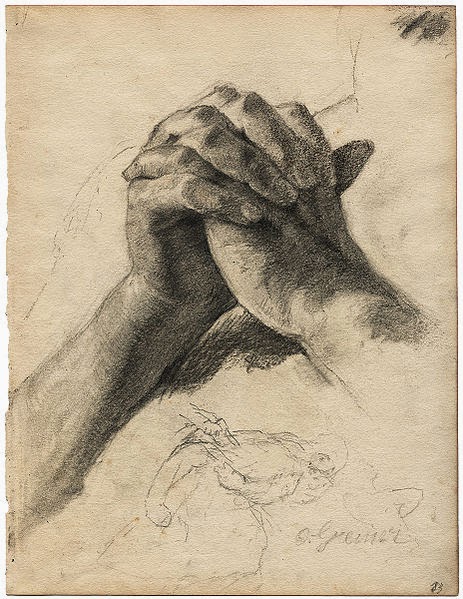
Otto Greiner, Praying Hands, circa 1900. CC

Some sayings sound legitimate on their surface. They sound pious. They sound biblical. Like this one: “Cleanliness is next to Godliness”. Only problem is, that one isn’t in the bible. At all.

It is sometimes hard to tell what truly is Christian and what merely sounds Christian. Charles Spurgeon wisely said, “Discernment is not a matter of simply telling the difference between right and wrong; rather it is telling the difference between right and almost right.” So what sayings are right, and what sayings are almost right (AKA ‘wrong’)? Let’s look at the following sayings which have become such cliches.
Some of these mottoes are:

1. “Let go and let God
2. “I don’t use commentaries because they’re men’s wisdom. I only use God’s Word when I study.”
3. “We can’t know for certain what the bible means, I’m not that smart
4. “Pray big because we have a big God.”
5. “He’s so heavenly minded he’s no earthly good

Does praying big mean as Cassandra Martin says on her blog,

We tend to pray small prayers, shy prayers, safe prayers. God wants us to pray big prayers, risky prayers, prayers that stretch our faith, expand our vision, and place us firmly in His hands. He wants us to take His word seriously and “with confidence draw near to the throne of grace, that we may receive mercy and find grace to help in time of need.” (Hebrews 4:16) Praying Big begins with remembering that we serve a very BIG God. He is bigger than our fears, our struggles, our falls, our joys, our plans, and our expectations. Praying Big encourages us to invest ourselves in prayer in a big way. Faith-full people are always big pray-ers. When we pour ourselves into prayer, God pours Himself into us. Praying Big invites us to see our lives, our challenges, our opportunities, and our world through heaven’s eyes. Prayer changes our vision, our responses, and our attitudes because in prayer God changes us.

Gee. That sounds good. Or does it mean as Anna Diehl said on her blog, The Pursuit of God,

Here’s a popular little jingle in Christendom: “Pray BIG, because we have a BIG God.” But what does this mean exactly? If we need a car, does God want us to pray for a brand new SUV instead of some small beat up clunker? If we need a new place to live, does He want us dreaming of mansions instead of just hoping for a room somewhere? If finances are tight, are we supposed to name and claim millions instead of just what we need? Is God offended by our lack of faith when we don’t dream big and pray expectantly? Well, it depends.
God wants us to be bold in our prayers, but only when our priorities are aligned with His.
~Anna Diehl

Think about the kinds of things you’ve asked God for recently. What were your prayer requests over the last year? Lump them all together into your mind and then divide them into two categories: things that have to do with your earthly comfort, and things that have to do with your spiritual growth. Which category do you pray about more often?

Gee. That sounds good too.

Or does it mean as so many ‘name it claim it’ casually teach, like Joel Osteen, that we need to be more ambitious in what we’re asking God for and more confident in what we’re looking for in our lives and to do this we need to pray ‘God-sized prayers’?

No. That definitely sounds bad.

This confusion is why we need to examine what we say and be mindful of our cliches.

The root verse for this ubiquitous phrase we’ve come to hear so frequently is usually supported by an interpretation of Hebrews 4:16,

Let us then with confidence draw near to the throne of grace, that we may receive mercy and find grace to help in time of need.”

Gill’s Exposition explains the boldness and confidence indicated in the Hebrews verse:

…a drawing nigh to God in that ordinance with spiritual sacrifices to offer unto him: and this may be done “boldly”; or “with freedom of speech”; speaking out plainly all that is in the heart, using an holy courage and intrepidity of mind, free from servile fear, and a bashful spirit; all which requires an heart sprinkled from an evil conscience, faith, in the person, blood, and righteousness of Christ, a view of God, as a God of peace, grace, and mercy, and a holy confidence of being heard by him; and such a spirit and behaviour at the throne of grace are very consistent with reverence of the divine Majesty,

The Wailing Wall, Jerusalem,
by Gustav Bauernfeind (1848-1904). CC

Let’s contrast confidence to approach the throne after the cross as opposed to the Temple days before the cross. In the days before the veil was torn it meant that you had to go through an incredibly time-consuming and intricate set of rituals to enter the holy of holies where the presence of God was. The High Priest must atone for his sins in order to be considered pure enough even to enter. If you made a misstep, you would be struck dead.

Think of Uzzah, who put his hand on the Ark of the Covenant, and was stuck dead instantly, because his hand is sin while the dirt of the ground is just dirt, not sin.

The Holy of Holies was separated from the rest of the tabernacle/temple by the veil, a huge, heavy drape made of fine linen and blue, purple and scarlet yarn and embroidered with gold cherubim. God said that He would appear in the Holy of Holies (Leviticus 16:2); hence, the need for the veil. There exists a barrier between man and God. The holiness of God could not be accessed by anyone but the high priest, and then only once a year. God’s “eyes are too pure to look on evil” (Habakkuk 1:13), and He can tolerate no sin. The veil and the elaborate rituals undertaken by the priest were a reminder that man could not carelessly or irreverently enter God’s awesome presence. Before the high priest entered the Holy of Holies on the Day of Atonement, he had to wash himself, put on special clothing, bring burning incense to let the smoke cover his eyes from a direct view of God, and bring sacrificial blood with him to make atonement for sins (Exodus 28; Hebrews 9:7) Read more: http://www.gotquestions.org/Holy-of-Holies.html#ixzz2y1390c2Z

In those days, coming boldly before the throne with confidence was not possible. However, once the veil was torn, signifying that THE atonement had been completed, we can all approach now. We don’t have to wait for a certain day, we don’t need a representative to go for us, we can all approach and He is listening. We know He is listening because He is our intercessor. (Romans 8:34)

So understanding the reason for our confidence (or boldness as some versions say) it brings the focus back on Jesus. Now to look at the size of prayers we’re told to make.

We have somehow equated boldness in behavior to largeness of prayer. We’ve swapped confidence in approach for magnitude in request. If there are “big” prayers by definition they are saying that there are “small” prayers too, and worse, assigning a size to prayers tacitly insinuates that the small prayers are no good.

Philippians 4:6 teaches, “Do not be anxious about anything, but in everything by prayer and supplication with thanksgiving let your requests be made known to God.”

Thanksgiving Prayer, 1942.Photo by Marjory Collins.
Farm Security Administration (Library of Congress)

It doesn’t say “by prayer let your BIG requests known to God” but instead it says do not be anxious about anything and make requests [of any size] known to God.

My God is big enough to care about everything, not just the big things. Are we to dispense with “small” prayers because He could get busy and overwhelmed? What a ghastly thought! He is perfect in patience. Because we don’t want to take up His time? Time in heaven does not exist, and He is the author of time on earth!

In the link above, Joel Osteen explains to the Wall Street journal reporter about big prayers. He says that “we get into a rut” with our prayers. Wrinkling his nose and speaking dismissively, Osteen said that ‘sure, we pray for our food, and our children, but we think hey, God’s got bigger things to deal with than my goals and my dreams…’ and so we don’t pray big prayers.” In Osteen’s latest book Break Out, he explains why we should pray big–this is from the book blurb

We were not created to just get by with average, unrewarding or unfulfilling lives. God created us to leave our marks on our generations. Every person has seeds of greatness planted within by the Creator. When life weighs upon us, pushing us down, limiting our thinking, labeling us in negative ways, we have what it takes to overcome and rise above into the fullness of our destinies

One of the five strategies for living a more rewarding life and leaving our mark according to Osteen is to “pray bold prayers”. The opposite to that of course, implicitly stated, is that praying ‘small’ prayers will result in a less fulfilling and rewarding life.

Yet to have a life fulfilled with all my personal dreams coming true is not the reason we pray. We pray because it is commanded (Luke 18:1). We pray to glorify God (John 14:13). We pray in a spirit of humility and unselfishness, pleading with Jesus to advance His cause and Glorify Himself. We pray to bear each other’s burdens and to be in His will and for reasons large and small we make petitions to demonstrate our acknowledgement of our dependence on Him. Jesus should be the orientation of the prayer and His will ultimately should be the goal.

So,..is praying for our food a small prayer? The Lord told us to pray in this way. In Matthew 6:11 He said to pray for our daily bread. Acts 2:42 says that they were continually praying, meeting, and breaking bread together as acts of worship. Showbread (AKA Bread of Presence) was a holy item in the temple, and the manna was in the ark. Food’s important.

Praying for our children? Is this a small prayer? Children are a heritage from the Lord, according to Psalm 127:3. Should David not have prayed for his sick son? (2 Samuel 12:16). Should Hannah not have prayed to be given a son? (1 Samuel 1:13). Should Job have not continually interceded for his children? (Job 1:1-5). Yet Job was called blameless and upright.

As far as the so-called “rut” goes…what about the persistent widow? She was lauded for persisting in her plea for justice. What about the admonition to always pray, and to pray ceaselessly? (1 Thessalonians 5:17)

Ephesians 6:18 says “And pray in the Spirit on all occasions with all kinds of prayers and requests” ‘All kinds”, the verse doesn’t say not to bother God with small petitions. It also does not say that the bigger you pray the bigger your faith is.

As we saw at the beginning of this essay from the three ways the phrase is used (Cassandra Martin, Anna Diehl, Joel Osteen) the ‘pray big because God is big’ mantra can mean different things by different people. The point of this exercise in examining these cliches and phrases is to be mindful of what we say, and to know what it is we’re saying so we can defend or explain it. (Jude 1:3, 1 Peter 3:15). Is what we’re saying God-honoring? Is it biblical?

Overall, though the cliche can be explained as a good thing, I try not to say this phrase at all because of the confusion it causes. Most often, people take it simply to mean that the bigger the prayer, the bigger our faith in God is. I pray for Him to heal my eczema. Do I lack the same quantity of faith as a barren woman praying for a child? And what about the biggest prayer of all, the most incredible act of the universe, prayer for salvation for someone? I think it’s dangerous to start sizing up prayers., it’s especially foolish to base a size of a prayer on the size of our God, because we can’t know how big He really is. And with all His size, He is a God of mercy, and His eyes roam over the earth, and sees when a sparrow falls. He knows the number of hairs on our head. Those are small things.

Just meditating on the fact that we can pray to an interceding Jesus is an amazing thing to ponder and be grateful for. God isn’t impressed by the size of our prayers,  Just as Jesus wasn’t impressed by the length of the prayers of the Pharisee but by the condition of our hearts. With that in mind I encourage you to read Anna Diehl’s piece above and see the example prayers. They give one pause for thought.

~~~~~~~~~~~~~~~~~

Further Reading

What are different kinds of prayer?

What are most common things people say are in the bible that aren’t in the bible?

Posted in bible, challies, commentaries, discernment, macarthur, matthew henry, spurgeon, teaching

Sayings and mottos that sound pious but aren’t. #2: "I don’t use commentaries because they’re men’s wisdom. I only use God’s Word when I study."

Part 1 of the series, Sayings and mottos that sound pious but aren’t. #1: “Let Go and Let God”
Part 3 of the series “I’m too humble to think that I could ever know what the Bible really means”
Part 4 of the series  Pray Big Because We Have a Big God
Part 5 of the series He’s so heavenly minded he’s no earthly good

Spurgeon

Some sayings sound legitimate on their surface. They sound pious. They sound biblical. Like this one: “Cleanliness is next to Godliness”. Only problem is, that one isn’t in the bible. At all.

It is sometimes hard to tell what truly is Christian and what merely sounds Christian. Charles Spurgeon wisely said, “Discernment is not a matter of simply telling the difference between right and wrong; rather it is telling the difference between right and almost right.” So what is right, and what is almost right (AKA ‘wrong’) about the following sayings which have become such cliches?

Some of these mottoes are:

  1. “Let go and let God”
  2. “I don’t use commentaries because they’re men’s wisdom. I only use God’s Word when I study.”
  3. “We can’t know for certain what the bible means, I’m not that smart”
  4. “Pray big because we have a big God.”
  5. “He’s so heavenly minded he’s no earthly good”

In part 1 we looked at “Let go and let God.” Now let’s look at #2,

“I don’t use commentaries because they’re men’s wisdom. I only use God’s Word when I study.”

“It has been the fashion of late years to speak against the use of commentaries…A respectable acquaintance with the opinions of the giants of the past, might have saved many an erratic thinker from wild interpretations and outrageous inferences.”
CH Spurgeon
Beth Moore says this a lot. It sounds like she’s being diligent and pious, doesn’t it? The phrase actually has a legitimate root. It’s called biblicism. GotQuestions defines biblicism as “Biblicism: a high regard for and obedience to the Bible as the ultimate authority” and this is a good thing.

However, many people take biblicism to an unintended end by rejecting all supportive works recognized as legitimately helpful by the Christian historical record.

It is less than pious to reject the wisdom of the faithful men God has raised up for our learning. God took time to mold men, justify them, install the Spirit in them, educate them, and empower them for good works. When we say “I don’t need commentaries” what we’re saying is that though we believe we have all the power necessary to learn all we need from the bible, (and we do, by the Spirit) it means we also totally reject God’s work in these men. It’s like saying, “I don’t need to listen to my pastor’s sermons because they are a man’s wisdom. I only need God’s Word” and then cover your ears in the pew and go la la la the entire sermon.

Jonathan Edwards

Who doesn’t need to read Jonathan Edwards’ sermon Sinners in the Hands of an Angry God? Who isn’t blessed in reading SPurgeon’s sermon on God’s Providence? Who doesn’t need to listen to Martyn Lloyd-Jones’ sermon series on the Great Biblical Doctrines? Who can’t use a Matthew Henry or a John MacArthur commentary? Do the people who make this impious claim really understand what they are saying? More to the point, do they realize what they leave themselves open to? Solid biblical and theological scholarship that comes from seminaries and universities or from church fathers obviously in the Spirit (such as Spurgeon who never went to college OR seminary) who remain adherent to God’s word, is teaching that actually guards us against heresy and helps us to remember of the hard lessons of church and martyrdom history.

It seems odd, that certain men who talk so much of what the Holy Spirit reveals to themselves, should think so little of what he has revealed to others. ~Charles Spurgeon

In almost every book or Bible study since Breaking Free, when Moore began to depart from the bible, Moore relates experiences of direct revelation from God or conversations with God. This is what will tend to happen as one rejects solid teaching supplements, begins to slack off in personal study, and fall into the trap of mystical intuition. We need as much help as we can get to remain on the right side of sound doctrine. (Titus 2:1)

“The best commentators are those who have written upon only one book. Few men can comment eminently well upon the whole Bible.” Charles SpurgeonAnd there are also a few logical facts to consider…

In and of ourselves, we aren’t the end of all wisdom about God’s Word. So sometimes we need a little help. That’s what commentaries are for, to help us understand the Bible better. Now, of course studying the bible alone is preferable. It is THE starting point. But it shouldn’t be the only method. Be discerning. But don’t neglect the historical wealth of God’s work in good men.

Martin Luther

In this issue of the student magazine, The Encourager, the author William J. Brown wrote, “To say the written wisdom of Spurgeon, Whitefield, Wesley, Calvin, Luther, Augustine and others have no bearing on our lives shows a bit of arrogance on our part. All we have left of these men is what they wrote. Their pastoral voices cry from the pages of ink-stained books. These men were wise (in many ways much wiser in their times than we are in ours.) We need to listen to these men and the things they desire to teach us about God’s Word.

One caution: Do not allow commentaries, sermons, books, or other notes to dictate to you about what the bible says and means. Begin with the Word of God itself and allow the Spirit room to work in illuminating it to your mind.

Here are some resources for you:

John MacArthur essay: How to Enjoy Bible Study

Kay Arthur’s study “Titus…Living with Integrity in a Hostile Culture” begins with an explanation about

Kay Arthur

inductive bible study- what it means and how to do it. [note: link is to .pdf]

How to Use Bible Commentaries

In keeping with Spurgeon’s exhortation that the best commentaries are ones where the author focused his heart, mind and attention on one book, the standout which comes to mind is Dr Martyn Lloyd-Jones’ exposition on Romans. As The Banner of Truth explains, “All over the world in the most diverse situations are to be found Christian men and women who owe an incalculable debt to the ministry of Dr. D. Martyn Lloyd-Jones who for thirty years was the minister of Westminster Chapel, London. His longest series of expositions was this 14 volume set of Romans, the greatest of New Testament Epistles.”

Martyn Lloyd-Jones sermons on Romans (free)
Martyn Lloyd-Jones commentary on Romans, 14-volume set for purchase

Pastor & book reviewer Tim Challies often makes recommendations on good commentaries. This link leads you to his page titled Best Commentaries on Each Book of the Bible

Wiki Commons, Amish housewife

To be sure, we strike a delicate balance between relying on the Spirit to illuminate the scriptures to us and consuming work the Spirit previously did in other men. We acknowledge that while He is all-sufficient for leading us into all truth (John 6:13), He is always working (John 5:17) and His work includes illuminating the meaning of scripture in others, too, who wrote it down for us.

Ultimately, the important thing is to actually read the bible. One may be surprised at how few people actually read it. I understand lives are busy. There’s a tendency to rely on one’s intuition, or at the other extreme, other people’s commentaries. Reading the bible is hard. Moms are busy, Dads are tired. Satan wants us to set daily reading aside ‘just for today.’ Soon you realize it has been two months.

When you begin, sometimes the text itself is hard to read. I just finished 1 & 2 Kings, and man, it was rough going. I hardly understood anything. The history was unfamiliar to me, the names were difficult to read and pronounce, the list of kings was confusing. I wanted to revert to the Prophets so many times, texts I love! But it’s important to just keep reading. Next time I read something from 1 or 2 Kings, it will be a bit easier. I needed to break that trail.

And now for something completely different, I think I’ll read Galatians next.

I use commentaries after I read a text, Vines Expository Dictionary of New Testament Words, old and new maps (I love seeing where these things are taking place), natural histories (if animals are mentioned or if the topography is important to the story), a Lexicon, Strong’s concordance, parallel verses, and more. I want to understand as much as possible about the text after I read it.

For example, it was helpful to know a simple thing like when I read “A Psalm of Ascents” to hear Phil Johnson explain that when the Israelites had to go to Jerusalem for a feast, it was uphill all the way. So they sang these song as they ascended. I looked up the topography and now I can better hear their singing in my mind and feel the dust under their feet and their tired legs as they ascend. Or when Elijah fled Jezebel from Mt Carmel to Beersheba to Mt Horeb, to see where he ran to and how far it was on a map.

Rely on scripture as your authority to learn the word of God and His revealed nature, and use supporting texts to expand your understanding for context and historical meaning. Don’t be abusive with them but don’t be ashamed, either. But above all, read the bible.

Commons, Photo by Savio Sebastian
Posted in apologetics, discernment, god's not dead, review

Movie Review: God’s Not Dead

Here are two excellent reviews of the God’s Not Dead movie. Both are selective about where and how to reprint, so here are the links and intro only:

The first is from Roger Patterson of Answers in Genesis:

Here is his introduction:

A film set for release in late March 2014 has been receiving a lot of attention in Christian media. God’s Not Dead weaves the stories of several students on a college campus, an outspoken professor, a local pastor, and several other characters together into a very interesting film. The storyline is one of conflict on a college campus where worldviews collide from multiple angles

Worse, though one of the key characters meets a demise, Mr Patterson says the scene does not include the Gospel elements as outlined in the bible. His review is succinct and clearly outlines the multiple unbiblical issues within the film. His review concludes with a “not recommended.” Please read Mr Patterson’s review by clicking on the link below.

God’s Not Dead Movie Review

Here is another review by two folks at Creation Ministries International, Scott Gillis and Lisa Cosner

God’s Not Dead movie review
A ‘feel-good’ movie that sadly did not make us feel good at all!

Here is GotQuestions’ very good treatment on the background of the saying “God is Dead“, which they rightly say is a rebellion against the authority of God in our lives.

Apologist Ravi Zacharias Ministry presents a 5-minute video by Oxford Philosopher Vince Vitale discussing  God’s Not Dead, which doesn’t refer to the movie but is timely apologetics anyway.

I know we become so excited when we hear reports of a new movie or television show coming out which claims to present our Jesus and His word in a God-honoring way. But we live in a fallen world, and those who are not saved cannot present anything but lies. Even those who are saved and who use these important media outreaches to share the Gospel often stumble because it is a time of apostasy, lack of discernment, and many won’t endure sound doctrine. Compromises are the order of the day. Please, in our love for Jesus and eagerness to share Him with the lost, let’s remember it is equally important to retain strict standards regarding His Gospel and His word. The best apologetic I’ve come across regarding the mantra ‘Even if it is flawed, let’s use it anyway, God can do anything’ is Sunny Shell’s, regarding the event that started all this last year, The Bible miniseries on The History Channel:

“Even though there’s a lot of error in this movie, still, don’t you think it’s a great way to show people who God really is, I mean, can’t God use anything to save someone?

A. No, I don’t think this movie is a great way to reveal the truth about God since it’s filled with lies about God. And yes, I realize God can use anything to save someone, but He only chose to use the message of the true Gospel to save all men (John 14:6, Acts 4:12). Nowhere in Scripture does God command or allow His children to use the work of Satan to proclaim His truth. And God is clear, anyone who denies Him and defiles His holy character or word, works for the devil, not for God.
Since the beginning of time, the devil has attempted to minimize and blaspheme God’s holy character by lulling us to disregard His holiness, justice and righteousness. God has never called His children of light to partner with the works of darkness (2 Cor 6:15-16). As God’s children, we are commanded to pursue holiness, rather than try to find a way to compromise the glory of Christ in order to “reach more people”.

Posted in discernment, noah, russell crowe, sunny shell

What’s biblically wrong with the Noah movie: an easy apologetic

These lists were compiled by men of the faith Chris Rosebrough and Glenn Chatfield. In viewing the list of aberrations from the bible in this movie, even one on the list should convince you that it is not a profitable way to spend your time or your money. The movie strays from the biblical record. If it strays from the Word, adulterates it in any way, presents a different God, or changes the historical record that the bible is, then it is not worth our time.

It is up to you to decide whether to watch or recommend. I hope you don’t. God doesn’t compromise His standards and His word says not to mess with His word!

as he does in all his letters when he speaks in them of these matters. There are some things in them that are hard to understand, which the ignorant and unstable twist to their own destruction, as they do the other Scriptures.”(2 Peter 3:16)

“But you must not mention ‘a message from the LORD’ again, because each one’s word becomes their own message. So you distort the words of the living God, the LORD Almighty, our God.” (Jeremiah 23:36)

Underline is mine. When you mess with the word, you’re messing with Jesus–

In the beginning was the Word, and the Word was with God, and the Word was God. He was in the beginning with God.” (John 1:1-2)

Chris Rosebrough

Here is Glenn Chatfield’s list. (Used with permission). He wrote that despite producer Scott Franklin’s claim that “I think we stayed very true to the story and didn’t really deviate from the Bible”,

Regardless of such a claim, from the reports I’ve read I’ve acquired some information as to unbiblical problems with “Noah.” And these don’t even include the fact that it was primarily an extremist enviro-nazi propaganda piece.” Here is Mr Chatfield’s list:

1. Only one son takes his wife on the Ark in the movie, while in the Bible all three sons had wives with them.

2. Noah decides who will be worthy board the Ark, while in the Bible it is GOD who chooses.

3. The son with the wife has twin daughters, which are perhaps supposed to be the future wives of the other two sons.

4. Noah seeks advice from his grandfather Methuselah to understand a vision by God; this never happened. Apparently in the movie Noah really never understands God.

5. Methuselah is shown to be sort of a witch-doctor with mental health issues.

6. Noah has no concern for the people who will be killed in the flood, but the Bible says he was a “preacher of righteousness,” which would make his lack of concern out of character.

7. When Noah learns that his son’s wife is expecting, he says if it is a girl she should be killed because God doesn’t want to repopulate the world. Yet in the Bible we find that repopulation is exactly why Noah and his family — all eight of them — are saved.

8. A wounded man cuts his way into the Ark and eats animals to stay alive as a stowaway, and even tries to kill Noah. The Bible says no one but the eight of Noah’s family were on the Ark, and none of the animals died on the journey.

9. Noah teaches theistic evolution to his family while on board the Ark.

10. The “nephilim” are giant rock-creatures, help Noah build the Ark, and defend the Ark in battle.

~~~~~~~~~~~~~~~

I know we become so excited when we hear reports of a new movie or television show coming out which claims to present our Jesus and His word in a God-honoring way. But we live in a fallen world, and those who are not saved cannot present anything but lies. (Psalm 14:4, 2 Corinthians 3:14). Even those who are saved and who use these important media outreaches to share the Gospel often stumble because it is a time of apostasy, lack discernment, or won’t endure sound doctrine. Compromises are the order of the day. Please, in our love for Jesus and eagerness to share Him with the lost, let’s remember it is equally important to retain strict standards regarding His Gospel and His word. The best apologetic I’ve come across regarding the mantra ‘Even if it is flawed, let’s use it anyway, God can do anything’ is Sunny Shell’s, regarding the event that started all this last year, The Bible miniseries on The History Channel:

“Even though there’s a lot of error in this movie, still, don’t you think it’s a great way to show people who God really is, I mean, can’t God use anything to save someone?


A. No, I don’t think this movie is a great way to reveal the truth about God since it’s filled with lies about God. And yes, I realize God can use anything to save someone, but He only chose to use the message of the true Gospel to save all men (John 14:6, Acts 4:12). Nowhere in Scripture does God command or allow His children to use the work of Satan to proclaim His truth. And God is clear, anyone who denies Him and defiles His holy character or word, works for the devil, not for God.
Since the beginning of time, the devil has attempted to minimize and blaspheme God’s holy character by lulling us to disregard His holiness, justice and righteousness. God has never called His children of light to partner with the works of darkness (2 Cor 6:15-16). As God’s children, we are commanded to pursue holiness, rather than try to find a way to compromise the glory of Christ in order to “reach more people”.

Reach people with the pure and unadulterated word of God. Isn’t it enough? It surely is!

~~~~~~~~~~~~~~

Further reading

An excellent review by Dr Brian Mattson, taking the issue from a different angle
Sympathy for the Devil