Posted in discernment, Uncategorized

Christians losing their minds over the Presidential campaign & election. Part 1

Part 2 here

First, Christine Caine’s social justice foundation mission statement:

Christine and her husband Nick founded A21, an anti-human trafficking organization dedicated to abolishing injustice in the 21st century.

Next, Martyn Lloyd-Jones, on the futility of seeking social justice in this world:

Jesus’ message is not intended to reform the world or improve it or to banish war or to make it better. The exact opposite. Our Lord never said that. He never said He’d banish war. He never said He’d make the world better. Never. Indeed, He said this: Continue reading “Christians losing their minds over the Presidential campaign & election. Part 1”

Posted in discernment, Uncategorized

Peter didn’t know what he was saying

1. He said to them, “But who do you say that I am?” Simon Peter replied, “You are the Christ, the Son of the living God.” And Jesus answered him, “Blessed are you, Simon Bar-Jonah! For flesh and blood has not revealed this to you, but my Father who is in heaven. (Matthew 16:15-17).

2. From that time Jesus began to show his disciples that he must go to Jerusalem and suffer many things from the elders and chief priests and scribes, and be killed, and on the third day be raised. And Peter took him aside and began to rebuke him, saying, “Far be it from you, Lord! This shall never happen to you.” But he turned and said to Peter, “Get behind me, Satan! (Matthew 16:21-23a)

3. And as the men were parting from him, Peter said to Jesus, “Master, it is good that we are here. Let us make three tents, one for you and one for Moses and one for Elijah”—not knowing what he said. (Luke 9:33)

1. In the first case, as Jesus and the Disciples came into the district of Caesarea Philippi, Jesus asked the men a question. “Who do people say that the Son of Man is?”

They replied, “Some say John the Baptist, others say Elijah, and others Jeremiah or one of the prophets.”

Jesus pressed them, asking a second time, “But who do you say that I am?”

This time Peter answered and it was the correct answer. “You are the Christ, the Son of the living God.” Continue reading “Peter didn’t know what he was saying”

Posted in discernment, Uncategorized

John Piper and his companions of fools

Who we choose to hang around with, learn from, and be yoked in fellowship with is important. You know that. But lest we attempt to diminish our personal and professional associations into mere “the verses are just a warming about possible temptation but I’m strong enough to handle it” territory, in fact, we have a biblical duty to separate from false teachers and from repeatedly disobedient brethren. (Romans 16:17; 1 Corinthians 16:22; Galatians 1:8-9; 2 John 7-11, 2 Thessalonians 3:14-15; 1 Corinthians 5:11- source). Here is a good verse and then a commentary on the subject.

Whoever walks with the wise becomes wise, but the companion of fools will suffer harm. (Proverbs 13:20)

Matthew Henry says of this Proverbs verse, Continue reading “John Piper and his companions of fools”

Posted in discernment, Uncategorized

Sexual sin: it wants you

Sexual sin is a biggie crouching at the door, waiting to capture you. Do you believe you’re immune to it? Do you believe it won’t happen to you? Do you think it’s not possible because you’re so strong, or so wise, or so Godly?

Samson was the strongest man in the Bible, and he fell to sexual sin.

David was the Godliest man in the Bible, and he fell to sexual sin.

Solomon was the wisest man in the Bible, and he fell to sexual sin.

The Bible’s warnings about sexual sin are clear. What are the protections we should take?

Flee from sexual immorality. Every other sin a person commits is outside the body, but the sexually immoral person sins against his own body. Or do you not know that your body is a temple of the Holy Spirit within you, whom you have from God? You are not your own, for you were bought with a price. So glorify God in your body. (1 Corinthians 6:18-20).

that, in reference to your former manner of life, you lay aside the old self, which is being corrupted in accordance with the lusts of deceit, and that you be renewed in the spirit of your mind, and put on the new self, which in the likeness of God has been created in righteousness and holiness of the truth. (Ephesians 4:22-24).

And He was saying to them all, “If anyone wishes to come after Me, he must deny himself, and take up his cross daily and follow Me. “For whoever wishes to save his life will lose it, but whoever loses his life for My sake, he is the one who will save it. (Luke 9:23-24).

It’s very clear. Sexual sin wants you. You don’t want it.

Posted in discernment, Uncategorized

Jude’s dreamers and Beth Moore’s necromancy

Consider this statement from Jude 1:8. Jude is talking about ungodly people, false teachers who are already marked out for condemnation, grace-perverters.

Yet in like manner these people also, relying on their dreams, defile the flesh, reject authority, and blaspheme the glorious ones.

Look at the part of the verse which casts a negative light on their reliance on dreams, where I’d underlined. What kind of dreams are meant here? MacArthur Commentary,

The wicked behavior of such men derives from their dreaming a term that Jude uses to identify these apostates as phony visionaries. The New Testament normally uses the noun onar to refer to dreams (Matthew 1:20, 2:12, 13, 19, 22, 27:19), but here Jude chose a form of the verb enupniazo, which is used only one other place int he New Testament, Acts 2:17. In that passage, Peter (preaching on the Day of Pentecost) declared, “‘And in the last days it shall be, God declares, that I will pour out my Spirit on all flesh, and your sons and your daughters shall prophesy, and your young men shall see visions, and your old men shall dream dreams.

Joel’s prophecy (Joel 2:28-32) and its affirmation in Peter’s sermon show that the dreams in question may refer to revelatory dreams (rather than normal dreams). During the Tribulation, prophecies, revelations and visions that have now ceased will return, along with divine revelation. God will speak to people through dreams, just as he did earlier in biblical history )e.g., Joseph in Egypt, Daniel in Babylon, and others).

False teachers often claim dreams as authoritative divine source for their “new truths” which are really just lies and distortions. Such claims allow apostates to substitute their own counterfeit authority for God’s true scriptural authority

At this point in writing the essay I decided to Google some quotes where a famous false teacher had mentioned dreams and end it there. I started with Beth Moore because she’s been around longest and had a higher likelihood of a quote somewhere regarding being a ‘dreamer’ as Jude puts it. I was absolutely shocked as this result came up on Youtube. It is a clip from the LifeToday program on television with James Robison from 6 years ago. At least, Moore mentions that she was 53 years old in the clip and she is 59 years old as of this writing. The 10-minute clip shows Moore describing a dream that she had had, and then its meaning and interpretation. But it’s worse than just a revelatory dream. Much worse.

In the clip, Moore fervently affirms that she just loves Jesus so much and the dream ‘he’ gave her just makes her love ‘him’ all the more. Moore’s friend is Mary Beth Chapman, wife of Grammy and Dove Award winning recording artist, Steven Curtis Chapman. About a year and a half prior to Moore’s dream, her friend Mary Beth had tragically lost her adopted Chinese daughter Maria to a car accident. Mary Beth had been in deep grief.

Moore opened by explaining that in all her 53 years she did not dream that vividly and she never had a dream from God. Though she’d repeatedly prayed and asked for Him to send her a dream,  she explained that God ‘said’ to her that “some people are just safer with the Word on the page.” (1:31 in the clip. By the way, this is an admission that Moore seeks extrabiblical revelation, and that she knows exactly that dreams are extrabiblical revelation).

Her dream involved seeing Mary Beth at a sound stage about to speak to an audience, with her dead daughter holding her hand, in a body and dressed in a white shirt with chunky bangs. At the time, Mary Beth Chapman hadn’t written her book and was not touring sound stages speaking to audiences. Not yet.

The glaring problem with Moore’s description of the dead child is that the redeemed of heaven do not have bodies yet.

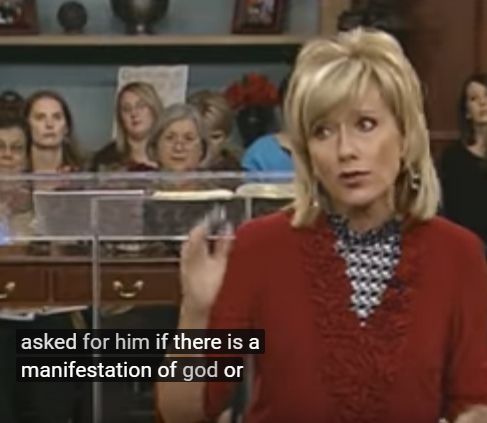
Moore explained that every night she prays He would send her a dream or a manifestation, she seeks it earnestly. Luke 11:29 and Luke 11:16 state that an evil generation seeks a sign. So her first mistake was to test the Lord by continually asking for a dream or a manifestation. (her words).

Her second mistake was not recognizing instantly that the dream she’d had was not from the Lord. Why? God abhors communing with the dead. It is a practice that He strenuously forbade the Israelites to engage in (Deuteronomy 18:10-12), calling it an abomination. The New Testament is also firm against sorcery, divination, and necromancy. (Galatians 5:19-21, Revelation 21:8).

Necromancy is defined as the conjuring of the spirits of the dead for purposes of magically revealing the future or influencing the course of events. In the Bible, necromancy is also called “divination,” “sorcery” and “spiritism” and is forbidden many times in Scripture (Leviticus 19:26; Deuteronomy 18:10; Galatians 5:19-20; Acts 19:19) as an abomination to God. It is something that the Lord speaks very strongly against and is to be avoided as much as any evil. (source

There is no reason to believe that a deceased person has any ability to leave heaven or hell in order to visit his living family members. Any such claim is a demonic deception (2 Corinthians 11:14-15). God declared such practices to be abhorrent to Him, and those who did practice such things in Israel were to be put to death (Leviticus 20:27; Deuteronomy 18:10-12). Satan would like nothing more than for people to dabble in the occult world of spiritism and necromancy. (source)

Moore’s third mistake was interpreting the dream herself. Genesis 40:8 plainly says that interpretations belong to God. Moore went on in the clip to interpret the dream herself. She said that the dream meant that Mary Beth was being called by God to speak in front of audiences. She further interpreted that God sent the dream to Moore and not to Chapman because it was too soon after the accident for Chapman as a mother to be able to handle seeing her daughter.

 Chapman said in an interview that she had desired a dream, too. She and her husband desired to see their dead daughter.

After the accident, we avoided the house for several days. We were begging God to show us himself in this, because this was clearly the darkest place he had taken us, and we were drowning. We were like, God, please, let us see. Let us see Maria. Let us have a dream. Let us see something so we know that you’re here. (Mary Beth Chapman)

The scriptures say,

For the living know they will die; but the dead do not know anything, nor have they any longer a reward, for their memory is forgotten. 6Indeed their love, their hate and their zeal have already perished, and they will no longer have a share in all that is done under the sun. (Ecc 9:5-6)

The dead no longer have a share in what is done under the sun. As for the desire to see a dead person,

Scripture never indulges that desire. In the Old Testament era, every attempt to communicate with the dead was deemed a sin on par with sacrificing infants to false gods (Deuteronomy 18:10–12). The Hebrew Scriptures say comparatively little about the disposition of souls after death, and the people of God were strictly forbidden to inquire further on their own. Necromancy was a major feature of Egyptian religion. It also dominated every religion known among the Canaanites. But under Moses’ law it was a sin punishable by death (Leviticus 20:27). Dead Men Tell No Tales

Moore’s dream is the exact definition of necromancy. In OT times, doing what Moore did, summoning a dream or a manifestation of a dead person and basing personal interpretations of future events on that dream was punishable by death.

Jude disparaged ‘dreamers’ and their reliance on their ‘dreams’ because dreaming is a dangerous activity. Sin never sits still. It deepens. It begins with one little sin not repented of, and another and another. It continues with straying from church, the Bible, prayer. It deepens with increased satanic activity surrounding you, traversing the abominable territory into personal revelations. Once a false teacher is comfortable with constant alleged personal revelations, then come the dreams, and then the necromancy, and finally, death, either sooner or later.

In Saul’s case, in the one and only case of communing with the dead, the Lord allowed a summoning of Samuel the Prophet through the Witch of Endor to demonstrate to Saul how far gone he was into the deep things of satan.You also notice that the witch already had a “familiar spirit.” (KJV). Samuel’s appearance was only to confirm Saul’s imminent doom.

This essay has a two-fold purpose. One, to show you again, how deeply Moore is apostate, and to warn you to avoid her. Secondly it is to remind you (and me) that sin never sits still, it is always on the move, prowling. (1 Peter 5:8). As sin moves, it deepens. It gets worse over time if unrepented of, never better.

There are only two ways to go in our walk on earth. One will be on the narrow road or on the broad road. One leads to destruction and eternal death, one leads to eternal life. Walk, or as Paul sometimes said, run, indicates movement. Sin never stays still. You either move toward the “deep things of God” (1 Corinthians 2:10) or you move toward the deep things of satan (Revelation 2:24). When one begins to seek voices and personal direct revelation from God and accept them, one is already far down the path of the deeper things of satan. When one dreams and believes the dreams are from God, it’s a dangerous thing. You then begin relying on the dreams and not “the Word on the page” (as Moore admitted above). Jude says of those who rely on dreams “defile the flesh, reject authority, and blaspheme the glorious ones.” When dreams turn to summoning the dead, and interpreting their activity into future earthly events, you’re already an abomination to God because you are a necromancer. Necromancers do not go to heaven.

Don’t dabble in dreams, nor should we ask for them. Don’t accept personal revelations, but repent of them. That Beth Moore did not recognize her necromancy dream as an abomination but attributed what was in fact the deep things of satan to God, just shows her blindness and abominable status before our holy Lord. Jude was serious, saying

Beloved, although I was very eager to write to you about our common salvation, I found it necessary to write appealing to you to contend for the faith that was once for all delivered to the saints. For certain people have crept in unnoticed who long ago were designated for this condemnation, ungodly people, who pervert the grace of our God into sensuality and deny our only Master and Lord, Jesus Christ. (Jude 1:3-4)

———————————————

End Note:

I’m posting these screen shots of the video with closed captioning in case the video is deleted (which Moore’s criticized videos often are.) I also saved the transcript of the video and I’ll post that if the video is deleted later.

Here, Moore admits she constantly asks God to show her a manifestation or give her a dream.

Here, Moore claims to see Mary Beth Chapman’s dead child Maria in body and describes her face, hair and clothes.

Posted in discernment, Uncategorized

“Fire fall down” – a good thing, or a very, very bad thing?

Have you ever sung that song about fire fall down? You know, the one from Hillsong United? You might want to re-think that.

In the excerpt below from the Strange Fire Panel Q&A session, Todd Friel, John MacArthur, and Justin Peters discuss the theological implications of pleading with God to send fire down on us.

~~~~~~~~~~~~~~~~~~~~~~~~~

Clip #20: (Singing) Fire fall down, fire fall down on us, we pray… As we seek you, Fire fall down, Fire fall down on us, we pray…

TODD: About 16 thousand kids are in the auditorium right now.

Clip #20: (Singing) Fire fall down, fire fall down on us, we…

TODD: All right. Now that song, by the way, goes on for 17 minutes. The word “fire” calling down fire from heaven is a persistent theme that we hear. Theologically do we want fire to come from heaven? In the context, and Justin can point this out, too, a lot of the conversation is about feeling, a burning, being set on fire, thereby calling the fire down from heaven. Theologically how do we respond to this prayer to call down fire from heaven.

JUSTIN: I can only assume that they’re referencing Acts 2, taking an image that is tied to a larger context. The fire there is defined as, even we were talking about this morning, clear and discernible ways that essentially, ultimately it was representative of the Spirit’s coming and the Spirit’s expression was in the gift of tongues for a specific purpose, to confirm the Apostles, to confirm what He was doing, as R.C. said yesterday, and now bringing out a people for himself, confirming the Jews were, in fact, going to be a part of the church. So it has a context. But instead it’s removed from that context and made to mean something just strictly experiential.

JOHN: Yeah, and again that’s a non-repeatable event, Pentecost, as we heard from R.C. Pentecost and then the subsequent exact same reality occurs I those different people groups to somehow turn Pentecost into this kind of mockery, as if you could literally call down fire from heaven is not only unbiblical, it’s just folly. But it’s more than that, it’s manipulation. It’s all about mind control. Rodney Howard Brown is a mind manipulator.

From a human viewpoint, even more frightening is this is demonic from a supernatural viewpoint. Fire came down from heaven, of course, in Leviticus 10 and consumed the worshipers…consumed the ones who offered the sacrifice. That’s the whole point of this conference. John talked about fire baptism, John the Baptist, and that was judgment. I really don’t…these people are so a-biblical, they’re so acquainted with words, Bible words without Bible sentences, Bible words without Bible context, Bible words without Bible doctrine. They throw the words around and they become means by which they manipulate people’s minds. Fire is obviously an incendiary word. It has all kinds of implications of heat and power and energy and…I mean, that’s a perfect word for them to use to manipulate people. The next time fire comes from heaven, it’s going to engulf the world in judgment. God will not drown the world in water again, but He will end the world in fire. The elements will end with a fervent heat. It’s going to be an atomic implosion, the uncreation when the elements melt with fervent heat, that is fire from heaven.

And I don’t think anybody in his right mind would be calling down fire from heaven, because that’s…that’s…going forward, that is a judgment metaphor after Pentecost. You will be baptized by the Holy Spirit and with fire. That’s another baptism, and that’s a judgment.

~~~~~~~~~~~~~~~~~~~~~~~~~

Moral of the story? Lyrics matter.

Posted in discernment, Uncategorized

God magnified His word above all else, who is Andy Stanley to subvert it?

I bow down toward your holy temple and give thanks to your name for your steadfast love and your faithfulness, for you have exalted above all things your name and your word. (Psalm 138:2)

It’s currently fashionable to dismiss the holy Word of God, AKA the Bible. It supposedly proves one’s relevance to say that one desires a closer relationship with Jesus as opposed to studying holy writ. When the heretical novel called The Shack was published in 2008 it swept the Christian world, remaining at a number one bestselling spot for several years. In it, the author never pointed to God’s word as sufficient and infallible. It rather undermined those concepts by insisting on personal revelation and denigrated the Bible as ‘that old dusty King James” thing. The author scoffed at the idea that God has spoken authoritatively and sufficiently through the Bible. He points away from Scripture he points towards subjective promptings and leadings. (source).

The subtle mocking and scoffing of the Word of God, so delicately put in a thinly disguised new age treatise in 2008, is by now in 2016 a full-blown attack by a leading and influential Southern Baptist Minister. The salvos have just kept coming, prompting pastor, author, and podcaster Justin Peters and Pastor Jim Osman to take note. Peters said on his podcast Friday on World View Weekend, that

A friend of mine sent me a video interview of Andy Stanley by Russell Moore. Moore asked Stanley what he would do if he were the “Evangelical Pope.” Stanley had some rather surprising remedies for what ails the Christian church. I’m joined in studio (my office) by my friend and pastor Jim Osman and we play the clip and discuss.

In the clip, Stanley said that he would ask pastors of all kinds (senior, youth, seminarians, etc) to “get the spotlight off the Bible and back on the resurrection. Let’s get people’s attention back on Jesus as soon as possible. To leverage the authority we have in the resurrection, as opposed to scripture.”

Matthew Henry said, of the Psalm 138:2 verse, that the LORD’S name and His Word is above all things-

For thou hast magnified thy word (thy promise, which is truth) above all thy name. God has made himself known to us in many ways in creation and providence, but most clearly by his word. The judgments of his mouth are magnified even above those of his hand, and greater things are done by them. The wonders of grace exceed the wonders of nature; and what is discovered of God by revelation is much greater than what is discovered by reason.

As a practical matter for us today in living our Christian lives, do not compromise on your life and always remember the Lord God Himself magnified His word and His Name above all else. Here is John MacArthur on the fact that our God is an uncompromising God who expects of His disciples, An Uncompromising Life

It might be well to remind ourselves at the very beginning that God is the uncompromising God. God never compromises an absolute. God never compromises a principle. God never sets aside a truth for expediency purposes. God always lives according to His word. In fact, He said, “I have exalted My word above all My name.” In other words, He says, “I Myself, as to My nature, make Myself submissive to My word.”

——————————-

Further Reading

June 24, 2015, Is Andy Stanley Ashamed of the Bible?

March 31, 2016, Andy Stanley’s problem with the Bible

Septem 1, 2016, Andy Stanley Sermon Review: The Bible is not infallible, nor needed

Septem 1, 2016, Shocked Andy Stanley learns the New Testament part of the Bible (satire)

Septem 12, 2016: These Words Shall Be On Your Heart, Pastor Gabe on why Stanley is so, so, so wrong

Posted in discernment, Uncategorized

Why the therapeutic gospel is another gospel

In the purchasable resource called Drive By Discernment, the apocryphal or heretical gospels are mentioned. Some of these you may have seen some of these false gospels on secular Library bookshelves, books such as –

Gospel of Thomas
Gospel of Peter
Gospel of Nicodemus
Early Life of Christ
Gospel of Judas

There are other kinds of false gospels. In a blog essay of the past, I’d written about the therapeutic gospel, a point made by Trevin Wax. He’d said that the true Gospel is Christ centered. The Therapeutic Gospel ultimately fails to satisfy because it switches out the great reward of knowing God for the lesser reward of receiving something from God.

In the previous, longer essay, Pastor Wax compares the subtle shift in a counterfeit Gospel from being Christ-centered to man-centered, by comparing the parable of the sheep as they are presented in Luke and in the false Gospel of Thomas. Here is the Gospel of Luke:

What man of you, having a hundred sheep, if he has lost one of them, does not leave the ninety-nine in the open country, and go after the one that is lost, until he finds it? And when he has found it, he lays it on his shoulders, rejoicing. And when he comes home, he calls together his friends and his neighbors, saying to them, ‘Rejoice with me, for I have found my sheep that was lost.’ Just so, I tell you, there will be more joy in heaven over one sinner who repents than over ninety-nine righteous persons who need no repentance. Gospel of (Luke 15:4-7)

The other is from the non-canonical, false Gospel of Thomas.

Jesus said, “The kingdom is like a shepherd who had a hundred sheep. One of them, the largest, went astray. He left the ninety-nine sheep and looked for that one until he found it. When he had gone to such trouble, he said to the sheep, ‘I care for you more than the ninety-nine.‘ (FALSE, NON-CANONICAL “Gospel of Thomas”)

What has happened here, said Mr Wax, is that in the counterfeit Gnostic gospel the writer has shifted the emphasis. The point of the parable in the counterfeit gospel is about the worth of the sheep, instead of the work of the Shepherd. Any teaching that does this, is another gospel.

Paul wrote in Galatians 1:8 some very strong words about ‘another gospel’. He said

But even if we or an angel from heaven should preach to you a gospel contrary to the one we preached to you, let him be accursed.

Matthew Henry wrote of this verse,

Some would set up the works of the law in the place of Christ’s righteousness, and thus they corrupted Christianity. The apostle solemnly denounces, as accursed, every one who attempts to lay so false a foundation. All other gospels than that of the grace of Christ, whether more flattering to self-righteous pride, or more favourable to worldly lusts, are devices of Satan. And while we declare that to reject the moral law as a rule of life, tends to dishonour Christ, and destroy true religion, we must also declare, that all dependence for justification on good works, whether real or supposed, is as fatal to those who persist in it. While we are zealous for good works, let us be careful not to put them in the place of Christ’s righteousness, and not to advance any thing which may betray others into so dreadful a delusion.

As Henry wrote, any ‘gospel flattering to self-righteous pride’ (or any other emotion, like self-esteem), or ‘more favorable to worldly lusts’, (like prosperity gospel) are devices of satan. Anyone who persists in them is dooming himself.

The therapeutic gospel appeals to your self-esteem, and it presented in a way that aims to make you “feel better” about yourself. Many women ‘Bible’ teachers promote a therapeutic gospel. They focus the lessons on the worth of the sheep rather than the work of the Shepherd.

The truth is, none of us suffers from low self-esteem. We already love ourselves with all our heart, all our mind, all our strength, and all our soul. Jesus said to get the attention off ourselves and love the Lord your God as we love ourselves. (Luke 10:27). If we loved God with as much steam as we already love ourselves, we’d really be cooking.

However the device of satan is to prevent that shift in attention. The therapeutic Gospel is one of those devices. If you listen to any teacher who focuses on the worth of the sheep rather than the work of the Shepherd, you are listening to another gospel. Rather than focusing on ourselves, In Matthew 16:24 re read that we are to deny ourselves

Then Jesus told his disciples, “If anyone would come after me, let him deny himself and take up his cross and follow me.

I’ll close with an echo of Paul’s words. If anyone teaches another gospel, let him be accursed. We are much too friendly with those who bring fatal gospels. Gill’s Exposition says of the Galatians 1:8 verse,

let him be accursed, or “anathema”; see 1 Corinthians 16:22 which may respect his excommunication out of the church, and his sentence of condemnation by Christ at the last day; and the sense be this, let him be ejected from the ministry of the word, degraded from his office, and cast out of the church; let him be no more a minister, nor a member of it; and let him be abhorred of men, and accursed of Christ; let him hear the awful sentence, “go ye accursed”, &c.

Finally, Barnes said of the Galatians 1:8 verse,

…that we are not to patronise or countenance such preachers. No matter what their zeal or their apparent sincerity, or their apparent sanctity, or their apparent success, or their real boldness in rebuking vice, we are to withdraw from them.

What makes us feel better, ultimately, is resting in Christ and looking at Him full in the face. Reflecting on His attributes is an endless delight.

Seek the LORD and his strength; seek his presence continually! (Psalm 105:4)

Posted in discernment, Uncategorized

Strange Fire Q&A: ?

Can you believe it has been three years since the Strange Fire Conference? Its impact continues, with men and women still using the wonderful resources at the website to confirm truth to their hearts. Many have been led out of the Charismatic chaos as a result.

For those of us who are in solid churches but sadly see it beginning to creep in, here is a Strange Fire Q&A which addresses the practicalities of being a bulwark against Charismatic practices.  How do we combat this? But first, a short backgrounder: Continue reading “Strange Fire Q&A: ?”

Posted in bible, continuationism, discernment, strange fire

Strange Fire Q&A: Why have some gifts ceased and others continue? Are we picking and choosing?

One hundred years ago, the modern Pentecostal movement was born. By October 2013 the Pentecostal movement has morphed into the Charismatic movement with its particular brand of false doctrine and had infected much of western Christianity and polluted quite a bit of Christianity abroad. The excesses of the movement include faith healing, reports of raising the dead, babbling tongues, alleged prophecies and direct revelation, disorderly church services and worse. The movement assaulted the sufficiency of scripture, the inerrancy of scripture, besmirched the name of Jesus Christ and damaged the faith of many.

John MacArthur and his team at Grace To You took a stand against this movement and sought to bring clarity to why its doctrines needed comparison to the Bible correction. To that end, they organized the Strange Fire Conference, held in the fall of 2013. One of the main purposes of the conference was to initiate a substantive discussion about these issues. It achieved its purpose. Every sermon preached at the conference rebuked the movement simply by preaching the truth, and brought correct biblical doctrine to the fore. Given the outcry, it seems that the effect was immediate.

There were many good questions asked at the various seminars and Q & A sessions held during the conference period, but not all of them could be immediately answered. After the conference concluded, ministers and theologians at Grace Community Church and The Master’s Seminary wrote out answers to these unanswered questions, compiled them, and put them on one web page.

The page is a treasure trove of good, solid rebuttals to and practical helps about what to do if encountering Charismatic doctrines in your church, in your family, or in yourself.

~~~~~~~~~~~~~~~~~~~~~~~~

Why are the teaching gifts and others in the list of gifts in effect today if the others ceased? Do we pick and choose?

As in all matters of life and doctrine, we must follow carefully the teaching of Scripture. We must be careful to interpret the text and to apply its direct teachings and its principles to every area of life. God has indicated clearly in His Word that some spiritual gifts were given for the duration of the church’s time on earth and some were intended for use only during the establishment of the church. We don’t have the authority to decide which gifts belong in those categories, nor do we desire to make that decision. Our only desire is to follow what God has revealed to us in Scripture.

The miraculous sign gifts accompanied the apostles and validated them as true spokesmen for Christ (2 Corinthians 12:12; Hebrews 2:3–4). The ministry of the apostles and New Testament prophets was to lay a doctrinal foundation for the church (Ephesians 2:20). They laid the foundation on which the evangelists, pastors, and teachers can build (Ephesians 4:11–13). Evangelists anchor new people into the foundation, and pastors and teachers strengthen and grow them from the foundation.

After the apostles died and the canon of Scripture was completed, the church has carried on through the equipping ministry of evangelists, pastors, and teachers. And now every Christian has the ability to discern truth from error by studying the written Word of God.
For a careful explanation of which gifts have ceased and how we know they were intended by God as temporary gifts, I refer you to Tom Pennington’s excellent teaching in “A Case for Cessationism.” Explore our sermon archive for more detailed exposition on the key passages related to the temporary spiritual gifts, such as 1 Corinthians 13:8–13, 2 Corinthians 12:12, Ephesians 2:20–21, and Hebrews 2:2–4.