Posted in discernment, Uncategorized

Are we “broken”? Should we celebrate “brokenness”?

On this blog I’ve mentioned numerous times that words matter. The words we use within the faith to express things do matter a lot. “Our” words should not be changed, or ‘updated’. This is because the faith is born in the mind, kept in the mind, and fought in the mind. Words reflect our understanding of concepts, and when satan attempts to change those words, it changes our understanding of the concept. Therefore, sin is no longer sin, but a mistake. Faith is no longer faith, but following. We’re missional instead of disciples, and we have conversations around the truth rather than proclaim the truth. We’re authentic and on a journey rather than evangelists standing our ground.

Another word that is emerging to change our common understanding of the faith, is ‘broken’ or ‘brokenness’. Over time, the faith has been feminized from Paul’s descriptions of a gritty spiritual war, to a romantic fling with a heroic boyfriend. We’re not, as Paul said, athletes pressing on for the prize, nor are we soldiers fighting for the faith, but we are gentle doves with broken wings looking for someone to fix us.

An example of the prevalence of this word and its concept is author Ann Voskamp of One Thousand Gifts. She has written a new book which was released last week. Its title is, The Broken Way: A Daring Path into the Abundant Life. Rick Warren’s wife Kay added her blurb to the review of Voskamp’s new book, describing it thusly,

In The Broken Way, a deeply personal revelation, Ann Voskamp leads us on a journey toward embracing and celebrating the brokenness in each of us. The passionate words that pour from her soul will make you weep and shout hallelujah at the same time. (Kay Warren, Saddleback Church, Lake Forest, California)

Let’s take a look at what is at the root of this move toward the concept of brokenness.

You might have heard of the doctrine of ‘total depravity’. This does not mean that all humans are totally as bad as they could be. There is such a thing as benevolence in the world, people who help. Total depravity means that humans are born with a total inability to be pleasing to Christ. It is the biblical doctrine that human nature is thoroughly corrupt and sinful as a result of the Fall. Our sin-nature drenches us from head to toe, and there is not one spot, corner, or area of our nature that contains what Christ deems as goodness.

The doctrine understands the Bible to teach that, as a consequence of the the Fall of man, every person born into the world is morally corrupt, enslaved to sin and is, apart from the grace of God, utterly unable to choose to follow God or choose to turn to Christ in faith for salvation. Theopedia.

Total depravity, or total inability, is based on numerous verses. Here are two:

And you were dead in the trespasses and sins in which you once walked, following the course of this world, following the prince of the power of the air, the spirit that is now at work in the sons of disobedience—among whom we all once lived in the passions of our flesh, carrying out the desires of the body and the mind, and were by nature children of wrath, like the rest of mankind.” (Ephesians 2:1-3)

for all have sinned and fall short of the glory of God, (Romans 3:23).

Because we cannot please God in any way of our own works, we need something or someone external to the human condition to resolve this devastating status of our inherent nature. That is why God in heaven sent His Son Jesus from heaven to live the perfectly holy life required to please God, and die on the cross while absorbing His wrath, punishing sinless Jesus for our sins. Satisfied with this sacrifice, God raised Jesus to life and imputes Jesus’ righteousness onto those humans who are called to believe. We become wrath-free and righteous in His eyes.

To the point of this essay, we become a new creation. This change in condition is my all-important point.

Therefore, if anyone is in Christ, he is a new creation. The old has passed away; behold, the new has come. (2 Corinthians 5:17)

For neither circumcision counts for anything, nor uncircumcision, but a new creation. (Galatians 6:15).

Jesus replied, “Truly, truly, I tell you, no one can see the kingdom of God unless he is born again.” (John 3:3).

Brokenness bespeaks of fixing, not of being made new. By its own definition, it means the creature retains some inherent worth, and simply needs a fix in some area or other. To say ‘we are broken’ is to say that we are not totally depraved, not totally unable to please God, do not require anything more than a fix-up in one area or another of this body before becoming pleasing to Jesus.

Nothing could be further from the truth. We are familiar with the hymn Rock of Ages. In the third stanza, we sing- “Nothing in my hand I bring, Simply to the cross I cling;”

When we are born again, humans retain nothing, absolutely nothing we can reuse in service to the Savior. We are made new, we are a new creation. Teaching about our brokenness is an idea that undermines the critical doctrine of this truth of our position in Christ.

Moreover, when by grace we are saved, we are made whole. Colossians 2:10 says that when we are made a new creation, we have been made complete, full. Other verses speak to this-

Until now you have asked for nothing in My name; ask and you will receive, so that your joy may be made full. (John 16:24)

And concerning you, my brethren, I myself also am convinced that you yourselves are full of goodness, filled with all knowledge and able also to admonish one another. (Romans 15:14)

We begin our lives completely unable, offering nothing of use to Jesus, and when we’re saved, we become a new creation and are completely able to please Him. There is nothing about our lives before or after salvation that is “broken”. Our lives entering through the narrow gate is one of submission and humility. Our lives after entering the gate as we proceed on the path of sanctification include repentance and strength. We go from complete depravity to complete righteousness.

Voskamp’s book and Warrens’ exultation advising us to embrace the brokenness in us is wrong. To do this demeans the Spirit’s ministry which completed us in Christ and is sanctifying us for life. It ignores the verses such as the ones below which advise us to cast away those weights which hinder us in the task of worshiping God and pursuing holiness. I’m not picking solely on Voskamp’s book but any and all teachings so common today which tell women to wallow in brokenness. Hebrews 12:1b-2 advises us to-

lay aside every weight, and sin which clings so closely, and let us run with endurance the race that is set before us, 2 looking to Jesus, the founder and perfecter of our faith, who for the joy that was set before him endured the cross, despising the shame, and is seated at the right hand of the throne of God.

Lay aside the weight of our initial sin which hindered us, a hindrance which we lost at entering His gates. Lay aside accumulated broken feelings after salvation which weigh us down. We have the joy of Jesus. (John 15:11).

Women, you’re not helpless doves waiting to be fixed, you’re gracefully saved spiritual soldiers marching in truth toward glory.

Now, I understand the female notion of teaching to the emotions. I know it’s easier to teach that way, and it’s a basis for a study that will be better received by the students of it. This is because we’re all hurt in some way. Life on earth hurts. We are maligned and rejected. We accumulate a broken heart full of wounds. Our job may break us. Boot camp may break us. We may feel broken as a grieving surviving spouse, overcome by sadness or despairing in some way. Remember the old days when divorced couples were known as having a “broken marriage”? Or children of divorce were from a “broken home”? I understand that sometimes we feel broken. It’s a useful word that describes a temporary emotional state. But it has nothing to do with the permanence of our status before Christ.

Those are emotions, surface, temporal and fleeting. Our basic conditions as humans is either-or. We are either totally unable or we are totally righteous (in His eyes). When we are saved we come with a knowledge that there is nothing fixable in us, we leave with Him our entire nature as depraved sinners and enter His gates with joy, knowing His righteousness is now imputed to us. Nothing of the old is left.

The issue is, are we broken, or depraved?

Broken?
Or depraved?
photo by Sparrows-love-the-snow

Christian wholeness is a doctrine that exalts Jesus. That and “brokenness” are irreconcilable and contradictory. Every Christian should fully appreciate everything that Jesus has done for us to make us whole in every way. Even though some Christians may temporarily feel broken in some areas of their life, no Christian should be content in remaining broken nor should we seek to become broken. We definitely do not pursue brokenness, as Ann Voskamp’s book teaches, and Kay Warren exults! It’s not pious to do so. It’s sinful because it rejects Jesus’s work which made us into a new creation.

The Holy Spirit who resides in us does comfort us. He helps us. He restores relationships. He is not a fix-it guy of “broken” people, He is God who loves and manifests His glory when He is faithful to His promises to us to comfort, help, and restore.

You might think it’s picky to pick on the word brokenness. But you saw at the start of this essay the words that have already been co-opted and redefined by liberals. It’s important for believers to retain each word describing a foundational faith-concept. Understood, it is the yarn that knits us together into the tapestry of believers comprising the worldwide church. If you pull one yarn the sweater is soon corrupted. Protect our words, they are ours. What they mean communicate important information from God’s mind to fellow believers. They even mean something to unbelievers who hear and see us using them. Ladies, don’t wallow in brokenness, rejoice, because He has made us whole!

But Jesus turned him about, and when he saw her, he said, Daughter, be of good comfort; thy faith hath made thee whole. And the woman was made whole from that hour. (Matthew 9:22)

———————————————

The fluidity of word use and their meanings is rife in the world, that’s just the way it is.Yet Christ’s word is eternal, and the meanings of the words of faith should remain so.  George Carlin was a hilarious but profane atheistic comedian who died a few years ago. His incisive and accurate observations on many topics became well-known over his long career. Here is one riff from a comedy set he used to perform regarding how the secular world is unaware of changes in meanings of words. It’s a long and funny set, but too profane in its entirety to post a video of. I post instead a cleaned up excerpt from a transcript. It’s a useful little exercise in tracking word meaning changes over time.

Read the following and you’ll see just how many words have changed. (If you’re as old as I am, that is, lol.)

One of the reasons is because we were using that soft language. That language that takes the life out of life. And it is a function of time. It does keep getting worse. I’ll give you another example. Sometime during my life, toilet paper became bathroom tissue. I wasn’t notified of this. No one asked me if I agreed with it. It just happened. Toilet paper became bathroom tissue. Sneakers became running shoes. False teeth became dental appliances. Medicine became medication. Information became directory assistance. The dump became the landfill. Car crashes became automobile accidents. Partly cloudy became partly sunny. Motels became motor lodges. House trailers became mobile homes. Used cars became previously owned transportation. Room service became guest-room dining. And constipation became occasional irregularity.

Posted in discernment, Uncategorized

What is ‘Bridal Mysticism’? And why is it so prevalent?

In 2005, Beth Moore was interviewed by Today’s Christian Woman magazine. They asked Moore:

Q. What led you to Jesus?

A. Beth Moore’s [2005] answer:

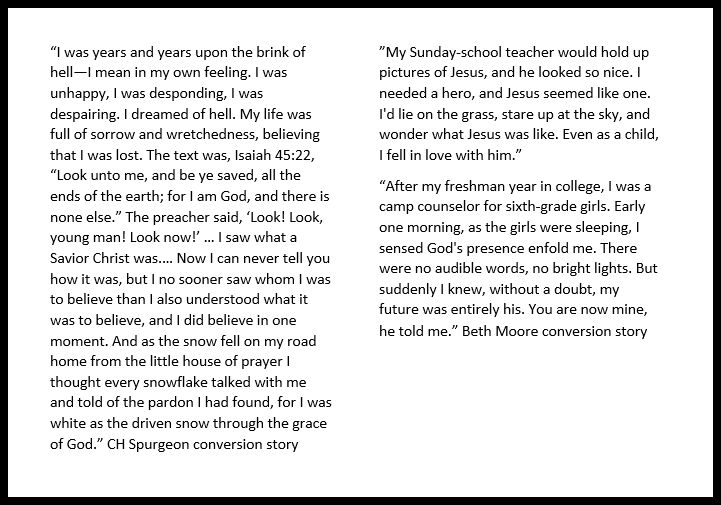
My Sunday-school teacher would hold up pictures of Jesus, and he looked so nice. I needed a hero, and Jesus seemed like one. I’d lie on the grass, stare up at the sky, and wonder what Jesus was like. Even as a child, I fell in love with him. After my freshman year in college, I was a camp counselor for sixth-grade girls. Early one morning, as the girls were sleeping, I sensed God’s presence enfold me. There were no audible words, no bright lights. But suddenly I knew, without a doubt, my future was entirely his. You are now mine, he told me. (source)

If that sounds familiar, it’s because it is very much like many other false teachers’ conversion stories.

It’s a testimony devoid of essential Gospel elements such as sin or repentance, but rife with romantic eroticism. Sarah Young describes her experience this way:

Suddenly I felt as if a warm mist enveloped me. I became aware of a lovely Presence, and my involuntary response was to whisper, ‘Sweet Jesus.’ This utterance was totally uncharacteristic of me, and I was shocked to hear myself speaking so tenderly to Jesus. As I pondered this brief communication, I realized it was the response of a converted heart; at that moment I knew I belonged to Him. (source)

Bob Dewaay explains the problems with such erotic romanticism.

The Bible speaks of the church as the Bride of Christ but does not describe the universal call of the gospel in sensual terms of a lover pursuing His love interest (who may have no interest in return). God is commanding sinners to repent. The gospel calls for repentance and faith, not romantic feelings looking for satisfaction. Voskamp’s romanticism is enhanced by her skill at describing things in a most sensual manner. The sensual terminology is designed to create a mood, a feeling, a sense of romantic mystery that longs for discovery and fulfillment. Those like me who relish clear description of theological concepts meant to be understood and discerned, will be horribly frustrated by the book. Her book is not meant to be a theological text filled with ideas to be judged true or false, but is instead a literary piece filled with feelings to be relished.

Conversion and life in Christ is not the fulfillment from a young girl’s romantic heart, yearning for a boyfriend. It’s the majestic gift of grace from a powerful but merciful God who draws people to Himself and forgives of sin, making them a new creation. Moore’s yearning for a heroic boyfriend is not the same as Godly reconciliation and peace from the spiritual battle in which all are engaged. Sadly, Moore has built a career on the false premise, and many millions have followed her down that path.

Such romanticism is not new nor did it originate with Protestants. Some Catholic mystics were adept at seeking and enjoying such unions. These women were popular in the Middle Ages. Here is an explanation of this kind of conversion story related to a famous Catholic mystic, Teresa of Avila:

Teresa described the soul’s intense desire for God in the language of erotic passion. In this, she belongs to a long tradition of mystical experience that is known as bridal mysticism. … 

The symbolism of bridal mysticism is found already in early gnostic forms of Christianity, where the central sacrament is called the Bridal Chamber. There the feminine soul of the gnostic unites with the masculine spirit and is in this way spiritualized, that is, liberated from the limitations of mundane existence.

The Catholic Encyclopedia explains mystical marriage:

In a more restricted sense, the term mystical marriage is employed by St. Teresa and St. John of the Cross to designate that mystical union with God which is the most exalted condition attainable by the soul in this life. … This state consists of three elements:
1. The first is an almost continual sense of the presence of God, even in the midst of external occupations.
2. The second element is a transformation of the higher faculties in respect to their mode of operation: hence the name “transforming union”;
3. The third element consists in an habitual vision of the Blessed Trinity or of some Divine attribute.

You notice in the writings of these women, especially Voskamp and Young, they mention “Presence”. That’s mystical bridal union state #1.  For example, Voskamp wrote,

The practice of giving thanks . . . eucharisteo . . . this is the way we practice the presence of God, stay present to His presence, and it is always a practice of the eyes.

This notion of continual presence and feeling it tangibly comes from a book written by Brother Lawrence, called Practicing the Presence, who was, you guessed it, a 17th century Catholic mystic.

These “mysti-chicks” such as Voskamp, Moore, Kim Walker Smith and Young, also mention that they have experienced bridal mysticism’s heightened senses and a clarity of thought, and third, they say they continually hear God or see angels or have habitual visions. Just as the Catholic encyclopedia says occurs in their descriptions of what they claim is the state of bridal mysticism.

Compare those flimsy, feelings & emotion saturated female ecstasy conversion stories with a real conversion story. This one is drenched in the scriptures.

Beth Moore’s conversion answer to the Christian reporter was terribly sad in its absence of anything remotely Gospel. A mysti-chick seeking a handsome hero to enfold her and keep her forever is a conversion story more attuned to bridal mysticism than the gritty realty of a repentant sinner saved by grace through faith.

And that’s bridal mysticism. As for the second part of my original question, why is it so prevalent? It is because apostasy is always present. As long as Christianity exists in this age, there will be those who claim to possess a transformed heart but do not possess one.

Now the Spirit expressly says that in later times some will depart from the faith by devoting themselves to deceitful spirits and teachings of demons, (1 Timothy 4:1)

Some of these people making the claim will be teachers, pastors, leaders. If you believe that false converts should be easy to spot, you’re wrong. Judas lived intimately with the disciples and Jesus for three and a half years and none of the disciples even suggested Judas as the false one when Jesus said there is one among them. Philip baptized Simon the Sorcerer, who later was cursed because he thought he could obtain the Spirit by money. Demas walked with Paul, the greatest evangelist on earth, but he showed his true colors when he left Paul because he loved the world more.

If the Disciples, Philip, and Paul could not initially spot a false convert under their nose, neither can we. However, false converts always do or say something eventually to reveal who they really are.

So, mysti-chicks did not originate with post-modern Christianity, nor did they originate in the Middle Ages’ Catholic bridal mysticism. They’ve been around as long as metaphorical Jezebel, whom Jesus threatened to strike dead. (Revelation 2:20-23). Be wary of teachers who have a conversion story absent of the necessary elements, who have added elements, or who have relied on some sort of temporal experience as the basis for their conversion. They must have a clear view of who Jesus is, (Savior) and who they are, (sinner) from the start. Not a mature perspective, because converts are babes in Christ, but a correct one. A house built on sand will not last.

For the ladies who wonder if it is OK to read or study under these false female teachers’ earlier works, ‘when they still seemed solid,’ just remember their conversion was based on sand. They were never solid.

Build Your House on the Rock
Everyone then who hears these words of mine and does them will be like a wise man who built his house on the rock. And the rain fell, and the floods came, and the winds blew and beat on that house, but it did not fall, because it had been founded on the rock. And everyone who hears these words of mine and does not do them will be like a foolish man who built his house on the sand. And the rain fell, and the floods came, and the winds blew and beat against that house, and it fell, and great was the fall of it.” (Matthew 7:24-27).

See below the conversion story of a 16 year old Charles Spurgeon, compared to the 18 year old Beth Moore conversion story. House of sand indeed.

Posted in discernment, Uncategorized

Discerning Jen Hatmaker: New stance on affirming homosexual marriage causes Lifeway to pull her books

Christianity Today is reporting on some news Jen Hatmaker has sparked. Jen Hatmaker is an author and reality television personality whose most famous book, 7: An Experimental Mutiny Against Excess was reviewed here on The End Time in 2013. That link is below. At that time I engaged in a two part look at Jen Hatmaker. Part 1 was a review of her book. Part 2 was a closer look at her emerging Catholic-based mysticism.

Hatmaker is in the news of late because she has come out solidly for homosexual marriage, claiming it is not only biblical, but can be a holy ordinance. As a result, Christian bookstore LifeWay, an arm of the Southern Baptist Convention, has stopped selling her books.

LifeWay Stops Selling Jen Hatmaker Books over LGBT Beliefs
One of evangelical women’s favorite authors loses her place in one of America’s largest Christian chains. In an interview published Tuesday, the Austin-based author and pastor’s wife told Religion News Service columnist Jonathan Merritt that she supports same-sex marriage and believes that LGBT relationships can be holy. … The Southern Baptist chain stated Thursday that the author’s statements “contradict LifeWay’s doctrinal guidelines,” and it has discontinued selling her books in its 185 stores or online.

Now is a good time to review what makes Hatmaker’s theology aberrant and why she should be avoided.

The following book review published in 2013 at The End Time gives an overview of how Hatmaker approaches the Bible and her response to it.

Book Review & Discernment- “7: An Experimental Mutiny Against Excess” by Jen Hatmaker, part 1

Part 2 looks at some key phrases in her book which reveal her entrancement with Catholic mysticism and liturgy. If you are a solid teacher of the Bible and a discerning student of it, you will not be promoting practices from false religions. It’s that simple.

Book Review & Discernment- “7: An Experimental Mutiny Against Excess” by Jen Hatmaker, part 2

Here is another good essay discerning Hatmaker,  written in May 2016 by Timothy J. Hammons, titled Jen Hatmaker’s Messiah Complex. Mr Hammons takes issue with Hatmaker’s flawed view of homosexual sin.

Amy Spreeman at Berean Research posted an article about Hatmaker in January 2016 which references her own essay and re-posts Christine Pack’s essay on Hatmaker, too. Four Concerns about Jen Hatmaker’s Teachings.

Just because a Bible teacher or leader is popular does not mean they are solid. In fact, oftentimes the opposite is true. (Luke 6:26).

As always, think these things through and do your investigations comparing to the Bible. Ask the Spirit for help and wisdom. He will give it!

If any of you lacks wisdom, let him ask God, who gives generously to all without reproach, and it will be given him. (James 1:5).

Posted in discernment, Uncategorized

Two divorce cases: Summer White and Melissa Moore

Many Christians have a sin or an issue which they have a particular affinity against or former involvement with. Children of alcoholics tend to have an interest in the Christian discussion of teetotaling. People who had been deceived by charismatic doctrine tend to be focused on deception/purity in the church. And so on.

Mine is divorce.

Continue reading “Two divorce cases: Summer White and Melissa Moore”
Posted in discernment, Uncategorized

Ted Dekker’s The Forgotten Way: Book Review and a Discernment Lesson

Ted Dekker is a Christian novelist who writes Christian thrillers. He has also written several book series of historical nature, several fantasy books, and Christian fiction. Dekker’s interests and range are diverse. He has won the Christy Award for best fiction book, ECPA Gold Medallion Award, INSPY Award, among other awards and recognition.

This month, Dekker has published a book which diverges from his usual genre of fiction. His new book is a study/devotional. It’s called The Forgotten Way of Yeshua for Power and Peace in This Life. I’ve been asked to look into the book and give an opinion as to its doctrinal solidity.

This article will serve a two-fold purpose. The first part will be to explain and teach how I approach the decision-making process on whether to read a Christian book or engage in a published study. Time is short in our lives and we do not have it to waste on absorbing poor or unhelpful material. Secondly and more importantly, the name of Jesus is tantamount. The material must reflect Him, His word, and His precepts correctly so His name is glorified. Thirdly, as women, we are more prone to error and tend to be unduly influenced by unbiblical things so we must be sure that what we take into our brain doesn’t pollute our brain. (1 Timothy 2:14, 2 Timothy 3:6). Be discerning, wise, and careful.

The second part of this article, as you scroll further down, will be a book review by a man who is familiar with Dekker’s works and who has read The Forgotten Way. So, a lesson, and a review.

How to Approach Whether to Read a Book or Study

I looked at Dekker’s website, and I read the sample lessons in his study and I downloaded the free sample devotionals. I read 30 pages of the devotional.

1. What I do first is, I look for contemporary buzzwords that indicate where a person’s heart or mind lay. If they use standard, biblical words to describe the standard biblical concepts such as justification, sin, repentance, etc, then all well and good. The first red flag I noticed is calling Jesus “Yeshua”. I’ve observed that many mystics seem to think this gives them more piety when they use the Hebrew name. Also people in the Hebrew roots movement call Jesus ‘Yeshua’. It’s an affectation. More buzzwords below.

2. The second big red flag is any leader who says he has discovered a new way, or a forgotten method, or an overlooked verse, or claims new meaning, it’s a problem. The point of Christianity is its unchanging nature because it’s founded on God and He does not change. It also indicates a mountainous pride. “Everyone else has forgotten this, no one else has noticed this, but I am here to rectify that.” Dekker’s promotional material is rife with promises that this ‘new way’ will revolutionize your faith, which leads to the third red flag-

3. Any promotional material that says it will change your life is of concern. The Holy Spirit changes your life, not a method. The point is to get to know Jesus better, not to change our temporal lives. Any time we are with Him in the word or worship or hymns or prayers, we become transformed and our transformation through ongoing sanctification changes our life. But short cuts like a 21 day devotional with a newly rediscovered method such as Dekker’s? I’m always suspicious of claims that promise an immediate jump in sanctification.

4. Fourth, notice if the author uses trendy buzzwords or buzzwords that are from another religion. In Dekker’s case, the promo material as well as the actual study contain many terms associated with New Age. Words such as “alignment, resonating, tuning fork, vibrate, same frequency” abound. These are not biblical words. There are biblical words that describe the concepts Dekker is attempting to get across. Other words that he uses have no biblical grounding. Either way, use the biblical word and not the words that are widely associated with a different religion. Never mind the obvious, that with the Holy Spirit IN us, we are already ‘aligned’ with Him and always on His ‘frequency.’

In considering whether to take up a study or read a Christian book, I ask myself if the writer seems to have a grounded, balanced view of Jesus. It seems that in this new study, Dekker’s entire emphasis is solely on the love of Jesus and not His wrath, justice, holiness etc. In fact, it seems he focuses on what WE can get out of Jesus rather than focusing on His attributes for His own glory’s sake. The constant references to “who we are” and being “able to love ourselves”(I got those from his promo video) are concerning.

There are sweeping claims in the promo material and in the part of the study I’d read. I read such outlandish things as “The whole world longs for the Way of Yeshua” and “An awakening is sweeping the world.” I do not like it when authors make sweeping statements about God as if they know things. Dekker does not know that all 8 billion people of the world long for the way of Yeshua. As a matter or fact, the world rejected and still rejects Jesus and He said they always will. (John 15:18). No one seeks after God. They all go their own way, (Isaiah 53:6), which is not the way of “Yeshua”. So Dekker’s sweeping statements are a problem.

Last, I look at who has supported the book or Bible study, or who promotes it. Dekker has blurb support and recommendations from Elevation Church, which is bad. Other readers liken Dekker’s book to Henri Nouwen, who in fact is a Catholic mystic.

From these flags, I’d say that the book seems to be a misstep for Dekker. It’s sad, because in his video he said he’d been working on it for years. As a woman, I would choose not to read the book/take the study because these red flags are enough to show me there are problems. I don’t want to use the bulk of my brain power while in a study busily warding off potential doctrinal issues. I want to be able to fairly safely engage in the study so as to learn from it and enjoy biblical truths. With so many better studies out there, I’d say give this one a pass.

The Book Review

Here is a review from a friend, Bryn Jones, who has read Ted Dekker’s The Forgotten Way.

I did read his e-book Waking Up, which is essentially a promo for the 21 Day “cleanse,” as he puts it. I wrote a review (2 stars). He gets a couple things very right. For instance, he stresses that we need to find our identity in Christ, not in our own efforts to measure up or prove ourselves. But there’s some wrong in there, too. Like you pointed out, he loves the “love” of God, and he comments on the omnipotence of God, but then fails when defining love. To him, love means never being offended and just showing kindness to everyone, never pointing out wrong, just accepting… etc. 

Oddly, John defines love as obedience to Christ (1 John 5:3). Also, if we’re never to correct anyone, or never to be offended, then there would be no content to the epistles (which were often corrective) and there’d be no reason for Jesus to outline how we are to address issues where a brother sins against us. What I heard is “planks of offense” in Dekker’s promo, which is a phrase I’ve heard from a charismatic friend who regularly quotes from the Word-Faith movement. In that version, they change Jesus’ teaching to say people have “planks of offense” in their eye, rather than the meaning of being guilty of the same issue they intend to correct in other people. I imagine the subtle change is so that these domineering pastors can chastise anyone who tries to correct them by claiming they have “planks of offense.” 

So, Dekker has some good in regard to the identification with Christ, that our position is secured and not in need of our efforts … but then he ignores the actual “elephant in the room” that many who “got saved” but are living lives that are so sinful they’ve “forgotten who they are” might actually not be saved. So, his advice that they need to just “awaken” to the “reality” of their position in Christ sounds rather … universalist.

The other thing that got me about the book was how the author claimed that the Ted Dekker he sees in the mirror, the novelist, is not the real person. It’s like a role he’d play on TV … it’s passing away … the true Ted is this spiritual one in Christ. He assures the readers that he’s not a Gnostic, but it sure sounds like it. I don’t think the “putting off of the flesh” meant that our personalities and occupations and interests are all worldly. God made us who we are and we will be perfected. Maybe I’m being picky. But it sure read very mystic/gnostic to me.

Bryn Jones is the author of the apocalyptic novella RESISTANCE, the thriller, The Next Chapter,the supernatural suspense novella, The Fold, & The End Times Christmas novella, The Last Christmas

~~~~~~~~~~~~~~~~~~~~~~~~~~~~~~~~~~~~~~

I hope this helps. As always, search out these things for yourself, and remember that prayer is the best vanguard. Pray to the Holy Spirit to give wisdom and discernment. (James 1:5). Read your Bible to grow, and be careful of what you choose to study, even from formerly solid teachers.

Be sober-minded; be watchful. Your adversary the devil prowls around like a roaring lion, seeking someone to devour. (1 Peter 5:8)

Posted in discernment, Uncategorized

The Power of Music- Baby Moved to Tears as Mom Sings Worship Song

In his book, Real Worship: Playground, Battleground, or Holy Ground? Warren Wiersbe wrote,

Music confronts the whole person, mind, heart, and will- and demands some kind of response. Music instructs the minds, inspires the emotions, and challenges the will. … It should not surprise us that great revival movements, evangelistic campaigns, and political and nationalistic crusades have all swept forward on the wings of song.Even Israel felt a new sense of unity and victory when they sang God’s praises at the Red Sea (Exodus 15), a scene that will be repeated in new dimensions when God’s people arrive in heaven. (Revelation 15:1-4).

I am convinced that congregations learn more theology (good and bad) from songs they sing than from the sermons they hear. Music reaches the mind and the heart at the same time. It has the power to touch and move the emotions…

RC Sproul said of music in his online class Recovering the Beauty of the Arts,

Just as conversion is an aesthetic experience in which the converted person is first awakened to the sweetness and excellence of God in Christ, so our musical expression of worship should continually direct our attention and stir us to adore His beauty and majesty.

But do not take my word for it. Watch what happens when a mom sings “Good Good Father” to her baby

Baby Moved to Tears as Mom Sings Worship Song to Him – “Good, Good Father”

Song Leaders, please be ever so mindful of the tremendous impact music has. Wiersbe said music

can be a wonderful tool in the hands of the Spirit or a terrible weapon in the hands of the Adversary. Naive congregations can sing their way into heresy before they even realize what is going on.

Posted in discernment, Uncategorized

Nebuchadnezzar knew it was best to take the youth

James Montgomery Boice preached through Daniel. In his initial sermon of the series, Daniel 1: A Young Man Decides, he expounded on how liberals use language to change the meaning of words, and to inculcate a loyalty to the new definition by showing how Nebuchadnezzar did the same. (Daniel 1:1-7).

How does one change the loyalty of people who adhere to a different God, and make them loyal to him and the Empire? And as much as possible make them forget their loyalty to their homeland and all that was within it (including their God)? In the sermon, Boice noted that the originator of the word changes was Nebuchadnezzar.

We see of course that Nebuchadnezzar took young men, who at that age are more impressionable and perhaps have not come to a settled loyalty yet. Or who at least could moldable and be made to forget.

Next, you entice them. That was why the King offered the young men choice delicacies from his own table. Nebuchadnezzar was making the world attractive.

Third and chiefly, Nebuchadnezzar did it through changing their names. Their names had God within them. According to Daniel 1:6, the young men’s original Hebrew names were

Dani-El
Hananiah
Misha-El
Azariah

Daniel and Michael have the name for God (El) in them, the plural name of El is Elohim which we may be more familiar with. In Hebrew, Daniel means “God is my judge”, Mishael means “Who is like God?”. The names were great reminders of their racial and Godly heritage. Hananiah and Azariah contain a shortened form of the name Jehovah. Hananiah’s meant “Jehovah is gracious”, Azariah’s meant “Jehovah is my helper.”

Nebuchadnezzar was intending to mold them by giving them names of local Babylonian deities in order to distance the men from their own God and inculcate a local loyalty.

We can apply Nebuchadnezzar’s tactic to our own day. Nebuchadnezzar did it then, and the world still does it. Changing words and meanings of words is a scheme that molds followers to a new concept or idea. Liberals change words within the Christian vocabulary. They don’t abandon the great concepts outright, they simply change the meanings of the words.

A word like sin is changed to mean: not any want of conformity unto or lack of obedience to the Law of God, which is the word as true Christians know it. Sin is changed to oppression that resides in the social structure to a word so that it’s not a personal thing, where you and I individually have rebelled against God, but is instead something ‘out there’ in the system that can be overcome by revolution.

The name Jesus according to traditional understanding is the second person of the Godhead, God the Son who became a man-God who died on the cross for our sins and rose from the dead to be seated at the right hand of the Father.

The word ‘Jesus’ has come to be redefined in some liberal quarters, not the second Person of the Trinity, but is changed to mean simply a Person who is an example to us, not someone who achieved anything for us.

Salvation comes not as a word meaning not God’s deliverance to us by His grace instead of the penalty due us for our sins, but a word meaning we are freed from the world’s socially oppressive structures.

The word faith has been changed to mean not that obedient response of the heart to God’s declaration of what He’s done, but instead becomes something like “commitment”.

Change the word meaning, and you can change the mind. What’s important though, its that external pressures, liberals, or the world, cannot change the heart. What keeps the heart warm and moldable to God is reading His word and prayer. Daniel, Hananiah, Mishael, and Azariah could not be swayed from their faith to God and in God. They remained actively attuned to Him and steadfast in their faith in both heart and mind and so were true to the end.

When you speak to people and they say words like faith, salvation, Jesus, sin, or any other common word, they might mean something totally different to that person from what your understanding of these words are. It’s always important to first, know what you believe and can define it. Second, when discussing Christian concepts, don’t take for granted that both you and the other person have the same understanding of the words you are using. Third, recognize that there is nothing new under the sun, and people opposed to the truth use and re-use the same tactics that are intended to incrementally sway you away from the truth.

One wonders what tactics were being used against the truth to draw the Galatians away from the Gospel. Paul was amazed it had happened so fast.

I am astonished that you are so quickly deserting him who called you in the grace of Christ and are turning to a different gospel (Galatians 1:6).

The word ‘quickly’ is tachus which means quick, fleet, speedy. We get the word tachometer from tachus. Tachometer is a measure of velocity of machines. I know right now you’re picturing a tachometer needle speeding up form first gear to top gear. Sometimes desertion of the truth can happen that fast.

Make sure your loyalty is founded on a solid rock and that you (and I) have a solid understanding of what word means what in the faith. Especially the moldable youth. I do not think it is an accident that over this last generation we have herded the youth away from the main church service and sequestered them all in one room or building. Nebuchadnezzar knew that the impressionable teenagers were best to remove from their traditional place and mold to a new thought by sequestering them, enticing them, and redefining what they used to know into new concepts.

Stay strong, Ladies, oppose redefinition of our words, which are precious to the faith and important to the mind and heart. Watch your teenage children. Don’t be satisfied when you superficially hear the Youth Pastor teaching them of Jesus, sin, faith and the like. Make sure you know that he knows what they really mean, and that your children do too.

And, Do your best to present yourself to God as one approved, a worker who has no need to be ashamed, rightly handling the word of truth. (2 Timothy 2:15).

Posted in discernment, Uncategorized

The red rage of the Pharisees yesterday and today

One moment in the life of a blogger who writes discernment essays:

Stumble into the kitchen, bumblingly make the coffee. Yawning, plop down in the chair and fire up the laptop. As the blue light turns to screen saver, I launch open the browser. As the coffee finishes perking and I finish yawning, I pour a cup and look forward to the day. My prayer is to reach women with the truth, to use scripture rightly to turn them away from the false so they can see the glory of Jesus.

Oh, look there is a comment on my blog. Let’s see what it says. It’s from a woman named Karen Setters.

“You and your blog are some of the most inaccurate and heretical false accusations against some of God’s most anointed and accurate teachers in the Body of Christ. How any informed Christian listens to you after the nonsense you spew against God’s people is beyond me! May the Lord Jesus Christ turn your heart, mouth, and blog to understanding the truth of His Word and His people, because obviously you don’t. Satan is using you and when you stand before the Lord at the final day, you are going to be shocked and maybe lost if you don’t humble your Phariseeical heart and listen to what the true Spirit of God says to you.”

In addition to naming me as a heretical, inaccurate, nonsensical, Pharisaical, satanic person, in Karen’s second comment she also called me an antichrist and a coward.

Okey dokey then, lol, I surmise that the truth of scripture did not reach her heart! It’s a powerful reminder however, that those women held in the clutches of a false teacher or who cling to false doctrine clench untruth tightly. The more anger and nasty language that emerges from their mouth demonstrates the further distance away from Jesus they actually are.

Remember, fellow blogger ladies and fellow witnesses, when you point out a false doctrine or a false teacher, anger is often the reaction. It always has been and always will be. Look at the Pharisees’ reaction to Jesus words and deeds and to His designated witnesses like Paul and Stephen. They reacted with gnashing teeth, fury, stone-throwing, blinding rage. They became murderous. (Luke 6:11, Matthew 12:14, John 8:59, Acts 7:54…)

This is because they loved their sin and they loved the darkness. What happens when you poke a rabid bear? A reaction like Karen Setters’ is what happens. Seething, frothing anger and nastiness. In the Luke 6:11 verse it says the Pharisees and Scribes became actually mad with rage. It’s an unthinking, non-rational, senseless, red rage. Matthew Henry says of the Luke 6:11 verse,

Pride, obstinacy, malice, and disappointed self-confidence were “all” combined, therefore, in producing madness. Nor were they alone. Men are often enraged because others do good in a way which “they” do not approve of. 

This kind of rage is also an example of how powerfully sin wants to remain. Sin is the second most powerful force on earth. Jesus’s power in regeneration is the most powerful, but for those left untouched by His hand on their heart, sin reigns and the rage shows just how powerfully it is lord of a person.

The most violent reaction to the truth is murder. Martyrs abound in ever generation and in every country today. As Mark Dever and Burk Parsons and Jesse Johnson and Pastor Gabe of WWUTT.com remind us,

The truth is divisive. Jesus said it would be and we see of course that it is. Jesus said in Luke 12:51,

Do you think that I have come to give peace on earth? No, I tell you, but rather division.

It’s His truth that divides. The truth is the dividing line. In between the gulf of truth on one side and lies on the other, is often anger. The only reaction we can have when met with such anger, even to martyrdom as those in the “closed countries” are met with, is compassion and love. (Mark 10:21).
Posted in discernment, Uncategorized

Did Jesus come to judge the world or save the world? Context, context, context

A favorite tactic for those who take verses out of context, is to read only part of the verse. Or, as in today’s case, to take a complete verse as the statement or their defense, but forego the next verse, which is obviously attached to the former. Here is the example.

As for anyone who hears My words and does not keep them, I do not judge him. For I have not come to judge the world, but to save the world. (John 12:47)

It’s popular for many people to rely on that verse as their defense in saying not to point our error or to name false teachers. “Stop judging!” people say. “The Bible says not to judge, even Jesus didn’t come to judge!”

However, the verse 47 continues the thought into verse 48.

There is a judge for the one who rejects Me and does not receive My words: The word that I have spoken will judge him on the last day.

So people WILL be judged. Gill’s Exposition of the Entire Bible says of John 12:47-48,

and receiveth not my words; the doctrines of the Gospel, but disbelieves them, and denies them to be true, looking upon them as the doctrines of a mere man, and an impostor:

hath one that judgeth him; let not such an one think that he shall escape righteous judgment; though Christ does not judge him now, there is one that judges him, yea, even now; and declares, that he that believeth not shall be damned, and that he is condemned already

the word that I have spoken unto you the same shall judge him in the last day; according to the different dispensations wicked men are under in this world, will be the rule of their judgment hereafter: such who are only under the law of nature, will be judged according to that, that will accuse them, convict them, and condemn them: such who have been under the law of Moses, or the written law, will be arraigned, proved, and pronounced guilty, and punished by, and according to that law; and such who have been under the Gospel dispensation, and have been favoured with the revelation of the Gospel, but have condemned and denied it, that will judge them at the last day. The judge will act by its present declaration, and according to that proceed, as it stands in Mark 16:16. It will rise up in judgment against such persons, and be an aggravation of their condemnation.

Part of what we mean when we say don’t take verses out of context is first, read the whole verse, not just part of it. Second, read the verses around the verse you want to quote. As a matter of fact, it’s good to read the entire passage, page, or even chapter. You will get a better idea of the flow and the points raised and settled. If realtors’ mantra expression is: “There are three things that matter in property: location, location, location,” then the Bible student’s mantra should be “There are three things that matter in Bible study- context, context, context.”

context


Posted in discernment, Uncategorized

What makes a false religion, false?

Left, a Muslim woman in a hijab. Right, Catholic nun in her habit.

If it’s not one false religion, it’s another. False religion has been with us since the Garden. It’s nothing new. When Jesus returns, He mused whether He will even find faith upon the earth. (Luke 18:8)

The question of the day is, what makes a religion false?

Humans have an innate sense of worship. We don’t worship who God wants us to worship. We don’t worship in the way He wants us to worship. We don’t worship for the right reasons.

Examples of these are of course, Adam and Eve, who were tempted into worshiping themselves (“you will be like God”.) Cain did not worship in the right way. (Genesis 4:3-5). But there is a right way to worship and a wrong way to worship. Neither did Nadab and Abihu. (Leviticus 10:1). Many in the days of the Incarnation did not worship Jesus for the right reasons. They preferred the glory of men to the glory of God. (John 12:43).

I’ve spoken with non-saved people who think that God was being too harsh for preferring Abel’s blood offering and by rejecting Cain’s offering of the fruit of the ground. As if God is someone who should be happy with whatever worship we throw at Him. As in our own earthly lives, there are standards. Even unsaved people know that. Parents have standards for children’s behavior, bosses have standards for evaluating their employees, factories have standards of production to ensure a quality product. When it comes to God though, people think that no standards is the more “loving” way.

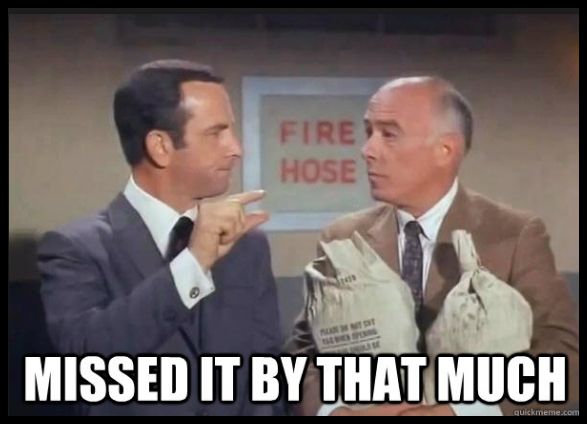
Not so. There was a spy spoof TV program in the 1960s called Get Smart. Max the bumbling, incompetent spy used to say “Missed it by that much.”

Obviously, this phrase was used when someone, usually Max,
was just a little bit off in his aim, guess, or goal.
Missed it by that much!

And because the path is narrow, it is easy to miss the mark.

However when it comes to faith and worship, missing it even by that much means the wrong eternity. Jesus said the path is narrow. (Matthew 7:13). Though we can never fall off the path once we are on, those who are not saved concoct all manner of methods to save themselves.

For example, in Japan, we learn that it was thought if you crawled through a volcanic “womb cave” you would be reborn.

For centuries, religious devotees, or ascetics, looked towards Mount Fuji as a place of worship, trekking up the mountainside to reap its spiritual powers. The mysterious lava caves were thought of as “human wombs,” and those who journeyed through the dark passageways could experience rebirth. … The cave known as Tainai, which translates to “womb,” is said to be the birthplace of Sengen, the deity of Mount Fuji.  It was common for the religious followers of the Mount Fuji cult to associate terrestrial features of the mountain with parts of the human anatomy. 

I won’t go further into detail, though the articles does. Suffice to say that anyone passing through the womb caves of Mt Fuji and performing the rites there did not save themselves, nor did they cause their own rebirth.

In Catholicism, there are made-up salvation methods such as the Treasury of Merit and Indulgences. From his online class “Justification By Faith Alone,” RC Sproul explains,

The treasury of merit exists so that people can get into heaven. Very few people die and go directly to heaven, according to the Roman Catholic view. The majority of people who die go to purgatory to have their impurities purged. Purgatory is not hell; it is not a place of punishment. People in purgatory do not have sufficient merit to get them directly into heaven. The few who go directly to heaven have sufficient merit as well as supererogatory merit. Works that go beyond the call of duty produce supererogatory merit. Supererogatory merit is more than is required to get into heaven, allowing for the excess to be deposited into the Treasury of Merit. When indulgences are purchased, withdrawals are made from the treasury of merit for those in purgatory.

Purgatory and Indulgences are weird. All that is just as weird as the volcanic womb tunnels.

There are many other weird methods to save one’s self in many other false religions that we could go into but they are all complicated, weird, wrong, and bad.

The truth is so much simpler.

For by grace you have been saved through faith. And this is not your own doing; it is the gift of God, not a result of works, so that no one may boast. (Ephesians 2:8-9).

So what makes a religion untrue, or what makes Christianity true? There are some doctrines that the Bible declares as essential for true faith.

The Bible itself reveals those doctrines that are essential to the Christian faith.  They are 

1) the Deity of Christ, 2) Salvation by Grace, 3) Resurrection of Christ, 4) the gospel, and 5) monotheism. These are the doctrines the Bible says are necessary.  Though there are many other important doctrines, these five are the ones that are declared by Scripture to be essential. A non-regenerate person (i.e., Mormon or Jehovah’s Witness, atheist, Muslim), will deny one or more of these essential doctrines. Please note that there are other derivative doctrines of scripture that become necessary also and the Trinity being one.

Also note that bedsides denying essential doctrines, a non-regenerate person may use the same terms as a Christian, saying things like “I have faith.” Or, “I believe.” They have adopted Christian terms but have through use or intent, redefined them to something they are not. Mormons for example, believe that Jesus is a god, so a superficial look at the essential doctrine that the deity of Christ is essential in that case would seem to satisfy. However, they believe Jesus is a created god, not THE Eternal, self-existent Father. So they deny the Deity of Christ even though they call Him a god. Therefore Mormonism is a false religion.

Catholics even use the term ‘justification by faith’ as born again believers in the true faith do, which is essentially what the Ephesians verse states. However, Catholics disbelieve the source of the necessary righteousness that justifies us is solely from God, but stems from an inner righteousness humans already possess or generate thought works.

Imputation has always been the one thing that has caused the many attempts to resolve the theological conflict of the Reformation to fail. Rome has always rejected the idea that we are justified on the basis of an imputed righteousness. The Roman view would be that the meritorious cause for God to declare a person righteous is because that person is righteous. The Reformed view would be that the meritorious cause for God to declare a person righteous is because Christ is righteous. (RC Sproul, online course “Justified by faith alone”. 

The essential doctrines are expounded upon at the link above. Here it is again. Those are the doctrines the Word of God declare are necessary for faith. If there is any religion which alter those or are absent any of them, it is a false religion.

How can a Christian determine which doctrines are essential and which are not? Here are two bullet points from a short essay by John MacArthur

I. All Fundamental Articles of Faith Must Be Drawn from the Scriptures
II. The Fundamentals Are Clear in Scripture

Any religion which deviates from the essential doctrines, alters them, or puts forth doctrines that are not from scripture or are unclear, is not a true faith. ALL religions which rely on anything other than the word of God and which draws its essentials from the word are false.

Another way to determine if a religion is false is to see how it handles the Bible. False religions may or may not use the Bible as their basis. Jehovah’s Witnesses use the Bible but they’ve re-written it. Mormons use the Bible but have added to it with their Doctrine and Covenants and Pearl of Great Price philosophies. Islam and Hinduism don’t use the Bible at all.

Christianity is revealed to us through the Bible. It’s one book, divided into 66 books, written over 1,500 years but is a unified, cohesive tome with a sole author. I’d encourage you to check out the link at CARM above which outlines the essential doctrines with the verses and explanations.

You might not have thought about it this way, but ALL OTHER religions have a sole author, too. Satan. He wrote the precepts of Mormonism, Catholicism, Hinduism, Jainism, Atheism, Buddhism, Islam, Wicca, and the rest. If a religion is not of God, it is of the devil. (Matthew 12:30). There are two paths, the broad and the narrow. There is either one or the other. (1 Corinthians 10:21, Matthew 6:24). Any religion that isn’t Christianity is opposed to Jesus and therefore it is of the devil. Even religions like Catholicism, which miss it by that much.