Posted in discernment, Uncategorized

An exhortation about false teaching from Jeremiah

It says in 2 Timothy 3:13, evil men and seducers will wax worse and worse. The study note for that verse explains that “all the dangerous movements of the false teachers (cf. vv. 1-9) will become increasingly more successful until Christ comes. Cf. 2 Thessalonians 2:11).”

This is a sobering thought.

Very sobering.

False teachers are a scourge and a plague. They are worse than locusts who sweep across the field and leave only broken and inedible crumbs in their wake. False teachers destroy souls. False prophets bring Jesus into disrepute and they steal His glory. Lest we believe that those who follow these false teachers and prophets are helpless victims, they are not. Followers of these locusts love to have it so. They actually heap up the false teachers to themselves. (2 Timothy 4:3).

False teachers have been around since even before the world was formed and satan was spreading his evil merchandise in heaven to his companion hosts. (Ezekiel 28:16). Jeremiah wrote in around 600BC about the evil, unholy trio of false priests, false prophets, and followers of both:

An appalling and horrible thing
has happened in the land:
the prophets prophesy falsely,
and the priests rule at their direction;
my people love to have it so,
but what will you do when the end comes?
(Jeremiah 5:30-31)

The word in Hebrew for appalling is “a horror.” False teaching, false teachers, false prophets, and false converts who love them are a horror, from a word meaning ruin, desolation.

False teachers is a serious issue, people. We tend to want to lessen their impact by rationalizing. We want to decrease their evilness by calling them merely innocuous bones to spit out whilst we ingest otherwise good food. But is this how God sees them? No. He calls them and their followers a horror, a ruin, and a desolation.

False teachers and false prophets have been in existence since almost the beginning. False converts have also been with us, also. (Cain, anyone?). The 2 Timothy 3:13 verse reminds us that things will only get worse. The diffusion of evil will eventually blanket the world, and during its inexorable diffusion, its intensity will deepen.

The breach between light and darkness, so far from being healed, shall be widened [Henry Alford]

What this means for us is that we are at risk. We are more at risk than our parents or our grandparents, because as the verse says, things will get worse and worse. If we are at risk, then our children are more at risk. How are we at risk? Those who become false teachers want to deliberately ensnare you and me. They want to sell their merchandise because they are greedy. (2 Peter 2:3, 1 Timothy 6:5). If we for some reason are unstable or naive, we will be seduced. (2 Peter 2:14, Romans 16:18). The New Testament is rife with constant warnings. We can’t be content, ignorant, or relaxed about this.

Because we are all sinners, we can fall prey to these false teachers at any time. The antidote is not to be naive, but be wise. For we are not unaware of satan and his schemes (2 Corinthians 2:11). We must not be unstable, but cling to the solid Rock. Do this by constant repentance, persisting in the good works we’re commanded to do, and by prayer and study of His word. Envelop yourself with the blanket of His word.

I speak of this issue frequently. That’s for several reasons-

1. No matter where you read in the Bible, there is always either an issue of or a warning about false teaching. If it is a big deal to God, it is a big deal to me.

2. I am a woman, and women are even more at risk for falling into false teaching and following false converts. (1 Peter 3:7, 2 Timothy 3:6, 2 Corinthians 11:3).

3. Because as satan floods the church with false converts who in turn pile up false teachers, it will be harder and harder to detect the genuine. We are an army of forgiven soldiers whose job it is to love Jesus with all our hearts, minds, souls, and strength, with no room for false teaching and no quarter for false prophets. Don’t give sway to it.

4. Because the purer we are individually and as a body, the more we can glorify Jesus. Our chief end in life is to do this. Don’t waver in being steadfast against false teaching and false teachers. They are not misguided, innocuous, harmless, or temporarily errant. They are evil. They are a horror. They are a ruin. This means being being willing to call Beth Moore an evil, abhorrent horror. To say that Sarah Young, Paula White, and others are full of deceit. Can you? Will you?

False teaching is a never-ending battle. We return to Jeremiah, writing in around 600BC, 2,500 years ago-

For wicked men are found among my people;
they lurk like fowlers lying in wait.
They set a trap;
they catch men.
Like a cage full of birds,
their houses are full of deceit;
therefore they have become great and rich;
(Jeremiah 5:26-27).

God asked in Jeremiah 5:31, ‘What will you do when the end comes?’ It is always the main question. Our lives are a vapor, this era is but a moment. To the Lord, it has been but two days since Jeremiah wrote, not over two thousand years. (2 Peter 3:8). The end will come, for us all. I pray I am still standing form on His truth. I pray you are too.

———————————————–

Further Reading

The Cripplegate: Four characteristics of a false convert

Paul Washer’s site I’ll be Honest: A List of False Religious Hopes that Will Send Many to Hell

Posted in discernment, Uncategorized

Does God speak to us? Should I expect Him to?

How can I hear God? What do you do to listen to God? Will God be giving me explicit instructions for my life, like He seems to be doing for so many other women?

Beth Moore book: Jesus, the One and Only, p. 48.

Personalized whispers are not scripture, nor are they equal to scripture. “Personalized whispers” is not a teaching method Jesus uses. Yet women are being taught consistently and for decades that it is.

The concerning part is that this generation of younger women has been raised on a steady diet of women in celebrity positions who, for decades, have ‘taught’ the above, that they regularly hear the voice of God. Therefore, women coming up now believe it is the norm to have a personal God in your pocket whispering instructions to you for every little thing, from career moves to audible instruction in theology. But this is most assuredly not the case.

What these celebrity women leaders have done is create a discontent among female congregants who do not have a personal God and wonder what they are doing wrong because they don’t. Because of the poor teaching and constant eisegesis in their celebrity lessons that they, unfortunately, have relied upon, many younger women now realize they lack the skills to understand Gods will in a biblical way.

The will of God is to repent & believe, be baptized and participate in communion, and obey Him all your life.

We know how and where to obey in specific life choices because we read the Bible.

For example, as far as day-to-day choices go, like where to live, what college to go to, whom to marry or whether to marry, the more we obey, the more we’re conformed to Him, which means the more we can confidently decide for ourselves, knowing God prevents bad choices and ordains all things, AND makes all things work to the good of those who love Him. This is where trust comes in. We pray, (not to ‘hear back’ but to repent and submit and praise His sovereignty over all things), we understand the generalities of God’s will for our lives (Matthew 22:36-40). Then we pull up our big girl panties and we just decide.

Should we expect to hear from God? NO. Here are two scriptural explanations why. I repeat, we should NOT expect to hear God audibly, or in a still small, voice, or even in signs or omens, tell us specifically what to do or where to do at any given moment.

Ladies, expect to find God’s will by reading the Bible, whereupon the Spirit can conform you to His image and likeness and renew your mind. Don’t expect to hear a personalized whisper, an impression on your heart, or an audible voice directly telling you. Ultimately the reality of our sanctification is more delicate, mysterious, and beautiful than any whispers could ever be.

RESOURCES

“God told me…?” a 90-second video.

The Blazing Center has an essay titled “Listening to God without Getting All Weird About It“. HT Michelle Lesley

Two other resources for you on God’s will

Here is GotQuestions with a short answer to ‘What is God’s will?’
Know God’s will

And John MacArthur with a longer answer-
Taking the Mystery out of God’s Will

Sola Sisters, from 2012-
False Teachings About Hearing Audible Words From God Taking Even Deeper Root in Today’s Church

Grace To You blog from 2016
That’s Not Jesus Calling

Posted in discernment, Uncategorized

If Jeremiah, John the Baptist, and Paul were Arminian…

Today’s essay explores the notion that if Jeremiah, John the Baptist, and Paul had been Arminians, how would their testimonies sound? Using today’s vernacular, let’s see how it reads when these eminent Christians say they “chose God” of their own free will.

——————————————–

Photo from Pixabay.com

The Sovereign call of Jeremiah to speak YHWH’s words becomes:
Jeremiah asking Jesus into His heart and making a career decision,

“When I was a youth, one night I couldn’t sleep. I walked around for a while outside, unfamiliar with this restless feeling. I felt young and inept at whatever I tried my hand. I remember clearly, it was the third of Tishrei, a cool September morning. I was at Sabbath at the synagogue. I was overcome with Avital’s lyre playing of the ninth repetition of “Just As I Am.” It all came together in my heart. I made a decision to walk the aisle toward the rabbi, and I knelt down and sincerely asked Messiah into my heart. Rabbi told me I was saved. Afer that, I decided I wanted to be a Prophet of God because I knew that God had a great plan for my life. When I came forward the priest had told me that. I became a prophet even though I was young and didn’t know how to speak. It was a God thing for sure. I’m so happy that day I walked the aisle and decided for the Savior.”

The powerful testimony of Christian Terrorist Paul on the road to Damascus becomes:
Paul meekly being led in praying the Sinner’s Prayer and choosing to change his whole life around-

Paul explained, “I was exceeding my peers in Law, at that time I was breathing out threats and fire against the Christians. I was at the peak of my career. I had the esteem of my colleagues, and I was young enough to have the world in front of me. Yet something lacked. Then one day while I was walking along the road to Damascus on an official Pharisaical mission to jail and execute followers of The Way, I felt a restlessness. Is this all there is, I wondered? Just being the best at everything and killing blasphemers, nice as that was? I spoke about it with the men who were walking with me, but most of them didn’t understand, except for one fellow traveler. He explained that I needed to decide to follow Jesus and that I should use my free will to choose Him. Of course! That was the answer. He led me in the sinner’s prayer. I’ve been saved ever since. You should decide for Jesus too, everyone should. I don’t know why they don’t. That I did is what makes me a great example of Christian self-decisional regeneration. Not to boast, though. Grace and peace to you.”

John the Baptist’s call as the last Old Testament Prophet, foreordained and empowered since the womb, becomes a lifestyle choice-
John the Baptist shares his testimony about accepting Jesus

“I didn’t get along with my parents, they were very aged and they just didn’t understand me or my generation. I felt so lonely, like I didn’t fit in with any of my friends. I went to live in the desert to try and find myself, and figure it all out. One day as I was roasting some locusts over the fire and sewing a new camel hair outfit, I realized suddenly that what I needed was Messiah. What I lacked was that I hadn’t accepted Jesus as my personal Lord and Savior! I decided to give my heart to Jesus. I also decided to stay in the desert. It’s a relationship, not a religion, so who needs church? I have peace about that.”

Don’t those Arminian testimonies sound ridiculous? We do not decide for Jesus. He decided long before the world was ever made or we were ever born. Now here is how it really happened, with the addition of the verses about God’s call to Jesus to become His Son.

The Call of Jeremiah-

Now the word of the LORD came to me, saying,
Before I formed you in the womb I knew you,
and before you were born I consecrated you;
I appointed you a prophet to the nations
.”
(Jeremiah 1:4-5)

Paul-

But when God, who set me apart from my mother’s womb and called me by His grace, was pleased to reveal His Son in me so that I might preach Him among the Gentiles,
(Galatians 1:15-16)

John the Baptist-

for he will be great in the sight of the Lord. He shall never take wine or strong drink, and he will be filled with the Holy Spirit even from his mother’s womb. (Luke 1:15).

Jesus-

I will tell of the decree: The LORD said to me, “You are my Son; today I have begotten you”. (Psalm 2:7)

And now says the LORD, who formed Me from the womb to be His Servant, To bring Jacob back to Him, so that Israel might be gathered to Him (For I am honored in the sight of the LORD, And My God is My strength), (Isaiah 49:5).

I am not familiar with this author but I thought his explanation of the biblical truth of God’s sovereign choice of His elect was the clearest and most succinct I’ve read in a while.

Why is one’s understanding of election important?

Why is it important to understand that election is unconditional and individual? If we believe, as Arminians propose, that election is the result of God looking ahead via His omniscient foreknowledge to see who will choose Him and persevere in Him, we make God’s choice of particular people contingent upon their choice/faith in Him. This makes election a reward or an obligation that is given in response to foreseen faith. This is not the gospel of grace. Election in this view is not God independently choosing us; rather, we are choosing Him and He is merely ratifying the choice by calling “elect” those who have chosen Him. Again, this makes man, not God, sovereign in election, and dishonors God by diminishing His sovereignty. 

Such a view also leaves a pocket for pride in the human heart. Since the choice to believe is supposedly made by the sinner independently, the one who chooses to believe and respond positively to the gospel offer has proven himself more “worthy” of salvation, with all its attendant blessings, than the one who rejects the gospel. Of course, such an exalted view of man is unjustified by Scripture.  

We do not choose Jesus. If we did, we could – and would – boast. No, He chooses us. All the glory rightly belongs to Him.

Posted in discernment, Uncategorized

The global church is bloated with counterfeit Christians

On that day many will say to me, ‘Lord, Lord, did we not prophesy in your name, and cast out demons in your name, and do many mighty works in your name?’ And then will I declare to them, ‘I never knew you; depart from me, you workers of lawlessness.’ (Matthew 7:22-23).

A few days ago I’d mentioned I had heard a song from 1964 by the Sego Brothers and Naomi called Sorry, I Never Knew You. In the song, a man was dreaming that he was standing before Jesus on Judgment Day and to his shock, he was placed on Jesus’ left. He heard Jesus say to him, “I never knew you.” It was the first Gospel song to sell 1 million copies.

Link to song

The verses in Matthew, to me, are some of the most haunting and devastating prophecies in the Bible. Prophecy is surer than a promise, it will happen. On that day many people who claim to be Christian but are not will try to prove it to Jesus by recounting their deeds in His name, but sadly, they were self-deceived and will be sent to the Lake of Fire for eternal torment instead.

The problem of professing Christians who do not actually possess Him is significant. The global church is bloated with counterfeit Christians, some of whom know they are false and gleefully upset whole families and sneakily pollute their church. (Titus 1:11, Jude 1:4). Others have only a dim clue they are false but never repent or even try to seek him, perhaps lazily believing their deeds will be enough to get them to heaven instead of repentance and faith. Others have no idea at all they are on the broad path to destruction.

External Christianity, professing Christianity possesses millions of people who feel like Christians, who have been induced into thinking they are Christians, who live with the hope of entering heaven and escaping hell, but will find at the end that they were wrong. There are millions of people who claim to believe in Jesus, who use His name who call Him “Lord,” who say they believe in Him, expecting heaven, only to receive hell. John MacArthur

Occasionally someone asks me about their faith as a Christian. They’re doubting. They ask questions or share concerns about the genuineness of their faith. Sadly, I hear others responding to doubters superficially, saying that the doubter should dismiss these doubts out of hand, because ‘it’s just satan messing with you.’

While that certainly could be the case, sometimes the person really isn’t saved. They’ve become genuinely worried when they perceive a major difference between their ‘walk’ with Jesus and others’ walk with Him. These queries should be taken seriously, very seriously. Not everyone who professes faith possesses the Spirit.

RC Sproul often speaks of the difference between a mere profession of faith, and the possession of it. The key is assurance. In this article titled “Faith and Fruit”, Sproul says,

One thing that is sometimes neglected in the discussion of spiritual growth is the fact that the assurance of our salvation contributes mightily to our maturity. If we have a proper understanding of assurance, it becomes an impetus for holy living. When we know that we belong to Jesus, our love for Him motivates us to obey His commands and thus we increasingly display the reality of salvation.

In the final analysis, any assurance we have of salvation is grounded in the person and work of Christ. By His life, death, resurrection, and intercession, He has demonstrated His full ability to save His people. We are justified because of His righteousness, and so the confidence we have in our salvation is not ultimately a confidence that we have in ourselves but a confidence that we have in the Savior.

Despite this fact, an important existential question remains. If true faith is the instrument by which the righteousness of Christ is imputed to us, how do we know that we have true faith? How do we know that we are not only professing faith but also possessing it?

There are several evidences of true faith. One of the most important is whether or not we have love for Christ at all in our hearts.

Dr Sproul continues with other pieces of evidence. It’s a good article, and short.

In the weeks after I was first saved, I was convinced that I could grow just as much by watching TV preachers and not have to go sit in a congregation. I’d never attended church in my 42 years of life (except for a wedding, baptism, or event as a visitor) and I definitely didn’t want to start. So I stayed at home for almost a year and watched Joel Osteen.

In 2004 he was at the height of his popularity. He was in the throes of buying the Compaq Center which would host the tens of thousands of people that flocked to his church. I liked Osteen for three reasons.

1. He made me feel good.
2. I was fascinated with his rhetorical ability. As a rhetorician and an academic I was interested in how he held an audience week after week, and how he continually crafted his 28-minute ‘story arc’ so perfectly
3. All those tens of thousands of people could not be wrong.

Someone gave me a Bible, thankfully, and once I began comparing what Osteen said with what the Bible said, it was game over. The Spirit exposed Osteen to me as a liar.

But back to the numbers. Many people think that because a church is large or that so many people attended the Crusade and “came forward” or so many youths were saved at camp etc. that these numbers are evidence of genuine conversion. Not so! Quite often, it’s the opposite. (Luke 6:26). I remember a few years ago when John MacArthur hosted the Strange Fire conference. This was a conference designed to scripturally expose practices that are misleading hundreds of millions of people.

Tim Challies live-blogged the conference. He shared the numbers. One objection to the conference was that it was making a big deal of only a small part of the movement, the so-called lunatic fringe. Not so, Challies said.

[Naysayers claim] This issue is only true of the extreme lunatic fringe side of the movement. MacArthur believes that this statement is patently untrue. There is error in this movement all the way through it. 90% of the movement believe in the prosperity gospel. 24 to 25 million of these people deny the Trinity. 100 million in the movement are Roman Catholic. This is not characteristic of the fringe. This is the movement and it grows at a rapid rate.

I want to turn back to Matthew 7:22-23, the verse where Jesus said ‘many will say to me, Lord, Lord…’. I looked up the word “many” in the Greek. In this verse, by Strong’s Greek Dictionary, it is the word polloi, main word polys.

polýs – many (high in number); multitudinous, plenteous, “much”; “great” in amount (extent).
4183 /polýs (“much in number”) emphasizes the quantity involved. 4183 (polýs) “signifies ‘many, numerous’; . . . with the article it is said of a multitude as being numerous” (Vine, Unger, White, NT, 113,114) – i.e. great in amount.

Do you see the issue??? ‘Many’ is an exceedingly great number! A great quantity. It’s not just the jungle tribesman who will be rejected, not just the militant atheist. It is possibly the woman sitting next to you in the pew! Maybe the youth who served on all the committees! Hopefully not the long-term deacon!

I’m not saying that we should go around looking askance at every person in the church, suspicious of their faith or standing before Jesus. I am saying that first, the issue is so much bigger than people think. Hundreds of millions of professing Christians on this earth at this very moment think they are going to heaven but they are not. How much do you have to hate them to let them keep thinking that? It’s one great, biblical reason that the Strange Fire conference was loving.

And second, if a person comes to you unsure of their faith, don’t dismiss their concerns. Really come alongside them and delve. Sit down, listen, and love them. If they wonder and they trusted you enough to come to you, then it’s a serious conversation that needs to be had.

Third, if you have known a sister or brother a long time and there does not seem to be any fruit whatsoever, and instead you see a long-term pattern of rebellion of one kind or another (they promote strife, they gossip and slander, they refuse to submit to their husband, etc) then if you have a good relationship with that person, and there seems to be a good moment to sit down over coffee, gently bring up the issue. The book of 1 John is helpful here.

Remember the word polys. ”Much in number, emphasizing the quantity involved. We love Jesus and have no issue with His right to reject whom He will reject and judge those whom He will judge. It will be a glorious moment of vindication where we can praise Him in His final victory over His enemies. However, while we are still here on earth, we love and care for our neighbors. What a devastating moment if the Lord says “I never knew you.” But what a glory to His Spirit if you have helped a person examine their faith, discipled a wobbler, prayed for a person of whose faith you were unsure, and on the Day they come out the other side and are placed on Jesus’ right! Oh what a day that will be.

——————————–

Further Reading

Do Not Hinder Them, book by Justin Peters

This article might help. There are all kinds of different Counterfeit Sanctifications.

Also, Dr MacArthur’s pamphlet, “Is it Real? 11 Tests of Genuine Salvation.”

Posted in discernment, Uncategorized

Mail Call #8: How much should “associations” factor into my assessment of whether a teacher is false or not?

Mail call! Another question from a reader.

A woman asked me recently whether she should read a certain book because the preface to the book was written by a false teacher, though the book itself was written by a solid teacher.

I’m glad that people are aware that associations can harm a reputation and can also be an indicator of future doctrinal problems in a leader or teacher. Associations do matter.

The pure and the polluted share nothing in common ultimately. And the people of God cannot form intimate relationships with those who don’t belong to God. All relationships like that are superficial. You cannot make a meaningful relationship with an enemy of the gospel. They live in a different world with a different and completely hostile and antagonistic leader. Separating from Unbelievers part 1

I posted an essay not long ago covering the event when Moore went on Joyce Meyer’s television interview show. The two women praised each other. Moore-Meyer is a bad association, one of many that Moore has shown (also associating with Jen Hatmaker, Victoria Osteen, Joel Osteen, etc) in spiritual endeavors.

Billy Graham used to associate with Popes in spiritual endeavors and praised them as brothers, that was another bad association among many that Graham has shown. His son Franklin hosted a Crusade where he’d invited a Catholic Bishop to give the opening prayer.Ravi Zacharias also went on Joyce Meyer’s interview show and praised her as a good Bible teacher. Dr David Jeremiah frequently appears on TBN channel flogging prosperity Gospel with other heretical Prosperity ministers during their annual beg-a-thon, also a bad association. So yes, when we see these teachers are associating with, praising, and not rebuking these false converts, it is a concern and often very telling as to the state of their heart and mind. We should not partner with people who abuse the Bible, twist God’s word, and distort the Gospel. As Michelle Lesley wrote this week, when she assesses a Bible teacher, one of the factors she looks at is that

She cannot currently and unrepentantly be partnering with or frequently appearing with false teachers in violation of 2 Corinthians 6:14 ff.

First of all, look to see if the pairing is a spiritual endeavor. If Beth Moore and Joyce Meyer ran into each other at the beauty salon and posed for a photo for a customer there, that would not be an association we would want to use as an assessment criterion. They would in that hypothetical case just being mannerly. The key is, are they pairing up in a spiritual endeavor?

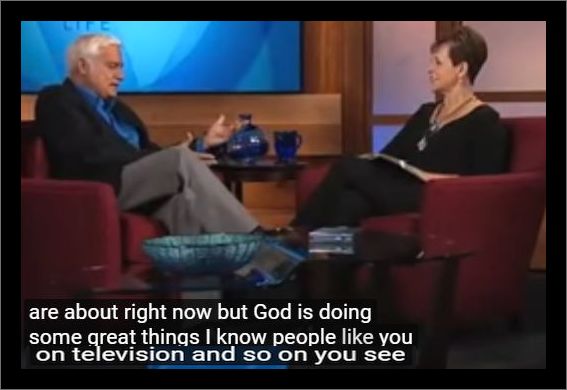
Here, Ravi Zacharias appears on Joyce Meyer’s TV show,
and says that God is doing great things like Meyer on television.

And second, when we look at a leader or teacher’s associations, don’t throw out the baby with the bathwater. We have to take a prayerful & measured look when we’re looking at secondary circumstances like who is hanging around our author or preacher or teacher. Please allow me to share two examples from my own life.

One example is the Drive By series by Todd Friel. Todd Friel is the speaker on Wretched Radio and Wretched TV. He has a number of series where guest speakers give a 5-10 minute lecture on the series topic, whether it’s the Holy Spirit, or Discernment, or Marriage, etc. On one of the series, I believe it was Drive By Theology, pastor RW Glenn was a featured speaker on a number of the lectures. It turned out later that Glenn had been an adulterer the whole time and was eventually fired as pastor. Afterward, if a person was looking at the list of speakers on Friel’s DVD and saw Glenn’s name listed, on a DVD about the theology of all things, they might say, “I’m never going to listen to Friel again, he has bad associations!” That would be hasty because it was not known to Friel at the time that Glenn was sinning. He has since not been invited to participate in any further DVDs.

I have a thick heavy book called the Art & Craft of Preaching. It contains essays and interviews about how famous or well-known pastors prepare their material. I bought it ten years ago. Since then, several of those pastors have apostasized. Men like Rick Warren, Bill Hybels are listed in the table of contents alongside good men of faith like Alistair Begg and John Stott. Would I refuse to have anything more to do with Alistair Begg because ten years ago he participated in a book with pastors who later became heretics? No. It may be very likely that Begg didn’t know the full list of the men what would be in the book, or it was not known that ten years later several of them would become heretics.

So be careful and not superficial. Look at
–at patterns
–over time
–repentance

We don’t make a superficial decision based on one instance, that would not be fair. YOU wouldn’t want someone to make a decision about you based on one error or one circumstance where we don’t have all the facts. In the second case, you look over time. Is the person constantly having bad associations? Do ALL this teacher’s books have a heretical person introducing it? Is she continually saying things that are not in the word or is always twisting the word? Is she sliding down a slope? Or was her partnering with a false teacher only one instance?

John MacArthur on unequally yoked:

The issue here is linking up with an unbeliever, side by side, under the same yoke, pulling the same furrow, in the same direction, with the same goals and objectives. Now, that might mean a partnership in a common business — if it is likely that the nature of your partnership will lead to compromising situations down the road when your worldviews collide.

Beyond all that, however, the primary application of 2 Corinthians 6 is with regard to spiritual enterprise. The primary warning is to never link up with an unbeliever in spiritual pursuits.

Posted in discernment, Uncategorized

Does your phone bless or curse those around you?

If you’ve ever been around people who drink alcohol, and you’re not drinking, you know how their increasing lack of sobriety looks and sounds. The person drinking thinks they are still in full possession of all their faculties, but to the sober observer on the sidelines, the story is completely the opposite. It’s a stark and un-pretty picture.

I used the drinking analogy to set up my main point. There are a lot of people who don’t drink, but it seems that there are few people who don’t have a cell phone anymore. I am one. I don’t have a cell phone, a smartphone, a mobile device, tablet, iPad, or portable technology of any kind. I am the one on the sidelines, watching the rest of the world get drunk on cell phone checking. It’s a stark and un-pretty picture.

Never was the rising cell phone addiction so prevalent than when I went into the fray last weekend to do some street photography. Athens, GA is a college town, and very liberal. As with most cities, there are fringe characters, weird dressers, buskers, hucksters, panhandlers and regular folks ambling along the bustling streets. I went into the city on a Friday afternoon after school and was there until about 5:30 or 6:00. I was observing and photographing long enough to watch the night city come alive. The buskers set up, and panhandlers claimed their spots, and the frat boys began roaming the bars in packs. Time to go.

I went home and began processing my pics. Once you see it, you can’t unsee it. ALL my photos contained a plethora of people either looking at, dialing, or speaking on their phones. The ones who didn’t, had a phone in their hand. Period.

It was a warm and bright spring day. The trees and flowers were blooming. The skies were vivid azure and the sun was glowing with long shadows, making dappled leaf patterns on the sidewalks. The shops were open and the al fresco cafes were inviting. There was plenty to look at and notice, but one would think all that was invisible with a number of passersby who were enthralled with the tech world of their two-inch smartphone screens.

I’m old enough to have been an adult when cell phones came in. I remember walking down city streets all over the United States and the world, enjoying the day, people watching at the cafe. I’d enjoy the clouds, muse on people’s fashion choices, admire the architecture. Most of all, I’d talk to the person I was with, sharing these thoughts and observations and listening to theirs. We created common memories and enjoyed our shared experience.

Those says seem gone.

Author Tony Reinke expressed his concerns with the technological age epitomized by the smartphone in his book 12 Ways Your Phone Is Changing You. In his book he writes of concerns wth technology creating the Age of Distraction, but he also tempers his concerns with ideas and strategies to steward our time well and use the technology instead of it using us.

He wrote,

We check our smartphones 81,500 times each year, or once every 4.3 minutes of our waking lives, which means you will be tempted to check your phones three times before you finish this chapter.

My time photographing the street activity in Athens seems to bear this out. I stood in one spot for about ten minutes and this was the scene.

Concerns are with any device that distracts us from engaging with God’s world and His people. In fairness, Reinke also said this about cameras, which I think can be applied to philosophies about any device-

If the cameras in our pockets mute our moments into 2-D memories, perhaps the richest memories in life are better “captured” by our full sensory awareness of the moment- the later written down in journal.

Smartphones are here to stay. That ship has sailed. What we’re left with is not that we use our phones but how we use our phones. A title (I think) Westminster Books used in reviewing Reinke’s book was, “Is your phone a blessing or a curse to those around you?” For me, they are a curse.

Justin Taylor at The Gospel Coalition writes that Reinke’s book blurb convicted him. Nate Claiborne at Christ + Pop Culture wrote

Whether for advances in productivity (thanks to apps like Things and Evernote) or the pull of imminent distraction (thanks to Facebook, Instagram, and Twitter being accessible at all times), my daily life is no longer the same. Rather than treating technological advances as givens, we ought to think about the good as well as the potential bad they bring.

You can find this Tony Reinke book at Westminster Books, and elsewhere.

Posted in discernment, Uncategorized

Brass in the Bible, and brassy, brazen women

Did you ever think about brass? Looking at some of the items in the Bible more closely is enjoyable. Linen, pomegranates, ants, and palm trees have all been examined on this blog. Soon it will be fishing boats. Today I’m interested in brass.

My interest was piqued when I was listening to a John MacArthur sermon on Revelation 1. As an aside I’d like to add a personal note. I’ve listened to Dr MacArthur’s sermons on the eschatological passages and I have researched his doctrinal stances on eschatology. I have of course also studied the eschatological doctrines myself directly in the Bible, and have listened to many other men preach on them. I believe Dr MacArthur is the most solid and biblical. Here, he preaches “Why every Calvinist should be a Premillennialist” and explains all the main eschatological viewpoints, biblically. He is firm but graceful on his pre-tribulation stance because it’s biblically rooted (a stance to which I hold and I believe to be the only correct one).

In the sermon, Dr MacArthur was going through the vision given to John of Patmos in Revelation 1:12-14.

“His feet were like burnished bronze when it has been caused to glow in a furnace.” What is that? Red hot. You’ve seen metal in a furnace, glowing, burning brass, or bronze. By the way, as a footnote, all of the temple and all of the tabernacle furniture that was in any way used in a sin offering was always brass. When you see brass in this situation, you know it has something to do with sin. And here you have feet glowing hot…very clear reference to judgment.”

Then MacArthur said,

By the way, as a footnote, all of the temple and all of the tabernacle furniture that was in any way used in a sin offering was always brass. When you see brass in this situation, you know it has something to do with sin.

Hmmm. Immediately I thought of the verse in 1 Corinthians 13:1 where Paul said,

If I speak in the tongues of men and of angels, but have not love, I am a noisy gong or a clanging cymbal.

The Greek word used in the verse for gong is brass. Now, not every biblical mention of brass is a symbol of sin. Brass instruments are mentioned. Bronze statues are made. Bronze tools are helpful. Alternately, the Calf the Israelites made was golden, not bronze. However, the bronze serpent called Nehushtan became an idol that had to be destroyed.

While brass or bronze in the temple is not used in a positive sense, now that I think about it, culturally, brass is not positive much either.

The word brazen means acting or done in a very open and shocking way without shame or embarrassment, to face with defiance or impudence —usually used in the phrase brazen it out

If someone calls you brazen, it’s not a compliment. For women, it’s even worse. A cultural epithet feminists continue to try and twist into an accolade is “the brassy woman.” This 2014 Elle Magazine article titled “Is it Really Okay for Women to be Brassy?” looked at one famous brassy woman and her life and death, comedienne Joan Rivers.

In all of the glowing memorials of Joan Rivers, who died last week at 81, she is lovingly referred to as “brassy.” And comedy, it seems, has begun to embrace the Schumerian vulgarity in all women. But, does society really, truly love a brassy gal? …

In nearly every piece of writing on the life and death of Joan Rivers, she is referred to as such. Her admirers say “brassy” like it’s a good thing. That wasn’t always the consensus.

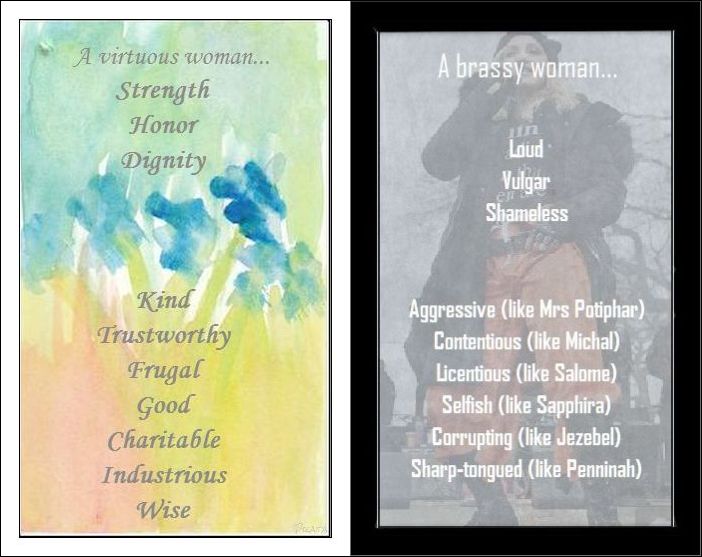
The halfhearted answer in the magazine article is that it’s kind of OK to be brassy, but the biblical answer is, no. Though the article calls brassy women “assertive” and “confident”, brassy women are more like the aforementioned clanging brass and clanging cymbal- just noise without music. Think of women who are or were considered brassy, Joan Rivers, Mae West, Chelsea Handler, Sarah Silverman. Now think of women who have never been called brassy, Jennifer Aniston, Olivia De Haviland, Meg Ryan. The former are profane, vulgar, and loud. The latter are demure, self-possessed, and dignified. Who would you rather be around? Which woman possesses the more biblical definition of womanliness?

Fun fact: If you mix other metals with copper, you get bronze and brass. Bronze is a mixture of about 90% copper and 10% tin. It’s darker than copper, and the color is less warm. In fact, bronze turns green when it oxidizes. Dark bronze can look almost chocolatey.

Take 70% to 85% copper and mix it with zinc, and you get brass. It’s a yellow-gold color. So how do you tell brass and gold apart? Brass is slightly darker and duller; gold is lighter and shinier. … An easy way to see if something is gold or brass is to use a magnet. Brass will attract the magnet, but gold won’t. If something says “K” or “karats,” it’s gold. Gold is also about twice as heavy as brass.

The brass implements at the temple were used just outside the holy of holies. Inside the holy of holies, was gold. For example, the bronze laver in which to wash and purify from sin before tending to priestly duties is a case in point.

The Bible is precise. The Holy Spirit inspired the men to write what they did for a reason, even down to the kinds of metal God chose to use for various items for various reasons. It would be fun to study the refining process, which metals are composed of how much dross and the biblical uses of various metals.

In High School I took “Shop.” One of the projects we did was working with metal. I made an iron capital E, similar to the large capital letter “M” that Mary Tyler Moore had on her apartment wall in the old TV show. Though the half semester course was over 40 years ago, I distinctly remember excitedly donning all the safety gear and carefully pouring the liquid metal into my mold. I could hardly wait until the item cooled. It came out great!

I was amazed by the beauty of the molten metal, the glowing colors and the gracefulness of how it poured. I was satisfied to learn how it changed from solid to liquid to solid again. Metal is beautiful and interesting. I lost my ‘sculpture’ long ago, I wish I hadn’t.

Brass, bronze, brazen. Think about it. Would you rather be “good as gold” with a “heart of gold”? Or a “brassy women” who is “bold as brass”?

**Ed Note: even searching for examples of “brazen women” to use in this essay yielded many sites and photos of women toting guns (as in criminals like gun moll), being profane and immodest, and/or involved in public sex or known for “confident” sexuality. I rest my case.

————————————-

Further Reading

Brazen Women: vintage postcards and photos with captions of historically daring women

Posted in discernment, Uncategorized

I’m not broken

Do you hear a lot of conversation these days involving the word ‘broken’ and ‘brokenness’? I do. It is the newest trendy word.

Words matter. They present reality, create meaning, knit a cultural understanding. Words matter.

The Lord revealed Himself to us by His Word. He IS the Word made flesh. He could have revealed Himself to us in pictures, symbols, or any other method. He chose the Word.

We will be judged by our words. Jesus said, “I tell you, on the day of judgment people will give account for every careless word they speak, 37 for by your words you will be justified, and by your words you will be condemned.” (Matthew 12:36).

Words matter.

In Genesis 11:1 we read, “Now the whole earth had one language and the same words.” In Genesis 11:7 God said, “Come, let us go down and there confuse their language, so that they may not understand one another’s speech.” [Literally, ‘one lip’].

How did the LORD choose to restrain man? By confusing their languages. He will reverse that on His Day. Zephaniah 3:9 has the prophecy-

For at that time I will change the speech of the peoples to a pure speech, that all of them may call upon the name of the LORD and serve him with one accord.” [literally, “one lip”].

Words matter.

Christians speak the one language of faith. Or we are supposed to, anyway. The Bible clearly explains the important concepts by which we live and construct meaning. They are in words, and the words are: sin, wrath, grace, sanctification, justification, imputation, atonement, good, evil … & etc. When we speak them to each other the meanings of these words should be clear to Christians. When we say, “I am a sinner” we know what we mean. When we say “God is good” we know what is meant by it. “I’m a depraved sinner” is understood. We should be ‘of one lip.’ But we’re not. By dropping and substituting words commonly understood for millennia, we are creating new understandings of the basics of the faith.

In today’s example, no longer are we sinners. We’re ‘broken.’

Brokenness the way it’s used nowadays does not mean what you think it means. In this piece by The Gospel Coalition, the opening paragraph succinctly describes my concerns with the increasing use of the word ‘brokenness.’ Unfortunately, the rest of the essay goes on to state the exact opposite of my point here today, so I don’t endorse the article.

In Christian circles, much has been made of brokenness, vulnerability, and authenticity in recent years. Some have expressed concern that these ideas have been overemphasized while holiness has taken a backseat. Brokenness in this context has tended to be of a faux variety. Much of it amounts to a confession of socially acceptable sins and mommy bloggers making messiness cool.

How does using brokenness the trendy way it is being used in Christian circles underestimate sin’s power? Brokenness evokes minor imperfections, not depravity. It removes the impetus from the sinner as the one performing the sin. We’ve gone from ‘I am a depraved sinner in need of grace’ to ‘I’m broken through no fault of my own and I need a heavenly butler to fix me’.

These mommy bloggers with messy lives authentically telling you about their brokenness are no different from the Pharisees who lengthen their tassels or make long prayers with long faces in order to show they are good.

Showing you are ‘bad/broken’ is no different than the Pharisees showing they were ‘good’. It’s still ‘look at me’. The result is the same also – hypocrisy.

“Maybe wholeness is embracing brokenness as part of your life.” Ann Voskamp, The Broken Way.

Maybe NOT. When we display our shining faces and our heavenly glow, we are demonstrating His victory to the world. Embracing brokenness is not displaying a victorious life.

And when you fast, do not look gloomy like the hypocrites, for they disfigure their faces that their fasting may be seen by others. Truly, I say to you, they have received their reward. (Matthew 6:16).

I do not know where these women are getting all this brokenness from, because before we’re saved, we’re not broken and in need of a little fix, as Lysa Terkeurst seems to think-

Brokenness where we are split open. Redemption where God knits us back together. Lysa TerKeurst

Before salvation, we are whole. Wholly evil, wholly depraved. We function unbroken and unabated in a cursed world where we fit in perfectly fine. After salvation, we are not fixed (as is the opposite of broken.) We are made a new creation. It’s not that our thoroughly depraved soul is dented and needs pounding out and fixing like a car mechanic doing body work on a bumper or a little knitting and voila, we’re fixed. We are so thoroughly evil that we must be made a new creation. So after salvation, nothing is broken then, either.

We’re not supposed to promote our brokenness by mooning around with a long face, writing endlessly about how broken we are. Personally, I believe doing so is an insult to Jesus, who saved us perfectly. Lest someone think I am being heartless, I do know that both before salvation and after salvation, we grieve, are bereft, lonely, sad, melancholy, stricken, and all the rest. Life hurts. It really does.

If ever there was anyone who had cause to call himself “broken” it was Paul. He was betrayed, abandoned, imprisoned, shipwrecked, beaten, lonely and even at one point “despaired of life”! He wrote in 2 Corinthians 1:8,

For we do not want you to be unaware, brothers, of the affliction we experienced in Asia. For we were so utterly burdened beyond our strength that we despaired of life itself.

Broken! For sure! But did he write anywhere in the Bible that we should dwell in our griefs? Wallow in brokenness? Embrace it? Never! What a ghastly thought! He wrote,

But even if I am being poured out like a drink offering on the sacrifice and service of your faith, I am glad and rejoice with all of you. (Philippians 2:18).

In whatever circumstance Paul found himself in, he urged rejoicing in the Lord. He never urged his people to wallow in brokenness. He never even said that as grief-stricken as he was at times that he himself was ‘broken.’

Sisters, we are not broken. If the current trendsetters using the word mean broken as in prior to salvation, well, before salvation we’re evil and depraved sinners who have no chance to please God, not broken. After salvation, we are a new creature, not broken.

If the trendsetters using the word broken to indicate a certain emotional state, well, call it what it is. Grief, broken-hearted, depression, melancholy, annoyance, overwhelmed. That’s OK, we all feel those things at times. But again, that’s not being broken. And in any case, as Paul said, rejoice, sisters, rejoice! Mooning around with a long face as a broken individual doesn’t earn you any points with Jesus. He said as much regarding the Pharisees, as I stated above.

If you’re sad, depressed, rejected, melancholy, whatever it is, rejoice! I know it’s hard. I’m not making light. But watch the words you say (and sing, and write). Saying that you’re broken is insulting to Jesus and unnecessarily transforming the Christian vocabulary into something trendy and indistinct.

I’m not broken. Are you?

Posted in discernment, Uncategorized

The biblical worldview is that there is the righteous and the wicked

When you read chunks of the Bible at one time, patterns and themes emerge that may not be as noticeable as when you read just a few verses more deeply. That’s why both kinds of study are valuable.

In reading the Psalms, one immediately notices David’s worldview. It’s stark, solid, and biblical. With David, there are the righteous, and the wicked. Period.

We live in times where Christians are pressured to blur those lines. We’re told to accept and tolerate all manner of sin, value any and all professions of faith even if they’re unaccompanied by fruit, and to view all people as inherently good. Failure to do the above invites catcalls of “Pharisee”, “judgmental”, or worse.

However, when we blur those lines, the loss to the church is that mission fields shrink and disappear. Doctrinal lines are dismissed. Sadly, if we don’t know who is in and who is out, who do we evangelize?

I found this article from a church in MO, called The Righteous and the Wicked. I don’t agree with their KJV-only stance, but I do agree with this article.

We believe that there is a radical and essential difference between the righteous and the wicked; that such only as through faith are justified in the name of the lord Jesus, and sanctified by the spirit of our god, are truly righteous in his esteem while all such as continue in impenitence and unbelief are in his sight wicked, and under the curse; and this distinction holds among men both in and after death. …

This article also emphasizes the fact that with God, there is no middle ground. With men, we see much middle ground or gray area. With God it is all black or white, right or wrong, for him or against him. Joshua made this very clear in Joshua 24:14,15 when he demanded that Israel make a choice to either serve God or not serve God. “Now therefore fear the LORD, and serve him in sincerity and in truth: and put away the gods which your fathers served on the other side of the flood, and in Egypt; and serve ye the LORD. 15 And if it seem evil unto you to serve the LORD, choose you this day whom ye will serve; whether the gods which your fathers served that were on the other side of the flood, or the gods of the Amorites, in whose land ye dwell: but as for me and my house, we will serve the LORD.”

The Bible makes it clear so many times, using opposites in a plethora of descriptions. This verse from Isaiah 5:20 is just one:

Woe unto them that call evil good, and good evil; that put darkness for light, and light for darkness; that put bitter for sweet, and sweet for bitter!

The verse presents three of the stark opposites:

Evil-Good
Darkness-Light
Bitter-Sweet

We read of those who are cursed and those who are blessed.

Those who are dead and those who are living.

There are those in Christ and those who are in outer darkness.

There are those who draw near, and those who fall away.

There are those who are hot, and those who are cold. The middle ground of lukewarm is something Jesus hates!

The sad thing is that some of these unsaved, evil people are professing Christians. Others are simply true Christians who are stumbling. Without practicing biblical discernment, we are losing our ability as a global church to detect the difference. This is to our detriment. The biblical worldview is that there is either-or.

We need to be mindful of the two-path approach to Jesus. Now, we don’t have the omnipotence that God does. When I try to have these conversations with fellow believers, they quickly shut it down, saying, “Only God knows the heart.” That is true. I can’t see the heart of people to say with the same certainty as God that a person is saved or not saved. I’m not omnipotent. But discernment doesn’t require omnipotence.  “You will know them by their fruits,” Jesus said, twice in the same lesson. (Matthew 7:15-20). He gave us the ability to discern the difference between a thistle and a fig, the difference between a grape and a thorn.

He didn’t say, ‘You won’t know them.’ He didn’t say, ‘You may know them, perhaps. Try again later.’ He didn’t say, ‘Stay quiet because only God knows the heart.’

Therefore by their fruits you will know them. (Matthew 7:20)

I’m not saying to go around and make unsound declarations about people’s position in Christ. But I am saying two things that revolve around this concept – inconsistency and hypocrisy in Christian life brings reproach upon the cause of truth.

Many will follow their sensuality, and because of them the way of the truth will be maligned; (2 Peter 2:2).

So for that reason,

1. Remember that there are two roads and two roads only. Societal pressure, cultural tolerance, personal timidity add to the reluctance of people to remember that. The biblical worldview is that it’s either-or with nothing in the middle! The middle road with mushy doctrinal lines is lukewarm. Jesus hates lukewarm. Do not tolerate sinners among you who preach false doctrine! (Revelation 2:20).

2. If you see a long-term pattern of sin in a person or a long time of no fruit, it is allowed and even commanded by His word, to do something about it. Some of these verses are aimed at pastors but it is also incumbent on lay-people to both edify and rebuke in sincere concern for their restoration. (1 Cor. 5:1-13, 1 Timothy 5:20, 2 Timothy 4:2, Titus 1:13, Galatians 2:14, Ephesians 5:11…)

In an attempt to be kind, or caring, or non-judgmental, we too often allow a believer (or a non-believer “believer”) to go on their wicked path. The believer, if he is a believer, loses rewards every moment he continues on his course of sin. More importantly, professing believers who continue on a wicked path bring reproach onto the name of Jesus. (Romans 2:23-24). The professing person who is self-deluded and not a believer at all, may, in fact, be shaken out of their deluded complacency unto salvation if one confronts them about their lack of fruit.

Even if they aren’t shaken out of complacency or a sinning path, and the Lord hardens them further instead, His glory is manifested in that person as a vessel of wrath. Plus, you are giving Him glory by obeying. Just as the result of our salvation discussions is left to the Holy Spirit, sin-correcting discussion results are also left to Him. Sometimes the person will be amenable, sometimes they will become angry and then amenable, and sometimes they will get mad and stay mad. If you have prayed, if you have been diligent to follow His statutes, if you’ve removed the log from your own eye, if you’ve spoken with a sincerity for the betterment and concern for the person, then leave the results to the Spirit. You’ve done your part.

The Takeaway:

There are two roads. There are the righteous and the wicked. The two roads people travel lead to His domain, whether it is the kingdom of Light in heaven or His domain of Outer Darkness in the Lake of Fire. After death, there is a great gulf fixed, that none many travel from one to the other. Speak the truth in love to those who you have concerns for before the roads become unalterably fixed after death.

As David said in Psalm 6:5,

For in death there is no remembrance of you; in Sheol who will give you praise?

Matthew Henry is concise regarding this verse, and of today’s concept, his comment on Psalm 6:5 is a good way to end it:

6:1-7 These verses speak the language of a heart truly humbled, of a broken and contrite spirit under great afflictions, sent to awaken conscience and mortify corruption. Sickness brought sin to his remembrance, and he looked upon it as a token of God’s displeasure against him. The affliction of his body will be tolerable, if he has comfort in his soul. Christ’s sorest complaint, in his sufferings, was of the trouble of his soul, and the want of his Father’s smiles. Every page of Scripture proclaims the fact, that salvation is only of the Lord.

Man is a sinner, his case can only be reached by mercy; and never is mercy more illustrious than in restoring backsliders. With good reason we may pray, that if it be the will of God, and he has any further work for us or our friends to do in this world, he will yet spare us or them to serve him. To depart and be with Christ is happiest for the saints; but for them to abide in the flesh is more profitable for the church.

~~~~~~~~~~~~~~~~~~~~~~~~~~~~

Further Reading

Dealing with Sinning Christians

When Should a Christian try to correct another Christian?

In keeping with the theme of knowing there are only two roads and that there are only the righteous and the wicked, let’s look at what a Biblical worldview is, and when a Christian’s biblical worldview can become diluted:

What’s a Christian worldview anyway?

Posted in discernment, Uncategorized

Help! My Friend Is Reading a Dangerous Book

A question was asked at our Bible Discussion Group on how to sensitively approach someone who is in a false religion in order to open discussion as to the truth. This same question has been asked of me personally regarding how to approach a friend whom you see carrying around a book by a false teacher.

At Discussion Group, I’d offered my process of how I deal with friends involved with false teachers, false doctrine, or false religion. I’d said that first, it depends on the relationship you have with them. If you don’t know the person or are only bare acquaintances, it won’t do to walk up to them and just say something brusque or out of the blue that in effect, amounts to saying “You’re doing it wrong.”

The Bible encourages and commands discipling relationships with one another. This is so we can keep each other accountable. We can carry each other’s burdens. Ultimately, close involvement with each other means can edify and grow one another and one way we do this is by helping sisters course-correct.

Therefore encourage one another and build one another up, just as you are doing. (1 Thessalonians 5:11).

We can’t build up a sister if we let them wallow in false doctrine. (Jude 1:23). Alternately, we won’t build them up if we are tactless and brusque. (2 Timothy 2:25, Galatians 6:1).

Assuming you are close enough with the sister to have established trust and are known to each other in a friendly way, then what I do is begin by asking questions. Perhaps the person is reading the book for research purposes. Maybe someone less discerning gave it to them and they haven’t thrown it out yet. Maybe they are getting ready to give it to someone else. Maybe a lot of things. Just ask. “Are you reading that book? What do you think of it?” “Let me know when you’re done, I’d love to get your take on it…” Etc.

Finally, I always have something else to offer the person in the books’ stead. It doesn’t help the person as much to just say that their book is a dangerous book, without having something in which to substitute. If they’d lacked discernment enough in the first place to get or read that book, then offering them material written by a credible author steers them into a better direction.

I was pleased when I’d come across this short discussion from 2016 where Noël Piper, Kathleen Nielson, and Gloria Furman discuss this very question. I was even more pleased when they shared that they do the same: ask, be gentle, discuss. Phew, at least I’m not off the deep end with this.

The women also discuss two other questions. If you can’t play back videos, here is a link to just listen.

One final thing. Their title mentions ‘a dangerous book.” Undoctrinal books ARE dangerous. Books like The Shack, Love Wins, The Circle Maker, any and all non-doctrinal, unorthodox books present a danger to the Christian. Adam and Eve only had to obey one command, and within a shockingly short time, satan easily managed to twist that command into a suggestion. Paul said to Titus that false doctrine upsets whole families (Titus 1:11). Paul warned Timothy that false doctrine undermines the faith. (2 Timothy 2:18). Make no mistake, (because satan isn’t making the same mistake), the false doctrine contained in books, movies, pamphlets, and Bible studies is a very present danger to the Christian mind and heart.

Here is the blurb for the short video:

Your friend is gushing about that book she’s been reading. It’s on the Christian Living bestseller list, but for whatever reason you suspect the book is more influenced by the spirit of the age than by a biblical worldview. … Nielson cautions against the overcorrection of reading only the Bible, since reading widely can actually enhance Bible reading, and Piper warns against becoming the kind of reader who only reads books from your own “tribe.”

Help! My Friend Is Reading a Dangerous Book
Noël Piper, Kathleen Nielson, and Gloria Furman Discuss

https://player.vimeo.com/video/187825197