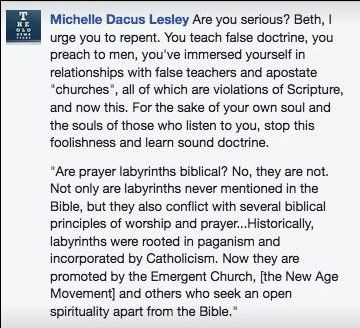
Are prayer labyrinths biblical? GotQuestions has the answer:
Are prayer labyrinths biblical? No, they are not. Not only are labyrinths never mentioned in the Bible, but they also conflict with several biblical principles of worship and prayer.
Please go to the link to read the explanation as to why prayer labyrinths are not biblical. GotQuestions lays out 5 reasons why.
Is Beth Moore a false teacher? Yes. She is a false teacher.
1. She twists the Bible. (2 Peter 3:16),
2. She preaches from her own visions. (Ezekiel 13:7, Romans 1:21),
3. She associates with heretics and calls them friends. (1 Corinthians 15:33, Proverbs 14:7),
4. She preaches Word-Faith heresy. (source on what this doctrine is and why it is bad and comparing Moore’ sword-faith to scripture),
5. She is a mystic who promotes Lectio Divina, Contemplative Prayer, Labyrinths, and other mystical practices.
As someone commented on Amy Spreeman of Berean Research’s FB page,
Nope! I am appalled at how many church leaders think this woman is biblically sound!!
Me too. Me too…
PS: The Media Team at Beth Moore LPL responded to Mrs Lesley’s and Mrs Spreeman’s negative comments about the labyrinth
“Hi Amy! I’m on Beth’s media team, and we chose this picture not realizing that it was a Prayer Labyrinth. Thank you for teaching us! We appreciate your help.”
The Media Team, which is the face and the name of Beth Moore “did not know” it was a labyrinth. Um, okay…
The same God who brought the Reformation in the sixteenth century is still at work today. His plan has not changed, and what He has purposed for His glory and our good will be accomplished.
On March 9-11, 2017, Ligonier Ministries hosted its 30th annual National Conference. Alistair Begg, Tim Challies, Leonardo De Chirico, Sinclair Ferguson, W. Robert Godfrey, Michael Horton, Steven Lawson, Augustus Lopes, John MacArthur, Albert Mohler, Stephen Nichols, Michael Reeves, Derek Thomas, and Stephen Tong joined R.C. Sproul to celebrate the five-hundredth anniversary of the Protestant Reformation and consider the future of the church.
During the conference, there was a Panel Discussion/Audience Q&A comprised of Steven Lawson, RC Sproul, Al Mohler, and John MacArthur. Thirteen questions were asked and answered on a variety of topics. Since I’m interested in discernment, and since we can learn much from the men who were assembled, I was especially interested in their answer to the following question:
How do you define a false teacher? How much error is needed before they are considered false?
The answers were transcribed and this one begins at the 32:23 mark on the video, linked above.
Three good answers were given. Of course many other things can be said, they only had so much time and had other questions to discuss. Here is a synopsis of the three responses and I’ll add my own thoughts after that. You can view/read the full responses at the link above.
Dr Sproul said that when is a false teacher a false teacher is when he teaches falsehood. This might seem obvious but in this day and age where ‘tolerance’, ‘forgiveness’ and ‘non-judgmental-ness’ reigns, we have forgotten many of the basics. If he or she teaches falsehood, they are a false teacher. Would the Holy Spirit in us allow falsehoods to permeate a person and their teachings? No. His ministry is to point to Jesus.
Dr Al Mohler followed up Dr Sproul’s comment by saying that in addition to falsehood, any teacher who resists correction is also false. By the strict definition of teaching falsehood=false teacher, Apollos would have been false. However when he was corrected by Priscilla and Aquila, Apollos was glad, and accepted it. If you can think of some particular teachers today who teach falsely, and have definitely been contacted to repent of their falseness and given the truth, and they continue in falseness, then this helpful barometer might clear some confusion up as to who might be true and who might be false.
Dr MacArthur added another layer to the discussion with his response. A false teacher teaches falsely, but what would he be teaching that is false? In addition to behavior, (a truculent liar) what content does a false teacher teach?
MacArthur said that there are some absolutely non-negotiable truths that you are false if you deny the Trinity. If you deny the deity of Christ. If you deny His sinless life, substitutionary death, salvation by grace through faith, the gospel. That’s the drive-train of truth. Saving truth. Those are not negotiable.
So by those standards, and I admit there are others, a false teacher teaches things that are false (though not stated, would be additions to scripture in the form of personal thoughts, revelations, or visions) is uncorrectable, and twists or in some way denies the hard and fast basic truths of Christianity.
The Bible says not to add to His word, but it also says not to delete anything from His word. (Deuteronomy 4:2, Deuteronomy 12:32, Revelation 22:18-19). If I can add my own thought to he conversation: any preacher who regularly and defiantly omits one of the basic truths from Christianity is also false. I think we can all think of the prime example here: Joel Osteen. He has been asked many times why he doesn’t preach sin or wrath, and he says that is not his calling. We can’t have the Good News of blessing and salvation if we do not know what the bad news of sin and our need for Jesus to escape God’s wrath.
One more thought: the Bible has only one skill standard for teaching: “able to teach” as stated in 1 Timothy 3:2. As Crossway defines able: “refers to the ability to communicate and apply the truth of Scripture with clarity, coherence, and fruitfulness”. The rest are behavioral/moral standards. Any false teacher might be able to teach the truths of scripture faithfully, appear to be correctable, but live in opposition to the standards the Bible commands. Jimmy Swaggart comes to mind here. And one does not have to be a rampant sinner seeking prostitutes to be living like hell, there are many Bible teachers whose greed and profligate living is well known, as well as many female teachers who usurp their husband’s and the church’s authority. Any of those are in opposition to God’s standards for life.
During the panel discussion, Sproul said Calvin said no theologian is ever more than 80 percent right. Sometimes when I bring up that so-and-so is false, I’ll receive this type of response. The person intimates that we must tolerate the false teachers, because after all, we all sin and no one is 100% right. I think this misses the point entirely. I agree we’re all sinners, and no one is perfect. As mentioned, Apollos was teaching partially. I don’t think that Peter, Paul John etc had no possibility of growth or understanding as they studied and matured in their walk. Even Jesus grew in stature and wisdom. (Luke 2:52).
The difference between one of the Apostles or Apollos or any true preacher today is that:
1) they want to teach truth, scrupulously,
2) they are correctable when error is pointed out,
3) their overall growth is in wisdom and stature as time goes on,
4) their heart’s desire is that Jesus is glorified and the saints are growing.
A false teacher
1) is greedy
2) opposes God
3) is uncorrectable
4) makes sons of hell twice as bad as they are
False teachers ahead: beware!
Photo by Braydon Anderson. Unsplash, free to use.
False teachers will always be with us until eternity begins and Jesus purges their blot from the new heavens and new earth. Praise Him for holiness and purity.
Joy is apparently the new trend in advertising buzzwords. It’s everywhere. This product will bring you joy. That product will make you happy on your search for joy. This campaign promises ease on the road to joy. That item is joy. Et cetera.
Johnnie Walker Whisky
The Johnnie Walker Scotch Whisky people did a little something different that the other companies are envious of and are now copying. They hired a psychologist to give their ad executives insight into what makes people tick, so as to better point their products to the lack in their lives. Here is just one headline touting the new trend:
Well, 93% of Americans want to find more ways to experience joy, and 83% would like to experience small amounts of joy daily vs. larger, occasional doses.
What the psychologists discovered is that people want to find joy. However, joy as an end in itself is not the main goal. The venerable liquor company now “aims to promote the idea that finding joy is part of the recipe for success.” The psychologists found out that having money doesn’t necessarily make you happy. Possessing the largest house isn’t necessarily joy-inducing. Getting the promotion in your career won’t absolutely bring contentment. Those things are part of the recipe for success, and the recipe’s biggest ingredient is joy. If you have joy, the other things are just so much sweeter and your chances for success in life increase. Joy becomes a means to an end.
It’s a new take on the old problem: what makes a person lastingly happy? And from what source does this joy come? I’m sure it is not from Scotch Whisky. King Solomon tried that and poetically and poignantly wrote about drinking in Ecclesiastes 2:10-
I searched with my heart how to cheer my body with wine—my heart still guiding me with wisdom—and how to lay hold on folly, till I might see what was good for the children of man to do under heaven during the few days of their life.
His conclusion: finding cheer in wine is folly and vanity.
Reddi Whip
Reddi Whip Company immediately got on the Johnnie Walker bandwagon and their take on joy is that if you have joy, sharing it brings more joy. Their ad was to show a winning Little League team sharing their winning joy with the losing team by smearing them all, and some food, with the whipped product in a massive food fight on the field.
Solomon said that apart from God who can have joy in their food? (Ecclesiastes 2:25)
Cadbury Chocolates
I said at the opening that joy is the new trendy buzzword but as Solomon said, there is nothing new under the sun. Ten years ago, Cadbury Chocolates kicked off a content-led campaign including the titles of “Gorilla”, “Eyebrows” and “Trucks”.
The new direction moved CDM from being a manufacturer of chocolate to a producer of joy. It also created a debate around whether creating “joyful” content rather than “persuasive” advertising featuring chocolate actually works or not. “Eating Cadbury Dairy Milk chocolate mirrors the same physical and emotional experience of pure joy.” (Source)
Did it work? Did creating joyful content incite people to buy the chocolates as a joy-experience rather than simply buy an item to eat? Yes, their payback was 171% higher.
We know that Solomon said that all is vanity, striving after wind. We usually look at the word vanity but today let’s look after striving.
Striving in this context means longing or grasping after. Man in his endless enmity against God is always seeking to fill that “God-shaped hole in their heart”. As GotQuestions explains,
The “God-shaped hole” concept states that every person has a void in his soul/spirit/life that can only be filled by God. The “God-shaped hole” is the innate longing of the human heart for something outside itself, something transcendent, something “other.” Ecclesiastes 3:11 refers to God’s placing of “eternity in man’s heart.” God made humanity for His eternal purpose, and only God can fulfill our desire for eternity. All religion is based on the innate desire to “connect” with God. This desire can only be fulfilled by God, and therefore can be likened to a “God-shaped hole.” The problem, though, is that humanity ignores this hole or attempts to fill it with things other than God.
Joy is serious advertising business. In addition to Whisky, Reddi Whip, and Cadbury Chocolates, we have people expressing that “the last time they felt real joy was when they were a kid”, drinking Coke. A BMW is joy. Sherwin-Williams says the right color paint is joy. And so on. Hoy is important to people on earth. The restlessness in seeking it but never quite finding it is palpable and palpable.
Whisky, chocolate, desserts, toppings, money, career, toil, friends, sensual pleasures, all are vanity, said the preacher in Ecclesiastes.
There is a difference between possessing joy and experiencing its effects. One is permanent, the other is temporary. You feel joy in buying and driving your new car for the first time. In sharing the news you’ve been promoted. Winning the lottery and having more money. These things bring “an experience” of joy, but its effects wear off.
When our joy rests on an experience, it dissipates. Joy isn’t lasting when it’s attached to things that pass away. When we strive after things that break down, (cars), that disappear, (money), that don’t last (food…careers) the joy experience is seen to be what it is, wind.
Where is joy, then?
There is nothing new under the sun – except Jesus. His mercies are new every morning. The only true joy there is exists in Christ.
Though you have not seen him, you love him. Though you do not now see him, you believe in him and rejoice with joy that is inexpressible and filled with glory, obtaining the outcome of your faith, the salvation of your souls. (1 Peter 1:8-9).
The verse is telling us that “The Christian’s joy is bound up with love to Jesus: its ground is faith; it is not therefore either self-seeking or self-sufficient” [Steiger]. The joy we possess is bound up in glory. It is an eternal, lasting, glory-joy that is inexpressible because its source is from God.
The outcome of our faith is Jesus Himself. Knowing Him is joy.
In my opinion I believe He desires to fill our heart with holiness and righteousness of His Son.
Certified life coach Holley Gerth assures us that “there’s a God-sized dream knocking on the door of your heart”. Plus, she “shows you how to forget the lies and expectations the world feeds you and instead believe that God loves you and has even bigger plans for your life than you’ve even imagined.”
Before I was saved, I had not just big plans, I had huge plans for my life. After salvation, God showed me how puffed up those dreams were. Thank you, God.
Michelle Cox prays for us that that He might “Open God-sized doors so that I can accomplish those big things You want me to do…”
Now in addition to God-sized dreams we have God-sized doors? Why all this supersizing?
Paula Casill asks us “Did you know that your dreams and goals are important to God?”
Maybe so. Personally I can’t say with the same conviction as Paula does of what God considers important because I can’t read His mind, only see what He has declared important on His pages of Holy Writ. I do know He considers important being a follower of His plan and will, which is to pursue holiness and be an obedient participant in His sovereign global and eternal plan for His Son.
I don’t know about the motivations of all these people who write book after book about having God-sized dreams. In fairness, some of them write about being obedient to God when the ‘dream’ (I wish they’d just call it a plan or a decision) means they want to do a big scary thing, like start an orphanage or to rescue sex-trafficked girls, or do missionary work in the 10/40 belt, etc.
But for many of them what they mean when they say we have a God-sized dream, is that we have a big, personal dream we want our Big God to fulfill.
Supersizing our dreams is not a good idea. Nowhere do I read in scripture that God has big plans for my life other than the already big adoption into the most perfect family ever, inheriting all things in the universe, and having the Perfect Father, Friend, Brother, Priest, and King who saved us from the wrath that we deserve. I think that is pretty big.
But it goes on. He makes a place for us, will give us perfect work to do that will not be toil, changes our desires from our own dreams to His (hint, hint, you God-sized dream people :)! And much more. He gives us His Spirit, His love, and grows us in holiness. That’s pretty big. Why isn’t that enough for people? Must we have huge dreams too? Must we encourage each other by saying God has huge plans for our lives? Because sometimes His plan for our life is not a fantastic rollercoaster of supersized dreams, but difficulty, humiliation, rejection, and heartache.
I think of the Prophet Ezekiel. “Ezekiel, God desires to fill your heart with big dreams!” He was living a nice life with his wife whom he dearly loved, and who was the “delight of his eyes”. Yet one day God’s word came to Ezekiel and God said in Ezekiel 24:15-18,
The word of the Lord came to me: 16 “Son of man, behold, I am about to take the delight of your eyes away from you at a stroke; yet you shall not mourn or weep, nor shall your tears run down. 17 Sigh, but not aloud; make no mourning for the dead. Bind on your turban, and put your shoes on your feet; do not cover your lips, nor eat the bread of men.” 18 So I spoke to the people in the morning, and at evening my wife died. And on the next morning I did as I was commanded.
Would today’s kind of evangelism-slash-encouragement about how God is going to fulfill your God-sized dreams given Ezekiel any help?
Isaiah was having a nice life. Did someone come along and tell Isaiah that “there’s a God-sized dream knocking on the door of your heart” that God wants to fulfill? No, in fact he was called to preach for many decades and told that no one would believe him ever- Isaiah’s ministry would seem to be a failure. Worse, he had to go naked in public for three years as a sign (Isaiah 20:3-4) and many other less-than-dreamy sized things happened to Isaiah.
I think of the Prophet Jeremiah. Did someone come along and tell him that his “dreams and goals are important to God?” After his call to the office of prophet, things got very difficult for him. Same with Joseph, Moses, Abram, Hannah, Job…
In the NT, young Mary had God-sized dreams, the upcoming marriage to her betrothed and a nice life with children. However soon enough she was nearly divorced and disgraced, then had to flee her country for her life, live in exile, return and then as an old woman, see her Son crucified in a horrific manner. Saul/Paul had dreams, and he fulfilled them. He was at the top of his profession as a lawyer-theologian in the Sanhedrin, a Pharisee’s Pharisee. Then one day he was struck blind, rebuked by the Living Jesus, and told he will be beaten and jailed in almost every city he comes to for the rest of his life. His life would be one of pain and suffering for the sake of the Name.
I think the biblical record and my own experience give me the confidence to say that after salvation, our personal dreams are either shown to be puffed conceit or are taken away and substituted with ‘dreams’ that are from God and in fact are personally difficult to follow. In many cases, the person’s life got worse after their call or after salvation. Why tempt people in evangelism or encouragement with something that isn’t really borne out in the biblical record?
My dreams are not God-sized. I don’t know what size they are. I pray that the Lord removes the fruit flies from my kitchen. I pray He will resolve my headache. I pray He will provide enough money for me to get to the end of the month. But are those puny dreams and wants? He said He will provide. (Matthew 6:33). He said to cast ALL our cares upon Him. (1 Peter 5:7). Trusting Him and obeying Him is huge.
When I pray for others, those dreams are puny also. I dream that the heart of my family be converted to Christianity. The heart, how big is it? Small. 9 ounces? 5 inches? It’s a small thing, the heart. But a very big God can convert that heart from one of stone to one of malleable, forgiven clay. Conversion is a God-sized dream. I pray He will use me as salt and light to show Himself to others. Salt is small, but God makes it big when He uses it. Puny sized dreams aren’t they? But they are God-sized because only God can do those things.
Are founding orphanages and witnessing with a scimitar aimed at your head the only kind of “big dreams” one can have? Isn’t salvation a God-sized dream? We should hear more about those kind of dreams.
Are my dreams lesser, smaller, just because I dream of having a quiet and modest life, persevering in faith in the day-to-day mundane? 1 Thessalonians 4:11, 2 Thessalonians 3:12, 1 Timothy 2:2 say otherwise. Tell a homeschooling mom of four that God has God-sized dreams for her and she’ll likely say that a shower, or a nap, or putting on clean clothes at some point during the day or eating a meal all by herself from start to finish is good enough dream.
So let’s stop rambling on about the size of our dreams. Let’s dispense with personal dreams and focus on Jesus and His commands. If we intuit that the “dream” in our mind is one that Jesus put there, whether it is to stay behind and live a quiet, comfortable life within our sphere that has little regional influence, or is one that makes a huge splash in the difficult areas of the world, so be it.
As for dreams themselves, the Bible says,
Commit your work to the Lord, and your plans will be established. (Proverbs 16:3).
There are so many pamphlets, teachings, sermons, and books out there today “educating” the Christian on “How to Hear God’s Voice.” None of these teachers seem to realize that God doesn’t need our help hearing His voice. None of these teachers seem to realize that much of what they write conflicts with each other. The different “ways”, “tips”, “methods” are piling up. Soon we will have a hundred ways to hear God’s voice. Sadly, all of them will be wrong.
Worst of all, many of these teachers claim that if you do NOT hear God’s voice, either it is because your faith is weak, or you can never enjoy intimacy with God if this “critical” element is missing. They make absolute statements that have no basis in reality, but harm the hapless who believe them. It’s heartbreaking, what these false teachers teach. Here are a few examples:
One of the greatest benefits of our salvation has to be that of hearing God speak to us personally. There can be no intimate relationship with our heavenly Father without it. But, as easy as it is for us to speak to Him, the average Christian has a hard time hearing His voice. This is not the way the Lord intended it to be.
God is constantly speaking to people. But too often, they miss out on hearing God’s messages because they seek His guidance only occasionally – usually when they’re going through a crisis or facing a major decision. Then, with a dire need to hear from God, people become confused and frustrated when they don’t clearly hear what they should do. Here are 10 ways how you can hear from God and recognize his voice regularly:
Maybe you’re someone who wants to hear God’s voice, but you don’t know how. Perhaps you’ve even tried, and feel like He didn’t answer you. Maybe you want to listen but can’t focus long enough to hear. Or maybe you’re frustrated, because it seems like God is talking to everyone else but you. If you think God doesn’t want to speak to you, be encouraged: Jesus says in John 10:27 that “My sheep hear My voice and I know them, and they follow me.”
That John 10:27 verse the ‘how to hear God’ teachers use often as a (false) basis that God is speaking audibly today- my sheep hear my voice. Well, are you a sheep? If so then I guess Jesus is actually a vine, or He is actually living water.
In these last days it’s more important than ever for us to fine-tune our spiritual ears to hear the Lord’s voice. God is constantly speaking to us. He’s trying to warn us of things to come. So many times we simply shrug it off. We think, “That’s just me.” But it’s not. It’s the Holy Spirit’s voice. To be able to hear God’s voice, we must set aside time to wait in His presence and allow Him to talk to us. It’s when we are quiet before the Lord that we can hear from Him most clearly.
He is trying to warn us? Trying?! Is there anything God cannot do? (Genesis 18:14).
Joyce Meyer has this to say about how to hear from God, delicately disdaining to her readers with this article about hearing from God, It’s Not that Complicated:
Even though I sincerely loved Jesus, I went to church for years without knowing that God talks to people. I observed all the religious rules and holidays…I went to church every Sunday. I was really doing all that I knew to do at that time. But it wasn’t enough to satisfy my longing for God. I could’ve spent every moment in church or in Bible study, but it wouldn’t have quenched the thirst I had for a deeper fellowship with the Lord. I needed to talk to Him about my past and hear Him talk to me about my future. But nobody taught me that God wants to talk directly to me. No one offered a solution for the dissatisfied feelings I endured.
Meyer says this in other places:
–Recently God told me that … Meyer
–Hearing God’s voice throughout the day has become a natural way of life for me …Meyer
I suppose once you start to be known for being a special recipient of God’s words, you have to maintain the pretense.
You’ll notice that Meyer’s is a familiar theme with the false teachers educating people on how to hear from God: unfulfilled longing. Church isn’t enough. The Word isn’t enough. Prayer isn’t enough. Redemption isn’t enough. Sarah Young who wrote Jesus Calling, a book all about her conversations with God, who allegedly spoke audibly to her and she recorded ‘His’ words, said she had a yearning for “more.” If Jesus isn’t your all in all, if you aren’t thrilled with the Word, if you aren’t sated by church worship and fellowship with the saints, then a disembodied voice from the ether isn’t going to fulfill you. The adulation you receive from ignorant followers might fulfill you for a while. The royalties from the books you write about hearing from God might fulfill you for a while. The applause on interview shows might fulfill you for a while, but it is all vapor. Only Jesus can fulfill you, and He is not speaking now.
He spoke. In His word.
Long ago, at many times and in many ways, God spoke to our fathers by the prophets, 2but in these last days he has spoken to us by his Son, whom he appointed the heir of all things, through whom also he created the world. (Hebrews 1:1-2).
I was pondering that verse the other day and thinking about all the ways God had spoken in previous times. Through a burning bush. Through a donkey. Through an angel. Through His prophets. Through a fleece. Through dreams (‘Joseph, flee to Egypt’).
Then I began thinking about ALL the many folks in times past who heard God speak without the help of Andrew Wommack or Joyce Meyer or Lynette Hagin. God had no trouble speaking clearly to those whom He desired, without the aid of lessons and books and how-tos.
Then I began thinking of a silly scenario using the false teachers’ own words. Like this in Joel 1:1-2, as Joel was going around doing his daily tasks, he hears,
The word of the LORD that came to Joel, the son of Pethuel: 2Hear this, you elders;
And Joel says to himself, “Shoot! I can’t hear God clearly! I KNEW I should have bought that Joyce Meyer pamphlet at the market when I saw it! Now I’ll never have intimacy with God!”
Or this from Haggai 1:1, In the second year of Darius the king, in the sixth month, on the first day of the month, the word of the LORD came by the hand of Haggai the prophet to Zerubbabel the son of Shealtiel, governor of Judah,
“Stop! I haven’t even built my prayer closet yet! I haven’t done what Lynette Hagin said, to set aside time to wait in Your presence and allow You to talk to me!”
Or this from Jeremiah 1:4,
Now the word of the LORD came to me, saying,
Wait! this doesn’t coincide with Dallas Willard’s point #3, that I should “make your main goal to become a spiritually mature person in a close relationship with God. That’s the only way I’ll clearly and correctly hear what God has to say to me.” Since I haven’t made my goal yet and since I am not a spiritually mature person, and since according to Mr Willard, that is the ONLY way I’ll correctly and clearly hear what God is saying to me, then it must not be God. Phew, I’ll just go to the store and get another Willard book just to be sure I am on the right track.
Isn’t it silly to think that multitudes of people heard God clearly before all these false teachers started writing manuals for hearing from God? Doesn’t it diminish God’s glory to intimate, or even say out flatly as so many of these teachers have, that God can’t get to you unless you do certain things? He hung the moon by His word. He also made the stars, knows them and named all of them. He upholds the universe by the power of His will. He ordains every single event on earth every second of every day for 8 billion people. But He can’t make Himself heard unless you do what Andrew Wommack says?
I hope I’ve shown through this reverse method how silly it is that the God of the Universe needs any help from any of these teachers explaining methods for “How to Hear God.” He’s God. He never needed any help making Himself heard before and He never will.
Stick with the word, it’s glorious and clear. It is currently the method we are told that He uses to make Himself known. It should hopefully excite you and fulfill you. If that isn’t enough and you seek tips and how-tos for “more”, sadly, you’ll get less.
Long ago, at many times and in many ways, God spoke to our fathers by the prophets, 2but in these last days he has spoken to us by his Son, whom he appointed the heir of all things, through whom also he created the world. (Hebrews 1:1-2).
In RC Sproul’s class called Knowing Scripture, in lesson 4, “Literal Interpretation,” Sproul taught against a certain popular method of decision making he calls “lucky dipping.”
In this method, when the believer wants to hear from God or wants to make a decision, they ask God to lead and guide them, and then they open the book and let their finger or their eye fall on a particular passage. They read the passage and then rest on it as their “answer” to their problem. Sproul said that this is a spiritualistic method of interpretation that rips verses from the Bible’s context. He said,
“God did not inspire passages of Scripture many years ago to tell us answers totally unrelated to the literal meaning originally intended. God does use Scripture to speak to us, but the message is always consistent with the literal interpretation.” Sproul, Knowing God
He gave an example of a hypothetical believer who asked God to lead him. He opened his Bible and read Matthew 27:5, ‘And throwing down the pieces of silver into the temple, he departed, and he went and hanged himself.’
The audience laughed. Sproul went on. He said that the person didn’t like the ‘answer’ at all, muttering ‘That can’t be right’. He repeated, ‘Lord, lead me’, and opened the Bible and dipped again, landing on Luke 10:37. “You go and do likewise.”
Sproul’s exaggerated example reveals the ridiculousness of using the Bible like a Magic 8 Ball.
I think we can all agree that dipping is unwise and we should avoid it. Sometimes when pastors preach exclusively in the topical method, they can tend to ‘lucky dip’, too. Not that they use it as a method for finding personally tailored advice, but as a method for coming at the scriptures with a topical agenda in mind.
But if topical preaching is the main method of preaching and teaching, rather than expositional verse-by-verse, then a lazy tendency can creep in. Sometimes the leader can handle the scriptures carelessly, selecting different verses from different Testaments or different literary genres to support their point. With a careful pastor who normally exposits, occasional topical preaching can be fine or even necessary. Sometimes the congregation needs clarity on an issue, especially if there has been a national or local tragedy, or if there has been a particular problem in the membership that is causing confusion or division.
But if a teacher or pastor continually preaches topically, then lucky dipping could become a problem. If the pastor doesn’t take the care that’s necessary, the sermon could simply become a mere listing of of verses disconnected from the overall argument.
And back to the original statement about laymen doing the lucky dip. If a pastor or teacher teaches topically all the time, taking verses from here, there, and everywhere, or worse, from all different translations in order to support the topic, he or she is actually teaching his congregants to lucky dip. With less training than the teacher, the church member might say, ‘Well, he/she goes all over the place with the verses, it must be OK if I do too’. And then you wind up with people who might eventually use the scriptures as a Magic 8 Ball, divining God’s will or manipulating His word to make it say what it doesn’t say.
It’s admittedly easier to open the Bible and find the one verse that will seem to help for the moment, rather than setting down to carefully study a passage in context. That is why a lazy tendency can creep in. Resist that. And resist following teachers who do that all the time. The Bible is God’s own word to humankind, the only supernatural message we have ever received with purity and unimpeachable truth. Handle with care.
God relented from the disaster He’d promised upon the Ninevites.
But it displeased Jonah exceedingly, and he was angry. (Jonah 4:1).
Then God gave Jonah some shade.
Now the LORD God appointed a plant and made it come up over Jonah, that it might be a shade over his head, to save him from his discomfort. So Jonah was exceedingly glad because of the plant. (Jonah 4:6)
As our pastor preached on Sunday, “This seems kind of backward!” What are your priorities? What are mine?
Sometimes we can detect our own heart condition by what makes us exceedingly glad and what makes us exceedingly angry.
This past February I wrote a two part series on the problem with evil. The problem with evil is, its beauty. I’d written about how hard it is for us, even saved Christians, to grapple with a very present evil in our lives, and the difficulty of identifying it correctly. The worst evil is so beautiful, so harmless-seeming, so gentle, that our minds often refuse to discern it.
As Christian counselors, pastors and people helpers we often have a hard time discerning between an evil heart and an ordinary sinner who messes up, who isn’t perfect, and full of weakness and sin.
I think one of the reasons we don’t “see” evil is because we find it so difficult to believe that evil individuals actually exist. We can’t imagine someone deceiving us with no conscience, hurting others with no remorse, spinning outrageous fabrications to ruin someone’s reputation, or pretending he or she is spiritually committed yet has no fear of God before his or her eyes.
She summed up exactly what I’d been writing about a few months ago, but shorter. It’s clear, scriptural, and helpful. Of course, I hope you never have to encounter a truly evil person, but if you do, this piece will help you discern it.
The piece5 Indicators of an Evil Heartis organized into ten slides with a photo and a short blurb, with scripture, that help the counselor, pastor or layperson identify evil from a temporary stumble. I offer this essay to you as a very good resource.
This series is a study on hypocrisy. Number 1 is above. The series is based on the following verses.
it is not what goes into the mouth that defiles a person, but what comes out of the mouth; this defiles a person. (Matthew 15:11).
Woe to you, scribes and Pharisees, hypocrites! For you are like whitewashed tombs, which outwardly appear beautiful, but within are full of dead people’s bones and all uncleanness. 28 So you also outwardly appear righteous to others, but within you are full of hypocrisy and lawlessness. (Matthew 23:27-28)
Waffling is a secular term that means changing one’s mind frequently on a topic. “For breakfast” means to do it easily. That defines world-famous evangelist and itinerant crusade preacher Billy Graham, whose going back and forth on theological issues was so easy and so frequent it became second nature to him.
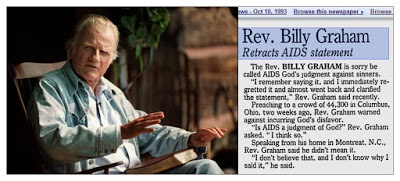
His slide from what he stated he believes, into doctrines so far outside orthodoxy, was so incremental and so little reported, that many people don’t know that he spent a lot of time retracting, clarifying, re-explaining and watering down any doctrine where he encountered push-back. Here is one example. In a sermon given on September 1993 in Columbus OH he remarked about AIDs
Is AIDs a judgment of God? I could not say for sure, but I think so.
Afterwards, Graham received many protest letters. He contacted the Cleveland Plain Dealer newspaper and retracted what he’d preached. His stated reason for saying it in the first place was that he was tired.
“I do believe God stands in judgment of all sins but AIDs is a disease that affects people and is not part of that judgment. To say God has judged people with AIDs would be very wrong and very cruel. I would like to say that I am very sorry for what I said.”
When Graham preached about sins, he said he wasn’t sure if AIDs was a judgment of God, but when experiencing criticism for saying it, suddenly he is sure that it is NOT a judgment for sins.
Here is a comparison to Graham’s waffle on AIDS of how a preacher of God’s word is clear on biblical doctrines. He is supposed to be able to succinctly give an answer, and then stand on the Rock when the waves of cultural anger resulting from his firm stand wash up upon him. Here is John MacArthur on the same subject 4 years before Graham dealt with it in his sermon.
People have asked me whether I believe that AIDS is the judgment of God. My response is that AIDS is the judgment of God in the same sense that cirrhosis of the liver is the judgment of God or that emphysema is the judgment of God. If you drink alcohol, you’re liable to get cirrhosis of the liver. If you smoke, you’re liable to get emphysema or heart disease. And if you choose to violate God’s standards for morality, you’re likely to contract venereal disease—even AIDS. It is a law that the Bible describes in terms of sowing and reaping. Article You can Trust the Bible, 1988
When a preacher is at the pulpit, it is assumed that he has been confirmed by elders as to his calling, been trained, and has studied/ prepared for the sermon. He should then declare the biblical truths with clarity and conviction. If there exists a pattern of waffling, retracting, and constantly clarifying, then it is perhaps either an issue of his qualifications for preaching (able to teach- 1 Timothy 3:2) or his heart, with hypocrisy leaking out.
Paul’s criterion “able to teach” in 1 Timothy 3:2 refers to the ability to communicate and apply the truth of Scripture with clarity, coherence, and fruitfulness. Source
Watch out for the constant clarifying, retracting etc. A preacher is supposed to be a declarer of truth, not a constant retractor of tired sermon mistakes. Such a pattern could betray either hypocrisy as stated in the two verses above, or the following:
Woe to you, when all people speak well of you, for so their fathers did to the false prophets. (Luke 6:26) for they loved the glory that comes from man more than the glory that comes from God. (John 12:43)
For am I now seeking the approval of man, or of God? Or am I trying to please man? If I were still trying to please man, I would not be a servant of Christ. (Galatians 1:10)
This is a study on hypocrisy. Hypocrites deceive us so easily, sad to say. They deceive themselves, worse to say. Hypocrisy is poison for everyone involved.
This series is based on two verses.
it is not what goes into the mouth that defiles a person, but what comes out of the mouth; this defiles a person. (Matthew 15:11).
Woe to you, scribes and Pharisees, hypocrites! For you are like whitewashed tombs, which outwardly appear beautiful, but within are full of dead people’s bones and all uncleanness. 28 So you also outwardly appear righteous to others, but within you are full of hypocrisy and lawlessness. (Matthew 23:27-28)
Waffling is a secular term that means changing one’s mind frequently on a topic. “For breakfast” means to do it easily. That defines world-famous evangelist and itinerant crusade preacher Billy Graham, whose going back and forth on theological issues so easily it is second nature to him.
It’s been 15 years since Graham’s last crusade. His heyday of the 1960s, 70s, and 80s was well before this latest generation’s knowledge and experience. Youngsters don’t know who Graham is, except for the name. Hence, this essay series.
As for the waffling, Graham’s pattern has been to say something in an interview or in print and when it causes a ruckus, then he apologizes, or says he was misquoted, or he didn’t mean it, or he doesn’t remember saying it. Back and forth the waffling goes, on issues like creation/evolution, baptism, AIDS, alien life outside the planet, and more, over every decade of Graham’s life.
It is well known that Graham has been a friend and counselor to Presidents. He has counseled every President of the United States, since WWII up through #45, Donald Trump.
Richard Nixon, who served from his election in 1969 until his resignation in 1974, met with and took phone calls from Billy Graham on a regular basis. They were personal friends and had been since before Nixon’s election.
Unbenownst to Graham, Nixon secretly recorded all his phone calls and visits inside the White House, and later, at Camp David, the presidential retreat. The recordings of course included calls to and from Graham.
In 2002, hours of the Nixon tapes were released to the National Archives. In one that was recorded on February 1, 1972, Nixon and Graham can be heard discussing Nixon’s and Graham’s true feelings about the Jews. This conversation was secretly recorded with H.R. Haldeman in attendance, who also kept a diary, (archives here) in which he further reported that Graham said that “the Bible says there are satanic Jews and that’s where our problem arises.”
In the tape under consideration today, February 1, 1972, Nixon is complaining about the Jewish dominated media. In researching Graham’s flip-flops on different theological topics, I’d read one in which great evangelist Graham is quoted as explaining why he chose NOT to evangelize Jews. (as stated in Christian News April 24, 1972, “The Conversion Of The Jews” where Graham said he does not judge the Jews as a people lost to salvation).
Really? So I researched further, googling “Graham evangelize Jews.” What I found was equally disturbing. The Nixon Tapes. I had not been aware of Graham’s recorded conversation revealing his thoughts on what he deemed as a Jewish problem.
Here is the (near) transcript I put together from various quoted articles and also some of the actual tapes. The conversation was held after Graham had led a White House prayer breakfast. The NY Daily News called the conversation “chilling and frightening.” I agree.
Graham had said he’d planned a meeting with editors of Time Magazine
Nixon: You meet with their editors, you better take along your Jewish beanie (yarmulke).
Graham: That right? /chuckles/
Nixon then said that media such as Life magazine, Newsweek, the New York Times, the Los Angeles Times, and others, are “totally dominated by the Jews.” Nixon goes on to say that network TV anchors Howard K. Smith, David Brinkley and Walter Cronkite were “front men who may not be of that persuasion,” but that their writers are “95 percent Jewish.”
Graham: This stranglehold has got to be broken or the country’s going down the drain.
Nixon: You believe that?
Graham: Yes, sir.
Nixon: Oh, boy. So do I. I can’t ever say that but I believe it.
Graham: No, but if you get elected a second time, then we might be able to do something
Nixon: … not all the Jews are bad, the best Jews are the Israeli Jews
Graham: That’s right … but there’s a powerful bloc of Jews … opposing you in the media.
Graham: And they’re the ones putting out the pornographic stuff.
Graham later confides to Nixon how he acts when Jews are around.
Graham: I go and I keep friends with Mr. Rosenthal at The New York Times and people of that sort, you know. And all — I mean, not all the Jews, but a lot of the Jews are great friends of mine, they swarm around me and are friendly to me because they know that I’m friendly with Israel. But they don’t know how I really feel about what they are doing to this country. And I have no power, no way to handle them, but I would stand up if under proper circumstances.
Nixon: You must not let them know.
Graham’s actions of friendliness to Jews to their face and internal hatred for their control of media and their destruction of the country, in addition to being satanic, is hypocrisy at its worst.
In 1994 when the Haldeman diaries were published and Graham was questioned about Haldeman’s memory of events, Graham said flatly that “those are not my words.”
He lied.
A false witness will not go unpunished, and he who breathes out lies will perish. (Proverbs 19:9).
Imagine, to lead a prayer breakfast so sensitively delivered that Nixon said people were in tears, and then for Graham to turn around and speak about the Jewish controlled media that is ruining this country, and colluding with the President to “do something about it” is venal beyond belief.
They are Graham’s words. In 2002 when the tapes themselves were released, it turned out to be true that Billy Graham had indeed spoken those words. He is either a deeply anti-Semitic man, or pretended to be in order to curry favor with a President and keep his seat at the power table. Either way, it’s gross.
“He just showed that he was the pious hypocrite that we all knew that he was anyway,” says Arthur Schlesinger Jr., who had served in the Kennedy White House a decade earlier. “Sinclair Lewis wrote about all those fellows in the great Elmer Gantry.”
Schlesinger nailed it when he referred to Elmer Gantry.
Gantry is an incendiary look at hypocrisy from the inside. I don’t know how author Sinclair Lewis did it so expertly, but he showed us the very thought process and the slow hardening of heart of one pastor over a lifetime, who inside his whitewashed tomb was evil, lusty, craven, self-seeking, vainglorious, greedy, and more. Read that book.
Oh! The waffle? It came in a 2002 statement.
Although I have no memory of the occasion, I deeply regret comments I apparently made in an Oval Office conversation with President Nixon. They do not reflect my views, and I sincerely apologize for any offense caused by the remarks.’ NY Times