Posted in discernment, Uncategorized

Do we possess that much power?

Church signs. Most of them are cringeworthy. The messages on them try to be clever, punny, funny, or light-heartedly serious. The worst simply promote false doctrine or are erroneous in terrible unintended double entendre ways.

None really work, or at least not the way the sign-writer intended them. Why not just put a Bible verse on there? Or announce the times of worship and welcome one and all?

A few days ago, a friend sent me an email that contained a motto from a streetside Baptist Church sign. The sign read,

“No one can separate you from the love of God but you”.

This is not true. If we could separate from God’s love, we would be God, because we’d be stronger than Him. Let’s look a bit closer:

  • First, the saved. Can they be separated from God’s love?
    We are sealed with the Holy Spirit. (Ephesians 1:13). Can man UNseal what God has sealed? No. We do not have that much power
  • Next, the unsaved: can they separate themselves from God’s love?
    If they refuse to repent, they can. But all people are so drenched in their sin nature and blinded to God’s love no one would ever repent by themselves, unless God drew them first. (John 6:44).

So no matter who you’re talking about, we cannot separate ourselves from God’s love. I reject the statement on that church sign as false. Friends, don’t believe every sign.

Posted in discernment, Uncategorized

Speaking up for discernment ministries

Aw. Poor discernment ministries. They are getting such a bad rap these days.

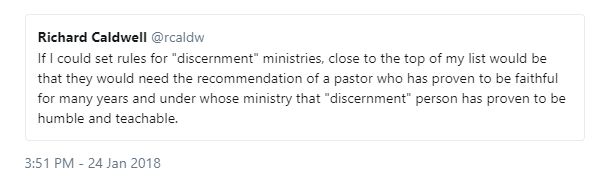
Richard Caldwell tweeted,
That makes sense, and I agree. However the “scare quotes” might not be totally necessary. Discerning the true from the false is a Ministry. Not a “Ministry”.

Randy White says there’s a Sickness in Discernment Ministries(Not THAT Randy White)
I can only think of a few things that the church needs more today than discernment. But I am completely convinced that discernment ministry is not the way the church is going to gain this discernment.

Perhaps this author and I have a different view of the goal of discernment ministries. The individual Christian is the one responsible responsible for cultivating their discernment, not ministries external to the local church. They are a resource, not the sole training ground for the Christian. Hebrews 5:14 says,

But solid food is for the mature, for those who have their powers of discernment trained by constant practice to distinguish good from evil.

So, whether or not we specifically possess the spiritual gift, we’re supposed to practice discernment constantly and train ourselves to detect good from evil, or as Charles Spurgeon says, detecting right from almost right. The pastor, if he preaches expositionally verse-by-verse, helps his people learn discernment because they are getting a good grounding in the word. Daily study and weekly sermons and personal study are the training we need in order to discern. We don’t rely on outside ministries to train us. We do consult ministries as an additional resource. Discernment ministries can be a good educational source, but a secondary one. So, in that sense, no, external discernment ministries are not the way the church is going to gain this discernment – or shouldn’t. However, that isn’t their intent.

Pastor John Chester of Piedmont Bible Church and Parking Space 23, says that we need discernment. However, in his view, “many of my concerns about many of these ministries have been magnified as some prominent ones have degenerated into de facto internet gossip columns and platforms to pursue personal grudges against pastors, theologians and churches.” Further, he believes ‘they are unbiblical, they are unhealthy, they are not very helpful, they often have significant blindspots’ and Pastor Chester has sworn off them.

Yes, some of these ministries have devolved. That’s sad but true. But swearing off all discernment ministries because a few, and I say a few, have devolved, is throwing the baby out with the bathwater in my opinion. Satan has the purpose and ability to corrupt every ministry that’s based on a spiritual gift. He has corrupted Preaching. He has corrupted Helps. He has corrupted Missions. He has corrupted Serving, Teaching, Exhortation, Giving, and Leadership. Discernment is no different. Or maybe it is, because discernment is the gift that aids the Christian in detecting when any spiritual gift-based ministry locally or globally is going adrift.

Eric Barger writes When Discernment Turns Ugly, that “Until the Church rejects the venomous battering of Christians by other Christians merely pushing their pet theologies, we will continue to exist in various “us and them” camps where some are simply intent on impugning others for the sake of making points with their followers and proving themselves “right.” ”

Wow.

But again, I agree to a point. Some Discernment Ministries that devolve entrench themselves into an us-and-them camp. Paul warned about dividing into camps based on who the leader is. (1 Corinthians 1:12). This isn’t new. It’s an old tendency not restricted to Discernment Ministries. Not new are theological debates with entrenched sides and camps. (Synod of Dort, anyone?). Sometimes theological debates on gross or fine points of theology are important, and by necessity, whenever you have debates, there are sides. That’s OK sometimes. Good debates help the cause and keep the doctrinal lines clear. Bad debates can simply be ignored. It’s that simple.

Add to this, biblical illiteracy is at an all-time high. Phil Johnson, Executive Director of Grace To You and a pastor at GraceLife, and a conference speaker, said recently that he believes that the state of the church now equals or exceeds the doctrinal mess and moral decay evident in Corinth. Isn’t it interesting that just when biblical literacy and by extension, discernment, is most needed, discernment ministries are being tarnished and urged to be done away with? Another brick in the wall.

There is a great need for discernment.

Pastor Gabriel Hughes of First Southern Baptist Church in Junction City, KS and the voice of When We Understand the Text (WWUTT.com) said this week,

Just witnessed to 36 high school students, mostly churched. I asked them, “How do we talk to God?” Unanimously they said, “Prayer!” I then asked, “How does God talk to us?” They said revelations, visions, voices, dreams, someone said, “He just does.” No one said the Bible.

This week also, a pastor studying in a Maine seminary wrote a short letter to the editor at Lighthouse Trails, mourning the lack of discernment in seminaries and churches.
Letter to Editor: Pastor Studying at Christian College in Maine Discouraged by Lack of Discernment

Yet discernment ministries are getting slammed

Michelle Lesley does a gracious and expert job of defending discernment ministry. Again.
Answering the Opposition- Responses to the Most Frequently Raised Discernment Objections

You notice that lack of discernment in general arose during an era when expositional preaching is in decline. Topical, hip preaching based on felt needs and pragmatism (whatever works) was the fad these last couple of decades. And as a result, lack of discernment has risen. Since it is not to be found in many local churches, or is absolutely rejected when brought up, then the need for outside ministries filled that need for many. People searched for confirmation of the things they were identifying in various books, sermons, ministries and the like in their home churches. They weren’t getting help at home, so they went to web-based ministries. At least they were trying to follow the Hebrews verse. Good for them. Good for the good Discernment Ministries that were able to provide good information.

I was blessed. Back in 2011, I had a difficult time accepting that Beth Moore was a credible teacher. Yet everyone around me was applauding her and enthusiastically using her books and materials. I broached the question respectfully to a leader and received a less than respectful reply. Unknown to me then, I was also marked as a troublemaker. When the leadership later flogged Jentezen Franklin’s Daniel Fast book from the pulpit and urged us all to publicly contract to do his Fasting Plan, I again respectfully questioned it. I was veritably tossed out on my ear. But in between those two events I searched online for help with the Beth Moore issue and Franklin’s Daniel Fast issue. Chris Rosebrough was helpful with the Moore issue. He not only declared that she was wrong, but taught why, point by point. In this practical fashion, I learned how to discern. Tim Challies’ book reviews and John MacArthur’s expositional preaching helped so much also.

In my experience, far from Discernment Ministries promoting “venomous battering of Christians by other Christians merely pushing their pet theologies” as Eric Barger said above, I’ve seen venomous battering of Christians by other Christians for merely questioning their pet teachers. But these internal bickerings, protections of pet teachers and theologies, and take-downs, are invisible when they happen inside a church. More noisy and visible are the few Discernment Ministries crashing spectacularly. Those get the attention. But the real problem is inside churches that marginalize discerners, and fail to cultivate knowledgeable members through preaching strong and correct biblical doctrine.

To me, the big issue isn’t discernment ministries. It’s lack of discernment from elders, pastors, and leaders who are actively teaching inside local churches. And it’s lack of tolerance or respect to hear those members out when an issue does arise who either trying to follow Hebrews 5:14’s example, or specifically attempting to edify their home church via the spiritual gift of discernment .

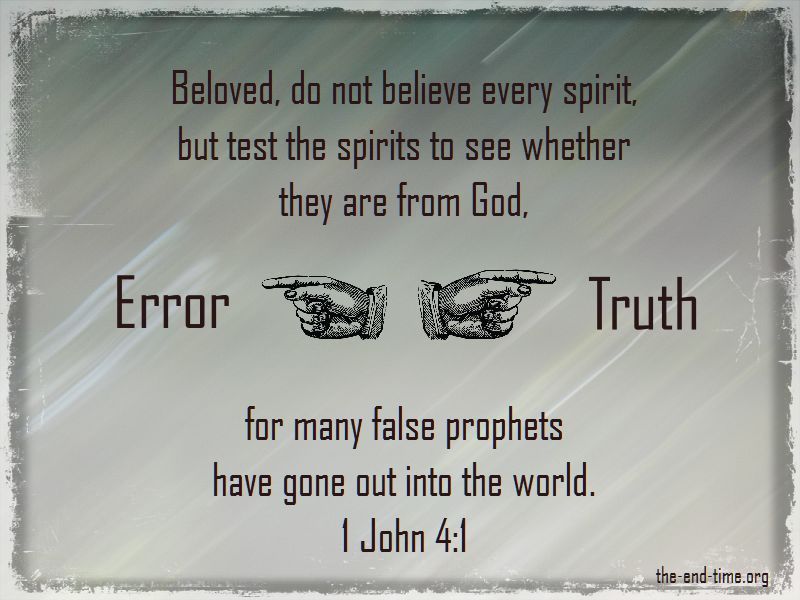
Beloved, do not believe every spirit, but test the spirits to see whether they are from God, for many false prophets have gone out into the world. (1 John 4:1)

Discernment is both a duty of every Christian and a spiritual gift given to some for the purpose of edifying the body.

As with all spiritual gifts, it’s incumbent upon the gift to use it wisely for the edification of the local body. (1 Corinthians 14:3-5, 12, 17, 26; Ephesians 4:12). If you have the gift of discernment, please use it wisely and humbly. We would say the same about those with the gift of giving, helps, leadership, teaching, mercy, and the rest.

Most discernment ministries (or ministries that partly deal with discernment among other issues) are good. Justin Peters Ministries, Michelle Lesley, Gabe Hughes/WWUTT, Tim Challies, DebbieLynne Kespert, Chris Rosebrough, Phil Johnson, Berean Research, CARM.org, and others manage to maintain a clean discernment ministry and also use their other gifts in balance, and do so wisely, humbly, and doctrinally. There are many others I could name.

This issue arose because some false brothers were brought in under false pretenses to spy on our freedom in Christ Jesus, in order to enslave us. (Galatians 2:4)

If there was somebody out there who could correctly help us avoid enslavement to false doctrines, why would we want to say no that that?
error and truth discernment

Posted in discernment, Uncategorized

Pay closer attention, lest we drift away: A sailing story

Therefore we must pay much closer attention to what we have heard, lest we drift away from it. (Hebrews 2:1).

The question was raised at Bible Family Group last night, how does a Christian prevent developing a hardened heart? One wise older man said by staying in the Word.

The word is the only antidote for developing poor habits, shrinking our biblical worldview, and drifting away. I agree.

The word drift away used in the Hebrews verse in Greek means-

properly, to float (flow) alongside, drifting past a destination because pushed along by current. /pararrhyéō (“drift away from”) only occurs in Heb 2:1 where it refers to going spiritually adrift – “sinning by slipping away” (from God’s anchor). 3901 /pararrhyéō (“gradually drift away”) means to “lapse” into spiritual defeat, describing how we slowly move away from our moorings in Christ.

Paul often used nautical allusions and marine metaphors. Last night at Family Group I’d shared the experience from when I was living on the sailboat that relates to the verse. We usually sailed during the day, unless we were on an overnight passage out in the ocean. But if we traveled down the Intracoastal Waterway, we’d find a snug spot to anchor in at night and went to bed after the sun sank.

The anchor becomes all-important. The anchor holds you in place, prevents you from drifting and damaging other boats anchored or moored nearby, and keeps you afloat rather than crashing into the rocks or going aground.

We spent a lot of time tending the anchor. When we initially set it, we’d take time to ensure it was set correctly. Is the rode taut and not tangled? Are the flukes digging into the ground? Is there enough depth under us for when we swing with the tide or current?

Then we’d watch it a while. We took reference points ashore to compare with our position. One reference point isn’t really enough. Drift is deceptive and incremental. You could be drifting away and still seem like you’re lined up with the same reference point. So we’d take two references. Three references are better so you can triangulate.

During the night, we’d sleep lightly, listening carefully for any change in the pattern of the waves slapping the bow, or any other untoward noises that meant there was likely a problem.

We spent a lot of time tending the anchor.

Do I spend an equal amount of time tending the anchor of my spiritual life, the Word? Do I treat it carefully, thoughtfully? Do I employ reference points to ensure I’m not drifting? Reference points in our spiritual lives that help us against drifting away from the truth are: visiting our prayer closet, studying His word, corporate worship, small groups, discipling and being discipled, and so on. Are we in position, standing firm in the center line of that narrow way, not going to the right or the left? Are we vigilant, listening for any variation in pattern of our sanctification in life?

We spent much time tending the anchor because our lives depended on it. We should take an even greater amount of time tending the anchor of our spiritual life because our spiritual life depends on it. When Paul says we must pay closer attention, the word in Greek means exceedingly, abundantly, vehemently.

When man sails upon the waters, he is not in his element. It is a foreign environment. It’s an environment that’s hostile, with many things in it either actively or benignly trying to kill him. Just so, Christian man on earth is not in his element. There are many things in this environment actively or benignly trying to kill him. We should pay the closest attention so  we do not drift away. Remember all the nature documentaries…what always happens to the gazelle that lags behind and is alone?

Stay anchored to the Word, in position, with lots of reference points and a growing biblical worldview 🙂

boat

Posted in discernment, Uncategorized

Are we supposed to feel God’s presence?

Some ladies who teach the Bible claim to have had special feelings of a tangible presence of God. Sarah Young, author of Jesus Calling, Ann Voskamp, author of One Thousand Gifts, Beth Moore, author of lots of books, and other women, claim to feel God. They report a warm mist, a force entering them, a tingle and so on.

The question often arises, if I don’t feel God, am I doing something wrong?

No.

You might sense God as you commune with Him in prayer or the Word, but maybe you don’t. Feeling physical sensations are not a requirement for communion with the Lord. Most people do not feel a tangible presence of God at any time. Here, we look to Job. He expresses that in fact God feels far from Him but still Job will commune with God via treasuring the words of His mouth more than even the food that keeps Job alive.

Behold, I go forward, but he is not there,
and backward, but I do not perceive him;
on the left hand when he is working, I do not behold him;
he turns to the right hand, but I do not see him.
But he knows the way that I take;
when he has tried me, I shall come out as gold.
My foot has held fast to his steps;
I have kept his way and have not turned aside.
I have not departed from the commandment of his lips;
I have treasured the words of his mouth more than my portion of food.
(Job 23: 8-12)

Be encouraged. Leave the warm mists, forcible compelling, tingles and other sensations to the ladies who claim such things. More than likely they are not even sensations from God. Be satisfied as Job was, with the words of God’s mouth. It’s enough, isn’t it? More than enough.

bread verse

Posted in discernment, Uncategorized

The power of crafty words

Now the serpent was more crafty than any other beast of the field that the LORD God had made. He said to the woman, “Did God actually say, ‘You shall not eat of any tree in the garden’?” (Genesis 3:1)

We are introduced to satan early and his introduction contained an extremely negative assertion about his character. He’s crafty.

Satan is an angel. He is an unholy angel, as opposed to Gabriel or Michael who are holy angels. If you look at the angels’ activity you see just how powerful and intelligent they are. They administer judgment. (e.g. Revelation 8:6-13). They give the Law. (Acts 7:53, Hebrews 2:2, Galatians 3:19). They give the Gospel to the whole earth at once. (Revelation 14:6). They stand on the sun. (Revelation 19:7). They hold back the wind. (Revelation 7:1).

They’re powerful.

We’ll come back to that in a moment.

I’m enjoying the buzz around a couple of movies just out. Darkest Hour is the story of Winston Churchill’s early days as England’s Prime Minister. He was leading the United Kingdom through tough times as WWII rages on the continent and is about to hit home for Britain. Much of the focus of the movie is on Churchill’s oratory. It’s a movie largely without action and is tightly confined to the bunker tunnels and small rooms below the city. Churchill made several famous speeches which roused the populace, enabled changed minds and hearts to make decisions, and cemented the nation in unity to face the evil force that was soon to come upon them. It’s a movie about speeches.

Another movie just out is called The Post. It depicts the editor Ben Bradlee and owner/publisher Katherine Graham of the Washington Post during the critical years of the decisions about whether to release the Pentagon Papers, and leading up to their coverage of the Watergate Break-in, which eventually led to the downfall and resignation of American President Richard Nixon. It’s a movie about words.

Words, whether written or spoken have power. Where would we be without Thomas Paine’s Common Sense, Lincoln’s Gettysburg address, Kennedy’s ‘to the moon and back’, Reagan’s ‘tear down this wall’? We remember Chief Joseph’s surrender speech, ‘I will fight no more forever.’ Lou Gehrig’s farewell to baseball ‘luckiest man alive’ speech. President Reagan reassuring a shocked nation after the space shuttle Challenger exploded and the astronauts having ‘slipped the surly bonds of earth’ to ‘touch the face of God.’

Look at the impact of President Franklin Roosevelt’s Fireside Chats:

Fireside chats is the term used to describe a series of 28 evening radio addresses given by U.S. President Franklin D. Roosevelt between 1933 and 1944. Roosevelt spoke with familiarity to millions of Americans about the promulgation of the Emergency Banking Act in response to the banking crisis, the recession, New Deal initiatives, and the course of World War II. On radio, he was able to quell rumors and explain his policies. His tone and demeanor communicated self-assurance during times of despair and uncertainty. Roosevelt was a great communicator on radio, and the fireside chats kept him in high public regard throughout his presidency. Their introduction was later described as a “revolutionary experiment with a nascent media platform”.

I’m brought back to the early chapters of Genesis. The serpent. What was his mode of attack? Did he hold Eve hostage and force her to eat the fruit? Did he call for his legions of followers to surround them and attack? No. He did it with words. Satan attacks with words.

We should not pay attention to satan.

Of course we don’t pay attention to satan, you say. Of course not, silly! But we do. We come across a false teacher and we listen. We rationalize that we have the power to ‘eat the meat and spit out the bones’. We wail, ‘But he/she helped me so much!’ Of course false teachers are skilled at oratory. They can make fine speeches. They use words well. They’re crafty!

False doctrine is sin because false doctrine doesn’t originate from God. (John 7:16, Titus 1:2). God hates false doctrine. (Revelation 2:15). Several of the letters in the New Testament were written to address errors of false doctrine (Galatians 1:6–9; Colossians 2:20–23; Titus 1:10–11). Take false doctrine seriously. Why? Its words will affect you.

Why do we know that speeches, movies, newspapers, and advertising affect us, but mistakenly think that listening to false doctrine won’t?

The Bible says that those who listen to false teachers are heaping these teachers up so they can ‘suit their own passions.’ (2 Timothy 4:3). Don’t indulge your passions by falling into satan’s crafty trap of words.

Black

~~~~~~~~~~~~~~~~~~~~~~~~~~~~~

Further reading

Challies: The Five Tests of False Doctrine

Michelle Lesley: Is She a False Teacher? 7 Steps to Figuring it Out on your Own

Got Questions: How can I recognize a false teacher / false prophet?

Art of Manliness: Resurrecting the Lost Art of Oratory

Posted in discernment, Uncategorized

An exhortation

Have you polished, adjusted, and thanked God today for your spiritual armor? We should be armed and ready, from head to toe, and praising the Lord for His generosity in protecting us from the demons and from the evil one himself! If we are on guard, rooted in His word, and seeking His face, we can always spot the real from the imitation, the Godly miracle from the demonic copy, the truth from a lying sign. It is a skill that needs honing, and we will need it more than ever as each day progresses. Be ready and sharpen that sword: read your Bible today!
armor

Posted in discernment, Uncategorized

A move of the holy spirit & Christian emotionalists

We hear a lot about the big moves of the Holy Spirit. We see Youtube clips of young millennials falling to the floor, or standing with arms upstretched in front of smoke filled stages, pulsing lights, glitter, laughing and sobbing. Afterward they smile tiredly, saying “The Holy Spirit really moved!” Or, “The Holy Spirit really showed up!”

As an aside, I dislike that phrase, ‘The Holy Spirit showed up.’ It’s crass. It’s akin to attending a funeral and saying to the bereaved, “So your wife croaked, eh?’ The Holy Spirit doesn’t ‘show up.’ He isn’t hailing a taxi running late, throwing a scarf around his neck while jumping out of the cab and huffing into the church. The Spirit doesn’t ‘show up’. The Holy Spirit governs the universe.

To the main point regarding big moves of the Spirit. Successive years of successive generations of younger church-goers have twisted Hebrews 11:1’s statement of what faith is:

Now faith is the substance of things hoped for, the evidence of things not seen.

Into –

Now faith is the substance of things we’ve come to tangibly possess, the evidence of things seen and experienced.

Spurgeon had something to say about these “Christian emotionalists” in Sermon 898, A Word with Those Who Wait for Signs and Wonders,

And when the people were gathered thick together, he began to say, This is an evil generation: they seek a sign... (Luke 11:29-30)

There are some, and these are generally the most uneducated, who expect to experience remarkable dreams or to behold singular visions. Others we have met with, who suppose that in order to being saved they must feel some very peculiar physical sensation. Now you must not look for this. You must not put physical contortions or sensations as a test before the Lord, and say you will not believe in Him otherwise.

You seek what is quite unnecessary. What do you want a sign for? You want, you say, a token of God’s love. What token of God’s love to you can ever be wanted, now that He has given His only-begotten Son, first to live on earth, and then to die in pains extreme, the just for the unjust, “that whosoever believeth in Him should not perish, but have everlasting life”! I blush for you, that you should ask any token of God’s love while Jesus Christ is before you…

I must tell you what is more, you are acting the part of an idolater. What does an idolater do? He says, “I cannot believe in an unseen God; I must have a golden calf or an image, that I can see with my eyes and touch with my hand.” You say just the same. You cannot believe God’s naked word, you demand something you can feel, something you can see. Sheer idolatry.

You might feel an overwhelming sense of joy, or peace, or well-being, or love for Jesus at times. These emotional times can occur when prayer is answered, providence is seen, worship is genuine, or Bible reading has deepened your view of the Savior. Strong emotion is good and appropriate. But to rely on such moments as proof of the Spirit’s presence casts a vain hope upon the shores of the Rock which stands above all. Your sure faith is in Him and His word that reveals Him.

Depending on signs is seeking a golden calf of experience over faith.

If you’re looking for a move of the Spirit, a miracle, sign, or wonder, there are many that we can name which exalt Jesus. Unsaved men are helpless and unable to come to God unless the Spirit draws them. (John 6:44). He saves by grace. Any new believer is a miracle, because they cannot save themselves. Sanctification is a miracle of God, because only by the Spirit can we resist sin and grow in His likeness. Providence is a miracle of God because He sustains the universe by the power of His word every minute, and He ordains every event that happens to all 8 billion people on earth at every second.

Stop looking for glitter dust falling from the ceiling, for personal prophecies, and visible signs when we already have the redemptive, sanctifying, providential work of the Lord occurring all over the world every second.

I’ll leave John MacArthur with the last word-

For all those true believers who love the Lord, the promise is a wonderful promise. … I think it’s time in the church of the Lord Jesus Christ to give honor to the Holy Spirit, to worship Him, to love Him, to ascribe to Him the glory that He is due and to stop the nonsense that brings dishonor on His holy name.

pic

Posted in discernment, Uncategorized

Strong women, who can know?

Alistair Roberts wrote at Mere Orthodoxy about the need to dispense with the strong female character. It’s a well-written, if long, article. He made some excellent points. Then he followed up with another article at his own site, Alistair’s Adversaria, reacting to some push-back, here.

I want to include a few excerpts from his good original article and then continue with my own thoughts. We may need to dispense with the ‘strong female character’ as Roberts suggests, or as I propose, we may need to redefine what a strong female character is in the first place.

Popular culture is the focus of some of the most determined attempts to shift attitudes on a host of issues within society at large, and such forms of representation are an important dimension of this. While popular media and the various ‘messages’ within it may often appear innocuous, they are frequently anything but. Behind them lie concerted efforts to change the public’s thinking and perception on key matters and some carefully calculated agendas. The supposed shallowness of pop culture is deceptive: It is a realm where brilliant and talented people go to try to shape minds at their most unguarded and impressionable. It is on the ground of entertainment media that the so-called culture wars have largely been lost.

Yes! Yes! Yes! Entertainment is never innocuous. What we absorb in entertainment has an agenda, a worldview, and a purpose. It’s not merely to entertain you and me, it is to change our perceptions, and this happens more easily when we are at our most unguarded.

RE more recent portrayals of Disney Princesses:

Yet, despite their likeableness and roundedness as characters, these new princesses betray some concerning anxieties about women’s place and agency within the world. Within the kickass princess trope lurks the implication that, to prove equality of dignity, worth, agency, and significance as a character, all of a woman’s resolve, wisdom, courage, love, kindness, self-sacrifice, and other traits simply aren’t enough—she must be capable of putting men in their place by outmatching them in endeavors and strengths that naturally favor them, or otherwise making them look weak or foolish.

That is very well said!

His article becomes tremendous toward the end. The section titled The Heroism of Lady Wisdom recounts the strong female through God’s eyes. The woman at home, raising children, is where the real strength is-

Our failure to see the heroism and the strength of such a diligent and active woman is a failure to see the world as God does. The strength of such a woman is not that of conformity to more typically male forms of strength, but rather of the reflection of the work of the master creator, Lady Wisdom, within her own world of activity.

Women can be trained in martial arts and sword play. It takes strength of the physical type to perform those feats. Of course, women lack the same upper body strength as men and cannot replicate male feats of warlike strength exactly, but thanks to animation and CGI, we can overlook that fact.

If you do a Google image search for ‘strong women’ you get photos like these:

strong

But truly, who is stronger, Mulan, or Lydia? Lydia hosted a home church. (Acts 16:40). She was a working woman, but she also prepared endlessly for guests, cleaning and readying the domicile so that the main concentration could be on studying the Word and fellowshipping with one another. Dorcas/Tabitha sewed endlessly for charity. (Acts 9:36). She made garments and sat among other women, edifying and speaking and loving. It’s harder to unfailingly love through the years than it is to swing a sword once or twice.

Jael swung a hammer and drove one tent peg for a few minutes. (Judges 4:17-22). Yet Leah was used by Laban her father and unpreferred by her husband, but submitted to them both, uncomplainingly raised 6 boys, and was faithful to God all her days. Which takes more strength, a few moments of physical exertion, of a lifetime of putting God first? Who is the woman of valor?

Hannah was barren, a devastating indictment in the culture’s eyes. She was tormented by her husband’s other wife. She asked for a son and vowed to give him back to God- and then did. Which takes more strength, the woman of Abel-Bethmaach who negotiated a peace treaty, (2 Samuel 20:16-21a), or Hannah? Could you give up your son and only see him once a year? Withstand insults and torment from a competing wife and turn only to the Lord for comfort and petitions? I know my answer. I’d complain and gossip and plot against the jealous other wife. Hannah showed strength of character not just in one Bible event like the wise woman of Bethmaach, but maintained Godly character for years. What woman is “stronger”?

Mary is to me one of the strongest women of the entire Bible. As a virginal teenager (probable age) betrothed but not yet connubially married, she was told that she would conceive and bear a child by the Spirit. Adultery was a crime for which people were stoned. Mary faced it and said to angel Gabriel, ‘let it be done to me as God wills.’ She gave birth in the cold and among animals. She lived with the whispers of adultery and attendant humiliation and doubts about her character all her life. She was told at His birth she would see Him die horrifically. And she did see her Son die horrifically. She was obedient, she bore it- and praised God through it. Isn’t that strength? Could you do as Mary did?

Our culture sees external fighting as strength. Feminists create women who appear in movies and shows, proficient in martial arts, wars, battles involving swords, knives, or guns as ‘strong’ women.  It’s the trope that’s constantly pushed in front of us. Rapunzel, Merida, Elsa, Wonder Woman, Rey, are all presented to us in entertainment as the external female strong ideal because they wield weapons. They’re called strong because of their derring-do. They’re lauded because they make men look foolish. But the REAL battle is not with swords, but is the internal fight against sin. Truly strong women wield the sword of the Word. (Ephesians 6:17). Truly strong women help their husbands, support and care for them, (Genesis 2:18; 20b) not make them look weak or foolish.

There are so many named and unnamed Godly women in the Bible who fought their own sin-nature and demonstrated quiet strength for years. Real strength is obedience to God, submission to our roles, and resisting sin always. Be strong, women, be strong.

Further Reading

Essay: Bad Examples of Women Pastors (But Great Examples of Godly Women)

Sermon: The Proverbs 31 Woman


Posted in discernment, Uncategorized

Doing my best to puncture the balloon that Ladies Ministries try to inflate

I had heard of you by the hearing of the ear, but now my eye sees you; therefore I despise myself, and repent in dust and ashes. ~Job

To possess dignity is to be worthy of respect. Worthy of high esteem. Absorb this: you are worthy of respect. ~Beth Moore

“Woe to me!” I cried. “I am ruined! For I am a man of unclean lips, and I live among a people of unclean lips, and my eyes have seen the King, the Lord Almighty.” ~Isaiah

Be kind to yourself. Be compassionate to yourself. Be loving to yourself. Be patient with yourself. Have the courage to be yourself. ~Christine Caine

But when Simon Peter saw it, he fell down at Jesus’ knees, saying, “Depart from me, for I am a sinful man, O Lord.” ~ Simon Peter

Who you are is more important than what you are called to do. ~Priscilla Shirer

Man was created to glorify God. (Isaiah 43:7). Our inherited sin nature makes it impossible to do that without His redemptive work in our heart. It’s important to see ourselves as we are (were). Ladies, yes, it’s good to have “self-esteem” to the extent that we know who we are. We’re sinners, saved by grace alone. Women’s Ministries these days over-emphasize that we are women of valor, courage, of worth, esteem, and bravery. We’re princesses, running around sunlit meadows in wedding dresses dripping pearls.

Or we are as Isaiah, Job, and Peter saw themselves when they saw God: as worms in the dust, sinning with the pigs and needing to rely totally on the Father for any scrap of righteousness we might possess.

Praise the Lord He came, died for sin, was buried and resurrected. He glorified the Father and His reward will be…us. The Father will give Him a Bride, redeemed and washed. It is all about the Trinity and His work. It is not about us, our worth, our esteem, dignity, or “who we are.”

O Lord, depart from me, I am a sinful woman. Yet He lifted me from the muck and mire and gave me His righteousness, robes, Spirit, and future. From that moment, when I search inside myself to see my worth, esteem, or dignity, what I see is His.

Posted in discernment, Uncategorized

Ladies, do you want to fulfill your potential? (Think hard before you say yes)

Someone on Twitter asked if we could recommend any good women’s conferences centering on faithful Biblical exposition and an unrelenting love for the church. This was my reply:

Good conferences centering on faithful Biblical exposition &an unrelenting love for the church are any from MacArthur, G3, TMU’s Truth & Life conference, etc. I’m not an advocate of separate women’s conferences. Women need theology, so, “Conference”, not “Women’s conference” IMO.

Below is why I prefer men’s conferences, exactly this, as a reader alerted me to a few days after the Twitter inquiry-

caine

The Dallas Seminary’s Women’s Leadership conference concluded a few days ago. Christine Caine as the keynote speaker makes me so sad, because she teaches things unworthy of Christ. Through this invitation, the Dallas Seminary gives Caine credibility. Think of how many women are negatively influenced and exposed to her, or even when they see the line-up of speakers on the website.

I looked up the Bios of the other women who were on the schedule at the Leadership conference. A pattern emerged.

Have you noticed this phrase very often? It’s become a constant to many women’s ministry bios and purpose statements.

Her mission in life is to equip and inspire women to reach their full potential in Christ.

It sounds good. “Full potential.” Who wouldn’t want to reach their full potential, especially “in Christ”? It sounds great. Here are some more Ministry purpose statements I found along those lines.

[This ministry] exists to serve the local church, leaders, organizations, and individuals by inspiring and helping them connect with their God-given potential and purpose.

[This ministry] believes in the passion, purpose, and potential of every woman everywhere.

[This Teacher] has committed her life to equipping women of all ages, regardless of marital status, with practical, biblical truth to help them live more genuine lives.

I share this dream with some amazing friends… to gather and equip and unleash a generation of women.

According to these teachers in their ministry purpose statements, I can be genuine, reach my full potential, be ‘unleashed’ (because I’m shackled now, right?), find my purpose, and more. Sounds good.

Except it’s wrong. Ministry isn’t about me. It isn’t about my potential. It isn’t about my life. It isn’t about my purpose. We do ministry for an entirely different reason. A reason that has its focus not on ourselves, looking laterally. We look up.

My potential is this: as a sinner I have the utter and constant potential to sin. (Genesis 6:5). Sinners gossip, steal, covet, murder, lust, and more. That is what sinners do. It is what we have the “potential” for. As a believer, my potential is in Christ, and will be fully realized in Christ when He comes. When we are glorified our potential will be full, but not until then. As it is now, as long as we’re not raptured or dead and dwelling in heaven until the Day, we have the total potential to sin. More than potential, actually.

We have the Holy Spirit as a help and an aid to resist our sin-nature. The more we grow, the more we can resist sin through the Holy Spirit’s help. But we do sin. Paul remarked about that, and if there was any believer who had a shot at reaching his “full potential”, as Christine Caine puts it, it was him. Yet he still struggled with doing what he didn’t want to do, and didn’t do what he wanted.

For I do not understand my own actions. For I do not do what I want, but I do the very thing I hate. Now if I do what I do not want, I agree with the law, that it is good. So now it is no longer I who do it, but sin that dwells within me. For I know that nothing good dwells in me, that is, in my flesh. For I have the desire to do what is right, but not the ability to carry it out. For I do not do the good I want, but the evil I do not want is what I keep on doing. Now if I do what I do not want, it is no longer I who do it, but sin that dwells within me. (Romans 7:15-20).

The kind of ministry purpose statements I read and quoted some above sound more like a fortune cookie than deeply committed evangelical purpose. It’s like that funny blog essay Challies did, ‘Joel Osteen or Fortune Cookie?’  Joel Osteen was selected as the unwitting target because he is well-known for issuing nebulous platitudes instead of firmly proclaiming the Word. We can play the same game. “Ministry Purpose Statement or Confucian saying?” Confucius was a Chinese philosopher who lived in around 500 BC. Here is an example:

The will to win, the desire to succeed, the urge to reach your full potential… these are the keys that will unlock the door to personal excellence.

It’s a Confucian saying, but if we add “in Christ” to the end it might well match any of the liberal Christian ministry purpose statements we find of the type I’m talking about.

I wish these ministries would have in their purpose statements and their leader bios, something like this:

“Helping women learn who Christ is through the study of His word.”

Or,

“Helping women to learn theology so we bring honor to Christ in our lives and deeds.”

Or,

“Women together studying the person, life, work, and ministry of Jesus Christ.”

Or,

“Studying His word so as to transform our minds and become more Christ-like.”

Or,

“Encouraging women to study God’s revelation to us through His written word.”

If you’re checking out a ministry online and see something like the me-statements mentioned above, promising full potential or unleashing or finding your purpose, beware. Alternately, just because a ministry puts up a solid-seeming purpose statement, it doesn’t mean they are necessarily solid. There’s this purpose statement for a famous ministry, which sounds fantastic:

[This ministry] is dedicated to encourage people to come to know and love Jesus Christ through the study of Scripture.

Sadly, the about statement of purpose is Beth Moore’s at Living Proof. Rather, her purpose statement should read:

This ministry is dedicated to encourage people to come to know and love Beth Moore through the study of my direct revelations, personal dreams, pop psychology, and funny anecdotes.”

So, just be aware of the language ministries use. If they claim to want to help you attain your full potential, it might be wise to say to yourself,

“No thanks, I want to study Christ while on earth, resist my potential, and wait for Him to fulfill it when I’m glorified.”