I saw this clip on Todd Friel’s Wretched Youtube page last night and it was extremely moving to me. It was also convicting. It DID spur me to check myself and examine as to whether I am in the faith.
This is important to do, because as the video title suggests, there will be two types of people in hell. The two types are based on the verse from Matthew 13:50, where at the end of the age, angels will
throw them into the fiery furnace. In that place there will be weeping and gnashing of teeth.
By the way, when you study angels you notice how active they are in executing all God’s commands, especially in Revelation. Anyway, in the clip, Dr Sproul explains what the weeping and what gnashing of teeth is.
The weepers are weeping because they were self-deceived all along and were not saved when they thought they were. Jesus will declare to them, “Depart from me you workers of iniquity, I never knew you.” (Matthew 7:21-23). Hence the urgency to check one’s self to see if we are in the faith. (2 Corinthians 13:5).
The gnashers are angry. They refuse to acknowledge God for who He is, even while they are justly tormented in the fires of hell. How can this be, one might wonder, when the entire lake of fire has been prepared by God for the devil and his angels, and the unforgiven sinners? The fires are real, they are in them. How can they not acknowledge God?
Revelation gives us a clue as to the depth of sin and the anger at God’s authority. Even while they were alive and under punishment of God’s plagues, they did not repent. Revelation 9:20-21 has the first instance. The Lord sent an angel to open the pit and release hordes and billions of demons, which were so many they clouded the sun upon their release. The demons were given authority to plague mankind with sores and pain. A third of all mankind is killed! Further billions will be laying around writhing at the sting of demons, and yet-
The rest of mankind, who were not killed by these plagues, did not repent of the works of their hands nor give up worshiping demons and idols of gold and silver and bronze and stone and wood, which cannot see or hear or walk, 21 nor did they repent of their murders or their sorceries or their sexual immorality or their thefts.
To make the depth of their depravity even more pointed, the next verse from Revelation shows clearly that they KNOW it is God sending the plagues, and they did not repent. Instead, they cursed his very name!
They were scorched by the fierce heat, and they cursed the name of God who had power over these plagues. They did not repent and give him glory. (Revelation 16:9).
And again in verse 11 when another plague was sent, they did not repent but instead cursed the name of God again. Instead, they began assembling at Armageddon to fight him!
This all goes to show the power of sin. The power of sin to delude us as to its power. It can blind us. Am I self-deceived? Am I not in the faith? Will I hear those dread words ‘depart from me?’ Will I be weeping?
Please watch the short video and ponder the gravity of it all. The cross of Jesus split history. It split the whole of humankind into two types of people- saved and unsaved. It split the world into Gospel-loving and hell-bound. The cross stands alone as the point of beginning or the point of departure.
There will be two types of people in hell…
I thank God that there are and were men to preach the truth, even the unpleasant truths of scripture, such as hell, self-delusion, and false conversion. It’s important. Now, how do we examine one’s self? Further resources are listed below.
Sermon series:
Undoubtedly the sincere claims people make are sometimes far from reality. As chilling as that thought may be, there are countless well-meaning people who believe they’re saved, but they aren’t. Could you or someone you know be one of them? How do you know your faith is built on a solid foundation? Or is that something you can ever know this side of eternity?
Determine for yourself whether you are a Christian. John MacArthur shows you how to assess your spiritual condition in Examine Yourself.
If you don’t want to go through a series of sermons, here is a 15-page free booklet called Is it Real?11 Biblical Tests of Salvation.
If you don’t want to read a 15 page booklet, here is a 5-page free booklet called Examine Yourself.
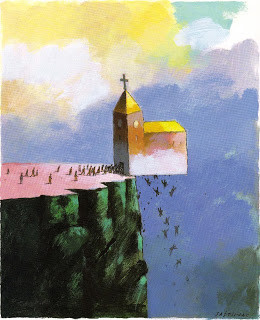
If you don’t want to read 500 words to examine yourself, then I direct you back up to the top to re-watch the clip, where there will be two types of people in hell. I’m not saying that if you don’t follow through in looking at these particular resources you’l go to hell, but I’m emphasizing that the power of sin to delude us is great and must be constantly watched against. There is nothing more important than checking one’s self to make sure we are not one of the two types. It’s the best thing you could do all day or for all eternity. 🙂 If nothing else, you will receive assurance! This illustration by artist Boris Sajtinac is all too vivid!
Believe me, I checked myself immediately after watching the clip. I know the power of sin to delude me is too great. I’ve seen it happen to others and I know it dwells inside myself. Please, pray and check, and be assured, dear sister.
I have written about Beth Moore’s legalism in the past (2011). It’s hard to believe that was 7 years ago. Here is a refresher course on how, while seeming to speak a Gospel-infused sermon, Beth Moore’s speeches are really just a ‘try harder’ legalism. This is a lesson in discernment.
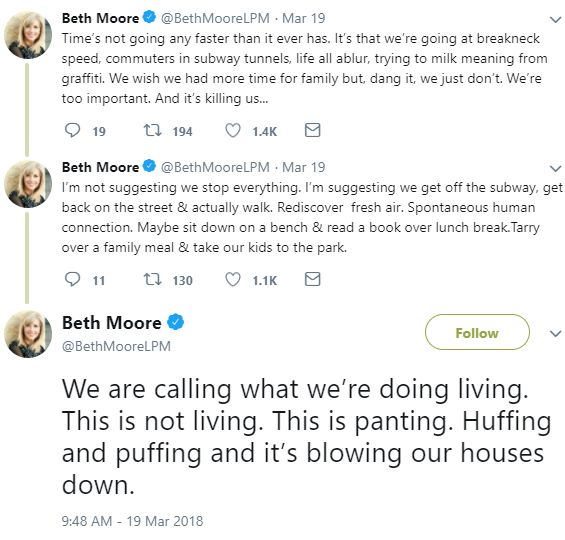
You have to listen carefully and do a lot of note-taking because Moore speaks so fast, or if you listen online, use the pause button a lot. Her ‘try harder’ theology is also in her books as you will see, so the issue is not just her speaking style, but her theology. You will hear that Beth Moore shapes the scriptures away from pure faith and toward legalism. She splits sentences, putting a crowbar between words and inserting things you’ve ‘got’ to do. There is a lot of ‘do this or else’. There are also lots of warnings about the dire conditions of our walk, without real explanations. Like this from a few days ago.
It seems she is trying to say that we shouldn’t be too busy. Too busy for what, she never says. Yet after more than three successive tweets (yes, it went on) she never got to any clear point. Milk meaning from graffiti? Huffing and puffing? And what does it mean, exactly, that we are ‘blowing our houses down’? A teacher is supposed to be “able to teach.” (2 Timothy 2:24). Not vaguely warn. Or be so in love with her writing that plain meaning is obscured…
Our precious Lord gave salvation as a gift. No matter how we stumble, or no matter how many times we enter a sin-repent-forgive cycle, we are saved and effective for His glory. He gave us a GIFT of salvation. It is the gift of redemption, a gift of imputed righteousness. Here are some examples of how Moore diminishes the gift of the Gospel and makes it a confusing, burdensome, treacherous walk among the heavy stones of the Law.
Example #1:
Her contemplative prayer quote: “[I]f we are not still before Him, we will never truly know to the depths of the marrow of our bones that He is God. There’s got to be a stillness.”
According to Moore, we will “never” “truly” know who God is UNLESS we are still. Beware of Bible teachers who frequently use absolute words.
Example #2:
In one study, Beth Moore is speaking of ‘confidence and competence’ that Christ gives us. The study is based on Hebrews 10:19-20 but her interpretation of the verse is wrong from the beginning. Once the basic interpretation is wrong it is no surprise that what follows falls into even worse error. Watch carefully as she inserts conditions to salvation. She even outlines the effect of not believing the new add-ons that she includes.
…but what can happen is this … If we receive Christ as our Savior but we never recognize and by faith believe Him to also be our healer and our restorer then we just stay just as cracked as when we got here.
The Gospel is now Law. According to Moore, we have to believe some things above and beyond what the Bible says we need to believe for salvation. According to Moore, we must believe in a different Christ than the Jesus presented in His Word. I certainly don’t see anything in His word about having to believe that Jesus is our Savior AND our Healer AND our Restorer or else we stay “cracked”. And what does cracked mean, exactly? This is some vague warning of looming disaster, the kind of warnings Moore loves to issue.
Now as for this cracked business, the Bible does speak of being cracked:
For My people have committed two evils: They have forsaken Me, The fountain of living waters, To hew for themselves cisterns, Broken cisterns That can hold no water. (Jeremiah 2:13).
The cracked ones were the ones who forsook God. They were the evil ones.
But when Jesus saves us, we are sealed! “Now He who establishes us with you in Christ and has anointed us is God, who also has sealed us and given us the Spirit in our hearts as a guarantee.” (2 Corinthians 1:21-22).
There is no in-between in the New Testament, being saved but leaking through a crack.
Example #3:
…it [confidence] just bleeds out everywhere, we can’t keep any confidence in there. Because we have never trusted Him to put three pieces of our lives back together. Is this making any sense to anybody? We have all these cracks and all these pieces. … And we’re supposed to be effective here on earth. … Salt and light and profoundly effective, but we can’t be any of that unless we have our God-confidence.
Again with the “we can’t…unless”. Note those words.
As to Moore’s addition of confidence as a necessary condition of keeping our salvation or being effective or something, Jeremiah wasn’t confident. His first worry was that he was too young for the job. (Jeremiah 1:6-8). By any standard, Jeremiah was an effective man of God.
Moses wasn’t confident. He worried he wasn’t eloquent enough to be a spokesman. (Exodus 4:10-12). By any standard, Moses was not too confident, but he sure was effective.
So far, from just three of her teachings we learn that —
1. Unless we accept Jesus as savior AND Healer AND Restorer, His work is not sufficient.
2. Unless we get some God-confidence, we are not effective.
3. Unless we believe certain things about Jesus, we will stay cracked.
4. Unless we are still, we will never truly know God.
The legalistic conditions pile up fast.
Example #4:
Moore’s book Breaking Free: Making Liberty in Christ a Reality in Life was reviewed by Paige Britton.
Britton says, “One rather ironic element of Moore’s teaching is her definition of “legalism,” one of the roadblocks we must remove if we want to journey on to authentic freedom. According to Moore, legalism occurs whenever one studies the Word but fails to enjoy God; it is the absence of relationship, passion, engagement of the heart (pp.75, 77). This definition is fine as far as it goes, but it effectively obscures the fact that Breaking Free is all about applying new rules in order to gain what God meant for us as a gift in Christ.
Isn’t that ironic. A book called Breaking Free is really just a new way to enslave you. Moore makes up and applies new rules to gain what was given as a gift says Britton, and I have noticed this too. So we have issues with new rules in Moore’s speaking ministry and in her tweets and in her books. Her theology, no matter where it’s publicly proffered, is a problem.
Once you start hearing the “got to” and “must do” and “unless you” you will hear her new rules permeating her teaching everywhere.
What does the Bible say about new rules for salvation? It says that adding an unbiblical load kills us.
“Woe to you as well, experts in the law!” He replied. “You weigh men down with heavy burdens, but you yourselves will not lift a finger to lighten their load. (Luke 11:46).
Now, therefore, why are you putting God to the test by placing a yoke on the neck of the disciples that neither our fathers nor we have been able to bear? (Acts 15:10).
Don’t listen to Moore or any teacher who imposes conditions on your walk that are absent from the Bible. Or who uses absolute words like unless, can’t, always, never, all the time, and so on. The Father loves us with an enduring, everlasting love that is perfect. Moreover, He is our priest who prays for us. He sends angels to minister to us. He gave us the Spirit to grow us. We are not cracked, leaking, unconfident, missing out on what we need, ineffective, on the verge of disaster, or any of the things Moore says we are. Moore’s world must be dark and heavy indeed.
Our world, though a mindful one and filled with obedient striving, is one of light and freedom from the very conditions Moore seeks to impose. This is because we are in Christ, and He met all the conditions necessary on the cross and broke that chain, in order to set the captives free.
It is for freedom that Christ has set us free. Stand firm, then, and do not be encumbered once more by a yoke of slavery. (Galatians 5:1).
Apostasy is defined as ‘a defection or revolt’. It is the formal disaffiliation from or abandonment or renunciation of a religion by a person. One who commits apostasy (or who apostatizes) is known as an apostate. It is important to remember that apostates never really were saved. 1 John 2:19 says, “They went out from us, but they did not really belong to us. For if they had belonged to us, they would have remained with us; but their going showed that none of them belonged to us.”
There are two kinds of apostasy. It shows that apostasy is a process. No one wakes up one day and says “Gee, I hate Jesus and I’m not going to church anymore.” The first kind of apostasy is a drifting away of the key doctrines of the faith. The second is a complete abandonment of Christianity. Remember, if you are saved, your salvation is eternally secure. If you have submitted to Christ no one can snatch you out of His Hand. (John 10:28 says “I give them eternal life, and they shall never perish; no one can snatch them out of my hand.” so we read that if He gives eternal life, then no one can take you away from Him. Equally, because it is He who gives eternal life, mere man cannot nullify His decision.
The primary essential doctrines of the faith one must stick to, According to Christian Apologetics and Research Ministry, (scriptures supporting them are here) and I agree with these as the essential ones, are–
1. Jesus is God in flesh, and Jesus is the proper object of faith. The Doctrine of the deity of Christ includes:
–The Trinity
–There is only one God in all existence
–That Jesus is both God and man.
2. Salvation is by Grace alone
3. The resurrected Christ
4. The Gospel
They are called the primary essentials because the Bible declares them to be essential to the faith. Secondary essentials are necessary truths, but there is no declared penalty for their denial — yet they are still essential to the Christian faith. Those include:
–Jesus is the only way to heaven
–Mary’s virgin birth
FYI, the recently departed evangelist Billy Graham denied both of the above.
An apostate very slowly starts to doubt the essentials. He or she begins to read and absorb other things that are contrary to those doctrines. Paul called false teachings gangrene because they quickly pollute the body and mind. (2 Timothy 2:17).
The Bible says that at the time of the end there will be a great falling away from the truth. Look to 2 Thessalonians for the prediction regarding the “falling away.” 2 Thess. 2:3-7 says, “Let no one deceive you by any means; for that Day will not come unless the falling away comes first, and the man of sin is revealed, the son of perdition, who opposes and exalts himself above all that is called God or that is worshiped, so that he sits as God in the temple of God, showing himself that he is God. Do you not remember that when I was still with you I told you these things? And now you know what is restraining, that he may be revealed in his own time. For the mystery of lawlessness is already at work; only he who now restrains will do so until he is taken out of the way.”
The lawlessness is sinfulness and the fact that Paul says it is already at work means that there have been apostates throughout the Church Age, even in Paul’s day. The verse I mentioned above in 2 Timothy 2:17 speaks of Hymenaeus and Philetus who spread false teachings, two men who “wandered away from the truth” and became “more and more ungodly”. (2 Timothy 2:16; 18). So you see, apostasy is a process.
Sanctification is a process, too. Just as apostates-in-the-making drift away from the faith, either fast or slow, those being sanctified progress toward holiness, either fast or slow. The Lord’s people will never, ever be lost to Him nor will they even become apostate. Ever.
I give them eternal life, and they will never perish, and no one will snatch them out of my hand. (John 10:28).
Praise Him for all His ways, His grace, and His priestly ministrations, and His sovereignty that keeps His sheep.
The advent of the internet has afforded Christian men and women opportunity to learn from many credible teachers and pastors, and to access a variety of different theological resources.
For example, all of Charles Spurgeon’s sermons and writings are online. John Owen is online. Pilgrim’s Progress is online. John MacArthur’s sermons, over 3000 of them, are online. Martyn Lloyd Jones, S. Lewis Johnson, BB Warfield sermons and materials, online, Valley of Vision, online. Blogs, podcasts, courses both free and paid (i.e Mt Zion Chapel Library, free; Ligonier, affordable paid), books, pamphlets, art work, lexicons, concordances, and more are available tot he believer as resources.
Wow.
In some ways, this period of time has given people, women in particular, opportunity to become deeply involved with the Word, especially if (other than her pastor) she has no males in her life, such as a Godly husband or brothers, father, etc. It is a rich time.
Alternately, the potential for deception among women has never been greater, either. Women are especially vulnerable to false teaching (2 Timothy 3:6, 1 Peter 3:7) and we must guard ourselves by all the means available to us. While many online ministries are solid, many other ministries online promote false teaching. Even church sermons posted on the internet can contain false teaching, as well as the false doctrine perpetuated by ministries that exist online only. So much falsity.
Now the Spirit expressly says that in later times some will depart from the faith by devoting themselves to deceitful spirits and teachings of demons, 2 through the insincerity of liars whose consciences are seared… (1 Timothy 4:1-2).
For certain people have crept in unnoticed who long ago were designated for this condemnation, ungodly people, who pervert the grace of our God into sensuality and deny our only Master and Lord, Jesus Christ. (Jude 1:4).
While it is true that the Bible prohibits women from operating in some roles (teaching men, pastoring), the Bible encourages all believers, women included, to be theologians. Being a theologian simply means you study God in His revealed self, via the Bible.
To that end, this Table Talk discussion from The Master’s University was helpful. The topic was Why Every Woman Should be A Theologian. Professor Abner Chou facilitated, and several other professors answered questions as the discussion went on.
The opening question was asked:
In light of complementarianism, we often emphasize things in light of what women cannot do; she cannot teach (men) she cannot preach or be a pastor. But let’s turn this around and ask what does the Bible encourage women to do? How can women can be active participants in the church?
One of the Professors answered (I’m sorry, his introduction was not contained in the tape):
Every believer is a theologian. Theology is simply asking and answering, ‘Who is God?’ Every time we ask ‘Who is Jesus’ we are engaging in theology. Believers should be about understanding who God is and how He has revealed Himself. Pursuing who He is is a key aspect that should fill the lives of every believer.
The talk went on from there. Betty Price, Associate Professor of Biblical Studies; Women’s Ministries, noted :
For too many years women’s Bible studies have been too light and fluffy, and not have been a serious study. It’s really hard to find something that gives much depth at all. They’re always quick little surface study guides that have a Bible clip and a few fill-in-the-blank questions in a workbook. Perhaps women have not been encouraged enough. … [Women’s studies] are geared around fellowship and social times, probably more than being a theologian. That’s not all bad, many of the women are stay-at-home moms and need the social times to come together with other adults. But I’d like to see deeper studies.
A study of the religious role of women in the Old Testament through the New Testament periods. Emphasis is placed on both the privilege and the limitations of women’s ministry in the early church.
Other resources:
Todd Friel’s Drive By series. He titled the series Drive By, and deliberately made the lectures short because the Internet was that student-theologians like you and me could listen to them in the car, even if the commute was short. However, these are also perfect for the stay-at-home mom who doesn’t often have a long, lingering hour to delve into a Bible study, but can find 8-15 minutes to listen to a lecture (and follow up in the Word later).
I’ve listened to the lectures in all three of these, they’re good. There are also other Drive By series, such as Drive By Biblical Counseling, etc.
Drive By Theology
35 Systematic Theology Lessons- Join Todd Friel and Dr. Steve Lawson (Dr. Metaphor) as they take you through 35 short lectures on every theology from bibliology to soteriology and every other “-ology” and you will see that the Bible is exactly what it says it is, “profitable for all of life and godliness.” $24.99
Drive By Pneumatology (Study of the Holy Spirit)
Drive By Pneumatology will provide a thorough, thoughtful and Biblical presentation on the doctrine of the Holy Spirit. $19.99
Drive By Discernment
Wolves are leaping over the fence. The sheep seem to be oblivious to their wiles. Drive By Discernment is designed to sharpen your skill to help you separate the true from the almost true. $19.99 – $24.99
Ladies, every woman should be a theologian. Priscilla was. Anna was. Mary was. The Bereans were. We can be too. Being a theologian simply means looking into His word to discover more each day who God is.
When I attend a worship service on Sunday that has all gravitas, seriousness, and intent to learn about, praise, and glorify the Lord, I am lifted up to great heights.
Our church is a Reformed-doctrine church that adheres to the ecclesiology of a plurality of elders. Our main teaching pastor exposits the scriptures verse by verse, book by book. He is good at it. We also have a confession time, where one of the elders gives us some scriptures to think about as he explains them, and then there’s a time of silence to repent or plead with God in any way we need to in order to prepare for receiving the preached word. Our music is doctrinal and Christ-exalting too. We do not pass the offering plate, but instead we have spots around the sanctuary during the service to place our money. Also we can give online.
It’s a serious church, all the more remarkable by the fact that we have many young adults (college students, grad students, and folks just beyond college) who are members. Their presence is encouraging. This is because of their dedication to learning the word, speaking the word in Godly conversations, and participation in local and far-off missions. Some of these ‘kids’ have already gone to Indonesia, South America, Seattle, and to other locations near and far to share the word of God. It’s joyous to be around them because of their zeal.
I realize I’m currently blessed, because many churches are not serious. There are things at the pulpit that take place that are far from explaining the word of God, the main reason for a pulpit. There are dances, skits, jokes, comedy routines, feel-good lectures, book promotions, smoke machines, rock bands, concerts that do not look any different from the world’s…
“Villains, Bad Guys and Minions” —series at Church by the Glades
Hillsong, 2015 Vision Sunday
I was speaking with a young student at school. She said she used to go to church before she moved here. I asked about her old church. She said that at her old church they served big snacks. She loved the snacks. Then after a while the church went to smaller snacks, so they tried to find a church that served big snacks. Then they moved here. They haven’t found a church with snacks yet. It was all about the snacks. She never mentioned Jesus or anything she’d learned.
I can’t fault her for that, she’s young. If we attract kids to church on the basis of snacks, then that is what they will associate with church, not Jesus.
Many churches’ Vacation Bible School budgets are larger in the snack department than the Bible materials department. Snacks are getting more and more elaborate, and the time to eat them longer and longer, and the Bible time shorter and shorter. Or, the craft time exceeds the Bible teaching time, or the song and dance moves with hand motions are the major part. I long for the old days of Bible Drills, Bible quizzes, and mini-sermons.
I don’t know who said it first, but “What you win them with is what you win them to.” If you attract people with prizes & trinkets, promises of fun, snacks, entertainment and the like, then you will always have to provide that so they’ll stick around. As people become more bored with what you’re presenting, you have to go bigger and more elaborate, to retain their attention. It brings to mind Janet Jackson’s secular song, “What Have You Done For Me Lately?” The people eventually only want entertainment and not sermons. So many churches are entertainment-driven and consumer oriented, not worship-driven and service oriented.
Charles Spurgeon was a preacher in the mid-to-late 1800s. He is called The Prince of Preachers. His pastorate in London lasted 38 years. During that time he preached numerous times per week, and
founded a pastors’ college, an orphanage, a Christian literature society and The Sword and the Trowel magazine. Over 200 new churches were started in the Home Counties alone, and pastored by his students. His printed sermons (still published) fill 63 volumes. Source
His sermons at the Metropolitan Tabernacle and then the Royal Surrey Gardens Music Hall drew 10,000 people on a Sunday. His work has held up to this time. He seems almost prescient, and that is because he stayed strictly within the narrow road of God’s Word, and thus he always seems fresh. Here is something he said-
Within suitable bounds, recreation is necessary and profitable; but it never was the business of the Christian Church to supply the world with amusements. Source
The above from which I’d excerpted the Spurgeon quote is a good one. It is titled, Spurgeon on the Entertainment-Driven Church and goes on with other reasons that a focus on entertainment in the church,
–Our Mission Is Not Entertainment
–Entertainment Negates the Weightiness of the Cross
–Entertainment Attacks the Preaching of Christ
I recommend the article.
Another article about trinkets and winning people to Christ (though not entertainment) caught my eye. I’ve been involved with the Christmas Shoeboxes at a previous church. It is a well-intentioned mission where people fill a shoebox with “stuff” for disadvantaged or impoverished children in Third World countries, along with Gospel tracts and/or Bibles. Operation Christmas Child (OCC) boxes are shipped through Samaritan’s Purse. The items OCC recommends items to put in the shoebox are
quality ‘wow’ item such as a stuffed animal, soccer ball with pump, or clothing outfit that will capture the child’s attention the instant he or she opens the box. Operation ShoeBox
At the GilandAmy blog, we read that Amy has some thoughts about Operation Christmas Child, prompted from some experiences a Tanzanian church planter shared with her. Thoughts such as,
“What happens when the life-transforming gospel of Jesus Christ is associated with dollar-store trinkets from America?” and, “…we don’t see in the Bible this model of ‘gift giving’ being used for disciple-making and planting churches,” and “So I started to wonder: Do we want children to expect toys at Christmas? Has that tradition produced good fruit within our own culture? Is that a Christmas tradition that Americans want to export to the rest of the world?” (Source)
Instead of skits at the pulpit, its own smaller way, have we paired games and entertainments with the Gospel in a shoebox?
We should be characterized by the worship of God. It should be lofty. It should be exalted. It should have a gravitas, a seriousness about it. Christ should be constantly being exalted. It ought to be Christ-centered, not man-centered. It’s not about you, it’s about Him. Here we should be engaged in endless praise. We should be learning, so that the knowledge of divine truth is increasing. We should be pursuing holiness and serving with joy. That’s how heaven comes down. That only happens in the church, the ordinary church. I love the church because it is heaven on earth.
I began these thoughts with Spurgeon about the need for seriousness of worship and in church and I’ll end with him. These words are true today as when he uttered them 150 years ago:
A time will come when instead of shepherds feeding the sheep, the church will have clowns entertaining the goats.
If you have to give a carnival to get people to come to church, then you will have to keep giving carnivals to keep them coming back.
An unholy church! It is useless to the world, and of no esteem among men. It is an abomination, hell’s laughter, heaven’s abhorrence. The worst evils which have ever come upon the world have been brought upon her by an unholy church.
I pray you as well as I are mindful of the gravity and privilege of worshiping the Great and Holy God in truth. He made Himself known to us in special revelation, and it’s His due to be worshiped seriously, intentionally, and as purely as possible, according to His word.
Paul wrote of church services:
But all things must be done properly and in an orderly manner. (1 Corinthians 14:40)
Do you feel trapped by social media? Does it make you sad, or anxious? Do you waste time? Many people say yes to all of the above.
I like social media. I have an account at Pinterest, Twitter, 2 Facebook pages- (a theological page and a personal page), two blogs (one theological and one personal) and an Instagram. My personal blog is 11 years old, my theological blog is 9 years old. I have 4,325 essays at my theological blog.
I am also on GroupMe, a mass group text messaging service. LOL I obtained my very first cell phone last month, solely for the purposes of calling AAA when my car breaks down (and is always does) and to receive church messages. I have photo accounts at Flickr and Unsplash. My account at Flickr is 11 years old and I have 1,936 pictures there. Unsplash is newer. I joined when it began, three years ago.
So you can see that I enjoy social media, to say the least. But then again, I have a lot of time, being unmarried without children. I like to stay-at-home and use the internet for witnessing in discrete and selective quantities. (I also attend church, go to small groups, disciple, and witness in real life, to be clear.) I also use it for my entertainment, having no television.
I’m old enough to remember when the internet didn’t exist, and it was hard to get your message out. I mean in that era when I was unsaved, my message was my secular writing. It was hard to break the gates of publishing in the 80s and 90s. So when self-publishing on blogs and such came along in the 2000s, I was thrilled. No gatekeepers except my conscience.
Being unsaved for most of my early adult life, until age 43, I didn’t have a Jesus message to share. But now that there are so many venues to share about Him and learn about Him from others’ social media pages, I enjoy using it all for that purpose. I like being able to get the message itself out more widely. Therefore, I have a goal, to use social media as a platform to share the beauty and truth of Jesus Christ. I use it to encourage, exhort, teach, and edify. I use it to learn from others.
Even then, I still have to limit my use of it. Temptations abound! I think long and hard about who I am going to ‘Follow’ or ‘Friend’. I do not want excessively negative things passing before my eyes. I liked when FB implemented an option to mute friends, that is, not to unfollow them but to not see their posts. I don’t like to see continual political posts. I won’t look at abortion photos. I won’t follow someone rambunctious or rebellious. Constant ‘woe is me’ pity parties get a mute.
As for my ministries, I also work to get the me-centeredness out of my fingers typing, and stick with my goal and plans: focus on saying something scriptural, something positive about Jesus, and something encouraging to my friends and church members every day. If I don’t, what is the point of all these social media accounts?
Still with all that social media can be very depressing. Often, it displays the worst of man, unsaved and saved. Here are four essays that I hope will help bring perspective and encouragement regarding social media.
~~~~~~~~~~~~~~~~~~~~
Social media requires a different kind of brain work than does sitting for long periods with a book. Personally I think the two kinds of reading are at odds. I strive to maintain the ‘book reading’ skills I’d taken for granted most of my life. I do feel a negative impact in this area from social media use. So does Michael Harris: I have forgotten how to read
For a long time Michael Harris convinced himself that a childhood spent immersed in old-fashioned books would insulate him from our new media climate – that he could keep on reading in the old way because his mind was formed in pre-internet days. He was wrong
Some people take long breaks from social media, or take the drastic step of abandoning it altogether. Here, Aaron Armstrong has some tips for using (or not using):
This weekend, my wife and I spent a great deal of time talking about social media—specifically how she responds to it. For a few years she was on Facebook, up until a particularly negative incident led her to abandon it.
In the old Bulletin Bard days (with 300 baud, remember that? lol) something called “flame wars” would erupt. That’s just internet lingo for people fighting online. Arguments are easier online because we forget there are actual people on the other side of the screen. Somewhere. Flame wars ignite on Twitter, Facebook…anywhere there are people. Here, Michael Coughlin reminds us at Things Above Us that
Everyone you meet is made in the image of God. Thus, each person you encounter has a level of dignity because of his or her Creator, and you are responsible to treat folks with respect as a consequence of this fact.
I was a journalist for almost 6 years. I hunted stories, dug up stores, investigated, published. Of course, a reporter is driven to get the story first. That drive still ignites me when a major even happens, but as a Christian, even a Christian ex-reporter/now-blogger needs to hold back and ‘consider these things’ first. And pray. When everyone is jumping on the bandwagon is takes maturity, patience, and wisdom to know when to speak and when not to speak. Not everyone needs to know my opinion. But then again, if we have some insight that might help a local body, then by all means publish. The wisdom is to know which to do when. Chris Martin has a few ideas for us.
I made a concerted effort to stay off of social media most of this past weekend because I was already a bit exhausted at a lot of the response I was seeing to the tragedy last Wednesday. … I should say before I continue, what follows are my opinions. These suggestions are not stone-cold social media sins. So, take them as you will. Here are three ways NOT to use social media immediately following a tragedy:
No one can serve two masters, for either he will hate the one and love the other, or he will be devoted to the one and despise the other. You cannot serve God and money. (Matthew 6:24)
Jesus is an all-or-nothing proposition. This is because He is all. He is the all in all (Colossians 3:11). He is everything good, He is sufficient. Nothing should compete with Him. Hence the warning about two masters.
Barnes’ Notes on the Bible
No man can serve two masters … – Christ proceeds to illustrate the necessity of laying up treasures in heaven from a well-known fact, that a servant cannot serve two masters at the same time. His affections and obedience would be divided, and he would fail altogether in his duty to one or the other. One he would love, the other he would hate. To the interests of the one he would adhere, the interests of the other he would neglect. This is a law of human nature. The supreme affections can be fixed on only one object.
Please be aware of any growing idols in your (and my) life, whom you (and I) are serving. We cannot have two masters else we will hate the one. Jesus is too precious to risk hating Him, even if for a short while before realizing and then repenting.
Answer to the Title’s question: We will hate Jesus when we serve another master.
If the world hates you, know that it has hated me before it hated you. (John 15:18)
The kind of hate we discussed on Monday was the kind of righteous holy hate that God has against sin, divorce, lying, and the 6 other things the Proverbs listed. On Tuesday I followed that up with looking at our hate against those things that God hates, which, mirroring our God, is also a righteous hate (hopefully).
But the world’s hate comes from a completely different fountain. It comes from satan’s river of hate, and the world not only drinks from that fountain, but is immersed and submerged in it.
For what reason does the world hate Jesus? He explained that in John 7:7b
but it hates me because I testify about it that its works are evil.
The Gospel is a command. It is a command for repentance and to obedience to God. People are commanded to repent because, as the other part of the Gospel so clearly says, people’s works are evil and do not please God. They will be judged one day.
No one likes to be told they are sinners, evil, and judged as wanting. In fact, the reprobate mind (as the unsaved possess) cannot understand those things. Therefore they will hate the one who tells them. They hated Jesus for it, and they hated it so much they killed Him.
Gill’s Commentary: how they had expressed their hatred, not only by words, calling him a gluttonous man, and a winebibber, a sinner, a Samaritan, a madman, one that had a devil, yea, Beelzebub himself, but by deeds; taking up stones to stone him more than once, leading him to the brow of an hill, in order to cast him down headlong, consulting by various means to take away his life, as Herod did in his very infancy;
And as Paul alluded to here, they will hate the Apostles and disciples for it.
Am I therefore become your enemy, because I tell you the truth? (Galatians 4:16).
Stephen told the Jewish leaders the truth, and they were cut to the heart, but as Ellicott’s Commentary explains, it wasn’t a righteous anger over their own sin, it was a hatred of the one who told them.
They were cut to the heart.—Literally, were sawn through and through. The word describes a keener pang than the “pricked” of Acts 2:37, producing, not repentance, but the frenzy of furious anger.
The world has a killing hatred of Christ and His people.
Some Christians think that if we make the church friendly, those who are seeking will eventually relax into repentance. But it is not so. There is no one seeking after God, no not one, Romans 3:11 says. Therefore there are no seeker friendly churches. And secondly, the Gospel is tampered with to make it palatable to those whom people think are seeking. But the Gospel is a violent thing, it commands what doesn’t want to submit, it reveals what doesn’t want to be revealed. It judges, it forces. Any Gospel that’s changed in any aspect is no Gospel at all.
Paul said in Galatians 1:8,
But even if we or an angel from heaven should preach to you a gospel contrary to the one we preached to you, let him be accursed.
No, we must carry the exact message the King sent to His Ambassadors, whether it’s received eagerly or in rejected in hatred.
Barnes’ Notes on the Bible reminds us not to be deterred.
If the world hate you – The friendship of the world they were not to expect, but they were not to be deterred from their work by its hatred. They had seen the example of Jesus. No opposition of the proud, the wealthy, the learned, or the men of power, no persecution or gibes, had deterred him from his work. Remembering this, and having his example steadily in the eye, they were to labor not less because wicked men should oppose and deride them. It is enough for the disciple to be as his Master, and the servant as his Lord, Matthew 10:25.
They hated Jesus. At some point, someone will hate you (and me) for sharing the Gospel, or for witnessing with our life and deeds. And that is good, for we would be like our Master. It’s hard to slough off the world’s hatred, but this world is not our home. We are from a far country, where no hatred exists, only love and devotion to our Master.
Yesterday at the opening of Hate week, we looked at what God hates. If God declares in His word that He hates something, it’s incumbent upon us to know what it is and to hate it too. We are made in His image, so we should love what He loves and Hate what He hates. We must obey Him and glorify Him. If we do the things He hates, we don’t obey Him, love Him, or glorify Him. Therefore, we look into these things, as unpalatable as they are.
It couldn’t be clearer in Proverbs 8:13.
The fear of the LORD is hatred of evil. Pride and arrogance and the way of evil and perverted speech I hate.
Matthew Henry explains from his Whole Commentary on the Bible, opens with saying that hating what God hates gives men good hearts. Then,
v. 13. True religion, consisting in the fear of the Lord, which is the wisdom before recommended, teaches men,
1. To hate all sin, as displeasing to God and destructive to the soul: The fear of the Lord is to hate evil, the evil way, to hate sin as sin, and therefore to hate every false way. Wherever there is an awe of God there is a dread of sin, as an evil, as only evil.
2. Particularly to hate pride and passion, those two common and dangerous sins. Conceitedness of ourselves, pride and arrogancy, are sins which Christ hates, and so do all those who have the Spirit of Christ; every one hates them in others, but we must hate them in ourselves,
The froward mouth*, peevishness towards others, God hates, because it is such an enemy to the peace of mankind, and therefore we should hate it. Be it spoken to the honour of religion that, however it is unjustly accused, it is so far from making men conceited and sour that there is nothing more directly contrary to it than pride and passion, nor which it teaches us more to detest.
*The froward mouth speaks false doctrines, and bad counsels and deceits.
*The froward mouth is the mouth that speaks perverse things
As the Geneva Study Bible says succinctly,
“So that he who does not hate evil, does not fear God.”
Kind of puts it into perspective, doesn’t it? Hate evil. This is wisdom.
Four years ago I posted a few articles looking at and critiquing the women of She Reads Truth (SRT) and IF:Gathering.
This week a reader emailed a question to me. She wanted to know what I thought of the women of IF and SRT now, after four years had gone by. She asked mainly about She Reads Truth. I’ll update my thoughts on that movement on another day, but today I’m going to focus first on the IF:Gathering:
She asked great questions and valid ones, to be sure. I had thought about doing an update, and her question spurred me to do it. In God’s providence and timing, last week the two women of Sheologians, Summer White and Joy Temby, did a podcast reviewing IF:Gathering. Yay! I listened to it. I am including notes on their insights and review. My thoughts will follow.
As a side note, the Sheologians ladies (Summer White and Joy Temby) mentioned how difficult it is to do discernment ministry. Not that the Sheologians, or even I, focus solely on discernment. But whenever we feel called to write about a person, teaching, or movement in the discernment spheres, it is hard. It is hard on the soul to listen and hear such things said about our God or against our Jesus. It is hard to write negatively. It is hard to think of the people that will be hurt by the conclusions we come to. It’s hard – but it’s important. So we do it.
We don’t do it lightly. I pray, I do hours of research, of course consult the Bible, and I check in other discernment ministries, like I did with the Sheologians. I work hard to be accurate and fair, being biblical without compromise despite a certain person’s or movement’s popularity. That said, here is a synopsis of Sheologians’ PLUSES and PRAISES of IF:Gathering:
They said that the IF ladies produce a conference well, and they know a lot about organizing and using social media and the internet to get their message out.
They mentioned that the Huffington Post did an article about the women and their movement a few years ago, noting in the article the movement’s emphasis on social justice. Sheologians said that if even a secular publication notices a Christian movement, it’s something. I’ll make a few notes about the social justice and popularity below.
The Sheologians noted that the IF website and live gatherings are known for their beautiful long tables laden with flowers backlit by fairy lights, gifts, womanly takeaways, and Pinterest-perfect backgrounds and tablescapes. Summer White wondered, what is the IF:Gathering attracting people TO? If you stripped away all of this, would they still come? Is the movement focused solely on aesthetics? Summer said that Jennie Allen addressed this in her speech, downplaying the aesthetics part of their movement and was relieved because of Jennie’s assurances.
Note- Not an IF:Gathering, just a simulation of one*
The Sheologians praised the IF:Gathering emphasis on the local church as important, and liked that the IF ladies stated that biblically equipping women is their goal. Summer White said that in Jennie Allen’s speech, Allen said that it is the church that must grow. That if the IF:Gathering disappears, who cares as long as local church is strong. This was the right priority, they said.
Many minutes went by in Jennie Allen’s speech without scripture, no Gospel talk, no talk of sin. When sin was mentioned, it was framed as part of our ‘brokenness’ or just that the devil was after you.
When Allen did mention sin 20 minutes into the speech, she made joke about sin, undermining confession of sin and undermining local church by joking about not confessing sin to people you’re in an actual relationship with.
The Sheologian women noted that Jen Hatmaker and Sarah Bessey have spoken at the conference. Both these women are overtly and obviously heretical. This is a problem.
Too much of a focus on emotionalism at the conference. There was a wrackingly grief laden testimony from a women whose small child died. Sheologians agreed that faith through grief can help, but there seems to be an over-emphasis with IF ladies. Also, that is the extent of it, there is no scriptural digging. Lots of emotion but not a lot of Jesus. They noted that story time is only beneficial as long as it ultimately points to Jesus.
Women do not need more emotionalism, we get that in our daily life we need to be pulled away more than running to it.
Jennie Allen got the Trinity wrong in her 2014 book Restless. She wrote that the Holy Spirit is a form of Jesus Christ. He most definitely is not, Summer White said. He is the Third Person of the Trinity. He is God.
There’s a lot of ‘God told me’, which is another mixed message since they talk a lot about women being in the scriptures, so why the emphasis on God directly telling them things, Summer White mused.
Sheologians’ Conclusion
Ultimately the Sheologians noticed that the IF Ladies say one thing and do another. They say they want to promote the local body, but joke about confessing sin to people you actually worship with.
You can’t preach the importance of the local body when you’re going to remove the necessity of confessing sin to people you’re in a relationship with.
You can’t preach importance of local church when you invite speakers who also undermine that doctrine with their heresies and various declarations against the church.
They could not take the IF ladies’ stated commitment to the Bible seriously when they constantly speak of directly hearing from God.
MY THOUGHTS
My warning about the IF:Gathering remains the same as four years ago, if not more fervent. Imagine, a woman who writes a book misrepresenting the Trinity formed a movement that same year where they intend to equip other women. This cannot be.
Direct revelation, ergo, Bible not sufficient
Their continual stance IS direct revelation. Regarding direct revelation, Jennie Allen revealed at the first IF:Gathering how IF got started. The ladies’ penchant to say ‘God told me’ that Summer noticed is in actuality not just a millennial-youth casual phrase. It is based on something terribly unbiblical. Here are Founder Jennie Allen’s words, transcribed from a video clip, actual video below:
For one second I want to give you a behind the scenes of where this all came from. About 7 years ago, a voice from the sky…[nervous laughter] which doesn’t often speak to me, but that day, there was this whisper. It was the middle of the night actually. It was ‘gather and equip your generation. … and for two days my bones hurt.
Doesn’t OFTEN speak to her?
Jennie went on to advise that
not all voices from the sky are God, FYI, but if it IS God he will give you what you need to accomplish what he spoke.
And this women who can’t figure out the Trinity can figure out which voice from the sky is God’s and which is the devil’s?
Margaret Feinberg was a speaker this year at IF:Gathering 2018, and is known for her book “God Whispers: Learning to Hear His Voice” and is a woman who even a liberal book reviewer called an evangelical mystic.
To me, this destroys any credibility the IF Ladies have in urging women to dive into scripture. Obviously for the IF women, it’s important to dive into scripture, as long as there isn’t a voice from the sky giving other orders or whispering into your ear. Then the Bible goes by the wayside.
Popular
HuffPo wrote of the movement back when it first started, piercing the notice of even that secular publication. I always go back to Luke 6:26 which I call the curse of popularity.
Woe to you when all men speak well of you, for according to these things their fathers used to treat the false prophets likewise.
Their first conference sold out in minutes. They were popular even at the start and are gathering even more steam as time goes on. This to me is suspicious, because of the verse. People don’t generally clamor in droves to a solidly Gospel Bible study, in fact, they reject it. Whenever something is instantly wildly popular, be suspicious.
Social Justice
The IF:Gathering is based on social justice, not a Gospel emphasis. They want to equip women with the biblical grounding SO THAT they can be ‘unleashed’ (whatever that means) to go out and promote “healing and reconciliation in the world.” The following is transcribed directly from their own words, an affirmation to the US Federal Government on their non-profit IRS returns,
To gather a new generation of women, equip them with the tools to know God more deeply and live out their purposes and unleash a movement to promote healing and reconciliation around the world.
This new wave of evangelical women is fueled by an ever-growing online culture of high-profile women bloggers and savvy social media types who have laid the groundwork for the new focus. [in Christianity of social justice]
While Christians are called to display kindness and charity to those less fortunate, and to meet saints’ needs, it is not our calling to rectify the sins of man globally. Social Justice is not the Gospel. Here is GotQuestions on Social Justice.
Emotionalism
Though we as women do feel things deeply, and it is our calling and privilege to nurture, we go overboard with the emotions sometimes. Emotional testimonies are not the Gospel.
The IF:Gathering IRS statement of purpose unfortunately includes an attitude of feelings regarding Bible verses rather than equipping women through teaching its intended meaning. Here is their statement of purpose transcribed. Links are below in the resources section.
“IF:Equip- A holistic, strategic, deep way to connect online with a like-hearted community and relevant resources. We hope to prepare women around the world to know God more deeply and to live out their purposes by sharing comments and feelings about daily passages posted online.”
Associations
The Sheologians made mention of several speakers whom the IF ladies had invited to speak at their annual gathering that illustrated problematic associations. Associations are not by themselves an indicator of solidity in a teacher or program, but it is to be taken into consideration. The Bible strictly warns to stay away from those who promote heresy. Mark and avoid them, (Romans 16:17), shut the door and do not even let them into the house. (2 John 1:10).
False teachers corrupt the divine standard and pollute the word, drawing away the unwary and are out greedily to kill, steal, and destroy. Therefore coffee klatches, sympathetic conversations, and mild-mannered toleration is not the biblical method for dealing with them, and are unwise in the extreme to employ.
In its first IF:Gathering, the speakers included feminist heretic Sarah Bessey and Bible-rejecter and church hater Jen Hatmaker.
This year’s Gathering, which concludes tonight, includes
IF:Gathering’s Board of Directors for each of tax years 2013, 2014, 2015, 2016 consisted of Larry Cotton with his wife Diann also as a Director. Sadly from the NY Times last week we learn that Pastor Cotton, who led Austin Stone Community Church, was “placed … on leave last Friday while it investigates “his qualification for his current role of leadership.” This was due to Cotton’s alleged participation in the coverup of a 1998 allegation of sexual abuse by a youth against one of the other pastors working with Cotton at the time, Andy Savage. While the statute of limitations has run out and Savage will not be prosecuted, the fallout of the accusation includes investigation of Cotton into his possible part in the incident and alleged coverup, so he is relieved of ministerial duty. It will be interesting to see what the IF Ladies, especially Jennie Allen, who called both Larry and Diann mentors, will say or do, if anything.
Associations matter.
I believe enough credible and long-term information exists to illustrate that submitting to Bible studies generated by these women is not healthy for your spiritual life. That pursuing unleashing,global healing and reconciliation, and social justice is not the Gospel call to women for a long-term or even short term lifestyle. That these ladies are to be avoided. There are other women to learn from. My stance is that women do not have to learn from women. They can and should learn from men. But if you feel compelled to search for women to learn from, Bible studies or devotionals to obtain, here are a few choices. I also enjoy and take inspiration from the older missionary stories, such as Gladys Aylward whose story is captured in A Little Woman or Elisabeth Elliot, or biographies of theologians’ wives such as Martin Luther’s wife Katherine Von Bora, or Susannah Spurgeon for example.
Ladies, please stay away from IF:Gatherings.
—————————————————-


 The advent of the internet has afforded Christian men and women opportunity to learn from many credible teachers and pastors, and to access a variety of different theological resources.






 the-end-time.org