The spring months are among my favorites of the year. The hot-hot-hot summer is not here yet. The skies display clarity, before summer haze sets in. The stars are bright at night. There is a new vigor and freshness of the days and a crispness to the evening where it feels just so good to draw up your blanket and cuddle.
The Lord ordained the seasons in their progressions since the very beginnings. The cycle is one that is both useful and beautiful. He could have made everything gray and rectangular. But He didn’t. The diversity of foods, lands, stars, trees, and seasonal changes is gloriously gorgeous. The display of leaves during fall, the harvest bounty, the stars glittering above in the clear night sky…all useful, yes, for signs and growing and timing … but beautiful too.
Our God is creative and His works are to be praised.
And God said, “Let there be lights in the expanse of the heavens to separate the day from the night. And let them be for signs and for seasons, and for days and years, (Genesis 1:14)
EPrata photo
While the earth remains, seedtime and harvest, cold and heat, summer and winter, day and night, shall not cease.” (Genesis 8:22)
For everything there is a season, and a time for every matter under heaven: a time to be born, and a time to die; a time to plant, and a time to pluck up what is planted; (Ecclesiastes 3:1-2).
EPrata photo
He made the moon to mark the seasons; the sun knows its time for setting. (Psalm 104:19)
Six days you shall work, but on the seventh day you shall rest. In plowing time and in harvest you shall rest. (Exodus 34:21)
EPrata photo
He has made everything beautiful in its time. Also, he has put eternity into man’s heart, yet so that he cannot find out what God has done from the beginning to the end. (Ecclesiastes 3:11)
How many muses were there? In classical Greek mythology, there were 9. They were daughters of Zeus, each one a muse, each one a goddess, each one presiding over a segment of the arts and sciences. Their function was to inspire devotees of that particular segment of the arts & sciences such as poetry, music, theater, and the like.
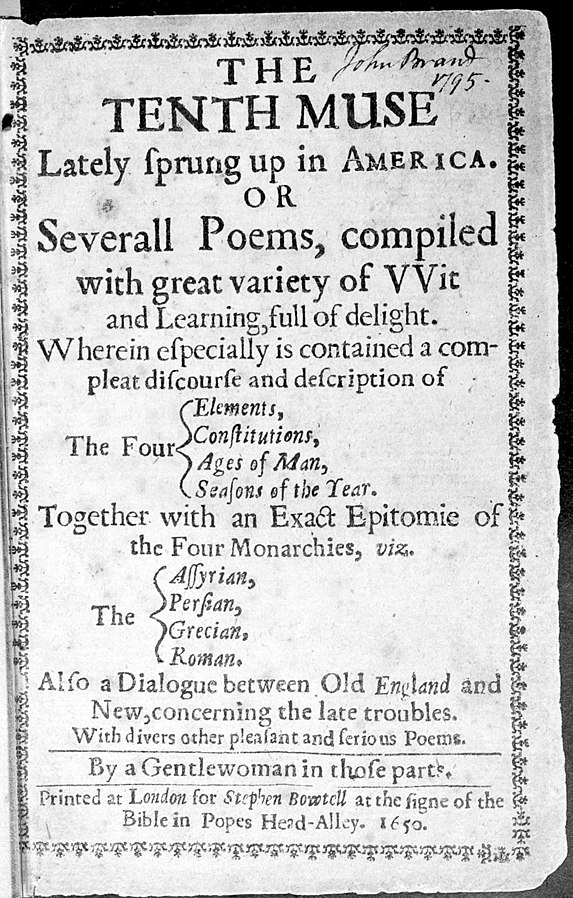
Of course, those Muses/goddesses were figments of Greek imaginations. They don’t exist. What does exist, 350 years later, is a body of poetry catalyzed by the God of all, the one true God, to whom its writer was devoted. Anne Bradstreet, wife, mother, emigrant to Massachusetts, wrote poetry and at a late stage in her life, her body of work was published by her brother-in-law in London with the title The Tenth Muse Lately Sprung Up in America.
This is # 4 in a series on Puritan Wives. I’ve written an introduction to this series on Puritan Wives, and an essay about Margaret Winthrop, wife of the first Governor of Massachusetts. I’ve also spent time acquainting readers with “American Jezebel” Anne Hutchinson, an essay I’ll repost following this one.
Anne Bradstreet was the first writer of poetry in the new world, man or woman, to be published. She hadn’t intended for her private thoughts to be published, but they were, and that was that. The rest is history.
Anne’s poetry was her outworking of her faith, and a satisfactory intellectual exercise. She processed the harsh realities of life and death in Massachusetts, with the hardships and joys of marriage, frailty in sickness, fears in childbirth, with the glories of heaven and a sovereign God. If Jacob dreamt of a ladder between heaven and earth with angels ascending and descending upon it, Anne’s quill pen scratching across the page with alternating thoughts of earthly life and heavenly promises is her ladder of connection ascending and descending between heaven and earth.
But let’s go back to the beginning.
Anne Dudley Bradstreet was born in 1612 and died in 1672. She was raised in wealth and comfort. Her father Thomas was a steward to the Earl of Lincoln. Anne had free access to the Earl’s entire library, and she devoured it. Well read and well educated at home, Anne had a sparkling intellect that her early life cultivated.
She married Simon Bradstreet at age 16, in 1628. Two years later, the persecution noose tightening against the Puritans in England, they departed for America with John Winthrop and his convoy aboard the Arbella. Anne admits that her heart rose up- against the idea. Not all wives accepted their husband’s decisions with equanimity. Bradstreet had wrestled with the concept:
She “came into this country, where I found a new world and new manners, at which my heart rose [in protest]. But after I was convinced it was the way of God, I submitted to it and joined the church at Boston.“
Pilgrim Fathers boarding the Mayflower, painting by Bernard Gribble.
Though none had died aboard their own boat the Arbella, 80 had died on the other ships in their convoy. So had most of the cows, horses, and goats. Arriving at the colony, they were shocked at the primitive conditions. The men they’d sent ahead to plant crops, store food, and build houses for them were either dead from illness to too sick to work. Two hundred emigrants died and another 200 soon departed that same winter back to England. Lady Arbella was the daughter of Thomas Clinton, 3rd Earl of Lincoln, for whom their ship was named. She, too, died shortly after arrival, and her husband died a month later.
Replicas of the 1636 church and house built by Reverend Thomas Hooker, the founder of Hartford. The replicas were constructed on the state capital grounds for the Connecticut Tercentenary Celebration, 1935 – Connecticut State Library
The Bradstreets bunked in a house with others in a communal living arrangement, where they had not even a table to work at or to eat. Quite a difference from the well-stocked quiet library in the Earl’s Estate where Anne grew up.
They also moved several times over the first ten years, from Salem to Boston to Cambridge to Ipswich to finally settling in Andover.
Anne had had smallpox as a child which left her weak, in pain and with a lifetime susceptibility to illness. The poor nutrition and privations of life in 1600’s Massachusetts exacerbated these susceptibilities. She contracted a fever after arriving in the New World, and at the end of her life, suffered from “consumption” AKA tuberculosis which was agonizing. In between was childbirth with its own pains and fears. The mortality rate for pregnant women in the 1600s was high and Anne frequently anticipated dying. In her poem “The Flesh and The Spirit,” we read of a debate between two sisters–one representing a flawed and frail earthly body and the other a transcendent spirit.
‘Puritans’ by George Henry Boughton, 1884
In 1666 a devastating fire burned their house to the ground. As was her practice, Anne fleshed out her feelings about this loss, yet another devastating loss. She’d lost three grandchildren and a daughter-in-law from which she never emotionally recovered. Of the fire, and perhaps thinking of the Bible’s Job, Anne wrote:
Then, coming out, behold a space The flame consume my dwelling place. And when I could no longer look, I blest His name that gave and took, That laid my goods now in the dust. Yea, so it was, and so ‘twas just. It was his own, it was not mine
Anne loved her husband thoroughly. Her poem To My Dear and Loving Husband is one of her most famous and also most endearing:
If ever two were one, then surely we. If ever man were loved by wife, then thee. If ever wife was happy in a man, Compare with me, ye women, if you can. I prize thy love more than whole mines of gold, Or all the riches that the East doth hold. My love is such that rivers cannot quench, Nor ought but love from thee give recompense.
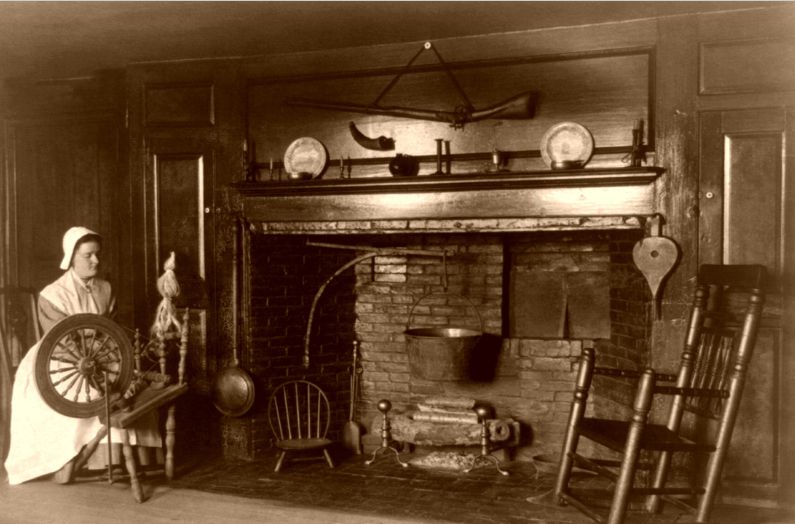
Anne had 8 children over time. She oversaw the care of their 4 girls and 4 boys, tended the livestock, made soap and candles, sewed the bed linens and clothes, and cooked endless large meals over an open fire in a pot that could weigh up to 40 pounds.
re-enactment. A Puritan hearthstone, by Henry A. Loveloy, 1906
She was a good mother, writing later of the experience of motherhood,
I Had eight birds hatcht in one nest, Four Cocks there were, and Hens the rest, I nurst them up with pain and care, Nor cost, nor labour did I spare, Till at the last they felt their wing, Mounted the Trees, and learn’d to sing
Her husband was busy in politics and missions as diplomat out and about New England, and thus was absent from home for periods of time. In fact, Simon served as magistrate at the trial of Anne Hutchinson, and voted for Hutchinson’s expulsion from the colony. These times stressed Anne, for she missed Simon. Anne’s poem A Letter to her Husband, absent upon Publick employment’:
My head, my heart, mine Eyes, my life, nay more, My joy, my Magazine of earthly store, If two be one, as surely thou and I, How stayest thou there, whilst I at Ipswich lye? So many steps, head from the heart to sever If but a neck, soon should we be together:
Anne Bradstreet rejoiced in worship, served her husband, raised their children, fulfilled her duties as First Lady of the colony (her husband served as governor). She sighed and wrangled with her emotions of the privations of New England, of loss, of death, of illness, of faith. She held tightly to God and her faith was strong.
Not all wives have had their private thoughts so publicly preserved but we are grateful to Rev. John Woodbridge, who shared them. It is more than likely that Woodbridge secreted copies of Anne’s poems to London for publication without her knowledge. It was unusual for a woman to be published and Anne would receive criticism for her non-domestic endeavors. So much so that Woodbridge wrote a preface assuring readers that the author was not a wanton, but in fact a worthy Christian woman. His respect for her talent and her Puritan womanhood is obvious: (source)
I doubt not but the Reader will quickly find more than I can say, and the worst effect of his reading will be unbelief, which will make him question whether it be a woman’s work and aske, “Is it possible?”
If any do, take this as an answer from him that dares avow it: It is the Work of a Woman, honoured, and esteemed where she lives, for her gracious demeanour, her eminent parts, her pious conversation, her courteous disposition, her exact diligence in her place, and discreet managing of her Family occasions, and more than so, these Poems are the fruit but of some few houres, curtailed from her sleep and other refreshments.
“On September 16, 1672, Anne closed her eyes in Andover with her treasured husband by her side and opened them in eternal glory.” (Benge & Pickowicz: The American Puritans). Three years before her death, in pain and constant prayer for release from this life, she wrote,
Oh how I long to be at rest and soar on high among the blest. This body shall in silence sleep Mine eyes no more shall ever weep No fainting fits shall me assail nor grinding pains my body frail With cares and fears ne’r cumbred be Nor losses know, nor sorrows see What tho my flesh shall there consume it is the bed Christ did perfume And when a few years shall be gone this mortal shall be cloth’d upon A Corrupt Carcasse down it lies a glorious body it shall rise…
Any regular reader of this space knows I love the Puritans. I loved them at first historically, then after conversion, spiritually. They were an interesting group. It should be noted that God preserved a majority of their writings for us from which we are still benefiting.
John Winthrop & Puritans
The Puritans are often portrayed in secular culture as dour, joyless, strict men who suppressed their wives spiritually and emotionally. The wives in turn were usually portrayed as overtired, harried, and overworked from having so many children. Puritan wives are seen as scraggly haired, burdened women with so many children the Old Woman Who Lived in a Shoe had nothing on them, with children sleeping in nooks and cupboards and an endless conveyor belt of household tasks that drove them into an early grave.
But it isn’t universally true. People are people, of course, so here and there were a few sour notes, just like in any generation. But the Puritans were an earnest group, dedicated to the ideals held in the Bible and when their efforts to purify the Church of England were met with persecution, they bravely set out to establish a society more closely aligned with God’s standards, in the New World.
Let’s take a look at one Puritan marriage, John Winthrop and his wife Margaret Tyndal Winthrop.
John Winthrop lived from 1588 to 1649. He was an English lawyer and a leading figure in the founding of the Massachusetts Bay Colony in 1630. This was the settlement that followed the original founding of the Plymouth Colony by the Pilgrims in 1620. He then served as the settlement’s governor for 12 of the first 20 years. If you are familiar with the phrase “city upon a hill” that was John Winthrop’s vision for the colony, captured in his preserved writings. He delivered that sermon aboard the sailing ship Arbella, and it’s one of America’s most famous sermons.
John Winthrop married Margaret Tyndal in 1618. She was 27 years old. (John was 30, Margaret was his 3rd wife, the previous 2 had died). Margaret was an educated young lady who knew how to read and write. Her family was a leading Puritan family of the time, and Margaret had been raised in Puritan Christian fashion.
John was working as a lawyer in London, which was about 100 miles away, so after marriage she moved to John’s father’s estate at Groton Manor to help him manage the Manor during the work-periods John was away. She was exceptionally capable to do this.
They communicated frequently through letters, many of which were preserved. John’s letters to Margaret were mostly absent of local news, they expressed mundane household items to each other, discussed the children’s sicknesses and recoveries, servant issues, and the like. They also expressed warm endearments to each other, belying the joyless Puritan marriage so often depicted in secular media.
Here is one example of John to Margaret, with modernized spelling:
“And now, my sweet love, let me a while solace myself in the remembrance of our love, of which this springtime of our acquaintance can put forth as yet no more but the leaves and blossoms whilst the fruit lies wrapped up in the tender bud of hope. … Let it be our care and labor to preserve these hopeful buds from the beasts of the field, and from frosts and other injuries of the air, lest our fruit fall off ere it be ripe, or lose aught in the beauty and pleasantness of it.”
And Margaret to John:
What can be more pleasing to a wife, than to hear of the welfare of her best beloved, and how he is pleased with her poor endeavors. I blush to hear myself commended, knowing my own wants; but it is your love that conceives the best and makes all things seem better than they are. I wish that I may be always pleasing to thee, and that those comforts we have in each other may be daily increased as far as they be pleasing to God.
Margaret constantly prayed for her husband, unfailingly encouraged him, and always looked to her family and also the needy around her. She expressed many times how grateful she was for her husband’s counsel, and likewise John was appreciative to receive her genuine support and encouragement.
At one point, John had been taken very ill in London. He had advised Margaret not to come because winter travel was dangerous and harsh. Nevertheless, though Margaret was an obedient wife, signing her letters thus and her husband affirming it, she flew to him in haste anyway. After her return, she wrote a encouraging note to him (I modernized the spelling), reminding him of their mutual devotion to their great God:
I desire in this and all other things to submit unto his holy will; it is the Lord, let him do what seemeth good in his own eyes. He will do nothing but that shall be for our good if we had hearts to trust in him, & all shall be for the best what so ever it shall please him to exercise us withall. He wounds & he can heal. He hath never failed to do us good, & now he will not shake us off, but continue the same God still that he hath been heretofore.
Margaret’s faith was founded upon the Rock, and thus, so was her marriage.
Husband and wife continued to write constantly and with the same amount of dignity and respect for each other for the next 12 years. But then came the Puritan persecutions. John lost his position at court. He saw the handwriting on the wall. He wrote: “My dear wife, I am verily persuaded God will bring some heavy affliction upon this land, and that speedily.“
John decided to strike out for the New World. With John so often in London, Margaret had been competently handling the affairs at the manor with all it entailed: accounting and records, managing people, raising the family.
Emigrating to the New World with all its newness, dangers, and lack of comforts must have put Margaret into a tailspin. The Pilgrims had only landed there less than 10 years prior. But she handled it with godly aplomb.
On her saying she will ‘cheerfully’ leave Groton Manor, John replied, “My comfort is that thou art willing to be my companion in what place or condition soever, in weal or woe.”
Within one year of John’s losing his position at court, he’d gathered a willing group to emigrate with him, supplies, ships, and had sailed for nearly unknown shores.
Margaret stayed behind to handle the increasing pressures at Groton Manor. The Manor’s tenants knew the Master had gone and became reluctant payers of rent, and she was also pregnant, and looking after the younger children who did not go with their father to the new world. Also during this time Margaret prepared for their own journey to leave England for Massachusetts Bay Colony. With the help of John’s eldest son who stayed behind to chaperone Margaret when the time came, she arranged to sell Groton Manor.
Yet they both agreed though they will be separated, they would set aside Monday and Friday at 5 pm to spend an hour in spiritual communion with each other, praying for each other and meditating on their godly marriage.
The pair were separated a year. Margaret had given birth shortly after John departed but sadly on the way over the baby died. She was buried at sea.
LOL, when Margaret arrived John had arranged to have a military cannon salute and a ship parade around the bay as she was rowed in.
Once reunited, to their mutual joy, Margaret set about helping the needy, raising the family, and supporting her husband, now Governor of Massachusetts Bay Colony.
In 1647 Margaret succumbed to an epidemic sickness raging among the colonists and she died at age 56, an aged person for that time.
John wrote that Margaret, “left this world for a better, being about fifty-six years of age, a woman of singular virtue, prudence, modesty, and piety, and specially beloved and honored of all the country.”
The couple set their love of God as primary in life, even before their love of each other. Their marriage was one of love, mutual devotion, dignity, and godliness. If you, dear sister, are looking for a historical model of a good and godly wife, look to Margaret Tyndal Winthrop. The inscription in the book of her published letters reads,
In memory of the name she is privileged to bear, which will ever be associated with all that constitutes the grace of CHRISTIAN WOMANHOOD.
Epilogue: Margaret and John were close Boston neighbors with Anne Bradstreet & husband Simon, and Anne Hutchinson & husband William, which whom they all shared a well. I’ll re-post about Anne Hutchinson and write about Anne Bradstreet in my ‘Puritan Wives series’.
It’s a daring prayer. It’s hard to do. It takes guts. It’s a prayer we need to pray, but I know I don’t pray it often enough.
‘Lord, please show me my sins and failings. I want to honor you’.
So He did.
I’ve mentioned I’m reading William Spurstowe’s book “The Wiles of Satan.” Yes it’s taking me a while, every sentence is gold and I don’t want to miss anything.
The book is convicting too. He goes through the ways satan attacks us. I’m up to Spurstowe’s “Fifth Strategy: By disguising things so that they appear to be what they are not”. He wrote:
“He hides the deformity which is inseparably bound to evil, by dying it with a superficial tincture of virtue. … How else could the greedy person (whom the Lord abhors, Psalm 10:3) please himself in his sordid stinginess, unless he pretended he was only practicing frugality by following the counsel of our Savior by gathering up the fragments, so that nothing would be lost. (John 6:12)?”
I live on a teacher aide salary. A salary that I’m paid for 190 working days but I still have to live on 365 days. I learned to make the monthly paycheck stretch. Originally, I worked a second job to make ends meet. It was still a struggle. Now I’m 15 years older and I’m tired from the first job when I get home. So now I go the frugal route instead of the second job route. Spend less and watch every penny.
And when they had eaten their fill, He said to His disciples, “Gather up the leftover pieces so that nothing will be lost.” (John 6:12)
I’m inherently frugal. I have been since I can remember. When I was 16 years old my parents bought me a car and gave me a gas credit card. They set no limits but I set a limit on myself of filling up no sooner than every 10 days. I don’t know why, my family wasn’t strapped for money. I just thought it was good to be careful, it was my parents’ money after all.
I’ve also always enjoyed a good sale or a good deal. But has the thrill of the deal and the satisfaction of meeting my budget responsibilities hardened into an idol?
When I read the Fifth Strategy from Spurstowe and it hit my brain like a comet, I began to wonder. Was I too self-righteous when reading the previous chapters that I hadn’t fallen for strategy one through four, so the Lord showed me that I am not immune to being deceived when I got to strategy five?
Probably. No, certainly.
I save my pennies and scour deals so that I can not only pay my bills and be responsible, but to have some for when I want to give to others. I tell myself that I’m handling the Lord’s means wisely so that I can be generous. But DO I give to others? AM I generous? Or as Spurstowe said, am I practicing sordid stinginess?
So, you say, “Well, I don’t give much, but I don’t have much. If I had more, I’d give more.” No you wouldn’t. No you wouldn’t. No if you had more, you wouldn’t give any more. You say, “How do you know that? You don’t know me.” Well, Jesus does. Verse 10, “He who is faithful in a very little thing is faithful also in much, and he who is unrighteous in a very little thing is unrighteous also in much.”
I need to make sure my skill in saving pennies and finding deals for the reason of being responsible with the means the Lord has given me AND for giving, doesn’t turn into saving pennies and finding deals for myself that nurtures a fleshly selfishness.
Gah! Anything can be an idol. Even a ‘good’ thing can be turned into sin.
But godliness actually is a means of great gain when accompanied by contentment. (1 Timothy 6:6).
Make sure that your character is free from the love of money, being content with what you have; for He Himself has said, “I WILL NEVER DESERT YOU, NOR WILL I EVER ABANDON YOU,” (Hebrews 13:5)
I have been blessed to have been an educator for many decades. Not continually the whole time, but I’ve spent years teaching children how to read better and to love reading. I am currently a Literacy Interventionist in a public elementary school. I am blessed to teach in this school system, which is well-run, reasonable, and has excellent leaders and teachers.
Since my beginning years in teaching, which was in 1982, the secular culture in America has changed staggeringly. I lived through the cultural revolutions of the 1960s- Second Wave Feminism, Civil Rights, Homosexual Rights, and Politics/War. Phew. It was a lot.
Eventually, the public education spheres begin to absorb these countercultural philosophies and attitudes of the secular world, and generations entering school who were raised after the 1960s increasingly adopted these new norms as normal.
The cultural revolution of the 1960s was sin, of course. Sin entering and rising in a massive wave that leveled up the sin already present in the world.
The 1960s’ cultural revolution was visible. Hippies emerged. Music changed. Clothing was different. Protests took place. You could see it and hear it all over the country.
It feels to me like another revolution is taking place, one that is as massive as the 1960s’, but invisible. I can’t see it visibly happening but I see the results of it.
It’s the War on Children.
As an educator I see children coming to us as young as age 5 and 6 with serious sin issues. It used to be in the old days, one or two 5th or 6th graders might pull some attitude, once in a while. Very few stood firm, not quaking at authority and seemingly unaffected by consequences. They’d crumble and cry pretty quickly. A call to parent(s) yielded response or support.
I’m shocked that nowadays we have so many kindergarteners who merely glance disdainfully at authority, lie, cheat, steal, talk back, and seem not to care about punishment. Parents are absent in fact or in spirit. These youngsters watch horror movies rated R and laugh when someone is killed. They think it’s funny. They have no work ethic. Physical violence is the answer to any issue they have, and increasingly, they have issues with even the most minor of bumps in the road.
EPrata photo
Not ALL students of course, but a demoralizing number of children come to us already ruined. Conscience-less. I know, I know, children are sinners. Sinners gonna sin. But what I’m talking about is a shocking absence of any care at all for rules, adults, or authority. And a shocking lack of concern for their own lack of conscience.
The war on children is not a new phenomenon, but it has lately escalated to catastrophic levels.” John MacArthur, The War on Children
I’ve had some struggles adjusting to this new reality. The leveling up of sin and its effect on children has caught me in a gap. My mind totally knows that this will happen. The Bible tells us that in the last days sin will rise, children will be disobedient, times will be brutal, and so on. (2 Timothy 3:1-3). I believe it because God said it.
Today we are not merely contending with the normal, accumulated evil of past generations. We’re also living in a culture that has specifically targeted children for destruction. MacArthur, The War on Children
But when you SEE it played out before your eyes, it takes a while for the heart to catch up to the brain. Knowing is one thing, grieving over it is another. My heart is sad and hasn’t calibrated yet to this new, awful reality.
That’s the gap; the head knows, but the heart can’t take it. It will take a little while for the Word of God to console me and fill that gap.
So, seeking a theological framework to help me process this new reality of ruined children, I got the new book by John MacArthur called The War on Children. I read it over Spring Break.
It was good but heavily aimed at parents. I had a hard time adapting it to my childless/single status. It was also heavy on culture’s wrongs and only a half page epilogue at the end for the hope, which was really what I was looking for. MacArthur gave good and current information on what the media, entertainment, schools etc are doing to children, but strangely absent was discussing video games’ part in the war on children.
For example, Kindergarteners were discussing this game, Five Nights at Freddy’s–
The Five Nights at Freddy’s series consists of horror-themed video games in which the player is usually a night-time employee at a location connected with Freddy Fazbear’s Pizza, a fictional children’s restaurant…the homicidal evil animatronics wander the restaurant at night, and the guard (who is the player) is instructed to watch over them. The homicidal animatronics mistake humans for animatronic endoskeletons, whom they will force inside character suits, killing them in the process. In the later game editions it is retroactively established that the animatronics are actually possessed by spirits of children murdered by restaurant cofounder…where a hidden news article explains that the restaurant’s reputation was damaged when blood, mucus, and foul odors began to leak from the animatronics’ eyes and mouths. With help from Michael, Henry sets fire to the restaurant, destroying every animatronic inside and freeing all the children’s souls. Inventor and founder William, meanwhile, is trapped and repeatedly tormented in eternal damnation by the spirit of Cassidy, one of the children he murdered. Excerpted from Wikipedia.
Explicit murders, trapped souls of children, torment and eternal damnation… this game is rated for ages 12+ which is still too young, but 6 years olds know all about it and even “play” it.
Of course any MacArthur book is worthwhile, ultimately. It did teach me of how important children are in God’s economy and how they are one of the foundations to the building blocks of this world. Children are KEY!
This culture is weaponized to destroy children. J. MacArthur
My Takeaways from the Book:
-Just HOW MUCH children are at risk. -Children are extremely important to God. Of course we know this, but reading the book the way MacArthur lays it out, drove the point home in a new way. -Prompted me to be ever more patient, kind, and loving with the children in my care at school.
The War on Children is available on Amazon and also Grace Books, among other book sale outlets.
I’ve been a Christian for only 20 years, but I’ve been alive for 63. Even as a youngster, I asked the eternal question to myself, “Why is the world like this?”
Young people, the unsaved, adults, no matter your age, location, or spiritual status, anyone, can see that the world is broken. People are crazy. Just watch the news, if you dare.
The world has always been filled with sinners seeking to fulfill their own desires. A sinner’s desires are completely corrupt and unholy. (Genesis 6:5). They will seek to fulfill these desires by any means they can find, and will eventually resort to graft or deception or bullying or anger, etc.
But it seems lately that the percolating anger in sinners is closer to the surface than ever. Sin makes people insane and they do insane things. That is what having a reprobate mind means. (Romans 1:28-32). I means that people are so darkened that they can’t think straight. For moral and spiritual purposes, they’re effectively insane.
It used to be that people seemed to be held in check from expressing their baser desires by cultural pressure. Even though we in America have never really been a Christian nation, people acted Christian. The veneer of morality prevented things from being said, acts from being done. Over time though, the social-moral fabric has frayed. Badly.
But… Jesus is alive and in control. He sees this foolishness and He will come back to take care of it.
The Great Day of the LORD “I will stretch out My hand against Judah, And against all the inhabitants of Jerusalem. I will cut off every trace of Baal from this place,” (Zephaniah 1:4)
This was a prophecy against Judah. Do you see that? EVERY TRACE of Baal will be gone!
“Therefore wait for Me,” declares the LORD, “For the day when I rise up as a witness. Indeed, My decision is to gather nations, To assemble kingdoms, To pour out on them My indignation, All My burning anger; For all the earth will be devoured By the fire of My zeal.” (Zephaniah 3:8).
And He rose from the dead so that He could conquer death and atone for our sins and to fulfill all the promises since Genesis! He is risen! He lives! He loves! He is with us in our time of trouble and He will come for His beloved! He will rectify the wrongs and rid the world of polluted governments and wretched religions, the Baals and the Molechs and the Mammons will be banished from the earth forever!
“and if Christ has not been raised, your faith is worthless; you are still in your sins.” (1 Corinthians 15:17)
But He IS risen, and we are with Him, “having been buried with Him in baptism, in which you were also raised with Him through faith in the working of God, who raised Him from the dead.” (Colossians 2:12).
No more sin, ever!
Then Death and Hades were thrown into the lake of fire. This is the second death, the lake of fire. (Revelation 20:14)
Mighty is our God who raises from the dead, justifies our sins through Jesus, and Who sets all prophecies down so we may see what must come to pass. Prophecy shows that no matter how crazy the culture gets, Jesus is always in control.
A woman named Lori Alexander who goes by the nickname The Transformed Wife, handle of @godlywomanhood, who claims to be a Christian, has an enormous platform across a plethora of social media accounts. When a man or woman is solid in their doctrine AND in his or her lifestyle, this is a good thing. I love that social media has been invented and provides us a way to get the word of God out into the world…To connect with like-minded brethren…To honor and glorify God.
But when the person has a lifestyle that is a horror to God or teaches error, wrong doctrines, or twisted Bible verses, it’s a grief to God. It is also a danger to those who aren’t discerning enough to see beyond the form of a teacher’s godliness. Then followers are drawn into a dark path. In June 2023 I critiqued Lori Alexander’s online work.
In my discernment essay critiquing Lori’s doctrines and teachings, I used sources such as her own words in screenshots, quotes from her own blog etc. and compared her theology to the Bible’s. My essay seemed to have angered her and upset her greatly and that anger has not simmered down in the last 6 months…
How do I know?
Recently a lengthy article was published examining Lori’s online output (I won’t call it a ministry) from a psychological perspective. The author was Daniel Schricker, Ph.D, who is not only known for his music, (@ComposerDan90) but also for his academic work in identifying cults. He should know, he grew up in one. Since then he has dedicated his academic career in speaking and writing about the psychological use of fear in cults- especially against children.
In his article on Lori, Daniel Schricker said that according to Hassan’s ‘BITE’ Model, there are four “sets of criteria by which to define the modus operandi of harmful organisations, Behavior control, Information control, Thought control, and Emotional control.” Dr. Schricker goes through each of these criteria with matching examples from Lori’s online advice. He makes a compelling case.
Most disturbing are Lori’s teachings on behavior, with Dr. Schricker concluding, “All of these represent forms of behaviour control that are based entirely on Lori’s feelings, nothing else,” he said.
We know that Christians must base our learning and teaching on the Bible, nothing else. Red flag # 1 that Lori Alexander is a false teacher.
In her teaching and her behavior, Lori does exhibit the other three sets of criteria that harmful organizations exhibit as well- Thought control, Information control, and Emotional control. As to the latter, Dr. Schricker said:
“Emotional control is central to Lori’s thinking about her faith and is something she cites as a key to making a marriage last. Rather than recognising emotions as a healthy part of the human experience, she seems to believe that they are responsible for many of the problems women face. In the cult of Lori, women must silence and ignore their emotions entirely.”
Dr. Schricker’s article has agonized Lori. She is spending much time on several of her platforms railing against it, as well as dredging up my article from June 2023, which means it still obviously distresses her.
While it is never my intention to purposely antagonize anyone, even false teachers such as Lori, the truth will wound. It will either wound unto a godly sorrow leading to conviction and repentance, or it will lead to a distress that hardens one further into their errant position. Sadly I think the latter is Lori’s case. Her anguish at being called out is hardening her into her errant positions. This is sad to see.
The Lord uses both conviction and time to bring someone to Himself. Of the false teacher in Revelation 2 called Jezebel, Jesus gave her time to repent (Revelation 2:21). But she did not wish to repent. See also Romans 2:4, ‘the kindness of God leads to repentance’. But if the person has a stubborn and unrepentant heart, they are storing up wrath for themselves on the day of Judgment. (Romans 2:5).
BOTH show the glory of God in the end. Both His kindness and His just wrath glorifies Him. While we always pray for repentance for the false teacher, we ultimately pray God will be glorified in whatever the outcome.
I’d like to take a moment to parse Lori’s outrage and defenses. The lesson here is that one can be SO entrenched on one’s position, they literally can’t see. Cannot. So entrenched in sin their thinking becomes futile, doesn’t the Bible say this? (Romans 1:21).
Lori went on to say in that same post: (underlines are mine)
Many female Bible teachers don’t like me simply because I don’t believe women should teach theology. They should stick to teaching the doctrines of biblical womanhood as God commands in Titus 2:3-5.
1.It’s not about personally liking or disliking someone. I dislike Beth Moore’s theology intensely but I believe her to be a very likable person.
2.Theology and doctrine are the same thing. Theology is learning about God. Doctrine is, ahem, learning about God’s ways and teachings.
3.Since Lori restricts herself to Titus 2:3-5 only, I wonder if she knows that King Solomon has advised the following:
Listen, my son, to your father’s instruction, And do not ignore your mother’s teaching; Proverbs 1:8
Or Proverbs 6:20? My son, keep your father’s commandment, and do not forsake your mother’s teaching.
Lori: “I have never aligned myself with false teachers nor have I ever preached in a church”
There is more to being false than simply those two things. It’s comforting to look at one’s self and say ‘I am not false because I never did X or Y’. Yes but what about when you did A or B? See: “Rich Young Ruler”. He thought he was saved because he ‘kept all the commandments since a youth’ but didn’t see that he had a huge hole in his theology, namely, his sin.
Lori said: “All of the commentaries of old agree with me and so do some other great pastors like Voddie Baucham.”
Cherry picking the sources that agree with one’s [unbiblical] stance is called confirmation bias. Psychologist Peter Wason has said this is the “tendency of people to favor information that confirms or strengthens their beliefs or values and is difficult to dislodge once affirmed.”
While it’s great to consult other sources like commentaries and credible pastors and teachers, ultimately, the Bible is the only reliable source. And the Bible disagrees with Lori’s stance that women cannot teach theology to other women or children. Another red flag. Also: see Lois, Eunice, Priscilla.
She said: “I also believe women teaching the Bible and preaching in Women’s Bible studies is what has led to the plethora of female preachers in most churches today!”
Lori likes to blame women for much of what is wrong in Christendom. Yet she never mentions the man’s or the husband’s or the pastor’s part in allowing the woman to preach or fall into error. We didn’t “all fall in Eve.” We all fell in Adam. (Romans 5:12, 1 Corinthians 15:22).
See, that is another example of how her skewed theology skews her mental worldview – thus what comes out of her mouth is error.
I’ve written on the dangers of skewed theology before, and the importance of balance. Yes, I agree Lori is right on some of what she teaches. The problem is the error of omission. Adrian Rogers in his ministry Love Worth Finding speaks of James 4:17 and the sin of omission:
What is a sin of omission? The sin of omission is failure to do what you ought to be doing. James said, “Therefore, to him who knows to do good and does not do it, to him it is sin” (James 4:17). It is a greater sin to fail to do what you ought to do than to do what you ought not to do.
Lori should be learning and teaching the whole counsel of God. It’s like this as an example: In the Bible the Proverbs 31 woman is counted as worthy and one to emulate. In Proverbs 31:16 the woman ‘considers a field and buys it; from her earnings she plants a vineyard.’
So let’s say a woman with a platform started teaching that women everywhere should buy a field and plant a vineyard. It’s in the Bible, right? This women was lauded for her activity, enscripturated in God’s word forever as a worthy women. Therefore ALL women should buy a field and plant an orchard. Then they will be happy and God will be happy.
And let’s say that is the only thing the woman teaches in her whole platforming career online. Is she right? Yes, the Bible does say that. But is that ALL it says for women? No. Lori makes the error of omission, failing to teach the whole counsel of God. See link below in “Further Reading” for an excellent article about what the whole counsel of God means.
One must be inside the strong fortress, its foundation the entire counsel of God. Every brick being every word of God. Clinging to two verses in the Bible as Lori does, Titus 2:4-5, will not sustain a person in the end. It’s like clinging to a sapling in a tornado. I’d rather be inside the strong fortress!
Why am I writing this? Truth requires a response. Dr. Schricker’s article presented psychological truth. My previous article presented truth of God’s word. To hear truth and to dismiss it or ignore it dishonors the truth giver and dishonors the Lord. It also puts people on a path of destruction.
My hope for Lori is this: that someday she will cease kicking against the goads, repent, and close all her platforms to honor the Lord. She spends much time on her many platforms, and repenting and closing her online work would mean she would have more time to tend to her home, husband, children, and grandchildren. I pray she will cease leading women down a dark path.
Great article by Randy Alcorn on The Whole Counsel of God: He opens the article with an example of what happens when we cherry pick verses to support our position. “If we want to better understand any doctrine or teaching, we must consider not bits and pieces of the Bible but “the whole counsel of God” (Acts 20:27, ESV). The Bible features a staggering breadth and depth of truth that selective proof-texting can never reflect.“
TableTalk Magazine: Discernment without Judgmentalism by Eric Bancroft: Today’s marketplace of ideas is tragically filled with lies, distortions, and even heresies. Christians are called to be discerning as they engage with these ideas and the people who present them to us (Heb. 5:13–14). Such maturity of thought and ability to help others is to be modeled by elders of local churches, who are called on to “give instruction in sound doctrine and also to rebuke those who contradict it” (Titus 1:9).
Ponder His grace today. His grace that preserved you until salvation. His grace IN salvation. His grace to prosper you. His grace to bring you to his heavenly home in the end.
I had a conversation with a young person about the man Job and his suffering. He thought everything happened all at once to Job. I said that at first satan asked to harass Job’s stuff and God said satan could, but don’t touch his body. Since Job didn’t renounce God, satan went back to God and complained that he needed to do more, and God said OK you can touch his body but spare his life.
I was sure I was right, but afterward I went back and checked anyway. Yes, that is Job 1 and Job 2, a two-stage attack from satan against Job. I got to reading it over again a few times, marveling at this amazing scene. So much to unpack. Isn’t it thrilling that every time you read the same passage over the years, something different ‘leaps out at you’?
This time, I began thinking about the suddenness of it all. I wondered, “How old was Job when this happened to him?” He was an adult and had been married a while. He had 10 adult children, many flocks, and servants. He had routines (making atonement sacrifices for his adult children), and they had routines (visiting each other). Job did his routines “continually”. (Job 1:5).
So as Sophia used to say on the TV show The Golden Girls, “Picture it, the land of Uz, 4000 years ago…” Job is living his life. Nothing remarkable happened. Oh, probably the usual servant issues, animals dying, an occasional tribal raid. But his life was stable and proceeding apace as the years went on. Like all of us, we think how it is now is how it’s going to stay. This attitude is even captured in the Bible where people are mocking, saying “For ever since the fathers fell asleep, all things continue just as they were from the beginning of creation.” (2 Peter 3:4b).
But it doesn’t stay like that. Apart from the certainty of God, the only permanent thing we can count on in this life is change. For Job, suddenly, BLAM! Life changed in an instant. We know why. He didn’t.
For us here and now, we sink into having the same attitude toward life. This marriage will last forever. This job will last forever. I bought my forever home. My health is good and will stay that way.
But then, BLAM! A drunk driver…a sudden onset disease…a boss closes the business…spouse hatefully departs or sadly passes away…
We all learn through reading Job about the sovereignty of God. The power of God. Man’s humble state before God. Not how about this also: the Book of Job teaches the fragility and the impermanence of life. How it is ALL in God’s hand.
Our lives here seem like they will go on the same. Until they don’t. One moment Job had ten thriving adult children and he was looking forward to next generations. Then not. He was rich, the next moment- poor. One moment a father, the next moment- no children or hope of grandchildren.
Now, we know the LORD graciously restored Job double what he had lost. (Job 42:10). He lived for 140 more years and saw his seed continue for 4 more generations. God did not have to do that. I’m glad for Job and Mrs. Job’s sakes that He did.
We read in the Bible verses like in James 4:14, ‘Yet you do not know what your life will be like tomorrow. You are a vapor that appears for a little while and then vanishes away.‘
Psalm 39:5, Behold, You have made my days as handbreadths, And my lifetime as nothing before You; Surely every man, even standing firm, is altogether vanity. Selah.
Psalm 78:39, So He remembered that they were only flesh, A wind that passes and does not return.
We skim them and say ‘Sure, yah, I believe that. Life’s short.” But do we REALLY believe it? The truth of it doesn’t impress itself on us as much as this verse,
As for the days of our life, they contain seventy years, Or if due to might, eighty years, (Psalm 90:10a)
and we think that is how long our life is going to be. We tend to think that our life will be long and “full of days”. It will follow a trajectory of growth to adulthood, a satisfying job, marriage, family, a long period of raising the family, then a comfy retirement and an easy death.
But God…may have other ideas about our life.
Life is short. Life in this flesh is impermanent. Life is fragile. Trust God, the permanent, unchanging One.
Miracle is one of those words that gets overused and then its meaning it diluted, like “awesome”.
“This ice cream is awesome!” “God is awesome!”
“I found a parking space. It was a miracle!” “I got an A+ on my paper. It’s a miracle!”
The dramatic rise in people accepting and even seeking the charismatic gifts means that more people believe that people are performing miracles, and believing that God is doing miracles left and right. Healings, gold fillings, gold dust falling, a wind coming up at just the right time, a financial windfall…all are claimed as miracles. But are they? What exactly are miracles, according to the Bible? And does God do miracles today?
While cessationists like me by no means deny that God has always had the power and will to do a miracle, and He does them today, they are much less frequent than we suppose. But nowadays, everyone is claiming a miracle.
A miracle is a supernatural event which has no human explanation. More than that, a miracle is a supernatural event which suspends natural law. (Source)
A miracle gives full warrant that it is from God. ~Augustus Strong The popular South African charismatic evangelist Angus Buchan, of the movie Faith Like Potatoes, planted potatoes and said it was a miracle that they grew. To be sure, the soil in his field was not conducive to bumper crops of potatoes, and he had been warned if a high probability of failure, but he attributed the fact that potatoes grew to a supernatural, direct and divine miracle.
He is a long term, popular evengelist, at one time hosting huge crusades for men. He has made unsubstantiated claims of healing the sick at his services. His entire ministry is based on the ‘miracle’ of the potatoes.
Christian Apologetics and Resource Ministries defines miracle as
A miracle is an out-of-the-ordinary direct and divine intervention in the world. Examples would be the parting of the Red Sea, Jesus walking on water, the resurrection of Lazarus, etc. Some hold that it is a violation of the natural order of physical laws. Others maintain that there is no such violation upon God’s part but only a natural manifestation of His work.
They are also known as powers and signs (Mark 9:39; Acts 2:22, 19:11) and mighty works (John 10:25-28). They are a manifestation of the power of God over nature (Joshua 10:12-14), animals (Num. 22:28), people (Gen. 19:26), and illness (2 Kings 5:10-14). They are produced by God’s power (Acts 15:12), Christ’s power (Matt. 10:1), and the Holy Spirit’s power (Matt. 12:28).
A miracle is an event in nature so extraordinary in itself and so coinciding with the prophecy or command of a religious teacher or leader as fully to warrant the conviction on the part of those who witness it, that God has wrought it with the design of certifying that this teacher or leader has been commissioned by him.
Miracles are the natural accompaniments and attestations of new communications from God. The great epochs of miracles—represented by Moses, the prophets, the first and second comings of Christ—are coincident with the great epochs of revelation. Miracles serve to draw attention to new truth, and cease when this truth has gained currency and foothold.
Some of the miracles in the Incarnation of Jesus’ time were making the blind to see. Do you realize there was no other recorded healing of this type in the Old Testament or the New, until Jesus did it? John 9:1-7 records Jesus performing a miracle of making an adult man born blind to see.
This is an amazing case, because Jesus didn’t cure a temporary condition recently onset, he reversed a biological, genetic defect.
The case of Lazarus was also a bona fide miracle, because Jesus raised a man who had been dead so long. Once again, He reversed biology by renewing the man’s very cells at the same time He gave Lazarus life again.
Finding a parking space in the front row, by comparison, is not a miracle.
An event in the external world brought about by the immediate agency or the simple volition of God, operating without the use of means capable of being discerned by the senses, and designed to authenticate the divine commission of a religious teacher and the truth of his message (John 2:18; Matthew 12:38).
The Apostles performed bona fide miracles also. They healed, raised the dead. Philip was whisked in a lateral ‘rapture’ or snatching away from one place to another. (Acts 8:39-40). That was a miracle. I’m hoping that in the New Jerusalem we can all travel that way.
Now you can see from just these passages that in our Lord’s mind, the miracles were not done simply to give evidence of the power of God, but they were given and performed by him with reference to a particular Messianic purpose. That is, the ultimate coming of the Messianic kingdom.
As for the apostles, the reason they were given power to do signs, is as Dr Johnson explains in the same sermon,
2 Corinthians 12:12, “Truly, the signs of an apostle were wrought among you in all patience in signs, wonders and mighty deeds.” Now notice here the expression, “The signs of an apostle.” And he goes on to say that the signs of the apostles are signs, wonders and mighty deeds. Miracles were the signs of the relationship of the apostles to our Lord. They were the signs that they were apostles, and they also were signs that in their ministry there was a connection between what they were saying and the kingdom of God that would come upon the earth.
Miracle of the Fishes, 1874 Alexander Bida
We don’t need people to perform a miracle any more because the bible now tells us about the Kingdom. We were not alive to hear Jesus in His incarnation, but the Spirit recorded the words through men, and we can read them and hear them. The signifying events are no longer necessary.
Miracles were done in in Moses’ day; in Elijah and Elisha’ day; in the day of our Lord and the apostles. He performed the miracles Himself or through men so as to accomplish His redemptive purposes. The miracles were signs of the accomplishment of his purpose of salvation. He will perform miracles again, Himself, via angels, and through men during the times prophesied in Revelation.
The creation of all things, Genesis 1:1-31. The deluge, comprising many miracles, Genesis 6:1-22.
Moses &the Burning Bush, illustration from 1890 Holman Bible
The destruction of Sodom, etc., Genesis 19:1-38. The healing of Abimelech, Genesis 20:17,18. The burning bush, Exodus 3:2-4. Moses’ rod made a serpent, and restored, Exodus 4:3-4 7:10. Moses’ hand made leprous, and healed, Ex 4…6-7. Water turned into blood, Exodus 4:9,30. The Nile turned to blood, Exodus 7:20. Frogs brought and removed, Exodus 8:6,13. Lice brought, Exodus 8:17. Flies brought, and removed, Exodus 8:21-31. Murrain of beasts, Exodus 9:3-6. Boils and blains brought, Exodus 9:10,11. Hail brought, and removed, Exodus 9:23,33. Locusts brought, and removed, Exodus 10:13,19. Darkness brought, Exodus 10:22. First-born destroyed, Exodus 10:29. The Red Sea divided, Exodus 14:21-22. Egyptians overwhelmed, Exodus 14:26-28. Waters of Marah sweetened, Exodus 15:27. Quails and manna sent, Exodus 16:1-36. Water from the rock, in Horeb, Exodus 17:6. Amalek vanquished, Exodus 17:11-13. Pillar of cloud and fire, Numbers 9:15-23. Leprosy of Miriam, Numbers 12:10. Destruction of Korah, etc., Numbers 16:28-35,46-50. Aaron’s rod budding, Numbers 17:8. Water from the rock, in Kadesh, Numbers 20:11. Healing by the brazen serpent, Numbers 21:8,9. Balaam’s ass speaks, Numbers 22:28. Plague in the desert, Numbers 25:1,9. Water of Jordan divided, Joshua 3:10-17. Jordan restored to its course, Joshua 4:18. Jericho taken, Joshua 6:6-20. Achan discovered, Joshua 7:14-21. Sun and moon stand still, Joshua 10:12-14. Gideon’s fleece wet, Jud 6:36-40. Midianites destroyed, Jud 7:16-22. Exploits of Samson, Jud 14:1-16:31. House of Dagon destroyed, Jud 16:30. Dagon falls before the ark, etc., 1 Samuel 5:1-12. Return of the ark, 1 Samuel 6:12. Thunder and rain in harvest, 1 Samuel 12:18. Jeroboam’s hand withered, etc., 1 Kings 13:4,6. The altar rent, 1 Kings 13:5. Drought caused, 1 Kings 17:6. Elijah fed by ravens, 1 Kings 17:6. Does he who supplies the Spirit to you and works miracles among you do so by works of the law, or by hearing with faith—(Galatians 3:5). Meal and oil supplied, 1 Kings 17:14-16. Child restored to life, 1 Kings 17:22-23. Sacrifice consumed by fire, 1 Kings 18:36,38. Rain brought, 1 Kings 18:41-45. Men destroyed by fire, 2 Kings 1:10-12. Waters of Jordan divided, 2 Kings 2:14. Oil supplied, 2 Kings 4:1-7. Child restored to life, 2 Kings 4:32-35. Naaman healed, 2 Kings 5:10,14. Gehazi’s leprosy, 2 Kings 5:27. Iron caused to swim, 2 Kings 6:6. Syrians smitten blind, etc., 2 Kings 19:35. Hezekiah healed, 2 Kings 20:7. Shadow put back, 2 Kings 20:11. Pestilence in Israel, 1 Chronicles 21:14. Jonah preserved by a fish, Jonah 1:17 2:10.
New Testament Miracles. The star in the east, Matthew 2:3. The Spirit like a dove, Matthew 3:16. Christ’s fast and temptations, Matthew 4:1-11. Many miracles of Christ, Matthew 4:23-24 8:16 14:14,36 15:30 Mark 1:34 Luke 6:17-19. Lepers cleansed, Matthew 8:3-4 Luke 17:14. Centurion’s servant healed, Matthew 8:5-13. Peter’s wife’s mother healed, Matthew 8:14. Tempests stilled, Matthew 8:23-26 14:32. Devils cast out, Matthew 8:28-32 9:32-33 15:22-28 17:14-18. Paralytics healed, Matthew 9:2-6 Mark 2:3-12. Issue of blood healed, Matthew 9:20-22. Jairus’ daughter raised to life, Matthew 9:18,25. Sight given to the blind, Matthew 9:27-30 20:34 Mark 8:22-25 John 9:17. The dumb restored, Matthew 9:32-33 12:22 Mark 7:33-35. Miracles by the disciples, Matthew 10:1-8. Multitudes fed, Matthew 14:15-21 15:35-38. Christ walking on the sea, Matthew 14:25-27. Peter walking on the sea, Matthew 14:29. Christ’s transfiguration, etc., Matthew 17:1-8. Tribute from a fish’s mouth, Matthew 17:27. The fig tree withered, Matthew 21:19. Miracles at the crucifixion, Matthew 27:51-53. Miracles at the resurrection, Matthew 28:1-7 Luke 24:6. Draught of fishes, Luke 5:4-6 John 21:6. Widow’s son raised to life, Luke 7:14,15. Miracles before John’s messengers, Luke 7:21-22. Miracles by the seventy, Luke 10:9,17. Woman healed of infirmity, Luke 13:11-13. Dropsy cured, Luke 14:2-4. Malchus’ ear restored, Luke 22:50-51. Water turned to wine, John 2:6-10. Nobleman’s son healed, John 4:46-53. Impotent man healed, John 5:5-9. Sudden crossing of the sea, John 6:21. Lazarus raised from the dead, John 11:43-44. Christ’s coming to his disciples, John 20:19,26. Wonders at the Pentecost, Acts 2:1-11. Miracles by the apostles, Acts 2:43 5:12. Lame man cured, Acts 3:7. Death of Ananias and Sapphira, Acts 5:5,10. Many sick healed, Acts 5:15-16. God also testified to it by signs, wonders and various miracles, and by gifts of the Holy Spirit distributed according to his will. (Hebrews 2:4). Apostles delivered from prison, Acts 5:19. Miracles by Stephen, Acts 6:8. Miracles by Philip, Acts 8:6,7,13. Eneas made whole, Acts 9:34. Dorcas restored to life, Acts 9:40. Peter delivered from prison, Acts 12:6-10. Elymas struck blind, Acts 13:11. Miracles by Paul and Barnabas, Acts 14:3. Lame man cured, Acts 14:10. Unclean spirit cast out, Acts 16:18. Paul and Silas delivered, Acts 16:25-26. Special miracles, Acts 19:11-12. Eutchus restored to life, Acts 20:10-12. Viper’s bite made harmless, Acts 28:5. Father of Publius, etc., healed, Acts 28:8,9
It is my pleasure to tell you about the miraculous signs and wonders that the Most High God has performed for me. (Daniel 4:2)
But in no way were miracles themselves proof of faith. Miracles confirm already existing faith, but rarely if ever catalyzed a person to faith. As A. Strong describes:
Miracles alone could not produce conviction. The Pharisees ascribed them to Beelzebub. Though Jesus had done so many signs, yet they believed not…. Though miracles were frequently wrought, they were rarely appealed to as evidence of the truth of the gospel. They are simply signs of God’s presence in his world. By itself a miracle had no evidential force.
There are interior miracles, and external miracles. An interior miracle would be the indwelling of the Holy Spirit into a newly regenerated person. Justification is an internal miracle. We can’t see the actual breaking of bonds or the new heart, but we can see the effects of this interior miracle, the fruit of the Spirit.
The growth of a person in sanctification is another internal miracle. These are miracles because they are done by God without an intermediate instrument directly upon a person’s soul, heart, mind, and body. It truly IS a miracle when we are saved!! These are the miracles in works of grace.
An external miracle are all the others I posted above in the ATS Dictionary list. Consistently, the word for miracle in the Bible is “sign”. A sign points to something. In the case of a miracle, the sign points to God.
And the types of miracles that are being claimed today are absolutely nothing like New Testament miracles, absolutely nothing like them. In fact, the types of miracles today could be distinctly seen as different than New Testament miracles. Jesus and the apostles instantly and completely healed people born blind, a paralytic, a man with a withered arm. All obvious and disputable miracles, even Jesus’ enemies didn’t challenge the reality of His miracles that He had the people there to verify them. He raised the dead, of course, as we well know. They never did a miracle that was slow, they never did a miracle that took time, they never did a miracle that was less than permanent. By contrast, most modern miracles are partial, gradual, temporary, sometimes reversed, and almost impossible to verify.
So before we go around claiming this or that miracle, let’s honor the Holy Spirit, our High priest
The Gathering of the Manna, c1470
The miracles in the Old Testament and the New Testament signify of God. There were miracles of creation, where He used no instrument but by the power of His word, created something ex nihilo or out of nothing. Genesis 1:1 is an example of that. So was the coin in the fish’s mouth and the appearance of manna. There are miracles of healing, of triumphs over demons, of demonstration of power over nature, such as calming the storm at Galilee or shriveling the fig tree or causing rain or stopping the rain. There were miracles over animals, such as making Balaam’s donkey speak or the animals passively migrate to the ark or commanding the ravens to feed Elijah.
Miracles are a tremendous thing to ponder in scripture and to reverentially ascribe to God’s power, love, and creative artistry. Let’s not willy-nilly diminish that awe and reverence by calling mundane things miracles or ascribing to God what He has not done.
For false messiahs and false prophets will appear and perform signs and wonders to deceive, if possible, even the elect. (Mark 13:22)
Our God is not to be trifled with, loving as He is. Miracles are done every day in sustaining this world alive, and all the people on it. Let’s not diminish that by rejoicing over a parking space at the mall. Convenient, yes. Miracle? No.



















 the-end-time.org