Posted in adopted son, beth moore, book review, God, jesus, Michael

Book Review: "Things Pondered," Beth Moore’s story of adopting a boy and giving him back

Beth Moore published a book in 2004 called, Things Pondered: From the Heart of a Lesser Woman. It is a book of vignettes and poetry, recollections and descriptions of the various events in Beth Moore’s life from young womanhood as a bride through early days of her marriage, becoming a mother, and her adopted son. This book review pertains to the kindle version. Moore’s words from the book are in italics.

~Beth Moore & Privacy~

For all of Beth Moore’s outward seeming openness, her frequent discussions about herself, her thoughts, trials, self-esteem issues, sexual molestation, motherhood, and hysterectomy, she rarely if ever speaks of the fact that she adopted a son at his age of 4 and then at age 11 gave him back to the birth mother.

Her public persona is one which creates a (false) sense of intimacy with women, of being open and transparent. Her books and conferences strive to create an atmosphere of a slumber party, sharing secrets, and giggling over the love of our Groom Jesus. But when it comes time to be transparent in one-on-one situations, Moore is quite zipped up. Moore is “closely protected by assistants who allow very few media interviews. After several interview requests from CT, her assistants allocated one hour to discuss her latest book and ask a few questions about her personal life. Each question had to be submitted and approved beforehand, I was told, or Moore would not do the interview. Follow-up interview requests were declined. I was permitted to see the ground level of her ministry, where workers package and ship study materials. But Moore’s third-floor office, where she writes in the company of her dog, was off limits.” (Christianity Today)

There is some curiosity from people regarding the little-known topic of the son Moore adopted, named Michael. Though Things Pondered is about other events in Moore’ life too, the bulk of it is about Michael, and so will this review.

~Mary~

The title of the book refers to Mary’s thoughts when the angel told her she would bear a Son. (Luke 2:19). Moore speculates on what Mary was thinking, the nuts and bolts of Mary’s ponderings. Such speculations are not good and not bad. It all depends on the point of view from which they make the speculation. Moore is a contemplative navel gazer who talks about herself constantly and thus her p.o.v. stems from herself. Therefore the thoughts she imagines Mary to be thinking were also about herself. To wit:

“In that moment a host of memories must have been dancing in her head. The angel’s appearance. His words. Her flight to the hill country of Judea. Elizabeth’s greeting. Their late-night conversations. The first time she saw her tummy was rounding. Joseph’s face when he saw her. The way she felt when he believed. The whispers of neighbors, the doubts of her parents. The first time she felt the baby move inside her. The dread of the long trip. The reality of being full-term, bouncing on the back of a beast. The first pain. The fear of having no place to birth a child. The horror of the nursery. The way it looked. The way it smelled. …The following is my response to her worthy example.”

Except, that in reading the things Moore believes Mary was pondering, you would never know Mary was bearing the Son of God.

Here is the same verse with a mature preacher of the word also speculating on what Mary was pondering. Please compare.

“It [verse 19] takes us into the heart of Mary. It says, “But Mary treasured up all these things, pondering them in her heart.” This is just mulling them over, contemplating them deeply. She went much deeper, believe me, than the amazed people in verse 18. I mean, this is just…this is just beyond comprehension. Here is a 13- or 14-year old girl, she’s looking into a feed trough and she’s seeing there a baby that’s come out of her womb. She’s never known a man. This baby was conceived and born without ever knowing a man. This baby is the Son of the Most High God. This baby is the rightful heir to the throne of David. This baby is the Savior of the world. This baby is the anointed Messiah. This baby is God, the Lord.

I mean, it’s all so mind-boggling in the common world of human beings. Mary must have wondered, you know, when is He going to start saying profound, theological things? Tomorrow? Is He going to do miracles? What’s going to happen here? What am I to expect out of this child? Will I have a normal relationship with this child that a mother has to a baby? Will I nurse this child as mothers do? Will I raise this child as mothers do? What will this child be like? And when will He enter into His glory? When will He take His Kingdom? When will that all happen? And how am I going to be a mother to a child that is God? She must have wondered all those kinds of things. Must have wondered even about discipline, setting an example. How do you set an example for God? I mean, anything that would come into a mother’s mind must have come into her mind. She just pondered it. She just thought deeply about it. And she thought deeply about God’s redemptive purpose and how God had promised a Savior and a Savior had finally come.” (source)

Moore instills self-ponderings in Mary. They are self-focused. Dr MacArthur’s are Jesus-centered. So if Moore is following “Mary’s worthy example” as she stated the purpose of the book to be, you see the focus of the book is off-kilter already.

~Michael~

In Things Pondered, Moore says she and her husband wanted a son but several years passed and they assumed they were not going to receive one. Then on February 14, 1990 the Lord answered their prayer and her husband “gave the gift of a boy” for Valentine’s Day.

In her 2005 memoir, Feathers from My Nest, Moore said her husband saw “urgent needs of a certain little boy that “could really use a home.” … We were oblivious, I had nothing but romance in my eyes. Happily ever afters. Utter certainty that love will conquer all.“

I searched for clarity in the book and got none. On one page Moore said Michael was “orphaned”, on the next she said that his birth parents “gave up on each other and on him”, and that the “marriage of his second guardians collapsed”. After 7 years, Moore says the mother (Anne) “resurfaced,” even though she was “a close family member“, “strongly desiring” her son back. However, there was no mention of any legal proceeding nor any custody battle, even though she consistently said in the book that they had adopted him. Chapter 3 is called “The Adoption.” On page 54 Moore said she sat in a restaurant with Anne and after assurances that this was what Anne wanted, Moore said that Anne “granted him to us.”

Moore says his birth mother was “a close relative” named Anne. No other details, but later in the book Moore said that “I didn’t love him like an aunt… I loved him like a mother.” Perhaps the boy is her sister’s son.

Very early on Moore says the family saw the emergence of Michael’s angry behavior. She said she “envisioned the adoption to be a glorious romance” but was instead the family became increasingly traumatized by his “fits of violence and anger”. There were many school disciplinary hearings, and many nights Moore and her husband were at a loss on how to deal with him. In his 4 short years prior to being adopted by the Moores, she wrote he was continuously abandoned, abused, neglected, and had Child Protective Services intervening on a rotating basis. When Michael entered the Moore home at age 4, it wasn’t long before they knew they had a long haul on their hands. Fear of abandonment again raised its head while during the day he refused to cry, laugh, or love. Yet at night he insisted on falling asleep by holding Moore’s head and chanting “Mommy please don’t leave me.” Finally Moore said they were “stretched to the point of ripping”.

Screen shot from “Things Pondered” by Beth Moore

It’s more than unsettling to see a woman who had committed to adopt a boy but then lay down conditions for his continued residence, which if not adhered to would result in giving him back. More unsettling still is that Moore set the condition very early on in Michael’s tenure. Most unsettling to me is the way she phrased it- “he refuses to be helped,” putting the onus onto the boy.

Here is a similar real-life case from a couple of months ago. Please compare.

“Ohio Couple, Give Back Adopted Son After 9 Years “
“An Ohio couple who authorities say returned their 9-year-old adopted son to the county after raising him since infancy have been charged with abandoning the child…the parents said the boy has aggressive behaviors and would not agree to get help….County Prosecutor Michael Gmoser said Thursday that he doesn’t usually seek indictments in misdemeanor cases but views this as “reckless” abandonment. “When you are the parent and you recklessly abandon a child or children, there are criminal consequences,” Gmoser said. “These children don’t have a return-to-sender stamp emblazoned on their forehead.” … “If your 9-year-old needs help, you get him help,” Olivas told the newspaper. “It is not a question of a 9-year-old wanting it or not.“

In the book, Moore explains in the next scene that her husband convinced her to let Michael stay. A short while later Moore was complaining in her book again. She said Michael “needed more than they had.” She asked “Why hadn’t God given him to parents who really knew what they were doing? Who didn’t have such demanding lives already? Who didn’t have other children?”

They decided to stick with it and just and love him. They kept him for 7 additional years and his behavior slowly but inconstantly improved. Cut to years later-

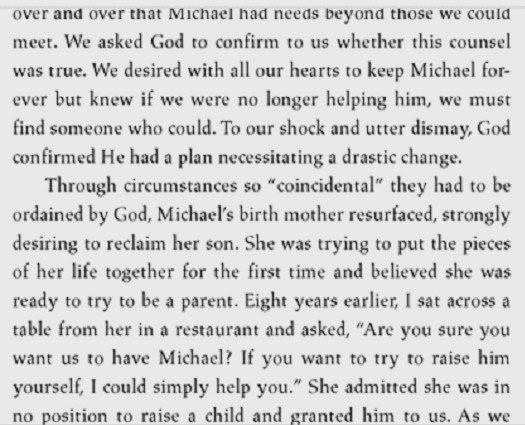
Screen shot from “Things Pondered” by Beth Moore

It is hard to gain a settled clarity as to the what the author is saying, when one reads a sentence that says they knew they needed to find someone else, not them, to help Michael, and in the next sentence that “to their shock and utter dismay, God confirmed” that Michael needed to go.

If you add up the timing, when Moore says Michael’s alarming behaviors surfaced he was approaching pre-adolescence. If he was “granted” to the Moores at age 4 and they returned him 7 years later at age 11, then the approaching preadolescence must mean age 10. He was at most 10 when he evidenced behaviors that alarmed them.

She wrote this book ten years ago, but Moore refuses to add to the narrative or be any more open than she already has been. Though Moore has famously been open and clear about other situations in her life that are equally as emotionally difficult to discuss, such as her self-esteem issues, her sexual molestation and her hysterectomy, Moore adamantly refuses to discuss with any clarity or detail about the Michael issue. In her book published a year later titled Feathers from My Nest, Moore said the adoption engendered “complexities of circumstance and emotions like nothing I have ever known” (unlike sexual molestation?) and that she is “fiercely and unapologetically private about it” but she “could not possibly write about my children without writing about all my children…even one who was only “mine for a season.”

So there is another internal inconsistency that fails to clarify the situation and instead muddies it further. ‘I’m private about Michael but I could not possibly NOT write about him.’

Other statements in Things Pondered don’t add up. For example, was Michael orphaned as stated on page 27? Or abandoned as stated on page 35 and 41? Did the mother “strongly desire” her child returned, or did she demand “custody”? Was it a legal “adoption” as stated on page 29 or private matter of a family temporarily taking in one of their own as described on page 54?

Moore’s whole book, and subsequent responses to inquiries about him could be reduced to an easy one paragraph with clear language and Christian transparency: “My sister Anne couldn’t handle being a mother so I agreed to raise her son as my own. Seven years later Anne got her life together and wanted Michael back. With a mixture of sadness and relief, we gave him up. To this day we still aren’t sure if it was the right decision.”

See how easy it is to be transparent and clear?

How did it all turn out? Moore said Michael is now a tattoo artist covered in tattoos and that she is very, very proud of him.

Moore’s penchant to be overly dramatic in her live studies carries over to Things Pondered. Kim at Upward Call blog said this of Moore and I agree,

“My personal reaction to Moore may not be the same as others. She is overly emotional and dramatic. I find that tedious. I don’t want tear-jerking stories. I want the Word of God. I don’t want forced allegorizations; I want to know God more. Her style, I’m told, is quite dynamic. I listened to a few of her broadcasts. I don’t care for her “dynamic” style. I am immediately on guard with speakers who rely on their dynamism. Let’s say Moore goes through a personal trial and she loses her edge. Let’s say she becomes rather mild and sedate. What will she be relying on then?”

“One of the best speakers I have ever heard is S. Lewis Johnson. He spoke with such a calm, quiet, authoritative tone and manner. I learn so much from him. A bible study should NOT rest on the strength of the speaker; it ought to rest with the strength of how God’s Word is presented and explained. When we rely on style alone, it becomes a matter of taking the Scripture and adjusting it to make us look more dynamic.“

The same is true of Things Pondered. From the opening explanation I was disappointed. Moore’s perspective of Mary’s ponderings unfortunately showed the shallowness and earthliness of Moore’s own ponderings. Her hyper-drama, the soaring language of forced dynamism, the promise of transparency but ultimately the muddiness of the issue of her son, I was hoping to learn more about the adoption issue and like all of Beth Moore’s material, simply came away with less understanding and more questions.

In conclusion, the book is not something I enjoyed. Moore’s foundational perspective I’d described, being from herself about herself, to herself, is circular. It ultimately excludes Jesus. And if you don’t believe Moore is not Jesus-focused, a simple look at the numbers will tell you. In Things Pondered, she mentions Jesus 8 times. She mentions God 117. My recommendation is to ponder no further and read a better memoir.

Tim Challies reviewed and recommends the following books for women:

Glimpses of Grace by Gloria Furman
The big question Furman explores is simply this: How does the gospel change the way a woman lives out her calling as a homemaker?

Fierce Women by Kimberly Wagner. Wagner’s concern is for women to embrace their “fierce” qualities and to use them for God’s glory instead of for destructive ends.

Desperate by Sally Clarkson & Sarah Mae – This one is written especially for the mother of young children.

Women’s Ministry in the Local Church by Ligon Duncan, Susan Hunt – Duncan and Hunt focus specifically on the unique opportunities women have to serve in the life of the local church.

One popular book for women [Challies] does not recommend is Created To Be His Help Meet by Debi Pearl.

Challies recommends you get to know these women (biographies):

Lady Jane Grey by Faith Cook. Here is the short, tragic life of Lady Jane Grey.

John & Betty Stam by Vance Christie. Christian martyrs who sparked a great resurgence of missionary fervor.

Posted in evil, prophecy

What does a seared conscience look like?

“Now the Spirit expressly says that in later times some will depart from the faith by devoting themselves to deceitful spirits and teachings of demons, through the insincerity of liars whose consciences are seared,“
(1 Timothy 4:1-2)

What does a seared conscience look like? Like this:

Now as the king of Israel was passing by on the wall, a woman cried out to him, saying, “Help, my lord, O king!” And he said, “If the Lord will not help you, how shall I help you? From the threshing floor, or from the winepress?” And the king asked her, “What is your trouble?” She answered, “This woman said to me, ‘Give your son, that we may eat him today, and we will eat my son tomorrow.’ So we boiled my son and ate him. And on the next day I said to her, ‘Give your son, that we may eat him.’ But she has hidden her son.” (2 Kings 6:26-29)

You see the issue. The woman was appealing to the King for justice. For a breach of contract. But what a breach of contract! She was SO SEARED in mind that she never stopped to think of what she was saying. “I want justice because the other woman broke our deal to cannibalize our children?!” The horror is that she related this so matter of factly. The worse horror is that she was so unconscious about her sin that she simply and unemotionally stated the facts of the case without stopping to think of what she was actually saying.

That is a seared conscience.

That is also a judgment. Judgment for their apostasy was prophesied by Moses in Deuteronomy 28:56-57:

The most tender and refined woman among you, who would not venture to set the sole of her foot on the ground because she is so delicate and tender, will begrudge to the husband she embraces,to her son and to her daughter, her afterbirth that comes out from between her feet and her children whom she bears, because lacking everything she will eat them secretly, in the siege and in the distress with which your enemy shall distress you in your towns.

Cling fast to the faith. In my opinion, this is why Paul said to take very thought captive, every thought. (2 Corinthians 10:5). Do not listen to liars with seared consciences, who have already been pre-judged for their lies by having the seared conscience to begin with. The road which they travel and lure followers only gets darker and more evil with every step. As with everything biblical, there exists a progression. Ascent into holiness and then glorification is a process and descent into evil and the final apostasy is also a process. It all begins with one step.

This is where sin brings the unwary to: cannibalism…and worse. How can it get worse you ask? Apostasy is a terrible thing. It brings people so deep into sin they can’t even feel their sin anymore. People who have seared consciences are not only sinners, but are “inventors of evil”! (Romans 1:30) Worse, they not only sin deeply, don’t care, and invent ways to perform more evil, but they give hearty approval to those who practice the evil. (Romans 1:31).

Times of great apostasy are always dangerous for the vulnerable- the physically vulnerable and the spiritually vulnerable. In the Tribulation, the vulnerable will be at most risk once again. (Matthew 24:21-22; Luke 12:51-53). It will be a free-for-all of sins like we saw in the 2 Kings passage. A seared conscience is a terrible thing.

If you still feel conviction over your sin, great! Keep that feeling alive by remaining in a humble and penitent relationship with your Holy God. If you do not feel the same about sin as you used to, you must check yourself to see if you are in the faith. (2 Corinthians 13:5). If you don’t, you know the outcome. You will get eaten up- either by your neighbor because love has gone cold (Matthew 24:12) …or by satan, for the wages of sin is death.

Posted in Felix, peace, Sunday martyr moment

Sunday Martyr Moment: the Overseer of the church at Rome, Felix

Foxe’s Book of Martyrs. According to this summary from Christian Book Summaries,

Writing in the mid-1500s, John Foxe was living in the midst of intense religious persecution at the hands of the dominant Roman Catholic Church. In graphic detail, he offers accounts of Christians being martyred for their belief in Jesus Christ, describing how God gave them extraordinary courage and stamina to endure unthinkable torture.

From the same link, the book’s purpose was fourfold:

  • Showcase the courage of true believers who have willingly taken a stand for Jesus Christ throughout the ages, even if it meant death,
  • Demonstrate the grace of God in the lives of those martyred for their faith,
  • Expose the ruthlessness of religious and political leaders as they sought to suppress those with differing beliefs,
  • Celebrate the courage of those who risked their lives to translate the Bible into the common language of the people.

Text from Foxe’s Book of Martyrs

We left off with the conclusion of the eighth persecution under Emperor Valerian. Here we begin The Ninth Persecution Under Aurelian, A.D. 274.

From the modern language version of Foxe’s Book of Martyrs, it is stated that “Historians know Aurelian as the Roman Emperor who held the barbarians in check beyond the Rhine River and regained Britain, Gaul, Spain, Syria, and Egypt for the Empire. Christans know him as just another barbarian and persecutor of the Church of Jesus Christ.”

The overseer of the church at Rome, Felix, was the first martyr during Aurelian’s reign. Felix was beheaded in AD 274. Agapetus, a young gentleman, who sold his estate, and gave the money to the poor, was seized as a Christian, tortured, and then beheaded at Praeneste, a city within a day’s journey of Rome.

These are the only martyrs left upon record during this reign, as it was soon put to a stop by the emperor’s being murdered by his own domestics, at Byzantium. Aurelian was succeeded by Tacitus, who was followed by Probus, as the latter was by Carus: this emperor being killed by a thunder storm, his sons, Carnious and Numerian, succeeded him, and during all these reigns the Church had peace.
~~~~~~~~~~~~~~~~~~~~~~~

The Christian rarely has peace on this earth. Even while the Apostles were laying the foundation of the church, spiritual war erupted in the heavenlies and satan sent his minions to lob weapons of false doctrines and false teachers to enter the church and sow tares. Spiritual war is continuous and we are never at real peace.

Though when our church and its doctrines are being attacked in the heavenlies by false prophets, AND we are being attacked in the earthly realm by bodily threats, harm, and death, it is a wonder that the church remains alive at all.

Thank the Lord that He is the Overseer of the Church at Earth and in Heaven! He is powerful enough that the gates of hell will never prevail against it. (Matthew 16:18).

It is only by His power and His Spirit that we have true, inner, spiritual peace, being reconciled to God once again. When Jesus comes in His glory, then all the saints will also have the peace that eludes us on earth, freedom from sin’s effects, and freedom to proclaim His name without persecution. I can’t wait for that day.

Posted in discernment, false teachers, holy living

How do you confront a brother or sister who follows a false teacher?

This blog is about prophecy, discernment and encouragement. In the discernment department, I write a lot about false teachers and show from the bible how and why the particular ones mentioned are false. I do the same with false doctrines.

However it is harder to know how to approach a person in your church who is under the sway of some of these teachings. You know that so-and-so is false. They don’t. There is no question that the issue shouldn’t be raised, because after all, the gifts are to be used for the building up of the saints to the ultimate glory of His name. Jesus wants a pure church. The Spirit works hard to ensure it, so that we can point to Jesus in holiness. But HOW do you approach someone you see involved in a Beth Moore study, or going to a Bethel Redding or IHOP conference, or using a curriculum by Henry Blackaby?

It reminds us that faith cannot be removed or detached from the realm of real life.
~John MacArthur
It’s one thing to know about false teachers in the academic sense, but quite another to put the information to edifying use inside a church teaching situation. Both theological knowledge and deeds are important in a Christian. I’ve had the opportunity to approach some various church leaders and some brethren in various churches regarding different false teachings or teachers. With that in mind here is what I did when approaching a person about a false teacher.

Please understand that this is not a template or a method to be mindlessly copied. I’m just a forgiven sinner, a woman in Georgia working out my salvation with fear and trembling. There may be other ways to bring up the subject in a church or with a person. There are undoubtedly other scriptures to rely on as the basis for the action. Please share your method and your thoughts on scriptures that apply to the issue.

Painting by echo feng, cc license

First of all, if you desire to approach someone about a false teacher or false doctrine in your church, it demonstrates the love you have of Jesus to care for His name so much that you want to protect your sisters from the dangers and poison that false teaching brings! “And many will follow their [false teachers] sensuality, and because of them the way of truth will be blasphemed,” (2 Peter 2:2). False teachers bring these heresies in and it always leads to destruction of those who follow- if they don’t repent. (Revelation 2:22-23). Therefore, remaining silent about the poison false teaching brings is actually hate. Helping brethren avoid the predators is helping them to abide in Him (1 John 2:27) and is love.

Though it is for the glory of the name of Jesus, it’s hard to share even with a wise and trainable sister, one who wants to know and asked to know, about a favored false teacher, only to then see her saddened over the truth. Thankfully, these kind of hard feelings are fleeting and ultimately relationship building and not relationship-destroying.

On the other end of the spectrum, some people become very angry when told that a false teacher isn’t worth pursuing. These people are usually bound up in pride, and they cling to the teacher because they have invested their ego and pride in making the decision to follow them in the first place. It is called “Deception by Investment”, and these people remain angry, but at you, for bringing it to light. They would rather continue investing in the false teacher instead of looking it up like a Berean, so as not to puncture their pride. This kind of anger can be relationship destroying because you become the object of their ire rather than the false teacher who is blaspheming Jesus.

The first step is always prayer. The first pass in the process is always pray for your pastor, teachers, and

By Chris Yarzab, cc license

Sunday School Director (who makes the decisions about which books to buy) or brother or sister you’ve developed a burden for.

Second, because it is a leader who makes the decisions on what curriculum to bring forward, I usually make an appointment with the leader and sit down in private and discuss my concerns. Even if it is a church member and not a leader who you want to talk with, still, make an appointment, maybe for coffee. Ask to stay after Wednesday night prayer meeting for a few minutes. Go to brunch after church.

I’d let the leader know that in the upcoming meeting you’re going to share concerns about such and such a teacher, so they will know what the meeting will be about- and so they can pray more specifically too. I’ve done this with the Pastor, Sunday School Superintendent, Teacher, and Ladies Ministry Leader. I don’t want to sandbag them or embarrass them publicly so I always ask to meet.

Most importantly and scripturally, meeting in private is also an acknowledgement of their office as leader, Hebrews 13:17 says,

Obey your leaders and submit to them, for they are keeping watch over your souls, as those who will have to give an account. Let them do this with joy and not with groaning, for that would be of no advantage to you.

Pray before the meeting. A lot.

Molly Sabourin
Original was in color

Third, when you meet: if they are a leader worth their salt, they will appreciate your humble approach and also appreciate the opportunity you’ve given them to personally research the issue you’re putting before them, and to pray. Even if you’re speaking with a sister, and even if they are confused or angry with the subject of the talk, they will see the lengths you’ve gone to reach them in love. If you were in error and didn’t know it, wouldn’t you want someone to come alongside and put their arm around you and take time and speak to you in love? (Mark 12:31).

In my opinion another benefit of doing it this way is that if my interpretation of the verses and the scriptures leading me to a conclusion that a teacher is false is actually  incorrect, the leader can then have an opportunity to instruct me.

This woman’s short essay on how she chose to bring up a Beth Moore teaching to a sister who was about to enter a BM study was really good. I find it instructive and encourage you to read it, too. Loving sisters who love Beth Moore.

Fourth, in the meeting, (if you get a chance to meet in privately or one-on-one), I’d have put together some notes about why you feel so and so is an unprofitable teacher. I use notes when I speak to the leader or person because I’m very shy socially and I refer to notes because I get really tangled up and I forget the points I’d wanted to make. I give it to them when we’re done. This helps because it gives someone a chance to later read over what you’ve said.

I’d keep it short and choose the worst offenses from the teacher’s cadre of false indicators. For example, though I’ve written about Beth Moore’s falsity many times, I am especially aggravated at the vision she says she had where Jesus spoke to her like she was a prophet and told her the church was paralyzed by unbelief. To me, it is the clearest example of her falsity. The link for that essay explaining why it is a false vision, with scriptures, is here: “Examining Beth Moore’s Statement ‘My Bride is Paralyzed by Unbelief’

Here is a good web page from Rev Matt Slick (who runs CARM.org) outlining succinctly Beth Moore’s many aberrations, you could pick and choose which ones the Spirit seems to be leading you to. The site has similar summaries for other false teachers, as well.

FMI: Is Beth Moore a false teacher?When you meet, the main idea is not to make an airtight legal case, but to share solid information particular to your heart and the church’s situation, and then to step back and let the Spirit apply these truths to their hearts.

I’d also include some verses which support your right and duty to point these things out, a few are above in the beginning of this post, a few are below. Just in case you get the old chestnut “Judge Not!” verse or “Touch not God’s anointed!”

  • Ephesians 5:11 Take no part in the unfruitful works of darkness, but instead expose them.
  • 2 Timothy 3:5 Having the appearance of godliness, but denying its power. Avoid such people
  • Romans 16:17 I appeal to you, brothers, to watch out for those who cause divisions and create obstacles contrary to the doctrine that you have been taught; avoid them.

5. When it comes time for the ladies study to begin, and the leader has dismissed your concerns or hasn’t had time to work through it yet, or the Sunday School class is about to start, have your prayerful decision ready. I hope it is that you will choose not to attend. If you’re asked by the other ladies or men why you’re not attending, have a short statement ready in your mind to reply. Not as detailed as you give the leader, but enough to say in a sound bite which conclusively states your opinion.

Something like “I have researched Beth Moore’s doctrine and her teaching methods and have come to the conclusion that since she confesses hearing from Jesus and having visions, she twists scripture from its historical context and allegories it too often, as she did in her Strongholds book with misapplying Galatians 5:1, so it seems she is a false teacher and I decided not to partake of the study. I’d be more than happy to talk about this later with anyone who has concerns with my (and my husband’s?) decision.”

Salem (MA) Public Library, cc photo

Or you might say, “Joel Osteen is a word-faith preacher who refuses to preach the whole counsel of God and since Ephesians 4:14 says to preach the whole counsel of God, Osteen demonstrates a lack of discernment and a rebellion against the Spirit inspired word, so I humbly decline to attend the study.” And then your absence from it will be the continuing statement.

Use scripture in all cases, with the leader and with the brethren and in all discussions. It is the power of God to apply truth to hearts. Always use scripture. I can’t say it enough, it is of extreme importance. Use scripture. It is not our earnestness or our fervor or our zeal which will win them over. It is not a carefully constructed argument. It is not the power of our intellect which will pierce the spell they are under with a false teacher. It is the Word!

“Now we have received not the spirit of the world, but the Spirit who is from God, that we might understand the things freely given us by God. And we impart this in words not taught by human wisdom but taught by the Spirit, interpreting spiritual truths to those who are spiritual.” (1 Corinthians 2:12-13).

The Spirit will resonate the verses you use in minds and hearts, and if I was a betting woman, at least one of them will seek you out later to say, “I had concerns too, but couldn’t put my finger on them. Can you tell me more?” And by golly you can hand them the same paper you gave the Leader you chose to speak with previously.

6. At all times keep praying. And keep loving the sisters and brothers who are under the teacher’s spell, by all means. Some of them might be false converts but some of them will be truly brethren in the faith, standing on the same blood soaked ground you’re standing on.

‘Under A Spell” rjg329, cc license

The spell of the false teacher is always powerful. Picture a doctrine-whisperer seducing the brethren.

I was reading up on Beth Moore the other night. I read one woman’s blog where she had written that she had attended a Living Proof conference and really wanted to talk with Moore, because two of her children had died and she knew Moore could share the grief of child-loss, since Moore had given her adopted son back to his mother after raising him for 7 years. This blogger said she approached a counselor at the back of the arena when the conference was over. The following is an excerpt from her narrative. While I understand the woman was in the throes of grief, it is still a startling example of how deeply people get wrapped up in false teachers:

“As we were walking and I was crying, I realized that Beth Moore was standing right beside me with her back to me. I looked at the woman leading me out of the room and held up my hand as if to say, “Just one minute.” With my other hand, I reached out and literally took a hold of Beth’s arm as if it were my only chance to ever be that close to her and feel her love. I couldn’t help but think of the woman who touched the hem of Jesus’ robe……not implying that Beth has this same power, but simply saying that I truly wanted a blessing from Beth and in touching her hoped that I would receive it.”

These women are truly ensnared! Those who follow false teachers are caught up on something satanic. We can’t beat satan but the Spirit of God can. I say satanic because the false teacher always tries to shift your gaze from Jesus to themselves. So many of them have elevated the teacher to a status they certainly don’t deserve but if they are so emotionally (or financially) invested, they will balk at the notion that they have misplaced their trust. Just be sensitive.

On the other hand sometimes the Spirit helps by moving a person out off range of the predator. Distance helps clear the vision and they see the false teacher in a new light.

This is the narrative of a pastor’s wife who moved from Alabama to Wisconsin to plant a church with her husband. She used to love Beth Moore but found out after the move that her love affair was drying out. Her writing is clear and down to earth funny. “Secret Life of a Pastor’s wife: Breaking Up with Beth Moore“

Josh Mishell, cc license

“Even though I am a native Southerner, born and bred in Alabama and having lived in the south all of my life, when I look through my Midwestern lenses, Beth Moore is not relevant. Her homey humor, “beloved,” and “bless your heart” sayings don’t translate. I would watch the faces of native Wisconsinites as they watched her DVD. They thought she was cheesy and as much of an over-the-top caricature as Jeff Foxworthy. “You girls, know what I’m sayin’, right? We wouldn’t be caught dead without our face on and our hair did.” Hah! Most of the Wisconsin women I know can shovel snow, chop wood, and milk a cow without batting an eye. So many of my students grew up on dairy farms and were out milking cows by 5 am, shared a room with 4 other siblings, and didn’t have a car until they graduated from college and bought their own. Concern about curling their hair in Africa would not rank in their list of concerns. And quite frankly, she’s very patronizing to women and holds very, very strict gender stereotypes.”

Nick Sherman, cc license

If a teacher doesn’t translate it is because they are embedded in the world and using the world’s language- the wrong language. God’s word always translates because He transcends distance and time.

The upshot is that even if initially your message about a false teacher is not received, the Spirit is always working. He perhaps had prepared the person you’re going to speak with by sending other people prior to you. Or subsequent to your talk, His work might continue in physically moving the person from the location of false teacher’s sphere…or cause financial hardship to prevent cable subscription so TBN won’t come into their house anymore, or to simply illuminate the scriptures when that person is reading the bible, or continue the work in a zillion ways we can’t anticipate. Though we get emotionally wrapped up in the conversation, it is not the only thing the Spirit is doing and His work extends far beyond our little participation in it.

“so shall my word be that goes out from my mouth; it shall not return to me empty, but it shall accomplish that which I purpose, and shall succeed in the thing for which I sent it.” (Isaiah 55:11)

That’s why we use the Word and not our opinion in these talks. Our opinion is just a puff of wind, but His word is always working!

7. Not to say that it always works out. Sometimes the person you speak with doesn’t see the light but your exhortation might entrench them further into their snare. This, too, is the work of God. His glory is always the highest outcome of everything we do. He is working for the glory of His name. This is where I found Ezekiel 2:3-7 especially helpful-

Flickr marsmet533, cc license

“And he said to me, “Son of man, I send you to the people of Israel, to nations of rebels, who have rebelled against me. They and their fathers have transgressed against me to this very day. The descendants also are impudent and stubborn: I send you to them, and you shall say to them, ‘Thus says the Lord God.’ And whether they hear or refuse to hear (for they are a rebellious house) they will know that a prophet has been among them. And you, son of man, be not afraid of them, nor be afraid of their words, though briers and thorns are with you and you sit on scorpions. Be not afraid of their words, nor be dismayed at their looks, for they are a rebellious house. And you shall speak my words to them, whether they hear or refuse to hear, for they are a rebellious house.”

NOT that we’re prophets but on His day the person will have no excuse. In Revelation 2:20-22 Jesus is describing a false prophetess and commanding John to tell the church at Thyatira to leave off her and repent, and He gave them time to repent. He is always reaching for His sheep. But not all repent and leave off the false teacher, but His glory is such that they will know they were told. Ultimately, it is not up to us and it is not about us, but about Him and His glory, now and on His Day.

In conclusion, those are my thoughts on how to approach a person involved with a false teacher.

  1. Pray, (Philippians 4:6)
  2. Research with biblical accuracy to the best of your ability, (2 Timothy 2:15)
  3. Respect your leaders, (1 Thessalonians 5:12-14 )
  4. Meet and talk humbly of the issue, (Galatians 6:1)
  5. Share notes, (1 John 2:1)
  6. Be open to correction, (Hebrews 12:11)
  7. Pray some more, (1 Thessalonians 5:17, Ephesians 6:18)
  8. Separate from the false teacher, doctrine, curriculum, or teaching (Romans 16:17)
  9. Remain reliant on the Spirit no matter the perceived, observed, temporal outcome, (John 14:26)
  10. Pray (Romans 8:26).

Often, I’ve discovered that there are more people in the church who feel the way we do but simply don’t

Yenkassa, cc license

speak up because they don’t know HOW to go about bringing difficult topics up. And for others, the notion of challenging a current popular teacher’s doctrine on a biblical basis will be a new thing to them, because many churches or church members never do it at all. They are watching what we do, which is pursuing holiness and building each other up. (Ephesians 4:11-32; Philippians 2:1-18). There are always wider lessons in everything the Spirit in involved in. Just make sure the Spirit IS involved by being gentle, prayerful and biblically accurate.

This is what I came up with after prayer and research. What do you think? What has been your experience?

~~~~~~~~~~~~~~~~~~~

Further Reading

Is It Right for a Christian to Expose False Prophets and False Teaching ? (by Damon Whitsell)

Speaking out against false teachers

Why we must pursue holiness

Posted in christianity, john macarthur, paul washer, tony miano

Ambrose Bierce on the Silent Christian

Our pastor said that we should not be silent Christians. The next day once again I came across Ambrose Bierce’s Devil’s Dictionary. His book is a satirical reference book which lampoons hypocrisy in politics, law, religion and culture. I looked up what he had to say on certain religious topics. It has been a few years.

On Religiosity:

Religion, n. A daughter of Hope and Fear, explaining to Ignorance the nature of the Unknowable.
“What is your religion my son?” inquired the Archbishop of Rheims.
“Pardon, monseigneur,” replied Rochebriant; “I am ashamed of it.”
“Then why do you not become an atheist?”
“Impossible! I should be ashamed of atheism.”
“In that case, monsieur, you should join the Protestants.”

On Carnal Christians:

Repentance, n. The faithful attendant and follower of Punishment. It is usually manifest in a degree of reformation that is not inconsistent with continuity of sin.

On our Sinful State:

Man, n. An animal so lost in rapturous contemplation of what he thinks he is as to overlook what he indubitably ought to be. His chief occupation is extermination of other animals and his own species, which, however, multiplies with such insistent rapidity as to infest the whole habitable earth and Canada.

On Neighbors:

Neighbor, n. One whom we are commanded to love as ourselves, and who does all he knows how to make us disobedient.

Then I read this Paul Washer quote on Twitter. He has a point, doesn’t he?!

If you notice in the New Testament, the invitation comes in the form of an authoritative command. Repent and believe! ~Paul Washer 

Isn’t it great when we see mature preachers proclaiming the word of God! Who doesn’t thrill in their heart when they see a Paul Washer unapologetically proclaiming his fear of the LORD, his persistence in confronting sin, and his humble explanation of the blood of Jesus!

Who doesn’t love to see Tony Miano’s calm love reaching out to angry people on the street?

Who doesn’t stand in admiration of John MacArthur’s poise while graciously continuing to proclaim Jesus even when heckled during the Christmas concert, never stumbling but even reaching his hand out to the person and asking to speak to him later.

These are mature men of the faith, whom I look up to.

But the proclamation of Jesus and Him crucified (and resurrected!) is not just for mature men. It is for me, too. I exhort us to proclaim Him boldly, but do I? Sometimes I do not. Sometimes I faint in fear or swallow my tongue.

So when I say let’s be bold this year, let’s keep exhorting for His return even though the culture mocks eschatology, let’s not swerve from confronting sin even though the culture eviscerates us for it, let’s vow to know nothing among us but Christ and Him crucified…I mean me too!

For I decided to know nothing among you except Jesus Christ and him crucified. 
1 Corinthians 2:2

Posted in atonement, discernment, division, unity

Unity among the body, no divisions

It is important to pursue unity. It is equally important to know exactly what unity you’re pursuing. Paul said,

“I appeal to you, brothers, by the name of our Lord Jesus Christ, that all of you agree, and that there be no divisions among you, but that you be united in the same mind and the same judgment.” (1 Corinthians 1:10).

Though the liberal, the post-modernist, emerging church would like it to, the verse does not stop here:

‘I appeal to you, brothers, by the name of our Lord Jesus Christ, that all of you agree, and that there be no divisions among you, but that you be united.’

No. Scriptures say we are to be united in the same mind and in the same judgment. Mindless unity among any person whether or not someone professes all the Gospel is not what is in view here. So what does ‘the same mind’ mean? Matthew Henry’s Commentary says,

“In the great things of religion be of one mind; and where there is not unity of sentiment, still let there be union of affection. Agreement in the greater things should extinguish divisions about the lesser. There will be perfect union in heaven, and the nearer we approach it on earth, the nearer we come to perfection. Paul and Apollos both were faithful ministers of Jesus Christ, and helpers of their faith and joy; but those disposed to be contentious, broke into parties. So liable are the best things to be corrupted, and the gospel and its institutions made engines of discord and contention. Satan has always endeavoured to stir up strife among Christians, as one of his chief devices against the gospel.

You see his point. Satan even uses the Gospel to divide. We must agree on the greater things and to do that, we must know what they are.

Amos 3:3 says, “Do two walk together, unless they have agreed to meet?“

picture by Moyan Brenn on Flickr

Much happens before two people arrive somewhere and then go forth together. They individually and then together study on where they are to go, and what they are to do, how they will get there, and at what time. How will they know where they are going unless they consult and agree, and are friends? Of first importance is that the individual agrees with God in all His statutes, and then the two who are to go walking agree with the basis for their appointment. Then they walk. No one arrives at the designated place and one says to the other, “Ready to go get our haircut?” and the other says, “But I thought we were going to the movies?” They know why they are there and where they are to go.

It is this kind of agreement that Paul has in mind in instructing the Corinthians. He doesn’t mean unite with all who profess Christ so that there will be no divisions. Divisions are inevitable and never let a post-modernist liberal tell you otherwise. The Gospel divides. (Matthew 10: 34-37; John 7: 5). Those who adhere to it are always offending those who don’t, even within the church of Christ, for there are many tares.

A mindless unity would indicate Paul was saying the Corinthians should unite with Judaizers, Gnostics, and Nicolaitans, so that the body is not divided. But uniting with false professors always divides anyway, that’s what Matthew Henry was saying when he explained that satan uses the Gospel to divide. Division is not the issue. If there are divisions over doctrine, that is good. If there is division among those who agree, it is bad. There’s a huge difference.

Biblical unity is not nor should be mindless. It is a problem when it is not of same mind and not of same judgment, meaning of the same doctrine and same discipline.

In modern days, false teachers urge us to unite with Mormons, Catholics, Muslims, Jews, any and all people who speak the name God and mention Christ, but in fact there is NO agreement behind it. We hear people say “The three Abrahamic religions” and claim “we worship the same God.” Therefore they are not of the same mind and the same judgment. They cannot go walking with a true Christian.

If those I mentioned above agree and then meet to go walking, they will find that they are in fact divided. “I thought we were going to Kolob?” The other one says, “But I thought we were headed to Purgatory?” while the third remarks, “No, I thought we were going to Mecca.” And the fourth comments “But we should go to the Western Wall and then to synagogue…” You see? They do not agree after all and should not go walking. There is no unity there.

CC photo by supernovaK

Whenever someone tells you that we should unite in order to reduce division, refer them to Paul’s full exhortation and ask what it means to be united in same mind and same judgment. And in case we ourselves are not sure, please listen to this fantastic sermon from Phil Johnson, who goes over exactly what the Gospel is, and the things of first importance that make up its necessary elements. After hearing this, you will know what it means to have same mind and same judgment with other Christians, united in His atoning, bloody death and glorious resurrection.

Things of First Importance (Phil Johnson)
1 Corinthians 15: 1-5

“Walking” by Katherine Johnson, CC photo

Posted in amen, encouragement

Jesus IS the AMEN!!!

In Revelation, Jesus instructs John to write seven letters to seven churches. He introduces Himself to each church as a different aspect of Himself.

In Revelation 3, Jesus instructs John to write to the Church at Laodicea. He is concerned that this church is lukewarm, not hot nor cold. He began it this way:

“And unto the angel of the church of the Laodiceans write; These things saith the Amen, the faithful and true witness, the beginning of the creation of God;” (Revelation 3:14 KJV)

JESUS IS THE AMEN.

Pulpit Commentary says of The Amen, “The word “Amen” is here used as a proper name of our Lord; and this is the only instance of such an application. It signifies the “True One.” It is a word much used in St. John’s Gospel, where it appears repeated at the commencement of many discourses, “Verily, verily.””

Gills Commentary says of The Amen,

“Christ may be so called, because he is the God of truth, and truth itself; and it may be expressive of his faithfulness, both to God his Father, and to his people, in whom all the promises he either made, or received, are yea and amen; and also of the firmness, constancy, and immutability of Christ, in his nature, person, and offices, in his love, fulness of grace, power, blood, and righteousness…”

Jamieson-Fausset-Brown Bible Commentary says “His unchanging faithfulness as “the Amen” contrasts with Laodicea’s wavering of purpose, “neither hot nor cold” (Revelation 3:16).”

In Isaiah 65:16 it is noted in the Hebrew He is the God of a-men (truth)

“So that he who blesses himself in the land shall bless himself by the God of truth,” (God of Amen)

In the New Testament Paul explains, “For all the promises of God find their Yes in him. That is why it is through him that we utter our Amen to God for his glory.” (2 Corinthians 1:20)

God is the God of truth, His Son is Truth, He is the Amen! John MacArthur explains both the Revelation 3:14 verse and the 2 Corinthians 1:20 verse:

“Scripture tells us in 2 Corinthians 1:20, a very important truth. It says, “For all the promises of God in Him are amen.” All the promises of God in Him are amen. What does that mean? That means that all God’s promises and all God’s covenants are guaranteed and affirmed by the person and work of Jesus Christ. In the Old Testament God said I will forgive your sins. God could never do that if it were not for the person and work of Christ, right? Because forgiveness was purchased by His atoning death. All of the promises that God made to take men and show them mercy and loving kindness, grace and give them a Kingdom and a hope and an eternal life are bound up in Jesus Christ fulfilling His work. So that everything that God ever planned or purposed for man, everything that God ever promised for man finds its amen in Jesus Christ. God’s promises are all certain in Him. They all become sure in Him. And so, Jesus Christ is God’s amen, “

Happy New Year, Amen!

Posted in earthquake data, earthquakes are increasing, prophecy, signs

By The Numbers 2013: how many earthquakes this year?

As the New Year enters and the old year departs, it is time for me to produce my annual By The Numbers, year in review. It has no particular meaning, other than it demonstrates that either I have too much time on my hands, or I enjoy research and manipulation of data as a hobby. Both, I think!

A few years ago I became interested in the schism between what I saw were definite increased numbers of global earthquakes and the US Geological Survey’s equally definite insistence that quakes were not increasing. I decided to look into the data, using their own numbers, benchmarks, and search engines. Well guess what? Earthquakes were increasing.

Jesus said that His coming would be preceded by signs. Some of these signs are emotional, such as men becoming greedy, loveless, brutal, etc, as listed in 2 Timothy 3:1-5. Some of the prophesied signs are religious, such as apostasy rising among the professing church, false doctrine being accepted, and a loss of discernment, as many verses in 1 John, 1 Thessalonians, and other passages tell us. Some of the signs would be geophysical or celestial. There will be earthquakes in diverse places, the seas will be roaring, there will be signs in the skies and so on.

Most of those signs mentioned in the passages, notably Matthew 24, Luke 21, and Revelation 6, are going to occur in the Tribulation period. However, the signs Jesus enumerated and are listed elsewhere in the Old and New Testaments are for the entire church age and will continue into the Tribulation. The church age is between the moment Jesus ascended (Acts 1:11) and when He calls for His bride, ending the Age of Grace. (1 Corinthians 15:51-52). The Tribulation period will begin the moment after the rapture and finish when Jesus returns to the Mount of Olives. (Zechariah 14:4). His signs of return are spread throughout the church age and then are clustered heavily well into the Tribulation.

As Jesus likened the signs to birth pangs, and birth pangs increase as the event nears, so will the signs increase. I could look at numbers of baptisms to determine if apostasy is rising, or number of crimes to see if lovelessness is increasing, but there is a large element of subjectivity to them. Instead I just concentrate on the geophysical signs presented in hard data because there is a lesser amount of subjectivity included in the results. It is in that context that I put together an annual look at the data than can be quantified.

One final caveat: we don’t need signs to tell us Jesus is coming, because He said He is coming and that is all we need to know. I do this out of curiosity and interest, not because we need validation from scientific sources for the certainty of His appearing.

Meanwhile we can learn from the lessons every disaster gives us. John MacArthur’s church is in California. In January 1994 a tremendous earthquake occurred. It is known as the Northridge quake. The earthquake had a “strong” moment magnitude (Mw) of 6.7, but the ground acceleration was one of the highest ever instrumentally recorded in an urban area in North America.

The epicenter was practically underneath Grace Community Church. Five days later, Dr MacArthur delivered a sermon titled “Lessons from the Earthquake.” It is a tremendously relevant and insightful sermon, and I urge you to read to or listen to it. Here are the main bullet points he shared. In every calamity, there are many lessons for the Christian, and many other, separate lessons for the non-Christian. He preached 7 lessons for each.

Lessons for Christians
God is sovereign,
What is eternal can’t be destroyed,
Disaster produces dependence on God,
Adversity enriches fellowship,
Suffering makes us long for the perfect kingdom,
Calamity strengthens us to serve others,
What is the greatest calamity can bring God the most glory.

Lessons for not Christians
For those unprepared to die, lesson number one, life is fragile,
There are limits to self-protection,
Death is inevitable,
We live in a cursed world,
Temporal disasters are only previews of coming attractions,
God uses calamity to call people to repentance,
Time is limited to heed the warning.

Time is limited. All of history is dwindling down to the moment when Jesus will return, and judge the living and the dead for all eternity. THAT is the main lesson I share with you. Repent, while there is still time. Let these statistics and notes be a lesson to you and to us all through the year: life is fragile, and to enter death unprepared is an eternal tragedy.

WEATHER

“The 2013 extreme weather events included several all-time temperature records in Northern and Southern Hemisphere. The February extent of snow cover in Eurasia and North America was above average, while the extent of Arctic ice in the same month was 4,5% below the 1981–2010 average.” (source)

There were lots of record high temperatures, and record lows. It snowed in Cairo Egypt, and in many other places in the usually arid and snowless Middle East. Typhoon Haiyan was the largest storm on record. “With sustained wind speeds of more than 310 kilometres per hour, Haiyan was the most powerful tropical cyclone to make landfall in recorded history. … Unusually warm subsurface Pacific waters appear to have endowed Haiyan with the energy that made it the strongest typhoon ever known to make landfall.” (source)

TORNADOES

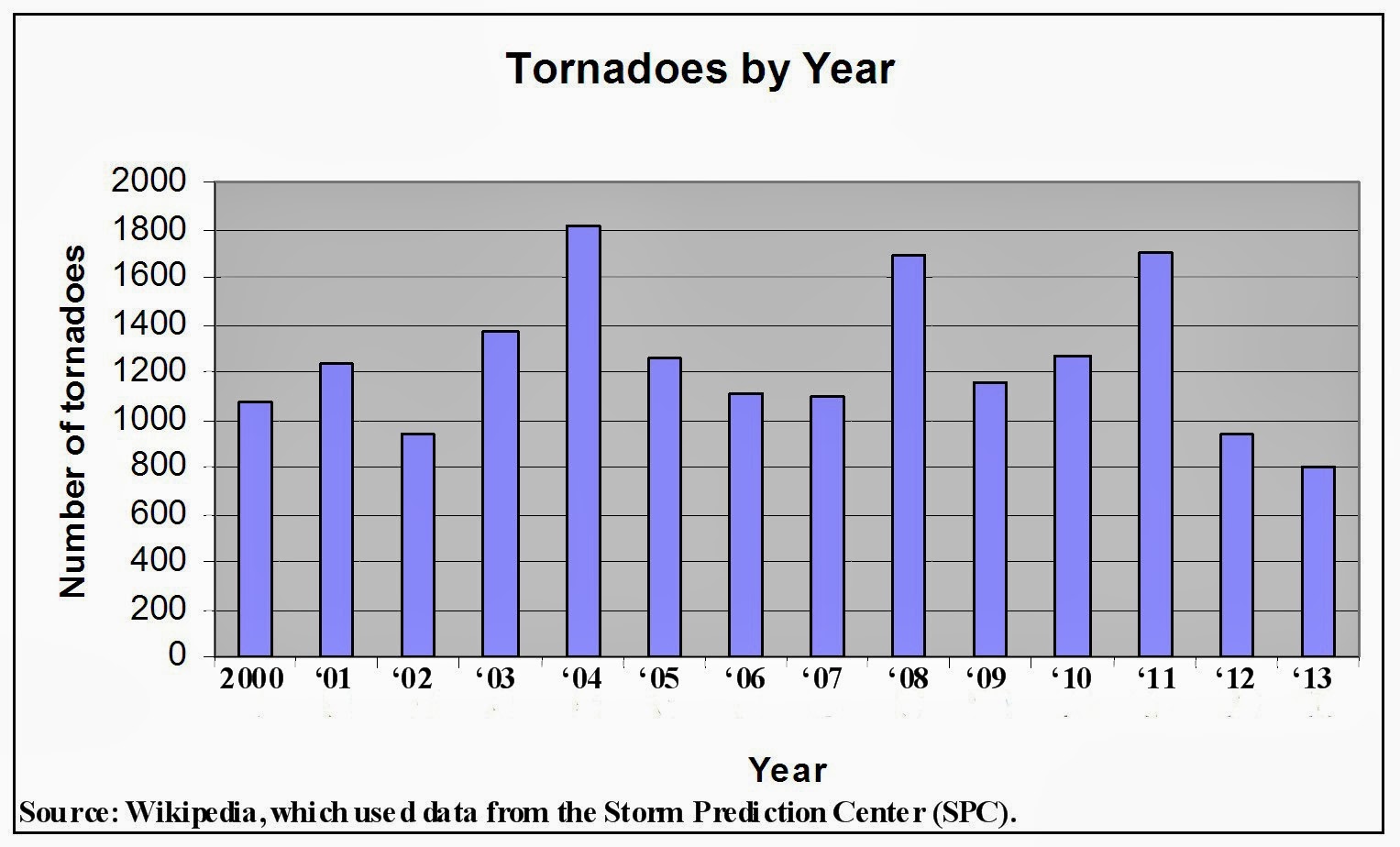
Though the top deadliest tornadoes occurred in the 1800s and the early part of the 1900s, tornadoes in the new millennium have some notable aspects.

Notable events for the 2013 tornado year were-
–A general under-performance of tornado activity continued for the second straight year across the United States during 2013,
–The largest tornado outbreaks occurred in times typically not noted as the main tornado season,
–Two confirmed violent tornadoes that passed through New Minden and Washington, IL. are “the only violent tornadoes on record in Illinois during the month”. (Tornadoes.com)
–On May 20, 2013an EF5 tornado struck Moore, Oklahoma – the first EF5 tornado to occur in nearly two years. (Wikipedia)

Notable events for the tornado year 2011 were:
–553 people in the United States died, compared to 564 US deaths in the prior ten years combined. (Wikipedia)
–The April 25–28, 2011 tornado outbreak is the most prolific tornado outbreak in US history. It produced approximately 358 tornadoes, with 209 of those in a single 24-hour period on April 27. (Wikipedia)
–The May 22, 2011 Joplin MO tornado is the 7th deadliest US tornado on record, with 162 deaths

General note:
–Four of the top ten costliest tornadoes occurred in the last two years. Costliest tornadoes number 1 and 2 were the April-May 2011 Joplin MO and Tuscaloosa Alabama tornadoes, and 3rd, the May 2013 Moore OK, and 4th, Hackleburg, Alabama in April 2011.

2004, 2008, and 2011 were the highest number of tornado years. Click to enlarge

~~~~~~~~~~~~~~~~~~~~~~~

LIGHTNING

I know the men at the Weather Service have been working for many years to get lightning information out to people. I think – hope- this graph shows their efforts are working.

~~~~~~~~~~~~~~~~~~~~~~~

Dave Barry wrote a laugh out loud, hilarious review of the year. I mean Laugh. Out. Loud. In it, Barry said, “the economy’s been recovering for years now without actually getting any better.” He’s right. But at least the bank bailout has been successful. Fewer banks are failing. But there are still more failing in this decade than at the beginning of the millennium.

~~~~~~~~~~~~~~~~~~~~~~~

VOLCANOES

The go-to database for searching eruptions is Smithsonian Volcano Project. However, they shut their database down recently for searching with filters. So I can’t get good volcano information. Here is an article from The Atlantic, though the first sentences drive me crazy:

2013: The Year in Volcanic Activity
“This been a particularly eventful year for the world’s volcanoes. Out of an estimated 1,500 active volcanoes, 50 or so erupt every year, spewing steam, ash, toxic gases, and lava.”

OK…so if this was a ‘particularly eventful year’ and 50 volcanoes erupt every year, how does this year compare?? Did 60 volcanoes erupt? 70? 1000? How many eruptions over 50 qualifies as a ‘particularly eventful year?’ But the article does have lots of beautifully photographed volcano eruptions.

This was interesting, from Dec 29: El Salvador’s Chaparrastique volcano erupts for first time in 37 years , and there was this

Seven Volcanoes In Six Different Countries All Start Erupting Within Hours Of Each Other “A new island has appeared in the Pacific. A submarine eruption just off Nishino-Shima Island Japan has erupted for the first time in 40 years. The Japanese Navy noticed the explosions as boiling lava met sea water giving rise to plumes of steam and ash.“

The Extinction Protocol person published a volcano report which got a lot of attention, and I looked into it but can’t see where he got his data from. Caveat Emptor:

2013 marks record year for the number of volcanoes erupting across the planet (as of Dec 5, 2013)
“This year will go down on record, as seeing the most volcanic eruptions recorded in modern history. The previous number was set in 2010, at 82 volcanic eruptions for the year. The number of volcanoes erupting across the planet has been steadily rising from a meager number of just 55 recorded in 1990.”

He also said that all the planet’s supervolcanoes are in a phase of simultaneous inflation, but…I dunno. Caveat Caveat Emptor.

EARTHQUAKES

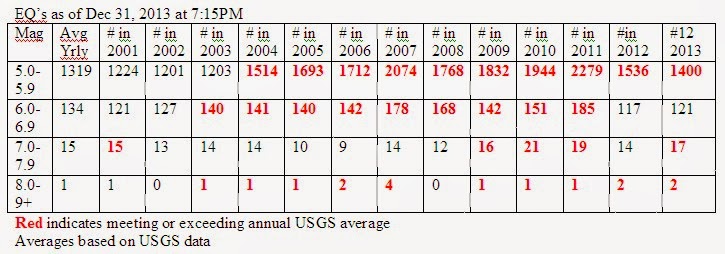
Here is the updated chart of the global number of earthquakes in various magnitudes. USGS benchmarks are seen in the left-most column. Numbers in red indicate meeting or exceeding those benchmarks. Click to enlarge.

This science researcher named “R. Webb” in the UK looked into long, long-term trends, over centuries. He reports of earthquake trends,
“Apart from the “long-term” trends… which show an ongoing persistent increase, it is perhaps more stark to record that earthquakes across the planet show a marked increase in activity since 1997. There are more major earthquakes occurring now, and this on an ever more frequent basis. 

Trends since 1986

For example, between 1986 and 1996 (incl), a period of 11 years, there were “just” 15 earthquakes listed by USGS of magnitude 7.0 or greater. This is not markedly different (albeit a slight decrease) from previous (similar periods) of 20th century, where an average of about 18 might be expected.

But between 1997 and 2007 (incl), a period of only 11 years, there were 99 earthquakes with magnitude 7.0 or greater : This is more than a six-fold increase on the previous similar period – and is a stark increase on any earlier decades in 20th century too.

His estimation of there being 190 quakes greater than 7.0 magnitude during the 38 year period between 1977 and 2014 was grossly underestimated. There were 583! (as of Dec 31, 2013)

The trends in nature here, particularly from 1997 support the wider realisation of prophesy about the “End Times”, namely that an increase in earthquake activity is a per-requisite for the “second coming of Jesus Christ” foretold in the bible. It does not indicate how close we are to this event, but suggests it is not too far away. …Although Jesus is clear that no one will know the day or the hour, and his return will indeed happen “when you do not expect”, he does give us broad pointers, one of these being natural events – like earthquakes. (source)

Broad pointer…I agree. And as John MacArthur advises, there are lessons to be learned in each and every calamity. These aren’t just numbers on a page but lives affected, deaths injuries, lives changes. As always, be in prayer for the people affected by disasters, and be in prayer that the Lord should come soon. May 2014 be the year of the rapture.

Henceforth there is laid up for me the crown of righteousness, which the Lord, the righteous judge, will award to me on that Day, and not only to me but also to all who have loved his appearing.  
2 Timothy 4:8