Posted in discernment, Eve, heresy, Jesus bible, the shack, william p. young

Eve, an upcoming book by William P. Young of The Shack; The heresy continues

William P. Young is an author of religious stories. You might know him as the author of the runaway bestseller a few years ago, The Shack. (2008). He also wrote Cross Roads in 2012. Young said The Shack was fiction, nonetheless he used biblical theology to twist God’s word and manipulated the “fictional narrative” to present a different Jesus, a different Holy Spirit, a different God, a different view of sin and a totally different view of the atonement. Young’s book harmed Christians by insinuating Young’s aberrant theology into their minds, all under the sensitively emotional flow of ‘fiction.’ You can read a substantive Christian review of The Shack here at Tim Challies’ site.

In addition, I did some digging and discovered that Young channeled some of The Shack. Channeling is when an author turns off his mind, gives it over to a supernatural entity, and allows that entity to write the book for him. The writer is then simply a vessel used by an entity on the other side (a demon) speaking what the demon wants said. It is an occult practice that is surprisingly prevalent. One example is Beth Moore channeling “When Godly People do Ungodly Things.” An ironic title when a supposedly godly person channels demons to teach about God.

Stay away from The Shack.

Unfortunately, Young is not finished with writing, and he has another book of religious fiction coming out. It’s called “Eve“. Read some of the promotional material describing the upcoming book Eve below-

Eve is a bold, unprecedented exploration of the Creation narrative, true to the original texts and centuries of scholarship—yet with breathtaking discoveries that challenge traditional misconceptions about who we are and how we’re made. As The Shack awakened readers to a personal, non-religious understanding of God, Eve will free us from faulty interpretations that have corrupted human relationships since the Garden of Eden.

I want you to double down and really think about what is being said here. This is a discernment lesson on how to resist language that is designed to get you to succumb to curiosity and read a heretical book. I am going to re-paste the same blurb from above with some words highlighted and then explain why they are highlighted.

Eve is a bold, unprecedented exploration of the Creation narrative, true to the original texts and centuries of scholarship—yet with breathtaking discoveries that challenge traditional misconceptions about who we are and how we’re made. As The Shack awakened readers to a personal, non-religious understanding of God, Eve will free us from faulty interpretations that have corrupted human relationships since the Garden of Eden.

Any time you read that someone has discovered a new way to interpret the biblical narrative, RUN. Key words are “unprecedented” and “breathtaking discoveries.” How can a text be ‘true to centuries of scholarship’ yet yield discoveries no one else has ever noticed? Has the Holy Spirit hidden these new interpretations until now? From everyone except Young? No. Just think of the pride and hubris here. Everyone, just everyone has gotten it wrong about Eve, and Wm. Paul Young as he likes to sign himself, is the one man to find out the real interpretation.

“Challenge traditional misconceptions.” ‘Tradition’ is a loaded word, used by bible twisters to paint Christianity, or the Bible, as irrelevant. It’s another way to say what Young said in The Shack, subtly undermining Christianity, with using the word ‘old’, such as “the old seminary training wasn’t helping” and “he half expected him to pull out a huge old King James Bible…”. When a word is used like that enough times within the story, slowly the reader comes to accept the undermining. And again, the hubris and pride here is evident. We have all been shackled to misconceptions and “faulty interpretations”, and William P. Young is going to “free” us. With a book. Of fiction.

You can have a pretty good idea what these so-called interpretations are that “have corrupted human relationships since the Garden of Eden.” All this hyperbole makes it sound like it is another Bible, the book Eve is going to be that startling and powerful. But secondly, given the age of feminism, I am surmising that Young is going to throw out there an egalitarian view under cover of supposed scholarship coated in narrative and then when the blow-back comes coyly say, “It’s just fiction…”

Here is more of the blurb seeming to affirm that indeed, feminism is on the table:

Eve opens a refreshing conversation about the equality of men and women within the context of our beginnings, helping us see each other as our Creator does—complete, unique, and not constrained to cultural rules or limitations.

In an interview, Young said of his new book,

Having said that, most of the existing assumptions we have of the Genesis story have been told from an either/or, and dominantly male, viewpoint rather than holistic and human, and I believe that has had a devastating impact on our view of God and our relationships, one with the other. This novel is not intended to add to the existing adversarial divisions but look for something deeper and truer about us as human beings that will bring freedom to us all.

The Genesis story has been told in God’s point of view. If the Word is absent a response or perspective from Eve, that is because God arranged it that way. And yet it isn’t absent. Both their answers to God’s questioning were recorded. Both were – ahem – equally cursed for disobeying. It is not up to Young to re-frame it.

Secondly, there’s that coyness again, dis ingenuousness, or outright lie. The book Eve IS intended to add to the existing adversarial divisions, because in another interview Young said he fully expects his ‘evangelical friends’ to be upset.

Thirdly, there is that hubris and pride again. Young is saying here that his interpretation of the Garden story of sin has found something truer (than the Bible?!) and will “free us all.” Jesus freed us, not Young. His Word frees us, not Young’s new interpretation of it. Wm. Paul Young is going to free us with his new interpretation? RUN.

Young says that for 40 years he has had questions regarding those moments in the Garden. Quite often the false teachers will seek to affirm their piety by placing a lengthy time frame on something. I’ve been studying for 10 years…I prayed for several hours…Beth Moore told a long story about her 21 days of fasting before coming to some sort of epiphany, which she then taught to the audience. Here, Young seeks to buttress his faulty scholarship by placing it within a long time frame because he seeks to give it substance.

I understand his fascination with that moment in the Garden that changed everything. I have read and re-read Genesis 1-3 many times. My favorite places to go in the Bible are the early part of Genesis and all of Revelation, tremendous bookends. There are many questions, some that can be illuminated by the Spirit with proper scholarship and consistent with traditional interpretations for the last 4000 years, and other questions that will not be answered this side of the veil, if ever. God put in His word what He knew would benefit us and what He wanted to put in there. So we wait, and if it still matters to us in heaven, we an ask there. It’s part of submitting to the authority of God and of trusting Him

However, Young’s questions are sad. He said he has for 40 years asked:

–What happened?
–Where did we all go wrong?
–What is it about us as human beings that can produce such great wonder and do such catastrophic damage?

Answers: “What happened” is contained in Genesis 1-3. Period. It is clear and beautiful and enough.
We “all went wrong” when we absorbed Adam’s sin-nature. Biologically, generations subsequent to Adam and Eve changed when disobedience (sin) entered their heart and mind. Witness son of Adam, Cain, who killed his brother, failed to properly worship God, and backtalked Him. At the Fall of Man, God cursed the earth and prophesied about the pain and anguish Adam’s rebellion will bring to all future generations. This is information that is presented clearly in Genesis 3. Anyone having trouble with it means they repudiate the corrupt nature of our biology and the fact that we are all born sinners. (Psalm 51:5, Psalm 14:3, Romans 3:12, Romans 5:12).

The reason some “humans produce great wonder” is that they are energized by the Holy Spirit to do such wonders. And remember, what seems a wonder to us is not a wonder if it is not done in Christ and for Christ. Anything done in the flesh is a filthy rag to God, even what seems a wonder to our innocent or ignorant eyes. (Isaiah 64:6). Others who remain in sin do “catastrophic” damage to each other and to our Holy God, as did Eve and Adam, because satan comes to steal, kill and destroy. That’s what sin does. It is always a catastrophe. These are not difficult concepts.

Questions answered.

Now, I am not totally being flip when I say that. Young is a perfect example of the verse which warns that some are “always learning and never able to arrive at a knowledge of the truth.” (2 Timothy 3:7). For 40 years Young has been seeking answers to questions that are already answered in the Bible. He continues to ask them because he does not like the answers.

Some, like Young, “… devote themselves to myths and endless genealogies, which promote speculations rather than the stewardship from God that is by faith.” (1 Timothy 1:4).

CONCLUSION

At some point, a Christian must come to a settled conviction about what they believe. It might seem pious to wonder about why it all went wrong for 40 years, but it actually betrays the heart of an unregenerate person. When one engages in endless speculations, one cannot witness to truth. If Young wondered for 40 years about the origin of sin and its effects, then he does not understand our need for a Savior from that sin. A person who doesn’t understand why we need a Savior is not a Christian.

When I say we must come to a “settled conviction,” I’m not talking about uninformed dogmatism. The Spirit’s ministry is to make scripture clear. Ask Him to help you come to an informed, grace-filled conviction. Once you know what you believe and why, you can witness with power.

I am being tough on Young and advising you my dear sisters and brothers strongly about the language that Book Publishers are using to arouse curiosity regarding this book. Young himself said in an interview that he understands that many of his evangelical friends will be alarmed at the concepts in the book. Therefore Young said to “read first and ask questions later.” That is exactly what the serpent got Eve to do! Eat first, ask questions later. Don’t fall for it. Book promoters are good at whipping up curiosity. If you read “Eve“, you will become frustrated and upset at the twisting going on, or you will succumb to the confusion that endless questions bring and begin to say “yes, maybe he has a point…”

You will also be shocked to see some of your favorite, previously solid bible teachers, friends, pastors, celebrities you admire, extol this book. Apostasy is growing. Like a magnet sweeping up iron filings, the attraction to apostasy is proving irresistible to many. Books like these naturally draw out the serpent’s poison that is already in them. However it is still saddening and discomfiting when we hear and see comments from teachers and leaders we once thought of as discerning suddenly swerve and extol the left path, and not the right one.

It is all for the glory of God however. Whom He allows to be drawn to these false notions about Him and engage in unedifying things (Philippians 4:8) it is for the purpose of showing who the genuine Christians are. Bear fruit, stay the course, pray always, and exalt Jesus with your heart, mind, strength, tongue and heart. These things please our Sovereign. And that is what we are put on earth for.

Shorter Catechism-
Q. 1. What is the chief end of man?

A. Man’s chief end is to glorify God, [a] and to enjoy him for ever. [b]

[a]. Ps. 86:9; Isa. 60:21; Rom. 11:36; I Cor. 6:20; 10:31; Rev. 4:11
[b]. Ps. 16:5-11; 144:15; Isa. 12:2; Luke 2:10; Phil. 4:4; Rev. 21:3-4


Posted in encouragement, Michelle Lesley, no greater love

Movie Review: No Greater Love (re-blog from Michelle Lesley)

I love movies, documentaries, and television shows. However as a Christian, I’m offended at much of the fare offered these days. We are told to redeem the time, and to involve ourselves in edifying things. (Ephesians 5:16, Philippians 4:8-9). So then, it’s a struggle to find entertainment that fulfills the necessities of Christian living and honors God.

Here is Michelle Lesley with a good movie find. She reviewed this movie at her blog and I was so pleased to find another good movie via her review. I watched it last night and I agree with her assessment that it is God-honoring and biblically sound. Here is Michelle Lesley’s review:

~~~~~~~~~~~~~~~~~~~~~~~~~

Throwback Thursday ~ “No Greater Love”– Movie Review

I stumbled across this movie at my local library a few days ago, and, boy am I glad I did.

Jeff and Heather were the “lucky ones”. Best friends from childhood, high school sweethearts, and married by 22, they were inseperable soul mates.

After the birth of her first and only child, Heather Baker (Danielle Bisutti) fell into a deep depression. Hopelessly lost, she did the unthinkable– she abandoned her husband and her infant son –and vanished. Jeff Baker (Anthony Tyler Quinn) was forced to raise their son Ethan as a single father.

Ten years after his wife’s disapperance, Jeff is finally ready to move on and is on the verge of marrying his new girlfriend. His world, however, is dramatically rocked when Heather shockingly reappears in the most unusual place.
(From the “No Greater Love” web site.)

If you liked the movie Fireproof, you’ll almost certainly like No Greater Love. The acting is much better, and so is the production quality. Of course, that’s to be expected when a movie is made by a professional studio hiring professional actors rather than by a church using mostly church members as actors. (That’s certainly not a dig at Sherwood Baptist Church. They did a fantastic and admirable job with both Fireproof and Facing the Giants –both of which you should see, if you haven’t already –it’s just that professional studios and production companies have the resources and budget to put together a more polished product.)

The storyline of No Greater Love is unique and endearing, but believable. The only thing I found to be a bit of a stretch was, well, how do I say this without giving too much away? Let’s just put it like this: It can take a long time and a lot of difficult, painful emotional work for the most Godly among Christians to forgive someone who has wounded them unfathomably. Generally speaking, one would expect that, for a similarly wounded unsaved person, forgiveness would probably come much more slowly and with even greater difficulty. But I suppose there are exceptions to the rule.

Theologically, this movie is right on target. Director, Brad Silverman, says in his commentary on the movie that his goal was to be as theologically correct as possible, and I think he nailed it. To be honest, one of the reasons I picked up this movie was to see if there were any false doctrine or theology in it, so I was on the lookout for Biblical error. None to be found as far as I could tell.

Does No Greater Love overtly share the Gospel, spelling it out step by step? No. That’s your job and mine, not the job of a movie. I think, primarily, this is an entertaining movie which reinforces Biblical truth that Christian viewers (should) already know. But it would also be a great movie to share with unsaved friends as a conversation starter for sharing the Gospel in detail.

For more information on No Greater Love, visit the web site and “like” the Facebook page.

No Greater Love is available for purchase at:
Lionsgate Studios
ChristianBook.com
Amazon.com

No Greater Love can be viewed for free here

Posted in encouragement, love, widows

Jesus’ incredible care for widows

When Jesus saw his mother and the disciple whom he loved standing nearby, he said to his mother, “Woman, behold, your son!” Then he said to the disciple, “Behold, your mother!” And from that hour the disciple took her to his own home. (John 19:26-27)

Widow – Konstantin Makovsky, 1865

The Bible speaks so often of the widow, the landless stranger (or alien) and the orphan. This is because in tie social hierarchy of Israel and environs, these three struggled the most in poverty at the lowest of the lowest of stations. Both the Old Testament and the New Testament outline the expectations for the Israelites to take care of the people who unfortunately fell into one of these three classes.

Bible Study Tools/Bakers Evangelical Dictionary describes the plight of the widow.

Widow

Married woman whose husband has died and who remains unmarried. The Hebrew word translated “widow” is almana, and it occurs fifty-six times in the Old Testament. … The Septaugint virtually always translates almana with the Greek term for widow, chera (cf. Job 24:21 ). The same Greek word occurs twenty-six times in the New Testament.
Words that occur in the general semantic field of the term “widow” in the Bible shed light on both her personal experience and social plight. Weeping (Job 27:15; Psalm 78:64), mourning (2 Sam 14:2), and desolation (Lam 1:1) describe her personal experience after the loss of her spouse. Poverty (Ruth 1:21; 1 Kings 17:7-12; Job 22:9) and indebtedness (2 Kings 4:1) were all too often descriptive of her financial situation, when the main source of her economic support, her husband, had perished. 

Indeed, she was frequently placed alongside the orphan and the landless immigrant (Exodus 22:21-22; Deuteronomy 24:17; Deuteronomy 24:19; Deuteronomy 24:20-21) as representative of the poorest of the poor (Job 24:4; 29:12; 31:16; Isa 10:2) in the social structure of ancient Israel, as well as in the ancient Near East. With minimal, if any, inheritance rights, she was often in a “no-man’s land.” She had left her family, and with her husband’s death the bond between her and his family was tenuous.

The New Testament. Widows were prominent in the New Testament. It was no accident that one of the poorest of the poor, Anna, was privileged to greet the infant Messiah (Luke 2:36-38). The adult Jesus followed in the footsteps of his prophetic predecessors with his concern for the plight of the widow. He healed a widow’s son because of compassion for his mother (Luke 7:11-17); he protested the exploitation of widows (Mark 12:40). He reversed the standards by which people were judged with the parable of the widow’s tithe: the widow gave from her poverty while the wealthy merely offered from their abundance (Mark 12:41-42). In another parable, the church was compared with an importunate widow who kept demanding that her case be heard. Similarly, the church must persistently pray for eschatological justice, the redressing of all wrongs against her (Luke 18:1-8).

There is much more at the link. It seems that if the widow had no able bodied or willing sons, it often happened that she could not work the land well enough to retain it, which is why she is often classed with the landless immigrant.

Things are not so different now. From the US Social Security Office of Policy, we learn

Despite increased labor force participation rates among women and reforms under the Employee Retirement Income Security Act, widowhood remains an important risk factor for transition into poverty, although somewhat less so than 20 years ago. Women widowed at younger ages are at greatest risk for economic hardship after widowhood, and their situation declines with the duration of widowhood. We also find that women in households that are least prepared financially for widowhood are at greatest risk of a husband’s death, because of the strong relationship between mortality and wealth.

James Tissot (French, 1836-1902). The Widow’s Mite

It’s worse for most women who divorce or are divorced from their husbands. They endure an immediate and often permanent plunge in their socio-economic status.

Divorce makes men – and particularly fathers – significantly richer. When a father separates from the mother of his children, according to new research, his available income increases by around one third. Women, in contrast, suffer severe financial penalties. Regardless of whether she has children, the average woman’s income falls by more than a fifth and remains low for many years. (Source: The Guardian, Men Become Richer after Divorce)

In one of the most tender scenes in the Bible, Jesus cared for His mother while He was suffering on the cross. He knew He was going to die of course. Presumably His foster father Joseph had already passed on. At the opening of the essay I’d shared the verse from John 19:26-27, when Jesus committed His mother to John the disciple and John took her in “that very hour.”

Have you ever wondered why Jesus did not speak to one of His brothers? He had brothers and sisters, that is a biblical fact.

Is not this the carpenter, the son of Mary and brother of James and Joses and Judas and Simon? And are not his sisters here with us?” And they took offense at him. (Mark 6:3)

So why, then, did Jesus arrange for His mother to be housed with John, and not immediate family of James, Joses, Judas, or Simon? Likely it was because his half-brothers did not yet believe in Him. (John 7:5). In His agony, every breath a struggle, He commanded John to take in His mother, whom He addressed with an honorific of “Woman.”

MacArthur’s Commentary on John states,

Even as He was dying, bearing man’s sin and God’s wrath, Jesus selflessly cared for those whom He loved. (cf. 13:1, 34, 15:9, 13) Evidently His earthly father, Joseph, was already dead.  The Lord could not commit Mary into the care of His half brothers, the children of Mary and Joseph, since they were not yet believers (7:5). They did not become believers in Jesus until after His resurrection (Acts 1:14, cf.1 Cor. 15:7, thought he James referred to in that verse may be the Apostle James). 

Therefore He entrusted her to John, he became as a son to her in His place, and from that hour he took her into his own household. This may seem a very mundane thing to be concerned about in His hour of greatest sacrifice, but the beauty of the Savior’s love and compassion for His widowed mother, in the face of His own excruciating pain, reflects His love for His own.

Widow’s Walk, by Maja Lindberg Source

There are many tender scenes in the Bible where women are honored, cared for, healed, loved, and honored. Hagar, badly mistreated, received a visit from a pre-incarnate Jesus who gently spoke to her in her hour of need. The Woman at the Well, a sinner shunned by her townsmen, was given the privilege of a personal evangelistic moment with Jesus one-on-one. He did not rail at her for her sins, not like He did the Pharisees, but instead simply told her everything she ever did, revealed Himself to her as Messiah, and offered Living Water. After Eve sinned along with Adam, we read in Genesis 3:21 that God personally made skins from animals and clothed her (and Adam). And once again I refer to the quote above from the Bible Dictionary about the Lord’s extolling of widows such as Anna, the persistent widow, and the widow with the mite.

His eye is on the sparrow. (Matthew 10:29). It is on the actual tiny, insignificant sparrow but it is also on the metaphorical sparrow, the small and insignificant widow dwelling in poverty and hanging on to the lowest rung of the socio-economic ladder. We have a good and gracious God whose eye sees all, knows all, and cares for those who love Him.

Exalt His mighty name today, His care is unparalleled. If you are grieving a lost, widowed and feeling marginalized, insignificant, sad and hidden, fear not. Our wonderful Lord is watching out for you. If His pain on the cross did not stop Him from arranging care for Mary, His mother, you can be sure He is arranging good and gracious care for you at this moment.

Are not five sparrows sold for two pennies? And not one of them is forgotten before God. (Luke 12:6)

I have been young, and now am old, yet I have not seen the righteous forsaken or his children begging for bread. (Psalm 37:25)

Posted in cotopaxi, ecuador, end time, eruption, prophecy, revelation, volcano

Ecuadoran Volcano Erupts for the First Time Since the ’40s (UPDATED)

UPDATE: Ecuador declares state of emergency over Cotopaxi volcano activity

“We declare a state of emergency due to the unusual activity of Mount Cotopaxi,” Correa said during his weekly Saturday address. “God willing, everything will go well and the volcano will not erupt.”

~~~~~~~~~~~~~~~~~~~~~~

Ecuadoran Volcano Erupts for the First Time Since the ’40s
By Erik Klemetti

ECUADOR WAS GREETED this morning with a coating of ash from Cotopaxi. This eruption would be its first since explosions rocked the volcano in 1940 and possibly 1942. Today’s eruption was quite small—two explosions that rained ash (see below) on the southern edge of Quito. Climbers on Cotopaxi heard the explosions in the early morning hours, both of which happened after earthquake swarms over the past few days. … Cotopaxi needs to be closely monitored as eruptions in 1877 produced lahars (mudflows) that travelled over 100 km from the volcano. You can watch Cotopaxi on the IG webcam. 

UPDATE 12:45 PM EDT: It looks like Cotopaxi is continuing to have explosions—check out the recent Tweet with a shot of the growing plume.

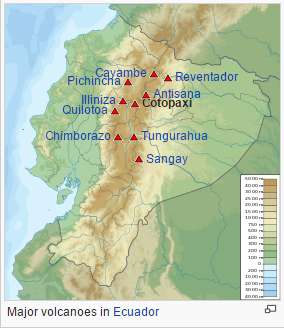
Valley of Volcanoes. Wikipedia

My husband and I spent a month in Ecuador with two of his friends. We had met some Ecuadorans when they came to Maine for an exchange program and we flew there to visit them in return. We rented an apartment in middle Quito and branched out from there with our friends ushering us around their stomping grounds.

The volcano Pichincha was front and center in the middle of the huge capital city of Quito. If I wanted to see the top, I’d have to stand on my tiptoes and lean over the sink and crane my head upward.

I was amazed that 2,671,191 people live within mere miles of an active volcano. As a matter or fact,t he entire Valley of Volcanoes, the spine of Ecuador, is filled with active volcanoes. Some population center or another is always threatened. We bathed in hot springs fed by underground magma chambers at Papallacta. We washed our clothes in hot springs tricking down the volcano sides at Baños. Baños means baths. Volcanoes are a way of life to Ecuadorans.

The fences surround little private hot tubs heated by volcanic thermal springs
at Papallacta. You can see the steam on the right behind the pumpkin
and in the middle next to the hut. EPrata photo

Here is a photo of part of populous Quito:

EPrata photo

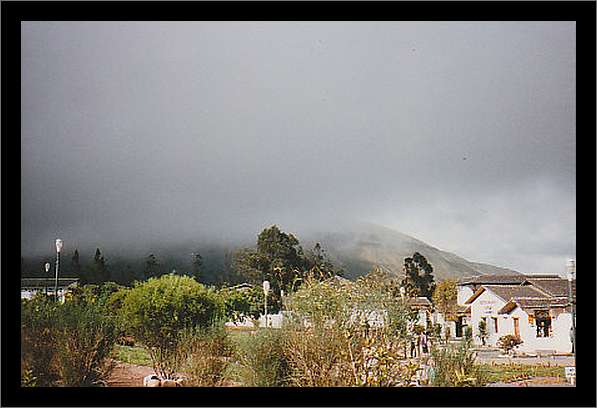
Here in northern Ecuador near Cayambe, another volcano dominates the skyline, even through the low hanging clouds.

EPrata photo

Naples Italy is another huge population center living among a growling bear. Wikipedia says,

Vesuvius has erupted many times since and is the only volcano on the European mainland to have erupted within the last hundred years. Today, it is regarded as one of the most dangerous volcanoes in the world because of the population of 3,000,000 people living nearby and its tendency towards explosive (Plinian) eruptions. It is the most densely populated volcanic region in the world.

I feel for all the people around the globe today who are under threat of active volcanoes. Japan and Indonesia are other places where people have been recently evacuated. As we go about our daily life we trust that certain things will work, like the trains, subway, planes, roads, electricity, etc. When there is an interruption like the ah fall on South Quito, it makes life harder than it is already, especially for so many people in Third World countries.

Worse is that these kind of natural interruptions and natural disasters will only continue to increase. We think that we can manage around some light ash falls, some cracks in the road after a temblor, but eventually we will not be able to manage. The seriousness of natural disasters will exceed man’s ability to not only endure them, but even to comprehend them. (Revelation 16:21, Revelation 9:3-4, Revelation 6:14 etc.)

When the rapture happens and we are gathered to Jesus He will unleash all His stored-up wrath and the earth will literally go crazy with earthquakes, volcanic eruptions, hailstorms, heat, floods, and more.

Revelation 6:12 says “And I beheld when he had opened the sixth seal, and, lo, there was a great earthquake; and the sun became black as sackcloth of hair, and the moon became as blood;”. The sentence is constructed in a way that seems causal. Earthquake occurs, and within the same sentence with no period, the sun turns sackcloth and the moon turns red. Can an earthquake cause this? Yes, if it sparks a volcano eruption. Read more about this below at the link “Of volcanoes, dry fog and sun as sackcloth“

The time is drawing nearer and nearer when sin will be loosed to do its worst, when disasters will top each other again and again- daily. All those who are not true believers will be left behind to face that. Many who think they are believers will shockingly discover they are not, when the true brethren suddenly are gathered up at the last trump into glory and they are left behind.

Just a friendly reminder, that we are not on earth to play, but to work, pray, witness, and labor for the Master.

——————————————
Further reading

Of volcanoes, dry fog and sun as sackcloth

CNN: Cotopaxi sends huge ash plumes into the sky

In-Depth Economic Times: Volcano in Ecuador spews huge column of ash

Posted in discernment, ligonier, rc sproul

Ligonier Ministries: The State of Theology "We are in a new dark age"

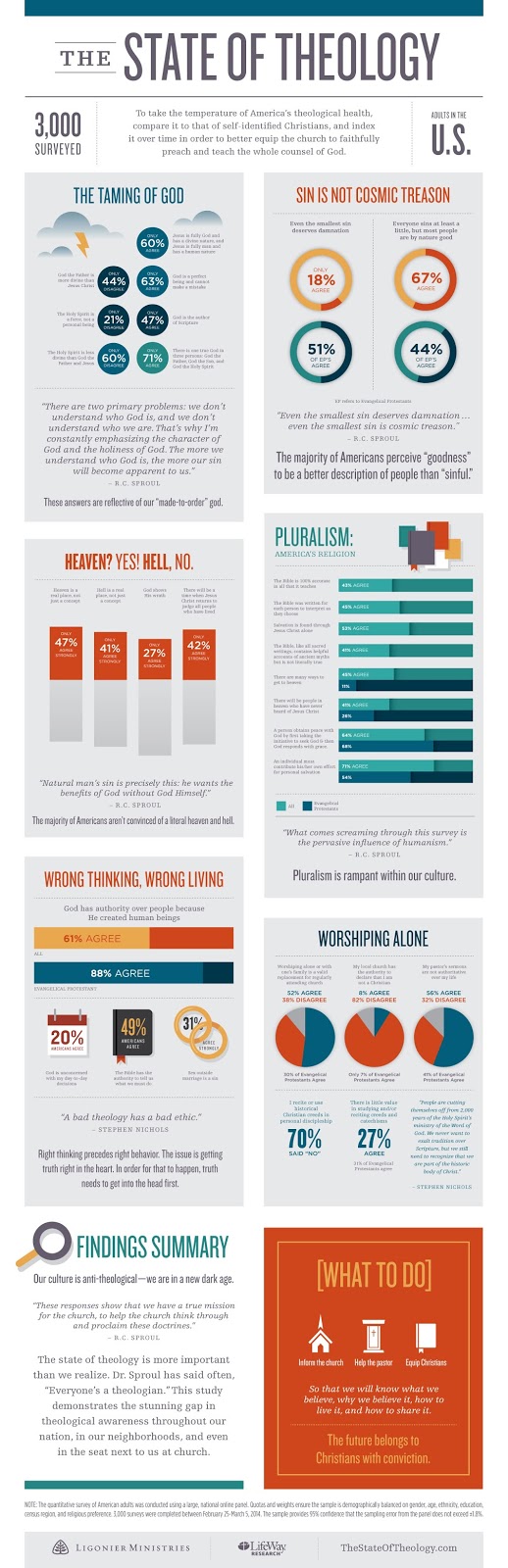
Here is a wonderful info-graphic from Ligonier Ministries.

The State of Theology

It is Ligonier’s desire to serve the church in fulfilling the Great Commission. This survey has helped to point out common gaps in theological knowledge and awareness so that Christians might be more effective in the proclamation, teaching, and defense of the essential truths of the Christian faith. 

View the infographic, listen to Dr. R.C. Sproul discuss these findings on Renewing Your Mind, or download the official white paper and survey with key findings. You can also download the entire study in a .pdf.

Remember the point of absorbing this information is to educate yourself, but then to go forward and witness properly to others, either Christians or non-Christians. Now you know where the gaps in biblical knowledge are and can be part of helping to fill that in for people.

Thanks goes to Ligonier Ministries for this information and all their enduring hard work.

—————————————-

Further reading

Wretched: Drive By Theology

Phil Johnson’s List of helpful Theology Bookmarks

Posted in death, hell, judgment, prophecy, second coming, sin, wrath

Preaching wrath-sin-death-judgment as well as salvation-grace-redemption-hope

“Wrath”. EPrata photo

A third of the Bible is prophecy. There are fulfilled prophecies, prophecies that have been fulfilled and will be again (double prophecies, Pentecost, Acts 2:14-21), and prophecies that are yet to be fulfilled. (Christ’s second coming)

There are complicated prophecies, (Book of Obadiah, Daniel’s prophecies) and simple prophecies. (Messiah will be born of a virgin, (Isaiah 7:14). Prophecies that involve war upon nations (Ezekiel 35:4) and prophecies that involve just one individual. (Eve will be the mother of all the living, Genesis 3:20; Mary a virgin would give birth, Luke 1:35).

Many Christians are fascinated by prophecy and study them diligently. But there is a prophecy that many people don’t like to study and it is one that affects all people, Christian and non-Christian alike.

Jesus said He is coming again to judge the living and the dead. (Ecclesiastes 3:17; Jeremiah 17:10). Non-believers will be judged based on their works and condemned, and believers will be judged not unto condemnation but still, judged according to our works.

No Christian likes to be thinking about the prophecy of being weighed in the scales and found wanting. No one likes to think they have disappointed Jesus. We all want to hear “Well done, good and faithful servant.” (Matthew 25:23). Not all of us will. Some will enter heaven by the skin of their teeth. (1 Corinthians 3:15).

Yet Christians are told several times about our coming judgment (not unto condemnation, but according to our works).

Believers are judged at the Judgment Seat of Christ (Romans 14:10-12). We will all have to give an account of ourselves. Jesus will judge the decisions we made, whether they were founded on the flesh or upon Him.

One subset of judgment will be teachers of His word. Teachers of the Bible will be judged more strictly-

Not many of you should become teachers, my brothers, for you know that we who teach will be judged with greater strictness. (James 3:1).

Grumblers will be judged-

Don’t grumble against one another, brothers and sisters, or you will be judged. The Judge is standing at the door! (James 4:11, James 5:9).

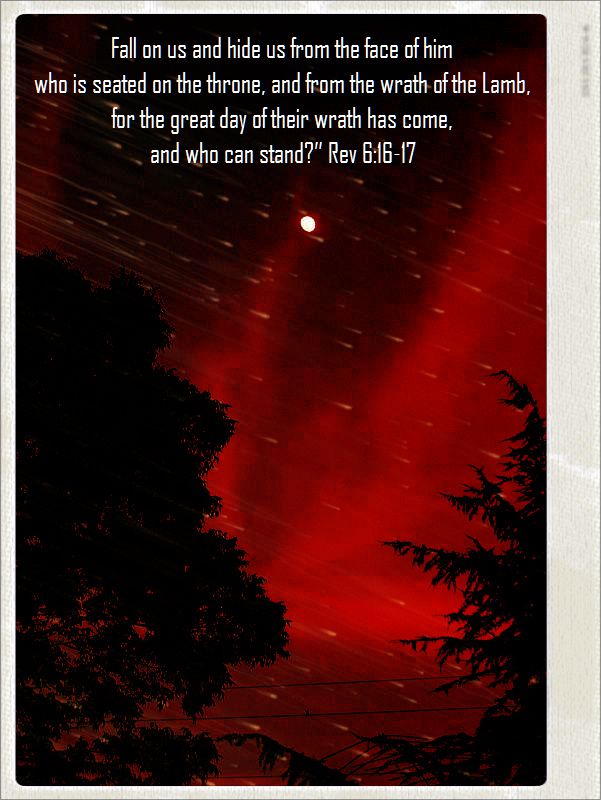
“Doom sky”. EPrata photo

All non-believers will be judged. As much as a Christian cringes at the thought of being judged by the Mighty Righteous God, non-believers absolutely hate us even mentioning it to them! The lost person becomes angry at the very thought of them having failed the standard God sets forth. Yet it will happen, at what is called the Great White Throne Judgment of Revelation 20:11-15.

This judgment does not determine salvation because the lost person’s eternal state is fixed at death. Everyone at the Great White Throne will be an unbeliever who has rejected Christ while they were living and is therefore already doomed to an eternity in the lake of fire. (Revelation 20:12). The judgment they will be experiencing is their life works projected like a mirror against a holy and righteous God and the level of their torment assigned. Yes, there are different degrees of punishment in hell.

Believers should think about this most difficult subject for several reasons. First, because as each person is cast (thrown) into the Lake of Fire (Revelation 20:15) we can easily what John Bradford said. He was a martyr, imprisoned for the faith in 1553. As prisoners were paraded to the execution stake, Bradford would exclaim,

The pious Martyr Bradford, when he saw a poor criminal led to execution, exclaimed, “there, but for the grace of God, goes John Bradford.” He knew that the same evil principles were in his own heart which had brought the criminal to that shameful end. (Source A treatise on prayer by Edward Bickersteth (1822).

Over time the phrase has been amended to say “There but for the grace of God, goes I.” Any one of us could be that person facing the wrath of Jesus, condemned and tossed into the torment forever, unless it had been Him sovereignly saving us. We are no longer under wrath, but at one point in our lives, we were. Don’t forget that.

Second, the Christian should ponder these things because we must give the full counsel of God as we witness. (Acts 20:27). We must share the bad news before we can get to the Good News. The bad news that there is no one righteous, no, not one. (Romans 3:10). We all fall short of the glory of God and are destined for the Lake of Fire forever, to be punished for our sins by the Judge. We tend to shorten the witnessing moment because we expect the outrage and anger when sharing that the person we are talking with is a sinner in need of the grace of Jesus. It’s hard to make someone angry. Even pastors shorten the counsel of God, by omitting the sin-death-wrath-punishment part and then quickly get to the part that they think is more palatable, or “attractive.”

“Red heaven” EPrata photo

The full counsel means both sides, His sovereign choice of the people He elects to salvation, and the personal responsibility of each man to repent and believe else be eternally responsible for their sin. Spurgeon said of the full counsel of God–

Running away with half a Truth, they are like men that go through the wilderness wearing only one shoe—they become lame in one foot—and that makes them limp all over. It does not matter which foot it is that is lame—the man is a cripple if either foot is thus afflicted.

Think often of the prophecy of the Second Coming of Jesus. He spoke of it more often than anything else. The Bible refers of it constantly. Within the Second Coming are a host of different prophecies. I agree, they are interesting to study. However, we need to remember that we labor for a holy God and He will return to judge the living and the dead.

Acts 10:42
He commanded us to preach to the people and to testify that he is the one whom God appointed as judge of the living and the dead.

Romans 14:9
For this very reason, Christ died and returned to life so that he might be the Lord of both the dead and the living.


2 Timothy 4:1
In the presence of God and of Christ Jesus, who will judge the living and the dead, and in view of his appearing and his kingdom, I give you this charge: preach the word; be ready in season and out of season; reprove, rebuke, exhort, with great patience and instruction

———————————————–

Further reading

What does it mean to preach the whole counsel of God

The whole counsel of God

What is the difference between the Rapture and the Second Coming?

Posted in blackaby, experiencing God, false prophets, henry blackaby, mysticism

Blackaby’s Experiencing God: if we’re to find out where God is at work and join Him there, then where is God NOT working?

I was a baby Christian when the church to which I belonged at the time fell under the hoopla regarding Henry Blackaby’s “Experiencing God” study (published in 1990). Even though the study had been produced and circulating for about many years already, it had taken a bit of a while to get to our small church in rural Georgia.

I remember the promises that were made by the people promoting the book/workbook/study. “It will change lives.” “It will transform the entire church”. “There is nothing like it.”

I like to study and I went along with the flow and participated in it with a small group. Perhaps I am a natural skeptic, but from the outset I was leery of anything that promised life change that was not the Bible. As the study concluded, I decided that it was not for me, there were parts I didn’t understand and it made no change in me at all. The parts I didn’t understand were not because the material was complicated or overly theological or in another language. Even the most difficult or demanding of material I’ve studied in the Bible eventually becomes clear through hard work, proper study, and prayer. The Spirit makes it clear.

All things in Scripture are not alike plain in themselves, nor alike clear unto all (2 Pet. 3:16); yet those things which are necessary to be known, believed, and observed for salvation, are so clearly propounded, and opened in some place of Scripture or other, that not only the learned, but the unlearned, in a due use of the ordinary means, may attain unto a sufficient understanding of them (Ps. 119:105, 130). (Westminster Confession of Faith 1.7)

Experiencing the Experiencing God study caused confusion in me, not clarity. It’s what always happens when something I’m studying goes away from the Bible. The Bible is always clear to me. When things are not based on the truths found in the bible, they are cloudy, unclear, murky, opaque. This is how, through discernment, I know what is edifying and what is not.

It’s been 9 years since I took the Experiencing God study. I have learned quite a lot since then, by the Grace of Jesus and the edifying work of the Holy Spirit. I know that Mr Blackaby and co-author Claude King will have a lot to answer for when they stand before Jesus. Mr Blackaby opened the door to mysticism, (aberrant orthodoxy) and he opened the door to an experiential method of getting to know God and living it. (aberrant orthopraxy). The credentials that he had, of being part of the North American Mission Board, the International Mission Board and LifeWay, opened the door to allowing and encouraging both extremely poor orthodoxy and poor orthopraxy in the most conservative denominations of the faith.

John MacArthur commented on this remarkable and rapid insinuation of the EG study’s main precepts into even conservative sections of the faith in his essay False Prophets and Lying Wonders,

Similar ideas [that God gives extra-biblical persona, revelation] have found sweeping acceptance even among non-charismatic Christians. Southern Baptists have eagerly devoured Experiencing God by Henry Blackaby and Claude King, which suggests that the main way the Holy Spirit leads believers is by speaking to them directly. According to Blackaby, when God gives an individual a message that pertains to the church, it should be shared with the whole body. As a result, extrabiblical “words from the Lord” are now commonplace even in some Southern Baptist circles.

I’m saddened that the Experiencing God study is not only still used, but is still a best seller. According to Amazon.com, Experiencing God is ranked #42 in Books > Christian Books & Bibles > Education > Adult. That is amazing for a religious book/study published in 1990, twenty-five years ago. Many people have reviewed the study and tested it against the Bible. I won’t go into lots of parsing today. I have just a few questions about the book/study.

First, here are a few links to reviewers that have examined the Experiencing God study and why it comes up short when tested against God’s word.

The main point of Experiencing God has been touted again and again as this:

“Experiencing God: Knowing and Doing the Will of God” has a simple -– but challenging -– message: Find out where God is at work and join Him there. (source)

Here is my first question. Where is God NOT working?

Anyone? Anyone?

Yet the Bible says,

But Jesus answered them, “My Father is working until now, and I am working.” (John 5:17)

The answer of course its that God is working everywhere.

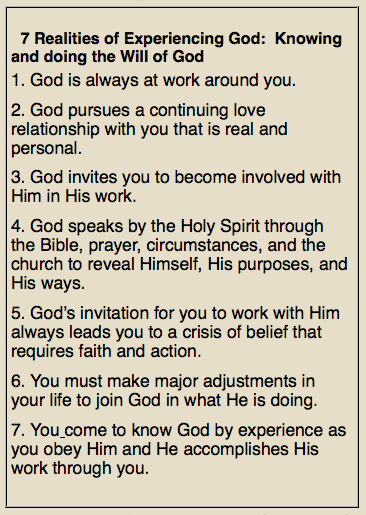
If one digs beyond the motto of the study, there are 7 main points that the study brings up. None are bad on the surface. As a matter of fact, some are good. The trouble with this study is that it combines so much biblical truth with some lies that it makes it past the gate of all but the most discerning. Mixing biblical truth with doses of lies makes for a dense evangelical fog.

Here are the study’s 7 main points, which King and Blackaby call “7 realities”:

So, as number 1 says if God is always at work around us, why does the study always urge us to “Find out where God is at work and join Him there”. Why do we have to ‘find out’? Why do we have to go there to join Him? If I stay here, and don’t go there, am I in a dead zone, a spot where God is not working? Worse, do we obey God by using our visual senses to make a determination as to what God is doing in a particular place? What about the missionary who worked for years and had not one convert? Was God not working there? What happens when we ‘find out’ where God is working because it is a happenin’, exciting church, and then it plateaus, and we scoot off to another happenin’, exciting place, as Rick Warren says, surfing the experience? Have we not covenanted with the people we worship alongside? Do we just abandon them because we see a better prospect somewhere else?

Or is the seed that was planted and then watered by another dead in the ground … or was it simply waiting on God’s timing to grow it? (1 Corinthians 3:6). Do we wander off into where we “see God is working and join him there? Or there? Or how about over there?

Anyway, you can see the inconsistencies in the 7-point bullet list generated by Blackaby and King. Number 7 is particularly troublesome.

Not to mention the most personal experience of God of all. When we repent and believe, He sends the Spirit to dwell IN US. This is the most personal, intimate, wondrous experience on can have with God, His very self dwelling in us making our body His temple. What a poor substitute Blackaby offers, the temporal and fleeting experience of human experience to determine how to know God.

While some things that last are edifying (the Bible, The Valley of Vision, Pilgrim’s Progress), other things that seem like they are lasting (Experiencing God) are not edifying, and indeed, their popularity bespeaks this warning:

Woe to you, when all people speak well of you, for so their fathers did to the false prophets. (Luke 6:26).

Posted in abram, jerusalem, king, melchizedek, priest

Melchizedek: one of the Bible’s most mysterious characters

One of the most mysterious characters in the Bible is Melchizedek. There are only a few bare references, and what we do know according to the Biblical record, only makes us ask more questions than apparently God has granted answers.

  • What does it mean when we read Melchizedek has a priesthood that will last forever?
  • Why did God establish a priesthood superior to the Levitical priesthood, and is it a precursor to the priesthood of Jesus?
  • How did Abram know Melchizedek ?
  • Is the bread and wine that Melchizedek brings to Abram a precursor of the bread and wine ministration Jesus put into effect at the Last supper?
  • Why doesn’t Melchizedek have a genealogy?
  • Is Jesus Melchizedek in a pre-incarnation?

Sigh.

Anyway here is what we do know about Melchizedek.

His name means “King of Righteousness”: he was both king and priest of Salem, an early name for Jerusalem. Melchizedek blessed Abraham. Jesus Christ succeeded to this role and became a high priest in the order of Melchizedek. 

Melchizedek was both king and priest. As a king, Melchizedek entertained Abraham. (Genesis 14:18 See also Heb 7:1.) 

As a priest, Melchizedek blessed Abraham. (Genesis 14:18-19). 

Abraham acknowledged Melchizedek as a priest of the LORD. (Genesis 14:20,22). Melchizedek here points ahead to Jesus Christ, who is also priest and king. 

The status of Melchizedek 

David appropriates Melchizedek’s office and authority for himself and his descendants Ps 110:1-2,4 The word “order” here means “in succession to”, meaning that Christ assumes the status and function of Melchizedek. 

The Davidic Messiah (Christ) inherits the office of Melchizedek. Jesus Christ was at that time being acclaimed as the “Son of David” and by implication here claims to be the Messiah. 

Jesus Christ as high priest after the order of Melchizedek
Heb 5:8-10; 6:19-20 Only the high priest could sacrifice for the sins of the nation in the inner sanctuary behind the curtain. 

The characteristics of the order of Melchizedek according to Hebrews 7:2-3,
Melchizedek’s order of priesthood was one of kingship, peace and righteousness; it did not depend on genealogical descent (unlike the Levitical priesthood); it is eternal, without known beginning or end. (See also Psalm 110:4; Hebrews 5:6; 6:20; 7:21). 

The uniqueness of Jesus Christ’s high priesthood in the order of Melchizedek Heb 7:6-7 Melchizedek was superior to Abraham and therefore to the Levitical priesthood descended from Abraham; Ps 110:4 The priesthood is secured by God’s oath. See also Heb 6:17-20; 7:16,20-22,26-27; 8:1-2. 

Jesus Christ’s high priesthood makes the Levitical priesthood obsolete Heb 8:13 See also Heb 7:11,18-19; 8:7-13

Source: Manser, M. H. (2009). Dictionary of Bible Themes: The Accessible and Comprehensive Tool for Topical Studies. London: Martin Manser.

Melchizedek in the Old Testament

Genesis 14. Melchizedek first appears after Abram’s victory over Chedorlaomer (Gen 14:1–12). The king of Sodom and Melchizedek, “king of Salem” and “priest of God Most High” (Gen 14:18 ESV), approaches the victorious patriarch. Melchizedek shows hospitality to Abram and pronounces a poetic blessing upon him. Abram responds by giving him a 10th of his spoils (Gen 14:18–20). 

Genesis provides no additional details about the identity of Melchizedek and doesn’t explain how a Canaanite city-king came to be a priest of God Most High. Further, Melchizedek does not appear in any genealogy. 

McKeown focuses on the function of Melchizedek within the narrative, drawing on the contrasting parallels between the kings of Salem and Sodom. Both kings approach Abram after the battle, but only Melchizedek comes bearing gifts. The first words of the priest-king form a poetic blessing, while the king of Sodom issues a command: “Give me the persons” (Gen 14:21 ESV). Within the broader context of Genesis, Melchizedek reminds the reader that Abram has been blessed by God. The character turns Abram’s victory into “a sign of God’s ability to deliver on the promises that he has made” (McKeown, Genesis, 88). 

Psalm 110. Melchizedek’s only other Old Testament appearance is in Psa 110, a psalm addressed to the king of God’s people. In it, the LORD promises to bring victory in battle and to establish the king as “a priest forever after the order of Melchizedek” (Psa 110:4 ESV). The psalmist then declares that God will stand at the right hand of the king, using him to bring judgment upon the nations (Psa 110:5–6). 

This eschatological reading of Psa 110 piqued the curiosity of Jews and later Christians, especially in regard to Melchizedek. Hughes illustrates: “Psalm 110 declared that God was going to do something new by bringing into history a priest-king like Melchizedek. His priesthood would last ‘forever.’ He would be appointed directly by God. A divine oath guaranteed it: ‘The Lord has sworn and will not change his mind.’ What an intriguing prophecy. God was going to establish a totally new priesthood” (Genesis, 215).

The New Testament. 

The first reference to Melchizedek in the New Testament is a quotation of Psa 110:4 found in Heb 5:6. The writer quotes the passage to affirm that Christ was appointed as heavenly high priest: “And being made perfect, [Christ] became the source of eternal salvation to all who obey him, being designated by God a high priest after the order of Melchizedek” (Heb 5:9–10 ESV). Hebrews 7, a commentary on the Old Testament appearances of Melchizedek, elaborates on this teaching. 

The author of Hebrews then turns to Psa 110, citing God’s promise to appoint a priest “after the order of Melchizedek” as indication of the Levitical priesthood’s imperfection (Heb 7:11 ESV). Christ fulfills the eschatological hope of the psalm not by meeting the legal requirement of descent, but by the eternal quality of His life (Heb 7:13–17). He is a superior high priest, bringing a new covenant which grants salvation to all who believe (7:18–25). 

Melchizedek provides Christians with a template for understanding the heavenly priesthood of Christ. This challenges our attempts to substitute human mediators for the divine, revealing a high priest whose saving work cannot be confined to any one culture or bloodline (Thompson, Hebrews, 164). 

Brockway, D. (2012, 2013, 2014, 2015). Melchizedek. In J. D. Barry, D. Bomar, D. R. Brown, R. Klippenstein, D. Mangum, C. Sinclair Wolcott, … W. Widder (Eds.), The Lexham Bible Dictionary. Bellingham, WA: Lexham Press.

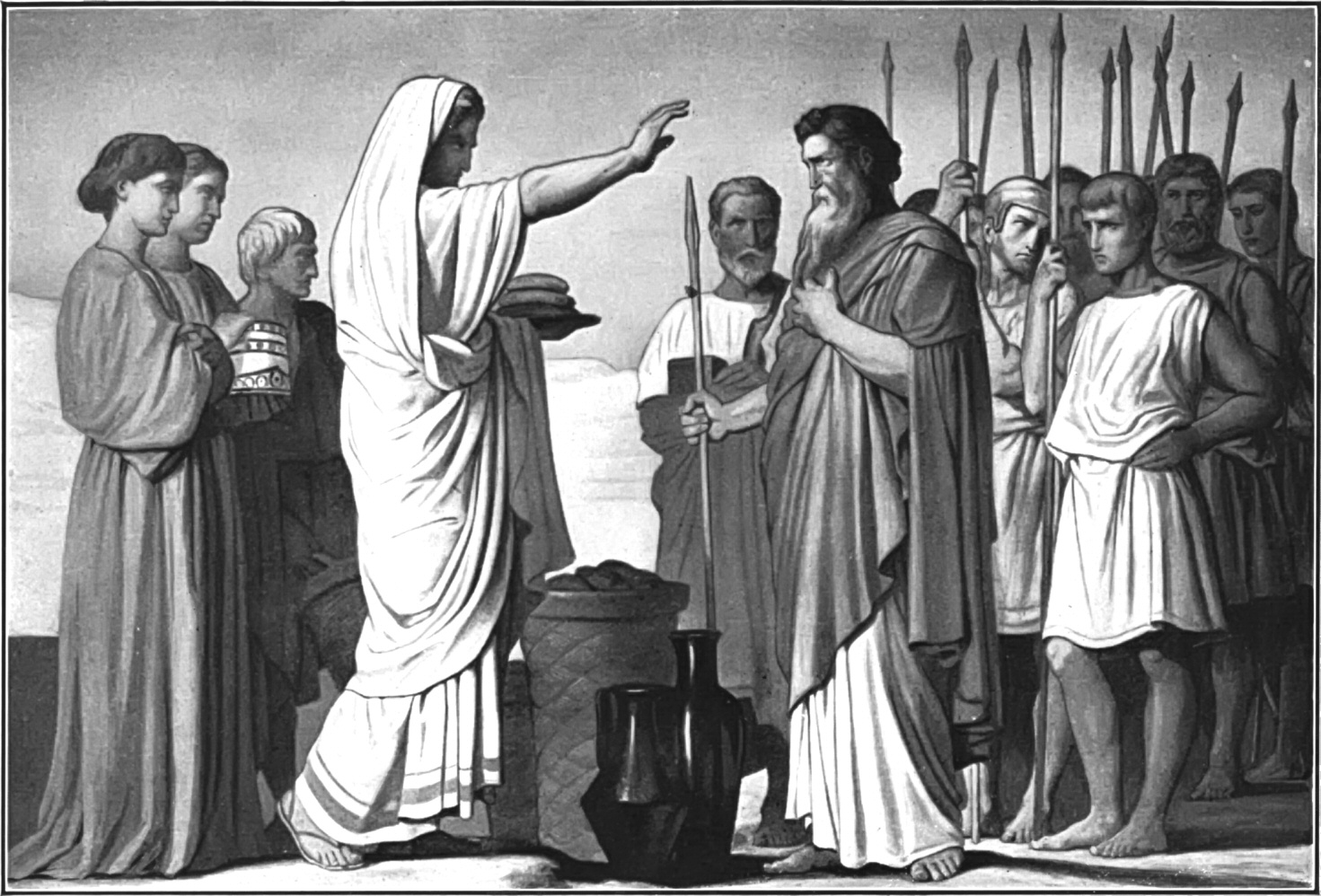
Melchizedek blesses Abram

‎Abram’s remarkable victory made him a hero in the land wherein he dwelt. His return from the battle field of Dan was a triumphal march. The king of Sodom came to thank him and bade him keep the grain and treasures which he had regained; but Abram returned everything to the Sodomites, “Save only that which the young men have eaten, and the portion of the men which went with me,” his allies. 

‎Here also occurred that mysterious meeting with Melchizedek, king of Salem, of whom the Bible says, “he was the priest of the most high God.” It would seem, therefore, that God was still worshipped by some people of Canaan. Melchizedek, His minister, came forth from Salem, which may have been Jerusalem; and he bore bread and wine to Abram. The priest king blessed the victor, and Abram gave him a part of all the spoils. Then they separated, apparently forever, two mighty servants of the Lord, who had recognized each other for a moment in passing, and then gone each his way.

When we get to heaven, won’t it be wonderful to seek these answers from the people themselves? If the LORD permits, that is. On the other hand, perhaps some of these questions we find so burning today will wither under the glory of truth shining from the from the face of Jesus. In any case, it will be humbling and thrilling to worship El Elyon alongside such a mighty and worthy king as Melchizedek, whose very name means “Righteousness.”

————————————

Further Reading:

The Priesthood of Melchizedek

Bible Q&A: Who was Melchizedek?