Poetry by Kay Cude. Used with permission. Click to enlarge.
Poetry by Kay Cude. Used with permission. Click to enlarge.
I love the old book, Earthly Footsteps of The Man of Galilee and the Journeys of His Apostles.
The book contains 400 original photographs by Robert E.M. Bain, taken in Egypt, Israel, Syria, Lebanon, Turkey, Greece, and Italy. Descriptions for each photograph are written by James Lee. These photographs depict the life of Christ and the influence of his ministry—the locations where Christ was born, baptized, crucified, as well as scenes from his prayers, miracles, and sermons. This resource also contains photography of sacred sites between Jerusalem and Rome.
In these photographs taken in the late 1890s, not much had changed in Palestine from the time of Jesus until then. When one sees the vintage, sepia photo of a lone colt tied to a tree in front of a house, one can easily imagine the scene when Jesus told the disciples to go find the young donkey so He could ride into Jerusalem. When one sees a cracked and browned picture of an oil or a flour mill, we can easily imagine commerce and trade as Lydia had with her business of purple.
Here below is a fence in Palestine. The caption explains what the reader is seeing and also contains thoughtful ponderings about Jesus and His Gospel. What I think of when I see this photo, is the impenetrable aspect of the fence and the strong deterrent of thorns. The verse from the Parable of the Sower springs to mind.
Other seed fell among thorns, which grew up and choked the plants. (Matthew 13:8)
The agricultural and localized references written in the Bible are so much better appreciated by us in our day when looking at photos like this, or when I seek to learn about the plants and animals of the region.
Sadly, the book is out of print and very rare and expensive, but fortunately, it has been digitized and I can look at the photos on my Logos 6 software. By the way, if you are reading this before noon on this day, Tim Challies has a Free Friday Giveaway that runs until noon on Saturday, raffling off a Logos 7 Silver package. A hefty gift, if you sign up and become the lucky winner.
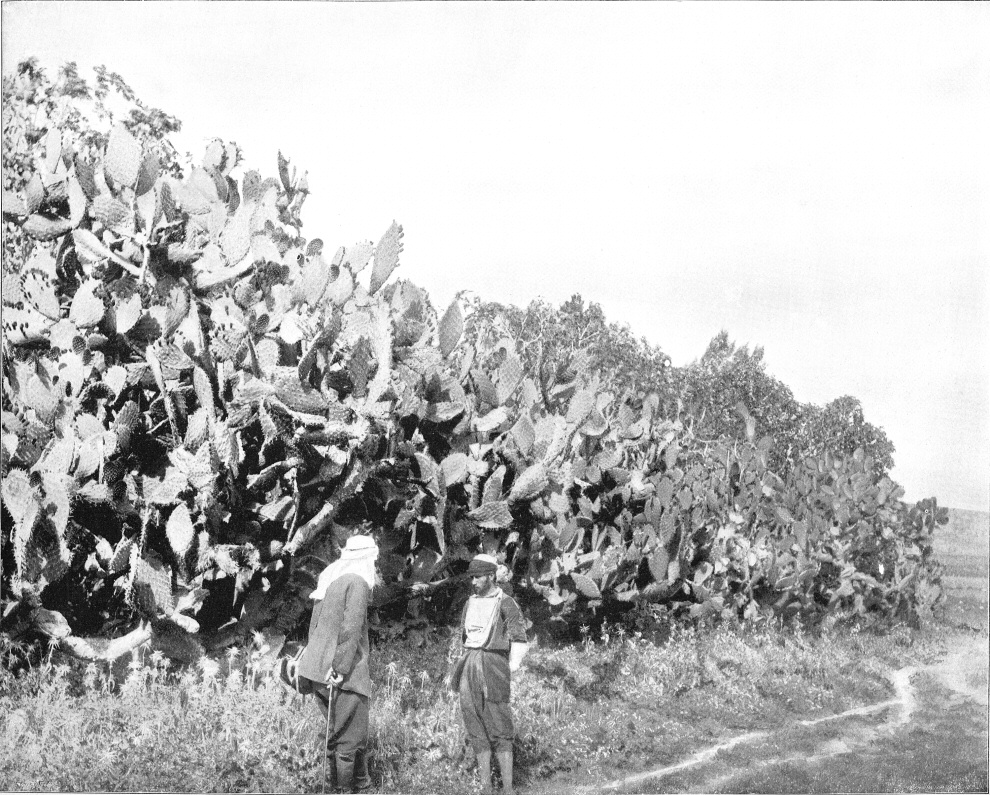
Earthly Footsteps of The Man of Galilee and the Journeys of His Apostles caption-
The thorny cactus abounds in Palestine. It forms a most secure fence, growing sometimes to a height of twelve feet. Beyond this wall are fig trees and olive trees, pleasant vines and fragrant flowers. The man in the picture with white head dress and staff held behind him is the dragoman of the photographic company of 1894.
We linger at Dothan because, besides the memories of Joseph and his brethren, there is an Old Testament picture which must have been recalled by Mary on her pilgrimage to Bethlehem. The prophet Elisha lived here for a time, and it was to Dothan that the Syrian King sent an army to surround and to capture him. By night they came—”horses and chariots and a great host.” And they “compassed the city.”
In the early morning, when Elisha’s servant arose from his bed and went forth “behold, a host compassed the city both with horses and chariots.” Then the prophet’s servant was afraid and he said: “Alas, my master; how shall we do?” And the prophet answered: “Fear not, for they that be with us are more than they that be with them. And Elisha prayed and said: Lord, I pray thee open his eyes that he may see. And the Lord opened the eyes of the young man, and he saw; and behold, the mountain was full of horses and chariots of fire round about Elisha.”—2 Kings 5:13–18.
The reality of the invisible realm, of God and His angels, of life immortal, of the protecting influence of heaven in all the struggles and endeavors of earth—these are doctrines which the Man of Galilee came to proclaim to the race of man. These are doctrines which gave strength and comfort to Mary in her pilgrimage from Nazareth to Bethlehem.
Jesus is utterly fascinating. These long-ago glimpses into the lands upon which He walked are endlessly interesting and encouraging. I hope you find them encouraging also. Of course, nothing can compare to the lands that await us, a renewed earth and domicile in New Jerusalem. Jesus is worthy to be praised, for His earthly sinless life, and His holy sovereign reign over all the earth and universe beyond.
“I am the Alpha and the Omega,” says the Lord God, “who is and who was and who is to come, the Almighty.” (Revelation 1:8)
Rivers figure prominently in the Bible, in the people’s economic life, in their well-being, and in prophecy. The first rivers mentioned in the Bible are the four rivers crossing the Garden of Eden.
A river flowed out of Eden to water the garden, and there it divided and became four rivers. 11The name of the first is the Pishon. It is the one that flowed around the whole land of Havilah, where there is gold. 12And the gold of that land is good; bdellium and onyx stone are there. 13The name of the second river is the Gihon. It is the one that flowed around the whole land of Cush. 14And the name of the third river is the Tigris, which flows east of Assyria. And the fourth river is the Euphrates. (Genesis 2:10-14).
The River Euphrates is also known later in the Bible as the Mighty River.
The Nile River is (likely reference) mentioned in Genesis 15:18-
In the same day the LORD made a covenant with Abram, saying, Unto thy seed have I have given this land, from the river of Egypt unto the great river, the river Euphrates:
In the 5th century Herotodus said that without the Nile, there is no Egypt. Its importance is clearly seen. Where the river has its sway, there is green. Where there is no river, the desert begins. The Egyptian people have always depended on the Nile for life.
As rain very seldom falls, even in winter, in Southern Egypt, and usually only slight and infrequent showers in Lower Egypt, the whole physical and political existence of Egypt may be said to depend on the Nile; since without this river, and even without its regular annual inundations, the whole land would be but a desert.
The Nile has two branches, the White and the Blue, and its overall length is 4,000 miles! About 900 miles of the great river flows through Egypt proper.
The Egyptians lived by the annual flooding of the Nile. When the floodwaters receded, it left behind fertile silt, which added greatly to the nutrient level of soil for crops.
Smith’s Bible Dictionary explains the specifics, and you will rapidly come to understand the Nile’s importance for the region.
“With wonderful clock-like regularity the river begins to swell about the end of June, rises 24 feet at Cairo between the 20th and 30th of September and falls as much by the middle of May. Six feet higher than this is devastation; six feet lower is destitution.” –Bartlett. So that the Nile increases one hundred days and decreases one hundred days, and the culmination scarcely varies three days from September 25 the autumnal equinox. Thus “Egypt is the gift of the Nile” – [as Herodotus first stated].
Thise are the agricultural and geographical facts. As for the Nile in the Bible, Moses was indirectly named due to his having been found in a basket in the Nile River. Exodus 2:10-
When the child grew older, she brought him to Pharaoh’s daughter, and he became her son. She named him Moses, “Because,” she said, “I drew him out of the water.”
The name Moses is Hebrew from the word mashah; drawing out (of the water), i.e. Rescued; Mosheh, the Israelite lawgiver — Moses, according to Strong’s Concordance.
We read of the Nile again in Exodus 7:21. One of the plagues of Egypt against Pharaoh involved the Nile.
And the fish in the Nile died, and the Nile stank, so that the Egyptians could not drink water from the Nile. There was blood throughout all the land of Egypt.
There is an interesting article at Atlas Obscura revealing the locations of and history behind the “Nilometer.”
In ancient Egypt, the behavior of the Nile could mean life or death each harvest season. So, long before the Aswan Dam was constructed to manage the flooding of the great river, Egyptians invented an instrument to measure the waters in order to predict the Nile’s behavior: the nilometer.
There were three kinds of nilometers, and examples of all three can still be seen around Egypt. The simplest was a tall column housed in a submerged stone structure called a stilling well. One of these nilometers can be seen on Rhoda (or Rawda) Island in Cairo, an octagonal marble column held in place by a wooden beam at the top that spans the width of the well. The stilling well included a staircase so that priests, who were in charge of monitoring the nilometers, could walk down and examine the column.
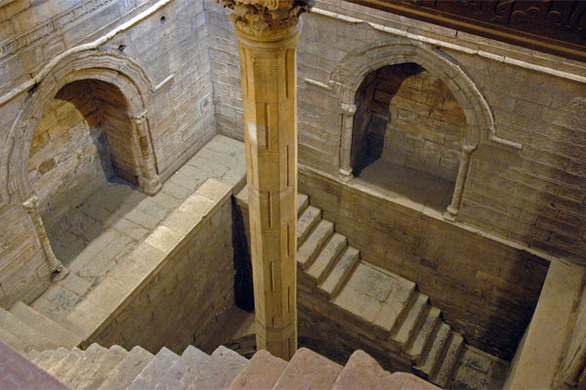 |
| Measuring shaft of the Nilometer on Rhoda Island, Cairo. Baldiri/CC by SA 3.0 |
The remainder of the article at Atlas Obscura is interesting. Check it out!
Sadly, the Nile also figures prominently in biblical future prophecy as well.
The third angel poured out his bowl into the rivers and the springs of water, and they became blood. (Revelation 16:4).
This evokes the former plague we read about in Exodus 7. J. Orr’s Commentary reminds us of the impact it had on the people.
The first of the series of plagues which fell on Egypt was of a truly terrific character. At the stretching out of the red of Aaron, the broad, swift-flowing current of the rising Nile suddenly assumed the hue and qualities of blood. The stroke fell also on the reservoirs, canals, and ponds. Whatever connection may be traced between this plague and natural phenomena (see Hengstenberg) it is plain that it stood on an entirely different footing from changes produced under purely natural conditions.
1. The water was rendered wholly unfit for use.
2. It became deadly in its properties (ver. 18).
3. The stroke was instantaneous.
4. It was pre-announced.
5. It descended on the river at the summons of Moses and Aaron.
6. It lasted exactly seven days (ver. 25).
An event of this kind was palpably of supernatural origin. Contrast Moses with Christ, the one beginning the series of wonders by turning the river into blood; the other, in his first miracle, turning the water into wine (John 2:1-12). The contrast of judgment and mercy, of law and Gospel.
The smiting of the Nile was – 1) A proof of the power of Jehovah, 2) A blow at Egyptian idolatry, 3) A warning of worse evil to come, 4) The removal of the plague at the end of seven days betokened the unwillingness of God to proceed to extremities.
Those extremities will come to full fruition and power during the Tribulation. In Isaiah 19 we read of the Burden of Egypt and God’s plans for the people.
And the waters of the sea will be dried up, and the river will be dry and parched,
Barnes’ Notes interprets the as-yet-unfulfilled prophecy this way:
Shall be wasted – This does not mean “entirely,” but its waters would fail so as to injure the country. It would not “overflow” in its accustomed manner, and the consequence would be, that the land would be desolate. It is well known that Egypt derives its great fertility entirely from the overflowing of the Nile. So important is this, that a public record is made at Cairo of the daily rise of the water. When the Nile rises to a less height than twelve cubits, a famine is an inevitable consequence, for then the water does not overflow the land. When it rises to a greater height than sixteen cubits, a famine is almost as certain – for then the superabundant waters are not drained off soon enough to allow them to sow the seed. The height of the inundation, therefore, that is necessary in order to ensure a harvest, is from twelve to sixteen cubits. The annual overflow is in the month of August. The prophet here means that the Nile would not rise to the height that was desirable – or the waters should “fail” – and that the consequence would be a famine.
What a disaster looms for Egypt (and the rest of the world!) Our God is creator and Sovereign over all. He will do it. One way to ensure that you are not present on earth for the coming Tribulation disaster of famine and judgments is to repent and place your faith in Jesus. Sins will keep you here but faith in the resurrected Son of God, in whom salvation is found in no other, will rescue you from the day of wrath.
Shall not the land tremble on this account, and everyone mourn who dwells in it, and all of it rise like the Nile, and be tossed about and sink again, like the Nile of Egypt? (Amos 8:8)
I hope you’ve enjoyed this quick natural history overview of the Nile River in the Bible. The Lord made the Nile. It has sustained people for thousands of years. It’s been a border, a life’s blood, and a symbol. It’s been used as a judgment and it will be used so again.
The Bible is rich with things to study. The best part is that all studies lead us back again to the same source: Jesus. He is the wellspring of life, all water flows from Him.
but whoever drinks of the water that I will give him will never be thirsty again. The water that I will give him will become in him a spring of water welling up to eternal life. (John 4:14)
This essay was first published on The End Time in December 2011.
Do you take the Lord’s power and grace for granted? Have you diminished His Holiness in your mind? Many people in this day and age have. How do I know? They think the Lord will somehow relent, and allow everyone into heaven after all. Or that His mercy is so great and so wide that they will be forgiven, even if they do not know Jesus. Jesus will not relent. His decision is final, and His decrees are sure. If you do not know Jesus on the day you die, you will be cast into hell. If you do not know Jesus on His day of wrath, if you die you will be cast into hell.
Even saying such a thing in this day and age seems like a revolutionary act. People chide us Christians who flatly declare the truth from the Word, that He will not relent. “Our God is a loving God,” they exclaim. “He would never do that!” Well, Remember rebellious Korah who was swallowed by the earth? Remember Uzzah who touched the ark? Remember Ananias and Sapphira, who blasphemed the Spirit by lying to the Apostle? Jesus will not relent, because He is the door.
“I am the door: by me if any man enter in, he shall be saved, and shall go in and out, and find pasture.” (John 10:9).
He is the only One who opens the door.
“I know your deeds. See, I have placed before you an open door that no one can shut. I know that you have little strength, yet you have kept my word and have not denied my name.” (Revelation 3:8).
He is the One who shuts the door.
“And they that went in, went in male and female of all flesh, as God had commanded him: and the LORD shut him in. (Genesis 7:16).
When the ark was filled He shut the door and the rest of the world was judged. And so it will be again, for the unaware.
“But while they were on their way to buy the oil, the bridegroom arrived. The virgins who were ready went in with him to the wedding banquet. And the door was shut. “Later the others also came. ‘Sir! Sir!’ they said. ‘Open the door for us!’ “But he replied, ‘I tell you the truth, I don’t know you.’ (Matthew 25:10-12)
He is the King of the Kingdom and it is He who says who enters and who doesn’t. He is the Door. Right now the door is open to all who would repent. It will be shut at the rapture. Not that anyone cannot be saved after the rapture, but with the door shut, you are in the cold, hard world and exposed to believing the lie.
“and with all the deceit of unrighteousness in those who perish, because they received not the love of the truth, that they might be saved. And for this cause God shall send them strong delusion, that they should believe a lie,” (2 Thessalonians 2:10-11)
Enter now while the door is open. Repent and believe the truth: that Jesus is resurrected Lord and He is the only way to enter the Kingdom. He speaks the truth, and when He says that judgment is coming, believe it. The time will come when the door will be shut. As it says in Isaiah 26:20- “Come, my people, enter you into your chambers, and shut your doors about you: hide yourself as it were for a little moment, until the indignation is past.”
While the door was open, they did not listen and believe in Noah’s day:
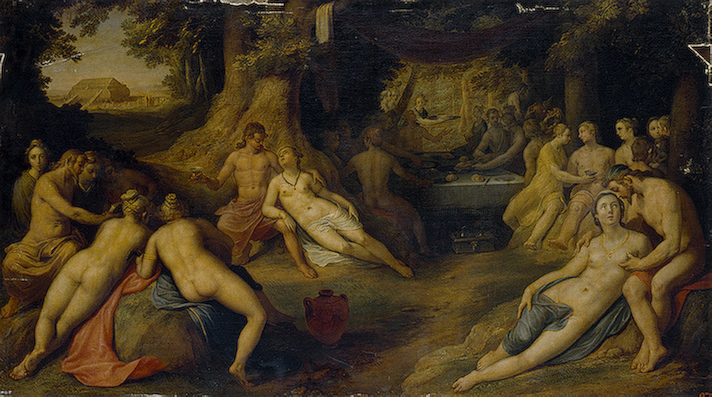 |
| Sinners before the Flood, 1594 Cornelis Cornelisz. van Haarlem |
 |
| After the Flood, Circa 1588 Cornelis Cornelisz. van Haarlem |
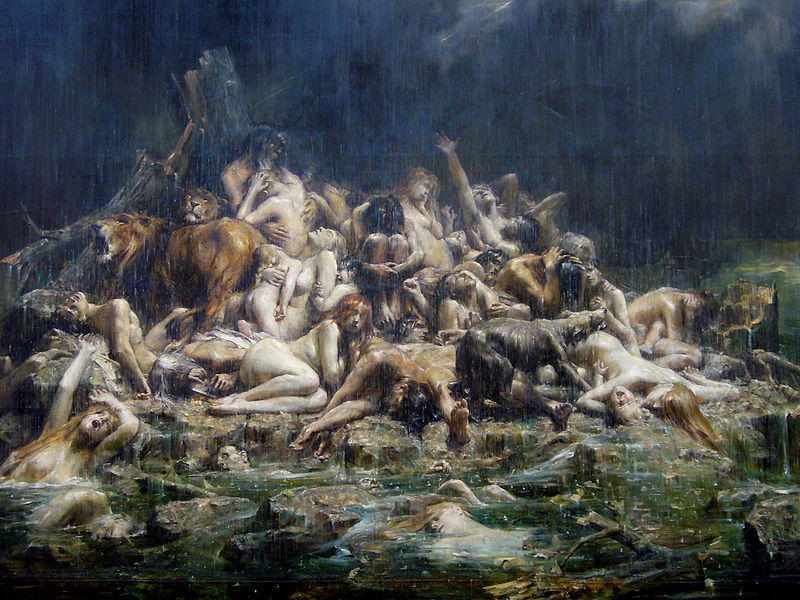
This is what Judgment looks like:
 |
||
| The deluge, Léon Comerre (1850–1916) |
This is what grace looks like:
.jpg) |
| Noah’s flood KAULBACH, Wilhelm von (1805-1874) |
How so? you ask. How is this grace? The serpents are writhing, the people are dying! Well, don’t focus on the serpents and the people. It is one way we diminish His holiness and His mercy. Focus on Him and His protected righteous and the fact that His promises of salvation are sure. The angels ministering, the ark itself was a lengthy warning to the same people who are now crying for the door to be opened. “Come, my people, enter you into your chambers, and shut your doors about you: hide yourself as it were for a little moment, until the indignation is past.” He made a way for the righteous to be saved!
Please answer His call, and repent!
“Once the owner of the house gets up and closes the door, you will stand outside knocking and pleading, ‘Sir, open the door for us.’ “But he will answer, ‘I don’t know you or where you come from.'” (Luke 13:25)
“Don’t grumble against each other, brothers, or you will be judged. The Judge is standing at the door!” (James 5:9)
I get excited as anyone about the thought of the rapture happening any minute. It has always been imminent, meaning, it could happen at any time without any particular circumstance HAVING to have happened first. Not like during the Tribulation where there is a specific series of chronological events, one preceding the other. Interest in the future has always been high.

Unfortunately, the theological field of study of “Last Things”, also known as Eschatology, has fallen into disrepute over this last generation. I do my best to present credible essays which strive to demonstrate that eschatology should still be a major area of concern for Christians.
One reason the field of study has fallen in status is because so many people think nothing of twisting the scriptures and promoting wacky theories. Others set dates. When the date passes by without the projected event having occurred, the followers become defeated not just with eschatology but with Christianity in general. Pagans also love to make a mockery of us when this happens. The verse below prophesies the mocking of prophecy.
They will say, “Where is the promise of his coming? For ever since the fathers fell asleep, all things are continuing as they were from the beginning of creation.” (2 Peter 3:4).
Another reason eschatology has fallen to less than credible status are that the fringe elements simply adding craziness to it. Aliens, conspiracy theories, and a heavy focus on interpreting signs and omens in current events all add to the pot which in turn adversely affects perceptions of the field.
A reader in all sincerity sent me a link to an article that seemed to explain certain aspects of the rapture with which she was unfamiliar. She was questioning it and wanted to know my take. I appreciate these kinds of questions because it’s encouraging to know that people think and question about these sources.
The author of the piece is a woman who writes at a website called Cross and Cutlass. She made many statements that were assertive in their dogmatism. When this happens it often confuses people, because dogmatic statements in print seem credible just for being dogmatic. It’s the old, “If it’s in print, it must be true” notion.
Here are some of her statements.
Originally, God set up the constellations to reflect the Gospel. Many people don’t know this, and I have only recently discovered this.
Warning #1. Whenever you see someone saying that an interpretation has been ‘hidden’ for thousands of years, and only recently discovered, run. The Bible isn’t a code, it’s not a secret, and it’s not unknowable until some lone person in a corner of the internet makes a “new discovery.” The Holy Spirit has been illuminating the Bible for millennia. The standard interpretations are the correct ones. It’s called church history, preaching the Gospel, and hermeneutics.
Warning #2. There are no scripture verses to support her statement that God set up the constellations to reflect the Gospel. Instead, she uses a hundred-year-old book as her source called The Witness of the Stars by E.W. Bullinger. I’ll provide a link below from the Creation Research Institute debunking Bullinger’s “Gospel in the Constellations” theory.
Listen. Scholars over the last two thousand years didn’t ALL fail to look up and notice the Gospel in the constellations. If it’s a new theory, it is almost a sure bet that it’s wacky, wrong, or based on twisted scripture and a poor hermeneutic. I’m talking to you Jonathan “Isaiah 9 Harbinger” Cahn and John “Blood Moons” Hagee.
The author of the wacky eschatological piece also claimed the following;
Now a great sign appeared in heaven: a woman clothed with the sun, with the moon under her feet, and on her head a garland of twelve stars. Then being with child, she cried out in labor and in pain to give birth. Revelation 12:1-2
The woman here is the constellation Virgo, the Virgin, who every Biblical scholar says represents Israel. In fact, Israel in Biblical days was well aware of these constellations and their meanings. Even as far back as Enoch.
Warning #3. Again we have a dogmatic statement with no proof: “the woman here is the constellation Virgo…” Then the author adds her connection to truth by incorrectly referencing scripture. She changed Virgo to virgin, which the scripture nowhere indicates. The Greek word for woman in the verse she cited means “woman, wife, lady.” As a wife, she would most assuredly NOT be a virgin, which the scripture actually indicates, The woman is, in fact, giving birth to a child. So, #hermeneuticfail.
The author goes on offering what seem like credible evidences but are actually tangential or made-up or just plain ridiculous. Like this statement:
Now, let’s move to Virgo being in labor. Jupiter was known by the Jews as the planet Messiah or the King planet. Jupiter enters the womb of Virgo every 12 years. Only every 83 years does it stay in the womb of Jupiter for the full period of a human pregnancy.

Be very cautious when people use constellations as their guide to prophecy. It is a satanic corruption. Astrology is an abomination to God. The Institute for Creation Research makes some excellent points regarding the constellations as a guide to the Gospel. Here are just a few of their good points, and the full explanation under each point is at the link:
The “Gospel in the Stars” Theory1) There is no uniform zodiac constellation. [in cultures across the world]
2) There is no uniform message behind the stars. As in the case of astrology, the star-formed zodiac signs can be assigned whatever meaning the interpreter decides upon; the purported messages behind the signs are completely arbitrary.
3) The message of the stars is out sequence.
4) There is no biblical evidence to support GIS. Bullinger cites a number of Bible verses that have nothing to do with stars revealing the gospel. For instance, he interprets the word “constellation” (Mazzaroth in Hebrew and Lucifer in the Latin Vulgate) in Job 38:32 as the twelve signs of the zodiac when, in fact, the precise meaning of the term remains uncertain.
I also wrote about horoscopes, i.e.interpreting the stars via their positions in the sky, and other omens/oracles, which forbidden to do.
GotQuestions has a good article about astrology.
Please be careful when following a website or teacher or preacher who is presenting explanations about Last Things. The fringe element is growing every day, with wacky theories, conspiracies, astrology, omens and signs.
I have found that one of the best expositors of the book of Revelation is John MacArthur. There are several other men I’d point you to, who do a good job with prophecy and explaining the scriptures regarding prophecy, like S. Lewis Johnson and James Montgomery Boice (who is excellent on the Book of Daniel!). The MacArthur sermons contain either audio or video AND transcripts. S. Lewis Johnson’s sermons are transcribed too. Boice is good, too. Also solid on eschatology are Phil Johnson and Martyn Lloyd Jones and Dan Duncan at Believers Chapel, all of whom are on the web.
Sad to say I do not recommend RC Sproul on eschatology. Though I do listen to him on the topics of holiness, justification, and beauty, I do not trust his hermeneutic on eschatology. He is a preterist, a stance that believes that all or most prophecies were fulfilled in 70AD at the destruction of the temple in Jerusalem. If one is a partial preterist they believe most of the prophecies were fulfilled. Further, preterists believe that Revelation’s language is only figurative. Though it is heavily symbolic, scripture interprets scripture and the correct interpretation CAN become known. Just not to preterists, I guess! I feel strongly about this. I use a reference from Randall Otto’s review of Sproul’s book as a punctuation to my feelings on preterism and eschatological hermeneutic overall.
Randall Otto reviewed Sproul’s eschatological stance as a preterist when Otto reviewed Sproul’s book The Last Days According to Jesus, thus,
One can only marvel at the hermeneutical duplicity at work here and the way it ravages genre analysis. By means of such a hermeneutic any text could be made to say anything. The recognition of genre types provides bases for how to understand a text. Seeing similarities in form and content to other texts enables the interpreter to view a text differently than if those similarities went unnoticed. By applying to the text the potential extrinsic genre-types, “the interpreter eventually determines the intrinsic, originally intended genre and thereby is able to utilize the correct ‘rules’ for understanding that text.” [12] The elasticity with which these “rules” are applied to such texts elicits a problematic inconsistency vis-a-vis the parousia.
So sadly, even within conservative and evangelical corners of the faith, misinterpretations in eschatology occur. Yet, last things are not unknowable. MacArthur said,
I’m seeing this world unravel. There doesn’t seem to be any way back. I mean this is totally out of control. This is a free fall down a black hole. So, you can’t just say, “Well, eschatology doesn’t matter.” That is not helpful. People want answers. Where is this thing going? It’s not fair to God, it’s a dishonor to God to say, “Well, the Bible is not clear.” It is clear. It is absolutely clear.
Here is an example of that clarity, even on eschatological matters. After the Soviet Union fell and the split-off nations came into existence, each with freedoms and openness to religion, 1,600 pastors in Kazakhstan asked Dr MacArthur to come and teach them. He spent 7 days a week, 8 hours a day teaching, for two weeks. The pastors wanted one entire day on Revelation so MacArthur went through the book systematically from start to finish. At the conclusion of chapter 22, the pastors said,
“You believe what we believe.” I said, “I believe what you believe?” Same Bible. Guess what? It’s so clear that people with no training, no seminary, and no commentaries could understand what the book of Revelation said.
Some things are difficult to understand. I’m not saying I have everything figured out. I can’t understand the Daniel verses referring to the Beast, or how the Last Days verses across the OT like Amos and Obadiah fit together in the grand picture, etc. But if I studied for a long time and referred to credible commentaries and prayed and was patient, I could by the illumination of the Holy Spirit. Peter mentioned that some verses were hard to understand when referring to some of Paul’s writing on eschatological topics.
He writes this way in all his letters, speaking in them about such matters. Some parts of his letters are hard to understand, which ignorant and unstable people distort, as they do the rest of the Scriptures, to their own destruction. Therefore, beloved, since you already know these things, be on your guard not to be carried away by the error of the lawless and fall from your secure standing. (2 Peter 3:16-17).
The context of Peter’s comment is the end of days, when the earth is to be dissolved and a new earth established. That’s the ‘such matters’ Peter is referring to. Peter says he understands when Paul writes of these matters that some parts are hard to understand, but not impossible because it is the unstable who twist them. If you are not unstable, by default, you already know the truth, and Peter urges us to stand on it, and not be carried away.
I think the best way to handle prophecy, especially the next one to be fulfilled (rapture!) is to study the Bible, which keeps us joyous in troubling times, listen to credible expositors preach the verses, and stay out of fringe end time groups online. We should also keep an expectation of imminence about us, and to stop looking for signs. It only promotes defeatism when the signs inevitably pass without fulfillment, and it destroys the credibility of the study of eschatology itself.

One day he got into a boat with his disciples, and he said to them, “Let us go across to the other side of the lake.” So they set out, 23and as they sailed he fell asleep. And a windstorm came down on the lake, and they were filling with water and were in danger. 24And they went and woke him, saying, “Master, Master, we are perishing!” And he awoke and rebuked the wind and the raging waves, and they ceased, and there was a calm. 25He said to them, “Where is your faith?” And they were afraid, and they marveled, saying to one another, “Who then is this, that he commands even winds and water, and they obey him?” (Luke 8:22-25; also Matthew 8:23-27).
 |
| Sea of Galilee, at Tiberias. View of ruins at shore of Galilee. 1862. Public Domain |
The Calming of the Storm, a 33-minute sermon on the biblical text of Luke 8:22-25 from Ligonier Ministries is very good.
The Sea of Galilee is an important location in the biblical history. Jesus displayed His sovereignty over creation on the sea of Galilee when He calmed the storm and rebuked the waves. ‘The wind and waves obey Him!’.
Don’t you find it interesting that seasoned fishermen were afraid for their lives? These were tough men who saw death on a daily basis. Between the high death rate in general in the first century, the daily animal sacrifices, and the naturally high mortality rate due to their profession, they were familiar with terror and the presence of death. Yet in this storm, they were afraid for their very lives.
What’s the Sea of Galilee like? Let’s get a mental picture.
The “sea” is really a freshwater lake. It ranges from 16 miles tall to 9 miles wide. By comparison, Lake Tahoe in the United States is 22 miles long and 12 miles wide. The Sea of Galilee has been given other names, including Lake Gennesaret, and Lake Tiberias.
 |
| City of Tiberias – Jewish Fishermen by the Sea of Galilee, Palestine, a photograph by William H. Rau, 1903. Public domain |
The storms on the Sea are legendary. This is because of its geography, which makes it prone to sudden, boiling storms and pitched waves. It sits about 640 feet below the level of the Mediterranean Sea, and it’s surrounded by towering hillsides. Ravines on the Sea’s west side funnel cool air into the basin. When the cool air rushes into hot air rising from the low sea level valley, the resulting clash can create sudden, fierce winds that stir up steep waves. These choppy waves can become big enough to swamp a boat. When you get a steep chop and no space for the waves to become rolling, there’s no time for the boat to climb up one wave and surf naturally down another. The waves simply pound down on its bow, and if caught broadside, the waves can capsize you in a moment. As a former yachtsman, I can attest that there is no worse situation for sailor and boat alike than high winds and a steep chop. The boat takes a severe pounding, as does the helmsman!
In Jesus’ time, a thriving fishing industry was one of the main ways men earned a livelihood in and around that area. Peter, James, and John earned their living as fishermen. The lake yielded many kinds of fish. Three of the most popular were Sardines, Biny fish, and Tilapia, now known as “St. Peter’s Fish”. According to the Wiki Bible project, “Biny fish are easily identified by the “barbels” or whisker type flesh that hangs from around the mouth. These fish are a hardy fish that was popular for the Sabbath feasts. These Biny fish can usually be found near schools of sardines as they are predatory fish eating everything from snail and mollusks to sardines.”
 |
| ‘The Storm On The Sea Of Galilee’ By Rembrandt van Rijn |
We know that the fishermen were petrified for their lives during the terrible storm. But after Jesus calmed the storm, they became more petrified.
He said to them, “Where is your faith?” And they were afraid, and they marveled, saying to one another, “Who then is this, that he commands even winds and water, and they obey him?” (Luke 8:25).
The word in the verse for afraid is phobēthentes, the main word is phobéō or phobos. You will recognize the English use of the word in ‘phobia’. It means to put to flight, to terrify, frighten. If the men hadn’t been trapped in the boat in the middle of the sea they would have run away! Much like the men did in Daniel 10:7. It is a fearful thing to fall into the hands of the living God. (Hebrews 10:31).
The scene should stir in us an awe and a recognition that there is nothing more terrifying, even waves that swamp your boat, than the living God who created the waves and calms them at a word. The takeaway is that though the waves made the men were fearful for their lives, when Jesus displayed His sovereignty over the creation, they feared for their souls.
He is a great God, powerful, yet kind to His children. Praise His holy name.
On that day many will say to me, ‘Lord, Lord, did we not prophesy in your name, and cast out demons in your name, and do many mighty works in your name?’ And then will I declare to them, ‘I never knew you; depart from me, you workers of lawlessness.’ (Matthew 7:22-23).
A few days ago I’d mentioned I had heard a song from 1964 by the Sego Brothers and Naomi called Sorry, I Never Knew You. In the song, a man was dreaming that he was standing before Jesus on Judgment Day and to his shock, he was placed on Jesus’ left. He heard Jesus say to him, “I never knew you.” It was the first Gospel song to sell 1 million copies.
 |
| Link to song |
The verses in Matthew, to me, are some of the most haunting and devastating prophecies in the Bible. Prophecy is surer than a promise, it will happen. On that day many people who claim to be Christian but are not will try to prove it to Jesus by recounting their deeds in His name, but sadly, they were self-deceived and will be sent to the Lake of Fire for eternal torment instead.
The problem of professing Christians who do not actually possess Him is significant. The global church is bloated with counterfeit Christians, some of whom know they are false and gleefully upset whole families and sneakily pollute their church. (Titus 1:11, Jude 1:4). Others have only a dim clue they are false but never repent or even try to seek him, perhaps lazily believing their deeds will be enough to get them to heaven instead of repentance and faith. Others have no idea at all they are on the broad path to destruction.
External Christianity, professing Christianity possesses millions of people who feel like Christians, who have been induced into thinking they are Christians, who live with the hope of entering heaven and escaping hell, but will find at the end that they were wrong. There are millions of people who claim to believe in Jesus, who use His name who call Him “Lord,” who say they believe in Him, expecting heaven, only to receive hell. John MacArthur
Occasionally someone asks me about their faith as a Christian. They’re doubting. They ask questions or share concerns about the genuineness of their faith. Sadly, I hear others responding to doubters superficially, saying that the doubter should dismiss these doubts out of hand, because ‘it’s just satan messing with you.’
While that certainly could be the case, sometimes the person really isn’t saved. They’ve become genuinely worried when they perceive a major difference between their ‘walk’ with Jesus and others’ walk with Him. These queries should be taken seriously, very seriously. Not everyone who professes faith possesses the Spirit.
RC Sproul often speaks of the difference between a mere profession of faith, and the possession of it. The key is assurance. In this article titled “Faith and Fruit”, Sproul says,
One thing that is sometimes neglected in the discussion of spiritual growth is the fact that the assurance of our salvation contributes mightily to our maturity. If we have a proper understanding of assurance, it becomes an impetus for holy living. When we know that we belong to Jesus, our love for Him motivates us to obey His commands and thus we increasingly display the reality of salvation.
In the final analysis, any assurance we have of salvation is grounded in the person and work of Christ. By His life, death, resurrection, and intercession, He has demonstrated His full ability to save His people. We are justified because of His righteousness, and so the confidence we have in our salvation is not ultimately a confidence that we have in ourselves but a confidence that we have in the Savior.
Despite this fact, an important existential question remains. If true faith is the instrument by which the righteousness of Christ is imputed to us, how do we know that we have true faith? How do we know that we are not only professing faith but also possessing it?
There are several evidences of true faith. One of the most important is whether or not we have love for Christ at all in our hearts.
Dr Sproul continues with other pieces of evidence. It’s a good article, and short.
In the weeks after I was first saved, I was convinced that I could grow just as much by watching TV preachers and not have to go sit in a congregation. I’d never attended church in my 42 years of life (except for a wedding, baptism, or event as a visitor) and I definitely didn’t want to start. So I stayed at home for almost a year and watched Joel Osteen.
In 2004 he was at the height of his popularity. He was in the throes of buying the Compaq Center which would host the tens of thousands of people that flocked to his church. I liked Osteen for three reasons.
1. He made me feel good.
2. I was fascinated with his rhetorical ability. As a rhetorician and an academic I was interested in how he held an audience week after week, and how he continually crafted his 28-minute ‘story arc’ so perfectly
3. All those tens of thousands of people could not be wrong.
Someone gave me a Bible, thankfully, and once I began comparing what Osteen said with what the Bible said, it was game over. The Spirit exposed Osteen to me as a liar.
But back to the numbers. Many people think that because a church is large or that so many people attended the Crusade and “came forward” or so many youths were saved at camp etc. that these numbers are evidence of genuine conversion. Not so! Quite often, it’s the opposite. (Luke 6:26). I remember a few years ago when John MacArthur hosted the Strange Fire conference. This was a conference designed to scripturally expose practices that are misleading hundreds of millions of people.
Tim Challies live-blogged the conference. He shared the numbers. One objection to the conference was that it was making a big deal of only a small part of the movement, the so-called lunatic fringe. Not so, Challies said.
[Naysayers claim] This issue is only true of the extreme lunatic fringe side of the movement. MacArthur believes that this statement is patently untrue. There is error in this movement all the way through it. 90% of the movement believe in the prosperity gospel. 24 to 25 million of these people deny the Trinity. 100 million in the movement are Roman Catholic. This is not characteristic of the fringe. This is the movement and it grows at a rapid rate.
I want to turn back to Matthew 7:22-23, the verse where Jesus said ‘many will say to me, Lord, Lord…’. I looked up the word “many” in the Greek. In this verse, by Strong’s Greek Dictionary, it is the word polloi, main word polys.
polýs – many (high in number); multitudinous, plenteous, “much”; “great” in amount (extent).
4183 /polýs (“much in number”) emphasizes the quantity involved. 4183 (polýs) “signifies ‘many, numerous’; . . . with the article it is said of a multitude as being numerous” (Vine, Unger, White, NT, 113,114) – i.e. great in amount.
Do you see the issue??? ‘Many’ is an exceedingly great number! A great quantity. It’s not just the jungle tribesman who will be rejected, not just the militant atheist. It is possibly the woman sitting next to you in the pew! Maybe the youth who served on all the committees! Hopefully not the long-term deacon!
I’m not saying that we should go around looking askance at every person in the church, suspicious of their faith or standing before Jesus. I am saying that first, the issue is so much bigger than people think. Hundreds of millions of professing Christians on this earth at this very moment think they are going to heaven but they are not. How much do you have to hate them to let them keep thinking that? It’s one great, biblical reason that the Strange Fire conference was loving.
And second, if a person comes to you unsure of their faith, don’t dismiss their concerns. Really come alongside them and delve. Sit down, listen, and love them. If they wonder and they trusted you enough to come to you, then it’s a serious conversation that needs to be had.
Third, if you have known a sister or brother a long time and there does not seem to be any fruit whatsoever, and instead you see a long-term pattern of rebellion of one kind or another (they promote strife, they gossip and slander, they refuse to submit to their husband, etc) then if you have a good relationship with that person, and there seems to be a good moment to sit down over coffee, gently bring up the issue. The book of 1 John is helpful here.
Remember the word polys. ”Much in number, emphasizing the quantity involved. We love Jesus and have no issue with His right to reject whom He will reject and judge those whom He will judge. It will be a glorious moment of vindication where we can praise Him in His final victory over His enemies. However, while we are still here on earth, we love and care for our neighbors. What a devastating moment if the Lord says “I never knew you.” But what a glory to His Spirit if you have helped a person examine their faith, discipled a wobbler, prayed for a person of whose faith you were unsure, and on the Day they come out the other side and are placed on Jesus’ right! Oh what a day that will be.
——————————–
Further Reading
Do Not Hinder Them, book by Justin Peters
This article might help. There are all kinds of different Counterfeit Sanctifications.
Also, Dr MacArthur’s pamphlet, “Is it Real? 11 Tests of Genuine Salvation.”
Well, that’s beautiful.

It’s the Hoshino Wedding Chapel in Karuizawaprefect, Japan. What a beautiful blend of function and form. Solaripedia gives this description from an energy savings point of view-
[T]he sloping stone base of this wedding chapel unites the ascending concrete arches that project up and out of the natural terrain. For insulation from the cold, the self-supporting concrete arches are separated by double glass. The chapel turns in plan towards the south, affording a more uniform distribution of solar radiation from the sun that rolls westerly across the sky. The chapel is radiant heated by tubes of water in the floor. The thermal mass of rock, concrete, and marble floors make it energy effective. The doors, pulpit and pews were designed and hand-crafted from fine cherry wood on the site in a design-build process. As in Nature, the engineering of this chapel represents an integral expression of form. The number-one wedding chapel in the world, this wedding chapel provides more than 4000 weddings a year.
There is not a single right angle in the Hoshino Wedding Chapel’s cascading concrete arches and soaring interior of inlaid stone.
Form and function, it’s a beautiful and delicate balance, especially when seen in in the animal world. a balance God achieved in just 6 days.
Spirals are beautiful and soothing. American Scientist says this about the logarithmic spiral-

“Of the numerous mathematical curves we encounter in art, geometry, and nature, perhaps none can match the exquisite elegance of the logarithmic spiral. This famous curve appears, with remarkable precision, in the shape of a nautilus shell, in the horns of an antelope, and in the seed arrangements of a sunflower. It is also the ornamental motif of countless artistic designs, from antiquity to modern times. It was a favorite curve of the Dutch artist M. C. Escher (1898–1972), who used it in some of his most beautiful works, such as Path of Life II.”
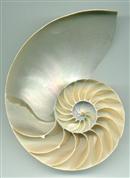
“The many intriguing aspects of the logarithmic spiral all derive from this single feature. For example, a straight line from the pole O to any point on the spiral intercepts it at a constant angle α. For this reason, the curve is also known as an equiangular spiral. As a consequence, any sector with given angular width Δθ is similar to any other sector with the same angular width, regardless of how large or small it is. This property is manifested beautifully in the nautilus shell ( left ). The snail residing inside the shell gradually relocates from one chamber to the next, slightly larger chamber, yet all chambers are exactly similar to one another: A single blueprint serves them all.”
Hrm, evolution didn’t cause such perfection, regularity, and beauty. The ‘single blueprint’ is God. As you go around today praise Him who made the earth and all that is in it. (Psalm 24:1). He didn’t have to make it beautiful, but He did. Man copies what is soaring and sublime, he can only copy the beauty that originates from and emanates from God.
Chris’ most recent work is below, with his artist’s statement below the picture.

1 Corinthians 2:9-10, “But, as it is written, ‘What no eye has seen, nor ear heard, nor the heart of man imagined, what God has prepared for those who love Him”–these things God has revealed to us through the Spirit. For the Spirit searches everything, even the depths of God.”
Often times verse 9 gets quoted as referring to the eternal state….however, I’m not sure why people do that. The context of Paul’s citation has no immediate bearing on the new heavens and earth etc. Instead, he’s quoting Isaiah 64:4 here (the text immediately following the passage I used for yesterday’s picture).
In Isaiah 64:4, that which “no eye has seen” etc. is not some future blessing for God’s people, rather Isaiah is talking about the absolute uniqueness of YHWH as attested by His acts of redemption on behalf of His people. This original context of the citation fits much more naturally into Paul’s line of argument in 1 Cor.1-2. In this section, Paul has been saying that the preaching of Christ crucified is a message that reveals God to and saves the souls of those who receive it as wisdom and power (1 Cor.1:21,23-24), while it confirms in condemnation those who reject it as folly (1 Cor.1:22).
This–Christ crucified as the saving revelation of the God who cannot be known by worldly wisdom–this is the “secret and hidden wisdom of God” imparted by Paul’s proclamation of the word of the cross (1 Cor.2:7), a wisdom that “God decreed before the ages for our glory. The spiritual understanding to perceiving the saving revelation of God in the crucified Christ is that which God “has prepared for those who love Him,” and this is why Paul supports his argument by citing a passage from Isaiah talking about YHWH’s utter uniqueness as revealed in His works of redemption.
In Isaiah’s day as in Paul’s (and ours) YHWH is made known as the only true God through His works of redemption. This is definitively true of the cross of Christ….a work of redemption so opposed to the fallen bent of humanity’s perceptions that the revelation of God imparted therein cannot be received apart from the merciful foreordination of God and present working of His Spirit.
So, verse 9 is talking about the never-before imagined glories of who God reveals Himself to be through the preaching of the crucified Christ. This–He Himself perfectly communicated in the love of the Son–is what God has prepared for those who love Him. And so, in that sense verse 9 can be seen as anticipation of eternity since ALL the joys of the eternal state can be summarized in that one statement: to know God in Christ.
With this in mind, the “these things” in verse 10 is God made savingly known through the wisdom of Christ crucified. This, then, is what the Spirit of God must reveal to us….If this is true, then the awesome thing to see is that Paul says the Spirit can do this–can reveal God to us in the Son–“For the Spirit searches everything, even the depths of God.” In other words, these “depths of God” are what the Spirit illumined eyes of faith perceive when they look to the crucifixion of the Son who will rise again. The unplumbable depths of God’s infinite heart–truly the beauty into which we will be pressing further up and further in for eternity–this is opened to us on Calvary…..May we, then, by the Spirit, in submission to the word, and in community with other believers, grow in knowing this all glorious Triune God who blessedly surpasses all of our knowledge, imagination, and hopes.
I like trees.
They’re majestic. They’re interesting. They’re helpful to the environment. They provide a home for birds. They provide scenes for artists. They enhance the view.
The Bible mentions many trees. Acacia, myrtle, juniper, cedar, cypress, chestnut, olive, almond, fig… The list goes on.
There are references to trees as a metaphor for strength and for prominent men (Psalm 1:3) or as a symbol of evil (Psalm 37:35).
Of all the trees mentioned in the Bible there is one pre-eminent tree. The Tree of Life.
Tree of Life
The meaning of “the tree of knowledge of good and evil” in the Eden narrative is not as clear as the meaning of the “tree of life.” Direct allusions to the tree of life are found in both the Old Testament and the New Testament. Significantly, in the book of Proverbs the tree of life is like a symbol:
• of knowledge (Prov 3:18);
• of righteous fruit (Prov 11:30);
• of accomplished desires (Prov 13:12);
• of a wholesome tongue (Prov 15:4; Marcus, “The Tree of Life,” 117–20).
Baez, E. (2016). Tree of Knowledge. Lexham Press.
The New Testament contains four references to the tree of life, all of which appear in Rev 2 and Rev 22. In this eschatological context, the tree of life functions as a future source of healing and immortality for the faithful.
In Revelation 2:7 and 11, the saints who emerge victorious in Christ through testing are promised the tree of life (Rev 2:7) and deliverance from the second death (Rev 2:11). Osborne argues that in this context, the tree of life symbolizes the cross, which makes access to God and eternal life possible (Osborne, Revelation, 124, 563). Similar imagery is attested elsewhere in the New Testament (e.g., Gal 3:13). Tree of life imagery also serves as a polemic against the Greek Artemis fertility cult of Ephesus, where her temple was a “tree shrine” in which she symbolized life (Osborne, Revelation, 124).
The final chapter of Revelation ties the tree of life back to the garden of Eden as “a picture of forgiveness and consequent experience of God’s intimate presence.” This chapter uses language and imagery of early Jewish literature (Beale, The Book of Revelation, 234–35).
Faro, I. (2016). Tree of Life. Lexham Press.
The tree of life used to be in the Garden of Eden. (Genesis 2:9). Where is it now? In the paradise of God- AKA heaven. (Revelation 2:7b, 19)
It is an actual tree. Will the tree of life be a palm tree? A new kind of tree humans have never seen before (except Adam and Eve)? I am very much looking forward to seeing this tree.
Spiritually, our precious Savior is a Tree of Life (John 14:6). In only Him is life. Praise God for sending His Son. He is the tree of life, in whom we are rooted, in whom we grow, and in whom we shelter.

Further Reading:
Answers in Genesis: The Tree of Life
The Tree of Life stood in the centre of the Garden of Eden which elsewhere is called ‘The Garden of the LORD’.1 It was a real tree, to be sure, but let me suggest that it was also symbolic of the fact that God was, and is, the source of eternal life and blessing. Adam and Eve were to have their life centred in Him, even as the Tree was in the centre of His Garden.

