At the thrift store, I got this book called “Bizarre Birds”, a youth Peterson Bird guide. It lists 20 birds that have an unusual quality: such as feeding, migration, looks, call and so on. I am pleased that I’ve seen 10 of them!
Puffin. Seen off Canadian coast at Seal Island. EPrata photo
“Did you know? A flamingo’s bill is unlike any other bird’s. It contains rows of bony plates that act like filters. A flamingo finds food by dipping its head into the bottom of saltwater bays. It sucks up the ooze and uses its tongue to force the mud out through these bony filters, leaving a rich meal of tiny crustaceans in its mouth. A flamingo feeds with its head upside down. Unlike the jaws of other birds, the flamingo’s upper jaw moves up and down instead of its lower jaw.”
Cool. This couldn’t have evolved. The first flamingo to try eating like that would drown. God is amazing in His creative abilities! I also learned that the Arctic Tern migrates from the North Pole to the South Pole and back every year. That’s 22,000 miles round trip, and mostly over ocean!
FLamingoes. Seen in The Everglades of Florida. EPrata photo
Think on Him as Creator for a moment. He made all the birds of the air in one day, on Day 5 of Creation Week. Each bird uniquely suited to its habitat. Each bird delightfully different in plumage. God’s creative ability is so infinite my finite mind can barely even comprehend how He even made all the birds of the world in one day! Along with other animals, too. Wow.
Let’s pause for a moment and praise Him.
Then God said, “Let the waters teem with swarms of living creatures, and let birds fly above the earth in the open expanse of the heavens.” 21And God created the great sea creatures and every living creature that moves, with which the waters swarmed, according to their kind, and every winged bird according to its kind; and God saw that it was good. 22God blessed them, saying, “Be fruitful and multiply, and fill the waters in the seas, and let birds multiply on the earth.” 23And there was evening and there was morning, a fifth day.
SYNOPSIS Exploring Ezekiel 13:4, I examine why false prophets are compared to jackals, studying their scavenging, predatory, and nocturnal behaviors. By probing metaphors and using historical resources, the piece encourages deeper biblical questioning and highlights the spiritual danger posed by deceptive teachers.
I discuss Ezekiel 13’s severe judgments against false prophets, especially women who claimed divine authority to speak in His name. I warn that modern figures who say “God told me” repeat this danger. I urge believers to avoid such teachers, to trust Scripture, and to rely on the Holy Spirit for truth.
Believers, if you have been faithful and your persevering walk is evidence of that faith, you will be given a pass into eternal glory upon which the Lord of Hosts, the Ancient of Days, the Holy-Holy-Holy Lord has written upon it Himself, personally for just YOU!
“He who has an ear, let him hear what the Spirit says to the churches. To the one who conquers I will give some of the hidden manna, and I will give him a white stone, with a new name written on the stone that no one knows except the one who receives it.’’ (Revelation 2:17)
“But there’s an interesting little historical note, when a victor won in the games, whatever great games were being held, it was not uncommon for the victor to be given as part of his prize a white stone. And the white stone was his admission pass into the festival that was held following the games for all the victors. Could it be that the overcomer will receive the ticket to the eternal victory in heaven?”
Commentary on that verse: “And then He says, “And a new name written on the stone,” and I read where they would do that. They would give the victor, like a trophy, a stone with his name and he alone could use it as his pass. “A new name written on the stone which no one knows, but he who receives it.” I can’t tell you how many people have asked me…what is that name? A lady will come to me any time I preach on the book of Revelation and say, “What is the name that no man knows?” Folks, I don’t know what the name is. If I knew what the name was then this verse couldn’t say what it says, it would have to say, “And no one knows except John MacArthur.” The only one who knows what it says is the person who receives it, that’s how personal it is. What it is to me is some kind of personal message from Christ to the one He loves which is given as an admission pass into eternal glory. I’ll know mine and you’ll know yours and we’ll know the Lord wrote them for each of us and for none of the others of us.” (source)
WOW! It is huge to think of the precious Savior not only saving me, not only guiding and protecting me, not only providing for me, but when He brings me to glory (amazing!) He gives me a personal message just for me, out of the millions thronging there!
Friend, if you have ever been picked last at PhysEd, if you have ever had unwanted divorce thrust upon you, if you have ever been fired from a job, marginalized at home, or left in any feeling invisible and unwanted, THIS should pick you up. A secret message/name is waiting for you, just for you, with the Savior’s love and care personally imprinting it and gracefully extending it to you in heaven. What a day that will be!
SYNOPSIS: People wonder when it is reasonable to leave off following a teacher. What are the standards for giving loving benefit of the doubt, or assessing them as false and banning them completely from your purview? Both are called for in the Bible.
This essay explores biblical decision-making, explaining that Christians need not seek mystical signs or personal revelations to know God’s will. Instead, believers should obey Scripture, apply godly wisdom, and trust God’s providence, understanding that no decision can derail His sovereign plan or purposes.
EPrata photo
Does the Bible speak to whom we should marry? Which college to attend? Whether to join the Army? Should we relocate to another state? Change careers now, later, or never? Go back to college?
While we cannot know God’s infallible will about anything except that which is revealed in Scripture, we are not to think that we have been left on our own with no assistance from God.”
Paul just decided things. He wrote often that he decided this or decided that. You would think, if we had to wait for a sign or a word from the Holy Spirit, which Paul absolutely directly received many other times, that he would wait to hear, watch for a sign, or listen to omens. But no, more often than we think, Paul just decided things.
2 Corinthians 2:1But I decided this for my own sake, that I would not come to you in sorrow again.
1 Corinthians 16:6Perhaps I will stay with you awhile, or even spend the winter, so that you can help …
2 Corinthians 1:23, But I call God as witness to my soul, that it was to spare you that I did not come again to Corinth.
Acts 20:16, For Paul had decided to sail past Ephesus so that he would not have to lose time in Asia; for he was hurrying, if it might be possible for him to be in Jerusalem the day of Pentecost.
It’s OK to decide!
In the 1970s and 1980s an extremely popular author was Richard Bach. He wrote Jonathan Livingston Seagull which was on the NY Times bestseller list for years. He was New Agey, mystical, advanced soul, self-enlightenment kind of guy. Lots of man-made philosophies in his books. He followed up Seagull with The Bridge Across Forever: A True Love Story. In it he sparked a frenzy for finding one’s “soulmate.” He proposed that there was one true predestined soulmate for each of us and it is our job to find her (or him). If we do not, then we miss out on the one fulfilling relationship we could have had.
The book centered on Bach eventually finding his alleged soulmate, Leslie Parrish, whom he married. They later divorced. In fact, Bach has been married 4 times.
But it was books like his with their massive cultural impact that sent people into an anxious state of mind, thinking that everything hinges on ourselves to figure out the right decision for everything or our self-actualization will never occur.
Sadly, the Christian culture of the 90s and 2000s absorbed some of that leaven, and introduced a similar mysticism to decision-making (and to Christian life in general) that unfortunately included waiting for personalized whispers, looking for signs, or other extra-biblical methods that will guide Christians along in decision-making, a process that that forgets God’s sovereignty.
For example, as in Experiencing God, the Blackabys say much about prayer being two-way communication with God (pp. 113, 117, 122, 131) — we speak, then wait for God to speak.
“Your task is to wait until the Master gives you instructions” (141). This is the critical fourth step in the “Seven Realities of Experiencing God.” Blackaby sums it up simply as “God speaks” (52). The Christian receives an “assignment” from God that is special and unique to each individual, the specific will of God for his own life.
Pastor Phil Johnson debunked about inner promptings and whispers, (transcript here from Super Session at the 2002 Shepherds’ Conference, audio here)
Now this kind of thinking is totally at odds with the principle of Sola Scriptura. We believe as Protestants don’t we, that the written Word of God – the Bible – contains everything necessary for our salvation and our growth in grace. 2 Timothy 3:16-17, All Scripture is given by inspiration of God and is profitable for doctrine, for reproof, for correction, for instruction in righteousness…listen to the next phrase…that the man of God may be PERFECT, thoroughly furnished unto all good works. Scripture alone is able to equip us thoroughly, perfectly for all good works. Everything we need in the process of our sanctification. There is no need for extrabiblical revelation. The Bible will equip you for all good works. It will give you all the explicit guidance you can possibly get from God. It contains principles to help you be wise and discerning as you pursue the course of your life, and beyond that we simply trust God in His providence to order our steps. You don’t need an explicit message from God telling you whom to marry, or where to go to school, or where to go to the mission field. [italics mine]
So how should we approach making decisions? As Johnson said, either there is explicit guidance in the Bible or there is wisdom to guide us as we read the Bible.
Any first step to decision making would assume first that one is saved. Apart from Christ, we can do nothing. (John 15:5). Secondly it assumes that the thing you’re undecided about does not involve sin. We never decide toward sin, we flee from sin. ( 2 Timothy 2:22; Genesis 39:12). Thirdly, it assumes that you’re relying completely on God’s word. If the item you’re trying to decide about is directly in the Bible, follow that command. “Should I submit to my husband?” isn’t really a decision to ponder, because it is already commanded.
Fourthly, the decision-making process assumes that you’ve yielded yourself to the Spirit of Christ within you. You’ve been striving for holiness, and you’re as much as a clean plate as you can be, being a sinner, lol.
Now, how to decide those things which are not directly addressed in God’s word?
Garry Friesen wrote a good book on Christian decision-making, linked above. He wrote that:
God’s guidance according to the way of wisdom can be summarized in four simple statements:
1.Where God commands, we must obey. 2.Where there is no command, God gives us the freedom (and responsibility) to choose. 3.Where there is no command, God gives us wisdom to choose. 4.When we have chosen what is moral and wise, we must trust the sovereign God to work all the details together for good.
–end Garry Friesen quote
Did you know that You Are Part of a Grand Plan? It’s not like you can mess it up. If you make this decision or that decision, it isn’t going to surprise God, or alter what He has planned for you. Providence, as mentioned above by Phil Johnson, is secure. His plan will be fulfilled, and your decision making isn’t going to change it. You aren’t going to miss out on anything. Beyond what is specifically prescribed in the Bible, and “we simply trust God in His providence to order our steps” as Phil Johnson explained.
In my own life, I moved from Maine to Georgia. I wanted a place with lower cost of living, and warmer weather. That’s it. He would have worked it out of I’d chosen Texas or North Carolina. Deciding on Georgia wasn’t a life-or death decision, just one that wasn’t sinful, fit my lifestyle, and made sense.
When I got to Georgia I applied for a number of jobs. I applied using common sense. What did I have experience in, was trained for, and was good at? It’s not like I consulted the Lord and waited for a sign or anything. I was following the biblical principle that he who does not work does not eat. I sought jobs I thought I had the best chance of getting and sustaining myself.
Some jobs I applied for were at the University in the journalism department, some with local magazines. The one I got (in His providential care) was for the Athens Banner Herald writing feature stories of people in my county as a freelancer. Later when I decided to go back to education – subbing at first and applying for parapro jobs, I didn’t consult the Lord. I just used common sense. The freelance job simply wasn’t paying enough. A job with the County Education system would:
-be fairly secure as jobs go (education is the largest employer in the county) -had health benefits (I was soon to be 50) -was what I was trained for. (formerly certified teacher with Masters degree) -I’d be working with kids (something I love).
If I’d decided to get a job as a bungee jumper trainer, lol, that would not be common sense. Watching for omens and signs, or waiting to hear directly from God would not make sense, either.
I knew the Lord would work it out. In His providence He did not ordain that I was given the first job I’d interviewed for as a parapro at another school, but a year later I got a job at the school I’m at now, a great fit. I’ve been there 17 years, 15 as a parapro. It’s not like there is only ONE decision or only ONE path.
If your life is in harmony with all the commands and principles of the Bible, you can actually do what you want to do without beating yourself up with introspection and fretting over whether God told you to do something or not. When Scripture says He orders our steps it’s talking about His guidance through His hand of providence. We step out in faith, and He guides our steps.
This essay explores Elon Musk’s AI called Grok, and its detailed response about when asked about me, Elizabeth Prata. I acknowledge AI’s knowledge and power, I contrast human intelligence and artificial intelligence, and I discuss ethical, theological, and practical implications of AI use within Christian life and media. Included is a link to my own AI Statement.
I comment on the beauty of the quiet predawn of rural life and the first bird’s song of the dawn chorus, seeing in it a symbol of creation’s praise to God. Thinking of scripture and nature, I imagine heavenly harmony where all creation sings in eternal joy.
A reflection on society’s moral and spiritual decline, this piece laments humanity’s increasing futility—anger, emptiness, and loss of meaning apart from God. Drawing on Scripture, it contrasts worldly pursuits and hollow creativity with the only true fulfillment found in Jesus, who alone gives purpose and life.
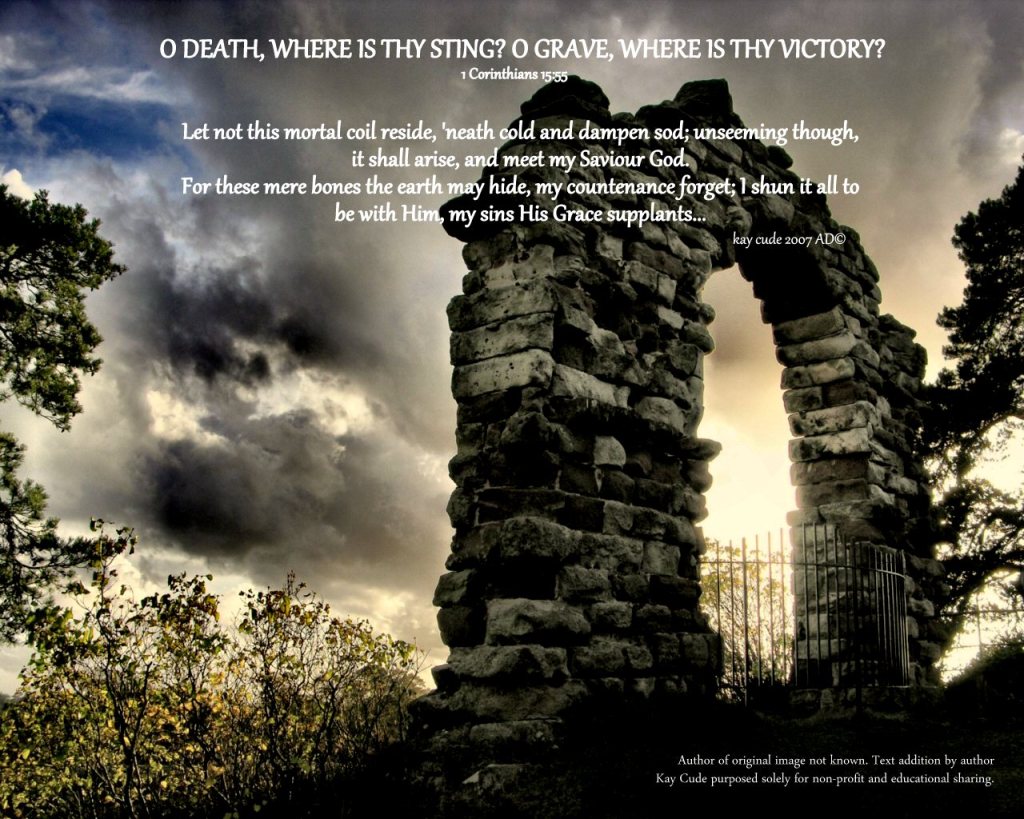
I particularly enjoyed this piece from poet Kay Cude. I hope you enjoy it too. May it encourage you, strengthen you, or simply allow your thoughts to linger on the wonders and glories of our Savior.
Poetry by Kay Cude. Used with permission.
Death, Where is Thy Sting?
Let not this mortal coil reside, ‘neath the cold and dampen sod; unseeming though, it shall arise, and meet my Savior God.
Fo these mere bones the earth may hide, my countenance forget; I shun it all to be with Him, my sins His grace supplants.