Paul tenderly gives a spiritual charge to his spiritual son, Timothy,
You therefore, my son, be strong in the grace that is in Christ Jesus. The things which you have heard from me in the presence of many witnesses, entrust these to faithful men who will be able to teach others also. (2 Timothy 2:1-2).
Paul can be seen as the spiritual patient zero, who took Timothy under his wing, the next generation, who is now charging Timothy to relate the truth to those who heard him, 3rd generation, who will turn around and give it to the upcoming generation. Four spiritual generations passing the baton of truth on down.
Thank goodness for historians. In ancient Rome during the last days of the Apostle Paul, Sallust and Livy, for example, wrote of the notorious jail in Rome known as the Mamertine, dubbed so in the medieval period. It’s originally known in history as the Carcer, or the Tullianum, or at least, the lower half of the underground dungeon was. History does not record for a definite fact that Peter and Paul were at different times held there, but tradition and Roman practice indicate it was a strong possibility.
This essay is constructed in three sections:
Section 1: The prison itself. What was it like? Section 2: Paul in Prison Section 3: Facing Death
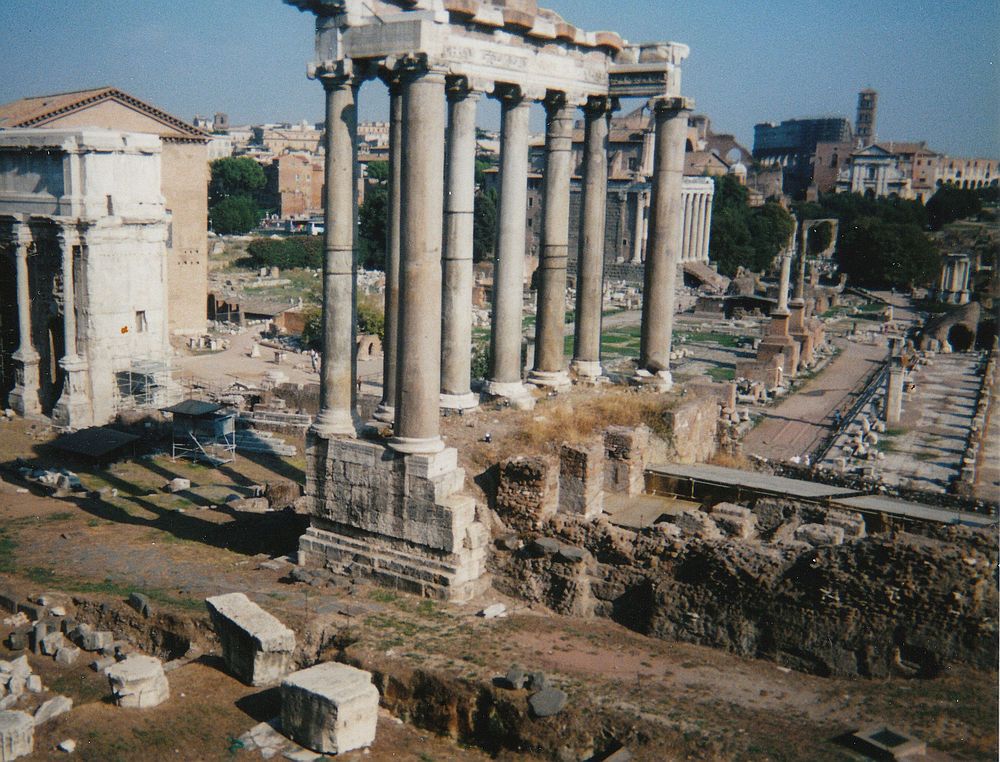
Roman Forum. Mamertine Prison was up behind the building with the dentil cornice. EPrata photo
What was the Mamertine Prison like?
The Mamertine prison was a prison in the Roman Forum where high-profile prisoners were kept, usually so they could be marched through the Roman streets during a triumph parade. High ranking commanders captured during war and other famous prisoners’ names are recorded on a plaque at the entrance. Since Paul was a significantly known public figure, it’s likely when he was imprisoned in Rome, this was the place he was kept.
The prison was deliberately constructed in the middle of the city and placed in the middle of that, into the Roman Forum, as a symbol of Rome’s power, authority, and as a warning. Crime had begun to rise as the city grew, and the Emperors wanted its citizenry to heed the consequence of crime. Hence the jail was visible and constructed so as to be fearsome.
Interestingly, Roman law did not consider the imprisonment itself as a punishment. Jails were simply a place to hold the captured or the criminals until execution, which was the punishment. Mamertine was a place of detention until execution. Barbarian Commanders captured in war were paraded and then strangled publicly, for example. Roman citizens, if unfortunate enough to have been detained for a crime, were taken outside the city on the Ostian Way and beheaded there, usually in private. Privacy in execution was a way to give a Roman Citizen his last dignity. Non-Romans were killed by any method; for example, sent to the beasts, used to the death in gladitorial games, or crucified as Peter was (tradition says, upside down). These executions were public for the spectacle of Roman power and for the amusement of its citizens.
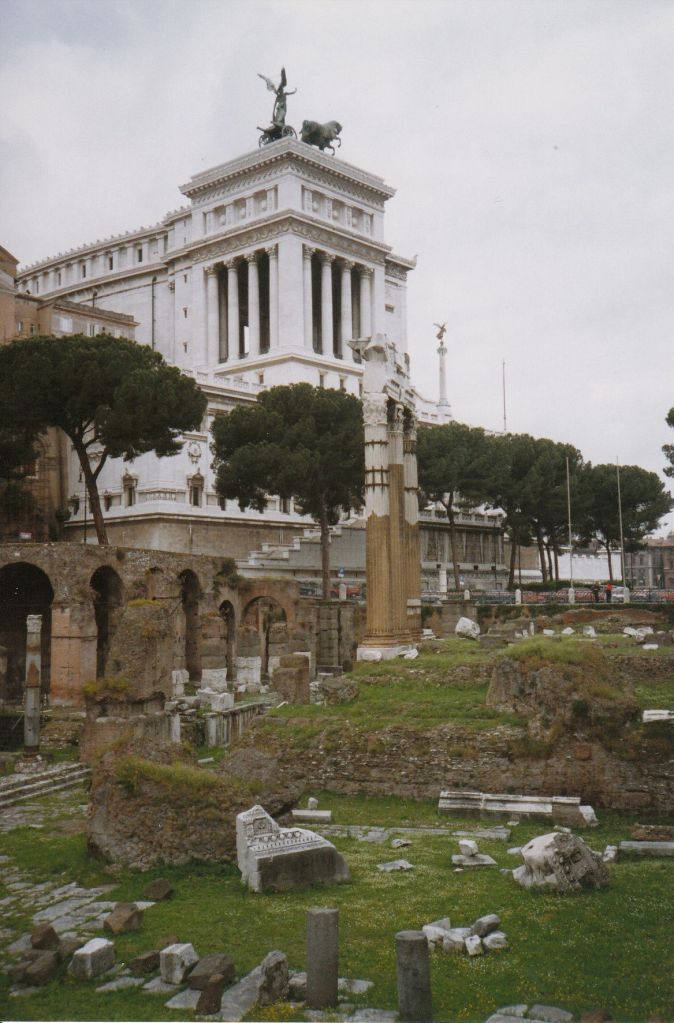
Roman Forum. EPrata photo
The Mamertine, or Tullianum prison was a two-story underground prison. The upper chambers had light and air and was drier. The lower, which prisoners were let down through a hole for their fate, was dank. Historians say the word tullius meant a jet of water and since the prison was originally built as a cistern, this signifies the origin of the name. When the 6th emperor of Rome Servius Tullius arose, the origin story shifted to claim his name as the name of the jail. Below the well or cistern ran the sewer known as the Cloaca Maxima. Seepage from the sewer into the cells just above was common. In fact, they used to flush out the corpses of the incarcerated dead to the Tiber River in this way.
Once the door was shut there was little air, no light, and the cell was steaming hot. Just the name of the Mamertine drew shudders, as in this account from historian Sallust-
“There is a part of the prison which is called the Tullianum, where you ascend a short way on the left. The Tullianum is sunk into the earth about 12 feet and is constructed of stone walls on all sides; above this is a room with a ceiling of vaulted stone. Foul from neglect, darkness, and stench, it is an altogether terrifying sight. … Sallust described “Its appearance is disgusting and vile by reason of the filth, the darkness and the stench.” Sallust, War against Catiline 55. “Execution of Prisoners.”
Prisoners who were held for trial were called in carcer from which we get the word incarcerated. If you were in the Mamertine prison, you were considered as dead. Sometimes, in fact, they threw you down to the lower cell and starved you to death. What a way to go, in the dark, forgotten, hungry, alone, and then you die the painful slow death of starvation, knowing your ignoble corpse will be flushed into the sewer as waste.
Paul in prison- what do the scriptures say?
Paul was jailed numerous times and in a variety of conditions. His first was at Philippi, where he’d delivered a slave girl of her demon of divination and the owner was upset his method of income was gone. This was around 51AD. Paul (and Silas’) release was a supernatural event accompanied by an earthquake and an instant loosening of all the bonds and chains. The jailer was converted, and the next day the magistrates came and let Paul and Silas go (but asked them to leave the city). Paul went to Lydia’s house. (Acts 16:22-40).
Paul’s second jailing that we know of occurred in Jerusalem. It was prophesied beforehand that he would be jailed, (Acts 21:11) but Paul pressed on, knowing at the outset that Jesus had said Paul was to suffer mightily for the Name. (Acts 9:16). Jews, jealous of Paul, claimed (wrongly) that Paul was allowing Gentiles into the Jews-only part of the Temple, and stirred up a riot. (Acts 21:28). This was AD 57. Paul was removed to Caesarea for his safety, kept another two years, sent to Rome under house arrest around AD60. He was released in 62AD.
Paul’s last jailing was likely at the infamous Mamertine prison. He had been deserted. He knew this was the end. He had written before that he had learned to be content in whatever circumstances he found himself in by God’s providence. He had learned he could do all things through Christ. (Philippians 4:11-13). Whether enjoying a comfortable house imprisonment attended to by family, whether free and dining at Lydia’s in fellowship with the saints, or hunkered down in the sewage at Mamertine, hungry and alone. We do not know if the Lord visited Paul at the end, but we do know the Lord visited Paul at other times in his jailings, like in Acts 23:11. Bible Knowledge Commentary says,
23:11. The importance of this vision was not only in its comfort and encouragement (cf. 18:9–10) but also in the confirmation it gave of Paul’s plans to go to Rome. The gospel of Christ would literally go from Jerusalem to Rome by means of the Apostle Paul. This was the fourth vision the Lord gave Paul (cf. 9:4–6; 16:9; 18:9–10).Toussaint, S. D. (1985). Acts. In J. F. Walvoord & R. B. Zuck (Eds.), The Bible Knowledge Commentary: An Exposition of the Scriptures (Vol. 2, p. 420). Wheaton, IL: Victor Books.
Facing Death
But in reality, I think it must have been hard to maintain a positive attitude in that place. Only Luke was with him, which must have been a comfort. (2 Timothy 4:11). Paul hopes to see Timothy and also Mark. Paul was a super-Christian, but still a man. He had been buoyed personally by Jesus many times, supported by family at times, and enjoyed within his circle of beloved friends. But what thoughts go through a man’s mind when sitting in a jail cell knowing the end has come? He longed to be with Jesus, that is certain. But he just have wondered if his actual death would be prolonged or painful. He must have wondered how long he would languish in that dank place. He had been blessed with glimpses of ‘the other side,’ but must have wondered what would it really be like to be with Jesus eternally. Here is A.T. Robertson’s The International Standard Bible Encyclopaedia entry of the end.
"When Paul writes again to Timothy he has had a winter in prison, and has suffered greatly from the cold and does not wish to spend another winter in the Mamertine (probably) prison (2 Tim 4:13, 21). We do not know what the charges now are. They may have been connected with the burning of Rome. There were plenty of informers eager to win favor with Nero. Proof was not now necessary. Christianity is no longer a religio licita under the shelter of Judaism. It is now a crime to be a Christian. It is dangerous to be seen with Paul now, and he feels the desertion keenly (2 Tim 1:15 ff; 4:10). Only Luke, the beloved physician, is with Paul (4:11), and such faithful ones as live in Rome still in hiding (4:21)." [Robertson's The International Standard Bible Encyclopaedia entry continues->]
"Paul hopes that Timothy may come and bring Mark also (4:11). Apparently Timothy did come and was put into prison (He 13:23). Paul is not afraid. He knows that he will die. He has escaped the mouth of the lion (2 Tim 4:17), but he will die (4:18). The Lord Jesus stood by him, perhaps in visible presence (4:17). The tradition is, for now Paul fails us, that Paul, as a Rom citizen, was beheaded on the Ostian Road just outside of Rome. Nero died June, 68 AD, so that Paul was executed before that date, perhaps in the late spring of that year (or 67). Perhaps Luke and Timothy were with him. It is fitting, as Findlay suggests, to let Paul’s words in 2 Tim 4:6–8 serve for his own epitaph. He was ready to go to be with Jesus, as he had long wished to be (Phil 1:23)."

Source-  Robertson, A. T. (1915). Paul, the Apostle. In J. Orr, J. L. Nuelsen, E. Y. Mullins, & M. O. Evans (Eds.), The International Standard Bible Encyclopaedia (Vol. 1–5, p. 2287). Chicago: The Howard-Severance Company.

And so, Jesus gathered Paul to Himself to enjoy eternal peace and rest after so much suffering for the cause. Of all people, we can say of Paul, "Rest in Peace, brother".
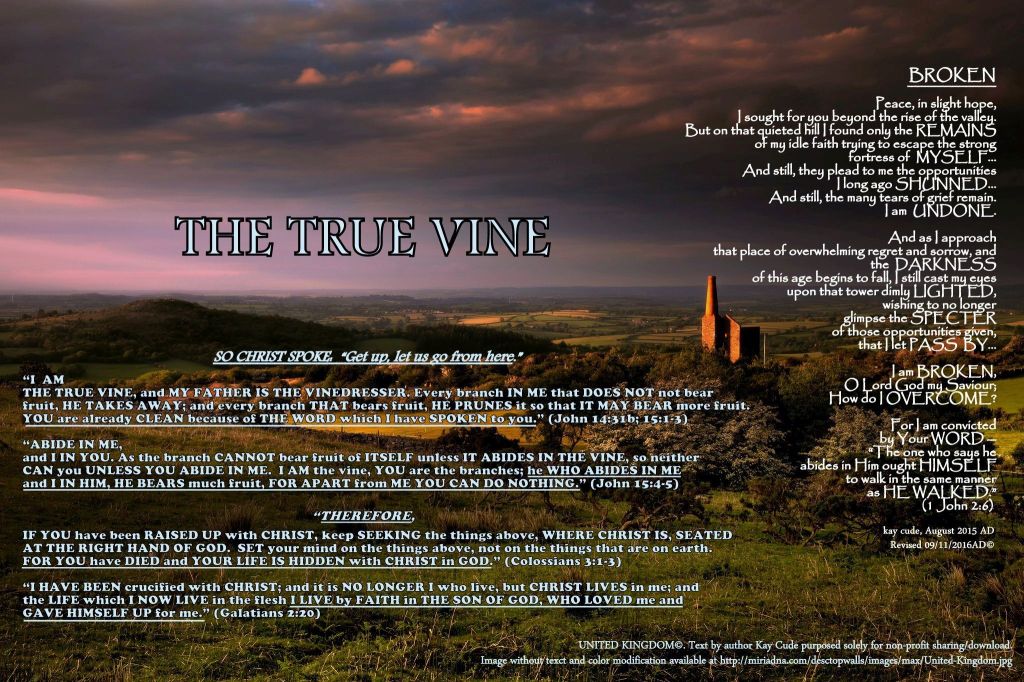
Artist’s statement: This was the very first Christian piece I ever composed. I began it as a poem of heartbreak about my son, but as I wrote and edited, it moved away from my sorrow about him to my sorrow about my spiritual immaturity and subsequent failures. Then it continued on to the approaching darkness of this age and my inadequacies and weakness relative to my witness for Christ. I still am panged when I read this piece, but determined to continue on and strive against my “self” and honor Christ.
The LORD, the Psalmist’s Shepherd. A Psalm of David.
The LORD is my shepherd, I will not be in need. He lets me lie down in green pastures; He leads me beside quiet waters. He restores my soul; He guides me in the paths of righteousness For the sake of His name. Even though I walk through the valley of the shadow of death, I fear no evil, for You are with me; Your rod and Your staff, they comfort me. You prepare a table before me in the presence of my enemies; You have anointed my head with oil; My cup overflows. Certainly goodness and faithfulness will follow me all the days of my life, And my dwelling will be in the house of the LORD forever. (Psalm 23:1-6).
As my elder read the Psalm during our time of congregational prayer, I wondered, how could a rod comfort a person? Isn’t a rod a metaphor for God’s justice, or his discipline? I made a mental note to look this up, and went back to listening.
I didn’t forget my mental note, and once home I looked up about a Shepherd’s rod and staff, also known as a “crook.” We’re all familiar, I think, with the crook. It’s the shepherd’s tool, the hooked rod usually associated with that profession. It is the symbol of the Shepherd’s Conference-
The staff usually had a curved end that was large enough to hook around a sheep or lamb’s neck so as to prevent it from falling into a ditch, or to reroute away from something dangerous, like poisonous plants or a snake’s nest. It was long enough to do this before the shepherd entered its fear sphere and then bolt.
The staff and the rod were almost an extension of the shepherd’s arm. It represented power, control, and authority of the flock. The rod was authoritative. You remember that it was the staff that God used to demonstrate His power through Moses to Pharaoh. (Exodus 4:17).
The Shepherd relied on the rod to beat back predators, protecting the flock. He would use it to poke a bush and look for snakes. He used the rod to scan the sheep. Their fluffy wool could hide parasites, skin diseases etc, so the shepherd used the rod to part the wool in order to examine its skin and wool for anything untoward. The shepherd’s hands would then run all over the sheep to make sure he was healthy and not beginning with some disease.
Each night as the sheep were brought into the shed or the fold, they would pass under the rod, which was used as a counting stick. Each sheep was touched by the rod in counting so that the shepherd ensured all of them were present, and none were lost. This was called ‘passing under the rod”.
The rod was also used for disciplining the sheep. Shepherds in Africa had a rod with a knob at the end called a knob-kerrie they would hurl at a sheep to startle it from, say, not running down a cliff or into a ditch if they couldn’t get there in time.
That David, the shepherd, said ‘the rod and the staff comfort me’ now becomes easier to understand. Jesus is THE Shepherd. His staff guides us, keeps us away from the ditch or falling down a cliff. His rod unearths the snakes and the poisonous weeds. His staff guides us to fresh clover and green pastures, still waters of living water. He counts each and every one of us so that none are lost, knowing where each of us is at any given moment. As we pass under his rod he checks us for disease or injury.
Even the rod of discipline, if it becomes necessary, is for our good. Don’t eat that poisonous weed! Don’t get near that wolf! Don’t run down that ditch! It is a comfort that the Shepherd can see from the heights of His vantage point the things we cannot. Our low vantage point and limited view often leads us to trouble, but He leads us to still waters and green pastures. He uses his rod and his staff to do it, and this is such a comfort.
The Gospel is simple. Repent and believe in Jesus Christ, who died for our sins and rose again, ascended to heaven and will return in judgment. That’s it. Repent and believe. It’s simple, but profound. It’s eternally life saving. It’s countercultural. It’s offensive. It’s foolish to those who are perishing (1 Corinthians 1:18)
Because it is too simple for some people, or too offensive for others to hear, well-intentioned Christians, even pastors, sometimes tweak the Gospel, change the Gospel, soften the Gospel, in order to “help.”
Now Simon’s mother-in-law was lying sick with a fever; and immediately they spoke to Jesus about her. And He came to her and raised her up, taking her by the hand, and the fever left her, and she waited on them. (Mark 1:30-31)
Luke 4:38-40, Matthew 8:14-15 repeat the same incident and in the same way, with Dr. Luke adding that the fever was high, and that others in the house advocated for her to Jesus.
I wasn’t saved by the grace of Jesus until I was 42 years old. I grew up in the sexual revolution and feminist revolution of the 1960s and ’70s, and my mother was a feminist. I disbelieved feminism in the main, but my tender years couldn’t withstand all of it, so I was tainted by its tenets to a degree.
The Southern Baptist Convention is said to be the largest Protestant denomination in the world. As such, there is newsworthy interest in its doings, never more than when the annual Meeting is conducted and a new president is elected. This year it was held on June 15-16 in Nashville TN. The president is elected to a two-year term. However, due to COVID-19 last year, outgoing president JD Greear served for three, because the Annual Meeting was suspended due to no mass gathering restrictions in most states of the US, including Tennessee.
You’ve seen these animal documentaries when the mama bird regurgitates already digested food into her chick’s beak. We all go “ewwww!” but we know that pre-digestion is a must for the chicks to be able to handle the food.
When a pastor plagiarizes his material, in whole or in part, he is doing the same thing. He is offering regurgitated, recycled, cold, pre-digested food to the flock. This is not nourishing. The flock will starve.
When they had finished breakfast, Jesus said to Simon Peter, “Simon, son of John, do you love me more than these?” He said to him, “Yes, Lord; you know that I love you.” He said to him, “Feed my lambs.” … He said to him the third time, “Simon, son of John, do you love me?” Peter was grieved because he said to him the third time, “Do you love me?” and he said to him, “Lord, you know everything; you know that I love you.” Jesus said to him, “Feed my sheep.” (John 21:15, 17, ESV).
Jesus often spoke in agricultural parables and allusions, knowing that the farmers, wine producers, wheat gatherers etc would understand. Not much has changed since the ancient days in terms of how wine is made, olives are gathered, wheat is sifted. Today’s layperson, even a city dweller, can understand the simple comparisons He made with gathering wheat as living symbol of gathering His people. But understanding the process of such production does enhance our understanding of the parables and allusions even more. So let’s dig in.
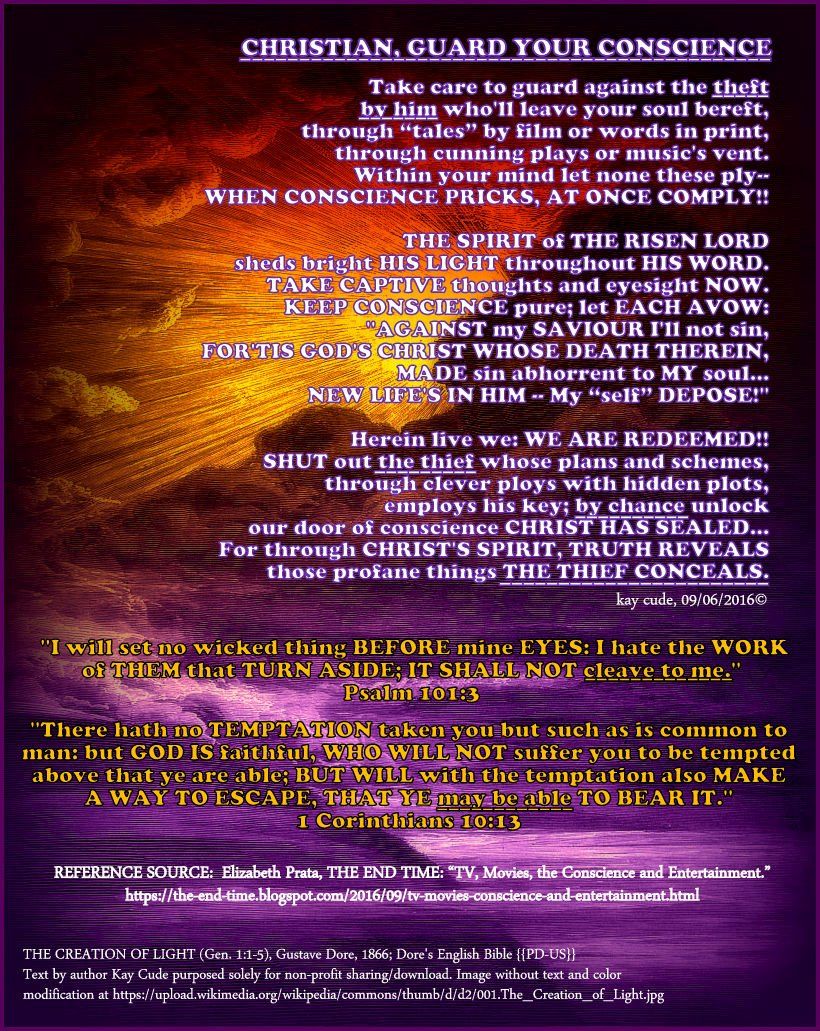
Kay Cude Poetry, Conscience. Used with permission. Right click to open in new tab a bit larger, if you need to.
I recommend the book by John MacArthur “The Vanishing Conscience“. It explains about how our conscience works in sanctification, and how violations of our conscience (sin) works to inhibit it.